
5 Handoff Points That Break When You Automate Content at Scale

Quick Answers
- Sequential content chains create n-1 handoff points where voice, metadata, and context can fail.
- Atlassian's 2024 survey found 55% of knowledge workers struggled to find information.
- Context reconstruction—digging through notes, replaying decisions, messaging senders—drains entire afternoons.
- Google can penalize pages as scaled content abuse when handoffs create near-duplicates.
- Passing complete drafts without decided-versus-open markers forces reviewers to re-litigate tone.
- Traffic cliffs from handoff-induced thin content can appear within 18 months.
Related Video
Watch: Programmable Trust Boundaries | Why your Live Media Infrastructure is Leaking Control by Net Insight
The part most teams underestimate isn't writing the content
It's the five quiet moments where work changes hands. Nobody confirms it landed intact. When you automate a content workflow at scale, those handoffs are where voice drifts, metadata vanishes, and review time gets eaten alive.
A sent draft is activity. It isn't proof anyone accepted the work. That gap is where scale breaks.
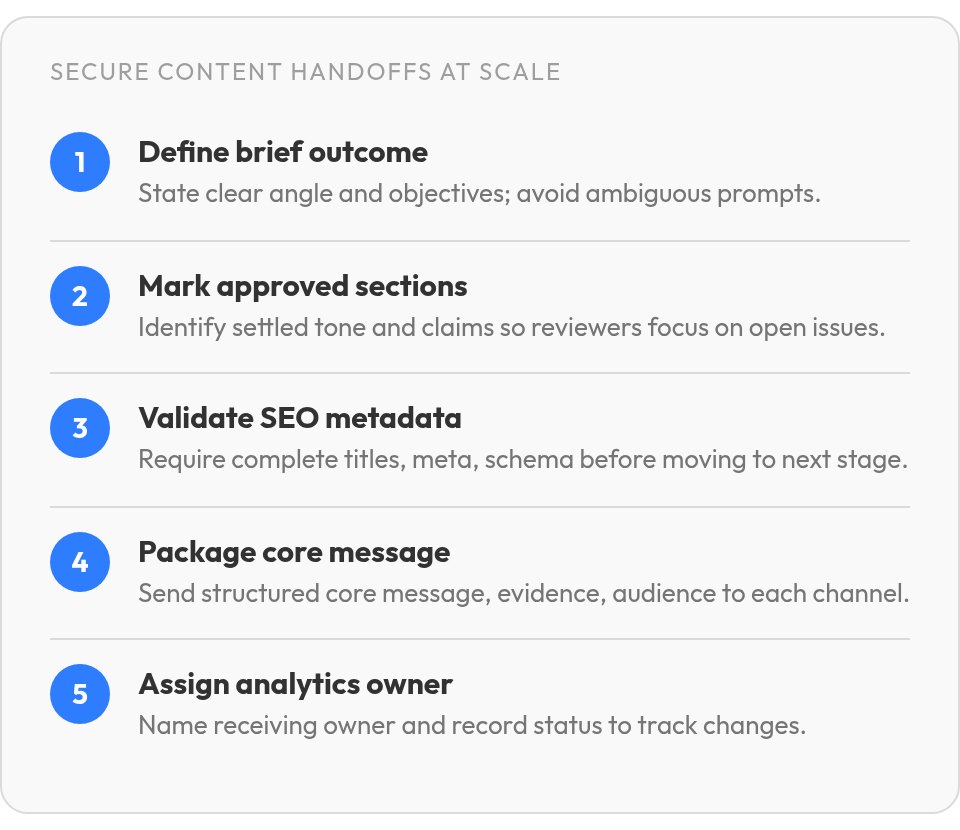
The Five Handoffs That Quietly Cost You Hours
Each row below pairs the break symptom with the cause and a one-line fix. The pattern mirrors multi-agent AI handoffs: a sequential chain of n stages has n-1 places to lose information.
| Handoff | Break symptom | Difficulty | Root cause | One-line fix |
|---|---|---|---|---|
| Brief → draft | Generated article misses the angle | Medium | Ambiguous prompts; no locked objective | State the outcome, not steps, in the brief |
| Draft → voice review | Reviewer re-litigates settled tone | Hard | Context flooding; no decided-vs-open markers | Mark what's approved so review targets edge cases |
| Content → SEO metadata | Titles, meta, schema arrive empty | Medium | Metadata gaps; no required fields | Validate required SEO fields before handoff |
| Article → multi-channel | Each channel owner re-extracts intent | Hard | No structured core message passed down | Pass core message, evidence, audience per channel |
| Publish → analytics | Nobody owns what changed | Easy | Lost provenance; no tracked acceptance | Name a receiving owner and a status record |
Context reconstruction becomes hidden work. An incomplete record lands, and someone on the receiving team has to rebuild what's missing: digging through CRM notes, reading long email chains, messaging the sender, cross-checking spreadsheets. None of it shows up on a status board, but it adds up fast. Atlassian's 2024 State of Teams survey of 5,000 knowledge workers found 55% struggled to track down information they needed, and half had worked on something only to learn another team already had it.
Context Flooding Is the Hidden Tax on Voice
The costliest break isn't a missing field. It's passing everything. Hand a reviewer an entire draft with no "this tone is approved, this claim is open" markers, and they re-check decisions already made. That re-litigation, not net-new judgment, swallows whole afternoons.
Your Scaling Checklist
Run these before you push volume through any automated workflow.
- Lock the objective in every brief so the draft optimizes for the right outcome, not a competent guess at it.
- Separate decided from open in voice review so reviewers judge boundary cases, not settled tone.
- Validate SEO metadata as a required field, never an afterthought, before content moves downstream.
- Hand each channel a structured package (core message, evidence, constraints, audience) instead of the full article.
- Name a receiving owner at publish so analytics and provenance don't belong to no one.
Structure and acceptance both have to be present. A handoff needs an actionable payload and a tracked moment where someone accepts it. Nail those two things, and voice survives the jump from one draft to a hundred.
Why Handoff Failures Matter in Scaled Content Automation
When you automate a content workflow at scale, the thing that breaks isn't the writing. It's the quiet moment where a draft changes hands. Nobody confirms it arrived with its voice, metadata, and context intact. We see this pattern repeatedly: teams measure output, celebrate volume, and miss the seams where quality leaks out.
Every added production step creates another transfer where the work can arrive technically complete but operationally unusable. Add a channel, add a reviewer, add an SEO pass, and you've added places to lose the thread. The more you scale, the more these invisible transfers multiply.
Broken Handoffs Translate Directly Into Lost Traffic
A failed handoff doesn't stay contained. It shows up later as a deindexed page or a ranking drop you can't trace back to a cause.
The pattern is consistent across programmatic implementations: when voice and context drop at a handoff, pages begin to blur together. The issue isn't whether automation was involved; the issue is whether each page carries enough real differentiation to justify its place in search.
- Confirm each draft carries its target intent before it moves downstream, so reviewers judge fit rather than reconstruct it.
- Lock approved voice and metadata at the point of acceptance. When voice drifts across handoffs, pages thin out, rankings drop, and recovery work becomes harder than prevention.
Context Reconstruction Is the Hidden Tax on Every Team
The real drain is work that never shows on a status board. Someone on the receiving end digs through notes, replays decisions, and messages the sender to rebuild what should have arrived in the first place.
A PMI report on enterprise projects tied a large share of project failure to poor communication between teams. In content operations, the same failure shows up as reviewers asking the same questions on every pass or writers rewriting sections because the brief didn't travel with the draft. The cost compounds because it happens before the visible work even begins.
- Pass what's already decided, not the full draft history, so the receiver works on open questions instead of relitigating settled calls.
- Give every handoff a tracked accept-or-reject step. A sent draft is activity; it isn't proof anyone accepted the work with the context to act on it.
Agencies and Lean SMB Teams Feel the Friction First
The pain lands hardest where volume outpaces headcount. Agencies juggling many clients and small teams chasing broad keyword coverage both hit the wall where manual quality can't keep pace with automated output.
Careful expert writing does not scale infinitely, even when the team is strong. Broad search coverage asks for more pages, formats, and channel variants than most editorial teams can manually police. Our view: the gap isn't solved by writing faster. It's solved by making handoffs carry decisions, so voice holds across SEO, newsletters, and social without a human re-checking every transfer. If you want the deeper mechanics of keeping tone consistent through automation, our guide on the four checks your AI content tool must pass covers it.

Handoff #1 – From Ideation to AI Prompt Engineering
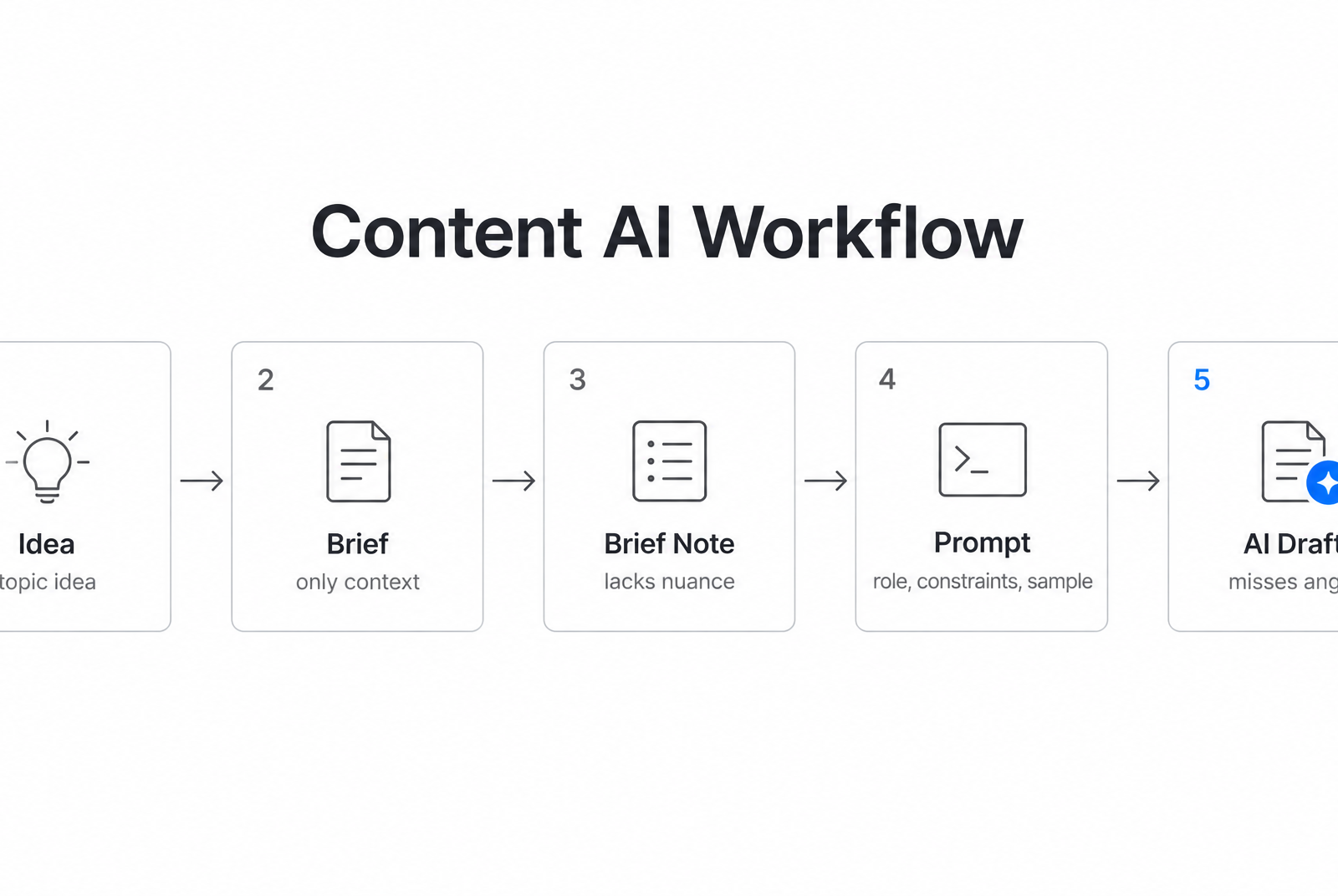
The first handoff looks harmless. Someone has a topic idea, writes a brief, and passes it to the AI. But this is where most of the damage starts. When you automate a content workflow, the brief is the only context the model gets. Everything downstream inherits whatever that brief left out.
A vague brief ("write about programmatic SEO") produces a draft that technically covers the topic but misses your angle entirely. The model fills gaps with generic coverage, and the generic version is exactly what the top of the search results already has. Research shows that programmatic sites commonly experience 40-50% of pages remaining unindexed, often because the content differs only in swapped variables rather than adding genuine value. The brief told the system to swap a variable, not to add value. That distinction is the whole game.
There's research that explains why this stage is so fragile. In multi-agent systems, a handoff summary keeps the operational facts (the topic, the keyword) but strips the boundary rules that govern how those facts should be used. Explicit constraints in prompts prevent the model from dropping guidance that vague instructions tend to lose. Your brand voice is a boundary rule. If the brief states it vaguely, the model drops it.
Vague Briefs Burn Your Revision Cycles
A thin brief doesn't fail loudly. It produces a plausible draft that a reviewer then has to rework line by line. The common thread in programmatic SEO failures is content that lacks real differentiation: briefs that asked for volume, not a point of view.
- Spell out the angle, not just the topic, so the model advances your specific take instead of defaulting to generic coverage.
- Embed keyword intent, not just the keyword, so the draft matches what searchers actually want to do.
- State the brand voice as an explicit constraint, since vague voice guidance is the first thing a model drops in translation.
Role, Constraints, Examples: The Prompt Shape That Holds
The prompts that survive scale tend to share a structure. You assign the model a role, lock the constraints it cannot break, and show it a sample of your actual voice. Think of it as the difference between automating keyword substitution and automating the injection of real expertise. The first produces pages that blend into every other template. The second gives the draft a reason to exist.
- Give the model a defined role so its register and depth match the content's purpose from the first draft.
- Hard-code the non-negotiables (locked metadata, approved claims, voice rules) so reviewers judge boundary cases, not settled ones.
- Feed it a real voice sample rather than describing your tone in adjectives, because models match patterns better than they interpret abstractions.
This is where our Persona Engine does the heavy lifting. It carries your voice into the prompt as an operationalized constraint, so the first handoff hands off intent, not just a topic. If you want a closer look at what a tool should guarantee at this stage, our breakdown of the checks your AI content tool must pass covers the tone-matching baseline.
Handoff #2 – From Prompt Output to SEO Metadata Layer
The second handoff is the quiet one. Your AI draft is done, the body copy reads clean, and the file moves to the metadata layer where title tags, meta descriptions, schema, and internal links get stamped on. Nobody watches this moment. When you automate a content workflow, this is where the draft's voice and expertise signals tend to evaporate.
The body might satisfy Google's quality bar, but the metadata gets filled mechanically from a template. The draft carried implicit authorship and source context. The title and description don't carry any of it forward. So the page body says expert while the metadata signals spam to both Google and the answer engines that read structured authority markers first.
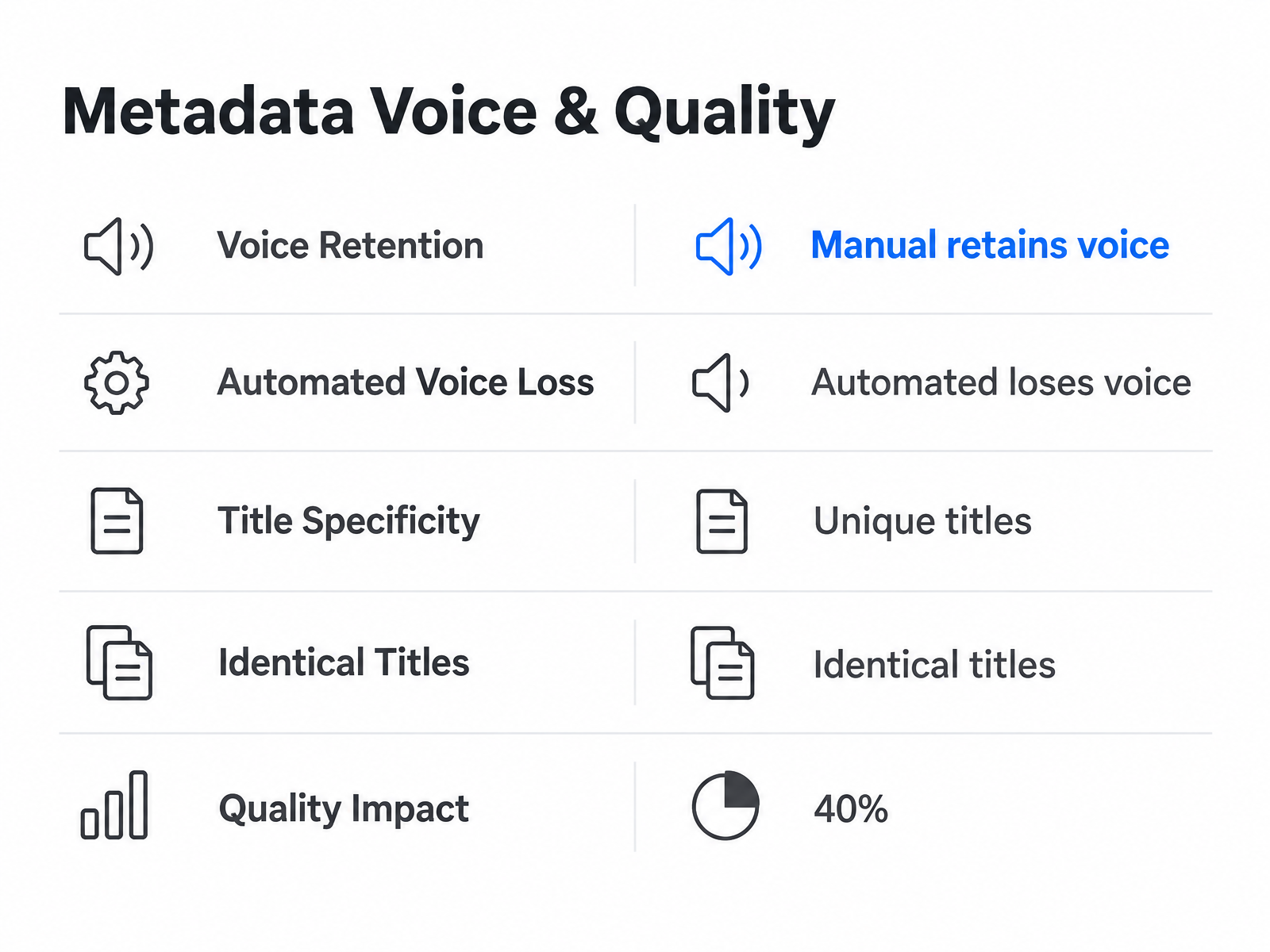
That gap matters more than it used to. Google's March 2024 core update was projected to cut low-quality, unoriginal content in results by 40%, and mechanical metadata is exactly the kind of repeatable pattern quality systems are built to detect.
What Metadata Elements Get Dropped in AI-First Pipelines?
Metadata is where sameness becomes visible to crawlers, and where programmatic efforts often collapse into patterns that trigger deindexing. The failure mode is consistent across penalized sites: lack of differentiation in structured elements even when body content varies.
- Write a unique title tag per page that reflects the draft's actual angle, not a swapped variable. Identical title patterns across pages are the first thing deindexing catches.
- Generate a meta description that carries the page's specific claim, so your voice shows up in the SERP snippet instead of a generic summary.
- Add schema tied to a named entity and real author, since answer engines prioritize structured authorship signals when deciding what to cite.
- Confirm internal-link suggestions point to topically related pages, not a boilerplate block repeated site-wide.
How Do You Validate Metadata Before It Ships?
Sites that generate large page sets by swapping only a single variable—a city name, a product category—while leaving every other element identical tend to see mass deindexing once Google's quality systems catch the pattern. The body copy isn't the only problem. Nothing in the metadata tells Google each page deserves to exist.
Progressive rollout beats publish-fast-fix-later here. Testing a first batch before scaling catches issues that would otherwise propagate across your entire content set. We treat that as the default for net-new programmatic work. If you're refreshing existing pages instead, you don't need the staged rollout. You already have performance data, so audit the live metadata and fix the decliners first.
- Run a schema validation pass to confirm structured data parses cleanly and names a real author.
- Audit keyword placement in the title and description so your target phrase reads naturally, never stuffed.
- Spot-check a sample batch against live pages before full publish to catch template collisions early.
The operating principle is direct: authority has to survive the metadata handoff. Automation that carries your angle into every title, description, and schema block is what keeps scale from flattening the brand into the same generic result the top of the page already shows. For teams standardizing this check, our guide on the four checks your tool must pass covers how we keep tone and ranking signals aligned.
Handoff #3 – From Draft Content to Brand Voice & Tone Validation
The third handoff is where your brand's personality lives or dies. The AI draft is written, it reads clean, and now it moves to the person checking it against your voice guidelines. When you automate a content workflow across dozens of topics, this is the stage where tone quietly drifts off-brand and nobody catches it until engagement drops.
One post sounds warm and plain-spoken, the next sounds like a legal memo, and a third slips in jargon your audience never uses. Each piece passed its own review. Together they read like three different companies. That inconsistency is a hidden tax on trust, and it compounds every time you add a channel.
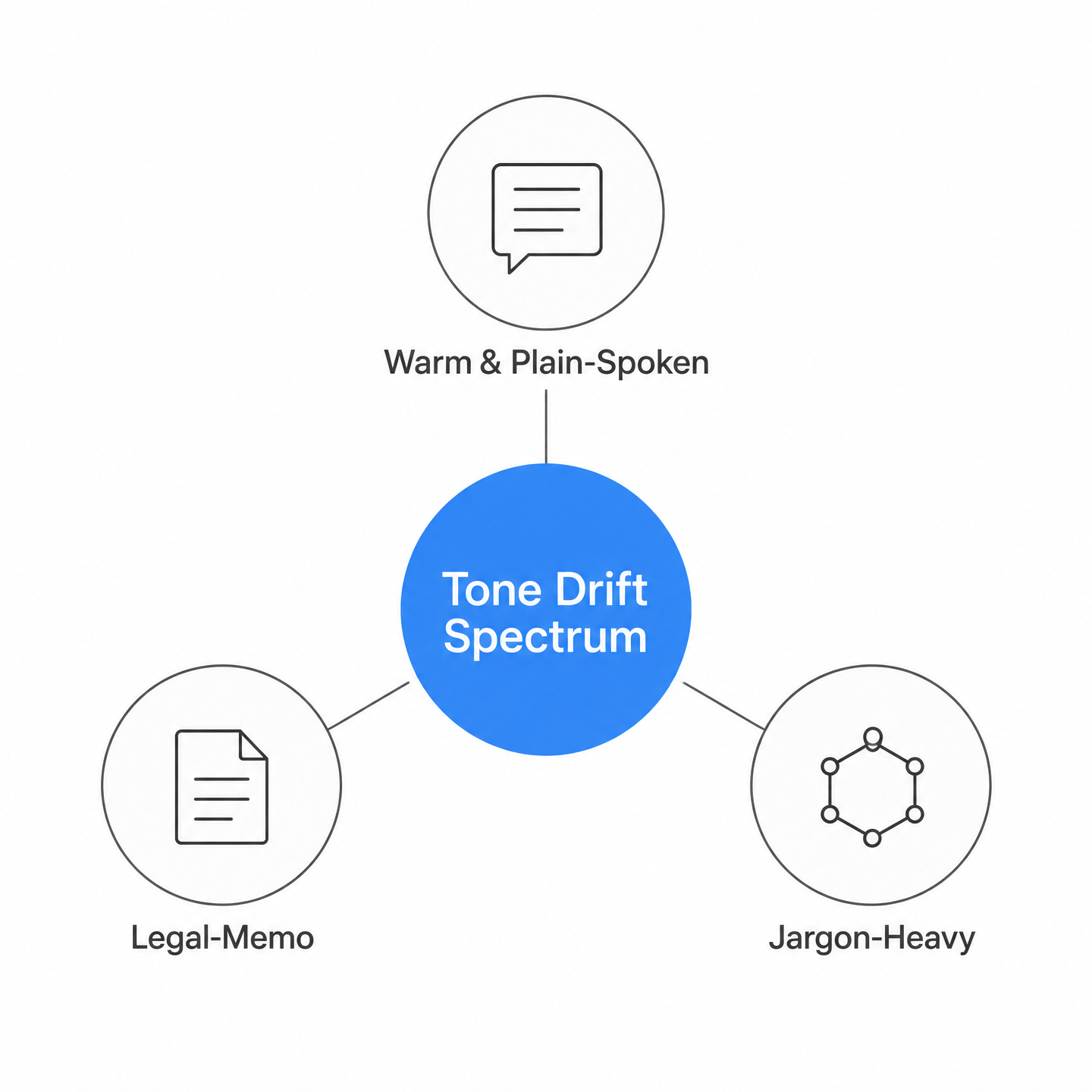
The fragile part isn't the factual summary; it's the style boundary. A draft can carry the right topic, sources, and structure while still losing the rules that make it sound like you. Vague voice instructions like "match our tone" as a prose note get lost in transit, but a locked, typed voice spec built into the system survives the handoff.
What Does Brand-Voice Drift Actually Look Like?
Drift rarely announces itself. It shows up as small register shifts that add up across a batch of pages.
- Check tone consistency across a sample of 10+ recent posts, not one page in isolation. Drift only becomes visible when you read pieces side by side.
- Flag jargon the draft introduces that your audience doesn't use. Models fill gaps with generic industry-speak, and that generic voice is exactly what the top of search already has.
- Watch for cultural or contextual missteps, like a casual joke in a compliance-heavy topic. These erode trust faster than a grammar slip.
Which Metrics Measure Voice Compliance?
You can't validate voice by vibes alone at scale. You need signals you can track across hundreds of pages.
- Run readability scoring so every piece lands in your target range. A spiky reading level between posts is an early drift signal.
- Use sentiment analysis to confirm the emotional register matches your brand, whether that's reassuring, direct, or playful.
- Apply automated brand-guideline validation. Modern quality systems can flag voice inconsistencies programmatically, which makes voice a measurable gate rather than a judgment call.
How Do You Lock Voice Into the Handoff?
The fix is voice-aligned automation that treats your tone spec as a hard constraint, not a suggestion. We see this work when the voice rules travel with the draft as structured, enforced criteria rather than a line in a brief.
- Encode your voice as an explicit, reusable persona spec so every channel inherits the same rules.
- Have reviewers confirm only the boundary cases the automated checks flag, instead of re-reading everything from scratch.
Skip heavy voice tooling if you publish a handful of pieces a month by one writer. The payoff shows up when you're scaling across topics and the drift is otherwise invisible. For teams at that stage, our four-check framework covers tone-matching in more depth.
Handoff #5 – From Published Asset to Analytics & Optimization Loop
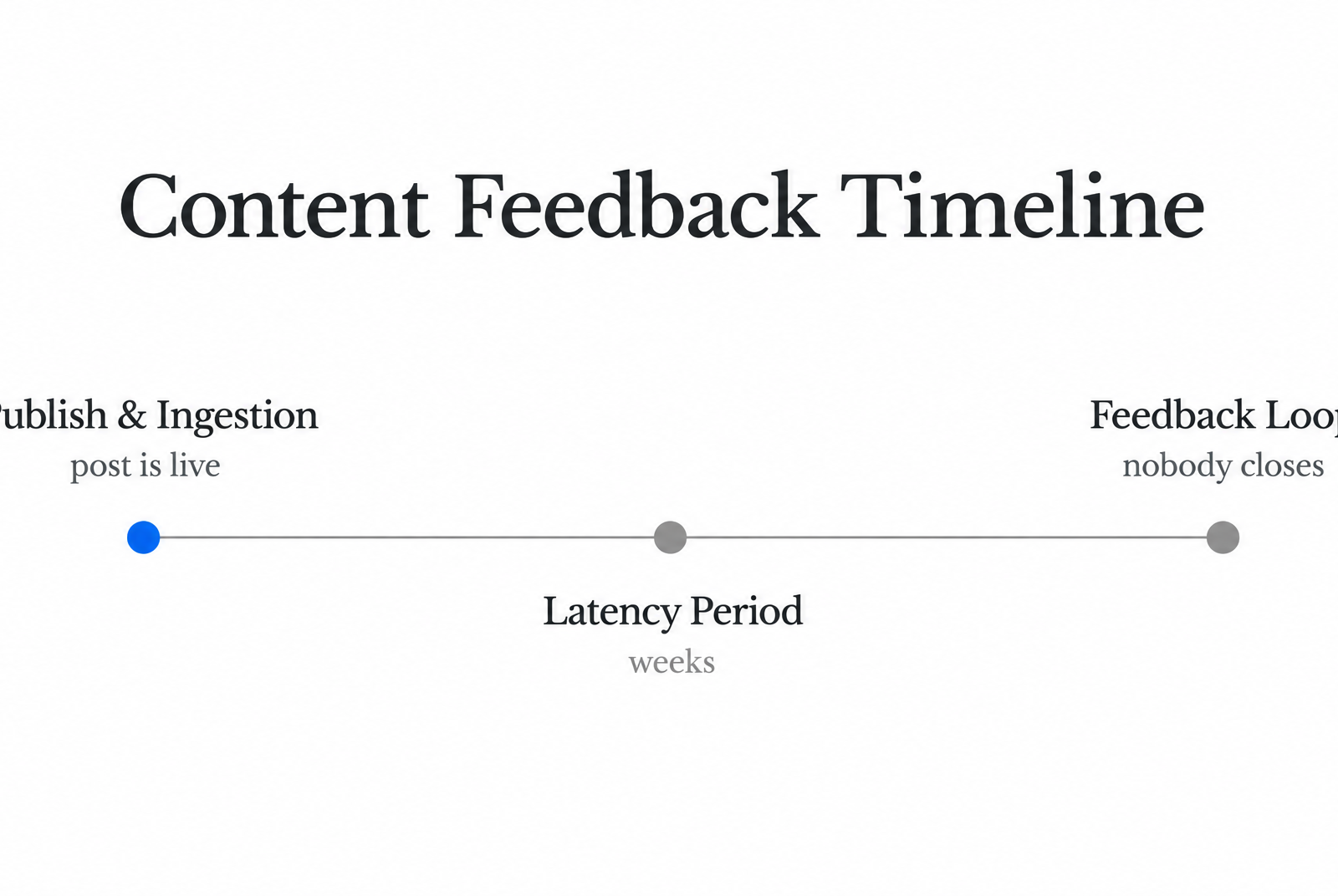
The last handoff is the one nobody schedules. Your post is live, the ranking data starts trickling in, and the numbers are supposed to flow back into the engine so the next round of content gets smarter. When you automate at scale, this feedback loop is where most teams quietly stop paying attention. The content ships, the dashboard updates, and nobody closes the loop.
Analytics latency means you often won't see whether a topic landed until weeks after you've already published ten more like it. By the time the data says a format flopped, the automated workflow has multiplied the mistake across every channel. The system never learns which prompts actually move the needle because the lesson arrives too late to change anything.
Why does the analytics handoff lose its context?
Analytics tools are excellent at preserving the measurable fact. They're weaker at preserving the editorial reason behind that fact.
The dashboard passes pageviews, bounce rate, and rankings. It drops the why: who the piece was for, what strategic intent it served, which brand positioning it protected. An optimization agent then sees a dip in dwell time and "fixes" it by rewriting toward whatever ranks, flattening the voice you spent months tuning. The performance signal survived. The constraint did not.
Which KPIs should trigger a prompt change?
Not every metric deserves a reaction. We tie prompt refinements to signals that reflect reader intent, not vanity counts. Engagement depth often tells you more than raw clicks about whether your angle resonated.
- Watch dwell time and scroll depth by topic cluster, not sitewide—these flag where your voice connected and where a prompt produced generic filler.
- Track indexation rate per batch before scaling a format. Low indexation is an early signal to refine the brief, not the volume.
- Flag ranking drops against brand intent, so an optimization pass doesn't rewrite a piece away from the audience it was built for.
What publishing checks prevent silent failures?
Bulk schedulers fail loudly at the worst moment: at publish, across every platform at once. A single source of truth for your content cuts queue errors because every channel pulls from one approved asset instead of a drifting copy.
- Validate formatting and asset specs per channel before the queue runs—image ratios, character limits, and link previews differ enough that one template rejection cascades.
- Lock approved voice and metadata as explicit markers in the handoff, so reviewers handle exceptions instead of reopening finished decisions.
- Set a fixed cadence for reviewing analytics and updating prompts—a weekly loop keeps latency from compounding into repeated misses.
Use small-batch publishing as your safety valve. A representative sample gives you enough signal to correct the workflow before one bad assumption becomes a full content library problem.
FAQ
What is a content handoff?
A content handoff is the transfer of work from one stage or team member to another in a production workflow. When you automate at scale, each handoff is a place where voice, metadata, or context can fail to travel with the draft.
Why do content handoffs fail?
Handoffs fail when the receiving party gets incomplete context. A draft might land with the right topic but without the angle, voice constraints, or decided-versus-open markers the next stage needs to act on it correctly.
How many handoffs does a typical automated workflow have?
Most automated content workflows have at least five: ideation to prompt, prompt to draft, draft to voice review, content to metadata, and publish to analytics. Each one is an independent failure point.
What's the most common handoff failure?
The most common failure is passing everything instead of passing what's decided. Reviewers re-litigate settled tone because the handoff didn't mark approved elements, and that rework swallows entire afternoons.
How do you prevent metadata from getting lost in handoff?
Validate required SEO fields before the content moves downstream. Treat metadata as a gate, not an afterthought, so titles, descriptions, and schema travel with the draft as structured, enforced requirements.
What metrics show a handoff is broken?
Watch for indexation drops, voice drift across batches, and reviewer cycles that balloon without adding value. Those signal that context is leaking between stages.
Do agencies struggle more with handoffs than in-house teams?
Agencies often feel the friction first because they juggle many clients and can't manually police every transfer. Lean SMB teams chasing broad keyword coverage hit the same wall where volume outpaces headcount.
How does Google detect handoff failures?
Google's quality systems flag patterns of sameness. When metadata and body content blur together across pages because handoffs dropped differentiation signals, those pages tend to get deindexed as scaled content abuse.
What's the difference between a handoff and a review cycle?
A handoff is the transfer of work with its context intact. A review cycle is what happens when the handoff failed and someone has to reconstruct what should have arrived in the first place.
Can you automate handoffs safely?
Yes. The key is treating voice, metadata, and constraints as structured data that travels with the draft, not prose notes that get lost. Automation that carries decisions scales. Automation that drops them doesn't.