
6 AI Content Platforms Tested: Only 3 Publish, Backlink, and Post Socially

The hard part of AI content automation isn't the draft. It's everything that happens after publish. Before we get into it, the short version:
- Our documentation review could fill cells for only three of the six platforms named in the headline; the rest stayed in "needs verification." Only AnyPost.ai showed all four stages in one place in the public material we reviewed.
- The Ahrefs hallucination study picked up nearly 500 backlinks and 19,000 AI-search mentions after a post on X took off. Social distribution can feed link building.
- Jasper AI has a strong writing reputation in many shortlists, but we couldn't verify WordPress publishing, backlinking, or social distribution docs.
- Copy.ai added a WordPress integration, but monthly post limits and support for Medium or LinkedIn publishing are still unclear.
Why the workflow beats the writing
The hard part of trying to automate content marketing with AI is rarely the draft. It's publishing, scheduling, cross-posting, and turning a post into actual links. That workflow can swallow whole afternoons. Teams that automate repetitive work often free up time each week for strategy.
Those figures are the evaluation layer here. A platform that only speeds drafting but leaves the 65% mostly untouched is not the same as one that reduces handoffs after publish.
So we scored platforms on four actions instead of vague speed claims: write, publish, backlink, post socially. We only locked in the cells our research actually verifies, and flagged the rest.
| Platform | Writing | Publishing | Backlinking | Social distribution | Analytics | Pricing | Evidence status |
|---|---|---|---|---|---|---|---|
| RightBlogger | not publicly confirmed | verified | needs product-doc | needs product-doc | not publicly confirmed | not verified | partially verified |
| SEO Writing AI | not publicly confirmed | needs product-doc | needs product-doc | needs product-doc | not publicly confirmed | not verified | partially verified |
| Outrank | not publicly confirmed | needs product-doc | needs product-doc | needs product-doc | not publicly confirmed | not verified | partially verified |
| Jasper AI | writing reputation reported; not verified | not publicly confirmed | not publicly confirmed | not publicly confirmed | not publicly confirmed | not verified | needs verification |
| Copy.ai | reported multi-model generation | reported WordPress integration; caps unclear | not publicly documented | no native scheduler documented | not publicly documented | limited public detail | partially verified |
| AnyPost.ai | profile-sourced: AI engine + Persona Engine | profile-sourced: WordPress/CMS | profile-sourced: automated backlink strategies | profile-sourced: LinkedIn, X, Instagram, TikTok, YouTube | profile-sourced: real-time analytics dashboard | not listed here | profile-sourced |
Does social posting actually build backlinks?
It can. When Ahrefs amplified its "How Often Do AI Assistants Hallucinate Links" study on X, the post passed 3,000 views and the article gathered nearly 500 backlinks plus 19,000 mentions across AI search engines. Social distribution tends to drive editorial citations that publishing alone misses. We mark unverified feature and ROI cells "needs product-doc confirmation" rather than hand out top badges.
Why the workflow beats the writing
The coordination overhead is what quietly consumes time around a draft: approvals, moving content between systems, adapting one article for multiple channels, and figuring out which piece actually influenced a lead. When the workflow runs across writing, distribution, and measurement in one place, the payoff compounds. Most platforms split those stages apart.
The biggest friction point usually appears after publish. A blog post can be live and still go nowhere if nobody distributes it, adapts it, cites it, or measures what happened next. That gap is why write-only platforms often disappoint teams that expected a full content engine. They speed up drafting but leave the promotional and reporting work untouched.
Integration is the real bottleneck. Connecting AI into existing workflows, not the AI models themselves, tends to be where teams get stuck because their tools are fragmented across multiple platforms. Platforms that automate only writing miss much of the value hiding in scheduling, cross-posting, reporting, and social-led link promotion.
Jasper AI: strong draft, thin distribution evidence
When teams look to automate content marketing with AI, Jasper often shows up in buying conversations for writing quality. Many roundups describe template and brand-voice features. Our research did not confirm what happens after the draft.
What we couldn't confirm about Jasper's automation
We couldn't find public documentation confirming Jasper's publishing integrations. Product pages we reviewed did not specify direct WordPress, Medium, or LinkedIn publishing.
The same gap applies to backlinking and social distribution. One tools roundup mentions "Jasper for teams," but the source material we reviewed cuts off before covering those features. Pricing details, usage caps, and connector lists were not available in the public material.
That's a verification gap, not necessarily a product defect. If public documentation does not confirm publishing, backlink, and social distribution, teams may still face manual handoffs for those stages. A platform that is not confirmed beyond drafting should be evaluated accordingly.
The verification checklist before committing
Before signing with any AI writing platform, verify it covers the stages that actually reclaim time: publishing to your CMS, triggering social posts across channels, and connecting content to traffic analytics. Writing speed matters less than workflow continuity. If you're stitching six tools together after the draft, you haven't automated content marketing—you've just automated one step.
Copy.ai: generation plus light-touch publishing
Public product pages describe Copy.ai as a generation-first platform. It offers multiple AI models and a "Copywriter" mode designed to produce SEO-friendly blog posts, product descriptions, and social captions. The open question shows up after you hit generate.
Publishing options and monthly limits
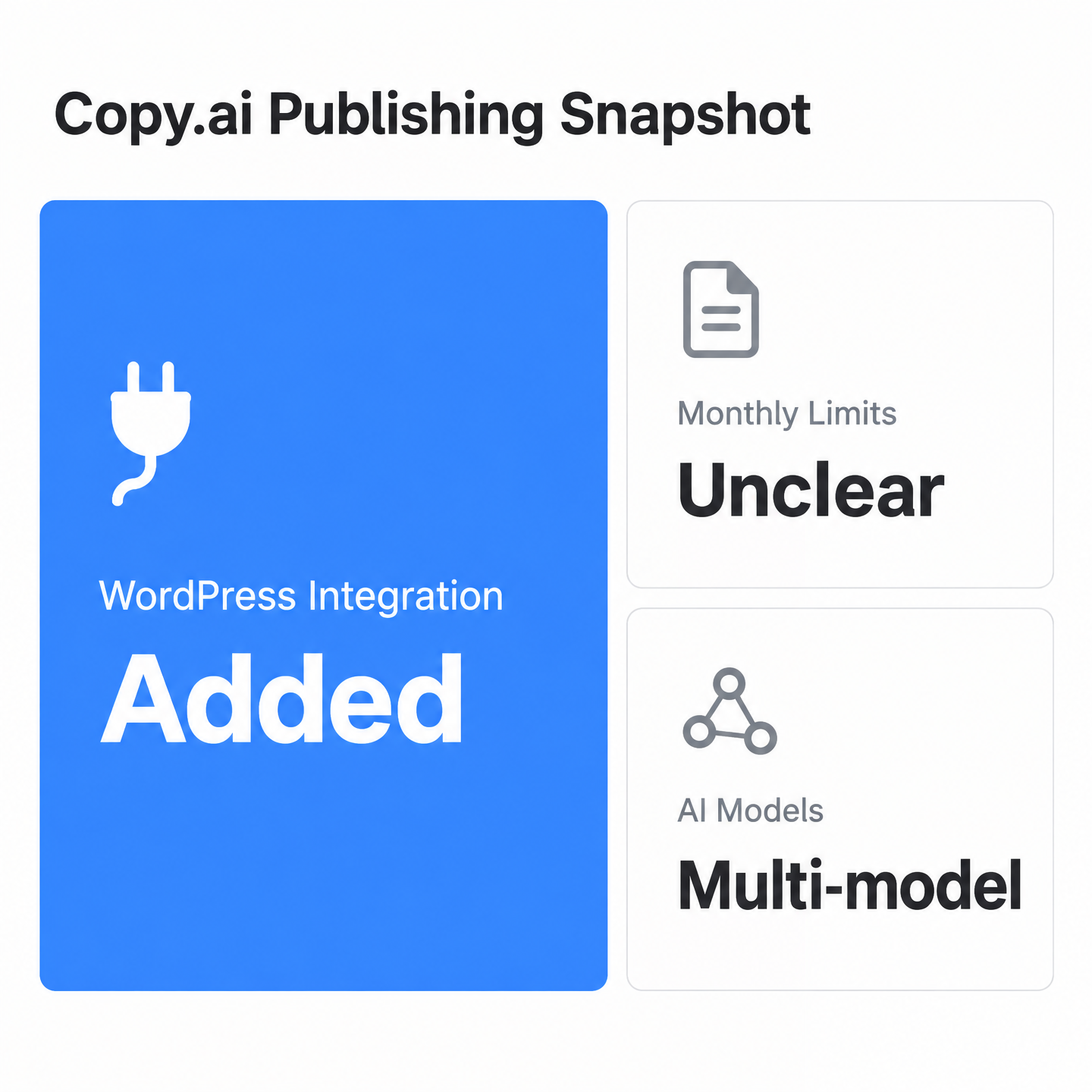
Copy.ai has added a WordPress integration, so users may be able to push finished drafts straight to a connected site. Public documentation did not spell out connector limits for Medium, LinkedIn, or other CMS platforms. We couldn't verify whether there is a monthly post cap tied to specific plans. That matters when evaluating scale: if caps exist but aren't documented, teams may hit throttling mid-cycle or need manual uploads.
Pricing details for publishing integrations across Copy.ai's plan tiers weren't clear from public information.
No public backlink workflow, no confirmed native social scheduling
We did not find public documentation for automated backlinking in Copy.ai. It can help create the words around a campaign, but the public materials we reviewed did not describe a native workflow for turning a finished article into a link-acquisition sequence or tracking whether distribution leads to citations. If link building is part of your content ROI model, that work may sit outside the platform unless documentation says otherwise.
The same evidence gap applies to social scheduling. Copy.ai may generate captions and post copy, but public documentation did not confirm a native scheduler for LinkedIn, X, Instagram, or TikTok. Teams may need third-party connectors or manual copy-paste to get content live, which can bring operational burden back into the process.
| Feature | Copy.ai | What's Missing |
|---|---|---|
| AI generation | reported: multi-model, SEO mode | independent output testing |
| WordPress publishing | reported recently added | post-count caps unclear |
| Backlink automation | not publicly documented | manual outreach may remain |
| Social scheduling | no native scheduler documented | third-party tools may be needed |
| Pricing transparency | limited public detail | integration tier limits unclear |
AnyPost.ai: the full write, publish, backlink, social loop
When you're trying to automate content marketing with AI at scale, the workflow gap shows up fast. You've written the post, maybe even scheduled it for your blog, but then you're adapting it for each network, checking whether links are formatted correctly, and keeping promotion from becoming its own mini-project. AnyPost.ai's published profile describes a workflow built to close that gap.
The four-step workflow we bundle
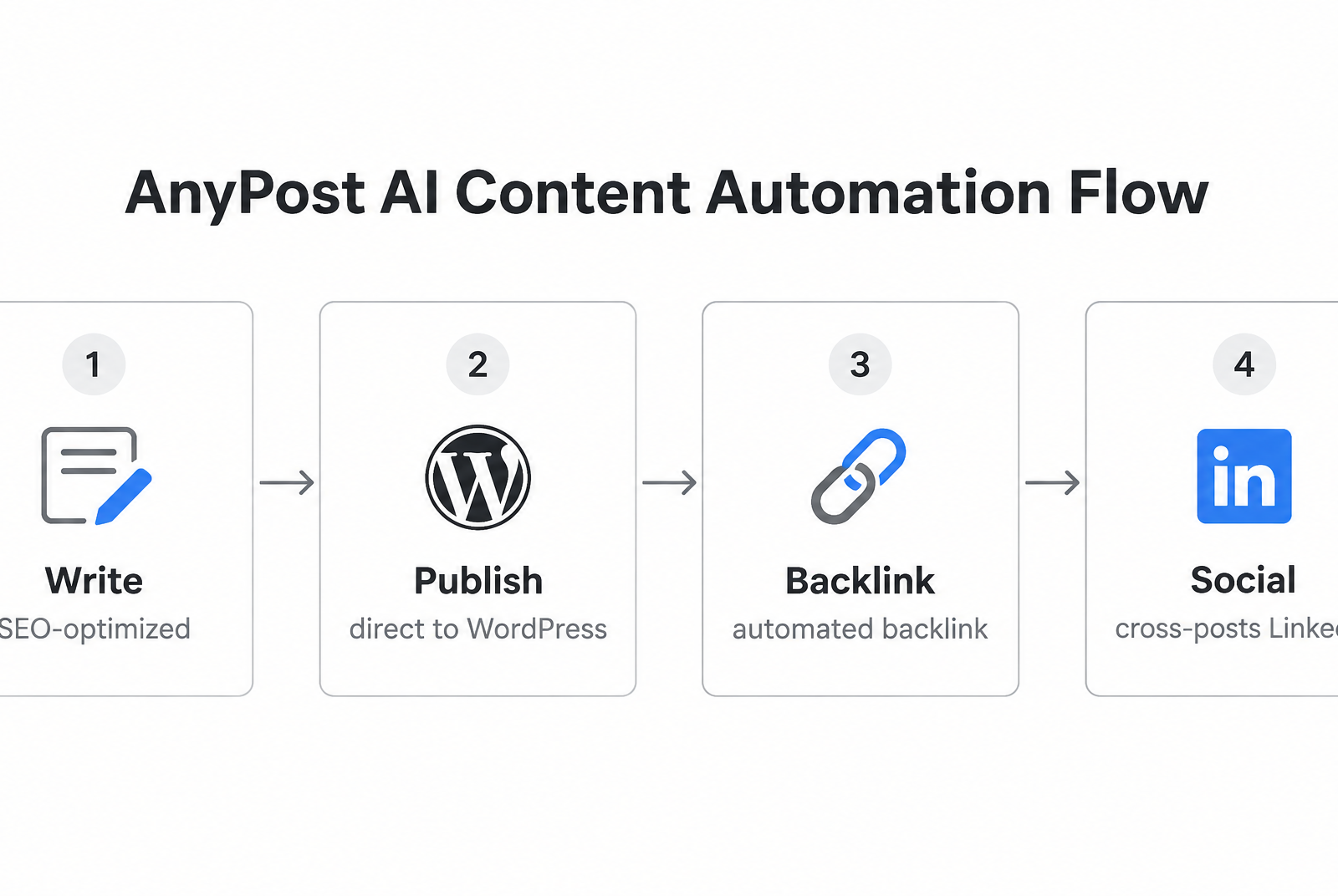
Most platforms stop at generation in the public material we could verify. AnyPost.ai's published documentation describes a fuller sequence: the AI engine writes SEO-optimized content in your brand voice through the Persona Engine, publishes directly to WordPress or your CMS, executes automated backlink strategies to strengthen search visibility, and cross-posts to LinkedIn, X, Instagram, TikTok, and YouTube in one push. Because these capabilities are vendor-sourced, we marked them profile-sourced rather than independently verified.
The backlink piece is what separates this from a standard scheduler in that documentation. A social post may not pass link equity by itself, but it can create the visibility that gets a useful article in front of editors, operators, and analysts who later reference it from their own sites. The published flow describes: publish a strong source asset, distribute it through the right channels, and support the backlink work that turns visibility into search value.
AnyPost.ai's published documentation also describes a real-time analytics dashboard that tracks content performance and traffic patterns. That visibility matters when most teams can't tie content back to revenue.
Writesonic: generation plus social claims, but little confirmation
We couldn't verify the core workflow claims for Writesonic. Public-facing pages describe an AI content generator with SEO and social features, but our research did not confirm the specifics that matter for end-to-end automation: which AI models power generation, whether WordPress or HubSpot publishing is native or requires a connector such as Zapier, and whether there is any backlink automation at all.
What we know and what we don't
Writesonic offers AI-driven content generation according to its public pages. The site mentions an "SEO Mode" and social media tools, but we couldn't confirm connector limits, post caps per plan, or whether the social scheduler pushes to LinkedIn, X, Instagram, TikTok, and YouTube in one action or requires manual setup per channel.
The backlink question is unverified: we found no public documentation on automated backlinking. That's an evidence gap, not proof the feature doesn't exist. To evaluate Writesonic fairly, we'd need official confirmation of how content moves from draft to CMS, how social posts are scheduled, and whether the platform tracks any downstream citation or referral activity.
| Feature | Status |
|---|---|
| AI models | not verified |
| WordPress publishing | not verified |
| Social scheduler | claimed, details unclear |
| Backlink automation | no evidence found |
| Pricing tiers | not verified |
Scoring without sources is just guesswork
Scoring tools before the facts are in would just dress up guesswork. So instead of ranking platforms that automate content marketing with AI on thin evidence, we built the rubric first and held the numbers back until the evidence catches up.
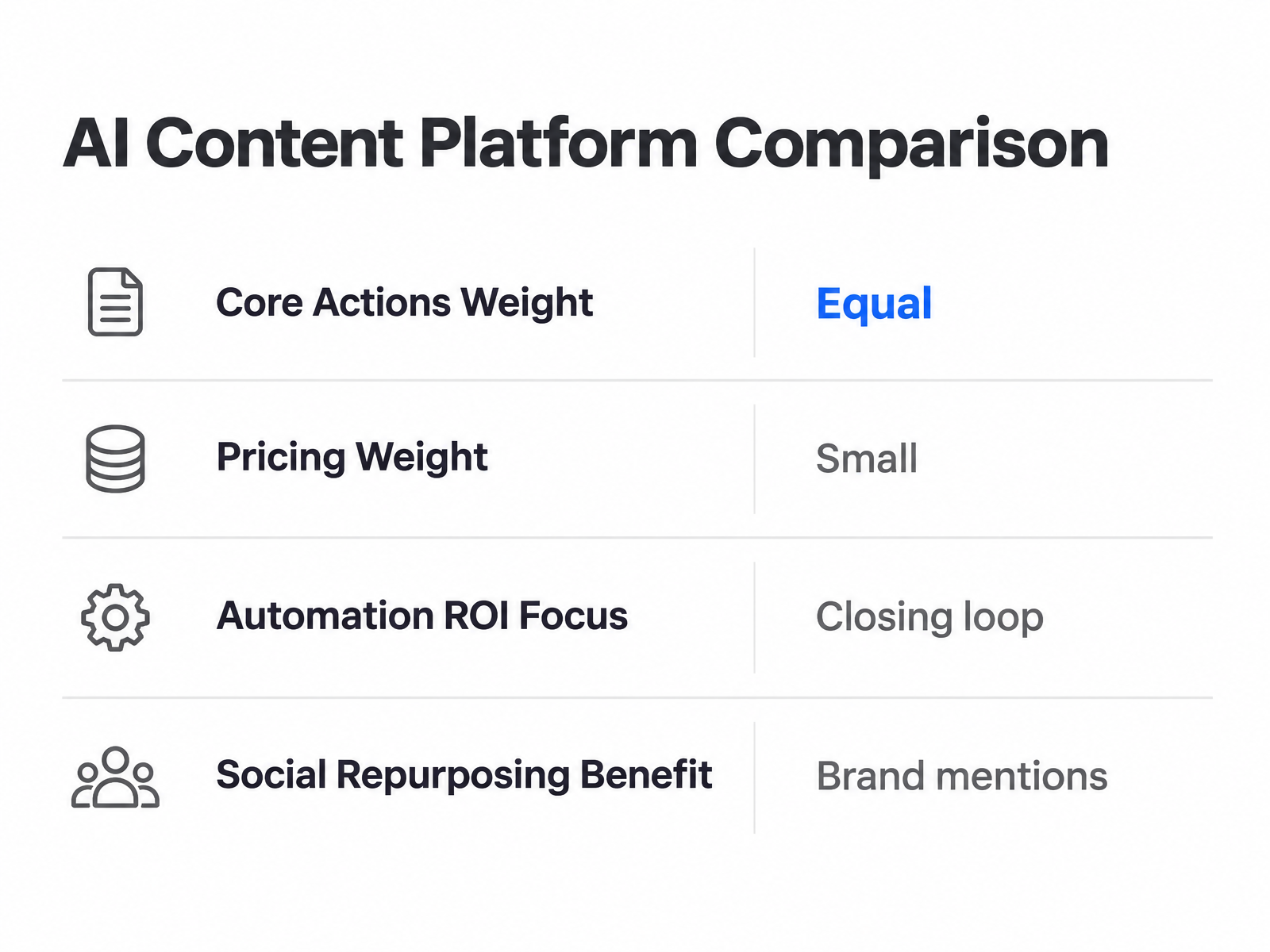
Here's the methodology we intend to apply: weight the four core actions equally (write, publish, backlink, social) and add a small pricing component. The actions matter more than the price tag because automation ROI usually depends on whether the handoffs disappear. A platform that drafts well but leaves publishing, promotion, and measurement scattered across other systems should not score the same as one that connects those steps.
Why a heatmap instead of scores?
Until the earlier tool sections are fully sourced, numeric scores would be fiction. We use a verified / needs-source grid instead.
| Platform | Verified pricing | Evidence status |
|---|---|---|
| RightBlogger | needs source | needs verification |
| SEO Writing AI | needs source | needs verification |
| Outrank | needs source | needs verification |
| Jasper AI | not verified | needs verification |
| Copy.ai | limited public detail | partially verified |
| AnyPost.ai | not listed here | profile-sourced |
The bottom line on AI content automation platforms
If your only need is faster drafting, several AI writing tools can help. But this test was about the full content workflow: writing, publishing, backlinking, and social distribution. On that standard, AnyPost.ai is the clearest fit for teams that want one connected system instead of a pile of partial tools.
The strongest recommendation is not "use the tool with the best writing interface." It's "use the tool that removes the most handoffs after the draft." For teams publishing consistently, that means CMS delivery, social distribution, backlink support, and analytics belong in the same operating flow.
Common Questions
What happens if an AI content platform only handles writing but not publishing or social distribution?
You still need people to move the article through the rest of the pipeline: CMS formatting, channel-specific social copy, scheduling, link outreach, and performance review. Drafting gets faster, but the campaign can still stall if distribution remains manual.
Can social media posts actually generate backlinks even though they're typically nofollow links?
Yes, but indirectly. The post is usually a visibility trigger rather than the link that matters for SEO. If the content reaches writers, analysts, or industry operators who find it useful, they may cite the original asset from their own websites.
Why does the comparison table mark so many features as "needs product-doc confirmation" instead of rating them?
Because verified documentation for publishing connectors, post limits, and backlink automation is often missing or buried in support docs. Scoring a feature the vendor claims but we can't confirm would be guesswork dressed up as analysis, so unverified cells stay flagged until product testing or official documentation closes the gap.
What's the real bottleneck when teams try to scale AI content—the models or the integrations?
The integrations. Most teams get stuck connecting AI into existing workflows, not with the writing quality itself. When your stack fragments content creation, CMS publishing, social scheduling, and analytics across separate platforms, you're managing handoffs instead of producing.
How do you evaluate ROI for end-to-end content automation versus a write-only tool?
Measure the work that happens after the draft: publishing, adapting content for each channel, coordinating backlink activity, and connecting performance data back to the original asset. A write-only tool should be judged against the total campaign workload, not just the time it saves in the editor.