8 AI Blog Writers Ranked on Publishing, Repurposing, Backlinks, and Reporting

Quick Answers
- This comparison covers eight AI blog writers: Frase, Koala, Outrank, SEOwriting.ai, Scalenut, Writesonic, Surfer, and Jasper. TheStacc is discussed separately using customer documentation.
- Frase and Koala describe publishing workflows in the reviewed vendor materials, although important review and citation details remain undocumented.
- Outrank, SEOwriting.ai, Scalenut, and Writesonic also describe publishing or optimization capabilities, but their approval workflows are not consistently stated.
- Surfer is primarily presented as an optimization tool, while Jasper emphasizes brand governance; neither should be treated as a complete publishing solution without confirming the required workflow.
- None of the eight tools documented a complete repurposing engine that converts blog posts into social carousels, newsletters, and video scripts with distribution tracking.
- TheStacc’s customer documentation separately describes multi-platform publishing and social scheduling, but those capabilities are not used to rank the eight vendor-documented tools.
- Subscription price is only one consideration. Editing, formatting, review, internal linking, and CMS handoffs can add substantial labor when publishing at volume.
What vendor docs actually show
We compared eight AI blog writers using a consistent four-part rubric: publishing automation, repurposing, backlink-related functionality, and reporting. This isn't hands-on testing—it is a side-by-side review of what the examined materials say each tool offers. A capability described by a vendor is treated as source-attributed evidence, not independent proof of performance. “Not documented” means unknown, not absent.
The strongest evidence concerns publishing integrations and optimization features. Repurposing and external backlink automation are much less clearly documented, so we do not manufacture an overall score across all four dimensions.
Tools with the clearest automation story
Frase’s reviewed materials describe research, drafting, publishing, and review controls in one workflow. Koala’s materials describe direct CMS publishing and research features, but do not clearly state how drafts move through review before publication.
SEOwriting.ai, Scalenut, and Writesonic describe combinations of publishing, optimization, linking, or AI-visibility features, but their approval defaults are not consistently documented. Surfer and Jasper serve different primary roles: Surfer focuses on optimization, while Jasper emphasizes brand voice and governance.
The matrix below is ranked by fit for a publishing-led workflow, not by content quality or ranking performance. Teams with different needs should reorder it accordingly.
| Rank | Tool | Verified for this comparison | Important unknowns | Recommendation |
|---|---|---|---|---|
| 1 | Frase | Vendor materials describe research, drafting, publishing, and review controls | Citation handling and some workflow details require confirmation | Check first for an integrated, review-led publishing workflow |
| 2 | Koala | Vendor materials describe direct CMS publishing and research features | Approval defaults and source-handling details are not clearly stated | Consider for publishing flexibility, subject to a review-process check |
| 3 | Outrank | Vendor materials describe draft creation, publishing connections, and optional human fact-checking | The depth of reporting, repurposing, and external-link functionality is unclear | Consider when draft review and optional editorial checking matter |
| 4 | SEOwriting.ai | Vendor materials describe CMS connections, optimization, and linking features | Approval behavior and broader reporting are not clearly documented | Evaluate for drafting and optimization rather than assuming full automation |
| 5 | Scalenut | Vendor materials describe optimization, internal-linking, and AI-visibility features | Plan-dependent availability and approval behavior require confirmation | Consider when optimization and visibility reporting are priorities |
| 6 | Writesonic | Vendor materials describe publishing, keyword, SERP, and AI-visibility features | Review defaults and unified reporting are not clearly documented | Evaluate if its combined research and visibility features fit your stack |
| 7 | Jasper | Vendor materials emphasize brand voice, governance, and approvals | The reviewed Pro-plan material does not establish a complete SEO publishing workflow | Best suited to brand-governed teams that can supply separate SEO and publishing steps |
| 8 | Surfer | Vendor materials describe SERP-based content optimization | It does not close the publishing workflow on its own | Use as an optimization layer alongside drafting and publishing tools |
Where documentation runs thin
Repurposing and backlinking appear in category messaging, but the reviewed materials provide little tool-specific evidence about complete workflows. A vendor mentioning internal linking, social scheduling, or AI visibility does not establish that it converts content into new formats, conducts external outreach, or provides unified reporting.
The same caution applies to review workflows. Koala, Writesonic, SEOwriting.ai, and Scalenut do not clearly state in the reviewed materials whether publishing defaults to automatic publication or editorial review. Frase describes research remaining associated with content, but that alone does not establish comprehensive source grounding. Okara and other tools encountered during research are excluded from the ranking because they are outside the defined eight-tool inclusion set.
No tool in the inclusion set documented a complete repurposing engine that turns one blog post into social carousels, newsletters, and video scripts with measurable distribution tracking. Treat that as an evidence gap, not proof that no such feature exists anywhere.
The part most teams underestimate isn't writing the content
It's everything that happens before the first word and after the last sentence. AI writing tools can generate drafts quickly, but moving a draft into a CMS—formatted correctly, with internal links, metadata, and images—can still require substantial manual work.
The subscription cost isn't the whole workflow cost. Drafting in one tool, optimizing in another, and publishing through a separate process creates handoffs. Reviewing output, checking facts, maintaining internal links, and coordinating approvals can consume time that would otherwise go to strategy.
Why fragmented stacks break at scale
Manual publishing adds friction to every article. Teams may draft in one tool, optimize in another, format elsewhere, and then copy content into their CMS. Editing at volume creates another cost layer when writers or contractors must clean up output before it is ready to ship.
Multi-tool stacks can become harder to coordinate as content velocity increases. The useful distinction is not simply which model generates the draft. It is whether the overall workflow supports research, review, formatting, and publishing without unnecessary handoffs. Platforms can be configured differently, so confirm the actual setup rather than assuming that an integration eliminates manual work.
Quick profiles: eight AI blog writers
The tools in this comparison break down into three groups: end-to-end publishing platforms, draft generators, and optimization tools that score what you write. Each profile below is limited to the reviewed vendor materials and the workflow questions those materials leave open.
Tools that draft and publish
Frase combines SERP research, drafting, and publishing according to its vendor materials. Auto-publish is described as opt-in, so teams should still confirm the configuration they intend to use. Citation handling beyond keeping research associated with posts is not fully detailed.
Koala includes research features on higher tiers, according to the reviewed materials. The vendor materials do not clearly state whether drafts wait for approval or go live immediately. Collaboration and source-handling details should be confirmed before relying on the platform in a review-sensitive workflow.
Outrank is described as saving articles as drafts in a CMS for review. Its materials also describe keyword research, publishing connections, and a paid human fact-check add-on. Those features do not by themselves establish repurposing, external-link prospecting, or unified reporting.
SEOwriting.ai is described as connecting to WordPress and Shopify, scoring content against search results, and supporting internal and external linking. The reviewed materials do not clearly state whether drafts require approval.
Scalenut is described as offering AI-visibility tracking alongside optimization features. Publishing and internal linking are associated with a higher-tier plan in the reviewed materials, and the approval workflow is not clearly documented.
Writesonic is described as publishing to WordPress and providing keyword planning, SERP data, and AI-visibility features. The reviewed materials do not specify whether drafts wait for review, so platforms like Writesonic should be configured and tested against the team’s editorial requirements.
Tools that optimize, not publish
Surfer is not presented as a complete drafting-and-publishing pipeline. Its vendor materials describe connections with other content tools, but users still need to establish who handles formatting, review, and publication. Citation handling is not established in the reviewed comparison material.
Brand voice without SEO data
Jasper includes templates and browser-based assistance in its materials. The reviewed Pro-plan material does not establish keyword research or SERP analysis as part of a complete publishing workflow. Teams considering it should confirm which SEO and CMS steps require separate tools.
The coordination tax
Many teams still stitch together separate tools for research, optimization, publishing, internal linking, and analytics. That stack can work, but every handoff creates another place for drafts to stall. The practical question is not how many tools appear in a stack; it is whether ownership, review, and publication are clear at each step.
Where tools actually connect to your CMS
We see a clear divide in publishing capability across these eight AI blog writers. Some vendor materials describe sending posts directly to a CMS. Others focus on drafts or optimization and leave formatting, metadata, and upload to the user.
Frase, Koala, Writesonic, SEOwriting.ai, Outrank, and Scalenut are associated with WordPress publishing in the reviewed materials, although plan availability and exact behavior vary. Koala’s materials add Shopify, Webflow, Ghost, and webhooks. SEOwriting.ai covers WordPress and Shopify. Outrank describes multiple CMS connections plus a webhook and draft-based review. Surfer and Jasper should not be assumed to provide equivalent publishing automation.
TheStacc is outside the eight-tool ranking but is covered by separate customer documentation. TheStacc covers WordPress, Webflow, Shopify, GitHub, Sanity, Framer, Wix, and HubSpot—and pairs its blog module with a separate social distribution layer that schedules posts to Instagram, Facebook, LinkedIn, and X. No other tool in this comparison documents social-distribution automation.
Approval behavior remains a key unknown. Frase describes review as the default unless auto-publish is enabled. Outrank describes drafts being saved for review. Koala, Writesonic, SEOwriting.ai, and Scalenut do not clearly state their defaults in the reviewed materials. Compliance-sensitive teams should confirm behavior in a test environment before committing.
| Tool | CMS coverage described in reviewed materials | Auto-publish or review evidence | Social distribution |
|---|---|---|---|
| Frase | WordPress, Webflow, Sanity, Wix, FraseCMS | Review described as default; auto-publish opt-in | Not documented |
| Koala | WordPress, Shopify, Webflow, Ghost, webhooks | Not stated | Not documented |
| Outrank | Multiple CMSs plus webhook | Drafts saved for review | Not documented |
| SEOwriting.ai | WordPress, Shopify | Not stated | Not documented |
| Writesonic | WordPress | Not stated | Not documented |
| Scalenut | Publishing associated with a higher-tier plan | Not stated | Not documented |
| Surfer | Optimization integrations; publishing remains a separate workflow | Not established | Not documented |
| Jasper | Publishing connections described, but not a complete SEO publishing workflow | Approval features described; exact CMS behavior requires confirmation | Not documented |
| theStacc, outside the ranking | WordPress, Webflow, Shopify, GitHub, Sanity, Framer, Wix, HubSpot | Configurable | Instagram, Facebook, LinkedIn, X through a separate module |
Repurposing: the evidence gap
Newsletter conversion, video scripts, Instagram carousels, and LinkedIn slides are often discussed alongside AI content platforms, but the reviewed materials do not establish a complete format-conversion workflow for any of the eight ranked tools.
We looked for evidence that a tool could convert a finished blog post into multiple distinct assets and track their distribution. We did not find documentation sufficient to support that claim. TheStacc’s separately documented social capability schedules posts to four platforms. That is distribution, not format conversion.
If repurposing is central to your workflow, require a demonstration using your own source content. Do not infer format conversion from social scheduling, integrations, or general AI-generation claims.
Backlinks: internal linking vs. external prospecting
The term “backlink automation” covers two unrelated workflows. Internal linking means adding contextual links between pages on your own site.
External backlink building is different: it can involve prospecting, outreach, and monitoring links from other sites. The reviewed sources did not establish a complete external-link workflow for the eight ranked tools. Internal-link suggestions should therefore not be presented as evidence of external backlink automation.
If external backlinks are central to your strategy, evaluate any proposed workflow against current search-engine spam policies and your editorial standards. These tools should not be assumed to replace a separate outreach process.
Reporting: rank decay and AI visibility
The reviewed materials do not establish unified dashboards combining traffic, rankings, backlink health, and content performance for every vendor. Analytics should therefore be evaluated feature by feature rather than treated as a standard category capability.
No third-party benchmark reviewed here rates these eight tools across publishing, repurposing, backlinking, and reporting. Broader collaborative-content scores cannot validate rankings across those four dimensions.
What a transparent rubric looks like
We score only cells supported by feature evidence. Documented capability depth, integration breadth, evidence quality, and workflow fit determine the recommendation. “Not documented” means unknown, not absent.
Where repurposing and backlinking data are missing, we withhold an overall four-dimension score rather than manufacture model-by-model ratings. The ranked matrix is consequently a publishing-workflow shortlist, not a claim that one tool produces better content or search results than another.
Pricing and plan limits should be confirmed directly with vendors before purchase. Cost comparisons also need to account for editing, review, formatting, and coordination. If a team edits heavily after drafting, the subscription fee may be only a small part of the total workflow cost.
Match the documented gap to the tool that closes it
We looked at eight tools to see which addresses the bottleneck of moving content from keyword to published post. The reviewed evidence does not show a single winner across publishing, repurposing, backlinking, and reporting. What matters is matching the verified gap in your workflow to the tool that addresses it.
Start with Frase or Koala if integrated drafting and publishing are the priority, then confirm review behavior and citation requirements. Evaluate Outrank when draft-based review and optional human fact-checking are relevant. Consider SEOwriting.ai, Scalenut, or Writesonic for their documented combinations of optimization, linking, publishing, or visibility features, without assuming undocumented automation.
Surfer remains relevant when the primary need is SERP-based optimization rather than publishing. Jasper is a better candidate for brand-governed workflows than for teams expecting a complete SEO pipeline from the reviewed Pro-plan material. TheStacc’s customer-documented publishing and social-distribution capabilities provide a separate reference point, but they do not change the evidence available for the eight ranked vendors.
Choose the smallest tool or stack that covers your verified bottleneck. Confirm current pricing, plan limits, CMS support, and approval defaults before you buy. Require vendor evidence before treating repurposing or backlink automation as included. Specialist tools can still be appropriate for optimization, brand governance, or drafting, while editing labor and review overhead deserve the same scrutiny as the subscription itself.
Frequently Asked Questions
Do any of these AI blog writers actually handle the complete workflow from keyword to published post without manual steps?
Frase comes closest in the reviewed materials by describing research, drafting, publishing, and approval controls in one workflow. That does not establish that every step is automatic or suitable for every team. Koala describes direct CMS publishing but does not clearly document whether drafts wait for approval or publish immediately. Confirm the configuration with a test draft before removing manual review.
If I'm already using Surfer for SEO scoring, what am I missing compared to the publishing platforms?
You may still need to handle drafting, formatting, metadata, internal links, review, and CMS upload through other parts of your workflow. Surfer is presented primarily as an optimization tool. Publishing-oriented platforms such as Frase or Koala describe more of the draft-to-CMS path, but their integrations and approval behavior still need to be verified for your setup.
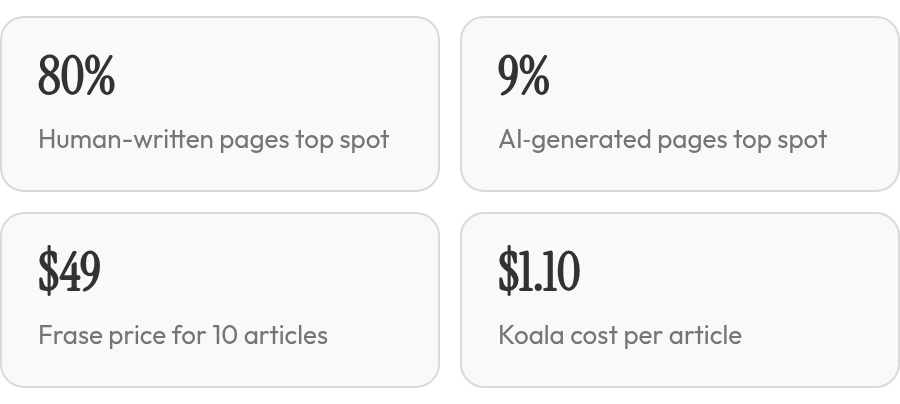
Why do human-written pages still outrank AI content if these tools claim to optimize for search?
The reviewed evidence does not support a universal ranking advantage for either human-written or AI-assisted content. Optimization features, SERP research, and approval controls can support an editorial workflow, but they do not guarantee rankings. Evaluate content quality, factual review, search intent, and publication consistency rather than relying on an unsupported category-wide percentage.
Can I actually turn one blog post into social carousels and newsletters with any of these tools?
No tool in the eight-tool comparison documents a complete conversion workflow from blog posts to carousels, video scripts, and newsletter sections with distribution tracking. TheStacc’s separately documented social capability schedules finished posts to Instagram, Facebook, LinkedIn, and X. That is distribution of existing content, not proof that one asset can be repurposed into multiple formats.
What's the real cost difference between a low-cost tool and a higher-tier platform when editing time is included?
A lower subscription does not establish a lower total cost, especially when review workflows and publishing responsibilities are unclear. Estimate the time required for editing, factual checks, formatting, internal links, approvals, and CMS work using your own articles. Higher-tier platforms with research, review, and publishing features may reduce some handoffs, but that benefit should be validated in a trial rather than assumed.