
AI Backlink Building Automation in 2025: A Safe Workflow With APIs, Bots, and Human Review

Key Takeaways
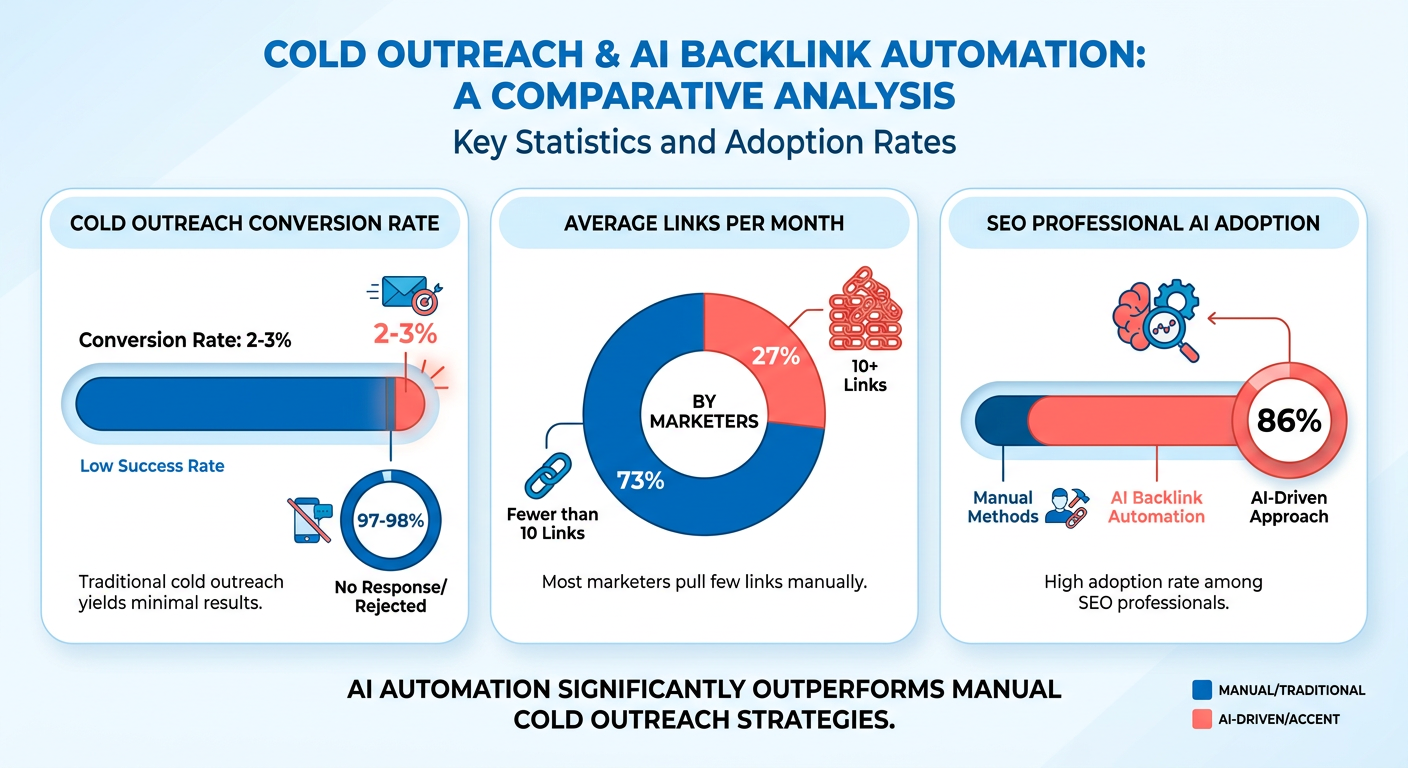
- Cold outreach converts at just 2-3% on average, forcing teams to send hundreds of emails to earn only a handful of links.
- Roughly 73% of marketers earn fewer than 10 backlinks a month through traditional manual outreach methods.
- By 2024, 86% of SEO professionals had already folded AI into their link-building and broader search strategies.
- Backlink indexes tracking 35 trillion and 43 trillion external links prove no human team can handle discovery manually.
- AI's strongest link-building value comes from producing brand-consistent content that attracts links, not from automating more outreach emails.
- APIs and bots excel at volume tasks like list-building, email discovery, follow-up scheduling, and broken-link monitoring.
- Automation cannot replace human judgment on page quality, which ultimately decides whether a placement gets approved.
Why AI Backlink Building Automation Matters in 2025
Manual link building stopped scaling for growth teams long ago. When nearly half of search engine optimization specialists rank link acquisition as the single most challenging aspect of digital growth, traditional outreach models clearly fail to meet modern demand. Relying on manual message drafting and target research creates an operational bottleneck that slows campaign execution.
Modern AI backlink building automation shifts the focus from mass outbound messaging to passive attraction. Instead of deploying software solely to blast cold pitch emails, sophisticated teams use language models to produce authoritative, research-backed assets. By generating content aligned with brand voice and topical demand, teams reduce outbound friction and create resources that naturally attract external citations.
Why Has Manual Link Building Stopped Working?
Manual link building fails at scale because the effort is linear and the returns are thin. Every target site requires individual site audits, customized messaging, and editorial sign-off. Scaling this process manually demands linear headcount growth, which creates diminishing returns as outreach volume increases.
The core challenge stems from the sheer scale of the web. Modern link databases monitor tens of trillions of URLs across millions of domains, a data volume impossible for human analysts to process manually. Algorithmic processing and API connectors excel at managing this data layer: compiling prospect lists, retrieving contact information, orchestrating follow-up schedules, and detecting dead links across target domains.
However, mechanical efficiency cannot solve editorial evaluation. Automated scripts cannot judge whether a published asset provides genuine value to a target site's audience. Relying on software to multiply outbound email volume without improving asset quality simply accelerates target exhaustion and lowers response rates.
What Do Algorithm Changes Mean for Link Strategy?
Google has shifted link value from quantity to earned authority, which rewards content that attracts links naturally. Search algorithms increasingly prioritize site authority, semantic depth, and reader engagement over raw link totals.
While external links remain an integral ranking signal, their relative impact functions alongside user experience metrics and topical comprehensiveness. In competitive search verticals, top-ranking URLs consistently exhibit robust referring domain profiles, reflecting the compounding visibility that high-ranking assets enjoy.
This dynamic reinforces the rationale for a content-driven pipeline. Search engines evaluate content based on utility, accuracy, and user alignment rather than the specific method of generation. Consequently, high-quality, AI-assisted content that delivers genuine subject-matter expertise complies fully with modern search quality standards.
Where Should AI Actually Work in the Pipeline?
Point AI at the attraction stage, not the acquisition stage. The highest return on investment comes from deploying machine learning models to synthesize comprehensive, link-worthy resources. Reframing automation around asset creation transforms link building from outbound cold pitching into inbound reference generation.
Operational boundaries must remain clear. Data mining, target filtering, and draft synthesis operate safely under automated execution because those tasks are data-intensive and reversible. Conversely, final pitch review and live placement approvals require explicit human sign-off to maintain brand integrity and prevent automated penalties.
The Four‑Stage AI‑Driven Backlink Pipeline
Most automated link-building architectures fail by misallocating technology across the acquisition funnel. Organizations frequently invest in aggressive outbound sequences, treating link growth as a throughput exercise while web editors evaluate incoming requests through strict quality thresholds. A structured four-stage pipeline corrects this imbalance by relocating machine intelligence upstream into asset synthesis and target validation, ensuring outreach is backed by content worth referencing.
Stage One: Content Production and Topic Discovery
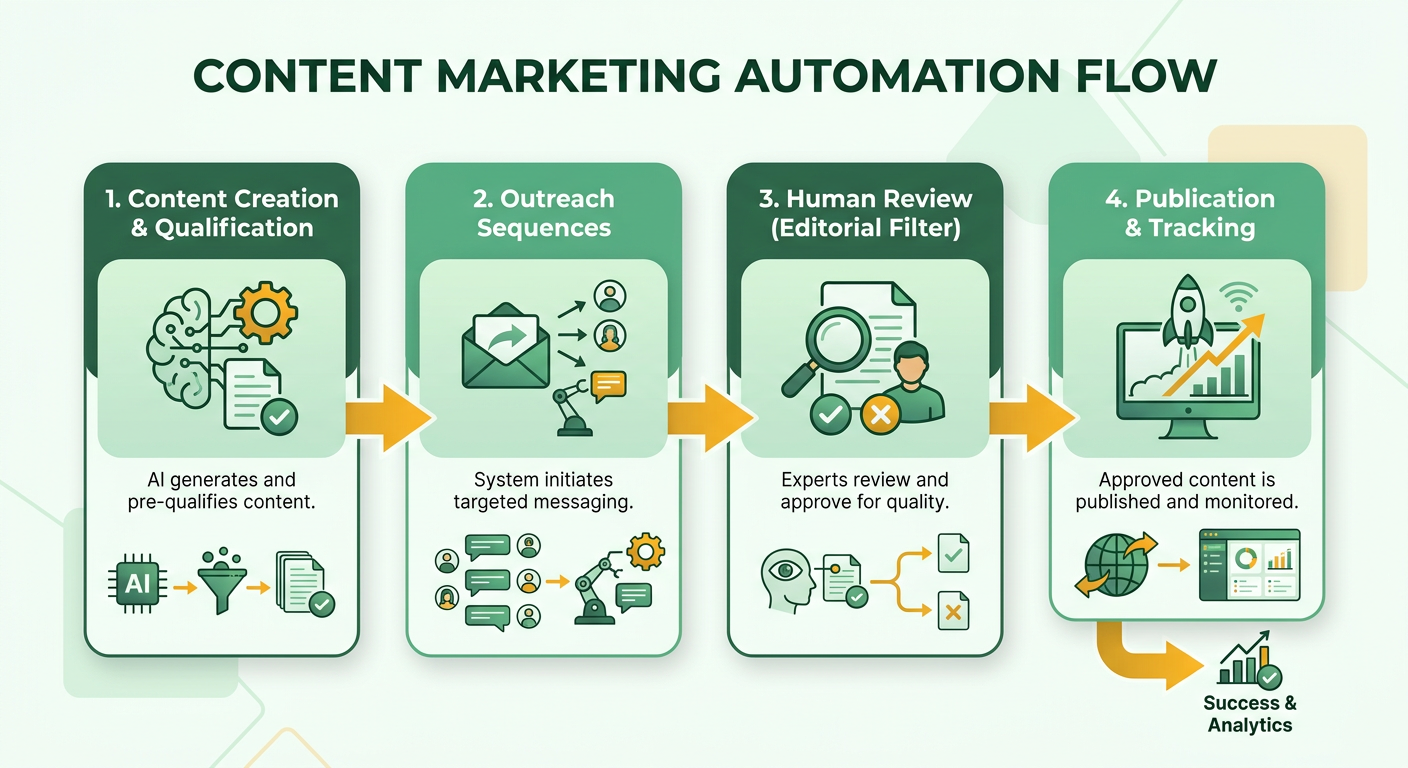
High-performing backlink pipelines begin with content architecture because outreach cannot overcome weak underlying material. Natural language processing models and competitive content gap analyses identify structural knowledge deficits across target niches. Topic research can shorten research cycles before outreach, and using that data-driven approach for topic selection helps content address established market demand.
Drafting workflows combine large language models with strict style guidelines and verified data sources. Rather than substituting for editorial teams, machine intelligence accelerates the synthesis of data-dense, citation-ready articles. Building comprehensive reference assets encourages organic link generation while keeping production timelines efficient.
Stage Two: Prospect Discovery and Qualification
Algorithmic filtering isolates high-value link targets without exposing domains to spam penalties. Data integration layers leverage web crawlers to evaluate prospective domains based on organic traffic growth, domain trust scores, and historical publishing frequency. Integrating enrichment tools such as Clearbit allows teams to filter targets by industry classification, corporate scale, and editorial focus, removing irrelevant domains before contact lists are generated.
Automated scoring models evaluate target prospects against custom link-quality parameters. Software algorithms handle multi-point data collection—evaluating outbound link counts, domain health, and page relevance—to present an optimized list for editorial review.
Stage Three: Personalized Outreach with Human Review
Modern personalization goes far beyond standard contact tokens. Large language models generate tailored outreach copy by analyzing a recipient's recently published articles, identifying content gaps, and framing proposed assets as contextual solutions. CRM and outreach software integrations automatically inject domain metadata and publishing history into pitch drafts without manual copy-pasting.
Execution workflows must enforce a mandatory approval step between message drafting and dispatch. Fully automated distribution risks sending poorly matched pitches or inaccurate statements, damaging domain reputation. Staging personalized communications in an approval queue allows human reviewers to verify brand alignment and relevance prior to transmission.
Stage Four: Link Health Monitoring and Iteration
Post-placement monitoring safeguards acquired link equity over time. Automated tracking systems query backlink profiles continuously to detect HTTP 404 errors, page de-indexing, rel=nofollow additions, or anchor-text modifications. System alerts notify managers immediately when referring URLs experience status shifts, enabling rapid outreach for link restoration.
Performance analytics create continuous feedback loops across earlier pipeline stages. Analyzing which publication formats attract higher placement rates allows language models to refine future topic modeling and prompt construction. Systematic data collection ensures subsequent outreach cycles benefit from empirical performance metrics.
API Integration & Data Orchestration

Connecting content generators, SEO analytics platforms, and outreach software requires robust middleware architecture. A common failure point occurs during data exchange between backlink discovery tools and customer relationship management platforms. Seamless automation relies on robust API orchestration that normalizes incoming metadata before queuing actions for team validation.
The operational core of link automation resides within system handoffs. Pipelines must transform prospect metadata across disparate schemas, manage query volumes against external indexing engines, and route system events through webhook listener endpoints. Proper data-layer engineering prevents sync failures and maintains queue integrity across complex campaign workflows.
Which APIs Power the Discovery and Qualification Stages?
Data discovery relies on RESTful endpoints provided by major SEO intelligence suites. These APIs programmatically extract competitor backlink profiles, domain authority metrics, and topical category tags, enabling real-time evaluation of potential publishing partners.
Prospecting services automatically categorize targets according to organic traffic metrics, publishing cadence, and editorial themes. Modern integration platforms offer pre-configured app connectors, streamlining data flow between SEO databases, email engines, and content management systems without requiring bespoke software development.
System architectures must isolate API functionality strictly to data enrichment and pipeline ingestion. Endpoints gather prospect information, append domain metrics, and calculate suitability scores, while final transmission actions remain blocked until cleared by an authorized reviewer.
How Do You Normalize Data Between Different SEO Tools?
Every SEO data provider uses proprietary metric definitions. One service measures domain authority on a 0–100 log scale, while another evaluates link profiles through separate trust flow and citation flow values. Integrating these disparate inputs requires an intermediate translation layer to standardize values before executing scoring logic.
Establishing a unified schema ensures consistent data processing across all pipeline integrations. Standardized payload fields—such as standardized domain rating, target URL, content classification, and contact history—allow systems to process prospects uniformly regardless of the underlying data supplier.
Authentication protocols must align with application architecture. OAuth 2.0 provides secure user-delegated authorization, enabling automatic token renewal without persisting raw credentials. Direct server-to-server data calls utilize encrypted API keys managed via secure secrets management services to prevent credential exposure and unauthorized quota consumption.
What Does Real-Time Sync Look Like in a Backlink Workflow?
Event-driven webhooks enable real-time synchronization across pipeline tools. Rather than executing periodic polling scripts to check for prospect updates or index changes, external systems immediately dispatch HTTP POST payloads to dedicated application endpoints when target events occur.
For example, when a target industry publication posts a new article touching on relevant research, an incoming webhook can immediately trigger the generation of a contextual response draft for reviewer evaluation.
Managing API rate limits requires deliberate traffic shaping. When executing parallel queries across metrics endpoints, systems implement request batching, temporary caching of static domain metrics, and exponential backoff algorithms upon encountering HTTP 429 status codes. These safeguards preserve system throughput while respecting third-party platform rate limits.
Human Review & Quality Assurance (Human‑in‑the‑Loop)
Automated systems efficiently process data mining, prospect scoring, and initial copy drafting. However, determining whether an outreach pitch resonates with a publication's editorial vision requires nuanced human evaluation. Human oversight must be strategically positioned at the acquisition stage to safeguard brand integrity.
This division of labor preserves operational security. Data extraction, domain verification, and initial draft generation are data-intensive and easily revised, making them ideal candidates for programmatic execution. Pitch distribution and live link placement directly affect domain reputation and compliance, demanding explicit human approval.
Why Can't AI Own the Whole Funnel?
Complete automation fails across the complete funnel because algorithms lack contextual judgment. While software platforms effectively handle target discovery, domain qualification, initial outreach drafting, and link health monitoring, securing live placements hinges on subjective editorial criteria.
A reliable heuristic for evaluating automation safety is simple: if an editor would have accepted a manually crafted request, automation merely accelerated delivery. If the asset fails editorial standards, automated outreach simply scales rejection rates.
What Should the Reviewer Actually Check?
An effective review gate evaluates three specific parameters before approving communications:
- Content fit: Verifying that the proposed asset aligns contextually with the recipient website's existing content strategy.
- Tone consistency: Confirming that messaging maintains brand standards and authoritative framing without sounding robotic.
- Placement legitimacy: Ensuring the target domain represents a legitimate, high-quality site rather than a spam link farm.
In-context editing tools streamline this approval workflow. Allowing reviewers to leave annotations directly within draft documents reduces friction and maintains clear audit trails for content adjustments.
How Much Time Does Human-Augmented Review Save?
Augmenting human reviewers with automated preparation significantly reduces overall cycle times. By delegating data extraction, domain scoring, and pitch drafting to background workflows, editorial personnel focus exclusively on high-value verification.
Time savings come from rapid asset and pitch synthesis, not automated message distribution. Establishing clear governance rules—such as explicit approval thresholds and designated escalation contacts for ambiguous targets—ensures high execution speed without sacrificing quality control.
Safety & Compliance Framework
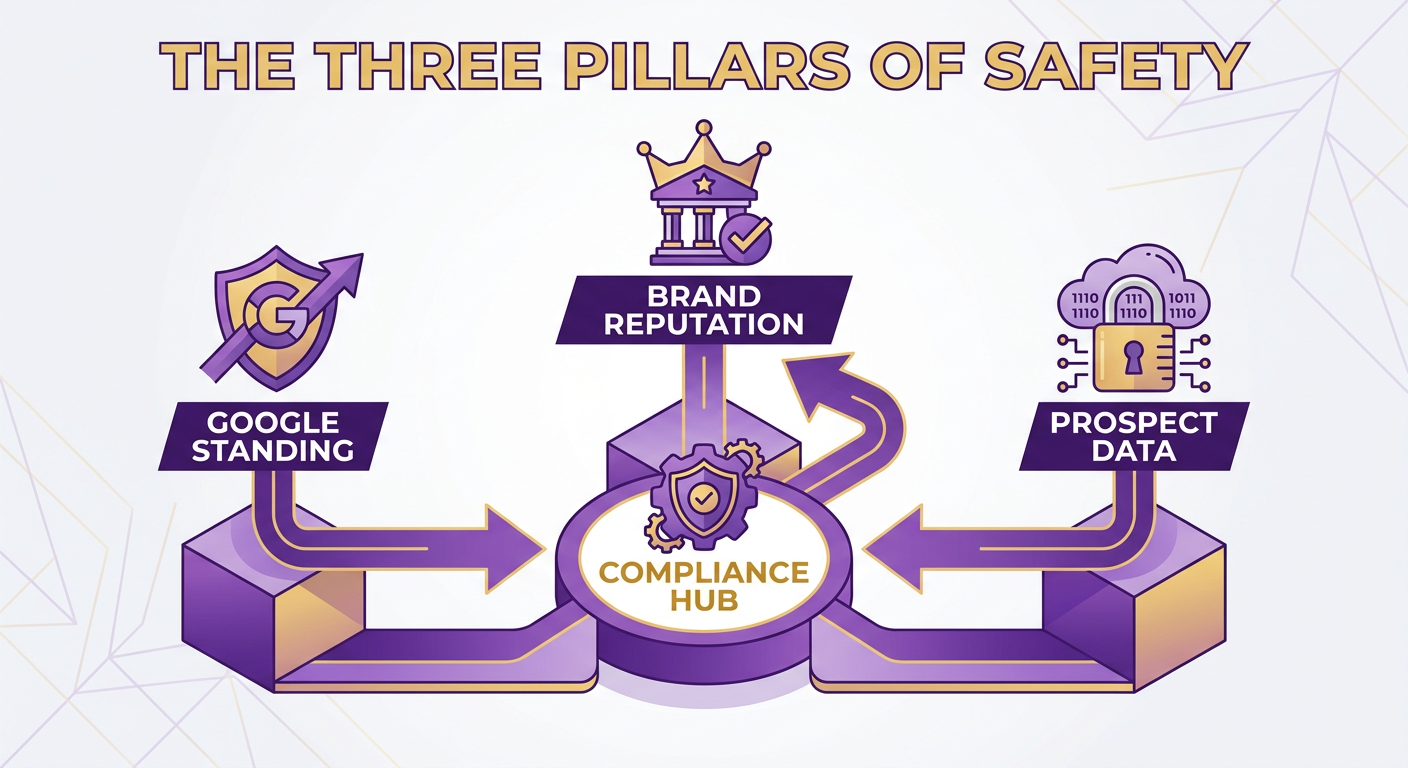
A compliant automation architecture protects domain authority, brand reputation, and recipient data privacy simultaneously. Risk management focuses on content intent and user value rather than software usage.
Search engine guidance explicitly focuses on utility. Google Search Advocate John Mueller stated: "Our systems don't care if content is created by AI or humans. We care if it's helpful, accurate, and created to serve users rather than just manipulate search rankings." Compliance frameworks must therefore prioritize depth and user intent over deceptive optimization tactics.
What Does Google Actually Penalize?
Search penalties target artificial ranking manipulation rather than automated tooling. Systemic web spam, artificial link networks, and low-utility content trigger algorithmic downgrades regardless of whether they are generated manually or programmatically.
Algorithmic weight distribution highlights this evolution. Backlinks remain one factor among many, but low-quality link schemes still carry disproportionate risk relative to potential ranking benefits.
Which Spam Signals Should Your Pipeline Flag?
Automated filtering mechanisms must automatically screen candidate sites for common spam indicators prior to outreach:
- Anchor text distribution: Monitoring exact-match keyword anchor ratios to prevent artificial optimization footprints.
- Domain quality thresholds: Filtering target sites exhibiting low editorial standards, excessive outbound monetization, or thin content profiles.
- Referring-domain diversity: Prioritizing broad domain acquisition over multiple links from a single domain family.
How Do You Monitor Broken Links and De-Indexing?
Automated link auditing systems track existing placements to prevent link equity decay. Daily web crawling verifies HTTP response headers, meta robots directives, and rel attributes on pages holding active backlinks.
Integrating health alerts into management dashboards enables immediate remediation when placements break or lose indexing status, ensuring outreach teams can promptly request link updates or replacements.
Staying Compliant With GDPR and CAN-SPAM
Data enrichment and outreach workflows must comply strictly with privacy legislation, including GDPR and CAN-SPAM requirements. Automated data collection engines must store contact data under legitimate interest frameworks, maintain opt-out records, and include functional removal mechanisms in all outbound communications.
Combining automated data enrichment with mandatory human transmission review ensures regulatory compliance and prevents unsolicited outreach to opt-out registries.
Implementation Roadmap & Measuring Success
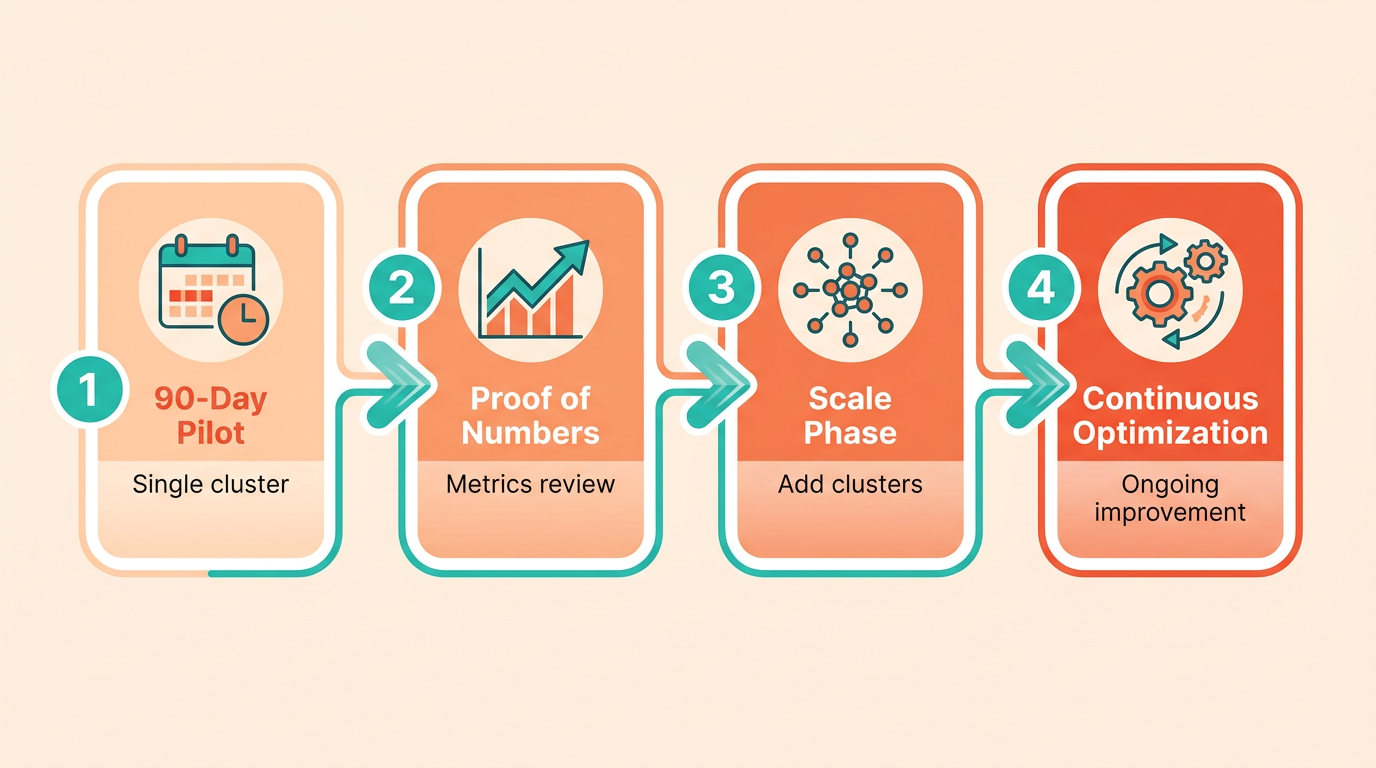
Deploying an automated link-building framework requires a phased pilot program rather than an immediate full-scale rollout. Initiating a 90-day trial centered on a single content cluster enables organizations to establish operational baselines and refine human review protocols before scaling.
Proper execution order dictates that asset optimization precedes outbound outreach. Concentrating initial automation efforts on constructing high-utility reference assets allows teams to evaluate organic citation performance prior to expanding outreach operations.
What Does a Realistic Rollout Timeline Look Like?
Implementation progresses across three structured phases over twelve weeks:
- Phase 1 (Weeks 1–4): Pilot. Select a single content cluster. Programmatic systems execute target discovery, domain scoring, and pitch drafting, while human reviewers oversee final sends. Publish three to five core research assets.
- Phase 2 (Weeks 5–8): Validate. Evaluate referring domain acquisition across the pilot cluster. Track organic citation rates to confirm content resonance before committing additional budget.
- Phase 3 (Weeks 9–12): Scale. Expand API integrations and extend automated workflows across secondary content clusters once conversion rates meet target thresholds.
Which KPIs Actually Prove ROI?
Performance evaluation rests on four core metrics: organic traffic growth, referring-domain acquisition rate, outreach conversion percentage, and net cost per acquired link.
Analytics platforms should map organic lead attribution directly to acquired backlinks. With 93.05% of global web traffic originating from Google search, connecting referring domain growth to downstream conversion tracking clarifies which content topics warrant continued investment.
How Do You Run the Post-Implementation Review?!
End-of-phase reviews evaluate campaign performance across risk mitigation, key performance indicator targets, and procedural refinement. Teams analyze placement records to ensure compliance, verify conversion metrics against baseline goals, and compare passive link attraction rates against outbound outreach costs.
Content assets that successfully generate passive backlinks serve as structural templates for future production. Conversely, assets requiring extensive outreach effort indicate content alignment gaps rather than delivery failures, guiding future prompt engineering and topic selection.
Frequently Asked Questions
1. Can I fully automate link placement if I only target high-authority sites?
No. High-authority publications enforce stringent editorial standards, making manual oversight even more critical. While automated scripts can evaluate domain metrics, a human reviewer must evaluate the relevance of the pitch and secure explicit editorial consent prior to link placement.
2. If backlinks are only 13% of algorithm weight, are they still worth pursuing?
Yes, because backlinks continue to act as key tie-breakers in competitive keyword spaces. Rather than pursuing mass link velocity, modern strategies focus on creating high-utility reference content that secures authoritative citations without risking search engine penalties.
3. Does Google penalize content just because AI wrote it?
Search engines evaluate content utility and user satisfaction rather than the creation mechanism. AI-generated assets that deliver thorough analysis and verified factual accuracy meet webmaster guidelines, whereas low-quality or manipulative text faces penalties regardless of how it was produced.
4. What happens when two backlink APIs report authority differently?
Workflow engines handle metrics discrepancies by passing raw API responses through a normalization layer. Converting distinct vendor metrics into a standardized internal scoring scale prevents workflow disruption and maintains consistent domain filtering logic across multi-provider setups.
5. How do I avoid getting my API key suspended during heavy prospect research?
Prevent API throttling by implementing middleware rate-limiting controls. Staggering batch queries, storing frequently requested domain data locally, and configuring automatic retry delays during peak usage preserve service quotas and maintain uninterrupted data flows.
6. What specific things should a human reviewer verify before a link goes live?
Reviewers must verify that the target page offers genuine topical alignment, that the outreach messaging adheres to brand communications standards, and that the receiving domain maintains legitimate organic traffic and transparent editorial ownership.
7. How should I roll out this automation without risking my existing rankings?
Begin by scoping a limited test campaign focused on one specific topic area. Validating asset performance and refining human review processes in an isolated environment prevents operational mistakes from impacting your core domain architecture before broader deployment.