AI Blog Writer Posts: Track Search Console Rankings and ChatGPT Mentions Together

Key Takeaways
- Search rankings and AI mentions measure different kinds of visibility, so tracking only one can leave gaps in your reporting.
- A recurring set of buyer prompts, checked manually and logged consistently, provides a low-cost baseline before you consider paid monitoring.
- Citation sets can differ across AI products and search features. A page that performs well in one channel may receive little or no visibility in another.
Related Video
Watch: How to Dominate AI Search Results in 2026 (ChatGPT, AI Overviews & More) by Surfer Academy
Why tracking rankings and ChatGPT mentions together matters
Google rankings tell you where your pages land. They do not tell you whether ChatGPT, Perplexity, or Google's AI features mention your brand when someone asks a buying question. Content optimized for traditional search can rank well while receiving little visibility in AI answers, where conventional position numbers do not apply.
AI Overviews add another surface on which your brand or content may appear. Citation sets can also differ between AI products and search features: they may draw on different pages, mention different brands, or answer the same prompt in different ways. Tracking one channel without the other can therefore leave part of the buyer journey unexamined.
AI mentions may drive higher intent
AI-referred traffic may convert differently from traditional organic search. One possible explanation is self-selection: visitors may already have read an answer summary before deciding to click. Someone who reaches your pricing page from an AI citation could be further along in their research than someone still exploring broad search results.
That is a hypothesis to test, not a universal conversion rule. Compare engagement and conversion rates in your own analytics, and check attribution before drawing conclusions from a small number of sessions.
The workflow: publish, track, compare
Tracking both channels means monitoring where your content ranks in Search Console and separately checking whether AI engines mention your brand when users ask buying questions. The options include manual spot-checks, paid monitoring tools, and custom checks built on an API. Whichever option you choose, use consistent prompts, dates, and logging fields so results can be compared over time.
Tracking ChatGPT mentions in your published content
Tracking whether AI engines mention your brand or cite your content means running buyer prompts through ChatGPT, Perplexity, and similar platforms, then logging what comes back. The options break into three tiers: manual spot-checks, paid monitoring tools designed for AI visibility tracking, and custom API-based checks you build on platforms such as the Perplexity Sonar API.
Manual spot-checks: the free baseline
Use a consistent prompt set that mirrors how buyers ask questions. Mix category prompts such as "best tools for SaaS content teams," problem prompts such as "how do I scale blog output without hiring writers," and comparison prompts that include named competitors. Where practical, use a clean session so earlier conversation context does not shape the answer.
For each answer, log the date, engine, prompt text, and three separate fields:
- Mentioned: your brand name appears.
- Cited: your URL is linked or identified as a source.
- Recommended: the engine suggests your product or content when asked what to use.
Add a sentiment note if the mention reads positive, neutral, or critical, and retain the response text or a screenshot when your workflow permits it. Answers can vary between runs, so repeating important prompts can help distinguish a recurring pattern from a one-off result. Run the audit on a regular cadence and keep the prompt set stable enough to support comparisons.
Paid tools: Otterly, Profound, TrueRanker, and Peec AI
Paid tools can be evaluated for recurring checks, historical reporting, and competitive share-of-voice. Depending on the product and plan, platforms such as TrueRanker, Peec AI, Otterly, and Profound may be configured to monitor selected prompts, engines, brands, or competitors.
Engine coverage, response retention, competitor reporting, and audit features vary. Confirm those details in each provider's current documentation rather than assuming that a mention, citation, and recommendation are treated as the same event. Pricing also varies by provider and coverage.
Consider a paid tool after the manual habit is established and you know which prompts and competitors matter. A dashboard alone does not tell you which content changes to make.
Custom API checks: building your own monitor
If you write code or work with a developer, you can build your own checker on the Perplexity Sonar API or a similar platform. Log the same fields used in the manual audit—date, engine, prompt, source URL, mention versus citation versus recommendation, and sentiment when available—and store the results in a database or spreadsheet.
Check the provider's current pricing, usage limits, and response behavior before relying on this approach. An API-based workflow can make scheduling and storage easier, but it still needs a consistent prompt set and a process for reviewing the underlying answers.
Pairing ChatGPT checks with Search Console exports
Track AI mentions and Google rankings together by exporting Search Console performance data to CSV. Pull clicks, impressions, CTR, and average position for the same date range you ran your AI checks, then merge the two datasets on URL slug or an internal content-group tag. Use consistent, human-readable URL slugs and add a content-group field in your CMS so exported rows match reliably across both sources.
When you open the merged file, you can see which posts rank well in Google but have no logged AI citations, and which posts appear in AI answers despite modest Google positions. That gap is an input to your content roadmap, not proof of a particular cause.
A post that ranks well but is absent from your prompt audit may be a candidate for clearer problem-solution framing, stronger supporting evidence, or additional distribution. A post cited in AI answers but performing poorly in search may warrant a technical and on-page review. Check indexing, links, content quality, and the accuracy of your mention log before choosing a fix.
Merging rank and mention data into a real-time dashboard
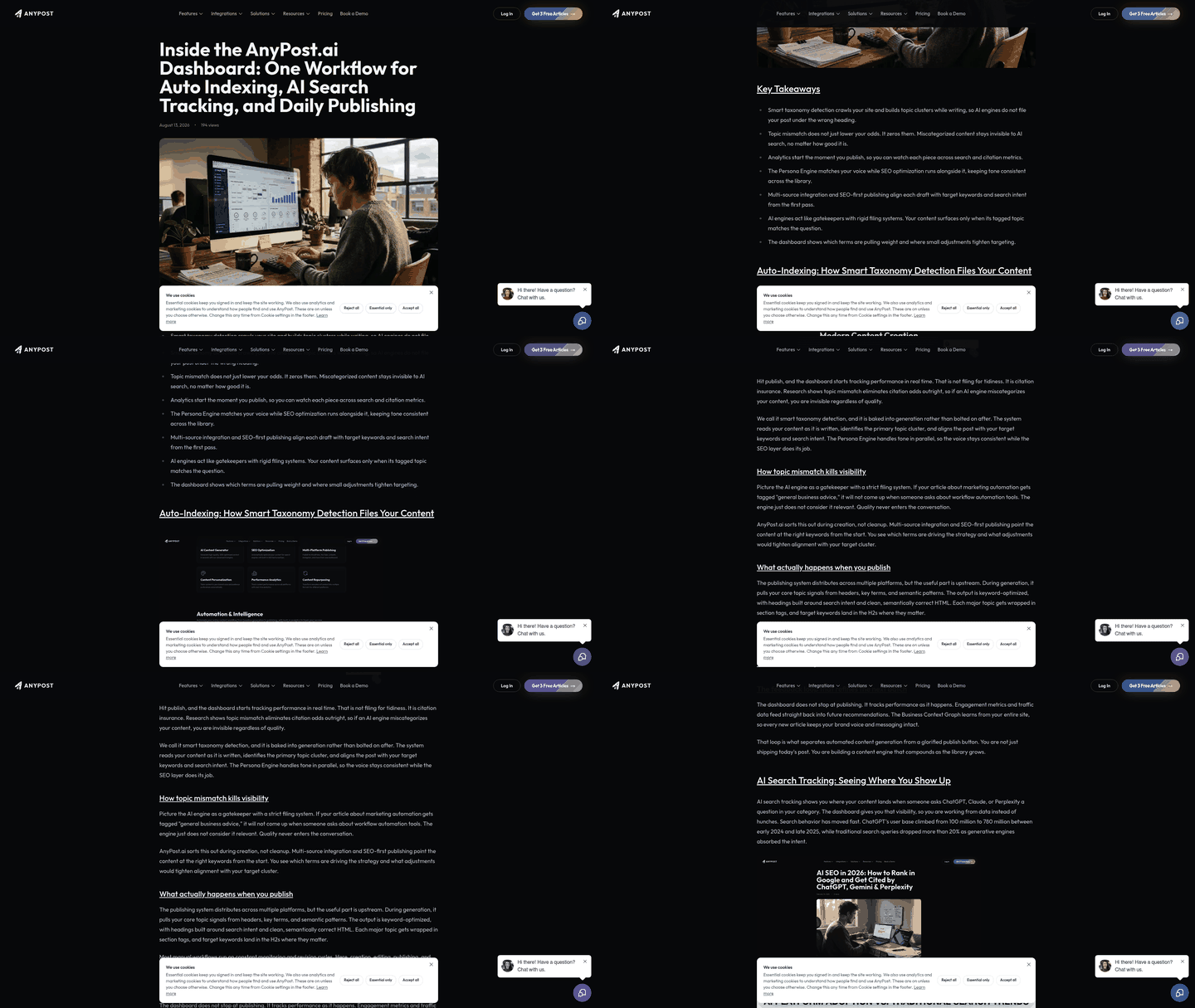
Once you've logged your Search Console rankings and AI mention checks, pull both into a single view that can be refreshed without rebuilding the whole sheet. Google Sheets paired with a simple time-series chart is one option. The goal is to spot ranking changes and mention changes quickly, then inspect the underlying rows before acting.
Getting data into the sheet without manual uploads
For Search Console exports, a spreadsheet can be configured to import a CSV hosted at a stable URL where your setup supports it. Refresh behavior and access requirements vary, so verify them against the current product documentation. If your CSVs live in Google Drive or you need more control over the import, an Apps Script workflow can be configured to fetch the file, replace the old range, and write the new rows on a schedule.
When automation isn't an option—your rank tracker only exports to your desktop, or you're logging mentions in a local file—fall back to manual CSV uploads. Keep the column structure, URL format, date ranges, and content-group labels identical across uploads so your charts and joins do not break.
Charts that show position and mentions on one timeline
Build a dual-axis time-series chart with date on the X axis, average ranking position on the left Y axis, and mention count on the right Y axis. Reverse the left axis so lower position numbers—better rankings—plot higher on the chart. That way upward movement in both lines signals improvement. Add a URL-level table below the chart so you can drill into which posts drove a spike or which pages lost visibility during a dip.
You can flag anomalies with conditional formatting, but choose thresholds that fit your own baseline. For example, you might test a rule that highlights a large week-over-week mention change or a ranking decline of several positions. Treat the highlight as a prompt to investigate, not as an automatic refresh instruction.
Annotate known tracking or attribution changes in the sheet. Otherwise, a measurement gap can look like a real loss of traffic or visibility.
You can also create an exploratory "mentions per ranking position" metric by dividing mention count by average position for each post. It is not an established industry KPI, and it should not be interpreted as a performance score without context. It can simply help surface posts that receive mentions despite relatively modest rankings, making them candidates for closer review.
Worked example: merged rows and the refresh decision
The following is a clearly labeled hypothetical dataset, included to demonstrate the sheet structure and decision process. It is not customer data or evidence of typical performance.
| Content group | URL slug | Week | Average position | Logged mentions | Content version |
|---|---|---|---|---|---|
| AI writing | /ai-blog-writer/ | Week 1 | 6 | 1 | original |
| AI writing | /ai-blog-writer/ | Week 2 | 11 | 0 | original |
| Prompt workflows | /prompt-templates/ | Week 1 | 15 | 2 | original |
| Prompt workflows | /prompt-templates/ | Week 2 | 14 | 3 | refresh_v2 |
| Content operations | /content-workflow/ | Week 1 | 4 | 0 | original |
| Content operations | /content-workflow/ | Week 2 | 4 | 0 | original |
The merged rows support three different editorial responses:
/ai-blog-writer/: Average position worsens and the logged mention disappears. First verify that both exports cover the same pages, prompts, and date range. If the change persists, review the page for outdated material, unclear structure, and search or technical issues. Record any refresh as a new content version rather than assuming one metric caused the other./prompt-templates/: Mentions increase after the logged refresh while average position remains broadly similar. Keep monitoring and compare the underlying answers. The version tag helps you investigate the sequence, but it does not establish that the refresh caused the mention change./content-workflow/: Search position is stable, but no mentions appear in the audited answers. Review whether the prompt set is relevant and whether the page clearly addresses the problem being asked about. If it does, a focused experiment with answer-aligned headings, examples, or supporting context may be more appropriate than a full rewrite.
This is the editorial value of the combined view: it separates "investigate a decline," "monitor an early signal," and "test a visibility gap" instead of sending every row into the same refresh queue.
Automating the weekly workflow with AnyPost.ai
The part most teams underestimate isn't writing the content. It's the repeatable check that tells you whether the post you just published is gaining visibility in traditional search, AI answers, both, or neither. Without a fixed routine, tracking becomes an occasional fire drill instead of a low-friction habit.
What a weekly publishing routine actually looks like
We treat publishing as the handoff point, not the finish line. Once a post goes live, the clock starts on two separate checks: a Search Console export to capture where the page lands in organic results, and a prompt audit to see whether ChatGPT or Perplexity mention the topic when buyers ask about it.
For Search Console, use a recurring export where your setup supports one rather than manually downloading CSV files every week. The Search Console API can be used to request performance data for specific pages. A scheduled process can be configured to write those results into a sheet, provided authentication, date ranges, page matching, and indexing delays are handled consistently.
For AI mentions, use the consolidated manual audit described above when you are tracking a small prompt list and do not need another subscription. Paid monitoring may be useful when recurring logging and competitive reporting justify the cost; pricing and coverage depend on the provider and plan. A custom API checker offers another route if you are comfortable maintaining scripts and reviewing provider costs and response formats.
Whichever method you pick, the cadence matters more than the tool. Sporadic checks are difficult to compare. A consistent time series can show when a ranking drop coincides with reduced AI visibility, or when a post that ranks well still earns no logged mentions. That is the signal to investigate which pages need a refresh and which need a different angle.
Optimizing prompts and content strategy using combined insights
Once you've built a dashboard that shows ranking and mention changes, the next step is deciding what to do with the signal. A ranking drop on a post about AI blog writers does not by itself tell you whether the content needs a data refresh, a structural rewrite, or a different angle. Combined tracking provides diagnostic cues, not a definitive diagnosis.
Mention patterns and sentiment can serve as inputs for clarifying copy, adding missing context, or revising tone. These are recommended experiments rather than documented case studies. Visibility in AI answers and traditional search may move together, but changing one does not guarantee movement in the other. Correlation between the channels does not prove causation.
Tagging dashboard rows to trace results back to changes
Tag each dashboard row with prompt version, publication or revision date, and content version so later results can be compared with the corresponding draft. When you refresh a post about AI blog writing tools and add a new section on prompt engineering, label that version in your sheet. If mention patterns change afterward, the tag tells you which revision to inspect. It does not prove that the revision caused the change.
A simple three-column append is enough: prompt_version, content_version, and revision_date. When you export Search Console rankings and run your mention audit, paste those tags into the same row. The result is a time series that connects editorial decisions to subsequent visibility observations while preserving the limits of the evidence.
General prompt-engineering guidance for SEO-focused drafts
If you're using an AI blog writer workflow to generate initial drafts, specify the audience, search intent, desired structure, factual constraints, internal terminology, and revision goal in your prompt. A prompt that says "write a blog post about AI content tools" leaves most editorial decisions open. A prompt that says "write a 1,200-word comparison post for SaaS marketing teams choosing between AI blog writers, targeting the keyword 'AI blog writer,' using a problem-solution-recommendation structure, with a neutral tone and no promotional language" provides clearer drafting constraints. It still requires factual review and editing.

Use evidence for content and GEO iteration rather than relying solely on prompt-tweak traffic claims. Ranking changes may reflect compound updates—fresher material, tighter structure, and answer-aligned phrasing applied together—rather than an isolated edit. Test one variable at a time when practical, and use version tags to distinguish what changed when a refresh includes several edits.
FAQ
1. How often should I run manual ChatGPT mention checks if I'm not using a paid tool?
Choose a recurring cadence you can maintain, and keep the buyer prompt set and logging fields consistent. Monthly checks may be sufficient for a small prompt list, while a faster-changing campaign may justify more frequent reviews. Look for repeated patterns across several audits rather than acting on one answer.
2. Why does AI traffic convert better than traditional organic search traffic?
It may not always do so. One possible explanation for stronger intent among some AI-referred visitors is self-selection: they have already read an answer and chose to visit anyway. That could place them further along in their research than someone still exploring broad organic results. Verify the pattern in your own analytics rather than treating it as a universal benchmark.
3. What does low overlap between AI Mode and AI Overviews citations actually mean for my content strategy?
If your own checks show different citation sets, treat the surfaces as separate visibility channels rather than assuming that success in one carries into the other. You can rank well in traditional search and still receive few logged AI mentions. Compare the sources and answers directly, then test content changes without assuming that one edit will improve every surface.
4. Should I reverse the ranking axis on my dashboard chart, and why does that matter?
Reverse the left Y axis so lower position numbers plot higher on the chart. That way upward movement in both ranking and mention lines signals improvement at a glance. Without reversing, a drop from position 3 to position 12 looks like growth on the chart, which breaks your ability to spot problems quickly.
