
AI Content Creation Guide: Match Each Draft to Its Channel Before Publishing

Why the same draft flops on one channel and wins on another
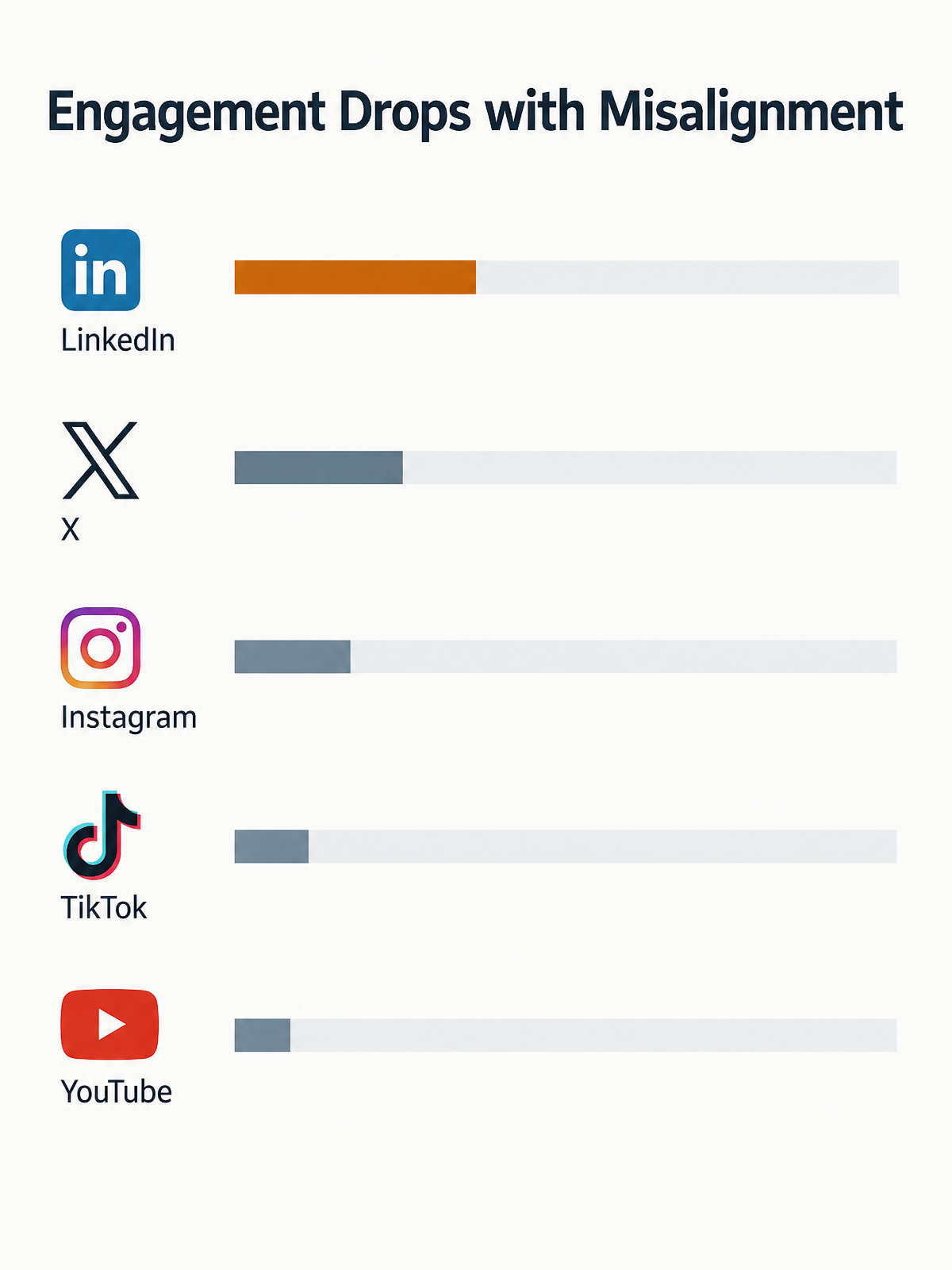
The same idea performs completely differently depending on where it lands. We've watched teams pour hours into AI content generation, then flatten every draft into one generic post and push it everywhere at once. Engagement stalls. They blame the content. The real culprit is channel misalignment.
Anecdotally, performance can shift substantially depending on where and how a piece appears. Some social media researchers argue that platform and format both shape engagement, so you can't predict how a piece of AI-generated content will do until you know which channel it was built for. Channel fit isn't a finishing touch. It's the variable that decides whether engagement happens at all.
Why channel alignment beats raw volume
Reach often comes from format-native adaptation, not raw output count. Teams that systematically match content to platform conventions can reach more of their audience per hour of effort, and many B2B marketers say repurposing extends the value of existing content budgets. But the lift only shows up when each draft actually speaks the channel's language.
One camp pushes for maximum output, pointing out a single post can spin into multiple assets. Another warns against repurposing just to fill a calendar. Both are right. Treat that potential asset count as a ceiling, not a quota. Channel-first mapping is the filter that decides which formats earn a slot.
Stay broad on output formats, narrow on the channels you commit to maintaining. A long-form article, a LinkedIn carousel, a short vertical video, and an email can all pull from the same source idea. Each gets rewritten for its destination, not copy-pasted into it.
Who gets the most out of a draft-to-channel system
Teams that run lean—SMBs, SaaS marketers, and agencies—often see the biggest return. These are often the teams publishing across several channels with the same headcount that used to run one blog. Systematic repurposing can materially reduce content creation time, which can be the difference between shipping consistently and burning out.
The cost of ignoring it is quiet but real. Mismatched drafts read as tone-deaf. A blog paragraph dumped into a social feed gets scrolled past, and over time it chips at brand perception, because people notice when you're not speaking their platform's dialect.
The mistake that undoes all of it
Handing the whole job to AI and shipping the output unedited. You know your brand better than any model does, and leaning entirely on automation for voice is one of the fastest ways to sound generic. Use AI to draft and adapt at speed. Keep human judgment on tone.
One lever many teams miss is scheduling. Because earlier posts may prime attention for later ones, the order and spacing of repurposed assets become a sequencing decision you can test—not just fatigue insurance. For the full build-out, our guide to automated blog content walks through the workflow end to end.
The Short Version
Channel-first publishing means a draft isn't finished when the words are written. It's finished when the right version has been matched to the right destination. A source idea might become a blog post, newsletter, carousel, video script, or social thread, but each format should earn its place by matching audience intent, platform behavior, and production capacity. The strongest workflows use AI for research, drafting, adaptation, and routing, then keep humans on judgment, voice, fact-checking, and final approval.
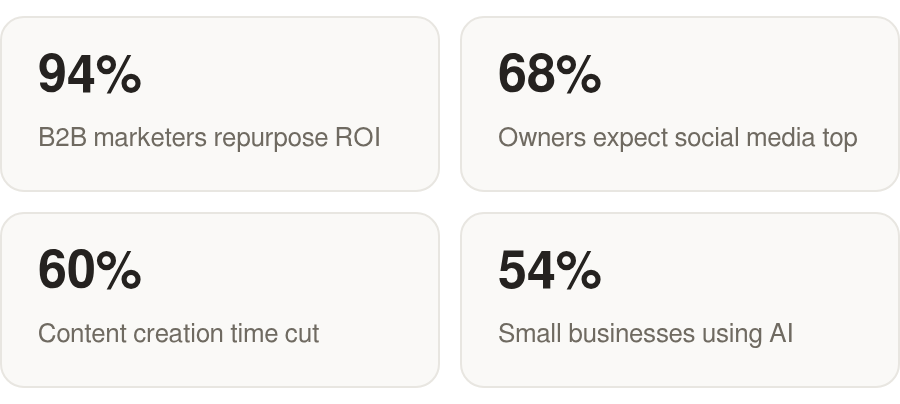
Constant Contact's Small Business Now survey found 68% of owners expect social media to be their top channel this year, with 41% citing email. That makes social and email obvious planning columns for many teams. It doesn't mean every draft belongs there. The call still comes from fit: what the audience wants in that channel, how much context the format can hold, and whether the piece can be adapted without turning into filler.
Draft Creation & Channel Mapping: Building a Channel-First Blueprint
Start with one master draft, then decide where it belongs. That order matters. Most teams do it backwards, writing straight into a platform and locking the idea to a format before they've judged which channel actually fits. A channel-first blueprint flips it. You generate the strongest version of the idea once, then score it against your channels before anything gets scheduled.
This is where AI content generation stops being a speed trick and becomes a planning system. The draft is raw material. The value comes from mapping it deliberately, and that mapping is a set of decisions you can make the same way every time.
How to build a channel-mapping matrix
Score each draft against your channels on four dimensions: audience intent, content length, visual requirements, and SEO goals. Rate every channel on each, then let the totals point to the primary home.
Example scoring matrix: For each draft, score each channel 1–5 on audience intent, content length, visual requirements, and SEO goals. Use weights that reflect your current strategy—for example, audience intent 40%, content length 20%, visual requirements 20%, and SEO goals 20%. Total the weighted score. The primary channel is the one with the highest total, not necessarily the channel you already use most.
| Channel | Audience intent (40%) | Length fit (20%) | Visual fit (20%) | SEO fit (20%) | Weighted total |
|---|---|---|---|---|---|
| Blog | 5 | 5 | 2 | 5 | 4.4 |
| 4 | 4 | 3 | 3 | 3.6 | |
| 2 | 2 | 5 | 1 | 2.3 | |
| 3 | 3 | 1 | 1 | 2.2 |
In practice, a long, search-driven explainer scores high for a blog and low for a quick social caption. A visual-first update scores the reverse. When a food bank comms lead needs one email, three social posts, and a text reminder from a single announcement, the matrix tells you which version carries the core message and which are supporting cuts.
For a lot of small businesses, social and email deserve early attention because owners keep naming both as their most valuable channels. Those columns may anchor your matrix, but the scores decide the primary channel for each specific piece, not the trend.
What actually decides the primary channel
Intent leads. Ask what the reader wants the moment they hit the content. Search intent wants depth and structure, so it maps to the blog. Passive scroll intent wants a hook and a visual, so it maps to social. Length and SEO goals follow from that intent read, and visual needs confirm whether a channel is even viable for the draft as written.
Some drafts should stay close to home. If a piece leans on nuance, citations, and structured explanation, it's better served as a strong article than a forced visual post.
Dual-publish or go deep?
The sources disagree here, and the disagreement is useful. One school says more formats mean more reach, so multiply every draft across every channel. The other holds that spreading effort too thin tends to stall momentum, and that a smaller set of deeply maintained channels finds a rhythm faster than a sprawling one.
Reconcile it this way. Broad on output formats, narrow on the channels you'll actually maintain. Dual-publishing a blog post and a LinkedIn thread works when each is genuinely rewritten for its channel. Spreading thin across channels you can't sustain is how rollouts stall in month two.
A voice-reference system, such as a persona guide or brand voice file, can be configured to keep every version sounding like you across LinkedIn, X, Instagram, TikTok, and YouTube, so the core message stays consistent as you rewrite it per channel. That's the point of mapping first. You predict fit instead of guessing at it.
AI-Powered Research & Idea Generation for Each Channel
Good channel-specific research starts before a single word gets drafted. AI content generation earns its keep here by pulling platform-specific signals into the idea stage, so the raw draft is already pointed at the right audience, keyword cluster, and format from the first sentence.
This is the step most teams skip. They prompt for a topic, get a generic draft, then try to reshape it channel by channel after the fact. Feeding channel research in upfront flips the effort curve. You do the alignment thinking once, at the source, instead of repeating the same repair work downstream.
What research AI can run per channel
AI can surface topic ideas, keyword clusters, and format suggestions scoped to a single platform instead of a blanket list. A blog idea gets a search-intent brief. An Instagram idea gets a carousel or short-video concept. Same core topic, different research output per destination.
The gap-finding logic matters most. When you do keyword research for a blog, it often exposes format holes elsewhere. You might spot an opening for a video on a topic your written content already ranks for, then pull short clips from it for social. Run it the other way too: a strong video transcript becomes a written tutorial or a takeaways post.
Point the research where your effort actually pays off. Score each channel on two axes: how much traffic or revenue it already drives, and how much of your competitors' content there goes unanswered. A channel that ranks high on both is where per-channel idea generation should run first, before you spread attention across platforms that return little.
How AI reads audience sentiment per platform
AI-driven sentiment analysis can read how an audience talks and reacts on a specific platform, then feed that tone back into your ideas. What lands on one network reads flat on another, so the signal is channel-specific, not universal.
There's a limit to what the model can infer. These tools predict natural language from patterns, not real understanding. As Constant Contact puts it, "output quality directly mirrors input quality. A vague prompt gives you a generic draft; a specific, contextual prompt gives you a useful draft every time." Sentiment data only helps if you feed it back into a sharp prompt.
Chase volume or stay selective?
Stay selective. One good piece can open a full run of assets across platforms, but possible doesn't mean publishable. Optimizely is blunt: don't repurpose content just for the sake of it, and don't rely entirely on AI, because you know your brand better than any tool does.
So use channel-first mapping as the filter. Of every format an idea could take, only some earn a slot on a channel that fits. That's where selectivity meets abundance.
One practical move before you buy anything: check whether your current platforms already have AI research built in. Many small businesses already use AI in some form, and a meaningful share plan to start soon, so the tools may already be sitting inside software you already pay for.
Repurposing Drafts Across Channels: From Blog to Carousel, Video Script, and Newsletter
One master draft can feed several formats, but only a handful deserve to run. That gap between what's possible and what's worth doing is where channel alignment earns its keep. AI content generation makes it easy to spin a blog post into a carousel, a thread, a video script, and a newsletter in one sitting. The harder call is which of those fits the channel and which is just noise you'll regret scheduling.
The upside is real when you get it right. A strong draft can support a steady publishing run without starting the team from a blank page every time. Channel-first mapping is the filter that decides which formats from a single draft actually get built, so generated content lands where it belongs instead of everywhere at once.
Turning a blog draft into a carousel or thread
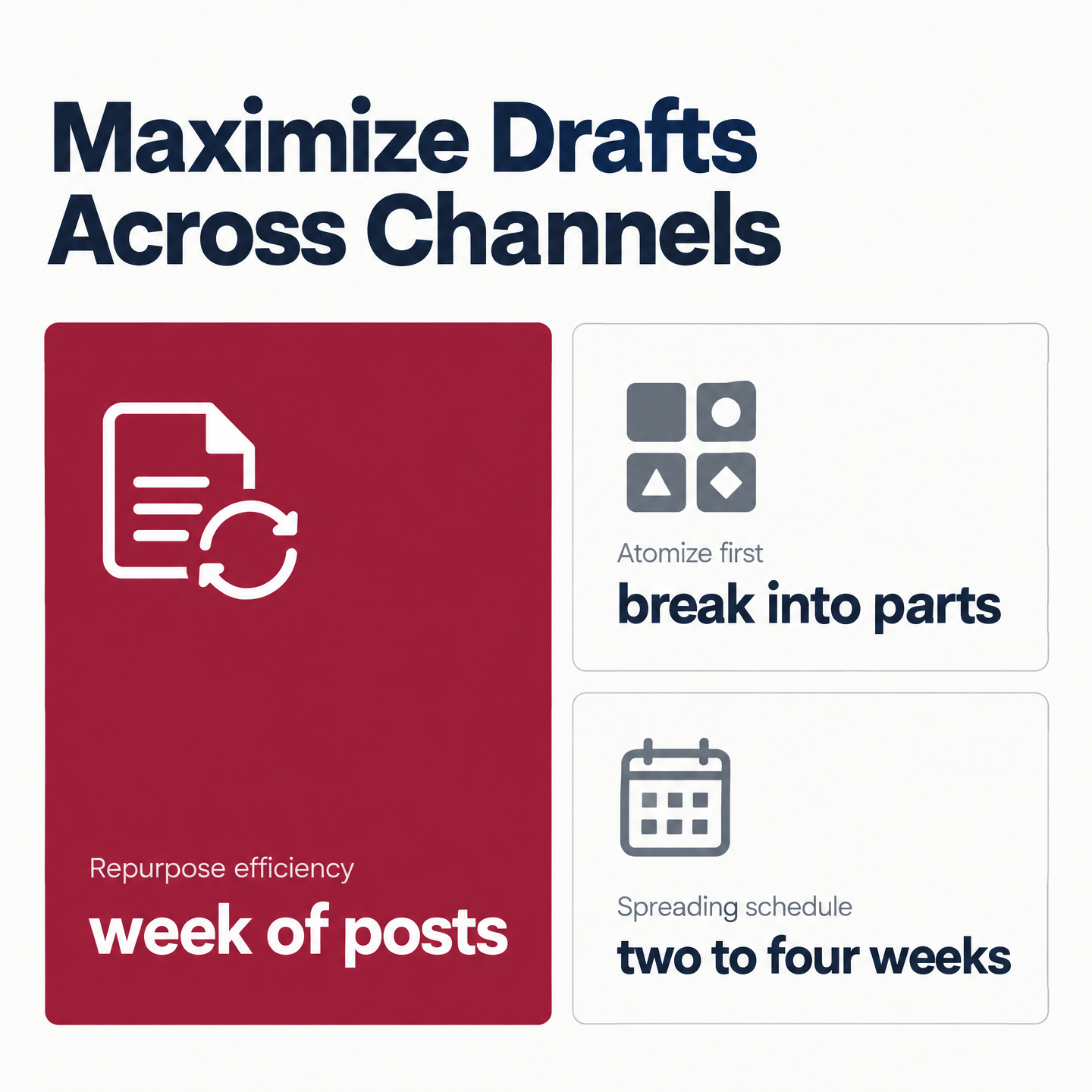
Atomize first. Break the master draft into its parts: the statistics, the quotable frameworks, the how-to steps, the one counterintuitive claim. Each atom becomes a slide or a post, not the whole article crammed into a caption.
For a carousel, one idea per slide keeps the swipe moving. Lead with the sharpest hook, hold one data point per frame, close on a clear action. A thread runs the same logic with tighter pacing. Open on tension, deliver one concrete claim per post, and save the link for a follow-up rather than the first line, where it depresses reach.
Skip this for thin posts. If a draft carries only one idea, forcing it into an oversized carousel pads it out and readers feel the filler. Repurpose the pieces that genuinely hold up in a new format, not everything you publish.
The structure that turns a post into a video script
Your blog outline is already most of the script. The intro becomes the hook, each H2 becomes a chapter or timestamp, bullet points become talking points, and your statistics become on-screen graphics. Record yourself walking through the post and you've got a long-form video for a fraction of the scriptwriting.
Short-form needs a different cut. For a compact vertical clip, extract one insight: hook immediately, make one hard claim, back it with a couple of quick examples, end on a single call to action. That's a separate asset, not a trimmed version of the long cut.
One caveat on audio. A narrated version should paraphrase the ideas as a discussion, not read the blog word for word. A verbatim recording sounds like a robot reading, and it undercuts the trust you built in the original.
For example, a master blog paragraph might say: "AI content creation can accelerate drafting, but channel fit still determines whether the post performs." A carousel adaptation could become: "Speed alone won't save a mismatched post. Slide 1: Why AI speed flops in the wrong feed. Slide 2: The channel-fit filter. Slide 3: One draft, three native versions." A newsletter adaptation could expand the same idea into a short note with the reasoning and a link back to the full article.
Where the newsletter fits
Email rewards a slower burn. Use the newsletter to expand on the draft's core argument with context the social clips couldn't hold, then link back to the full piece. It's often strongest after the audience has already seen the idea in a lighter format.
Don't fire everything at once. Let the carousel, thread, video, and email arrive in an intentional order, each adding a new reason to care instead of repeating the same announcement.
Quality Control & Brand Voice Consistency Across Channels
A draft can be grammatically clean, on-topic, and still wrong for your brand. That gap is where quality control actually lives. When AI content generation runs across five channels at once, the risk isn't typos. It's five slightly different versions of your voice, each drifting a little further from the last until customers stop recognizing you.
Voice consistency breaks first in an automated pipeline, and the fix starts before the draft exists. Same rule as the research stage: a prompt with thin context creates bland copy, while a prompt grounded in your actual standards gives the reviewer something worth shaping. The workflow only performs as well as the brand context you feed it.
Brand voice lives in a reference file, not a vibe
Don't keep your voice in your head. Write it down and make the tool read it every time. In one repurposing workflow, for example, the model can be given a brand-voice guide and three recent published posts before drafting a word. The instruction could be specific: plain language, first person, numbers over adjectives.
That reference file is your first review gate. When the guide says "numbers over adjectives," the AI checks itself against a rule instead of guessing your tone per channel. Give it the guide plus a few recent posts and the drafts land closer to your voice across every format, not just the one you wrote by hand.
The same discipline covers visual assets. A YouTube thumbnail, a carousel slide, and an email header should share color, type, and logo placement. Bake those rules into the same reference the AI reads so the look stays aligned wherever a draft goes live.
Where the workflow needs a human gate
Automation gets you to a strong draft. It doesn't get you to publish. Constant Contact is blunt: quality control is non-negotiable, so fact-check the details, layer in your own real-world examples, and guard your brand voice, because AI content should build trust, not chip away at it. That's the model for a review gate. Some checks stay human, and you name them in advance.
"AI is your marketing assistant, not your replacement."
That line applies to your QA stack as much as to the drafting. Before adding another tool, ask whether the workflow already has the AI support it needs. Then apply a simple test to anything new: does it fit an existing process, does it have a named owner, and will someone actually use it every week?
The payoff shows up in what slips through. A single missed factual error can force a correction across every channel that already published it, so one weak gate multiplies into cleanup jobs on every affected platform. Track two numbers instead of a dozen: how often a draft clears review untouched, and how often something reaches a customer that should have been caught. Those two tell you whether your gate is doing real work or just rubber-stamping. A lean, deep QA pipeline you actually maintain beats a sprawling one nobody owns.
So build review gates the same way. Fewer checkpoints, each with a clear owner and a clear rule, applied to every channel before publishing. That keeps voice tight, catches the platform-specific misses, and stops the drift before it reaches your audience.
Automated Publishing Workflows: From Draft to Live Across All Platforms
The moment a draft clears quality control, the pipeline can take over. A trigger fires—draft approved—and automation can format, schedule, and push each version to its channel without anyone copy-pasting into several dashboards. This is where AI content generation stops being a writing tool and starts working as a distribution engine.
The wiring makes or breaks it. Each platform may have its own technical requirements. LinkedIn may handle long-form text differently; X may cap length and chain threads; Instagram and TikTok may require media payloads; YouTube may expect a title, description, and chapter markers. Channel-first mapping can decide which formatted payload lands where, so your content arrives shaped for the destination instead of getting flattened into one generic blast.
One trigger, five channel-native payloads
Think of the approved draft as a single event that can spawn several differently shaped outputs. The blog post can publish to your site, a thread can queue to X, a carousel can render for Instagram, and a short-form script can route to TikTok or YouTube Shorts. Each one carries platform-native formatting decided at the mapping stage, not patched on at the last second.
The mechanics matter more than they look. A manual handoff usually means a person opening each dashboard, reformatting by hand, and re-uploading assets one platform at a time. Every one of those steps is a place where a typo slips in, an image gets cropped wrong, or a post gets forgotten. Automating the handoff collapses those passes into one event and removes the last bottleneck between approval and live.
A publishing scheduler can fan one approved draft out to every connected channel, which is where many teams save the most manual effort. The draft is written once, mapped once, then delivered across channels on its own timeline.
Scheduling is a sequencing lever, not a calendar
Don't push everything live at once. Staggering repurposed posts avoids audience fatigue, but there's a sharper reason to space them out. The order of release changes the role each asset plays: one piece introduces the idea, another deepens it, another converts attention into a click or reply.
Order your channel-native pieces so the earlier post primes attention for the one that follows, then let the automation hold each to its slot. That turns a posting calendar into a deliberate lever instead of a dump-and-hope release.
Build fallbacks before you build speed
Automation fails quietly, which is the danger. An API times out, a media file rejects, a token expires, and the post silently never goes live. Build for that before you scale. Add retry logic for transient failures and content validation that checks character limits, image dimensions, and required fields before a call ever hits the platform.
Here the discipline is depth over count. Some teams find that a smaller set of deep, well-maintained integrations reaches reliable use faster than a sprawl of shallow connectors. The predictor isn't how many connectors you switch on; it's how many are deep, owned, and actually used. Fewer channels maintained properly, with working fallbacks, may beat a sprawl of half-wired ones that break the first time an API changes.
Analytics, Iteration, and Optimization per Channel
Analytics is where channel alignment stops being a theory and starts producing evidence. Every draft you tailored, scheduled, and shaped for a specific platform now has a scorecard. The job is to read those scorecards correctly, then feed what you learn into the next draft. This is where AI content generation earns its keep as a system, not a one-off writing trick.
Most teams measure the wrong things. Counting likes, shares, and comments alone is a thin way to understand engagement across platforms. Those numbers tell you something happened. They don't tell you whether the format and channel did the work, or whether a post just got lucky with timing. Channel-first mapping gives you the missing variable: you know which platform each draft was built for, so you can attribute performance to a decision instead of a coincidence.
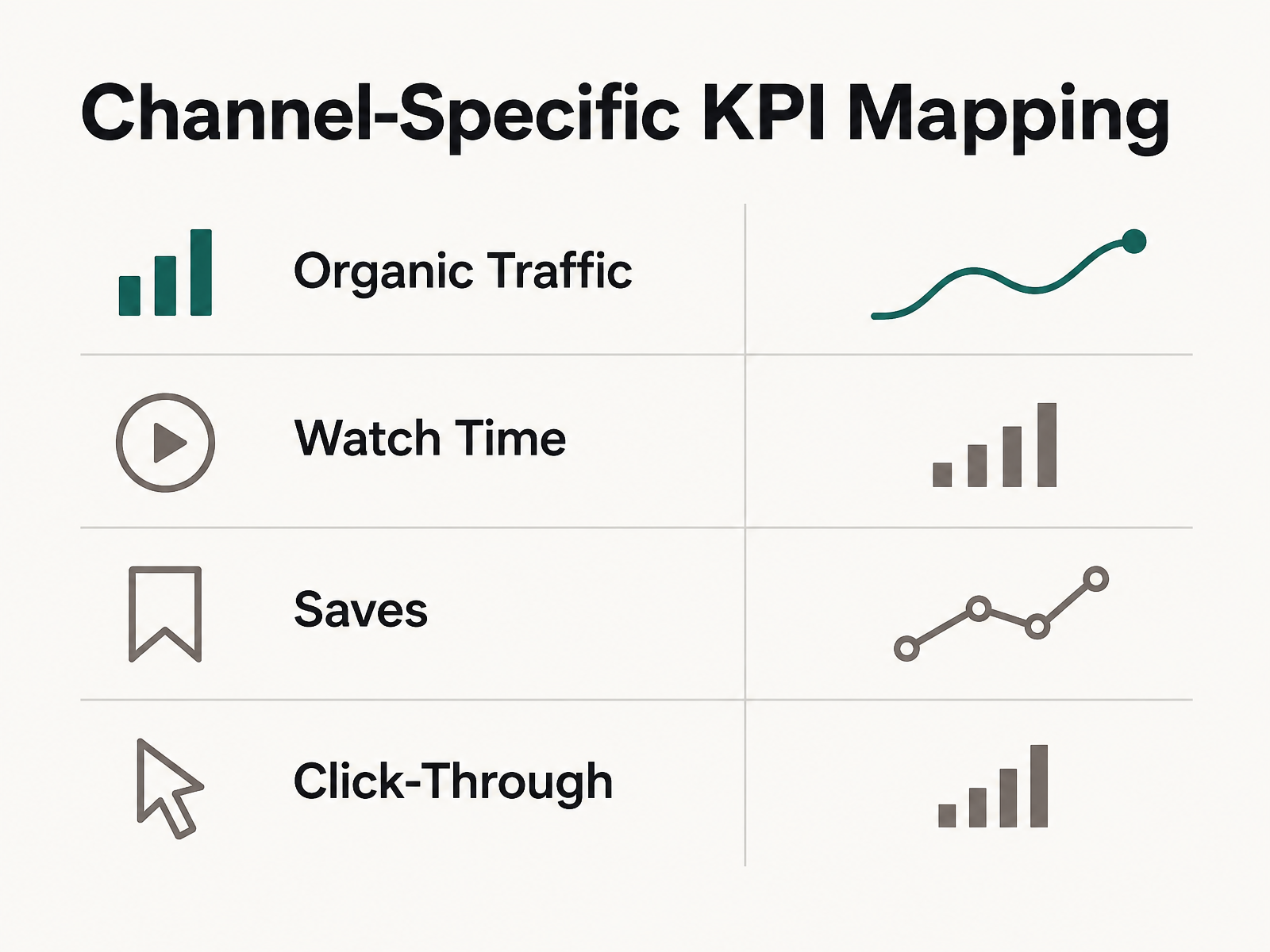
Which metrics actually tell you a channel is working
Pick KPIs that match the channel's job, not a blanket list. A blog post is measured on organic traffic, dwell time, and search rankings. A short-form video lives or dies on watch time and completion rate. A carousel is judged on saves and swipe-through, a newsletter on click-through and reply rate.
Track performance by format, not just topic. The same idea can win on one channel and flop on another, and a topic-level view hides that. Log results against the channel each draft was mapped to and patterns show up fast. You start to see that your how-to angles carry search, while your contrarian takes carry social. That's the alignment framework paying you back in data.
How sequencing beats simple spacing
Spacing repurposed posts over time is common advice for avoiding fatigue. It's sound, but it treats spacing as a defensive move. There's something more useful at work: different formats resonate with different audience segments, so the order in which they land shapes how each one gets received.
Read that way, spacing becomes a lever you can tune. You're not just avoiding burnout. You're sequencing drafts so an early post primes the audience for the one that follows. Test the order, not only the gap. A teaser carousel before a long-form video is a schedule you can measure and refine.
Where AI closes the optimization loop
Run format variations against each other before you commit budget. Ship two versions of a carousel opener to the same channel, hold everything else steady, and let the click and save data decide. After the test window closes, tweak the losing hook and rerun. Small copy changes on a single format compound into real gains over a quarter.
This is where AI content generation can shift from producing drafts to helping predict which drafts are more likely to land. Feed last month's channel-level results back into your prompts and mapping matrix, and each new draft starts closer to what already worked. The loop tightens every cycle. Analytics informs mapping, mapping informs the draft, and the draft arrives pre-aligned to the channel that will reward it.
Your Channel-First Playbook, Start to Finish
Everything above collapses into one repeatable loop: draft once, map to channel, then publish. This section turns that loop into a checklist you can run without re-reading the whole thing. Treat it as the operating manual for your workflow, not a set of suggestions.
The point of a checklist is to protect the alignment work from getting skipped under deadline pressure. When a Friday post is due and everyone's rushing, that's exactly when channel mapping gets abandoned and generic output takes over. A written checklist holds the line.
What breaks channel alignment most often
The failures we see repeat cluster into a few predictable patterns. Name them so you can catch them before they ship.
- Publishing everything at once. A full set of adapted assets shouldn't land as one blast. Give each channel version room to do a distinct job in the sequence.
- Chasing format volume over channel fit. A strong source piece can support many derivatives, but the available formats are options, not obligations. Only the formats that match a channel earn a slot.
- Reading a podcast script word-for-word off the blog. Audio needs a paraphrased discussion of the ideas, not a recital. Same rule for every format: adapt, don't paste.
- Buying tools you don't need. Before adding a subscription, audit the platforms already in your stack. Depth on a few channels beats shallow presence on many.
Which best practices actually move the numbers
The upside here is measured, not theoretical. Systematic repurposing gives you back drafting time and stretches one good idea further, so a single piece of work keeps earning across channels. Those gains only land when the format fits the destination.
Prioritize the drafts that already have traction. Pull last quarter's analytics and rank pieces by engagement rate, then repurpose the top performers first. A post that earned above-average shares or replies is a signal the idea resonates, and reformatting a proven winner beats gambling on a cold draft. Sequence the rest behind it.
Keep a documented voice reference and a channel-mapping matrix on hand for every draft. The alignment decisions should be consistent enough that any team member runs them the same way.
What a channel-first timeline looks like
Here's a timeline you can adapt for a typical content piece, from idea to post-publish review. Adjust the spacing to your cadence, but keep the order.
- Day 1. Research and master draft. Pull channel-specific signals into the idea stage, then generate one strong master draft. Alignment thinking happens here, once.
- Day 2. Map and score. Run the draft against your channel matrix. Decide which formats earn a slot and which get cut.
- Day 3. Repurpose and quality-check. Reformat for each approved channel. Fact-check details and confirm the voice holds across versions.
- Days 4 to 28. Schedule and stagger. Push each version to its channel in the sequence you want the audience to experience.
- Ongoing. Read the scorecards. Track performance by format and channel, then feed what you learn into the next master draft.
Run this loop enough times and channel alignment stops feeling like extra work. It becomes the shape of how you publish.
FAQ
1. Does channel-first mapping change depending on whether you're a solo creator or a larger team?
The system works at either size, but the constraint changes. A solo creator uses the matrix to protect focus and avoid overcommitting. A larger team uses it to keep multiple contributors from adapting the same draft in conflicting ways. In both cases, the central question stays the same: which channel is the draft truly built to serve?
2. What's the difference between repurposing for reach and repurposing just to fill a calendar?
Repurposing for reach starts with the audience's context. The idea is reshaped so it feels native in the feed, inbox, search result, or video app where it appears. Calendar-filling starts with an empty slot and tries to stretch a draft until it fits. One creates a new asset; the other creates a weaker echo of the original.
3. How do you handle a draft that only works on one channel?
Treat that as a good decision, not a failure. Some pieces are naturally best as search content, customer education, or a direct email. If the secondary versions require too much explanation, too much design support, or too much compromise, publish the strongest primary version and save the team’s energy for a better-fit draft.
4. When does scheduling become a strategic variable rather than just spacing posts out?
It becomes strategic when the schedule reflects intent. Instead of asking only when to post, ask what each asset should make the next audience interaction easier to understand or act on. That turns the order of posts into part of the content strategy rather than an administrative detail.
5. What's the most common point where automated pipelines silently break down?
The weak spot is often the handoff between approval and platform delivery. A draft may be approved, but the final payload still has to satisfy each channel's technical requirements. Validation, retries, and clear ownership keep that last mile from becoming a hidden failure point.