
AI Content Generation at Scale: Why Google Indexes Only a Fraction of Your Pages

Why Google Indexes Only a Slice of Your AI Content
Getting pages into Google's index is the whole game. You can run AI content generation at industrial volume, but if Google indexes only a fraction of what you publish, the rest is dead weight that still draws down crawl budget. That tension between output speed and index coverage is where most large-scale strategies quietly break.
One shift reframes how you should think about scaled AI content. When you flood Google with pages faster than it can validate them, coverage can slip. Ahrefs has put it this way: Google doesn't punish AI content, it punishes bad content. If you see a gap on high-volume, thin pages, it may not be a penalty on AI. Some providers describe it as a crawl-budget tax on volume Google hasn't validated yet.
The Indexation Gap Is a Crawl-Budget Tax
Crawl budget is the limited number of pages Google is willing to crawl on your site in a given window. Drop a large batch of new URLs and Google samples them, watches how users engage, then decides whether the rest earn a place in the index.
Search Engine Journal describes one mechanism: new URLs get a freshness boost, then crawl resources get pulled back once the novelty fades and the sampled pages underperform. That early traffic can mask weak content. Pair it with how scaled content gets filtered and the outcome can be predictable. Unvalidated AI volume can lose its crawl allocation before those pages ever rank.
- Audit your crawl stats in Google Search Console before scaling, so you know your current budget ceiling.
- Block low-value URLs (filter pages, redundant tags) in robots.txt to preserve crawl budget for pages that matter.
- Run near-duplicate detection as a pre-publish gate. Fingerprinting can catch near-duplicates at scale and flag thin content before it burns budget.
AI Text Ranks Fine. Thin Text Doesn't.
Google's own position is that it evaluates content quality, not how content was produced. Some analyses of AI content in search have concluded that AI text can rank in the top ten at rates comparable to human text, so authorship isn't the problem. Volume without value is.
Google Search Central says it directly: "a high quantity of pages doesn't make a website higher quality or more relevant to users." Publishing more pages than you can keep genuinely useful can trip the scaled-content-abuse filter and stall indexing.
- Gate every page on quality signals (E-E-A-T, originality, real usefulness) before it publishes, not after traffic drops.
- Give each page a distinct search intent. Swapping a city or keyword into a template may produce the thin pages Google refuses to index.
- Add human review to AI drafts. The teams pulling more organic traffic from AI content are often the ones pairing automation with editorial oversight.
Who Feels the Tax Hardest
SaaS firms, agencies, and local businesses running programmatic pages at scale tend to stand the most to gain from fixing this, because they often carry a high ratio of new URLs to crawl budget. That's where indexation pressure tends to bite hardest.
The move is to treat indexation as a measurable rate, not a hope. Keep every page above the quality bar before it ships and crawl resources are less likely to get withdrawn in the first place. For teams building repeatable workflows, automating content the right way means gating quality at the source.
The facts before the argument:
- Crawl budget is the finite number of pages Google will fetch from a site in a given window, and every uncrawled URL still draws it down.
- Google evaluates content quality rather than authorship, and some analyses suggest AI text can rank in the top ten at rates comparable to human-written text.
- The indexation gap on high-volume thin pages is often described as a crawl-budget tax on unvalidated volume, not a penalty against AI content.
- New URLs may receive a temporary freshness boost, then lose crawl resources once the novelty fades and sampled pages underperform.
- Google Search Central states that a high quantity of pages does not make a website higher quality or more relevant to users.
- SaaS firms, agencies, and local businesses running programmatic pages often carry a high ratio of new URLs to crawl budget, so the pressure tends to bite them hardest.
- Modifier-level patterns like "best CRM for [industry]" can hide zero-volume variants such as "best CRM for beekeepers" that may stall indexing.
Managing Crawl Budget for AI‑Generated Pages
Publishing thousands of pages is easy. Getting Google to crawl and keep them is the hard part. When your AI content generation pipeline outpaces Googlebot's crawl rate, the surplus pages sit in a queue, and every uncrawled URL still draws down the same limited budget.
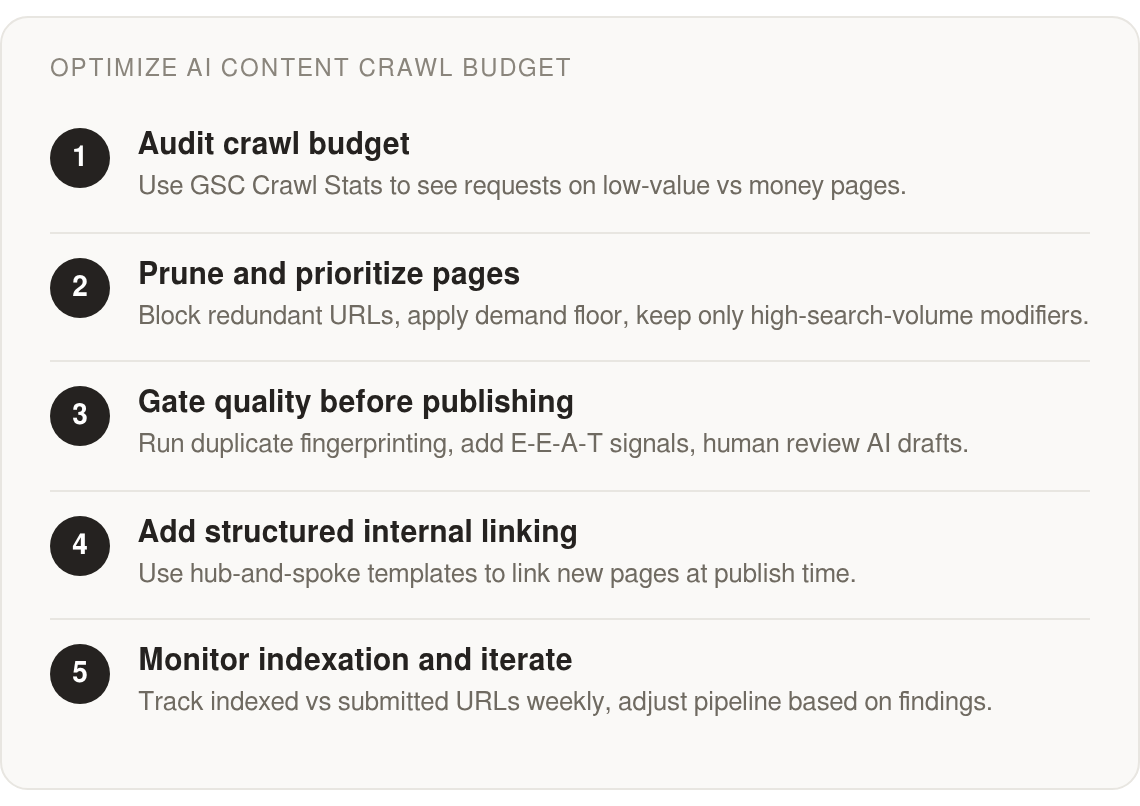
Crawl budget is the ceiling on how many pages Google will fetch from your site in a given window. Once it's spent, crawling stops. That ceiling matters most on large sites, which is exactly where scaled AI content lives. So the work here isn't producing more. It's making sure every page you produce earns its crawl.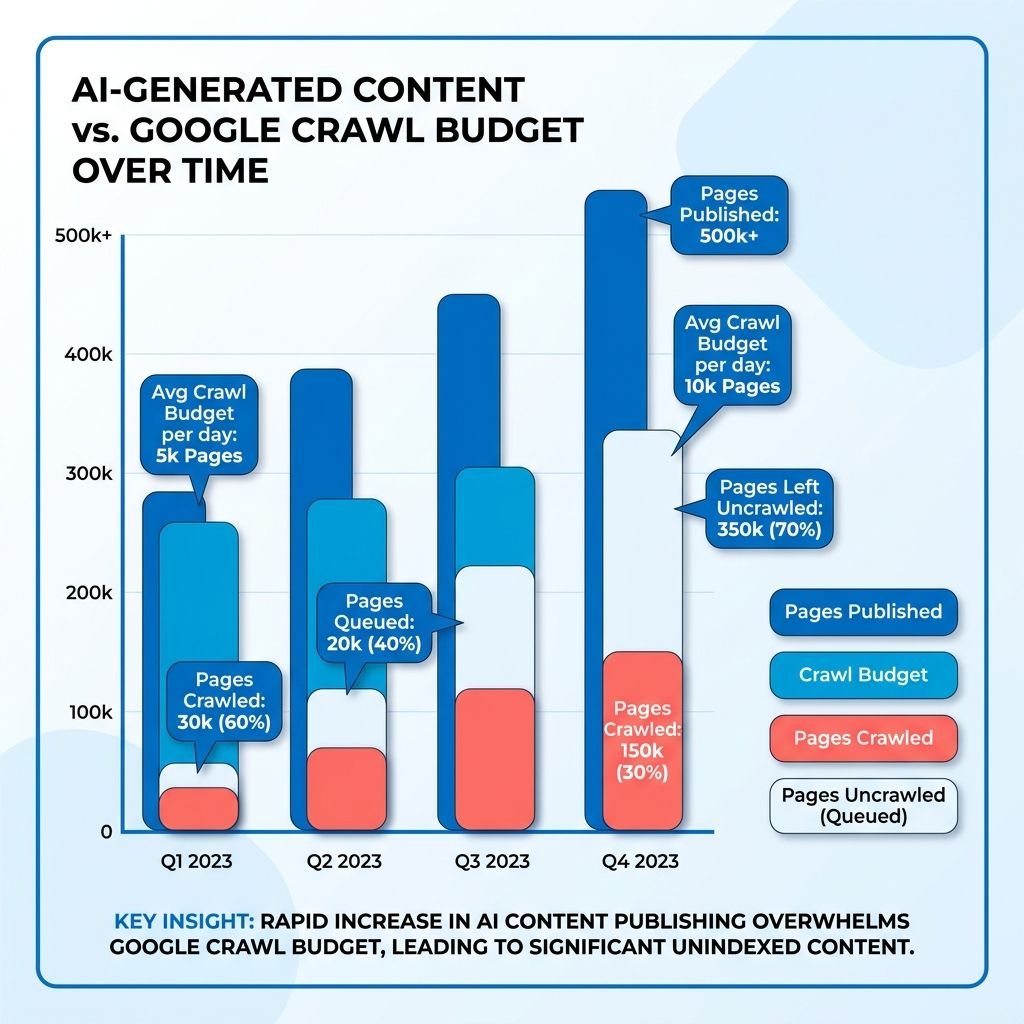
How Do You Audit Crawl Budget Before Scaling?
Start by measuring what Googlebot actually does on your site, not what you assume it does. The Crawl Stats report in Google Search Console shows fetch volume, response codes, and which page types eat requests.
- Pull the Crawl Stats report and note how many daily requests hit low-value URLs versus your money pages. If Googlebot spends its budget on filter and tag pages, your new content waits.
- Use robots.txt allow and disallow rules to block redundant URLs like category filters and duplicate tag archives. This redirects crawl attention to pages that affect the bottom line.
- Monitor the Coverage report weekly, not monthly. A weekly cadence catches a stalling batch before it drags the whole site down.
Which Pages Should You Prune or Prioritize?
Volume without demand is the trap. Plenty of programmatic programs publish at scale, then stall and get quietly removed when the pages fail to earn traffic. Thin and duplicate pages are the usual cause.
Prune before you scale. Cutting low-value URLs frees crawl budget for the pages that convert.
- Validate demand at the modifier level, not the head term. A pattern like "best CRM for [industry]" can hide zero-volume variants like "best CRM for beekeepers" that may only generate crawl waste.
- Apply a demand floor: sample your modifiers, check documented search volume for each, and kill any pattern where most variants show no demand. If the bulk of your modifier pool has zero search volume, you have a research project, not a traffic program.
- Use clean URL slugs instead of parameters, and publish in staged batches rather than dumping the full program at once. Both can help Google validate quality before pulling crawl resources.
Can You Catch Near-Duplicates Before They Burn Budget?
Near-duplicate documents are everywhere on the web, and AI drafting makes them easy to produce when prompts share the same grounding. The fix is to catch them inside the pipeline, before publish.
Duplicate detection is a well-studied problem at web scale. Fingerprinting approaches can resolve near-duplicates across large repositories while treating trivial differences like ads as noise. Run that same check as a pre-publish gate and you may stop the exact pages that would trip scaled-content filters and waste budget.
- Fingerprint every draft against your existing corpus and hold anything above a similarity threshold for enrichment. Automating this step, alongside content creation itself, can keep dedup consistent across thousands of pages.
- Auto-generate and segment your sitemap so high-value pages get submitted first. Prioritizing crawl order at the sitemap level can be a useful lever.

Skip aggressive fingerprinting if you publish under a few hundred pages a month. At that scale manual review is faster than tuning a threshold.
Making Every AI Page Prove Its E‑E‑A‑T
Weak E-E-A-T signals are often cited among the reasons AI pages stall before indexing. Most teams miss this when they scale AI content generation: Google isn't checking who wrote the page, it's checking whether the page proves expertise. Unproven pages are often what get sampled, found wanting, and dropped from the crawl queue.
Google has been blunt about it. Its stance is quality-first, summed up in one line: "Our focus is on the quality of content, rather than how content is produced." Some analyses of AI content in search keep landing on a similar conclusion: Google may punish bad content more than AI content, so well-made AI pages can rank alongside human-written ones. Authorship may not be the filter; E-E-A-T often is. So the job with automated content is to make every page carry those trust signals before it ever hits the queue.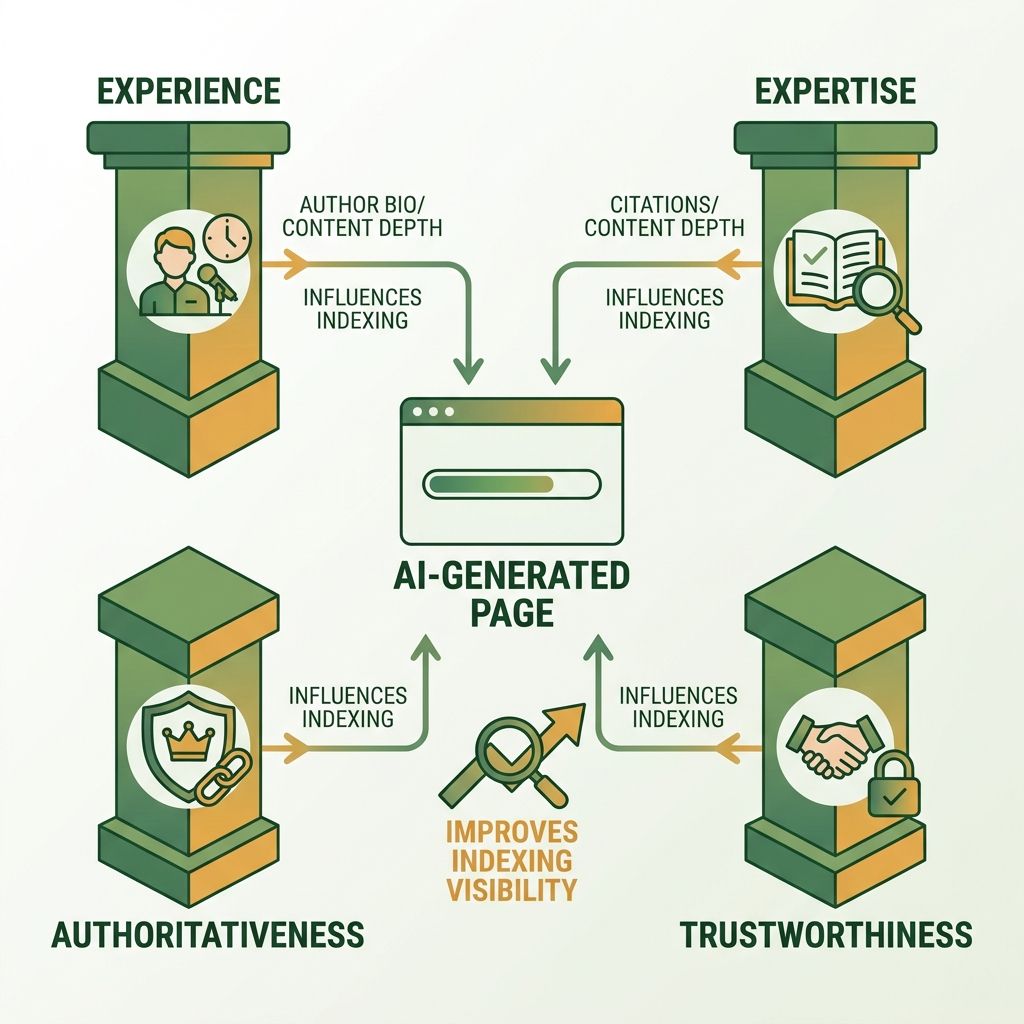
What E‑E‑A‑T Signals Actually Move Indexation?
Google evaluates expertise, authoritativeness, trustworthiness, and experience, and its quality threshold can quietly stall scaled AI content that adds nothing. Pages built mostly from unedited AI text, with little added value, may be the ones most at risk. Added value is the gate. Get these on the page and you are more likely to keep crawl resources instead of losing them.
- Add a real author byline backed by Person schema. A named, credentialed author is a direct trust signal Google's raters look for.
- Cite verifiable data sources inline so claims are checkable. That's what separates a useful page from generic filler.
- Write depth that answers the query fully instead of thin restatement, since thin output is one of the top indexation blockers for AI pages.
- Mark up content with Article schema so Google parses your author, publish context, and topic without guessing.
Keeping a Template From Cloning Itself
Scaled generation drifts toward sameness. For example, two hundred pages built from one template can start looking like near-duplicates, and duplicate or thin content can be a flagged reason AI pages don't get indexed. Search engines can detect near-duplicates cheaply and at scale, treating trivial differences as noise. If Google can catch it that cheaply, your pipeline can catch it first.
Run dedup as a pre-publish gate, not a post-mortem. A page that clears a similarity check before it publishes is less likely to draw the crawl-budget tax that unvalidated volume triggers.
- Fingerprint each draft against your existing library before publish, to catch near-duplicates while they're still cheap to fix.
- Enrich underperforming pages before adding new ones, because a high quantity of pages doesn't make a site more relevant to users.
- Keep a consistent brand voice across every page so the whole library reads as one credible source. Platforms like AnyPost.ai can be configured to support this with persona and business context settings.
Skip the heavy E-E-A-T build only on genuinely transactional utility pages where expertise isn't the query intent. Everywhere else, treat these signals as the price of staying indexed.
Internal Linking That Routes Crawl Equity Where You Want It
Internal links are how you tell Googlebot which pages matter. Publish a page with nothing linking to it and you've created an orphan. It sits outside the crawl path, and at high volume that's exactly where AI content generation pipelines bleed budget. Orphaned pages don't get found, don't get crawled, and quietly drop out of contention.
Prerender has flagged weak internal linking as one direct reason AI-written pages can stall before indexing. The fix isn't more links everywhere. It's a deliberate structure that routes crawl equity to the pages you actually want ranked. Done right, scaled AI content and healthy crawl budget stop fighting each other.
How Does Hub-and-Spoke Architecture Help Indexing?
A hub-and-spoke model gives crawlers a clear map. A central hub page links out to related spoke pages, and each spoke links back. This clustering concentrates authority and shortens the crawl path to deep pages, so Googlebot reaches new content faster instead of leaving it in the queue.
- Keep click depth shallow. Sit published pages close to your homepage or a major hub so crawlers don't burn budget digging.
- Link every new page into a relevant cluster on publish, never leave it orphaned. SEOmatic advises building internal linking into the template, not as an afterthought.
- Add breadcrumb trails so both users and crawlers can trace a page's place in your hierarchy without extra fetches.
Can Internal Linking Be Automated at Scale?
Manual linking doesn't survive thousands of pages. Programmatic systems can solve this by generating contextual links from the data layer itself. As the American Eagle guide describes one approach, a page template can pull dynamic fields to auto-build internal links alongside titles, headings, and metadata, so linking happens at publish time rather than in a cleanup pass weeks later.
This is where a platform like AnyPost.ai can be configured to wire contextual internal links in as each page goes live, keeping the crawl graph connected without a human touching every URL. Our guide on how to automate content creation covers the mechanics if you want to see how it fits a broader workflow.
- Generate contextual links from structured data at publish time, not in a manual audit later.
- Watch for JavaScript-dependent links. Prerender notes that AI crawlers can't render JavaScript at all, so JS-injected links are invisible. Keep your internal links in the raw HTML.
- Prune links to thin or duplicate pages before they burn budget. Google is clear that a high quantity of pages doesn't make a site higher quality.
What About User Experience Signals?
Architecture serves people too, and Prerender lists poor user experience among the reasons AI pages can fail to index. A site that's easy to move through keeps users engaged and signals value back to search engines.
- Run pages through a UX and performance audit before publishing to catch slow loads and broken navigation.
- Keep navigation consistent across templates so no page becomes a dead end for readers or crawlers.
Skip aggressive linking on pages you haven't validated for demand. Surfacing a thin page faster may just get it dropped faster.
The Monitoring Loop That Keeps a Program Compounding
Monitoring is where most scaled programs quietly fall apart. Plenty of programmatic programs never compound: they publish, stall, and get trimmed once the pages stop earning their keep. That gap is rarely a content problem you can see on day one. It's a monitoring problem, because the tools that make AI content generation fast also make it easy to stop watching once pages go live.
The fix is a repeatable loop, not a one-time audit. You want a dashboard that watches indexation the way you'd watch crawl budget, then a feedback path that pushes what you learn into how the next batch gets built. Treat scaled AI content as a dataset you enrich over time, not a firehose you leave running.
The Metrics That Actually Signal Indexation Health
Your dashboard needs to show the delta between what you submit and what Google keeps, not just raw published counts.
- Track indexed vs. submitted URLs weekly, not monthly. Check the Coverage report every week so a drop shows up in days, not after a quarter of decay.
- Log crawl errors and "Discovered – not indexed" counts. A rising discovered-but-uncrawled bucket can be your crawl-budget pressure surfacing in real time.
- Run URL Inspection on a rotating sample of pages. Spot-checking canonicals and last-crawl dates catches template-level problems before they spread across thousands of URLs.
- Watch the Performance report for impressions per page, not just sitewide totals. Pages earning zero impressions after crawl are dead weight drawing down budget.
One way to make the crawl-budget thesis measurable is to set batch-level pass/fail criteria around these four signals. For example, you might mark a batch as failing if indexed vs. submitted URLs fall below your baseline, if indexation retention drops after the freshness window, if discovered-not-indexed counts trend upward, or if impressions per indexed page stay flat while new URLs are added. The exact thresholds are yours; the point is to trigger a pause-and-enrich review instead of continuing to publish.
Early Indexation Is a False Signal
This is the trap that quietly kills programs. Newly published pages can get a temporary freshness boost, similar to the lift from manually submitting a URL for indexing. This can mask quality problems for a few weeks, then fade.
- Measure retention past the freshness window, not initial inclusion. A page that indexed in week one and dropped by month two may never have truly passed the quality bar.
- Set an automated alert for indexation drops on batches once the freshness boost fades. That's where the real signal often lives.
- Re-validate modifier demand before blaming content. Validate keyword patterns at the modifier level, not the head term. If a sample of variations shows little documented demand, the pattern may have been unviable and rewriting may not save it.
Feed the Data Back Into the Generation Loop
Diagnosis is useless without an iteration path. The strongest optimization move runs counter to instinct: enrich underperforming pages before you publish new ones.
- Pause net-new publishing when indexation retention dips. Adding volume to a stalling program may just spend more budget on pages Google is already reluctant to index.
- Route retention and impression data back into your content settings, so weak templates get depth added rather than replicated.
- A/B test title tags, meta descriptions, and content depth on a controlled slice, then roll winners into the template. Small, measured changes beat wholesale rewrites you can't attribute.
Fewer validated pages satisfy real demand and conserve the budget that fan-out squanders. That one decision protects both traffic and indexation.
Frequently Asked Questions
1. Does Google rank AI-generated content lower than human-written content?
Google evaluates content quality, not how it was produced. Some analyses suggest AI text can rank in the top ten at rates comparable to human-written text. The stalled indexing you see on high-volume pages may not be a penalty against AI; it can be a crawl-budget pressure on thin, unvalidated content that happens to be AI-generated.
2. My new pages indexed within days, so they passed the quality bar, right?
Early indexation can be a false signal. Newly published pages may get a temporary freshness boost, similar to the lift you get from manually submitting a URL. A page indexed in week one but dropped by month two may never have truly passed.
3. What does "Discovered – currently not indexed" actually mean in Search Console?
It means Google found the URL but hasn't spent crawl budget fetching it yet. A rising "Discovered – not indexed" bucket can be a crawl-budget pressure signal surfacing in real time. Track it weekly alongside crawl errors, because it may signal your pipeline is outpacing Googlebot's crawl rate.
4. Do small sites need to worry about crawl budget at all?
Crawl budget matters most on large sites, which is where scaled programs live. If you publish under a few hundred pages a month, skip aggressive fingerprinting and threshold tuning; manual review is faster at that scale. The pressure tends to bite hardest for SaaS firms, agencies, and local businesses running high-volume programmatic pages.
5. Should I delete thin pages or try to improve them?
It depends on demand. Enrich underperforming pages before publishing new ones, since added depth may beat replication. But prune pages built on zero-demand modifiers outright. If "best CRM for beekeepers" has no documented search volume, no rewrite may save it; cut the pattern and free the budget for pages that convert.
6. Why aren't my new pages getting crawled even after I publish them?
Common causes include orphan pages with no internal links, JavaScript-injected links that crawlers can't render, and crawl budget drained by filter or tag pages. Check whether Googlebot spends its requests on low-value URLs, keep internal links in raw HTML, and link every new page into a relevant cluster on publish.
7. How is manually submitting a URL for indexing different from earning it organically?
Manual submission can give a temporary freshness lift similar to what a new page may get automatically. Both may mask weak content for a few weeks before crawl resources get pulled back. Submission doesn't fix underlying quality, so if a page can't hold its index spot past the freshness window, forcing it in only delays the drop.
8. How do I validate demand before building a programmatic page set?
Validate at the modifier level, not the head term. Sample your modifier pool, check documented search volume for each variant, and apply a demand floor that kills any pattern where most variants show no demand. If the bulk of your modifiers return zero volume, you may have a research project, not a traffic program.