
AI Content Generation: From Ahrefs Gap to Published Page

Before we get into it, the short version:
- Some practitioner surveys report mixed ranking outcomes for AI-assisted pages: some climb, some hold flat, some drop.
- Ahrefs offers entry-level plans and optional content add-ons; exact pricing and credit limits vary, so check the provider's current terms before committing.
- Extra document credits beyond your plan depend on the provider and the current add-on structure.
- Minimum tooling cost depends on your selected keyword/data plan and AI content helper.
- A first published page may take a few hours; ongoing refinement often takes less than an hour per page per cycle.
- Search engines increasingly target unedited, low-originality scaled content, so human curation is the main safeguard.
The ranking happens after you hit publish
The payoff of AI content generation isn't more drafts. It's what you do once the page is live. Some practitioner surveys show mixed outcomes: pages that climbed, pages that didn't move, and pages that slid. If the tool alone were the differentiator, the results wouldn't scatter like that.
So treat generation as the start of a loop, not the finish line. AI has made publishing at scale cheaper, so many teams now produce more drafts than they used to. That changes the economics. If a large share of published pages never earn meaningful organic search traffic, and only a portion of searches lead to open-web clicks, publishing more unedited drafts mostly adds cost without adding proportionate ranking returns. The work has moved downstream, to the handful of pages that actually gain traction and to feeding their real performance back into headlines, meta tags, and internal links so they keep climbing.
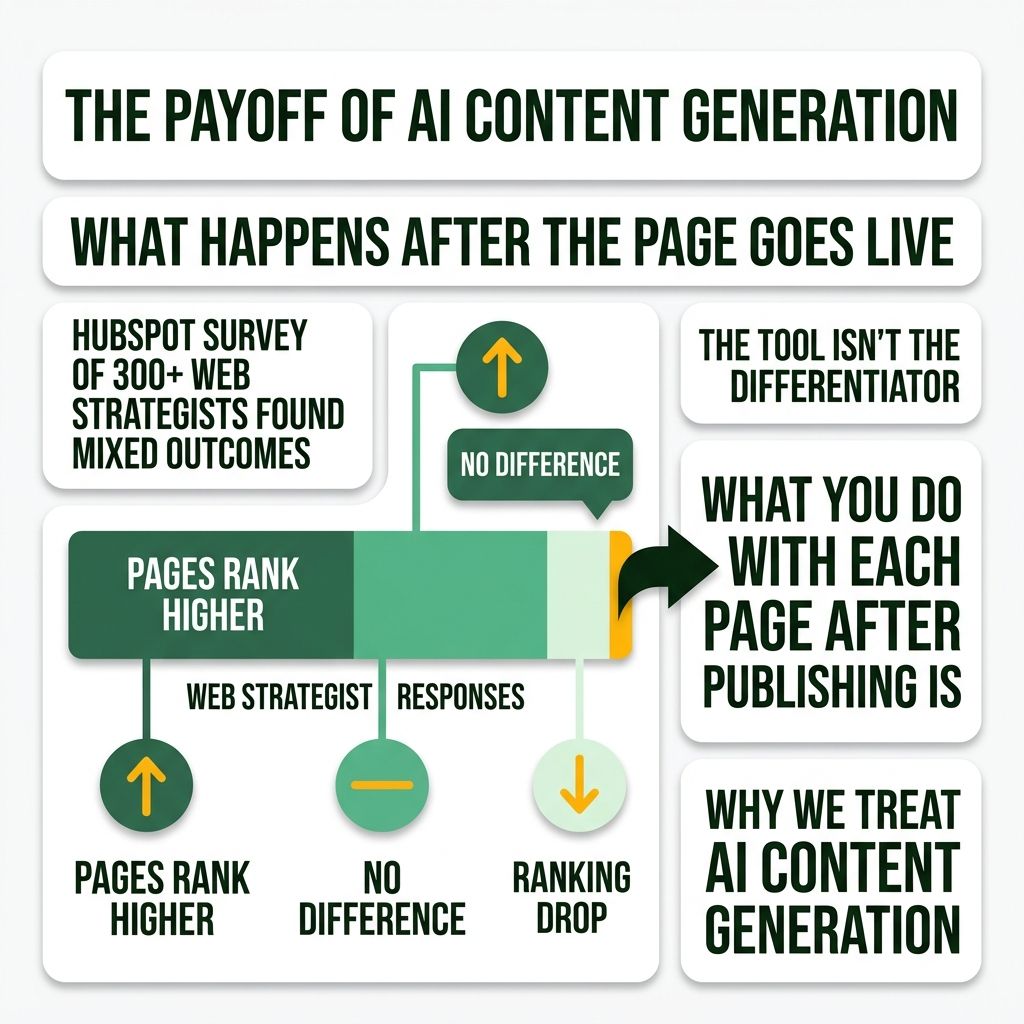
Why does post-publication refinement beat publishing more?
Post-publication refinement: adjusting a live page's headline, metadata, and links based on how it performs in search, then measuring the change. It tends to beat publishing more because many published pages never earn meaningful traffic. When production volume rises but search demand and open-web clicks are limited, another cold draft is less likely to win than squeezing more from a page that already shows signs of traction.
The pattern in miniature: generate variants, test against live data, keep the winner, with a human staying in the tuning seat. Teams that batch-publish AI articles often see gains from keyword research, gap analysis, added links, and editing, not from raw volume. The output is the easy part. The iteration is where rankings compound.
What will this guide cover?
We walk from a keyword/content gap to a published, refinement-ready page. You'll pull competitor topic data, draft against it, publish, then wire up a loop that watches performance and proposes edits.
| Aspect | Detail |
|---|---|
| Difficulty | Intermediate |
| Time to first published page | A few hours, depending on workflow |
| Ongoing refinement | Often under an hour per page, per cycle |
| Minimum tooling cost | Depends on your keyword/data plan and AI helper |
| Core benefit | Compounding improvements on pages that already show traction |
One scope note: skip a heavy refinement loop on pages with no impressions after a few months. There's nothing to iterate on. Refinement pays off on pages already earning clicks, not on dead drafts.
What do you need before starting?
A live site you can edit, a keyword research source, and a way to track each page's search performance over time. That's the whole stack. The rest is process.
- A keyword data source, such as Ahrefs or an equivalent, so drafts target real search volume instead of a model's guesses. Left alone, an LLM can invent confident-sounding volumes and difficulty scores.
- CMS access to update titles, meta descriptions, and internal links quickly.
- Performance tracking (rank tracking or Search Console) to tell refinement what's working.
- A human editor in the loop. Unedited, low-originality output can look thin and may be treated as scaled content abuse.
For a deeper look at pulling gap data before you draft, our walkthrough on Ahrefs Content Explorer for SEO automation pairs well with this workflow.
Prerequisites
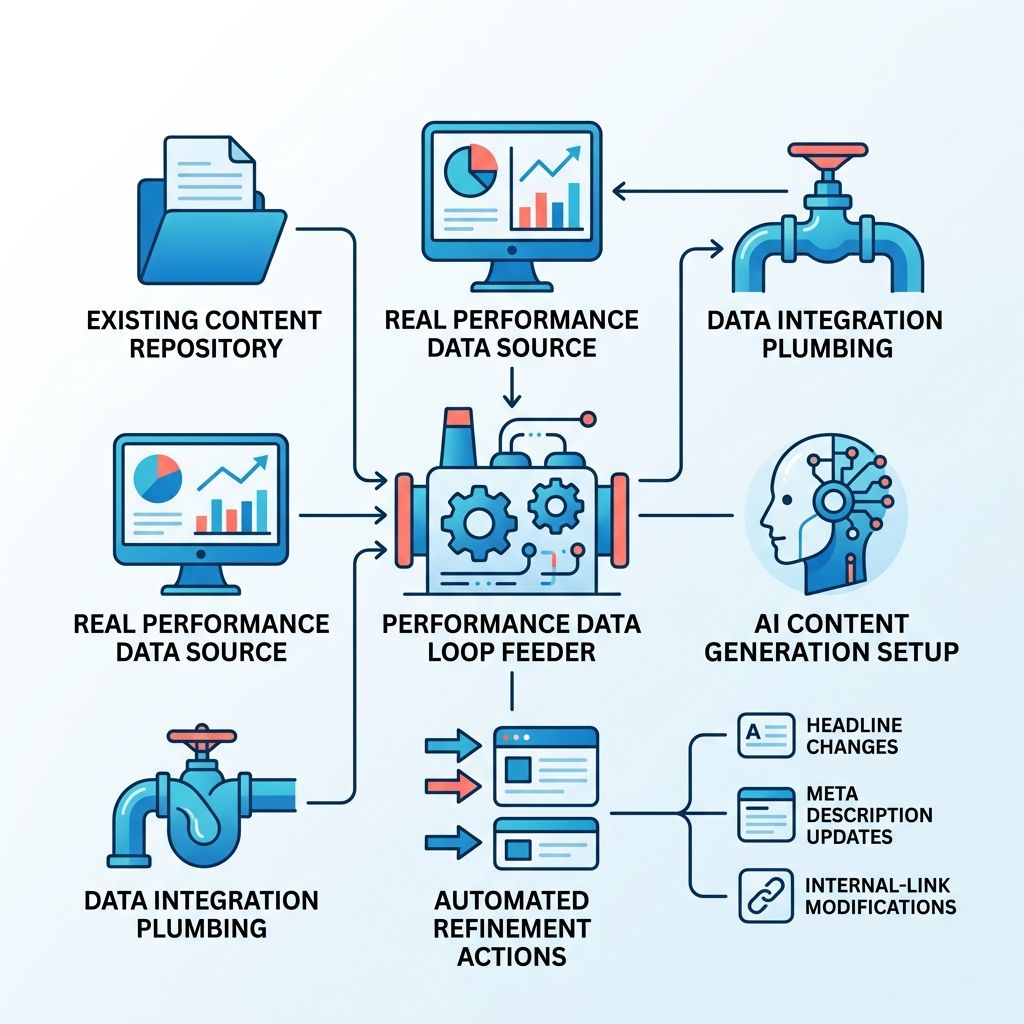
Before you build a loop that refines pages after they publish, you need the pieces that feed it. The whole thing rests on one dependency: real performance data flowing into your generation setup, then back out as headline, meta, and internal-link changes. That only works if the plumbing exists first.
So these prerequisites aren't about writing prose. They're about wiring live SEO data into the system that generates and later rewrites your content. Get this part wrong and you're optimizing against numbers a model made up.
What tools do you actually need?
Start with live access to real keyword and ranking data. Ahrefs is one common base, but its plan pricing and document limits change, so check the current entry tier and optional content add-ons against your actual site size before committing. The entry tier usually works for low-volume solo operators and small teams. Higher-volume content add-ons make more sense for teams pushing hundreds of updates a month.
Budget for what you'll actually publish and refine, not what you might. If your volume is low, a basic keyword/data plan is likely enough. If your publishing cadence is high, look at the provider's larger content allowances.
Why ground the model in real data?
This is the decision that matters most before anything else: force the model to pull live SEO metrics instead of leaning on its training memory. A large language model left to its own devices can fabricate plausible search volumes and difficulty scores. It optimizes for text that reads right, not numbers that are right.
This is where a live data connection, such as MCP-style tooling, earns its place. It hands the model real figures at generation time, so your headlines and meta tags get shaped by what's actually happening in search rather than a guess.
One caveat worth stating plainly. Grounding factual metrics in live data is correct. Letting competitor-consensus topic scores dictate your angle is not. Optimize on your own real performance signals after publishing, not on convergence toward what everyone else already ranks for.
What gets staged before the refinement skills?
Treat your build as a pattern, not a product. Swap any single component and the architecture still holds. That framing matters, because it means post-publication refinement is just extra skills bolted onto the same pipeline that created the page.
You'll want three things staged and ready:
- Live data access through your keyword plan and a data connection, so generation and refinement read from the same source of truth.
- Discrete process docs or skills, each doing one job: a headline rewriter, a meta optimizer, an internal-link updater.
- A performance feed that surfaces which pages are climbing or stalling, so the refinement skills know what to act on.
Core concepts
Most people picture AI content generation as a draft machine. Type a prompt, a blog post comes out. That framing misses the part that actually moves rankings: a loop that keeps editing pages after they go live, feeding real numbers back into headlines, meta tags, and internal links.
To make that loop work, you need its moving parts. Generation only earns its keep when the model is wired to live SEO data instead of its own training memory. The model is often optimizing for plausible text, not factual accuracy.
What does the architecture actually look like?
Three components carry the whole system. First, a live data layer, usually a data connection that pipes real keyword and ranking figures into the model so every decision grounds in numbers a tool measured.
Second, the generator, which drafts the page against a data-informed outline. Third, and this is where refinement lives, a set of post-publication skills that rewrite the page based on how it performs.
The best mental model is a pattern, not a product. Swap the model, swap the data provider, swap the orchestration tool, and it still holds. That portability matters, because you're not locked into any one vendor's writing quality.
What counts as a "skill" here?
A skill is a discrete, documented job the AI does. A headline rewriter is a skill. A meta-description optimizer is a skill. An internal-link updater is a skill. Each one reads live data, makes a narrow change, and hands off.
The useful part: refinement skills bolt onto the same pipeline that creates content. You don't build a second system. You add a headline skill fed by click-through data, a meta skill fed by impression data, and a linking skill fed by which pages are gaining ground. It maps cleanly onto how teams already run keyword data through automation.
One caveat on scoring. In-tool content scores can feel arbitrary. You can cover every topic in the data and score poorly, or ignore the data and score well. Treat those numbers as directional signals for your skills, never as ground truth.
Does Google care whether a human or machine wrote it?
Here the sources split. One position says you must disclose LLM-generated content to avoid penalties. Another says search engines judge quality, not provenance.
My read: disclosure is an editorial and trust choice, not a mechanical ranking lever. The real target in many quality guidelines is scaled content abuse: high-volume, unedited, low-originality pages. What matters is that a human refines the output before and after it publishes.
Best practices
The strongest setups don't stop editing when a page goes live. They treat the published URL as a draft that keeps improving as real numbers come in. That's the shift most teams miss.
So the practices below are about the loop, not the first draft. Feed live performance data back into headlines, meta tags, and internal links, and your best pages keep climbing instead of stalling. Get the refinement habits wrong and you either drift into "me too" content or trip search quality filters.
How do you refine headlines and meta tags after publishing?
Start with the elements cheapest to change: the title tag and meta description. The pattern is simple. Let the model propose headline variants, test them against real click data over a couple of weeks, and keep a human making the final call on which one wins. Automation generates the options; your judgment picks the keeper.
Wire this in as a discrete skill, not a new system. If your generation already pulls live SEO data, a headline rewriter and a meta optimizer are just more skills bolted on, fed by click-through and ranking numbers instead of keyword research. Same plumbing, different job.
Internal links deserve the same treatment. When a new page earns authority, point fresh internal links at the pages you want to lift. Some publishing platforms can be configured to add relevant internal and external links as part of generation, so new content connects to your priority targets as it publishes.
Example refinement workflow
Here's a clearly-labeled hypothetical to make the loop concrete. Suppose you have a page that shows impressions but a below-average click-through rate and sits around position 12 for its main query.
- Inputs: Search Console impressions, clicks, and position for the target query; the current title tag and meta description; the page's existing internal links.
- Decision rule: If 30-day impressions pass your chosen threshold and CTR is below your benchmark, propose a title variant that keeps the primary phrase near the front and adds a more specific benefit. If CTR is acceptable but ranking is still outside the top 10, test a meta description change that better matches the query intent. If a related page is climbing for a supporting query, add an internal link from that page to the target.
- Change one element at a time: update only the title tag, only the meta description, or only one internal link.
- Test duration: Run the change for 14 to 21 days before judging it. Search engines need time to recrawl and reweight the page.
- Rollback criteria: If clicks or CTR drop meaningfully over the test window, or if the page falls out of the top 20, restore the previous version before changing another element.
That sequence is not a fixed law; it's a starting pattern you can adjust with your own thresholds.
What pitfalls kill a refinement loop?
The biggest one is optimizing toward competitor consensus. Scoring a draft against top-ranking pages keeps you aligned with intent, but lean on it alone and you flatten the exact angle that would have won. Refinement should sharpen your point of view, not sand it down to match everyone else.
The second trap is scale without editing. Search quality guidance targets scaled content abuse, especially high-volume, unedited, low-originality pages. Automating headline swaps is fine. Auto-publishing hundreds of untouched drafts is how you get filtered.
On disclosure, the sources still disagree, and we've landed on treating it as a trust and editorial choice rather than a ranking lever. Quality is what's actually being measured.
Which pages are worth refining?
Don't spread refinement across everything. Educational how-to guides and comparison content tend to be the formats most likely to thrive with AI help; personal stories and opinion pieces tend to struggle. Point your loop at the first group.
Skip aggressive refinement on thin, low-intent pages entirely. If a page can't clear the originality bar with human input, no amount of headline testing saves it. Concentrate the loop on pages that already have traction and a real reason to rank.
Troubleshooting
Most things that break in a refinement loop have nothing to do with the writing. They often break at the data connection. When your setup starts recommending edits that make no sense, the first place to look is whether it's reading live numbers or filling gaps from memory.
That distinction matters because a disconnected model doesn't fail loudly. It keeps handing you confident, plausible suggestions built on figures it invented. Here's how to spot the common failures before they cost you rankings.
A dropped data feed sends the model guessing
The clearest symptom is a system that suggests optimizing a page for a keyword driving zero traffic. That's the tell that your live data pipe went down and the model quietly backfilled.
Check the connection before you touch anything else. If your ranking or keyword source stopped returning fresh numbers, the model doesn't pause. It substitutes values that read right but map to nothing real.
Debug by spot-checking two or three of its recommendations against your actual dashboard. If the search volumes it cites don't match what you see, the feed is broken, not the logic. Some tools can mirror Search Console data so you can check recommendations against real impressions and clicks rather than figures a disconnected model invented.
Editing too often sinks the page you just fixed
A page that was climbing suddenly stalls right after your loop pushed several changes in a week. That's not bad luck. Search engines need time to recrawl and reweight a title tag or meta description before you can read the effect.
Change one element at a time, then wait. Rewrite the headline, the internal links, and the meta description all at once, and you can't tell which move helped and which hurt. You just get noise.
Keep a rollback path. Version every title tag and meta description your system touches so you can revert a change that tanked within a few days. Without that, a bad edit becomes permanent by default, and you're guessing your way back.
Readers spot machine output now, so sloppy edits cost trust
Readers have gotten sharp about spotting machine output. With AI woven into a growing share of new web content, skepticism runs high, and a thin, obviously automated post turns people off fast.
That skepticism reaches your pages too. If your refinement drifts into thin, generic rewrites, you hit two problems at once: search quality filters and a reader who bounces because the copy feels hollow.
The fix is to gate every automated edit behind a real-numbers threshold. Only refine pages that already show signs of traction, and make the model justify each change against click or ranking data. Skip the loop entirely for pages with no measurable performance yet. There's nothing to optimize against, and you'll just churn edits that mean nothing.
Where to point the loop first
The whole point in one line: AI content generation gets you a published page, but the ranking comes from what you do to that page afterward. Publish, watch the real numbers, feed them back into headlines, meta tags, and internal links, then watch again.
The draft is the cheap part now. The edge lives in the refinement cycle you run on the pages showing early traction, using live SEO data instead of a model's guesses.
What should you do this week?
Start smaller than you think. Pick three or four published pages already sitting on page two or ranking in the teens. Those are where a title tag rewrite or a sharper meta description moves clicks fastest.
Wire up your live data feed first. You can't refine against numbers a model invented, so confirm the connection to real ranking and click data before you let anything auto-edit. Then set a cadence: propose variants, test against real click data for a couple of weeks, keep the winners.
Once that rhythm works on a handful of URLs, widen it. Add internal links from your newer pages back to the ones gaining ground. That single habit compounds faster than most people expect.
Where does this break down?
Skip the full loop if you only publish a page or two a month. The overhead of wiring live data into your system isn't worth it at that volume. Edit by hand and move on.
The loop also fails quietly when the data pipe drops. If your suggestions start pointing at keywords with no traffic, stop and check the connection before trusting a single edit. A disconnected model hands you confident nonsense that looks exactly like good advice.
And don't automate edits on pages ranking in the top three. The downside of a bad rewrite outweighs the upside there. Let those sit and protect them.
Which resources keep you moving?
Your best next step is closing the gap between your data source and your writing system. For most teams that means a keyword and ranking subscription paired with a model that reads from it in real time.
From there, the work is repetition. Publish, measure, refine, repeat. The teams winning with AI right now aren't the ones generating the most drafts. They're the ones treating every live URL as a page that can still get better.
Build the loop once. Then let your best pages keep climbing while you focus on the next batch.
FAQ
Can I run this refinement loop without paying for Ahrefs specifically?
Any equivalent keyword data source works, since the architecture is a pattern, not a product. You can swap the data provider, the model, or the orchestration tool and the system still holds. What you cannot skip is a live feed of real search metrics, because a model left alone can fabricate volumes and difficulty scores.
How long should I wait before deciding a title tag rewrite worked?
Test each change against real click data for a couple of weeks before reading results. Search engines need time to recrawl and reweight a title tag or meta description, so faster judgments give you noise. Change one element at a time, wait, then measure the effect against your dashboard.
Does auto-generating headline variants risk a search penalty?
Automating headline swaps is generally fine on its own. The risk comes from scale without editing: high-volume, unedited, low-originality pages that trip search quality filters. Keep a human editor picking the winning variant, and require each automated change to justify itself against real click or ranking data.
What types of content should I avoid running through this loop?
Skip personal stories and opinion pieces, which tend to struggle with AI help, plus thin low-intent pages that can't clear the originality bar even with human input. Educational how-to guides and comparison content tend to do better. If a page shows no impressions after months, there's nothing to iterate on.
How do I know if my data connection has quietly failed?
The clearest tell is a system suggesting you optimize a page for a keyword driving zero traffic. A disconnected model doesn't pause; it backfills invented figures that read right. Spot-check two or three recommendations against your actual dashboard. If the volumes cited don't match, the feed broke, not the logic.
Is the Content Kit add-on worth it for a small team?
Most solo operators and small teams likely don't need a large content bundle. The entry Ahrefs tier often covers low-volume publishing, while higher-volume add-ons make sense for teams pushing many updates a month. Budget for what you'll actually publish and refine, not for volume you might reach later.
Should I disclose that content was AI-generated?
The sources disagree here. One argues disclosure avoids penalties; another says provenance doesn't matter as long as content is helpful and original. Treat disclosure as an editorial and trust choice, not a mechanical ranking lever. What matters is quality, which comes from human refinement.
Where does AnyPost fit into this refinement workflow?
AnyPost is an example of a platform that can be configured to support parts of this loop, such as adding internal and external links during generation and surfacing search-performance data for review. The important part is to use whatever stack you have to connect generation to real performance data and human review.