
AI Content Repurposing: Semantic Chunking, Tone Matching Turn One Asset Into LinkedIn, X, TikTok

What You Need to Know
- Some industry research suggests that companies which regularly refresh and repurpose content can generate significantly more traffic than those that publish once and move on.
- Semantic chunking splits one long-form asset into multiple self-contained units, but chunk boundaries often require human review to ensure coherence and context.
- AI-generated posts can default to generic corporate tone without brand guardrails, creating an editing tax that determines whether outputs sound authentic or machine-written.
- Many marketers now use AI tools for content repurposing, shifting from a campaign mindset to treating every piece as a multi-platform asset.
The workflow at a glance
We built a five-column comparison grid that shows you the end-to-end workflow, the major decisions at each step, directional effort, skill level required, and expected payoff in traffic, leads, or production efficiency. The grid maps the transformation from one original asset through semantic chunking, platform-specific reformatting, tone adaptation, and publishing cadence—so you can see the full repurposing arc at a glance.
The Five-Column Repurposing Workflow Grid
| Workflow Stage | What Happens | Effort & Timing | Skill Level | Primary KPIs to Track |
|---|---|---|---|---|
| Original Asset | You start with one long-form piece: a 2,000-word blog post, a 45-minute podcast episode, a webinar recording, or a newsletter. This becomes your source of truth. | Existing content—no new effort here. | N/A | Traffic to the original asset; time-on-page for blogs; listen-through rate for podcasts. |
| Semantic Chunking | AI can identify multiple self-contained ideas within your source, grouping semantically similar sentences and splitting dissimilar ones. Each chunk becomes a standalone content unit optimized for context-rich extraction. | The initial extraction can be fast, but boundaries often need human review; semantic chunking and optimization are often treated as distinct workflow steps in AI tooling and training materials. | Intermediate—requires prompt design or tool configuration; you'll review chunk boundaries to ensure coherence. | N/A (this is a preparatory step). |
| Platform-Specific Formats | Each chunk is reshaped into native formats: LinkedIn carousels highlighting key takeaways, X threads with punchy hooks and supporting stats, Instagram captions paired with image prompts, TikTok slideshow scripts, short-form video scripts pulling the most quotable moments, and YouTube Shorts descriptions. | Varies by platform and whether your tool auto-adapts or requires manual tweaks; automation tools that connect your CMS to social schedulers can reduce hands-on time. | Novice to Intermediate—depends on whether your tool auto-adapts or requires manual formatting tweaks. Platform-native formatting constraints (character limits, video length caps, caption placement, thumbnail specs) are hidden workflow taxes. | LinkedIn: reach, engagement rate, profile visits, lead form fills. X: impressions, retweets, link clicks. Instagram: saves, shares, profile taps. TikTok: views, watch-through rate, shares. YouTube Shorts: views, average view duration, subscriber conversions. |
| Tone Version | AI can adapt voice and structure to match platform expectations: professional and insight-driven for LinkedIn, short and punchy for X, conversational with emojis for Instagram, entertainment-first hooks for TikTok. Without brand guardrails, outputs can default to a generic corporate tone—the final human-review and editing layer is a hidden tax that determines whether repurposed posts sound like you or like every other AI-generated account. |
Teams often underestimate the final review burden. AI can generate multiple posts from one blog quickly, but if every post needs several rounds of edits to sound human, you've traded writing time for editing time. The workflow only scales when your brand guardrails are strong enough that AI outputs pass the "sounds like us" test on the first draft.
Why AI content repurposing solves a distribution problem, not a content problem
We've watched valuable webinars, podcast episodes, and long-form posts sit idle after publication while teams scramble to fill content calendars. The distribution problem gets mistaken for a content problem: your audience scatters across LinkedIn, X, Instagram, TikTok, and email, yet a single asset published in one place reaches only a fraction of them. Repurposing solves that gap.
The strongest teams no longer treat publication as the finish line. They treat each original piece as an asset with a shelf life—something that can be reframed, redistributed, updated, and measured across multiple channels. That shift separates teams that constantly chase the next blank page from teams that compound the value of work they've already funded.
Software vs. services: the cost-efficiency tradeoff
Repurposing services—agencies or freelancers on retainer—offer human judgment and typically little learning curve but tend to price at premium monthly rates. Repurposing software can handle a similar transformation at a lower cost, with the tradeoff that you usually stay in the loop for final review. For some solo creators and small teams, an affordable monthly tool can replace part of what a junior social hire or retainer agency was doing, as long as you're willing to review outputs. Creators using AI tools daily aren't necessarily avoiding work—they're often reallocating it from repetitive reformatting to strategy and refinement.
Credit-based pricing models can hide cost. AI video generation or other richer creative formats can consume credits faster than static post creation, depending on the platform, making entry-tier pricing misleading at scale. Review the pricing terms before committing annually.
Platform-native formats matter more than volume
A blog post copy-pasted to LinkedIn, X, and TikTok isn't repurposed—it's duplicated. Real repurposing adapts content to match both format and context. LinkedIn audiences want actionable frameworks; TikTok wants entertainment-first hooks. A carousel can unpack a structured idea for a professional feed, a thread can create momentum around a sharper claim, and a short script can turn the same insight into a visual sequence. Repurposed content lives or dies on whether it feels native to each platform, not on the quality of the source material.
Generic AI repurposing can produce a flat tone everyone recognizes. Voice matching—training the AI on your existing writing rather than feeding it to a generic model—is often the critical feature, not speed or automation.
Who tends to benefit most
Likely segments include solo creators turning blogs into social posts, podcasters extracting episode highlights for LinkedIn and threads, video creators clipping webinars into short-form assets, brands repurposing recorded calls and presentations, agencies managing omni-channel content for clients, and marketers coordinating social calendars across multiple platforms. The unifying need isn't more content—it's distributing what you already made to the audiences who will never find the original format.
Some marketers report that repurposed content generates more leads than original content. Not every piece deserves a second life, though. Focus repurposing effort on proven performers with long-term value—posts that consistently attract traffic, engagement, or shares. A strong original idea can become a sequence of touchpoints when each version serves a distinct audience moment instead of merely repeating the same message.
Semantic chunking: turning one asset into many self-contained units
The biggest mistake teams make when repurposing content isn't choosing the wrong tools—it's treating chunking like a technical step instead of an editorial one. A common shortcut is to chop a 2,000-word blog post into arbitrary fragments: first 500 words, next 500 words, and so on. That approach ignores meaning. You end up with a chunk that starts mid-argument or cuts off before the payoff, and when you try to turn that fragment into a LinkedIn post, it reads like an excerpt because it is an excerpt.
Semantic chunking solves this by breaking source material into self-contained ideas rather than word-count blocks. A single blog post typically contains multiple standalone concepts that can each become a platform-native asset. One chunk might be a three-step framework, another a contrarian take with supporting data, another a case-study result. Each chunk carries enough context to make sense on its own, which is what lets AI content repurposing work without sounding like a transcript dump.
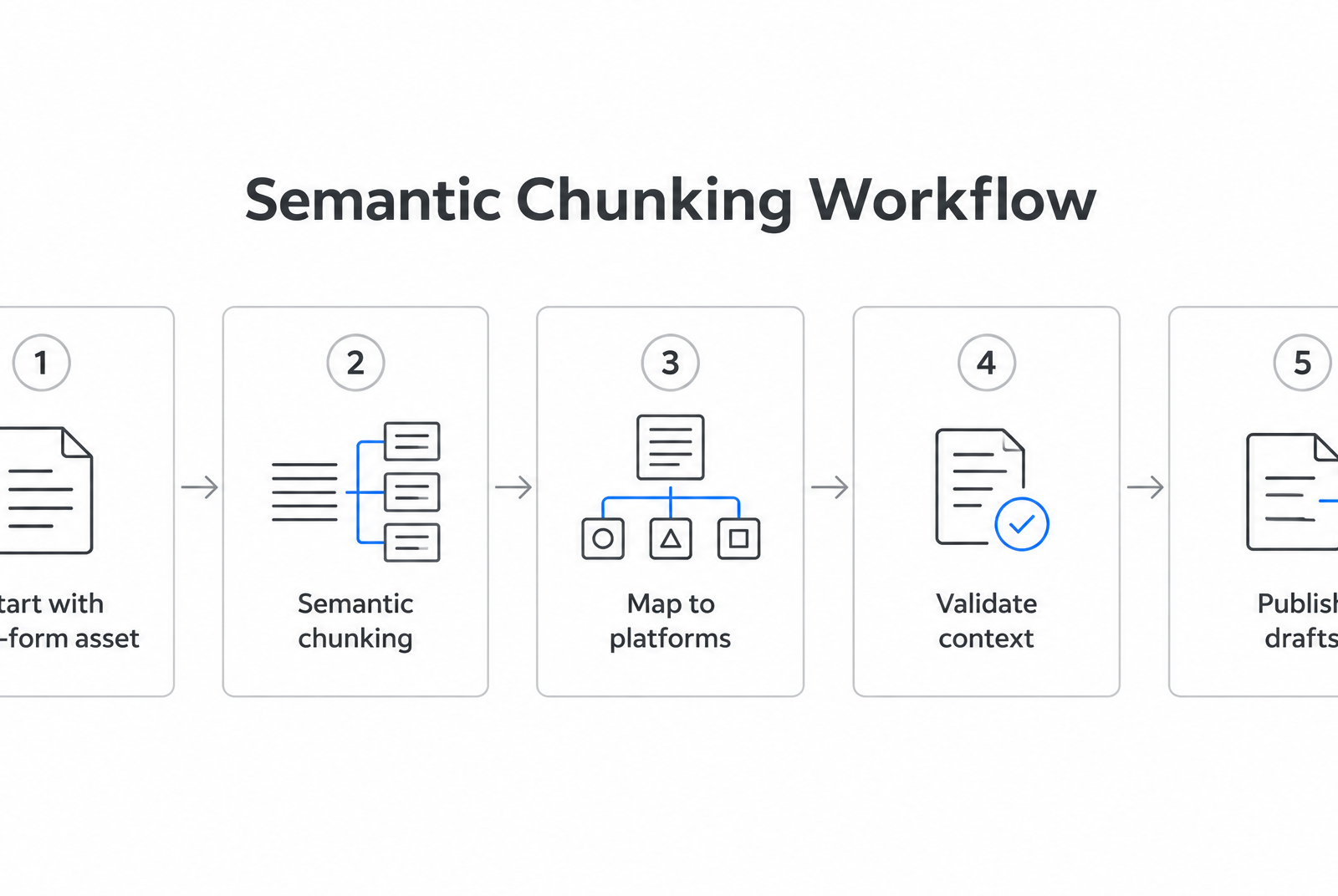
What semantic chunking looks like in practice
In a typical AI extraction flow, a transcript or article is analyzed for natural breakpoints: topic shifts, complete arguments, quotable moments. Instead of asking the model to summarize the whole asset, you can ask it to locate the pieces that can stand alone. The result is a set of source-backed units—each with a point, context, and enough internal logic to be reshaped later.
Tools with this capability can turn source content into platform-ready drafts quickly. They can accept a URL or pasted text, separate material by meaning, then pass each unit into formatting instructions for the channels you care about. The workflow shift is real: your team moves from writing platform-specific posts to reviewing AI-generated drafts and refining them for publication.
Context preservation is where teams stumble. If you drop a chunk into a social post without a short intro that anchors it to the original article's thesis, readers lose the thread. The chunk might be self-contained, but platform context still matters. A professional feed rewards framing and credibility; a real-time feed rewards sharper compression; a video-first feed needs the viewer to understand the premise before the visual beat lands.
Channel constraints become editorial guardrails here. Character counts, carousel slide limits, visual pacing, caption placement, and closers shape what each chunk can become. These aren't AI limitations—they're audience expectations. Use them to filter which chunks fit which platforms rather than forcing every chunk onto every channel. A layered framework, a compact proof point, and a quotable observation each call for different treatment. The extraction is automated, but the mapping still requires human judgement about what each platform rewards.
Tone matching across platforms: speaking the language of LinkedIn, X, and TikTok
A post optimized for thoughtful mid-workday reading will die in a fast-scrolling video feed, where users decide almost instantly whether to keep watching. AI content repurposing only works when the output respects how people actually consume content on each platform, not just when it resizes the canvas.
Platform tone profiles based on usage norms
LinkedIn readers expect professional framing and insight-led posts. Open with a lesson or a counterintuitive observation, keep sentences structured but not stiff, use first-person plural to position your company as a credible peer, and close with a question or a call to explore further. Jargon is fine if your audience uses it daily.
X rewards brevity and hook-driven structure. Lead with tension or a bold claim in the first ten words, strip every unnecessary modifier, use line breaks to create visual rhythm, and end with either a provocative question or a clear next step. Emoji use is optional but common for visual scanning.
TikTok scripts are conversational, busy, and visual-first. Start with a pattern interrupt ("The mistake we see every time…"), speak directly to the viewer as "you," keep sentences short and punchy, reference what's on screen, and close with a clear action. Formality reads as corporate and gets skipped.
Worked example: one source chunk into three platform-native formats
Suppose a long-form article contains the chunk: "Our workflow turns blog posts into platform-specific assets automatically." Here is how that chunk might be adapted, with the rationale for each format.
LinkedIn carousel
- Slide 1: "We used to repurpose by copy-pasting. It didn't work."
- Slide 2: "What changed: we feed the AI structured content, brand guidelines, and platform-specific examples."
- Slide 3: "We still require final human review for tone and accuracy."
- Slide 4: "Save this framework for your next repurposing sprint."
Rationale: LinkedIn carousels reward a clear framework and slide-based pacing; the post expands a single sentence into a small narrative, keeping the viewer swiping.
X thread
- Post 1: "Repurposing used to swallow whole afternoons."
- Post 2: "Now it's fast. The shift: train the AI on your voice + format rules."
- Post 3: "Then review instead of rewriting from scratch."
Rationale: X rewards a punchy hook, short sentences, and a thread structure that creates momentum; the same claim is compressed into scannable posts.
TikTok script
- "So this used to take us forever. Watch what happens now. [screen: paste blog URL] Minutes later, we've got platform-ready social drafts—all in our voice. The trick? We trained the AI on our brand rules first."
Rationale: TikTok needs a direct address, visual cue, and quick payoff; the script leads with the before/after shift and keeps the viewer oriented to the screen.
Linguistic cues to audit
Before publishing, check sentence length, hook style, formality level, jargon density, emoji presence, CTA phrasing, and whether the post leads with a stat, a lesson, a story, or a visual cue. The audit should also catch platform spillover: a thread that sounds like a press release, a carousel that reads like a caption, or a script that explains too much before showing anything.
Generic AI tone-matching workflow
A generic AI tone-matching workflow can use three inputs: your brand context (approved terms, voice traits, examples of past posts that performed well), the source chunk you're adapting, and the target platform's format requirements. The AI can generate platform-specific drafts. Then require human review for claim accuracy, brand-term preservation, platform-native structure, CTA adjustment, and disclosure where AI use is material. Some tools claim ready-to-publish output quickly, but that timeline assumes you've already trained the model on your brand voice—setup is front-loaded, speed comes after.
Building an end-to-end automated repurposing pipeline
The connective tissue between repurposing stages matters more than any single tool. Many workflows break down because chunking, tone adaptation, formatting, and scheduling scatter across platforms, forcing manual handoffs that kill efficiency. An automated pipeline can chain these stages so output flows directly from one agent to the next—if you record a webinar transcript once, a configured pipeline can produce a week of platform-ready posts for review.
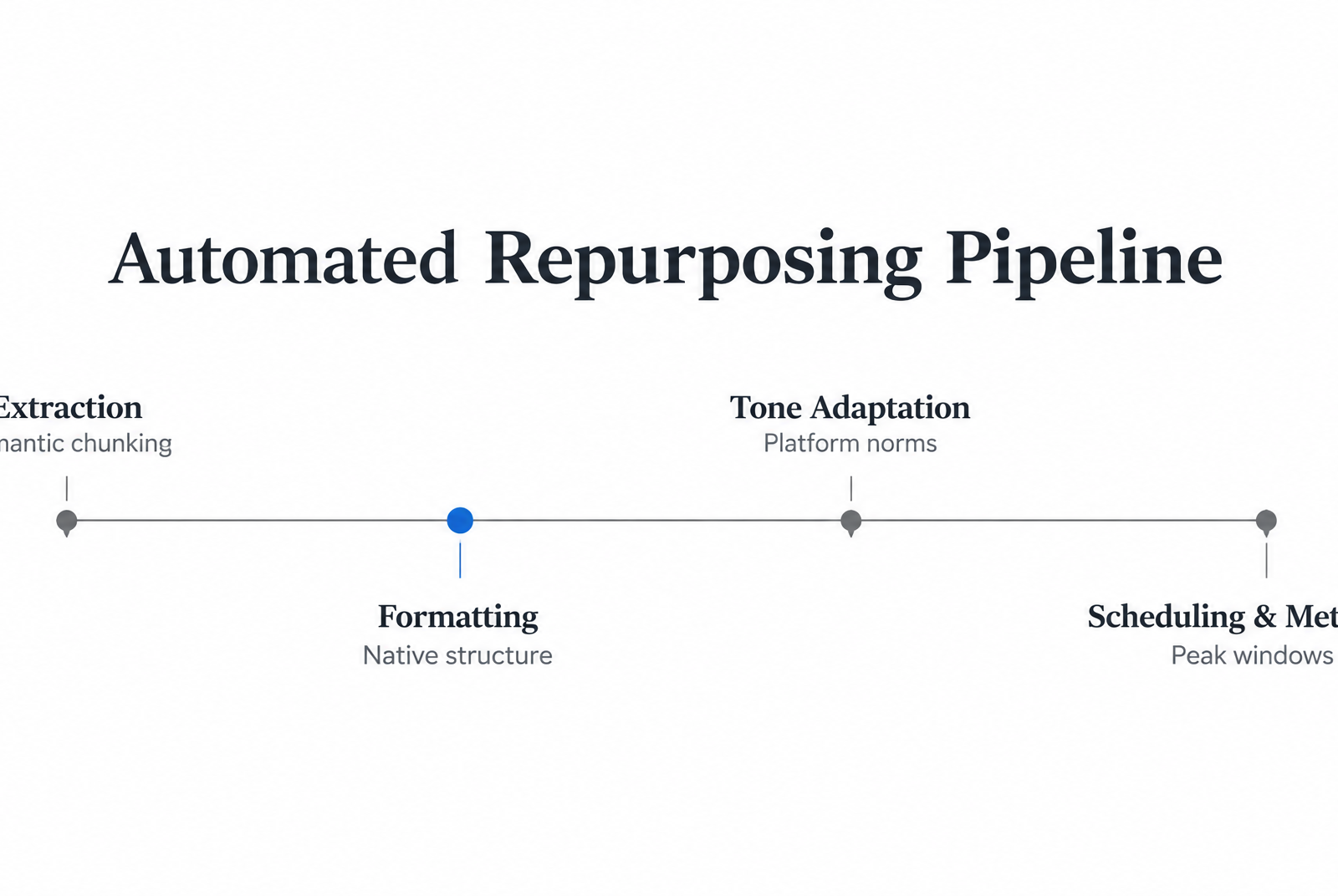
The architecture can follow a four-stage sequence. Stage one: extraction. An LLM reads your source asset—blog post, podcast transcript, webinar recording—and identifies self-contained ideas using semantic chunking. Each chunk becomes a candidate post. Stage two: formatting. A second agent converts each chunk into the native structure for its target platform, whether that means slides, numbered posts, short captions, or video script beats. Stage three: tone adaptation. The agent rewrites each formatted draft to match platform norms while preserving your brand voice through a semantic anchor, meaning a reference page that defines your terminology, style, and key messages. Stage four: scheduling and metadata. The final agent generates hashtags, UTM parameters for link tracking, and publishes or queues posts at the windows your analytics show are strongest for each channel.
Scaling without hitting credit walls
Once text workflows are stable, use higher-effort formats selectively. Video, image generation, captions, B-roll, and richer creative variants can require more setup than plain text adaptation, so they work best when tied to ideas that have already shown traction. That keeps the pipeline from turning every source asset into an expensive production queue.
A workflow of this type can run with limited supervision once configured, but two manual checkpoints help prevent drift. First, review your semantic anchor periodically to catch terminology shifts or new product features—stale anchors gradually produce outputs that drift from your voice. Second, audit tone-matched drafts in the early weeks to verify the AI stays grounded in your brand rather than sliding toward generic phrasing. By treating AI as a co-editor rather than a ghost, you scale your judgment alongside your output. The pipeline amplifies your voice, not your workload.
Measuring ROI and optimizing the repurposing engine
You publish semantic chunks across LinkedIn, X, and TikTok, watch engagement tick upward, then fail to connect any of that activity back to traffic, leads, or the original asset. Without attribution, you can't distinguish high-performing chunks from filler, and the whole engine runs blind.
Start with UTM parameters on every repurposed link. Tag source (linkedin, twitter, tiktok), medium (social), campaign (the parent asset slug or topic), content (chunk ID or theme), and optionally format (carousel, video, thread). When a user clicks through from a LinkedIn carousel on growth tactics back to your blog, you'll see utm_source=linkedin&utm_medium=social&utm_campaign=growth-tactics&utm_content=chunk-2 in Google Analytics. That single string tells you which semantic chunk drove the visit.
Then carry that chunk ID into an attribution model. For each parent asset and chunk, record platform, format, UTM, traffic sessions, leads, assisted conversions, backlinks or referring mentions, and any local-visibility signals your business already tracks. Add two cost fields: review time for that chunk-format combination and production cost, such as tool credits or agency fees. This connects the same chunk ID to traffic, leads, backlinks, local visibility, review time, and production cost by platform. It also shows whether a chunk that flops on one platform deserves a second angle on another—or whether the review time is erasing the production savings.
Track the KPIs that matter: traffic sessions, leads (form fills, demo requests), engagement rate, reach, views, click-throughs, follower growth, assisted conversions, cost per asset (tool credits plus review time), and time saved. The business case for repurposing centers on extracting more value from assets you've already paid to create—repeating your reach, nurturing leads across channels, and compounding visibility without starting from zero each time. Your dashboard shows whether that multiplication effect is happening.
Cost-side optimization and format tradeoffs
Compare software subscriptions against service costs by including the labor your team still owns. A low monthly tool price is only useful if review time stays manageable; a service retainer can make sense when internal review hours start crowding out higher-value strategy work. Calculate the breakeven using your loaded hourly rate, your publishing volume, and the number of drafts that need substantial revision.
A/B test hooks, chunk types, visuals, tone, CTA, post length, and publishing time while keeping the source idea constant. Run a single semantic chunk as two different opening angles, measure click-through on identical landing pages, and let the winner inform your next batch. Build a monthly ROI spreadsheet tying each repurposed post back to the original asset: columns for parent asset, chunk ID, platform, chunk type, format, publish date, UTM, spend (tool cost or agency retainer), production time, review time, engagement, traffic, leads, backlinks, local visibility signals, and next action. That feedback loop closes the optimization cycle—semantic chunks that drive backlinks, local search visibility, and conversions per platform become your template for the next parent asset.
Questions People Ask
What happens if my source content isn't structured enough for semantic chunking to work well?
Messy source material usually produces messy fragments. The AI may identify usable excerpts, but someone still has to decide where an idea begins, where it resolves, and what context a reader needs before seeing it on another channel. If your original article, transcript, or webinar has clear sections, topic transitions, and complete arguments, repurposing becomes much easier downstream.
How do I know when a repurposed post needs human editing versus when I can publish the AI draft directly?
Look for three failure signals: the claim has been softened or exaggerated, the phrasing sounds unlike your team, or the format ignores how the target platform is normally consumed. If none of those show up after a quick review, the draft may only need minor polish. If they appear repeatedly, improve the source instructions before increasing publishing volume.
Can I repurpose older content that predates my current brand voice, or will tone mismatches create inconsistency?
Older content can work if the underlying insight still holds, but treat it as raw material rather than finished messaging. Pair it with your current brand anchor and recent examples so the AI adapts the idea to today’s voice instead of preserving outdated phrasing. Start with legacy pieces that still earn traffic or engagement, then retire the ones whose point of view no longer matches your positioning.