AI Content Repurposing vs Programmatic SEO: Borrowed Reach or Traffic You Own?

Key Takeaways
- Picking between AI content repurposing and programmatic SEO is really a decision about what kind of traffic infrastructure you're building.
- Repurposed content borrows its reach from the source asset. If the original doesn't rank, the spin-offs won't either.
- Many marketers using AI tools report meaningful time savings, and some teams have scaled monthly publishing volume significantly without new hires.
- Programmatic SEO plays at a different scale, generating thousands of pages off structured data templates.
- Content backed by real first-party expertise, like client case studies and original research, belongs under manual curation, not automation.
- Generic how-to content that can be structured and made citation-ready is the safer candidate for automated workflows.
- Comparing raw page counts misses the real question: which content can be safely automated, and which needs oversight to protect domain authority.
The short version before you commit
Choosing between AI content repurposing and programmatic SEO comes down to what kind of traffic infrastructure you want to build. One turns existing assets into fresh formats. The other spins hundreds or thousands of pages out of structured data templates.
Teams get stuck comparing raw page counts. The real question is which content you can safely automate versus which pieces need a human to protect your domain's authority.
AI content repurposing: what you're actually getting
Repurposing takes one source piece, say a long-form guide, a webinar transcript, a podcast episode, and reshapes it into multiple formats. A long-form article becomes social threads, carousels, newsletter segments, video scripts.
The value is speed and format diversity. Many marketing teams adopting AI workflows report substantial time savings on production, and some have grown monthly publishing volume without adding to editorial headcount, just by systematizing the pipeline.
Here's what the benchmarks won't tell you. The performance of every derivative stays tethered to the search authority of the source. If the original piece never gains traction, the spin-offs have nothing to inherit.
So the operational boundary is clear. Assets built on proprietary data, direct client interviews, or founder insight need close human stewardship. Standard informational guides that lean on public facts are fine to hand to an automated transform.
Programmatic SEO: the volume play with a citation problem
Programmatic SEO generates pages at a scale repurposing can't touch. Depending on the setup, teams can produce thousands of pages in hours to days, often at a fraction of the cost of traditional production, which can run hundreds of dollars per page and take weeks.
Some large brands run millions of programmatic pages that drive a significant share of their organic traffic. Others pair a smaller set of traditional articles with a much larger network of programmatic integration pages, catching both awareness searches and bottom-funnel intent.
The catch: generic programmatic pages don't get cited in AI search results. As AI assistant usage climbs, with some surveys suggesting roughly a quarter of consumers now use one weekly, unstructured pages get summarized without a click. You thought you owned that traffic. Increasingly it's borrowed reach through answer engines.
Pages that aren't structured and citation-ready are more likely to be paraphrased than clicked. Google's Helpful Content system targets sites that put search engines ahead of users, which lands hard on low-quality programmatic builds.
The hybrid split most teams land on
The strongest setup splits the work: a programmatic-heavy mix for long-tail coverage, with a smaller share of traditional content for authority. AI agents can lift content velocity and cut research time dramatically, but they can't replace human judgment on pieces where ranking depends on demonstrated expertise.
Use programmatic logic for content with rich structured data and low-competition keywords: product specs, location pages, comparison tables. Reserve manual curation for content that needs first-party authority to rank and get cited: original research, expert analysis, case studies with real client outcomes.
The decision comes down to citation-readiness. If a piece can be made structured enough that AI engines cite it instead of summarizing it, automate it. If its value depends on expertise signals only a human can provide, keep it under editorial control.
| Approach | Volume Capacity | Cost per Page | Time to Launch | Best For | Citation Risk |
|---|---|---|---|---|---|
| AI Content Repurposing | Scales with source assets | Lower than traditional | Days to weeks | Multi-channel distribution, format diversity | Low if source content ranks |
| Programmatic SEO | Thousands of pages | Low per page | Hours to days | Long-tail keywords, structured data | High for unstructured pages |
| Hybrid (Recommended) | Programmatic-heavy + traditional layer | Mixed | Ongoing | Balanced reach and authority | Managed through curation rules |
One more thing: don't pick a tool before you define your page types. Teams that choose a platform first end up forcing their strategy into the tool's constraints instead of the other way around.
Why this choice matters at all
Really you're asking how to balance automated execution against human judgment across your whole footprint. That balance decides where your creative resources go.
Teams frame it as a volume question, how many pages can we generate, when the actual selection factor is citation-readiness. As conversational engines capture more queries, pages without structured markup risk getting digested into zero-click answers. Content that isn't built for those engines watches its visibility erode.
When auto-republish makes sense
Auto-republish works best when you're reshaping assets you already trust. A long-form guide breaks down into social posts, email newsletters, video outlines. The source carries your team's expertise, and the repurposing step is structural, not substantive.
It scales without a data-maintenance burden. You're not feeding templates with external datasets that go stale. You're pulling value out of content that's already vetted. This fits teams with strong pillar content but thin distribution bandwidth. You've got the depth, you just need the reach.
The risk shows up when repurposed content lacks the structured layer AI engines need to cite it. If a social post references a concept without defining it, or a carousel skips the underlying data, those pieces get summarized instead of linked. That's the curation call: deciding which source pieces are citation-ready as-is and which need a structured layer before you spin them out.
When programmatic SEO wins the long tail
Programmatic makes sense when you have rich structured data and low-competition long-tail keywords. Some travel platforms show the pattern with location-and-attraction pages. Each page targets a specific city-activity-intent combination, so a query like "family-friendly museums in Lisbon" lands on a page built to answer exactly that. Data feeds the template, the template scales instantly, the page resolves a precise query.
Deployment speed is unmatched, letting a brand grab thousands of long-tail variations almost overnight. But here's the constraint most teams miss: programmatic pages need ongoing refresh workflows, not a one-time generation sprint. Data goes stale, templates need tuning, and citation-readiness needs periodic audits.
In competitive niches, generic programmatic pages struggle. Modern algorithms are good at spotting and filtering low-effort templated directories that add nothing for the searcher. The pages that survive have strong data governance and refresh automation behind them.
The hybrid split, again, because it's the answer
Most teams settle on a programmatic-heavy mix with a thinner manual layer. The programmatic layer handles the long tail where structured data answers cleanly. The manual layer covers top-funnel awareness content where ranking depends on first-party expertise and E-E-A-T signals.
A workable model uses a foundation of editorial articles to establish authority, then a broader network of automated pages to hit specific intents. The programmatic pages stay citation-ready because they're built from structured data (integration specs, feature comparisons, API endpoints). The editorial content builds the domain authority that lets those programmatic pages rank at all.
A useful gut check for where a page belongs: does its value come from a defensible point of view, or from a lookup? Comparison hubs, opinionated buying guides, and original research sit on the manual side because their authority is the moat. Spec sheets, glossary entries, integration listings, and location pages sit on the programmatic side because the data is the moat. Pages that blur the two, like a category page that needs both a data table and an editorial recommendation, are the ones worth flagging for a human pass before they ship at scale.
The framework in one line: if a page's value depends on original analysis or editorial judgment, manual curation protects your domain authority. If it answers a query with structured, verifiable data, programmatic scales it efficiently.
Where the feature gap actually lives
Comparing repurposing platforms against programmatic tools is really about where you place your quality-control gates. The gap isn't volume anymore. It's what kind of control you keep over quality, structure, and citation-readiness.
Teams pick tools on page-count capacity when the real factor is long-term maintenance. A platform that can't maintain content over time or structure pages for citation will bleed visibility.
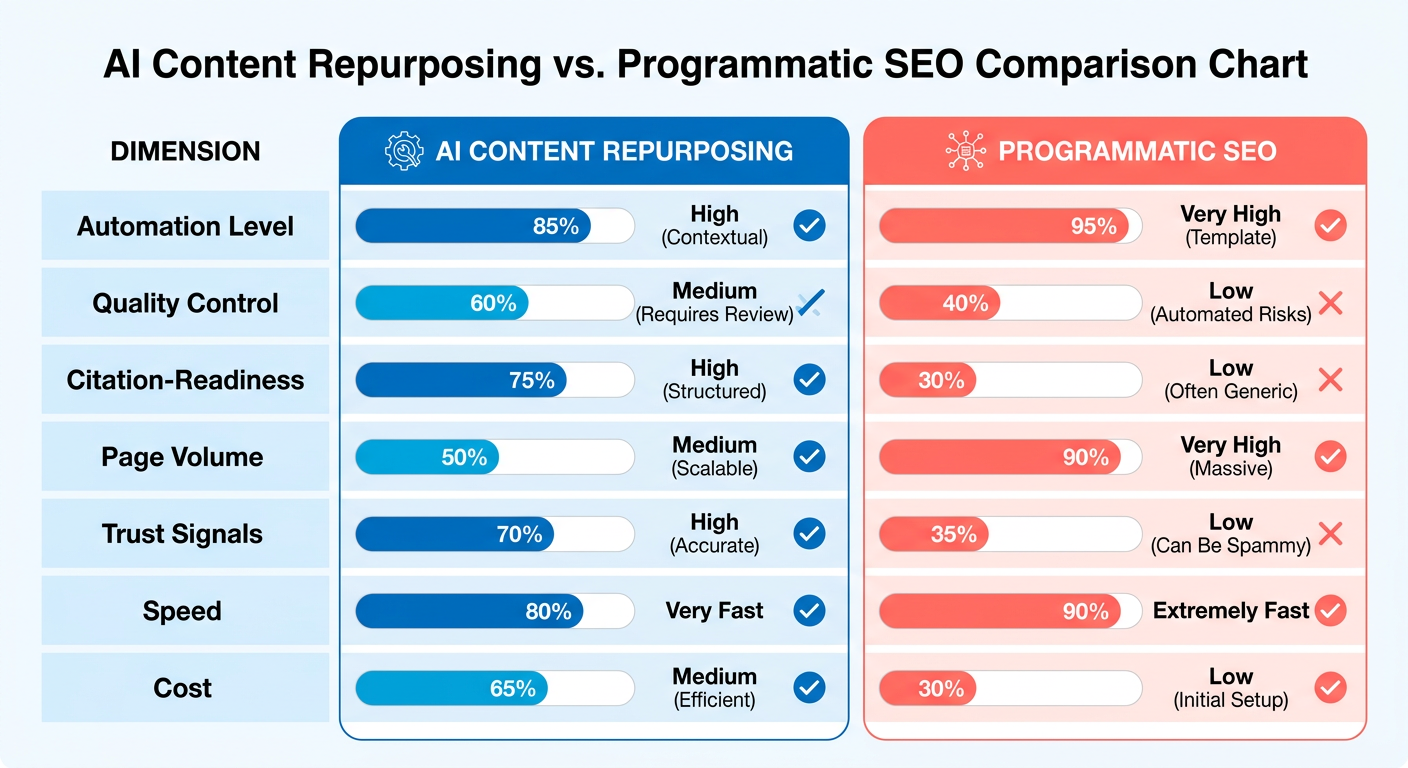
Content generation model
Repurposing turns one source asset into multiple formats: social posts, email sequences, video scripts, all from a single input.
The strength is format flexibility. You're not locked into templated pages. Each output adapts tone, structure, and depth for its destination. That works when the goal is cross-channel presence rather than long-tail keyword coverage.
Programmatic generates thousands of pages from structured data templates. You map a dataset (product specs, location attributes, comparison tables) to a reusable template, then publish at scale.
The advantage is keyword capture. Control the data source and template logic, and you can publish continuously as new data arrives. A marketplace adding hundreds of sellers a month can auto-generate a landing page for each. A B2B directory tracking thousands of vendors can spin comparison pages for every category-subcategory pair.
The split that matters: programmatic volume only works if the pages are citation-ready. Users relying on conversational AI for daily research may never click through when the engine can extract and present the answer directly.
Maintenance and refresh
Most repurposing platforms handle one-time transformation. Upload a source, generate outputs, publish. If the original changes or performance drops, you run it again by hand.
Fine for episodic campaigns. It breaks down when you're maintaining a library of evergreen assets that need periodic updates.
Programmatic tools increasingly cover the full lifecycle: data ingestion, template logic, publishing, refresh workflows, and AI-search visibility tracking. The strongest ones let you update the underlying dataset once and push changes across thousands of pages automatically.
This is where programmatic shifts from a volume play to maintenance infrastructure. If your pages need real-time updates (pricing changes, inventory shifts, regulatory adjustments), governed refresh workflows keep them current without manual work.
The ability to refresh content over time matters more than the ability to generate it once. Teams that treat programmatic as a one-time deploy end up with stale pages that lose rankings and fail citation checks.
Quality control and human oversight
| Feature | AI Content Repurposing | Programmatic SEO |
|---|---|---|
| Editorial review required | Yes, per output format | Yes, at template level |
| Automation level | Format transformation | Full page generation |
| Quality risk | Tone drift, factual errors per format | Generic output across all pages |
| Manual curation need | High (each output needs review) | Medium (template + sample audit) |
Repurposing needs output-level review. Every thread, newsletter, and script needs a human checkpoint to confirm the transformation kept meaning and tone. That caps your scale when you're repurposing dozens of source pieces a week.
Programmatic concentrates quality control at the template and data layer. Audit the template logic once, then sample-check the output. If the template is sound and the data is clean, most pages ship without individual review.
That's also the trap. Generic templates produce generic pages, which are wide open to algorithmic devaluation. In competitive niches, platforms with strong editorial oversight beat pure programmatic builds because every page reflects first-party expertise. The line runs between data-driven lookups and experience-driven analysis. If a page just displays structured records, automation is efficient. If it calls for subjective judgment, a human has to be in the loop.
Speed, and where speed betrays you
Speed is where these two split hardest. Programmatic manufactures pages from a data table, so its clock runs on how fast you can map fields to a template. Repurposing is fast in a different way: it turns one proven asset into many formats, not spreadsheet rows into pages.
The real performance question isn't raw output. It's finding the quality-assurance bottleneck. That's what decides where repurposing builds long-term authority and where sheer programmatic volume risks losing it.
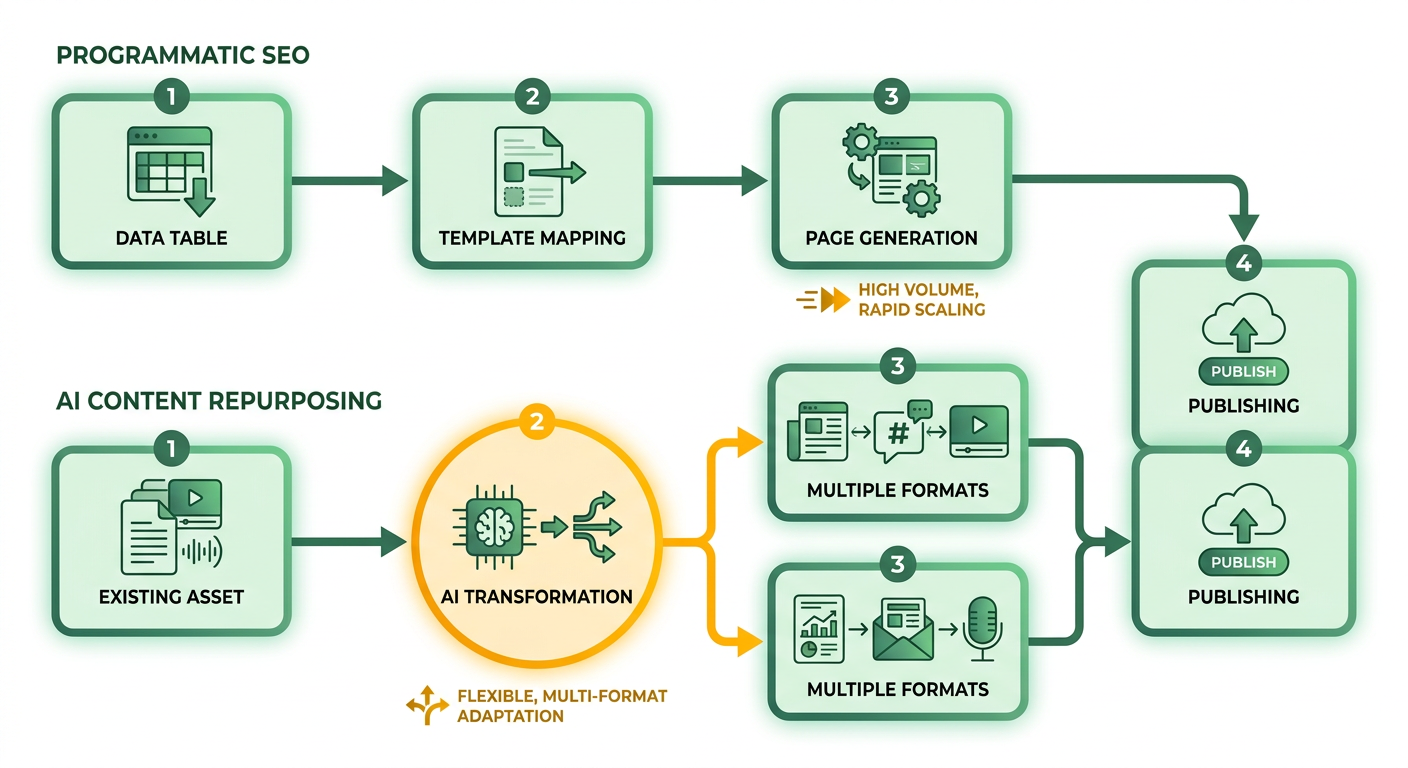
How much faster is programmatic?
Programmatic wins on raw velocity, full stop. Where editorial teams grind out a limited number of pages a month over weeks, automated workflows compress research and drafting from weeks to minutes.
But velocity only counts if the pages earn citations, and the data pulls in two directions. Some sources argue AI agents can refine templates and improve rankings without human input. Other research finds human-written content outranking AI content in most cases.
Our read: both are right, for different work. AI genuinely owns iteration on structured, patterned pages. Humans still own the pieces that need first-party expertise.
Which one scales without burning resources?
Repurposing scales on efficiency. Programmatic scales on volume. Teams that turn one webinar into blog posts, short clips, and email sequences reclaim hours that would have gone to net-new drafting, and can grow output without dropping editorial standards.
Programmatic scales bigger and riskier. Pairing high-authority editorial pillars with a vast network of automated utility pages captures both broad informational queries and specific transactional intent. The tradeoff is oversight. Every programmatic page you add is one more page no human reviewed.
| Performance factor | Content Repurposing | Programmatic SEO |
|---|---|---|
| Growth lever | Efficiency per source asset | Page count per data set |
| Failure mode | Format fatigue on one topic | Thin, near-duplicate pages |
| Review load | Heavy upfront, light downstream | Light upfront, deferred risk |
| Ranking driver | First-party expertise | Query-matched structured data |
| Scales best for | Expertise-driven, citation-ready pieces | Structured, data-rich long tail |
Repurposing lives in that first row. One source asset feeds multiple channels, so the expertise gets multiplied instead of diluted.
What should you auto-republish?
Automate the structured data. Curate the expertise. Spec sheets, location data, and comparison tables are safe to run programmatically because they're already citation-ready. Pieces whose value rests on first-party judgment need a human checkpoint.
The reason is a decaying moat. Programmatic scale still wins the classic blue-link long tail. That same generic volume gets summarized instead of clicked in AI answers, so the equity you build there erodes as engines paraphrase it.
A hybrid split works, but only if the programmatic share is engineered for citation. Match the volume to structured data, keep humans on the judgment calls, and your pipeline compounds equity instead of borrowing it.
Pros and cons, weighed against your SEO equity
The clearest way to weigh these is to ask what each does to your SEO equity. Repurposing inherits first-party expertise from a proven source, so it carries the trust signals search and answer engines reward. Pure programmatic wins on raw page volume but risks pages that generate unstable visibility.
That difference maps straight onto your risk profile. Repurpose existing content with AI and you're recycling verified expertise into new formats. Generate thousands of templated pages and the ranking risk climbs, with some pieces needing a human before they ship.
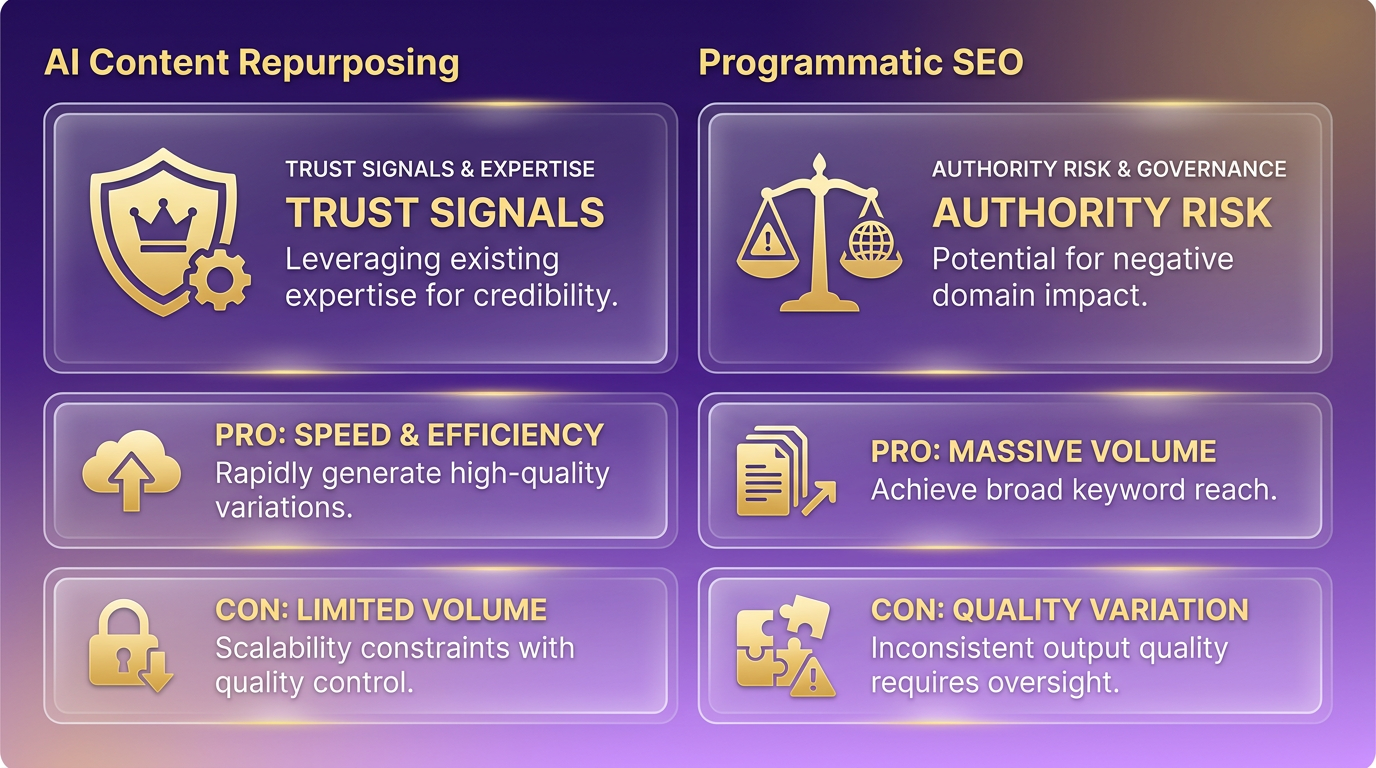
The real advantages of each
Programmatic's strength is velocity at scale. Large software directories have deployed hundreds of thousands of automated landing pages to capture integration queries, ground that would take years to cover by hand. For data-rich cases like spec sheets, location pages, and integration directories, nothing matches that reach.
Repurposing wins on quality-per-page and citation-readiness. Because each piece traces back to expert source material, it clears the bar that dooms generic programmatic builds. Repurposed pieces that match your tone and carry your brand context stay consistent and keep the trust signals intact instead of drifting into generic output.
The tradeoff is coverage. Repurposing can't blanket hundreds of thousands of long-tail queries the way a template engine can. It goes deep on assets you already trust, not wide across a keyword database.
Where each one falls down
Programmatic's weakness is exposure in AI answers. Generic pages get summarized without a click. Search engines are actively refining their systems to devalue pages built purely to capture volume without offering real utility.
AI-generated content has its own ceiling. Google's quality guidelines flag scaled content produced mainly to manipulate rankings, and thin AI pages are a common trigger. That's the E-E-A-T gap. It's also exactly why repurposing beats raw generation: it starts from human expertise instead of manufacturing it.
The contradiction worth resolving is the same one that runs through this whole comparison. One camp says AI agents can refine templates and improve rankings with no human input. Editorial purists say oversight is non-negotiable for brand trust. Both are right about different work. Let AI own iteration on structured programmatic pages, and keep humans on expertise.
| Factor | AI Content Repurposing | Pure Programmatic SEO |
|---|---|---|
| SEO equity | High. Inherits first-party expertise | Variable. Thin pages risk penalties |
| Citation-readiness | Strong when structured | Weak for generic templates |
| Volume ceiling | Bounded by source assets | 100k+ pages |
| Human oversight | Light on repurposed formats | Heavy on quality-sensitive pages |
| Best for | Turning trusted assets into channels | Long-tail, data-rich queries |
When to skip repurposing
Skip it when your target is a massive database of near-identical long-tail queries. If you're ranking store locations or product variants, a template engine covers that ground faster than reformatting source material ever will.
On the repurposing side, some platforms turn a single piece of content into social carousels and posts and publish across major networks, so the same expert source stays citation-ready on every channel. For most teams the honest answer is a blend: automate what's structured, curate what's expert.
Who each approach is actually for
The fastest way to pick your workflow is one question: does this piece earn its ranking from structure or from expertise? That single split decides where AI content repurposing protects your SEO equity and where raw programmatic volume quietly drains it.
The best fit breaks along citation-readiness, not team size or page-count ambition. Repurposing suits teams sitting on proven assets who want more reach without diluting authority. Programmatic suits data-rich operations with thousands of near-identical query patterns to fill.
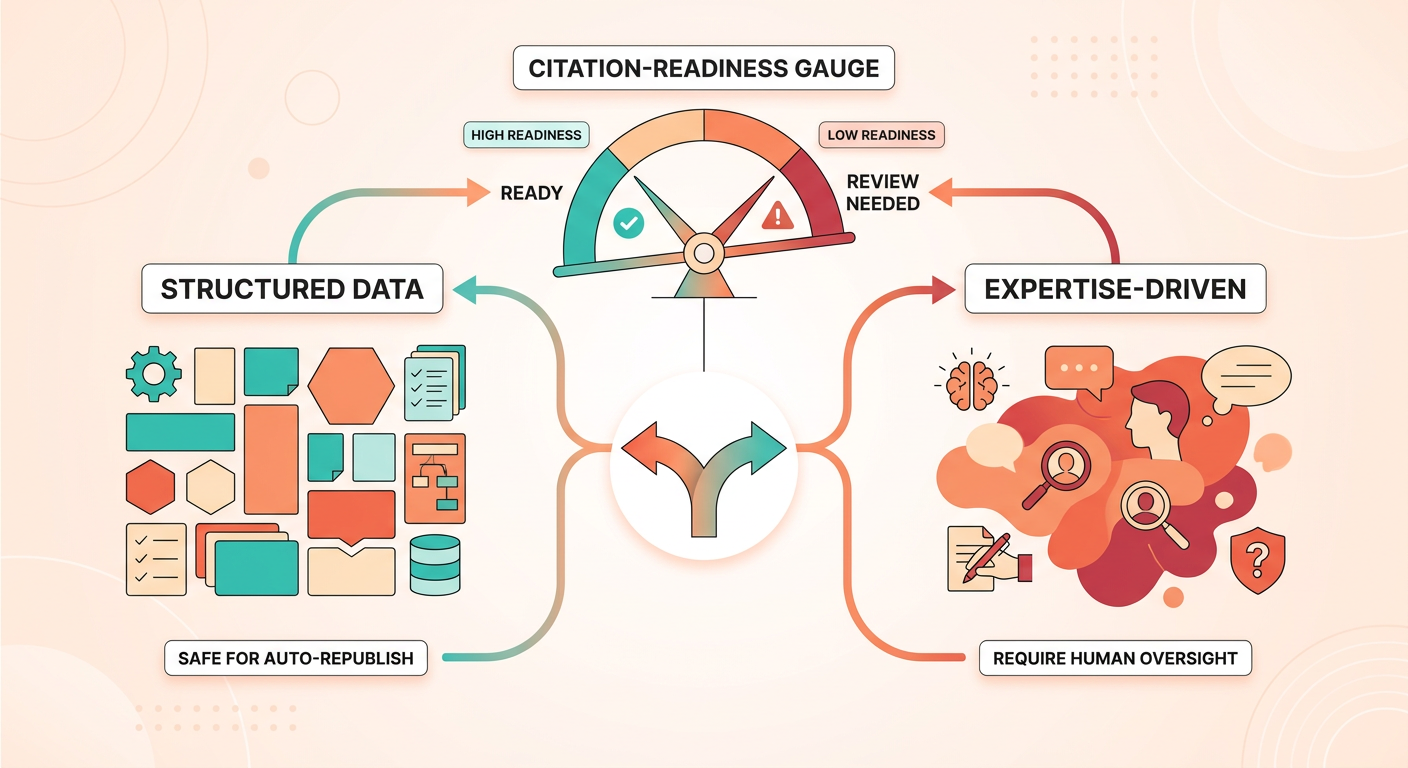
Who should choose AI content repurposing?
It fits teams with a library of expert-backed source material and limited bandwidth for net-new content. It inherits first-party expertise, so the output carries trust signals generic pages lack. That makes it the safest thing to put on autopilot.
The model works when you already own the source truth. A SaaS company with a library of technical webinars can turn each recording into LinkedIn posts, email sequences, and blog summaries without re-interviewing engineers. An agency with case studies can pull client-specific insights and distribute them across channels while keeping attribution intact. The output carries the same authority as the original because it's derived directly from verified work.
This is where repurposing platforms earn their keep, turning one high-quality asset into optimized social posts and newsletters while preserving the original author's insight. Capture your brand voice and you hold a consistent multi-channel presence without manual drafting.
Who should choose programmatic SEO?
Programmatic fits data-rich businesses with structured inventories: spec sheets, location pages, comparison tables. The model works when your value comes from the data, not the prose. Real estate platforms serve millions of property pages generated from listing feeds. Review platforms scale location-based landing pages using business listings and review data. Both depend on structure that templates without loss of utility.
The catch is durability. As conversational engines handle a growing share of informational queries, standard programmatic pages face a steep decline in referral traffic. Programmatic still wins the classic blue-link long tail, but it leaks reach the moment a query surfaces in an AI answer instead.
How to match the tool to the job
Map each content type to the workflow that protects its equity. Here's a common split:
| Content type | Best workflow | Why |
|---|---|---|
| Expert guides, webinars, podcasts | AI content repurposing (auto) | Inherits first-party E-E-A-T |
| Spec sheets, location data, comparison tables | Programmatic (auto) | Value lives in structure, not prose |
| Competitive-niche thought leadership | Manual curation | Ranking depends on judgment AI does poorly |
| Integration and template pages | Programmatic + periodic audit | High volume, low citation risk |
Some tools claim AI can improve rankings with no human touch. True for structural, data-pattern work. False for anything that needs deep expertise. So let AI own iteration on structured pages, and keep humans on the pieces where authority is the ranking factor. Skip pure programmatic entirely if your niche is competitive and your differentiation is expertise. Volume won't save you when the pages don't get cited.
What I'd actually recommend
After weighing both: don't pick one. The strongest content engines run both tracks in parallel, leaning heavily on programmatic pages while reserving a smaller slice for expertise-driven work. Repurposing is what makes that expert slice scale without diluting authority.
The winning question was never about raw volume. It's about how you integrate the two workflows. Get the split right and repurposing compounds your equity. Get it wrong and programmatic volume quietly turns into rented visibility.
Which content should you auto-republish?
Auto-republish anything that earns its ranking from structure: spec sheets, location pages, comparison tables, integration listings. These get their value from clean, consistent data, so AI can generate and refine them at scale. Large retailers generate millions of product and category pages from a single catalog schema, letting one template serve thousands of long-tail queries.
Keep humans on anything that ranks on expertise. Industry benchmarks consistently show content with genuine human experience and original testing performing better in competitive search. That gap isn't about grammar. It's about the first-party judgment search and answer engines reward.
That resolves the tension running through this whole piece. Automated agents can optimize technical templates and structured layouts. They can't replicate the firsthand authority needed to rank for competitive, opinion-based queries. Keep people on the content that carries your name.
Best choice by scenario
Match the method to what you already have. If your library leans on expert guides, webinars, and podcasts, repurposing turns those proven assets into fresh reach. If you sit on thousands of near-identical query patterns or a data-rich SaaS or e-commerce catalog, programmatic captures that long-tail volume, with human-curated pillars anchoring the trust. Building for AI-answer citation? Repurpose verified expertise, because citation-readiness rides on first-party judgment. And when you need both audience trust and long-tail coverage, run the two tracks together.
A working hybrid uses a core of expert-written articles to build domain authority, then deploys automated pages to catch specific long-tail terms.
Where AnyPost.ai fits
If your growth depends on turning proven assets into more reach, AnyPost sits squarely in the repurposing lane. We take one source piece and expand it across formats while preserving the first-party expertise that keeps content citation-ready. That's the safest half of your engine to automate.
Skip pure programmatic if you're in a competitive niche with no structured-data moat. The volume won't get cited by modern engines. For everyone else, build the mix: automate the structured pages, repurpose the expert ones, and keep a human on anything that trades on authority. Automate the distribution of your best insights across your active social channels, and your brand stays visible without adding to the team's daily writing load.
Frequently Asked Questions
1. What happens to my repurposed content if the original source article never ranks?
Your derivatives amplify content that hasn't proven it can pull organic traffic. Repurposed pieces borrow reach from the source asset's SEO equity, so they only benefit when the original ranks. If the source underperforms, spinning it into threads, carousels, or newsletters won't rescue its visibility.
2. Why do my programmatic pages get summarized in AI search instead of clicked?
As conversational search engines become more popular, they extract and display information directly on the search results page. If your pages lack structured data or unique insights, AI engines will summarize your content without sending visitors to your website. This shifts your organic search visibility into zero-click answers that read your facts without sending a click.
3. How do I tell whether a specific page belongs in the programmatic or manual bucket?
Ask whether the page's value comes from a defensible point of view or from a lookup. Comparison hubs, opinionated buying guides, and original research stay manual because authority is the moat. Spec sheets, glossary entries, integration listings, and location pages go programmatic because the structured data is the moat.
4. Can programmatic SEO trigger a Google penalty?
Search engines use sophisticated algorithms to identify and devalue sites that produce massive amounts of low-effort, templated content. To avoid penalties, automated pages must provide genuine utility and accurate, up-to-date information. Pages that survive have strong data governance and refresh automation, so generic volume without structure risks filtering instead of ranking.
5. Is programmatic SEO a one-time build I can set and forget?
Programmatic pages need ongoing refresh workflows, not a single generation sprint. Teams that treat it as a one-time deploy end up with stale pages that lose rankings and fail citation checks over time.
6. When should a team skip repurposing entirely?
Skip repurposing when targeting a massive database of near-identical long-tail queries, like store locations or product variants. A template engine covers that ground faster than reformatting source material ever will. Repurposing goes deep on trusted assets, not wide across a keyword database, so structured volume needs programmatic tooling.
7. How does AnyPost.ai fit into the repurposing side of a hybrid strategy?
AnyPost.ai automates the process of turning your long-form assets into optimized social media posts and newsletters. By capturing your unique brand voice, it helps you maintain a consistent multi-channel presence without manual drafting, ensuring your expert source stays consistent and citation-ready across all major social platforms.
