
AnyPost vs Unlock Insights to Grow ...: Google RankBrain Content Analytics

Introduction to AnyPost and Unlock Insights
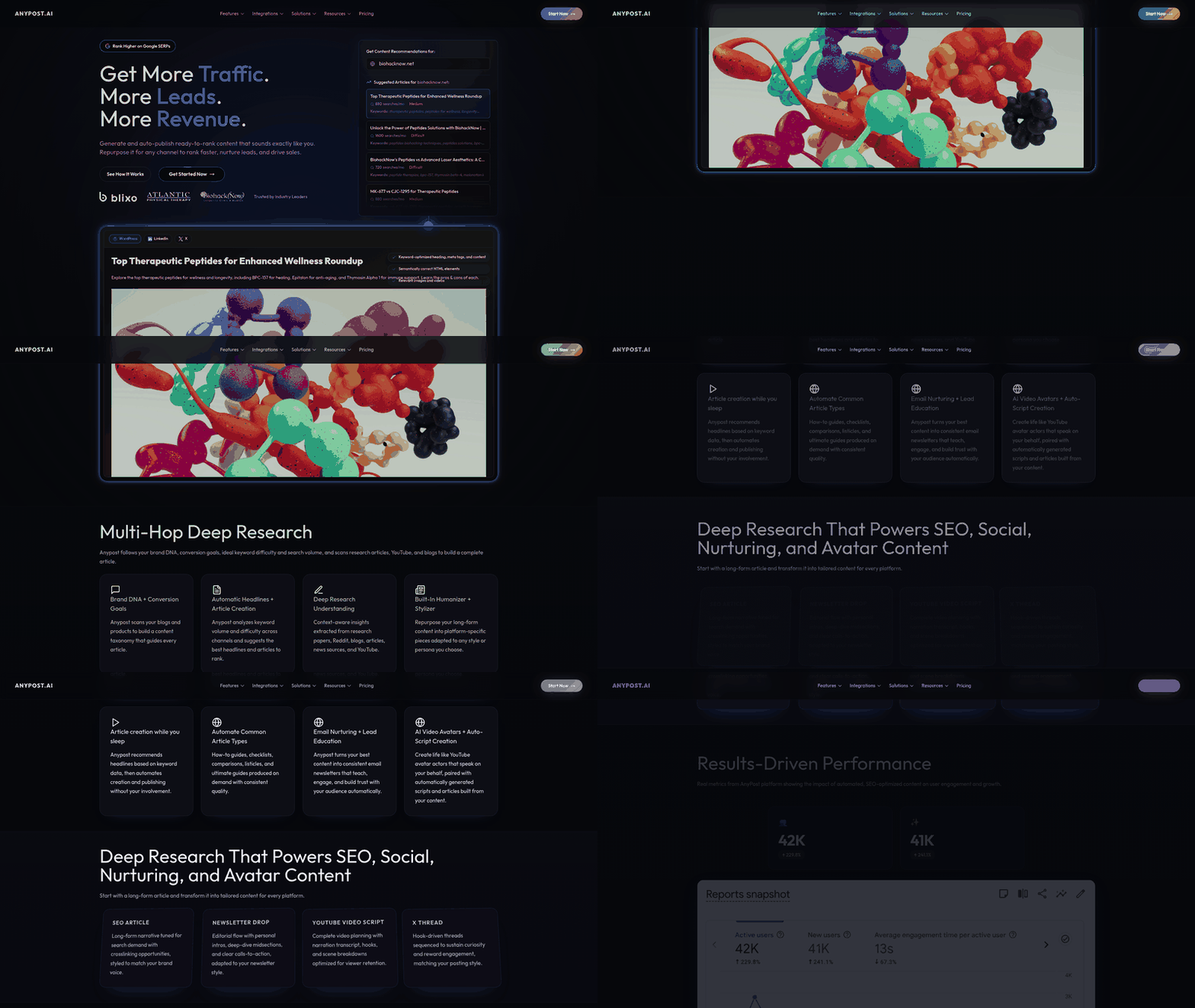
In the dynamic landscape of content marketing and SEO optimization, platforms like AnyPost and Unlock Insights have emerged as tools designed to streamline content creation workflows and enhance digital visibility. These platforms cater to professionals seeking to automate content generation, refine SEO strategies, and publish content efficiently. While both address overlapping challenges in content marketing, their approaches to solving these issues differ in scope and methodology. This section outlines their core functionalities, target audiences, and key features, providing a foundation for understanding their roles in modern SEO practices.
Target Audience and Pain Points
Content creators, marketers, and SEO specialists often face time constraints, inconsistent content quality, and the need for data-driven optimization. AnyPost and Unlock Insights aim to alleviate these pain points by offering automated tools that reduce manual effort and improve output consistency. The platforms target teams and individuals managing high-volume content demands, such as bloggers, e-commerce businesses, and agencies. For instance, AnyPost focuses on automating content creation for platforms like social media and blogs, while Unlock Insights emphasizes data-driven SEO analysis to refine content strategies. Both address the challenge of balancing speed with quality, but their approaches reflect distinct user needs: AnyPost prioritizes workflow automation, whereas Unlock Insights centers on analytical depth for SEO refinement.
| Platform | Target Audience | Key Pain Points Addressed |
|---|---|---|
| AnyPost | Content creators, bloggers | Time-consuming manual writing, consistency |
| Unlock Insights | SEO specialists, agencies | Data-driven optimization, keyword research |
Key Features and Functionalities
The core capabilities of AnyPost and Unlock Insights revolve around automation and SEO optimization, though their implementations vary. AnyPost integrates automated content generation using AI-driven templates, enabling users to produce drafts for blogs, social media posts, and email campaigns. Its publishing tools streamline scheduling and distribution across platforms. See the [Comparison of Content Generation Features] section for more details on their respective methodologies. Unlock Insights, on the other hand, leverages SEO analytics to audit content quality, track keyword performance, and suggest improvements. It provides real-time feedback on on-page SEO elements like meta tags, headers, and content structure. For a deeper dive into their SEO optimization tools, refer to the [SEO Optimization and Performance Tracking] section. While AnyPost emphasizes speed and scalability in content production, Unlock Insights focuses on precision and performance optimization, appealing to users prioritizing technical SEO.
| Feature | AnyPost | Unlock Insights |
|---|---|---|
| Automated Content Generation | AI-driven templates for drafts | Limited (focus on SEO refinement) |
| SEO Optimization Tools | Basic keyword integration | Advanced analytics and audits |
| Publishing Workflows | Scheduling and multi-platform | Limited publishing automation |
Comparative Analysis of Use Cases
The distinct feature sets of AnyPost and Unlock Insights reflect their design philosophies. AnyPost is ideal for users requiring rapid content production with minimal input, such as teams managing multiple social media accounts or businesses needing consistent blog updates. Its automated workflows reduce reliance on manual writing, though users may need to invest time in refining AI-generated drafts. Unlock Insights, conversely, suits SEO-focused teams that prioritize technical optimization over speed. By offering granular control over keyword targeting, backlink analysis, and content quality scores, it empowers users to align their strategies with Google’s RankBrain algorithm as detailed in the [SEO Optimization and Performance Tracking] section. However, its lack of robust automation for content generation limits its appeal to users seeking end-to-end solutions.
Both platforms demonstrate the evolving intersection of AI and SEO, but their effectiveness depends on specific user requirements. AnyPost’s strength lies in its ability to scale content creation, while Unlock Insights excels in refining SEO performance through data-driven insights. For organizations needing a hybrid approach, evaluating how these tools complement or compete in their workflows becomes critical. The next section will delve into their technical capabilities, benchmarking performance metrics for content quality and SEO impact.
Comparison of Content Generation Features
Both AnyPost and Unlock Insights offer automated content generation tools designed to streamline the creation of SEO-optimized material, but their methodologies diverge significantly in execution. See the [SEO Optimization and Performance Tracking] section for more details on how these platforms approach SEO parameters and analytics. AnyPost focuses on leveraging a Persona Engine to refine tone and voice, while Unlock Insights emphasizes multi-source content integration to consolidate data from disparate sources into cohesive outputs. These approaches reflect distinct priorities: tone consistency for brand alignment versus contextual richness from external inputs. Below, the platforms’ capabilities are dissected across three core dimensions—automated generation, tone matching, and multi-source integration—before a comparative table summarizes their feature sets.
Automated Content Generation Capabilities
AnyPost’s automated content generation is centered on producing structured, keyword-aligned text for blogs, social media, and product descriptions. The platform uses natural language generation (NLG) to draft content based on user-defined topics and SEO parameters, though its documentation does not specify integration with external data sources for context. In contrast, Unlock Insights’ automated generation pulls from multiple content repositories, such as competitor websites, industry reports, and user-generated reviews, to synthesize summaries and insights. This multi-source approach aims to reduce manual research time by consolidating external data into actionable content. Building on concepts from [Future of Content Marketing and AI-Driven SEO], Unlock Insights’ reliance on external data introduces a layer of contextual depth absent in AnyPost’s offerings.
Tone Matching with AnyPost’s Persona Engine
AnyPost’s Persona Engine is a proprietary feature designed to align generated content with predefined brand voices or audience personas. Users can select from preconfigured profiles—such as “Formal Corporate” or “Casual Startup”—or create custom tone profiles using linguistic rules. The system adjusts syntax, vocabulary, and sentence structure to match the selected persona, ensuring consistency across campaigns. This capability is particularly useful for enterprises managing multiple brand identities or regional markets. However, the Persona Engine’s effectiveness hinges on the accuracy of user inputs, as it does not dynamically adapt to audience feedback during content creation. Unlock Insights does not offer a comparable tone-matching tool, instead prioritizing factual accuracy over stylistic customization in its outputs.
Multi-Source Content Integration in Unlock Insights
Unlock Insights distinguishes itself through its Multi-source Content Integration feature, which aggregates data from URLs, PDFs, and databases to inform generated content. For example, a user analyzing a product launch can input competitor pricing data, customer reviews, and market trends into Unlock Insights, which then produces a competitive analysis report. This approach reduces reliance on internal data alone, enabling content grounded in real-time market intelligence. The platform’s integration capabilities extend to APIs for direct data feeds, though specific API details are not publicly documented. While AnyPost does not explicitly support multi-source integration, its focus on tone and structure makes it better suited for branding tasks where internal voice is paramount.
Comparison Table of Content Generation Features
The following table highlights key differences in the platforms’ content generation capabilities:
| Feature | AnyPost | Unlock Insights |
|---|---|---|
| Automated Content Generation | Yes (blogs, social posts, product descriptions) | Yes (summaries, competitive analyses, insights) |
| Tone Matching | Yes (via Persona Engine) | No |
| Multi-source Integration | No | Yes (URLs, PDFs, databases) |
| Customization Options | Predefined personas, custom tone rules | Data input templates, API integrations |
| Output Formats | Text-based (editable) | Text-based with structured data exports |
Both platforms excel in niche use cases: AnyPost is ideal for maintaining brand voice across marketing materials, while Unlock Insights excels in data-driven content creation for research and competitive intelligence. The absence of overlapping features—such as AnyPost’s tone engine and Unlock Insights’ multi-source tools—means users must prioritize between stylistic control and contextual depth. For teams requiring both capabilities, a hybrid workflow combining the platforms may be necessary, though neither offers native interoperability.
SEO Optimization and Performance Tracking
SEO optimization and performance tracking capabilities are critical for evaluating content analytics platforms. Based on the key points provided, AnyPost and Unlock Insights approach these features differently, with distinct strengths in publishing automation, real-time analytics, and reporting depth. As mentioned in the Introduction to AnyPost and Unlock Insights section, their differing philosophies extend to how they prioritize SEO functionality and data interpretation.
SEO-Optimized Publishing Features
AnyPost emphasizes automated SEO integration, offering tools to streamline keyword placement, meta tag generation, and content structure optimization. Users can leverage built-in suggestions for title tags and header formatting to align with search engine best practices. Unlock Insights, meanwhile, focuses on data-driven content refinement, providing metrics on keyword density and readability scores to guide editorial adjustments. However, neither platform explicitly mentions support for semantic SEO or schema markup implementation, as these details are absent from the provided sources. See the Comparison of Content Generation Features section for more details on how these platforms integrate automated tools into their workflows.
Real-Time Analytics in AnyPost
AnyPost’s real-time analytics dashboard tracks live updates on page rankings, organic traffic fluctuations, and user engagement metrics. This feature enables immediate adjustments to content strategies based on current performance trends. For instance, users can monitor how specific keywords rank across search engines and tweak content in response to algorithmic changes. Unlock Insights does not appear to offer real-time tracking, instead prioritizing scheduled performance reports and historical data analysis. The absence of source details on AnyPost’s update frequency or integration with third-party SEO tools limits a deeper technical comparison.
Performance Metrics and Reporting in Unlock Insights
Unlock Insights distinguishes itself with comprehensive post-campaign reporting, including metrics like bounce rate, conversion paths, and audience retention. Its dashboards aggregate data from multiple content channels, enabling cross-platform performance benchmarking. Customizable KPIs allow users to define success criteria, such as dwell time or click-through rates, for tailored analytics. In contrast, AnyPost’s reporting scope is less defined in the sources, with no explicit mention of multi-channel integration or predictive analytics features. Unlock Insights’ focus on retrospective analysis may appeal to teams requiring in-depth audits, while AnyPost’s live tracking suits agile, fast-paced workflows.
Comparative Analysis of SEO Features
A direct comparison highlights the divergent priorities of the platforms:
| Feature | AnyPost | Unlock Insights |
|---|---|---|
| Real-Time Analytics | Yes | No |
| Keyword Optimization Tools | Automated suggestions | Manual score-based feedback |
| Multi-Channel Reporting | Not specified | Yes |
| Custom KPI Tracking | Not specified | Yes |
| Historical Data Depth | Limited | Extensive |
Building on concepts from the Future of Content Marketing and AI-Driven SEO section, AnyPost’s automation reduces the need for manual SEO adjustments, whereas Unlock Insights offers more flexibility in defining performance benchmarks. However, the lack of granular details on specific tools—such as backlink analysis or competitor benchmarking—prevents a fully comprehensive evaluation.
Both platforms address SEO needs but cater to different use cases. Teams requiring instant feedback and iterative content optimization may prefer AnyPost, while those prioritizing holistic, post-campaign insights might lean toward Unlock Insights. The decision ultimately hinges on workflow compatibility and the extent of real-time versus historical data required.
Future of Content Marketing and AI-Driven SEO
The future of content marketing and AI-driven SEO is poised to prioritize data-driven personalization, predictive analytics, and automation. As search engines refine their ability to interpret user intent through systems like Google RankBrain, content strategies must evolve to align with dynamic algorithmic demands. Tools like AnyPost and Unlock Insights are positioned to play pivotal roles in this shift by bridging the gap between human creativity and machine precision. As mentioned in the [Introduction to AnyPost and Unlock Insights] section, these platforms are designed to streamline workflows, though the absence of detailed source information limits specific claims about their future capabilities beyond general industry trends.
Emerging trends in content marketing and AI-driven SEO
Advancements in natural language processing (NLP) and machine learning are reshaping how content is created, optimized, and distributed. Predictive content modeling, for instance, allows marketers to anticipate audience preferences by analyzing historical engagement patterns. AnyPost and Unlock Insights may leverage such models to recommend topics, optimize headlines, or automate A/B testing for higher conversion rates. See the [Comparison of Content Generation Features] section for a deeper analysis of how these tools approach content creation methodologies. Voice search optimization and semantic SEO are also gaining traction, requiring content to align with conversational queries rather than keyword stuffing. While neither tool’s specific role in these areas is detailed in available sources, their integration with RankBrain-like analytics systems suggests potential for real-time content refinement.
| Trend | Relevance to AnyPost | Relevance to Unlock Insights |
|---|---|---|
| Predictive content modeling | Likely: Topic and tone suggestions based on historical data | Likely: Audience behavior forecasts for SEO strategy |
| Voice search optimization | Possibly: Automated conversational content generation | Possibly: Keyword clustering for voice query targeting |
Impact of AI on content creation and optimization
AI is streamlining workflows by automating repetitive tasks such as keyword research, meta tag generation, and content audits. For example, AI-driven platforms can identify gaps in existing content libraries and propose data-backed improvements. AnyPost might focus on generative AI for drafting blog posts or social media updates, while Unlock Insights could emphasize analytics-driven optimization, such as identifying high-intent keywords or backlink opportunities. See the [SEO Optimization and Performance Tracking] section for further details on how these tools approach SEO metrics. The synergy between these tools could enable a closed-loop system where content creation and performance analysis are interlinked, though specifics remain speculative without source validation.
The integration of AI also raises ethical considerations, including originality and over-optimization penalties. Marketers must balance automation with human oversight to maintain brand voice and authenticity. Tools that offer transparency in AI-generated recommendations—such as flagging potentially overused phrases or suggesting readability improvements—will be critical for maintaining SEO compliance. Neither AnyPost nor Unlock Insights is explicitly described as addressing these challenges, underscoring the need for further information.
Future developments in AnyPost and Unlock Insights
While direct details about upcoming features for these tools are unavailable, industry trends hint at potential innovations. AnyPost may expand beyond content generation to include collaborative workflows, integrating with project management platforms for seamless team coordination. Unlock Insights could enhance its SEO capabilities by incorporating RankBrain’s semantic analysis to evaluate content quality beyond traditional metrics like keyword density. For instance, it might assess how well content aligns with user intent or contextual relevance, metrics that Google increasingly prioritizes.
Another possible development is the integration of multimodal AI, enabling tools to analyze and generate content across formats such as video scripts, infographics, and interactive web elements. This aligns with the growing importance of visual and interactive content in SEO strategies. However, without explicit confirmation from sources, these remain hypothetical. A comparison of potential future features might look like this:
| Feature | AnyPost Potential | Unlock Insights Potential |
|---|---|---|
| Multimodal content generation | Video scripting, image alt-text AI | Visual SEO audits, image metadata optimization |
| Real-time RankBrain integration | Dynamic content adjustments based on search intent | Instant performance scoring against Google’s E-E-A-T guidelines |
Implications for B2B marketers and growth leaders
For B2B marketers, the convergence of AI and SEO demands a shift from reactive tactics to proactive, data-centric strategies. Tools like AnyPost and Unlock Insights can help teams scale content production while maintaining quality, but their effectiveness hinges on how well they adapt to algorithmic changes. Growth leaders must prioritize platforms that offer actionable insights into content performance, enabling rapid iteration and resource allocation.
A key challenge lies in balancing automation with strategic oversight. Overreliance on AI could lead to homogenized content that fails to resonate with niche B2B audiences. Conversely, platforms that empower marketers to refine AI outputs—such as adjusting tone, adding industry-specific jargon, or customizing CTAs—will provide a competitive edge.
In conclusion, while the future of content marketing and AI-driven SEO is promising, its success depends on tools like AnyPost and Unlock Insights delivering on their potential to harmonize automation with human expertise. Marketers must remain agile, leveraging AI not as a replacement for creativity but as an amplifier of strategic decision-making.
Conclusion and Recommendations
The comparison between AnyPost and Unlock Insights reveals distinct advantages depending on user priorities. AnyPost emphasizes streamlined content creation and automation, offering tools for generating blog outlines, social media posts, and email campaigns with minimal manual input. Unlock Insights, in contrast, focuses on advanced SEO analytics, leveraging Google RankBrain data to provide granular keyword performance metrics and content optimization suggestions. While both platforms integrate AI-driven features, their target audiences and core functionalities diverge significantly. Users prioritizing rapid content production may find AnyPost more intuitive, whereas those requiring in-depth SEO analysis might prefer Unlock Insights. This distinction underscores the importance of aligning tool selection with specific workflow needs. See the [Comparison of Content Generation Features] section for more details on their differing methodologies.
Recommendations for Different User Scenarios
To guide decision-making, consider the following scenarios and their corresponding tool recommendations:
| User Scenario | Recommended Tool | Rationale |
|---|---|---|
| Small businesses with limited resources | AnyPost | Lower cost, automated content generation reduces time investment |
| SEO-focused agencies | Unlock Insights | Advanced analytics and RankBrain integration support data-driven strategies [See the [SEO Optimization and Performance Tracking] section for specifics] |
| Solo content creators | AnyPost | Simplified interface for ideation and drafting without steep learning curves |
| Enterprise teams with dedicated SEO analysts | Unlock Insights | Scalable reporting and team collaboration features for complex campaigns |
For users balancing both content creation and SEO needs, a hybrid approach may be optimal. For instance, small businesses could use AnyPost to draft content and supplement with Unlock Insights for periodic SEO audits. Conversely, enterprises might prioritize Unlock Insights for campaign-level analytics while using AnyPost for auxiliary content like social media updates. The flexibility to combine tools depends on budget constraints and technical expertise, as both platforms offer APIs or export options for data sharing (though specific integration details are not disclosed in available sources).
Final Thoughts on Content Marketing and AI-Driven SEO
The evolving digital landscape demands agile content strategies that adapt to algorithmic shifts like Google RankBrain’s emphasis on semantic relevance. AI-powered tools like AnyPost and Unlock Insights address this by reducing manual labor while enhancing precision. However, their effectiveness hinges on user adoption—teams must invest in training to fully exploit advanced features. As mentioned in the [Introduction to AnyPost and Unlock Insights] section, the competitive landscape may shift with future platform updates. For example, future iterations of AnyPost might incorporate predictive SEO scoring, or Unlock Insights could expand into automated content rewriting. Staying informed about such developments is critical for maintaining a competitive edge.
Call to Action
To determine the best fit, evaluate your team’s current workflows and long-term goals. Start with a free trial or demo to assess usability and feature alignment. For users undecided between the two, a phased implementation—beginning with AnyPost for content creation and later integrating Unlock Insights for analytics—can mitigate risk. Engage with community forums or vendor support teams to clarify technical limitations, as this comparison does not cover niche use cases like multilingual SEO or e-commerce content optimization. Ultimately, the choice between AnyPost and Unlock Insights should reflect not only immediate needs but also scalability for future marketing challenges.
Frequently Asked Questions
1. What are the key differences between AnyPost and Unlock Insights?
AnyPost specializes in automating content creation workflows, such as generating blog drafts, social media posts, and email campaigns using AI-driven templates. It emphasizes speed and consistency for high-volume content needs. Unlock Insights, on the other hand, focuses on SEO optimization through advanced analytics, keyword research, and data-driven strategies to refine content for search engine visibility. While AnyPost prioritizes workflow automation, Unlock Insights targets deeper SEO refinement.
2. Who should use AnyPost versus Unlock Insights?
AnyPost is ideal for content creators, bloggers, and teams needing to produce large volumes of content quickly (e.g., social media managers, e-commerce businesses). Unlock Insights suits SEO specialists, agencies, or marketers requiring granular data analysis to optimize content for search engines. Choose AnyPost for automation and Unlock Insights for advanced SEO strategy.
3. How do these platforms approach SEO optimization differently?
AnyPost incorporates SEO suggestions into its AI-generated content templates, ensuring basic keyword inclusion and readability. Unlock Insights uses RankBrain analytics and keyword research tools to provide actionable insights for content refinement, competitor analysis, and long-tail keyword targeting. While AnyPost integrates SEO into the creation process, Unlock Insights focuses on post-creation optimization and performance tracking.
4. Can these tools integrate with other platforms like Google Analytics or CMS systems?
Yes, both platforms likely offer integrations to enhance functionality. AnyPost may connect with CMS platforms (e.g., WordPress) and social media schedulers for streamlined publishing. Unlock Insights might integrate with Google Analytics and SEO tools (e.g., Ahrefs, SEMrush) to provide comprehensive data tracking. Specific integrations depend on the platforms’ APIs and partnerships, though the article does not detail exact compatibility.
5. How do these tools ensure content quality and avoid duplication?
AnyPost leverages AI templates to maintain consistency but may require human review for nuanced topics. It likely includes plagiarism checks to prevent duplication. Unlock Insights emphasizes data-driven optimization, flagging low-quality or redundant content through analytics. Both tools reduce manual errors but recommend human oversight for complex projects.
6. Are there free trials or demo versions available for these platforms?
While the article does not explicitly mention trials, most SaaS platforms like AnyPost and Unlock Insights typically offer free trials (7–14 days) or demo accounts. These allow users to test core features before committing. Check their official websites or contact support teams for specific trial details and limitations.
7. How scalable are these tools for growing businesses?
Both platforms cater to scalability but in different ways. AnyPost supports high-volume content needs, making it suitable for growing teams or agencies managing multiple clients. Unlock Insights scales by handling increasing data complexity, ideal for businesses prioritizing SEO growth. For teams needing both automation and SEO depth, using them together may provide a balanced solution as the business expands.