
Boost B2B Sales Leads with 32 Proven Tactics

Related Video
Watch: Gary Vaynerchuk Shares 13 Minutes Of B2B Marketing Strategies | INBOUND by HubSpot Marketing
Section 1: Introduction to B2B Sales Leads
B2B sales leads are defined as potential customers in the business-to-business (B2B) context—typically other companies or organizations—interested in purchasing goods or services from a business. Unlike business-to-consumer (B2C) sales, which target individual consumers, B2B lead generation focuses on identifying and engaging businesses that align with a company’s offerings [2]. These leads represent decision-makers or stakeholders within organizations who have expressed interest in a product or service, often through actions like downloading content, attending webinars, or requesting demos. The quality of these leads directly impacts a company’s ability to convert prospects into paying customers, making lead generation a cornerstone of B2B growth strategies [5].
The Importance of B2B Lead Generation
Generating high-quality B2B sales leads is critical for sustaining revenue growth and expanding market share. In competitive industries, such as finance and fintech, a systematic, data-driven approach to lead generation ensures that companies target the right accounts with tailored messaging [9]. Source [5] emphasizes that effective lead generation bridges the gap between marketing efforts and sales outcomes, enabling businesses to prioritize leads with the highest conversion potential. Without a consistent pipeline of qualified leads, even the most robust sales teams struggle to meet revenue targets. Additionally, B2B purchases often involve longer decision cycles and multiple stakeholders, underscoring the need for proactive lead nurturing and alignment between marketing and sales teams [2]. See the [Advanced Tactics for Boosting B2B Sales Leads] section for more details on aligning sales and marketing strategies for high-value accounts.
Common Challenges in B2B Lead Generation
Despite its importance, B2B lead generation presents unique challenges. One major hurdle is identifying and reaching decision-makers in target accounts, as many stakeholders remain hidden behind layers of organizational complexity [2]. For example, in sectors like finance, where buying committees are common, marketers must develop strategies to engage multiple influencers simultaneously [9]. Another challenge is the high cost of acquiring B2B leads compared to B2C, due to the specialized nature of products and the need for personalized outreach [5]. Additionally, many B2B marketers struggle with lead qualification, as not all website visitors or form submissions represent viable opportunities. Source [9] highlights that without clear criteria for evaluating lead quality, teams risk wasting resources on unqualified prospects.
Compounding these issues is the rapid evolution of buyer behavior. Modern B2B buyers conduct extensive research independently before engaging with vendors, reducing the effectiveness of traditional lead-generation tactics [5]. As mentioned in the [Content Marketing Strategies for B2B Lead Generation] section, creating valuable, educational content that addresses pain points at every stage of the buyer’s journey is essential. Furthermore, data privacy regulations and declining reliance on cold outreach have forced companies to adopt more ethical, permission-based strategies [2]. These shifts require ongoing adaptation, as outdated tactics like mass email campaigns yield diminishing returns [12].
To address these challenges, businesses must invest in tools and methodologies that enhance targeting precision and streamline lead qualification. Source [5] recommends leveraging analytics and CRM systems to track lead behavior and score prospects based on engagement levels. Building on concepts from the [Measuring and Optimizing B2B Lead Generation Efforts] section, tracking metrics like lead conversion rates ensures marketing efforts remain data-driven and effective. Meanwhile, source [9] advocates for hyper-personalized outreach in fintech, where buyers demand tailored solutions. By understanding these challenges and aligning strategies with current trends, B2B marketers can build sustainable lead-generation processes that drive measurable results.
Section 2: Content Marketing Strategies for B2B Lead Generation
- Create gated eBooks and whitepapers to capture contact information from prospects. High-value, in-depth content attracts qualified leads by offering solutions to specific challenges, as noted in content-driven prospecting strategies [8]. See the [Section 4] section for more details on leveraging AI tools to create such content.
- Audit SEO performance to ensure content ranks for relevant keywords. Improved search visibility increases organic reach, attracting more qualified B2B leads [12]. As mentioned in the [Section 3] section, SEO optimization is critical for aligning content with buyer intent.
- Repurpose content across multiple formats to maximize reach and efficiency. For example, turn a webinar into a blog post or infographic, extending its lifespan and value [12]. Building on concepts from [Section 4], AI tools can streamline this process for consistency and scalability.
- Track lead conversion rates to measure how effectively content turns prospects into sales-qualified leads. High conversion rates indicate alignment between content and buyer intent [5]. Building on concepts from [Section 6], analyzing these metrics helps refine lead generation strategies over time.
Section 3: Leveraging SEO Optimization for B2B Lead Generation
- Understand the role of SEO in B2B lead generation. SEO ensures your content ranks for industry-specific keywords, making it easier for decision-makers to find your solutions [2]. Unlike B2C, B2B buyers often conduct extensive research before engaging, so SEO helps establish credibility and authority early in their journey—see the [Content Marketing Strategies for B2B Lead Generation] section for how this aligns with thought leadership efforts [5].
- Audit your website’s current SEO performance. Use tools like Screaming Frog or Ahrefs to identify technical issues (e.g., broken links, missing meta tags) that hinder search visibility. Addressing these gaps is foundational to improving organic traffic [5].
Keyword Research for Targeted B2B Audiences
- Leverage keyword research tools to identify high-intent terms. Tools like Google Keyword Planner, SEMrush, or AnswerThePublic help uncover keywords your target audience uses when researching solutions [12]. Focus on long-tail keywords (e.g., “enterprise SaaS solutions for logistics”) to capture niche, high-conversion intent—these can inform the AI-driven content creation strategies discussed in the [AI-Driven Content Generation and Repurposing] section [5].
- Analyze competitor keywords for gaps. Use competitor analysis tools to identify keywords competitors rank for but you don’t. This reveals opportunities to target underserved search terms relevant to your B2B audience [12].
On-Page Optimization Techniques
- Optimize meta titles and descriptions with primary keywords. Ensure each page’s meta tags are unique, concise, and include relevant keywords to improve click-through rates from search results [5].
- Structure content with header tags (H1, H2, H3). Use headers to organize content logically, making it easier for search engines to parse and users to scan. Include secondary keywords in subheadings to enhance relevance [5].
- Incorporate keywords naturally into body content. Write for users, not search engines, by embedding keywords in context (e.g., within case studies or how-to guides). Avoid keyword stuffing, which can trigger penalties [5].
Link Building to Strengthen SEO Authority
- Earn backlinks from high-authority B2B websites. Guest posting on industry blogs, contributing to whitepapers, or being featured in trade publications builds trust with search engines and drives referral traffic—this complements the content marketing tactics outlined in the [Content Marketing Strategies for B2B Lead Generation] section [5].
- Monitor and disavow toxic links. Use Google Search Console to identify low-quality or spammy backlinks that could harm your SEO. Disavowing these links protects your site’s credibility [5].
By integrating these SEO strategies, B2B companies can improve their visibility in competitive markets, attract qualified leads, and align with the research habits of enterprise buyers [2][5].
Section 4: AI-Driven Content Generation and Repurposing
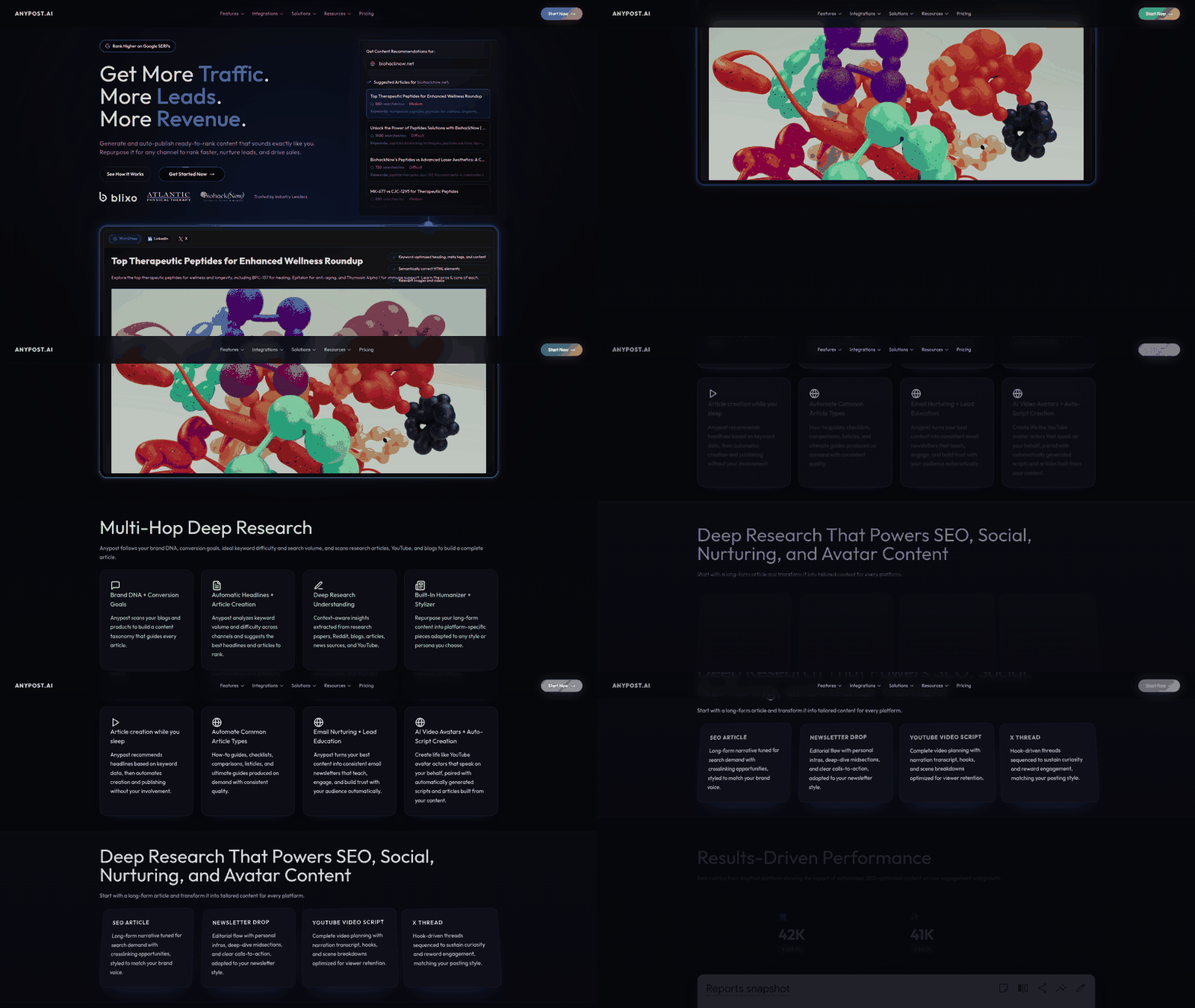
- Use AI-driven copywriting tools to generate blog posts, email sequences, and landing page copy tailored to specific buyer personas [12]. This accelerates content production while maintaining consistency in messaging aligned with audience needs [12]. (See the [Content Marketing Strategies for B2B Lead Generation] section for more details on blog posts and email sequences.)
- Integrate AI-generated insights with first-party data (e.g., CRM records) to personalize content recommendations for each stage of the B2B sales cycle [8]. This fusion of internal and external data enhances relevance and drives higher conversion rates [8]. (Building on concepts from [Introduction to B2B Sales Leads], CRM data integration is critical for profiling leads.)
- Monitor content performance metrics (e.g., time-on-page, lead-to-close ratios) to refine AI training models and improve output quality over time [8]. Continuous feedback loops ensure generated content evolves with changing buyer preferences [8]. (As discussed in [Measuring and Optimizing B2B Lead Generation Efforts], tracking these metrics is essential for refining strategies.)
Section 5: Channel-Specific Tactics for B2B Lead Generation
- Guest post on industry blogs to expand reach and build backlinks, enhancing SEO and credibility through third-party validation [11]. See the [Leveraging SEO Optimization for B2B Lead Generation] section for more details on SEO strategies.
- Repurpose Twitter insights into newsletter content to refine messaging based on real-time audience feedback, ensuring alignment with prospect needs [1]. Building on concepts from [AI-Driven Content Generation and Repurposing], this tactic maximizes content utility.
- Track analytics across all channels to identify which tactics generate the highest-quality leads, allowing for resource reallocation to top-performing strategies [10]. As mentioned in the [Measuring and Optimizing B2B Lead Generation Efforts] section, data-driven adjustments are critical for sustained success.
Section 6: Measuring and Optimizing B2B Lead Generation Efforts
Measuring and Optimizing B2B Lead Generation Efforts
Key Lead Generation Metrics
- Track lead conversion rates to evaluate how effectively marketing campaigns convert prospects into sales-qualified leads (SQLs). This metric helps identify gaps in nurturing strategies and content relevance [4].
- Monitor cost per lead (CPL) to assess the efficiency of lead generation channels. A high CPL may signal misaligned targeting or underperforming campaigns, requiring budget reallocation [5].
- Analyze sales-qualified lead (SQL) rate to measure how many leads meet the criteria for handoff to sales. A low SQL rate often indicates poor lead scoring models or misaligned marketing-sales definitions [4]. See the [Section 4: AI-Driven Content Generation and Repurposing] section for more details on refining lead scoring models.
- Calculate customer acquisition cost (CAC) to determine the total investment required to acquire a customer. Comparing CAC with lifetime value (CLV) ensures campaigns generate profitable, long-term relationships [5].
Essential Analytics Tools
- Use CRM platforms like HubSpot or Salesforce to centralize lead data, track interactions, and automate reporting. These tools provide real-time visibility into pipeline health and campaign performance [13].
- Leverage LinkedIn analytics to evaluate B2B content engagement, track company-specific interactions, and refine targeting for decision-makers in key industries [11].
- Implement web analytics tools (e.g., Google Analytics) to monitor traffic sources, landing page performance, and user behavior. This data identifies high-performing content and friction points in the buyer journey [5]. Building on concepts from [Section 3: Leveraging SEO Optimization for B2B Lead Generation], SEO-driven content visibility can further enhance analytics insights.
- Deploy marketing automation software to score leads based on engagement, prioritize high-intent prospects, and personalize follow-ups. Tools like Marketo or Pardot streamline lead nurturing workflows [4].
Optimization Techniques
- Refine account-based marketing (ABM) strategies by aligning with sales teams to target high-value accounts. ABM reduces wasted spend on low-potential leads and accelerates deal cycles [4]. As mentioned in the [Section 7: Advanced Tactics for Boosting B2B Sales Leads] section, ABM requires close collaboration between departments to maximize impact.
- A/B test landing pages and CTAs to optimize conversion rates. Testing variables like headlines, form lengths, and value propositions uncovers what resonates with B2B audiences [12].
- Adjust lead scoring models using historical data to prioritize leads with the highest likelihood to convert. Regularly updating criteria ensures sales teams focus on warm, qualified prospects [5].
- Retarget website visitors with personalized ads or email campaigns. Retargeting re-engages users who showed interest but didn’t convert, improving overall lead quality [5].
- Repurpose high-performing content across channels (e.g., turning blog posts into webinars or case studies) to maximize reach and reduce creation costs while maintaining consistent messaging [13].
Continuous Improvement and Data-Driven Adjustments
- Conduct quarterly pipeline reviews with sales and marketing teams to align on lead definitions, identify bottlenecks, and adjust tactics. Cross-department collaboration ensures metrics reflect real-world outcomes [4].
- Audit campaign performance monthly to eliminate underperforming channels and double down on successful strategies. Focusing on data-driven decisions minimizes guesswork and scales effective efforts [5].
- Update buyer personas annually based on new customer data and market trends. Evolving personas ensure messaging and targeting stay relevant to shifting organizational needs [5]. See the [Section 8: Putting it All Together - A B2B Lead Generation Roadmap] section for guidance on refining buyer personas.
By systematically tracking metrics, utilizing analytics tools, and refining strategies, B2B organizations can turn lead generation into a scalable, results-driven process. Each adjustment should be tested, measured, and iterated to maintain alignment with business goals.
Section 7: Advanced Tactics for Boosting B2B Sales Leads
-
Align sales and marketing teams to target high-value accounts. ABM focuses on prioritizing accounts most likely to convert, requiring collaboration between departments to define shared goals and strategies [4]. This alignment ensures consistent messaging and reduces wasted effort on low-potential leads [4]. As mentioned in the [Introduction to B2B Sales Leads] section, understanding the foundational role of lead prioritization is critical for advanced strategies.
-
Segment email campaigns based on industry, company size, and engagement level. Grouping leads allows for targeted messaging that resonates with specific segments. Source [2] emphasizes segmentation as a key strategy for improving campaign performance. For more details on crafting targeted content, see the [Content Marketing Strategies for B2B Lead Generation] section.
-
Sync CRM data with marketing automation tools for seamless follow-ups. Automate nurturing workflows triggered by lead behavior, such as downloading a whitepaper or attending a webinar. Source [8] recommends this integration to shorten sales cycles. Building on concepts from [AI-Driven Content Generation and Repurposing], AI-powered tools can enhance automation by generating personalized follow-up materials.
Section 8: Putting it All Together - A B2B Lead Generation Roadmap
Phase 1: Define Your Target Audience and Goals
- Conduct buyer persona research to identify decision-makers and stakeholders within target companies. This ensures marketing efforts align with the needs of the audience, a strategy emphasized in B2B lead generation frameworks [2].
- Set SMART goals (specific, measurable, achievable, relevant, time-bound) for lead generation campaigns. For example, aim to increase qualified leads by 20% within six months, as outlined in proven B2B growth strategies [5].
- Leverage CRM tools to segment audiences based on industry, company size, and engagement history. Segmentation improves targeting and is a core tactic in 2024’s best practices [12].
Phase 2: Build a Multi-Channel Lead Generation Strategy
- Add chatbots to your communication channels to capture real-time leads and reduce response times. Chatbots are highlighted as a top 2025 tactic for improving lead conversion rates [1].
- Personalize cold emails using recipient data, such as job titles or recent company news. Personalization increases open rates and is a key differentiator in competitive B2B markets [1]. See the [Section 5: Channel-Specific Tactics for B2B Lead Generation] section for more details on tailoring outreach to specific channels.
- Develop targeted content marketing strategies, including blogs, whitepapers, and case studies. Content marketing remains a cornerstone of 2024’s lead generation best practices, driving organic traffic and trust [12]. As mentioned in the [Section 2: Content Marketing Strategies for B2B Lead Generation] section, these formats help establish thought leadership and address industry pain points.
Phase 3: Nurture Leads with Data-Driven Tactics
- Implement lead scoring systems to prioritize high-intent prospects. This tactic, recommended in 2025 strategies, ensures sales teams focus on leads most likely to convert [10].
- Use LinkedIn for account-based marketing (ABM) to engage specific companies with tailored messaging. LinkedIn’s professional audience makes it ideal for B2B outreach, per 2025 growth strategies [2]. Building on concepts from [Section 7: Advanced Tactics for Boosting B2B Sales Leads], ABM requires alignment between sales and marketing teams.
- Automate follow-up sequences with email marketing tools to maintain engagement. Automation reduces manual effort while maintaining consistent communication, a tactic endorsed in 2024’s top lead generation methods [12].
Phase 4: Optimize and Scale with Analytics
- Track key metrics like lead-to-opportunity conversion rates and cost per acquisition. Data-driven optimization is critical for refining campaigns, as noted in 2024’s comprehensive B2B guides [5]. See the [Section 6: Measuring and Optimizing B2B Lead Generation Efforts] section for a deeper dive into tracking and interpreting these metrics.
- Conduct A/B testing on subject lines, call-to-action buttons, and landing pages. Testing improves performance and is a standard practice in 2025’s proven lead generation frameworks [10].
- Review and adjust strategies quarterly based on performance data. Continuous iteration ensures alignment with market changes and is a core principle of successful B2B sales pipelines [9].
Common Pitfalls to Avoid
- Ignoring personalization in outreach efforts, which reduces open rates and engagement [1].
- Failing to track metrics consistently, leading to missed opportunities for optimization [9].
- Neglecting CRM tools for lead segmentation, resulting in inefficient targeting [12].
By following this roadmap, businesses can systematically implement the 32 proven tactics outlined in this article. Each phase builds on foundational strategies from 2024–2025, ensuring alignment with current best practices while avoiding common missteps. For further details, cross-reference with specific sections of the cited sources [1][5][9][10][12].
References
[1] 35 Proven Strategies for B2B Sales Lead Generation in 2025 - https://www.unboundb2b.com/blog/generate-b2b-sales-leads/
[2] What is B2B lead generation? 15 proven strategies for growth - https://www.zendesk.com/blog/b2b-lead-gen/
[3] 11 Proven Strategies to Increase B2B Sales in 2026 - https://www.cognism.com/blog/how-to-improve-b2b-sales
[4] B2B Sales Acceleration: 7 Proven Strategies for Faster Growth - https://www.theinsightcollective.com/insights/b2b-sales-acceleration-guide
[5] Mastering B2B Sales Lead Generation: Proven Strategies for ... - https://quickmail.com/b2b-sales-lead-generation
[6] Call Center Lead Generation: Boost Your Sales with Proven Tactics ... - https://www.intelemark.com/blog/call-center-lead-generation-boost-your-sales-with-proven-tactics/
[7] Revolutionize Your Sales: 10 Proven B2B Pipeline Strategies - https://salesintel.io/blog/10-b2b-sales-strategies/
[8] Mastering the B2B Sales Cycle: Proven Strategies for Success - https://forecastio.ai/blog/mastering-the-sales-cycle
[9] B2B Sales Prospecting In Finance And Fintech: Proven Strategies ... - https://marketjoy.com/b2b-sales-prospecting-in-finance-and-fintech/
[10] 10 Proven Strategies to Find B2B Leads in 2025 - https://www.artisan.co/blog/how-to-find-b2b-leads
[11] (PDF) Digital Marketing on LinkedIn: In-Depth Strategies for Lead ... - https://www.researchgate.net/publication/380433146_Digital_Marketing_on_LinkedIn_In-Depth_Strategies_for_Lead_Generation
[12] 36 Best Ways to Generate B2B Sales Leads in 2024 - https://www.fundz.net/lead-generation-b2b-sales/
[13] Gary Vaynerchuk Shares 13 Minutes Of B2B Marketing Strategies | INBOUND by HubSpot Marketing - https://www.youtube.com/watch?v=yL30hznsUAU
Frequently Asked Questions
1. What is the key difference between B2B and B2C sales leads, and why does it matter for lead generation strategies?
B2B sales leads involve targeting other businesses or organizations, focusing on decision-makers or stakeholders, while B2C targets individual consumers. This distinction matters because B2B purchases often involve longer decision cycles, multiple stakeholders, and higher costs. For example, a fintech company might need to engage a buying committee in a corporate client, requiring tailored messaging and relationship-building strategies, whereas a B2C business could prioritize emotional appeals or convenience for individual buyers. Understanding this difference ensures marketing efforts align with the complexity of B2B sales processes.
2. What are the most effective tactics for overcoming the challenge of reaching hidden decision-makers in B2B lead generation?
Reaching hidden decision-makers requires a mix of strategic outreach and value-driven engagement. Tactics include:
- Account-Based Marketing (ABM): Target specific accounts with personalized content, such as LinkedIn outreach or customized email campaigns.
- Referral Programs: Leverage existing clients to introduce you to decision-makers in their network.
- Webinars and Thought Leadership: Position your brand as an authority to attract stakeholders searching for industry insights.
- Social Selling: Use platforms like LinkedIn to build relationships with influencers and gatekeepers.
For example, a SaaS company might create a free industry report and share it via targeted LinkedIn posts to engage C-level executives directly.
3. How can B2B companies align their sales and marketing teams to improve lead conversion rates?
Alignment between sales and marketing is critical for nurturing high-quality leads. Key steps include:
- Shared KPIs: Define metrics like lead-to-revenue conversion rates or cost per lead to ensure both teams work toward common goals.
- Regular Communication: Hold weekly syncs to discuss lead quality, customer feedback, and campaign performance.
- Lead Scoring Systems: Use data to identify which leads are most sales-ready (e.g., based on engagement with content or website activity).
- Feedback Loops: Sales teams should share insights with marketing about what messaging resonates with prospects.
A finance firm might use a CRM to track lead behavior, enabling marketing to refine campaigns based on sales input.
4. What metrics should B2B companies track to measure the success of their lead generation efforts?
Focus on both quantitative and qualitative metrics:
- Conversion Rates: Track how many leads move from initial contact to a sale.
- Cost Per Lead (CPL): Calculate the cost of acquiring leads across channels (e.g., LinkedIn ads vs. content downloads).
- Lead Quality Score: Assess how engaged leads are (e.g., webinar attendance, email opens) to predict conversion potential.
- Customer Lifetime Value (CLV): Compare lead generation costs to the long-term revenue from converted clients.
For instance, a fintech startup might prioritize channels with low CPL and high CLV, such as referral programs over paid ads.
5. Which of the 32 proven tactics mentioned in the article are most effective for generating high-quality B2B leads?
While the article highlights 32 tactics, three stand out for proven results:
- Content Marketing: Publish in-depth guides or case studies to attract leads actively researching solutions (e.g., a cybersecurity firm sharing a white paper on data protection).
- Account-Based Marketing (ABM): Target high-value accounts with personalized outreach, such as LinkedIn ads tailored to specific industries.
- SEO-Optimized Blogging: Rank for long-tail keywords to capture intent-driven traffic (e.g., “best project management software for finance teams”).
These tactics work best when integrated with lead nurturing strategies, such as follow-up emails or retargeting ads.
6. How can B2B companies generate leads on a tight budget without sacrificing quality?
Cost-effective strategies include:
- Email Marketing: Use newsletters or drip campaigns to nurture leads with minimal cost.
- User-Generated Content (UGC): Encourage clients to share testimonials or case studies, reducing the need for paid content creation.
- Free Tools or Resources: Offer lead magnets like calculators, templates, or webinars to attract organic sign-ups.
- LinkedIn Engagement: Build relationships by commenting on posts or joining industry groups.
A small SaaS business, for example, could use a free ROI calculator as a lead magnet and follow up with targeted email sequences.
7. Why is nurturing B2B leads more complex than in B2C, and how can it be optimized?
B2B nurturing is complex because purchases involve multiple stakeholders, longer timelines, and higher risk. Optimization requires:
- Segmentation: Group leads by role (e.g., CTO vs. procurement team) to tailor messaging.
- Educational Content: Share webinars or guides to address pain points at each decision stage.
- Automated Workflows: Use tools like HubSpot to send personalized follow-ups based on lead behavior.
- Social Proof: Highlight client success stories to build trust with skeptical stakeholders.
For example, a logistics company might send a C-level executive a case study while sharing cost-saving tips with procurement managers.