Build a Repurposing Pipeline That Feeds Four Channels Weekly

Key Takeaways
- Repurposed content can earn significantly more total impressions than single-channel publishing, while AI-driven workflows can reduce production costs.
- A single blog post can yield 15-25 derivative pieces, with teams reporting they produce that full set in under an hour.
- Per-piece content costs can fall substantially once AI-assisted throughput enters the production process.
- The savings and reach multiplier compound together, pushing true per-impression cost far below the headline figure alone.
- Automation without a distribution-first plan simply produces the wrong content faster, turning speed into a liability.
- Real-time SEO analytics can tune each derivative for its channel so snippets rank for search intent rather than merely filling a slot.
- Generic repurposing tools stop at reformatting, whereas a distribution-first pipeline tunes every asset against live search data.
Why a Weekly Repurposing Pipeline Beats Publishing Once
A weekly repurposing pipeline stacks two wins that most teams treat as a trade-off: lower production cost and wider reach. Build AI content generation for SEO into that pipeline and the two effects compound instead of competing. You scale output without watching quality slip.
This changes the economics of content marketing at the core. One solid piece of creative work fans out into multiple high-quality derivatives, and your brand stays visible across touchpoints without a proportional budget increase.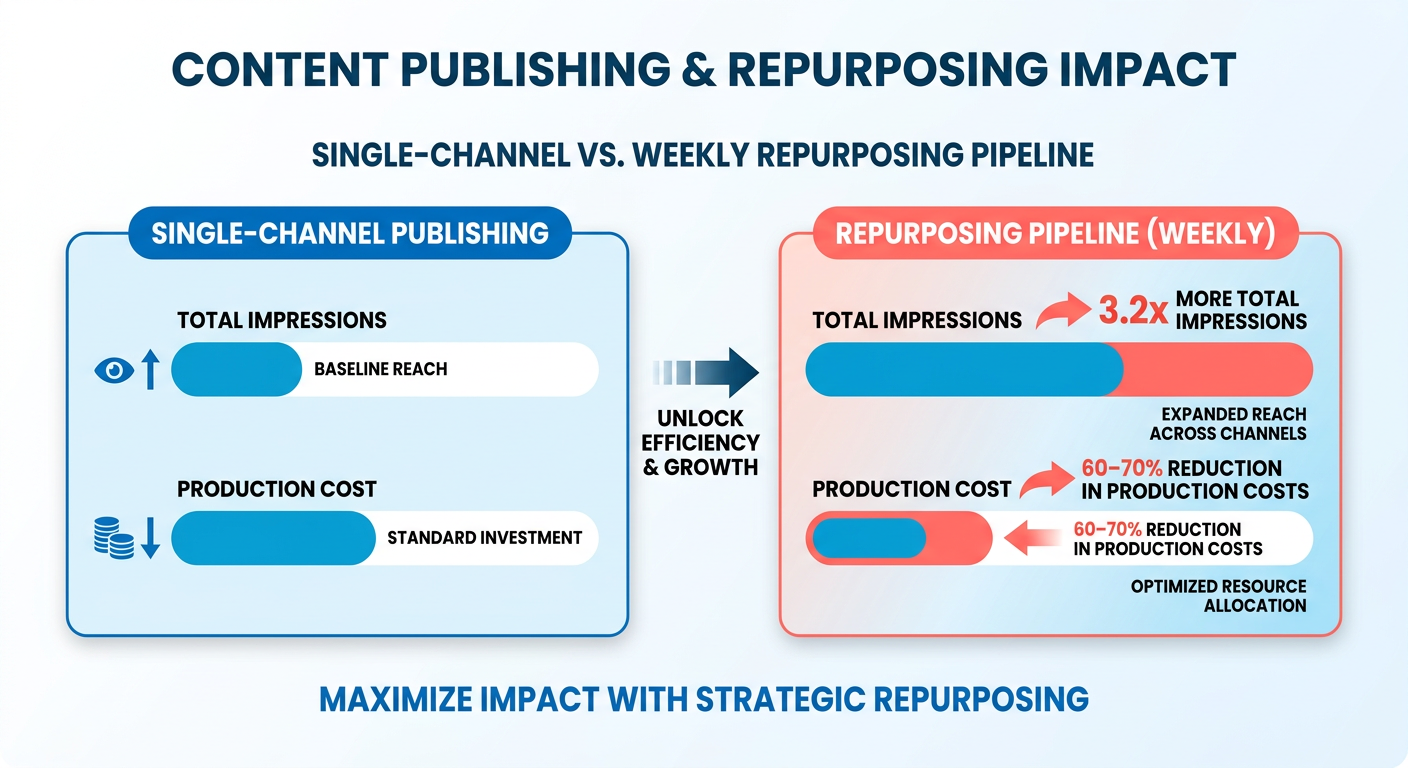
Why AI Content Generation for SEO Changes the Cost Equation
AI attacks throughput, not creativity. Automating the mechanical parts of drafting and formatting lets teams hold a four-channel weekly rhythm without burning out. That frees hours for strategy and research.
But speed alone is a trap. Without a clear strategy, rapid production just distributes misaligned assets faster. The real lever is integrating real-time search insights during generation, so every derivative is tailored to its platform's intent rather than acting as filler.
That's where this approach splits from generic repurposing tools. Instead of basic reformatting, each asset gets optimized against live search signals as it's created. Platforms like AnyPost.ai, which offer real-time SEO analytics engines, can be configured to execute these adjustments automatically. Relevance scores stay high across platforms, and search engines see the diversified, high-quality signals modern ranking algorithms reward.
Why Weekly Cadence Compounds
Fresh, diversified signals reinforce each other over time. Each week's article, video script, and social posts create discovery loops that point back to your core asset. Miss weeks, and those loops go cold.
There's a genuine debate worth flagging here. One camp argues repurposing is an operational problem AI solves. Another argues the hard part is upstream strategy—planning distribution during creation. Our take: both are right, in order. Set the distribution-first strategy once, then let automation carry the operational load week after week.
The core asset choice matters more than the topic. Pick sources rich enough to fan out. A 2,000-word blog post, a podcast interview, or a batch of customer testimonials all yield video scripts, blog posts, and social snippets. Thin topics don't.
Who Should Actually Run This Pipeline?
SaaS companies, agencies, e-commerce brands, and local businesses with steady content needs get the most from a weekly pipeline. If you publish sporadically or manage a single channel, skip the full four-channel build. The overhead outweighs the return until you have consistent source material.
Here's the practical picture of a one-article-into-four-channel week:
| Channel | Output Format | Avg. Production Time | Automation % (Manual vs AI) | Primary KPI | Weekly Output Goal |
|---|---|---|---|---|---|
| Blog/SEO | Long-form article | 20 min | Manual 100% / AI 30% | Organic ranking | 1 pillar piece |
| Video | 5-8 min script | 15 min | Manual 100% / AI 25% | Watch time | 1 script |
| Text + carousel | 10 min | Manual 100% / AI 20% | Engagement rate | 3-4 posts | |
| Short-form social | Clips/snippets | 10 min | Manual 100% / AI 15% | Impressions | 5-8 snippets |
Running this manually eats 15-20 hours a week across writing, editing, and reformatting. An AI-driven pipeline trims that to a few hours of review and approval.
Designing the Core Asset: Source Content Definition & Weekly Cadence
The core asset decision is a format-capacity decision, not a topic decision. Before you pick what to write about, ask what the piece can fan out into. A source that lends itself to multi-format extraction is worth far more than a narrow topic that only produces a single social post. That single choice sets the ceiling for your whole week.
Strategic planning prevents operational waste here. Define your distribution channels before drafting the core asset, and every extracted piece has a pre-determined home and purpose. Once that foundation is laid, AI handles the execution, turning a complex multi-channel plan into a manageable weekly routine.
What Makes a High-Value Source Asset?
A high-value source asset is evergreen, keyword-rich, and audience-centric—deep enough to spawn multiple formats. It needs distinct knowledge units: data points, case studies, or step-by-step frameworks that can be isolated and reshaped for different platforms without losing context.
Podcast interviews and testimonials work especially well. A single interview transcribes into a blog post, then splinters into quote cards and short clips. The rule we follow: if a topic can only produce one channel's worth of content, it's a post, not a source asset.
Balance topical relevance against long-tail opportunity. Your source asset targets a broad keyword while its derivatives chase specific long-tail queries each channel can rank for. Programmatic SEO pages make strong supplementary sources too—they're structured, repeatable, and already tied to search intent.
How Do You Plan the Weekly Cadence?
Fix the rhythm so the pipeline runs without renegotiation each week. A repeatable schedule turns repurposing from a scramble into a system. Here's the cadence we run:
- Monday research: Pin down the source topic, target keyword, and the long-tail variants each channel will chase.
- Tuesday draft: Produce the master 1,500-word article. With a persona-driven draft, you can hit an SEO-optimized piece in under 30 minutes.
- Wednesday SEO boost: Adjust the draft against real-time search signals, then extract metadata.
- Thursday and Friday: Fan the asset out across four channels, each format tuned to its own audience.
The metadata step feeds the micro-content. Pull the title, meta description, key takeaways, and pull-quotes in one pass. Those quotes become your social cards. The takeaways become carousel slides. Nothing gets written twice.
Why the Baked-In SEO Layer Changes the Math
Most pipelines produce derivatives, then guess at optimization. A distribution-first approach bakes SEO into every piece as it's created—keyword-optimized content, search-intent-aligned headings, and semantically correct HTML. The keyword targeting isn't an afterthought bolted on later.
For example: a SaaS startup treats each product update as a source asset. One release note becomes a pillar post, a demo clip, a changelog thread, and three feature-focused social posts. Ship weekly, and you compound reach without adding headcount. Integrating context extraction, competitor analysis, and multi-channel production into one workflow can get you professional-grade SEO results at a fraction of traditional agency retainers.
Mapping Content to Four Channels: Format & Distribution Strategy
Each of the four channels demands a different shape, and the source article rarely fits any of them cleanly. A blog post runs 1,500 words with headers and internal links. An X thread breaks into 280-character beats. A newsletter snippet is one tight idea. A YouTube script is spoken, not read. This is where AI content generation for SEO does its real work: the same source asset gets reshaped four ways, with search signals tuned per channel instead of copied flat.
The mistake most teams make is treating the four outputs as one piece pasted into four boxes. That's redistribution, not repurposing. Real repurposing transforms the format, reading live SEO signals to decide which keywords and angles each channel should carry. The blog optimizes for search intent. The thread optimizes for the scroll-stopping first line. Same source, different targets.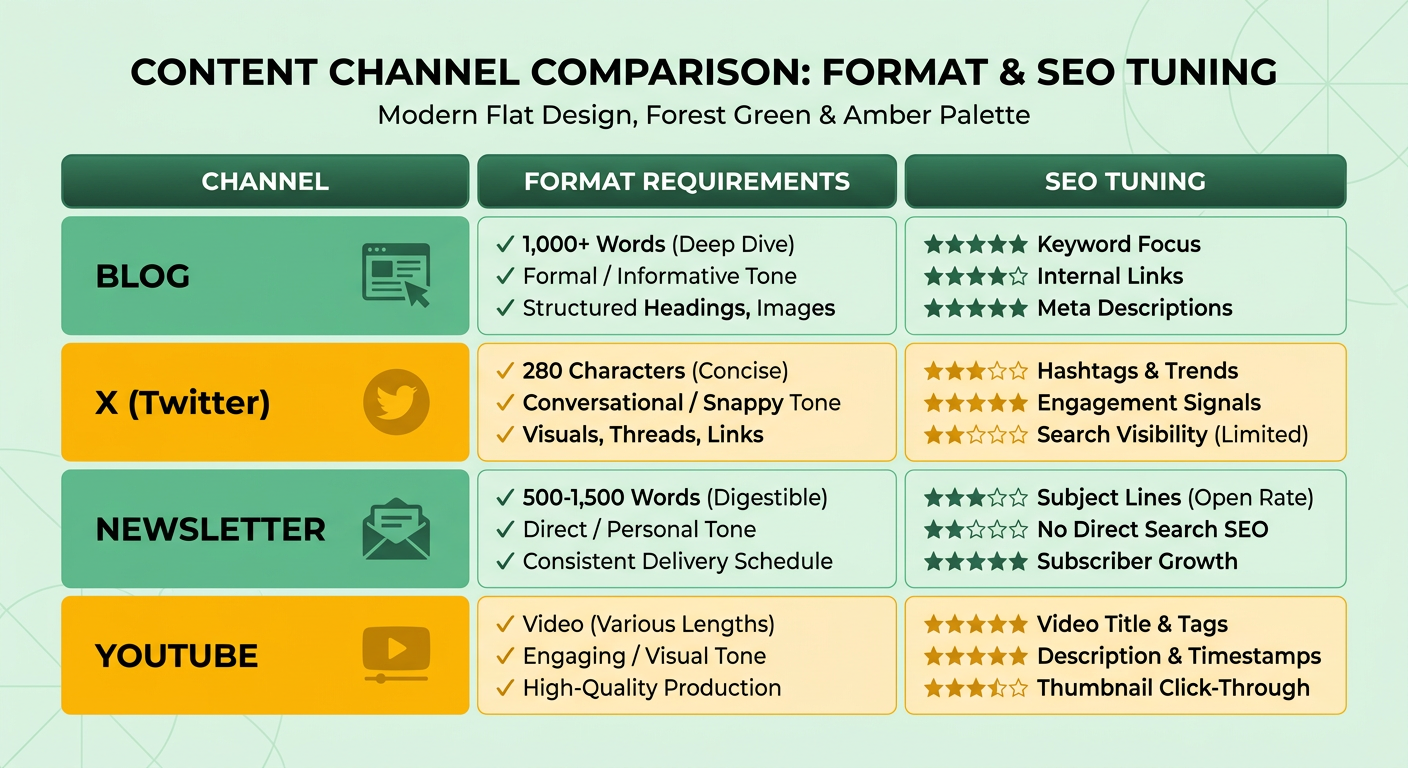
How Do You Map Source Sections to Channel Assets?
A mapping matrix pairs each part of your source asset with the channel format it feeds best. Your intro becomes the thread hook. A data table becomes the newsletter's visual. A how-to section becomes the video's value ladder. This pairing is the fastest way to systematically deconstruct core content.
Start with the highest-yield pairings. The blog's opening paragraph carries your strongest claim, so it makes the sharpest thread hook. A dense data section resists being read aloud but works as a static newsletter graphic. Step-by-step content maps almost directly onto a spoken video outline.
Match each fragment to the format that suits its density. Numbers want to be seen. Stories want to be spoken. Arguments want to be scrolled.
How Should You Adapt Tone and SEO Per Channel?
Tone shifts because the reader's mindset shifts. A newsletter reader opted in. An X reader is scrolling past. A persona engine can rewrite voice per platform, and the SEO analytics layer can adjust keyword weighting at the same time, so each output stays on-brand and on-target for how people actually search that channel.
This is the piece competitors skip. Most tools change the wording but leave the search strategy identical across every output. The blog leans into long-tail phrases with clear intent. The video description targets spoken-query terms. Automating the handoff between platforms queues each optimized asset for delivery without manual copy-pasting.
What Cadence and Video Structure Actually Work?
Structure YouTube output around three beats: a hook in the first ten seconds, a value ladder that delivers on the promise, and one clear CTA. A 2,000-word blog post yields a 5-8 minute video script—enough runtime to cover three or four real points without padding.
For distribution, publish each format when its channel is most active rather than dumping all four at once. Stagger the blog, thread, newsletter, and video across the week so each earns its own attention window.
This structured approach keeps video content engaging and directly supportive of broader marketing goals. Written insights become dynamic visual formats, capturing audiences who prefer watching over reading and maximizing the utility of original research.
Automating Transformation: AI Prompts, Templates, and Workflow Engines
The fastest way to kill a repurposing pipeline is treating the AI as a magic box. You paste a blog post in, you get four drafts out, and half are unusable because the prompt was too vague. The fix is format-specific prompt design, not better AI.
The templates force the model into a structural corner. Instead of "turn this into a thread," use "Summarize the core argument in 5 tweet-sized statements, each under 240 characters, with the hook as statement one." That distinction matters. AI tools excel at transformation when given format-specific instructions rather than generic ones. Generic prompts produce generic output; constrained prompts produce channel-ready drafts.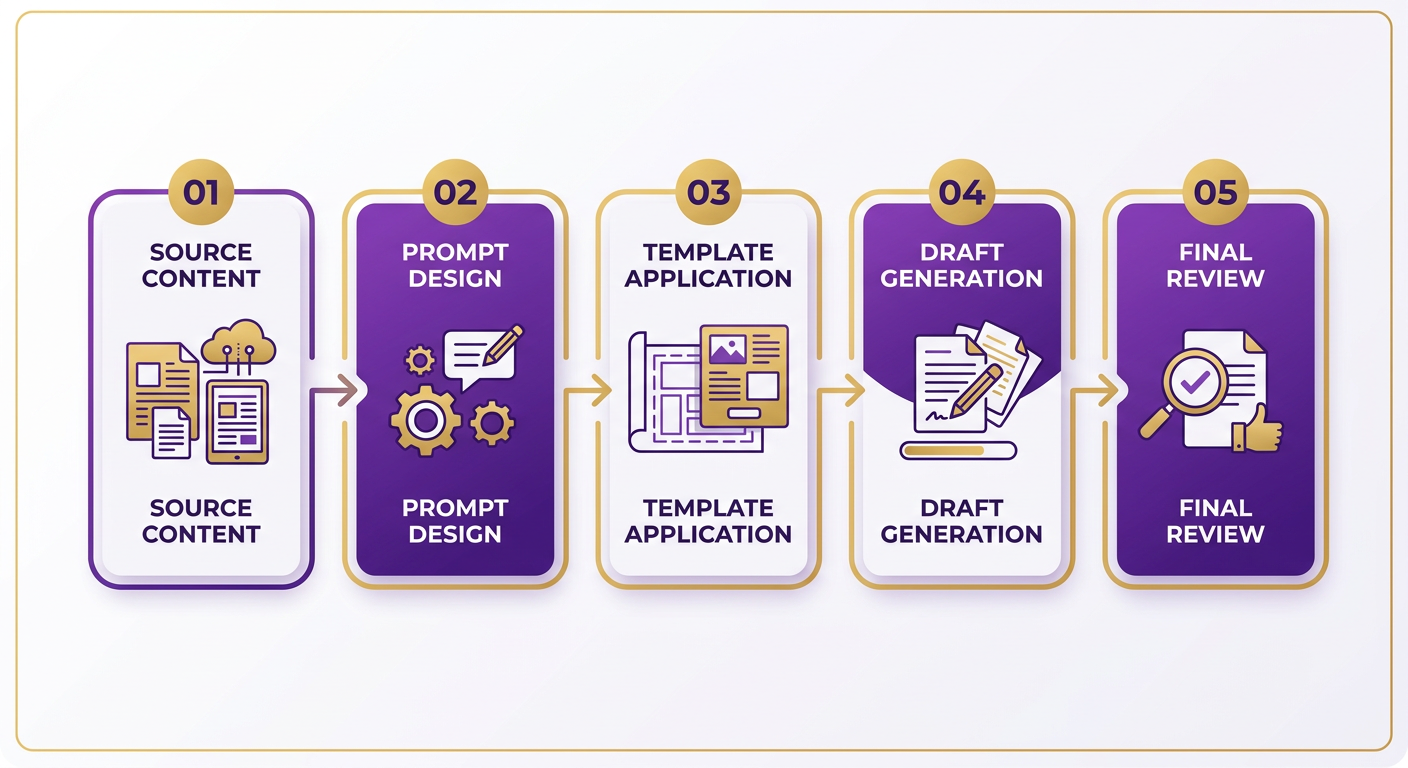
This is where AI content generation for SEO stops being a volume play and becomes a quality play. The prompt is the strategy. Skip prompt engineering and go straight to automation, and you're just redistributing mediocrity at scale.
What Does a Prompt and Template Library Actually Look Like?
A template library is a set of saved prompts, each paired with a target channel and a character limit. You build it once, then reuse it every week. Without this, your team rewrites the same instructions repeatedly, which defeats the purpose of automation.
Here's a starting set, organized by channel:
- X/Twitter thread template: "Extract the 5 most surprising claims from this source. Write each as a standalone statement under 240 characters. Statement one must be a hook that contradicts a common assumption."
- Newsletter intro template: "Write a 300-word newsletter introduction that summarizes the source's main argument. End with a single question to drive replies."
- YouTube script outline: "Convert this into a 5-8 minute spoken script. Use short sentences. Mark natural pause points and visual cutaway suggestions in brackets."
- LinkedIn carousel: "Identify 7 distinct knowledge units from this source. Each unit becomes one slide: a bold headline, a 2-sentence explanation, and a takeaway."
The pattern is consistent: state the format, state the length, state the structural rule. That's the whole game. When teams struggle, it's almost always because they skipped the structural rule and let the model decide the shape.
How Do You Wire This Into an Automated Workflow?
A workflow engine connects your content management system to your AI drafts folder, triggered by a single event: a new published article. That's where the operational savings compound. The automation handles the rewrite sequence end-to-end once this trigger is live.
The sequence looks like this:
- Trigger: A new article is published in your CMS (e.g., WordPress or Webflow).
- Generate: The workflow engine sends the article text to your AI tool with each saved template.
- Store: The four drafts (thread, newsletter, script, carousel) are saved to a folder named by date and source asset.
- Notify: Your content manager gets a single notification with links to all four drafts.
Build error handling into step two. AI output exceeds character limits regularly. Our protocol: if a draft exceeds 110% of the target length, the workflow automatically re-runs the prompt with a "strictly under X characters" instruction appended. If it fails twice, it flags the draft for manual review instead of silently storing a broken file.
The bottleneck moves from production to review, which is where you want it. A human should be auditing, not generating. Once approved, drafts dispatch directly to active social queues, completing the transition from raw text to live, platform-specific content.
What Does the Review Flow and Version Control Look Like?
Automation handles the first draft; humans handle the final call. A three-step review flow catches errors without creating a bottleneck:
- AI pre-check: The workflow runs grammar, tone, and plagiarism checks automatically. This catches the obvious issues before a human ever sees the draft.
- Content manager quick audit: A 10-minute pass to verify the draft matches the source's intent and the channel's voice.
- Final sign-off: The person responsible for the channel approves or sends it back with notes.
Version control is the piece most teams skip, and it hurts them later. Real-time analytics tracking shows how each published version performs, which becomes your prompt-improvement log. When a draft needs heavy edits, revise the template, not just the draft.
Add a memory layer to prevent repetition. Store hashes of previously published snippets. When the workflow generates a new draft, it checks against those hashes and flags anything too similar. This keeps channels from sounding like a loop, which is the fastest way to lose audience trust.
Scheduling, Publishing, and Distribution Automation
Publishing is where a repurposing pipeline either runs itself or quietly falls apart. The final stage moves approved assets into queues across all four channels. The smartest version of AI content generation for SEO doesn't stop at drafting—it carries search signals all the way into the schedule, so each post lands in the right slot with the right tags already attached.
Most teams automate creation and then hand-publish everything. That gap wastes the whole pipeline. If you built channel-specific drafts with live search data, you want that same data deciding when and how each piece ships.
Native vs. Third-Party Schedulers: Which Should You Use?
Native schedulers live inside a single platform. Third-party planners manage several channels from one dashboard. Use native tools when a channel rewards platform loyalty. Use third-party or API-driven publishing when you need one calendar across blog, social, newsletter, and video.
Native scheduling wins on reliability and format fidelity. Your blog CMS handles its own posts best. But native tools force you to jump between five dashboards.
API-driven publishing works better for the whole pipeline. One system pushes the blog every Monday, the thread Wednesday, the newsletter Thursday, and the video script on its own cadence. Recurring slots turn scheduling into a set-and-forget rhythm instead of a weekly scramble.
How Do You Set Up Recurring Slots and Attribution?
Recurring slots pin each channel to a fixed weekly window, then automation fills them from your approved queue. Pair every slot with automated UTM tagging so attribution is built in, not bolted on later.
Start by locking your cadence. Blog Monday morning. Thread Wednesday midday. Newsletter Thursday. This consistency does double duty. It trains your audience and gives search and social algorithms a predictable signal to reward.
Then wire in attribution at publish time:
- Automated UTM tags stamp source, medium, and campaign on every link. No manual edits.
- Link shortener integration cleans up tracked URLs so social posts stay readable.
- Per-channel tagging ties each derivative back to its source asset, so you see which repurposed pieces actually convert.
The SEO layer keeps paying off here. The same live signals that shaped each draft also inform posting windows, so publishing timing tracks real search and engagement data rather than a guess.
What Happens When a Publish Fails?
A publish failure needs to page you, not vanish. Good pipelines add retry logic for transient API errors and alert notifications the moment a post fails to land. Silent failures are the real risk. A skipped Wednesday thread breaks your cadence and nobody notices for days.
Set retries for timeouts and rate limits. Send a Slack or email alert on hard failures so a human can step in fast. Time-zone handling matters too. Schedule against your audience's local peak windows, not your own, and let the system convert automatically.
An online retailer, for instance, might schedule newsletter delivery based on historical subscriber activity rather than a generic morning blast. Automated scheduling tools let each email land when a recipient is most likely to open it, maximizing engagement through data-driven timing.
Measuring Success: Metrics, Attribution, and Continuous Optimization
A repurposing pipeline you can't measure is a pipeline you can't improve. The point of building AI content generation for SEO into your workflow is that you get search data back automatically, then feed it into the next cycle. Measurement isn't the last step. It's the loop that makes the pipeline smarter every week.
Most teams track one number per channel and call it attribution. That's how you end up optimizing for impressions while leads flatline. You need per-channel KPIs, a credit model that reflects how leads actually convert, and a feedback path back into the prompts.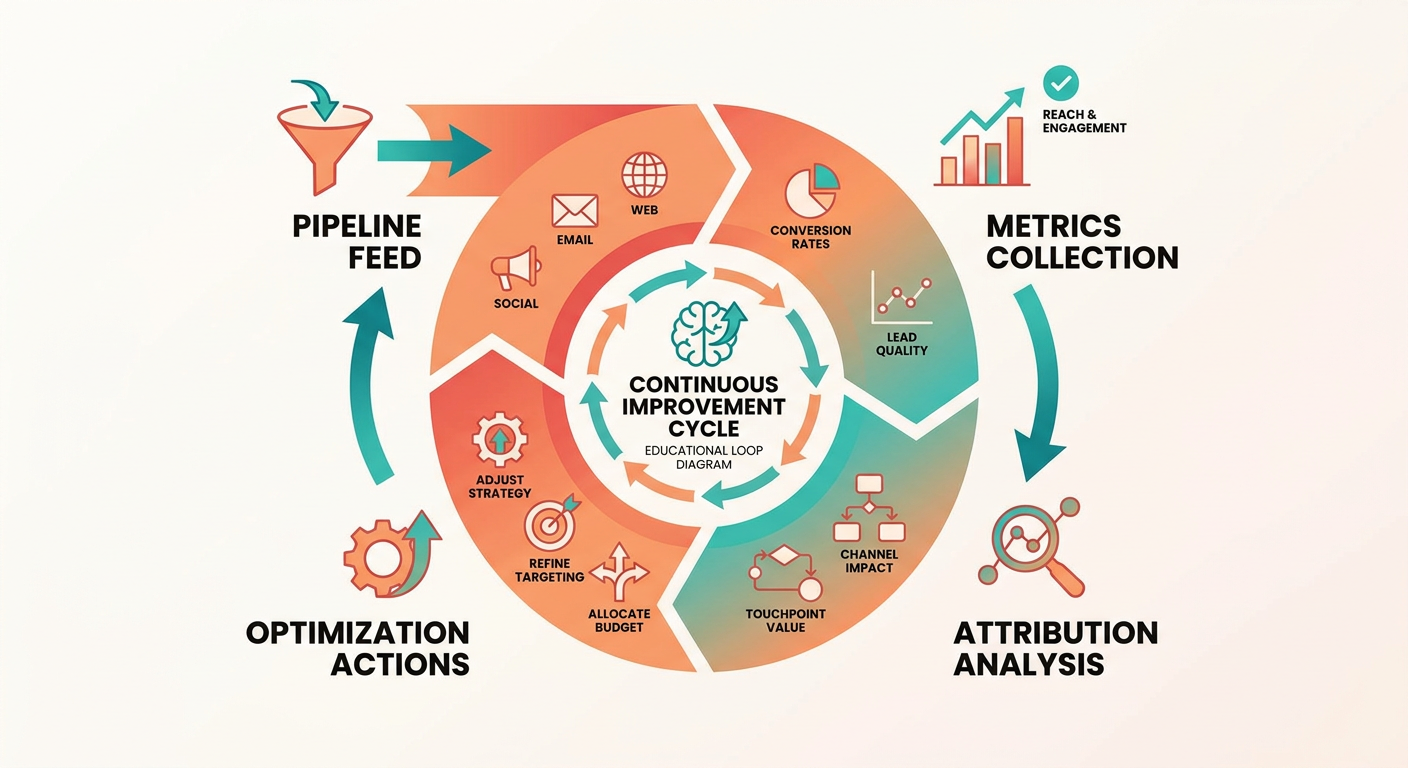
Which KPIs Should You Track Per Channel?
Track five metrics, but weight them differently by channel. Organic traffic and impressions measure reach. Engagement rate and CTR measure whether the format lands. Conversion measures whether it earns a lead. One flat scorecard across four channels hides more than it reveals.
- Blog: organic traffic and conversion carry the weight. This is your search-intent play.
- X threads: engagement rate and CTR tell you if the hook works.
- Newsletter: open rate and click-through matter more than raw reach.
- YouTube: watch time and CTR on the end-screen link.
The distribution-first principle set at design time becomes a measured commitment here. Feed real per-channel impressions back into which formats each source asset maps to. That turns a fixed mapping into one you re-tune every week.
How Do You Assign Lead Credit Across Channels?
Use a data-driven attribution model when you have the volume, and a linear model when you don't. First-touch over-credits discovery and starves your nurture channels. Data-driven splits credit by actual contribution across touchpoints, which reflects how a repurposed asset works across four surfaces.
First-touch: all credit to the first interaction. Good for measuring reach, bad for judging content that closes.
Linear: equal credit to every touch. A fair default when lead counts are too low for modeling.
Data-driven: weights each touch by measured influence. Our pick once you have consistent weekly conversions.
Build the dashboard where you can act on it. Pipe analytics into a live view in Looker or Data Studio, one row per channel, refreshed automatically. When impressions spike but conversions don't, you see it in a day, not a quarter.
How Does Performance Feed Back Into the Prompts?
Performance data should rewrite your prompt parameters, not just fill a report. If your data-driven tweets pull triple the CTR of opinion posts, tell the model to bias toward data-led hooks. The feedback loop is the difference between automation that plateaus and automation that compounds.
Run A/B tests to earn that signal. Pit AI-generated variations against a human-written benchmark on the same source asset. Measure CTR and conversion, not vibes. Keep the winner's structure and push it into the template.
Then run the money math. Calculate cost-per-lead for the automated pipeline against your old manual effort, including writer and specialist hours. With real-time analytics tracking built in, you can see how a single prompt change—like rewriting YouTube script prompts to open with a data point instead of a soft intro—moves end-screen CTR, and whether that shift lifts the whole channel's ROI. The tools surface what changed, so you can decide what to keep.
Measure, re-tune, repeat. That's the pipeline working as designed.
Frequently Asked Questions
1. How many source articles do I need per week to keep four channels running?
A single comprehensive piece of content each week is sufficient to fuel your entire distribution network. The key is selecting a topic with enough depth to support multiple angles, such as a detailed industry guide or an in-depth expert discussion. If a subject can be fully covered in a single short post, it lacks the structural complexity needed to feed a multi-channel pipeline.
2. What if my AI drafts keep exceeding a channel's character limit?
You can address this by refining your automation rules. Program your workflow to detect length violations immediately upon generation. If a draft exceeds the platform's constraints, the system should automatically apply a more restrictive prompt variation or route the asset to an editor's queue for rapid manual trimming before it reaches the scheduling stage.
3. Is repurposing the same as reposting my blog to social media?
No. Reposting simply copies the exact same text across different platforms, which ignores how audiences interact with each channel. True repurposing involves translating the core message into the native language of each platform—converting a detailed written argument into a spoken script, a visual slide deck, or a concise social update.
4. Should I run the full four-channel pipeline if I only publish occasionally?
It is best to establish a consistent publishing schedule on a single primary channel before expanding. Managing a multi-channel pipeline requires a steady stream of foundational content. Until your team can reliably produce and review core assets on a set schedule, the operational complexity of multi-channel distribution may distract from core content quality.
5. How do I stop my repurposed content from sounding repetitive over time?
Ensure your generation templates focus on different angles of the source material. You can instruct your AI tools to extract distinct sub-topics, alternative examples, or different data points for each platform. Regularly updating your prompt library also prevents the system from relying on the same structural patterns week after week.
6. Why not use first-touch attribution to measure which channel drives leads?
Relying solely on the initial point of contact ignores the touchpoints that nurture and close a prospect. Because a multi-channel strategy relies on repeated exposure across different formats, a multi-touch approach is necessary to understand how social updates, newsletters, and deep-dive articles work together to guide a user toward conversion.
7. What happens if a scheduled post fails to publish?
Your distribution system should include automated monitoring. If an API connection drops or a platform rejects a post, the system must immediately flag the issue for your team. This allows you to manually publish the asset or resolve the connection error before your weekly content calendar falls behind schedule.
Ready to stop creating content and start engineering discoverability? AnyPost.ai's real-time SEO analytics engine can automate the adjustments described above—turning your existing workflow into a distribution-first pipeline.
