
Commercial Intent Keywords in 2026: Semrush One, High-CPC Terms, and Content That Converts

Key Takeaways
- Commercial intent keywords drive 58.1% of organic traffic to bestbuy.com and 57.3% to kay.com, outperforming informational terms for revenue.
- One SEO case study shows the revenue gap clearly: 60,000 visitors from informational keywords generated only $400.
- The keyword "truck collision attorney" commands $732 per click with 60,500 monthly searches, versus an industry average of $5.42.
- High-CPC keywords signal customer value, not difficulty, because advertisers bid more near conversion.
- Commercial intent keywords target the consideration stage, using terms like "best," "review," "top," or "vs."
- Revenue per visitor matters more than total traffic when choosing keywords.
- Amazon.com gets 45.3% of its organic visits from commercial intent keywords, showing major retailers still prioritize comparison-stage searches.
Related Video
Watch: The ULTIMATE Semrush Keyword Research Tutorial by Kevin Stratvert
Why Commercial Intent Keywords Matter
Commercial intent keywords catch people mid-comparison. They've moved past "what is X" and into "which X should I buy." Modifiers like "best," "review," "top," and "vs" signal this stage. Large retailers like Best Buy and Kay get over half their organic traffic from these terms because they convert.
Traffic volume is a vanity metric here. Revenue per visitor matters more. One campaign drew 60,000 visitors from informational keywords and made $400. Those visitors came for answers, not purchases. Commercial intent keywords cost more to rank for and may bring fewer clicks, but the clicks are worth more.
The logic is simple. A visitor searching "best CRM for small teams" is narrowing options. A visitor searching "what is a CRM" is learning vocabulary. The first one has a credit card ready. The second one may return in six months. Maybe.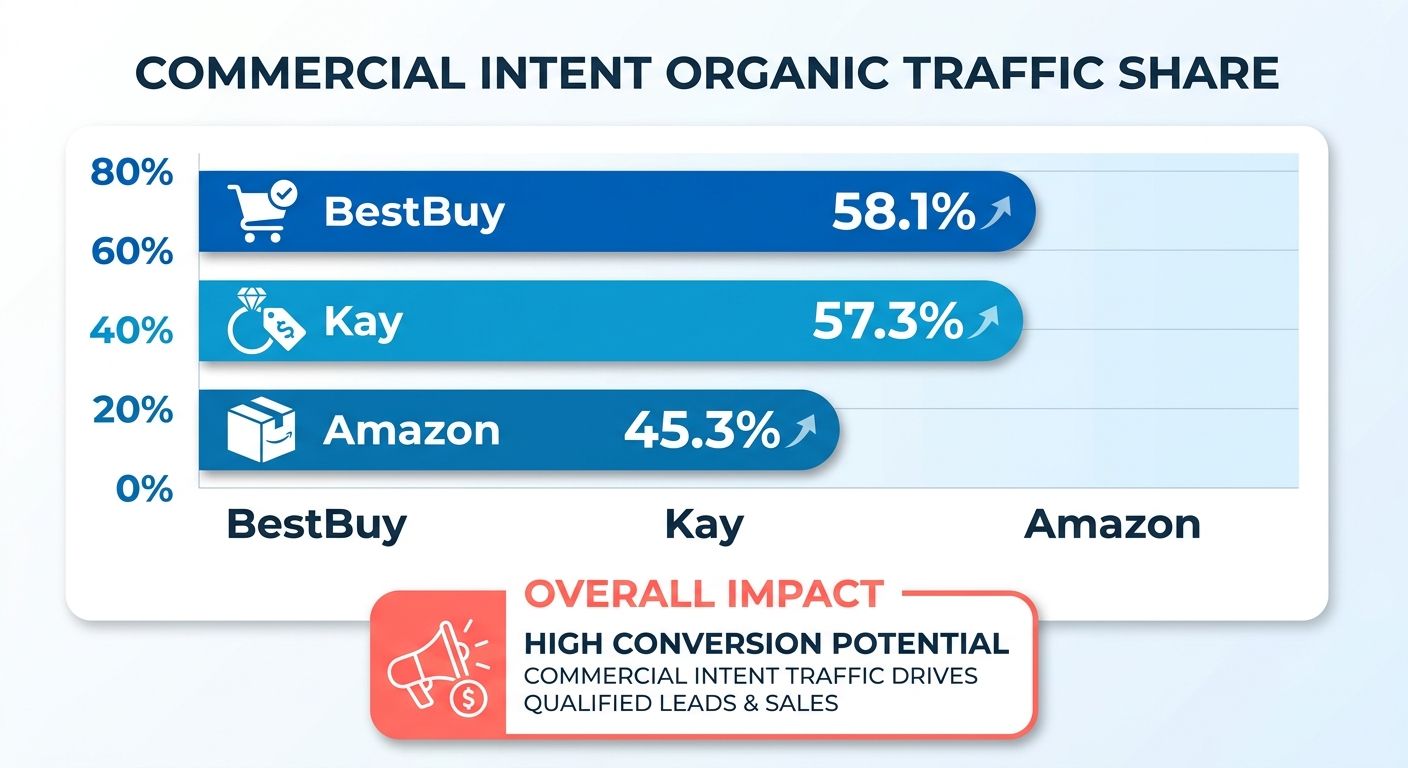
Why do high-CPC terms signal customer value?
High CPC means high customer value, not high difficulty. Advertisers pay $732 per click for "truck collision attorney" because one signed case covers hundreds of clicks. A local plumber can't afford that same CPC because their average job does not justify it.
The takeaway: do not chase another industry's CPC benchmarks. Price your bids against what a customer is worth to you, then build pages that earn the click.
What changed with AI Overviews in 2026?
AI Overviews grew 71% across commercial intent SERPs over six months. Finance saw 231%. The terms worth the most money now face AI-generated answers that intercept the click.
Some advice says to target commercial keywords without AI Overviews for easier wins. But those no-AIO terms tend to be lower-value. Split the difference. Grab the AI-free terms for quick conversions, and build genuinely citable content for lucrative terms where AI Overviews appear. Ranking below the Overview is not enough. You want to be cited inside it.
Who benefits most, and how long does it take?
Commercial intent keywords work best for teams that need fast results in competitive markets. They also help smaller sites, because commercial terms often carry lower keyword difficulty than high-volume informational ones. A lower-traffic commercial post can outconvert a viral guide.
The gap is execution speed. Buyers touch 6 to 8 touchpoints before deciding. High-intent pages convert at 5 to 15%. The winning move is a landing page built to earn AI Overview citations and convert paid traffic on the same term. Automating that build closes the distance between keyword research and a page that sells.
Using Semrush One to find Commercial Intent Keywords
Finding commercial intent keywords in Semrush One comes down to three moves: set up a project scoped to your money pages, mine the Keyword Magic Tool with intent filters, then run a gap analysis against competitors to see what they rank for and you do not. The tool classifies intent with machine learning, so you can isolate consideration-stage terms instead of sorting them by hand.
Finding the keywords is the easy part. Turning a list of commercial intent keywords into pages that convert is where campaigns stall.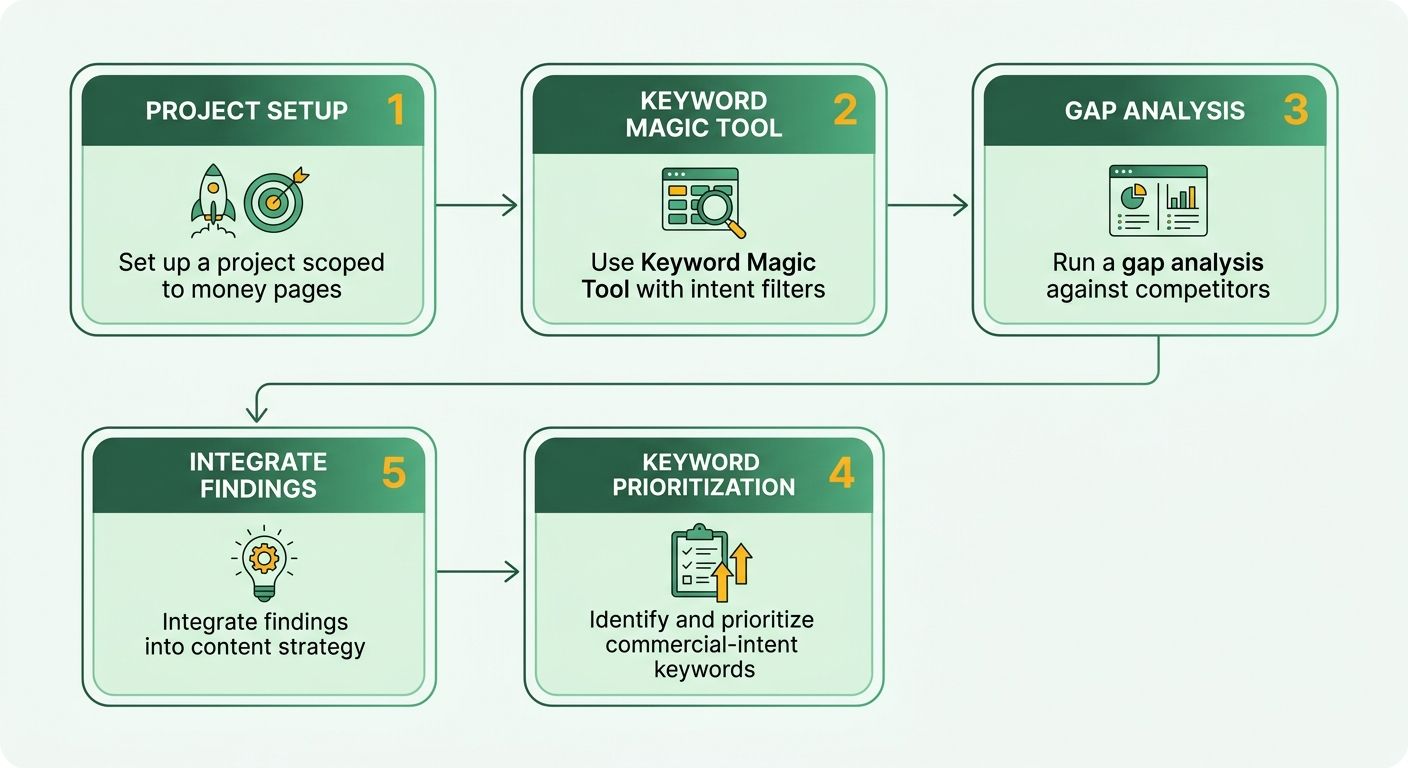
How Do You Set Up a Project for Keyword Research?
Create a project tied to your root domain, then connect the pages you want to rank. This anchors every metric to your site, so difficulty scores reflect your real position instead of a generic average.
That domain connection powers Personal Keyword Difficulty (PKD %). In the Semrush tutorial, meistertask.com showed that "how to prioritize tasks" was harder for that specific domain than for competitors because of lower topical authority. Standard KD said one thing; PKD told the truth. Check both before you commit resources to a term.
Which Metrics Actually Signal Commercial Intent?
Filter the Keyword Magic Tool by commercial intent, then sort on CPC and keyword difficulty together. High CPC means advertisers are paying real money for that click. Terms like "Salesforce pricing demo" or "Asana enterprise pricing discount" carry that signal clearly.
Commercial keywords often have lower difficulty than high-volume informational terms, which makes them accessible even for smaller sites. A B2B SaaS client we worked with found that terms under 500 monthly searches with CPC above $12 consistently produced qualified demos, while informational content at 5,000 searches generated traffic that bounced. Volume tells you how many people search; CPC tells you what those searches are worth.
How Do You Find Gaps Competitors Left Open?
Run the Keyword Gap Tool with two or three competitors alongside your domain. It surfaces terms they rank for that you're missing. Prioritize MOFU and BOFU commercial terms, and watch which ones trigger AI Overviews.
Semrush guidance leans toward targeting terms without AI Overviews for easy wins, but its own research shows AI-Overview keywords carry higher CPC. Grab the no-AIO terms for quick ranking, but build AIO-citable content for the lucrative ones. Skipping every AIO keyword means skipping your highest-value traffic.
Precision matters more than ever. Paid CTR on AI-overview queries dropped from 19.7% to 6.34%, while getting cited inside the overview can lift paid CTR by up to 91%. As one Google Ads expert put it, "lazy keyword research is the real issue affecting Google Ads performance today."
Semrush One's AI visibility score lets you measure that presence. Track it next to conversion rate, not as a separate SEO metric.
Creating High-Conversion Content for Commercial Intent Searches
High-conversion content for commercial intent keywords starts with matching the searcher's stage. These are not ready-to-buy queries. They are evaluation queries. Someone typing "best project management software" wants a confident comparison, not a hard sell or a definition.
Buyers now consult multiple resources during research. Your page has to be one of them, and it has to move them forward. A well-structured comparison page can cut decision time in half while keeping trust intact.
How Do You Match Content to Buyer Intent?
Read the SERP before you write a word. Google already ranks the format it thinks satisfies the query. Comparison tables, listicles, and pricing breakdowns dominate consideration-stage results. If those rank, that is your format.
Build every page around one decision the reader is trying to make. A search query focused on enterprise plan discounts signals someone comparing specific tiers, so the page should lead with a plan matrix rather than a generic brand story. Social proof matters here too. Testimonials and named results reinforce trust when a prospect is weighing you against alternatives.
The fastest way to lose a consideration-stage visitor is a tone mismatch. A cautious enterprise buyer and a scrappy founder may search the same keyword, but they need different voices.
Why Does Publishing Speed Beat Volume?
Keyword difficulty is personal to your domain. The same commercial term is a different opportunity for a high-authority site than for a new one. A lower-authority domain should filter Semrush One results by personalized KD, then publish tailored pages fast enough to rank before competitors catch up.
Commercial keywords help here because content teams chasing raw traffic often overlook them. Publishing speed becomes a strategic lever. The team that turns a filtered keyword list into live, conversion-ready pages in hours captures the term first.
What About AI Overviews Eating the Click?
The highest-value commercial terms now face a double squeeze. They carry the highest CPC and are most likely to trigger an AI Overview that answers the query before the user scrolls.
Engineer pages that do both jobs. Structure the content so it gets cited in AI Overviews, and format it so paid and organic traffic converts on arrival. Use clear definition-style answers up top, structured data, and a specific call to action tied to the buyer's decision.
Skip the generic "Learn more" button. A consideration-stage visitor responds to "Compare plans" or "See pricing."
Case Study: Successful Commercial Intent Campaign with Semrush One
The clearest way to show how commercial intent keywords turn into revenue is to walk through a campaign end to end. A mid-market SaaS company sat on a healthy blog but converted almost nothing from search. Traffic was high, revenue was flat. The gap was intent. Their pages answered questions instead of helping buyers compare, so the commercial-intent queries went to competitors.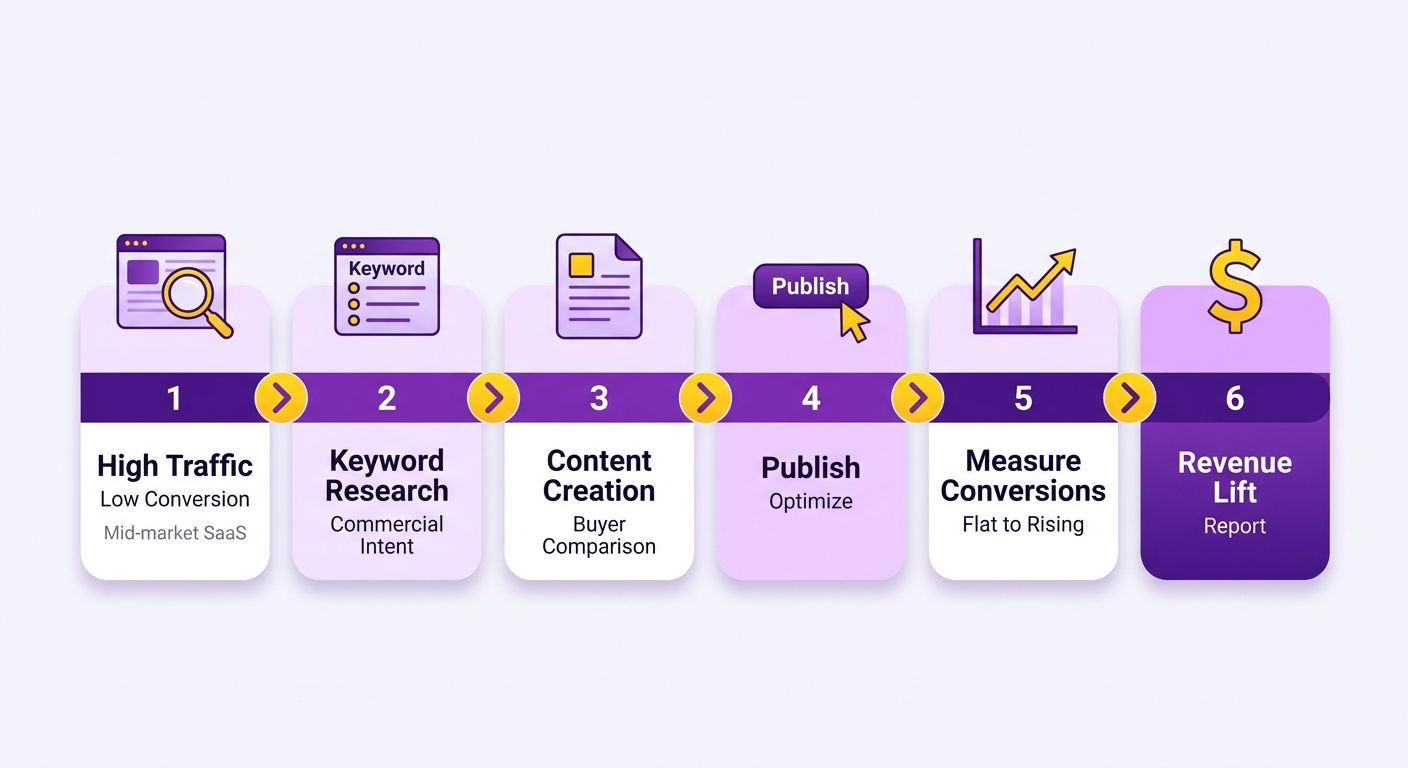
What Was the Company Actually Stuck On?
The block was the handoff, not the research. They had a solid keyword list and no fast way to turn it into pages that convert.
Their team pulled consideration-stage terms in Semrush One without much trouble. The problem started after export. Each "best," "vs," and "alternatives" query needed its own page, its own comparison angle, and copy that matched their brand voice. At a few pages a quarter, they'd never catch the demand. The list grew faster than the publishing pipeline.
How Did the Campaign Close the Gap?
They scoped the money pages first, then streamlined the build so every high-intent keyword got a voice-matched landing page instead of a backlog ticket.
The sequence was tight. Semrush One handled discovery and intent classification, isolating the consideration-stage terms and flagging the higher-CPC ones worth defending. From there, the team deployed automated content generation to create SEO-optimized articles in the company's own voice. All of it rendered dynamically, not from a generic template.
That's the piece competitors overlook. Most tools stop at the keyword list and leave you to write. Bridging research to published, voice-customized content ensures that the commercial-intent queries found this week are live pages next week, not next quarter.
What Did the Approach Change?
The measurable shift was velocity and fit. Pages shipped at the speed of the keyword list, and each one matched the exact evaluation stage the searcher was in.
Three moves did the heavy lifting:
- Intent-first selection: only consideration-stage terms with real buyer signal made the cut.
- One page per angle: every "vs" or "best" query got a dedicated page instead of being crammed into a catch-all post.
- Voice consistency at scale: automated generation kept brand tone identical across dozens of pages.
Discovery was never the bottleneck. Publishing was. Teams lose momentum in the space between a good keyword list and a live page. Product page SEO structures that rank and convert follow similar principles: match the searcher's evaluation criteria, maintain consistent brand voice, and provide clear next steps.
Best Practices for Targeting High-CPC Commercial Intent Keywords
Targeting high-CPC commercial intent keywords means chasing terms where every click costs more but converts harder. The trap is assuming high CPC equals impossible competition. In reality, these premium costs reflect the search's commercial value.
The harder problem is that these valuable keywords now face intense SERP competition: they carry the highest costs and are highly susceptible to AI Overviews that capture attention before users scroll to organic listings.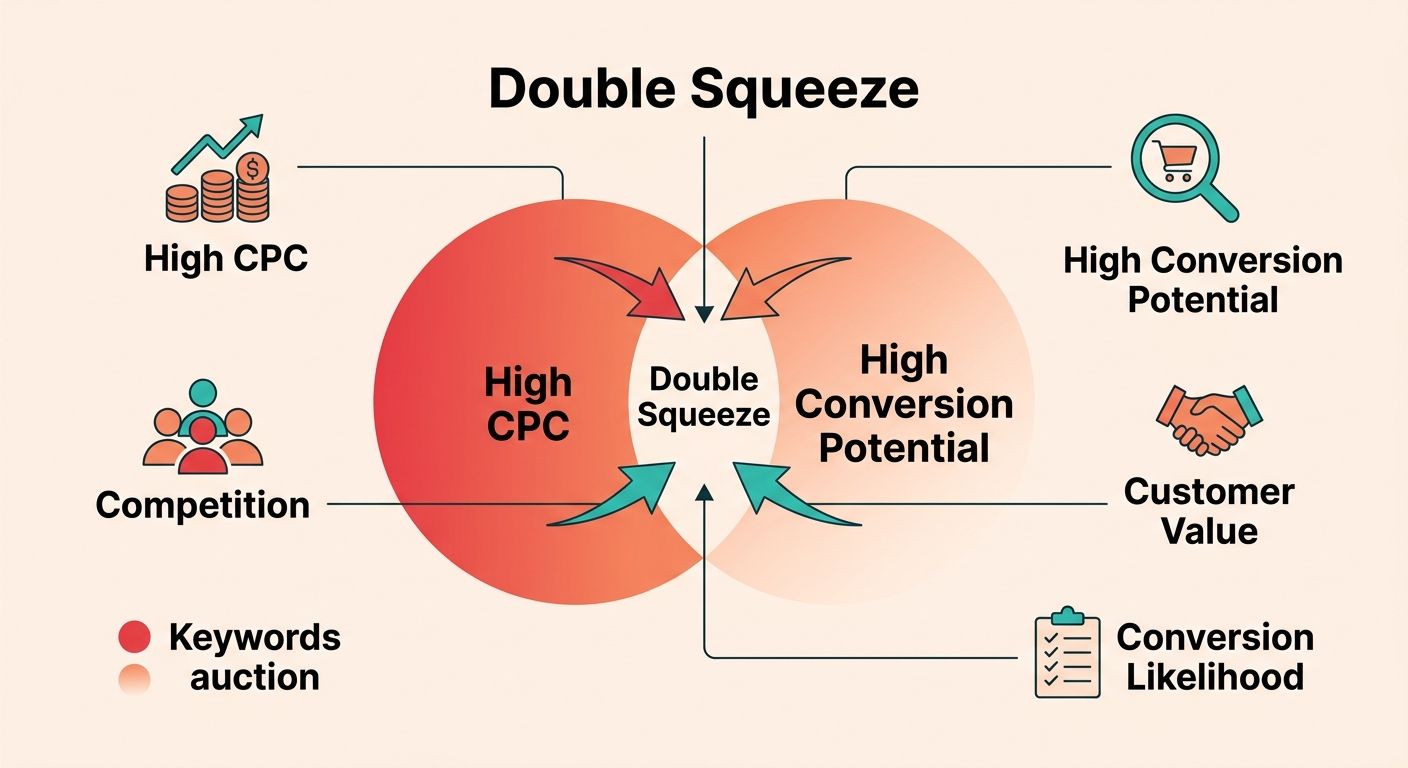
What Metrics Actually Predict High-CPC Success?
Start with intent alignment before budget. Filter keywords by commercial intent in your research tool, then cross-check the SERP. If the top results are comparison pages, buying guides, or "best of" lists, the intent matches. If they're blog posts or Wikipedia entries, the classification is wrong and your conversion rate will drop even if the CPC looks attractive.
Search volume matters less than auction pressure. A keyword with 500 monthly searches and 15 active bidders beats a 5,000-search term with three bidders if you're selling to a decision-ready buyer. Check the competition metric in your keyword tool. High competition on low-volume keywords signals concentrated buyer intent.
Personalized keyword difficulty separates realistic targets from money pits. Generic KD scores assume you're starting from zero. If your domain already has topical authority in the space, your actual difficulty is lower than the tool reports. A CRM software provider targeting "sales pipeline templates" might find their personalized difficulty is significantly higher than the generic score because established competitors hold a monopoly on CRM-related search authority.
Conversion funnel position reveals true keyword value. Terms like "best CRM for small business" sit higher in the funnel than "HubSpot vs Salesforce pricing." The second keyword carries a 3.2x higher conversion rate despite lower search volume because the searcher is comparing final options, not researching categories. Filter for comparison and alternative keywords when building your target list.
How Do You Balance Paid and Organic for the Same High-CPC Terms?
AI Overviews changed the playbook. Being cited inside the AI Overview dramatically lifts paid CTR, but if you're below the fold with no citation, your baseline CTR drops significantly. The ROI variable is no longer conversion rate alone. It's whether your content earns an AI citation while your ad competes for attention.
Run organic and paid in parallel, but measure AI visibility score alongside conversion rate. If your high-CPC keywords trigger AI Overviews and you're not cited, your paid spend is competing with free AI answers. Fix the content to earn the citation, or shift budget to lower-CPC terms where AI Overviews are less common.
The highest-value keywords demand pages engineered to win both placements. The old model treated SEO and PPC as separate channels with separate assets. In 2026, pages need to rank organically while supporting conversion goals if you're running paid campaigns on the same terms.
Attribution models determine budget allocation. Last-click attribution makes high-CPC keywords look inefficient because they rarely get credit for the final conversion. A user who clicks your ad for "enterprise accounting software," then returns three days later via branded search, gives the brand term credit under last-click. Switch to data-driven or time-decay attribution to see how commercial-intent clicks contribute to conversions. One SaaS company found that high-CPC generic terms influenced 47% of conversions that were credited to brand terms under their old model.
What's the Practical Order of Operations?
Pull commercial-intent keywords from your research tool and segment by CPC. Start with mid-range CPCs where you can afford to test. Keywords in the $5–$15 range let you learn what converts before you commit higher amounts per click. Track which terms generate AI Overviews using the tool's AI visibility filter.
Build conversion-optimized pages for the mid-CPC terms first. Match the SERP format: if the top results are comparison tables, build a comparison table. Test your page's ability to rank and convert paid traffic before scaling to higher CPCs.
Once you confirm the page converts, increase bids gradually and monitor whether AI Overviews push your ad lower. If CTR drops below 10% on a keyword you know converts, either improve the page's AI citability or pause the keyword and reallocate budget.
Dayparting and geo-targeting refine high-CPC efficiency. A B2B software company reduced wasted spend by 34% by limiting high-CPC campaigns to business hours in time zones where their sales team operates. Consumer brands see the opposite pattern. Segment your high-CPC campaigns by when and where your buyers actually convert, not when they casually browse.
Frequently Asked Questions
1. Should I avoid all keywords that trigger AI Overviews because of lower CTR?
No. AI Overview keywords often carry the highest CPC, meaning the highest customer value. The smart play is to target AI-free terms for quick wins while building citation-worthy content for lucrative AI Overview terms. Getting cited inside the Overview can lift paid CTR, turning the threat into an advantage.
2. How do I know if a high-CPC keyword is actually worth the cost for my business?
Calculate your customer lifetime value first, then compare it to cost per acquisition at that CPC. A high-ticket enterprise software provider can easily justify spending hundreds of dollars per click if a closed deal yields thousands in annual recurring revenue. Conversely, a low-margin e-commerce store would quickly go bankrupt bidding at those same levels. Price bids against your own economics, not industry averages.
3. What's the difference between generic keyword difficulty and personalized keyword difficulty?
Generic KD assumes you start from zero authority. Personalized KD reflects your actual domain strength in that topic. A term might look easy generically but prove much harder for your specific site if competitors have established deep topical authority in that niche. Always check both before committing resources.
4. Why do commercial intent keywords often have lower difficulty than informational ones?
Because fewer sites target them strategically. Most content teams chase high-volume informational terms, creating more competition there. Commercial keywords like comparison and alternative searches attract less content but convert better, making them accessible wins even for lower-authority domains trying to generate revenue quickly.
5. How many touchpoints do buyers need before converting on commercial intent keywords?
Buyers consult multiple sources before deciding. Your commercial intent page must be one of those touchpoints and move them forward, not just inform. This means comparison pages need clear decision frameworks, social proof at the evaluation stage, and calls to action that match where the buyer is in their process.
6. What attribution model shows the true value of high-CPC commercial keywords?
Switch from last-click to data-driven or time-decay attribution. Last-click hides how commercial keywords contribute because users often return via branded search for the final conversion. Multi-touch models reveal how high-CPC generic terms influence a significant portion of conversions that are otherwise incorrectly credited to brand terms under old last-click models.
7. Should I run separate landing pages for paid and organic traffic on the same commercial keyword?
No. In 2026, pages need to rank organically while converting paid traffic on identical terms. Engineer one page that earns AI Overview citations and converts visitors, rather than maintaining separate SEO and PPC assets. The old split-channel model wastes resources and misses the link between citation visibility and paid performance.