Content Audit: A Step-by-Step Guide to Auditing Your Whole Site

Key Takeaways
- A content audit inventories and reviews every page against your goals.
- Most audits take two to four weeks, depending on page count.
- Roughly 5% of content drives 90% of engagement.
- The best fixes are duplicate content, meta tags, and internal links.
- Quantitative audits track inventory, owners, metadata, and traffic.
- Qualitative audits judge relevance, accuracy, and business fit.
- There is no standard audit method, so define your criteria.
- Refreshed pages can regain rankings, traffic, and AI citations.
Quick Summary
A content audit inventories and reviews every page on your site. Score each page against your goals, then keep, update, merge, or cut it. Done well, audits revive decayed pages, lift rankings, and recover organic traffic. Budget two to four weeks, based on page volume.
One thing practitioner guides often skip: the method itself is not standardized. Academic reviews of the field still find no consensus on what separates an audit from a plain content inventory. Both views are true in different ways. The workflow works in practice, even without formal rigor. That means you define your own scoring criteria instead of waiting for a standard.
What a content audit actually involves
At its simplest: catalog every URL, pull performance data, score each page, then decide its fate. The three fixes that pay off most often are removing duplicate content, tightening meta tags, and repairing internal linking so strong pages pass authority to the rest.
Two audit types are worth separating. A quantitative audit builds the inventory, page types, owners, metadata, and traffic. A qualitative audit judges each page against your standards for relevance, accuracy, and business fit. The first tells you what exists. The second tells you what's worth keeping.
Where to actually spend your effort
Not everywhere. Roughly 5% of your content drives 90% of engagement, so treating every page as equally worth your time wastes weeks. Concentrate on freshness and authority in that high-performing slice first. That's the same lever behind higher organic traffic and more qualified leads.
Pair that skew with a maintenance cadence, not a one-time project. The average website lives just two years and seven months, yet only about a third of marketers audit twice a year. Do the math, and most sites reach end-of-life after only a handful of audits. Outdated pages quietly decay the whole way. A single audit patches the leak once. A recurring one keeps it sealed.
How long and how hard
Time scales with your site's footprint. A 50-page brochure site might take a couple of days. A 10,000-URL library runs into months.
Difficulty scales with scope. A beginner can inventory a small site with a spreadsheet and free analytics exports. Audits that fold in AI-visibility checks, crawl data, and accessibility standards demand more skill and more tooling.
Skip the full treatment if you're launching a brand-new site with a dozen pages. There's nothing to audit yet. The exercise pays off once you have enough content that you cannot remember what's live, which page ranks, or whether three articles are fighting over the same keyword.
Why content audits earn their keep
Most of your traffic, rankings, and AI citations ride on a tiny fraction of your pages. Get that fraction right and the whole site performs. Let it decay and you lose ground you already won. That's the case for auditing, and the numbers back it.
The ground shifts fast. Content that ranked last year may already be slipping this quarter. Search behavior changes, competitors publish fresher takes, and facts go stale. An audit catches that drift before it costs you position. Skip it, and you find out when a page that used to convert stops pulling its weight.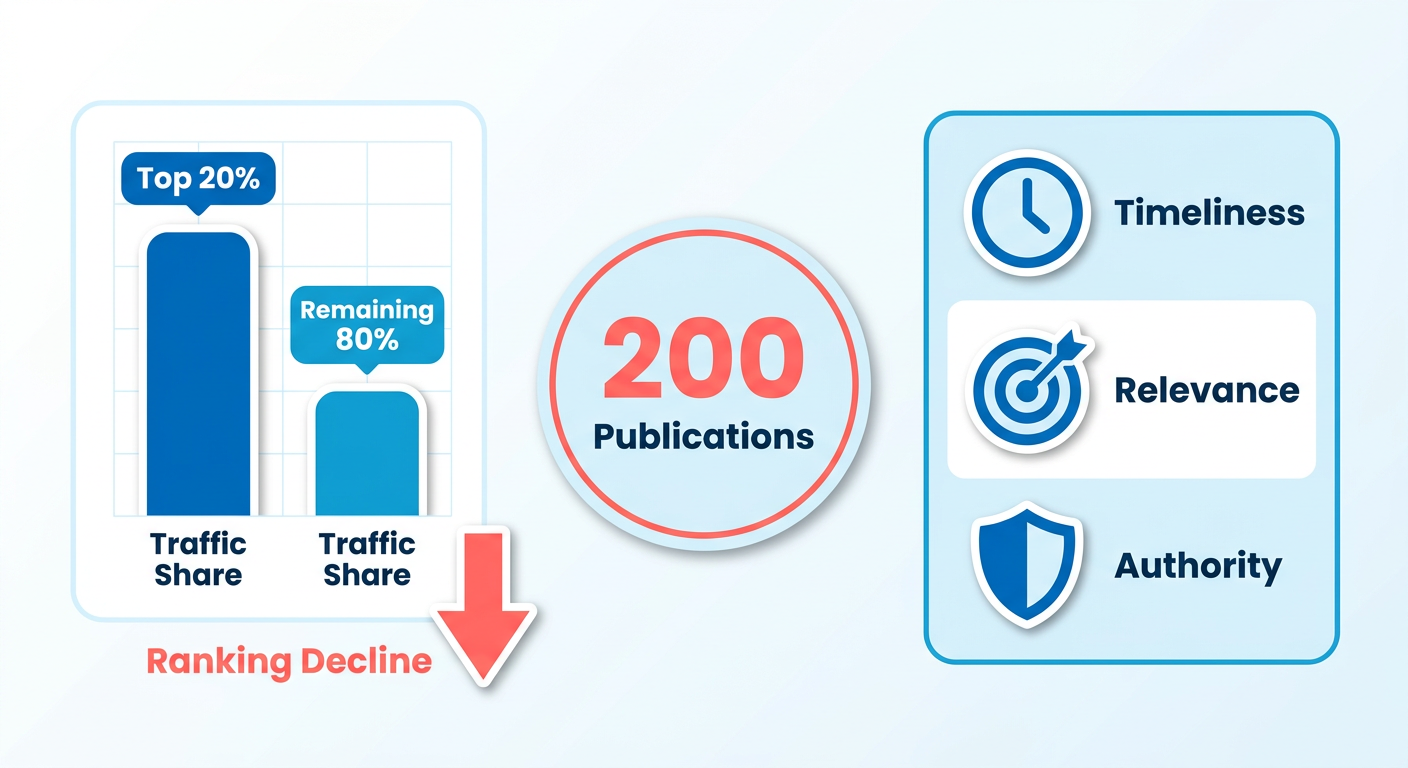
What breaks when you stop checking
The three quality signals most likely to slip are timeliness, relevance, and authority. A web content quality analysis of one regional site with 549 pages found exactly these three scoring lowest. Not a coincidence. Those are the signals that erode quietly while a page still looks fine on the surface.
Without a systematic check, decay compounds in the dark. Outdated statistics, broken external links, and obsolete product references pile up, and each one signals to search engines that nobody is minding the store. That's why one cleanup won't hold. If timeliness and authority keep drifting between checks, you need a cadence, not a single heroic pass.
Where the payoff actually shows up
On the freshness and authority of your high performers. That's the slice that moves numbers. Auditing everything equally spreads your effort thin across content that was never going to matter.
The payoff is documented. One company lifted organic traffic by 20% after auditing and optimizing its top pages. The win came from a simple move: find what's already working and stop it from going stale. That's also why 71% of marketers treat audits as core to SEO. Google leans on content quality as a ranking input, and quality is what an audit measures. Skip it and you're guessing which pages still clear the bar.
The problems an audit solves
Audits clear out the issues that quietly drag a whole domain down:
- Duplicate content: pages competing against each other for the same query, splitting authority.
- Thin content: pages too shallow to rank or earn a citation, watering down your site's overall quality signal.
- Poor internal linking: strong pages left orphaned, with nothing passing authority to where it counts. Fixing this is where a deliberate approach to content clusters through internal linking earns its keep.
This holds whether you run a five-page startup site or an enterprise library with thousands of URLs. Small sites audit faster. Large sites gain more per fix. Either way the mechanism is the same: inventory what exists, judge it against your goals, then decide what to keep, update, merge, or cut.
One caveat worth stating plainly. An audit that only sorts pages into keep-or-delete piles misses the point. The sorting is the method. The purpose is deciding what your site should become next.
Before you touch a single URL
Good prep separates an audit that lifts traffic from a spreadsheet nobody opens again. Lock down three things first: your tools, your scope, and your goals. Do that and the rest of the audit runs on rails.
The honest complication is a familiar one. Academic reviews drawing on a corpus of 200 publications keep flagging how easily teams confuse a simple inventory with a strategic audit. That distinction is exactly why prep matters. Set clear, customized evaluation criteria before you gather data, or you'll end up with a massive list of URLs and no idea what to do with it.
The tools you actually need
At minimum: a data source, a crawler, and a keyword tool. Google Search Console shows queries, impressions, and which pages actually earn clicks. Google Analytics gives you engagement and conversion data, so you can spot the pages doing real work. A keyword research tool fills in ranking positions and search demand.
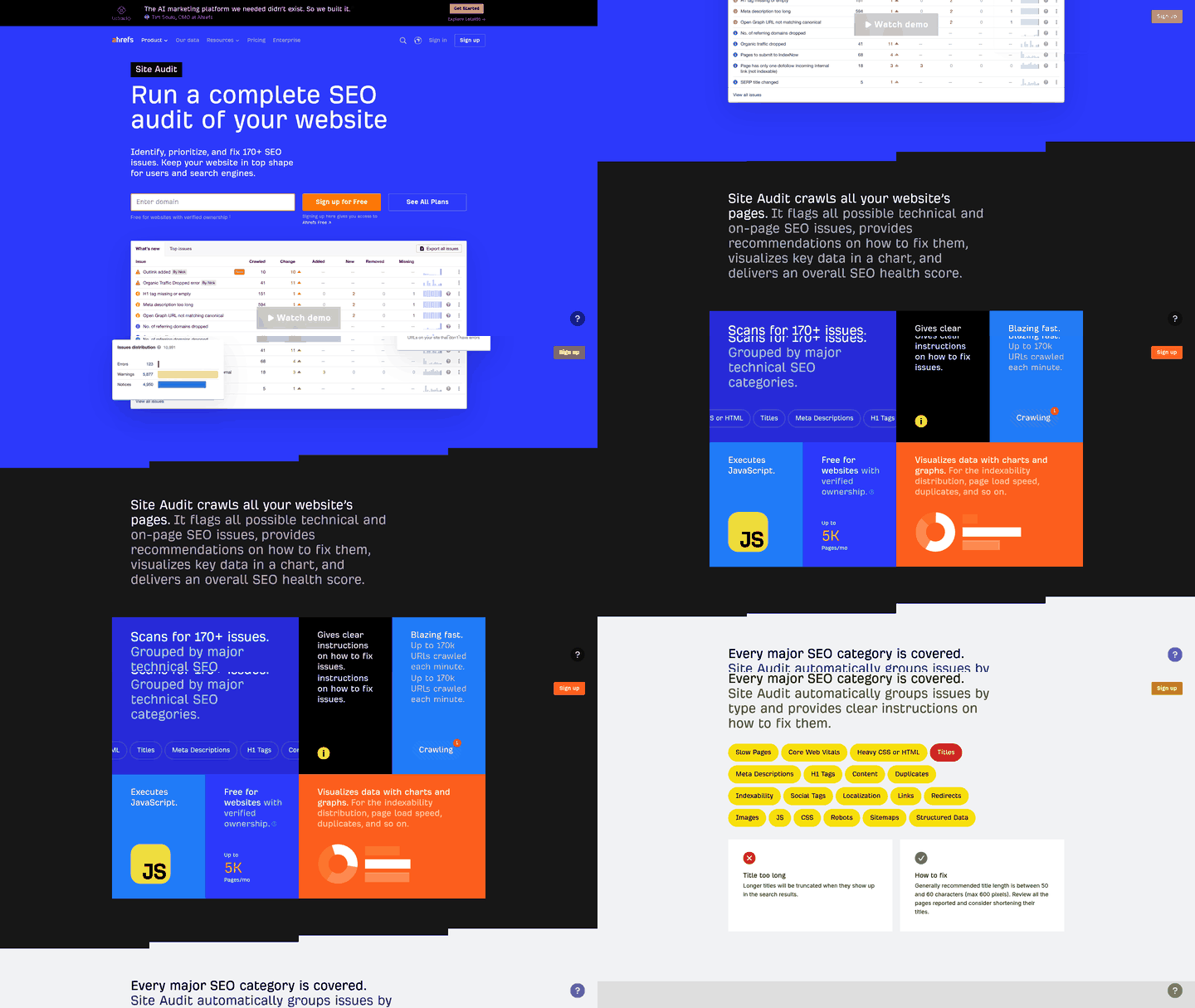
Add a site-crawling tool to build your raw page list. A crawler pulls every URL, its metadata, and its status codes in one pass, which beats copying links by hand. It also flags the boring-but-costly stuff: broken links, rogue noindex tags, orphaned pages that no longer get visits.
Defining scope and goals
Scope is which pages and content types you're reviewing. Goals are the outcome you're chasing. Set both before collecting data, because they change what you measure. A revenue goal weights conversion data heavily. An organic-traffic goal weights rankings and freshness.
Don't try to audit everything at once. Start with a manageable subset so the work stays finishable. Pick your goal in concrete terms, too. One audit might aim to lift organic traffic by optimizing high performers. Another might target more qualified leads by updating outdated pages and realigning them to search intent. Both concentrate effort where it pays off instead of treating every page the same.
One more prep decision worth naming: cadence. Content quality degrades continuously, so build your spreadsheet and workflow to be reusable from the start. Planning for a repeatable process now means every later review takes a fraction of the setup.
Who's involved, and how you track it
Pull in stakeholders early to agree on scoring criteria and what "good" looks like. Content owners, an SEO lead, and whoever owns the business goal should all weigh in before scoring starts. Aligning on criteria first prevents the fight that derails audits at the end, when someone disputes why their page got flagged for deletion.
Then build a content inventory spreadsheet as your single source of truth. Give each row a URL, page title, author, format, creation date, and columns for your metrics and your keep/update/merge/cut call. A shared sheet keeps a distributed team scoring against the same rubric. For a large or messy site, a content matrix does the same job at greater scale.
Running the audit, pass by pass
Conducting the audit means scoring every page against your goals, then deciding what to keep, update, merge, or cut. It runs best in five passes: quality, relevance, duplication, metadata, internal links. Work them in that order and each pass feeds the next.
One principle keeps you honest throughout: your effort pays off most on the pages already doing work, not on rewriting everything equally. Real-time analytics show you where that payoff sits, so you can prioritize the URLs already earning traffic instead of spreading yourself flat.
Evaluating content quality
Score quality with behavioral signals, not gut feel. Look at engagement metrics per page, then compare them against the page's goal. High engagement with low conversions means the topic lands but the call to action doesn't.
As one content strategist put it, audits let teams "identify gaps, redundancies, and opportunities for modular, reusable content." That framing matters. A weak page isn't always a delete. Sometimes it's raw material you fold into a stronger one.
Assessing relevance
Relevance comes down to two checks. Does the page target a query people actually search, and does it cover the topic completely? Run keyword research against each page to confirm real demand, then use topic modeling to spot thin coverage where competitors go deeper.
An honest carve-out: skip a full relevance rework for evergreen pages that already rank and convert. Chasing marginal topic gaps on a winner burns cycles you could spend rescuing decayed pages.
Handling duplicate and thin content
Flag duplicates and thin pages, then merge or cut. Duplicate content splits ranking signals across near-identical URLs, so consolidating them into one authoritative page usually recovers the lost ground. Thin pages that serve no goal are dead weight. Delete them and redirect.
Consolidation also cleans up your crawl budget and points search engines at your most comprehensive resource. Before you delete, though, check whether a thin page is worth expanding into a full guide instead. If the target keywords still hold business value, expansion often beats deletion.
Optimizing meta tags and internal links
Two quick wins close the audit: metadata and linking. Rewrite title tags and meta descriptions so they match search intent and pull clicks. Every high-value page deserves a title that earns the click and a description that previews the answer.
Then fix internal links. One content writer described an SEO-focused audit where the team "paid close attention to our internal and external links." Strong internal linking spreads authority to the pages you're trying to lift and keeps readers moving. Group your links around related topics rather than scattering them at random. Building content clusters through internal linking is a well-established method worth exploring if you want the deeper approach.
One practical target on this pass: keep click depth shallow, so no key page sits more than three clicks from the homepage. Pages buried deeper get crawled less and pass weaker signals. While you're in the links, log every broken link and orphaned page you find. A page with zero inbound internal links is effectively invisible to crawlers and readers alike, and fixing those connections often lifts the pages you already flagged as worth saving.
Turning the scorecard into action
A finished scorecard isn't the point. What you do with it is. Analyzing results means sorting every page into four buckets, keep, update, merge, or cut, then ranking those actions by the traffic and authority at stake. Act on the highest-impact pages first and let the long tail wait.
Most teams fall into the same trap. They treat the spreadsheet as the deliverable. The value is in the changes that follow, and those changes pay off unevenly.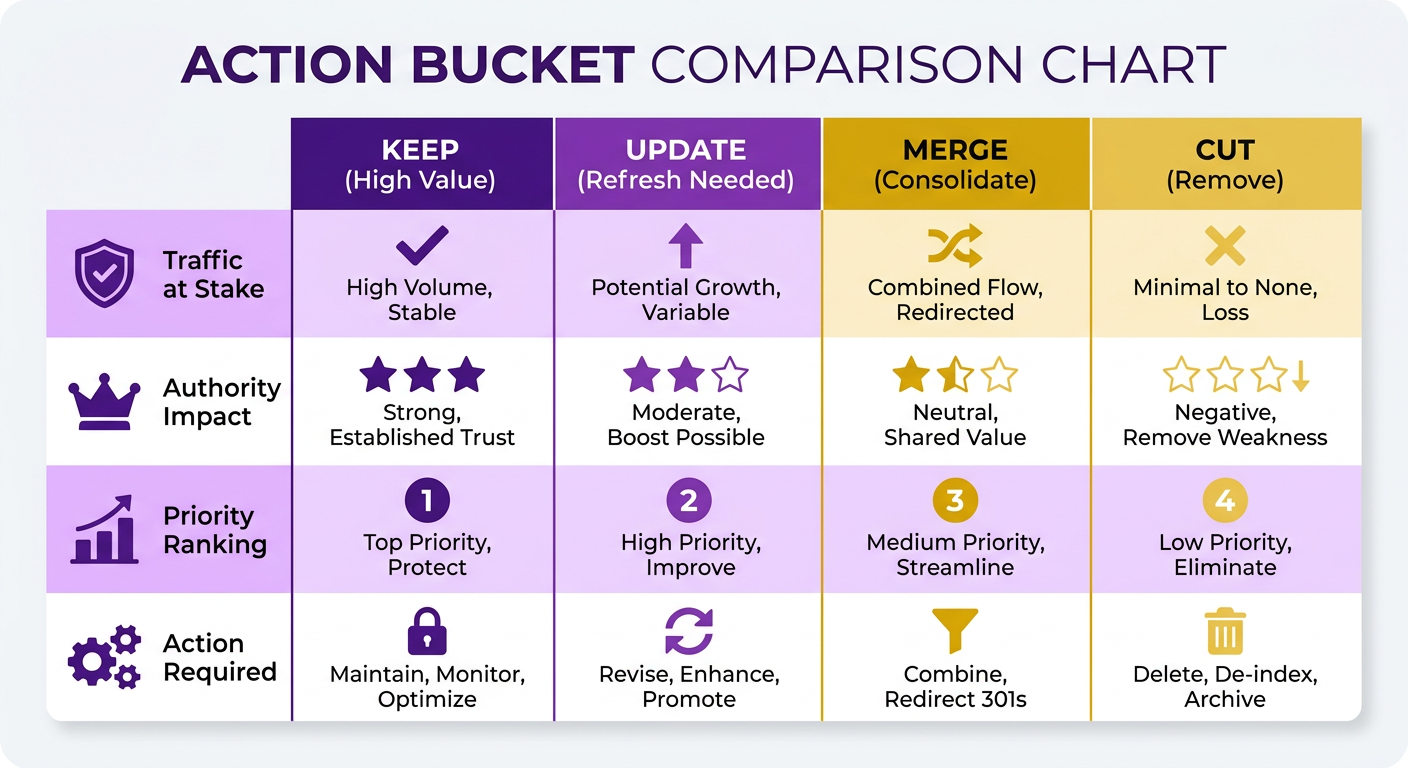
Prioritizing what to fix first
Start with the pages that already earn something. Updating and re-optimizing existing high performers is where effort compounds fastest, because a page that already ranks needs a refresh, not a rebuild, to climb further. AnyPost surfaces low-difficulty, high-intent keywords tied to your business context, so you can aim those refreshes at terms you can actually win.
Notice what makes this work. It doesn't require rewriting the whole library. It concentrates effort on a small, high-value slice and fixes the decay that crept in. Rank by potential impact, then work top-down until the return flattens.
Quick wins deserve their own lane. A page ranking on the edge of page one. A strong article buried three clicks deep. A duplicate splitting its own authority. These move fast and build momentum before you tackle the heavier rewrites.
Which changes actually move the needle
Structural adjustments give you the fastest ranking gains. Resolve keyword cannibalization and search engines can finally identify the primary page for a query. Update outdated metadata and click-through rates from the results page tick up almost immediately.
Internal links are the structural backbone people overlook. That link architecture decides how search equity flows through your site, turning isolated pages into a connected network. AnyPost bakes relevant internal and external links into every article it generates, so the authority-carrying structure is built in from the start.
Once a page is refreshed, get it re-indexed fast. Automated publishing shortens the gap between "we fixed it" and "search engines saw it," which is where the citation and traffic gains actually land.
Knowing whether it worked
Track it in Search Console and Analytics, then keep tracking. Watch impressions, clicks, and average position in Search Console for the pages you touched. Watch behavioral signals in Analytics to confirm the update served readers, not just the algorithm.
Set a baseline of your organic impressions and conversion rates before you make changes. That's how you measure the exact lift from your work and prove the audit's value to stakeholders. A single audit is maintenance theater. Build a cadence instead. Feed performance data and user feedback back into the queue, and treat auditing as a loop, not an event.
Auditing as a habit, not a project
A content audit isn't a one-time project. It's a habit. The sites that hold their rankings and keep earning AI citations treat maintenance as an ongoing cadence, refreshing the small slice of pages that carry the load before decay sets in.
How often to re-audit
Quarterly, or immediately after a major algorithm update. That timing catches ranking drops while they're still cheap to fix, instead of waiting for a page to fall off page one entirely.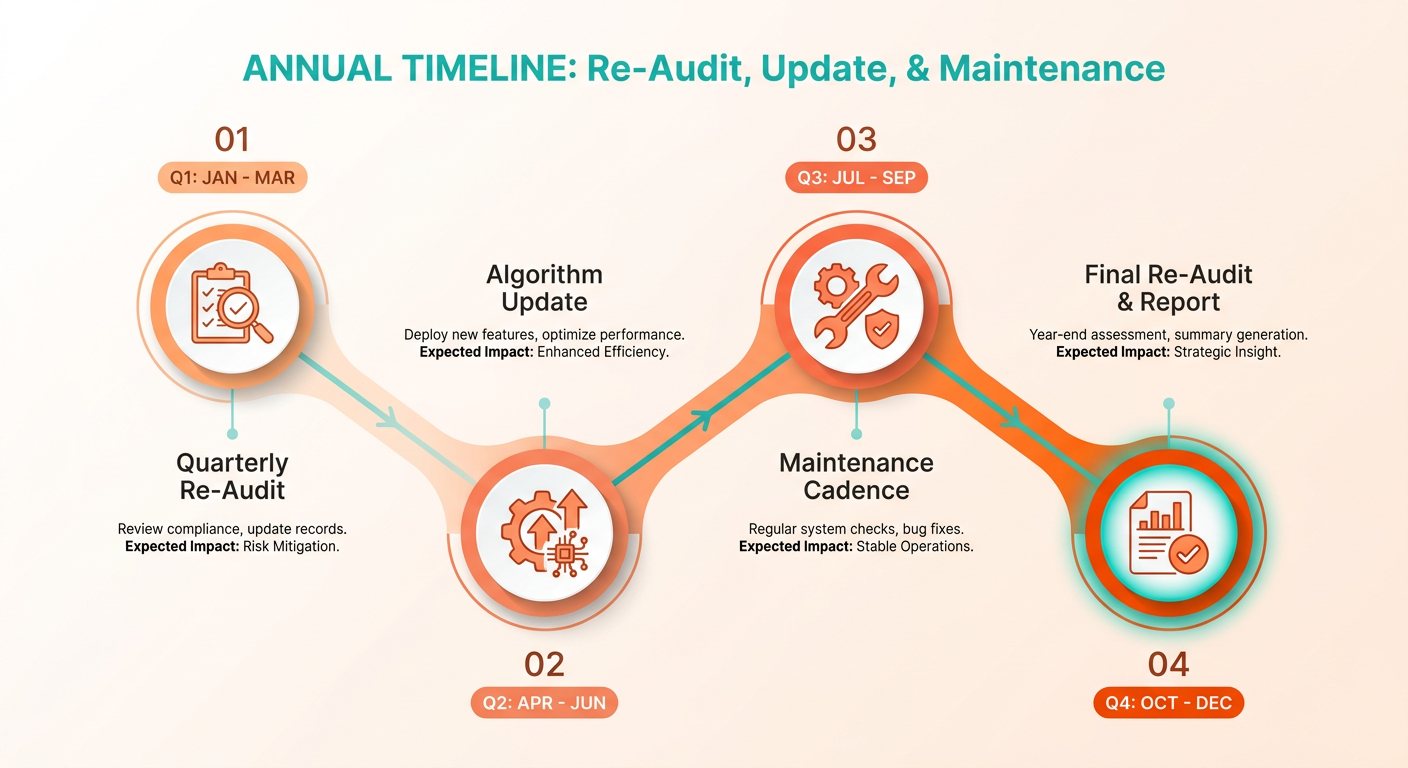
Most marketing teams struggle to hold a consistent review schedule, and their libraries age without oversight. Left unmonitored, search performance slides gradually as newer competitor pages capture the intent you used to own. Freshness and authority decay stack up unchecked across the whole library. The single heroic audit does almost nothing here. The maintenance rhythm is the actual product.
What to monitor between audits
Track performance continuously so your next audit starts with signal, not guesswork. Google Search Console shows impressions, clicks, and average position per query, so you can catch a page slipping before its traffic craters. Google Analytics tells you what happens after the click, which pages hold attention and which bounce.
Watch the early warning signs. A page whose impressions hold but whose clicks fall is losing the snippet war. A page whose position drifts down week over week is getting out-competed on freshness. Both are fixable if you catch them in a monthly glance rather than a yearly reckoning.
Then close the loop with user feedback. Comments, support tickets, and on-page behavior tell you where content confuses people. Fold those signals into your update queue alongside the analytics, and you refine based on what readers actually do, not what you assumed they wanted. AnyPost's real-time analytics keep those signals in one place, so you can see which high performers are worth re-optimizing and which decayed pages the audit flagged. Both kinds of wins come from refreshing existing work, not producing more of it.
Keeping voice consistent at scale
Consistency is the quiet failure mode of frequent updates. When you're refreshing dozens of pages on a rolling schedule, tone drifts, different writers pull in different directions, and the library stops sounding like one brand.
We solve this with a persona engine that locks tone and voice across every update, so a page rewritten this quarter reads like it belongs beside one written last quarter. That matters more than it sounds. AI systems increasingly cite sources that read as coherent and authoritative, and a fragmented voice undercuts both.
Pair that with automated generation and publishing to compress the update cycle itself. The bottleneck in most maintenance programs isn't knowing what to fix. It's finding the hours to fix it. Automating the drafting and the push means your quarterly cadence survives contact with a busy calendar, which is the only version of a maintenance plan that actually holds.
Frequently Asked Questions
1. What's the difference between deleting a page and using a 301 redirect when cutting content?
Redirect when a page has backlinks or residual authority. A 301 passes that link equity to a relevant surviving page, so ranking signals aren't lost. Delete outright only when a page has no inbound links, no traffic, and nothing topically worth preserving on your site.
2. My page gets strong traffic but almost no conversions. What should I do with it?
Keep the page but fix the call to action, not the content. Strong traffic with weak conversions means the topic attracts readers while the next step fails. Test clearer CTAs, better internal links to conversion pages, and offers matched to the reader's intent before considering deletion.
3. Can I run a useful content audit with only free tools?
A small site audit runs well on Google Search Console, Google Analytics, and a spreadsheet, no paid software required. Search Console supplies queries and clicks, Analytics adds engagement data, and the sheet becomes your scoring hub. Paid crawlers and keyword tools mainly help once sites grow past a few hundred pages.
4. How do I decide whether to update a page or merge it into another?
Update a page when it targets a distinct query and still has unique value worth strengthening. Merge when two or more pages chase the same keyword and split authority between them. Consolidate the overlapping ones into a single authoritative page, then redirect the weaker URLs to it.
5. What does "click depth" mean and why does it affect rankings?
Click depth is how many clicks separate a page from your homepage. Pages sitting more than three clicks deep get crawled less often and receive weaker internal authority. Bringing key pages closer to the homepage through internal links helps search engines find them faster and pass stronger ranking signals.
6. How do I audit a site with thousands of URLs without spending months on it?
Prioritize instead of reviewing every URL equally. Pull traffic data first, then focus deep review on the pages already earning clicks and rankings. Batch the rest by page type and score them quickly against status and metadata. This concentrates effort where returns compound and keeps large audits finishable.
7. Will AI-generated content pass a content audit?
AI-generated content passes when it earns engagement, targets real search demand, and reads as coherent and authoritative. Audits qualify pages on relevance, accuracy, and business fit, not authorship. Tools like AnyPost that lock consistent voice and build in relevant internal links help AI content meet those quality bars.
