
Content Automation That Preserves Brand Voice: Three Systems Compared

The Short Version
- Jasper positions Brand Voice as a setting that can carry through bulk grids, agents, and supported external tools; vendor materials cite a March 2026 MCP server update.
- Writesonic’s current positioning emphasizes AI search visibility, with higher tiers described as monitoring brand mentions across major generative-answer environments such as ChatGPT, Gemini, Claude, and Perplexity.
- HubSpot describes Breeze AI as analyzing content samples to generate brand voice summaries, with approved and avoided terms and inclusivity rules that can be applied across several content types.
- AI can execute adjective-based voice guides very literally. Generic descriptors like “professional” or “innovative” can become vague templates.
- Human editors reviewing individual posts can miss cumulative drift patterns across a high-volume batch. Performance data may reveal subtle voice erosion more reliably than one-by-one review.
Quick Summary
The part most teams underestimate isn’t writing the content. It’s making sure your content still sounds like you six months in. The current evidence supports comparing three systems with documented voice-preservation mechanisms: Jasper, Writesonic, and HubSpot. AnyPost.ai appears in vendor comparisons, but the research contains no specific documentation of its voice-governance architecture, so we’ve marked those cells “not verified” unless you add AnyPost-specific sources.
Evidence-backed comparison: Jasper, Writesonic, and HubSpot
| System | Voice-Preservation Tech | Content Types | SEO/GEO Automation | Publishing/Workflow Scope | Integration Flexibility | Pricing Tier | Evidence Strength |
|---|---|---|---|---|---|---|---|
| Jasper | Vendor materials describe Brand Voice, Audiences, and Style Guides; portability into bulk grids, agents, and MCP-connected tools | Blogs, social, email, ads, product copy | ≈ (SurferSEO integration listed; separate subscription may be required) | Bulk content grids, AI agents, Canvas editor, multi-seat workspaces | ✓ MCP server, Slack, Webflow, Google Docs, Word | Vendor materials | ✓ |
| Writesonic | Templates + SEO/GEO scoring; no detailed brand-voice mechanism documented in sources | Articles, landing pages, product descriptions, ads | ✓ GEO visibility tracking across major generative-answer platforms, keyword research, content briefs | Self-serve tiers with workspace limits; higher tiers described as adding GEO monitoring | ✓ Google Search Console, Google Analytics on higher tiers | Vendor materials | ≈ |
| HubSpot | Vendor describes Breeze AI voice setup; sample-based brand voice summary, approved and avoided terms, inclusivity rules | Email, blogs, social posts, landing pages, service content, SMS (beta) | ✓ Marketing automation, campaign tracking, A/B testing | Marketing/sales/service suite with CRM, pipeline, analytics | ✓ Native CRM, third-party app marketplace | Free tier; paid Marketing Hub plans (quote-only) | ✓ |
| AnyPost.ai | Not verified in sources | Not verified | Not verified | Not verified | Not verified | Not verified | ✗ |
Evidence-strength key: ✓ = documented feature with named mechanism or integration. ≈ = partial/vendor-level evidence; feature exists but mechanism details are thin. ✗ = not found in research.
Jasper’s stated edge is portability. Vendor materials describe defining Brand Voice, Audiences, and Style Guides once, then carrying those constraints into bulk production and agent workflows instead of one-off prompt text. One hands-on reviewer at Zapier reported that Jasper’s Brand IQ worked better than Writesonic’s brand feature in their testing, praising time savings and voice control while noting the need for fact-checking.
Writesonic’s current center of gravity is AI search visibility. Its higher tiers emphasize monitoring whether your brand appears in generative-answer environments, while article generation supports that visibility strategy. The sources confirm SEO/GEO automation and template workflows but contain no evidence of a structured brand-voice governance system comparable to Jasper’s or HubSpot’s.
HubSpot’s Breeze AI is described as applying brand voice across marketing, sales, and service content from one dashboard, with CRM tying outputs to customer data. The setup is described as guided: you paste content samples, set approved and avoided terms, and configure inclusivity rules. The free tier can be used to test the workflow before paid Marketing Hub plans.
Human editors become bottlenecks when content volume scales. HubSpot’s materials frame trained gatekeepers as a workflow problem rather than a quality safeguard. That framing holds when the bottleneck is rule compliance, because AI can apply concrete constraints more consistently once those constraints are embedded. It breaks down when the problem is pattern recognition across a publishing program. Brands that rely purely on pre-publish review can struggle to notice when a voice profile becomes more generic across a sequence of articles, because each individual draft may look acceptable in isolation.
Some legacy brand-consistency research predates widespread AI adoption. What changed is that AI turns weak guidance into repeatable output instead of letting individual writers compensate with judgment. If your site already contains content averaged across many sources, inferred voice becomes an averaging instruction enforced at scale.
Why Voice Governance Matters When You Automate Content
When you automate content marketing workflow at scale, the risk most teams underestimate isn’t the volume. It’s the slow erosion of the voice that made your content recognizable in the first place. Visual brand consistency tends to survive because logos, colors, and templates are locked into design systems. Verbal consistency is more fragile: the moment different people prompt different AI tools with different assumptions, messaging starts to blur.
The business cost shows up less as a dramatic brand failure and more as operational drag. Teams often spend hours rewriting AI drafts that missed the voice because the instructions were too abstract. Prospects encounter phrasing that could belong to any competitor. Internal reviewers start debating tone on every draft because the system never learned the rules in the first place. Industry surveys commonly report that maintaining consistent brand voice is a top challenge when scaling content production with AI.
Why your existing brand guide doesn’t work with AI
Most companies already have a brand voice guide—four or five aspirational adjectives plotted on a tone spectrum. Those guides were written for humans, who could interpret vague direction through context, experience, and taste. AI doesn’t interpret them that way. It turns soft language into probable language, which is why broad instructions can produce familiar, polished, forgettable copy.
The failure mode can show up in predictable patterns. Generic AI output can capitalize nonexistent product names, use vague attributions like “a leader said” instead of real names, and default to endless short bullet points—a sign that no human reviewed the draft. When voice features infer tone from a website, they may be drawing on a mix of human and machine output, creating a feedback loop that can flatten distinctive voice over time.
What enforceable voice governance actually requires
Skip adjective-based guides as the primary control layer if you’re feeding them into AI. They weren’t built for machines, and they often won’t constrain output. Sample-based training may work faster than building rules from scratch: you feed the system examples of your best writing, and it learns the structural patterns behind your voice. The difference is enforceable guidance: approved terms, banned phrases, casing standards, content structures, and claims the AI must follow at generation time.
Make the rules concrete: “Use active voice. State the outcome before the method. Never hedge with ‘we believe’ when you can document what happened.” Define what your brand is not as clearly as what it is. That negative constraint often sharpens voice faster than positive examples. Connect the voice profile to your actual product messaging so when your positioning changes, the AI doesn’t keep generating stale claims months later.
The honest limit: AI handles compliance with explicit rules better than it handles taste. Your workflow still needs people reading aggregate results, comparing content performance, and noticing when technically compliant output no longer sounds commercially sharp. Treat AI as the drafter and humans as the pattern-recognition layer, and you get speed without handing away editorial judgment.
How Voice Profiles Survive (or Don’t) at Scale
The infrastructure that determines whether your voice survives the process is often invisible until it fails. Many platforms ask you to feed them a brand voice once—a set of tone descriptors, some example content, maybe a style guide—and assume that input will travel through every piece of content you generate. It often won’t. The disconnect between what you define and what the system produces can compound over time because AI often generates content from statistical averages, not from conviction. Without structural constraints baked into the generation layer itself, your brand voice can degrade into the generic middle ground that every competitor sounds like.
The market’s strongest voice tools can enforce terminology, apply tone rules, and flag obvious departures from approved language. The harder question is whether the source document they enforce is worth scaling. If the brand profile is thin, the platform will not magically invent distinctiveness. It will make the thin profile easier to reproduce. That is useful for consistency, but dangerous if consistency simply means repeating the same empty phrasing faster.
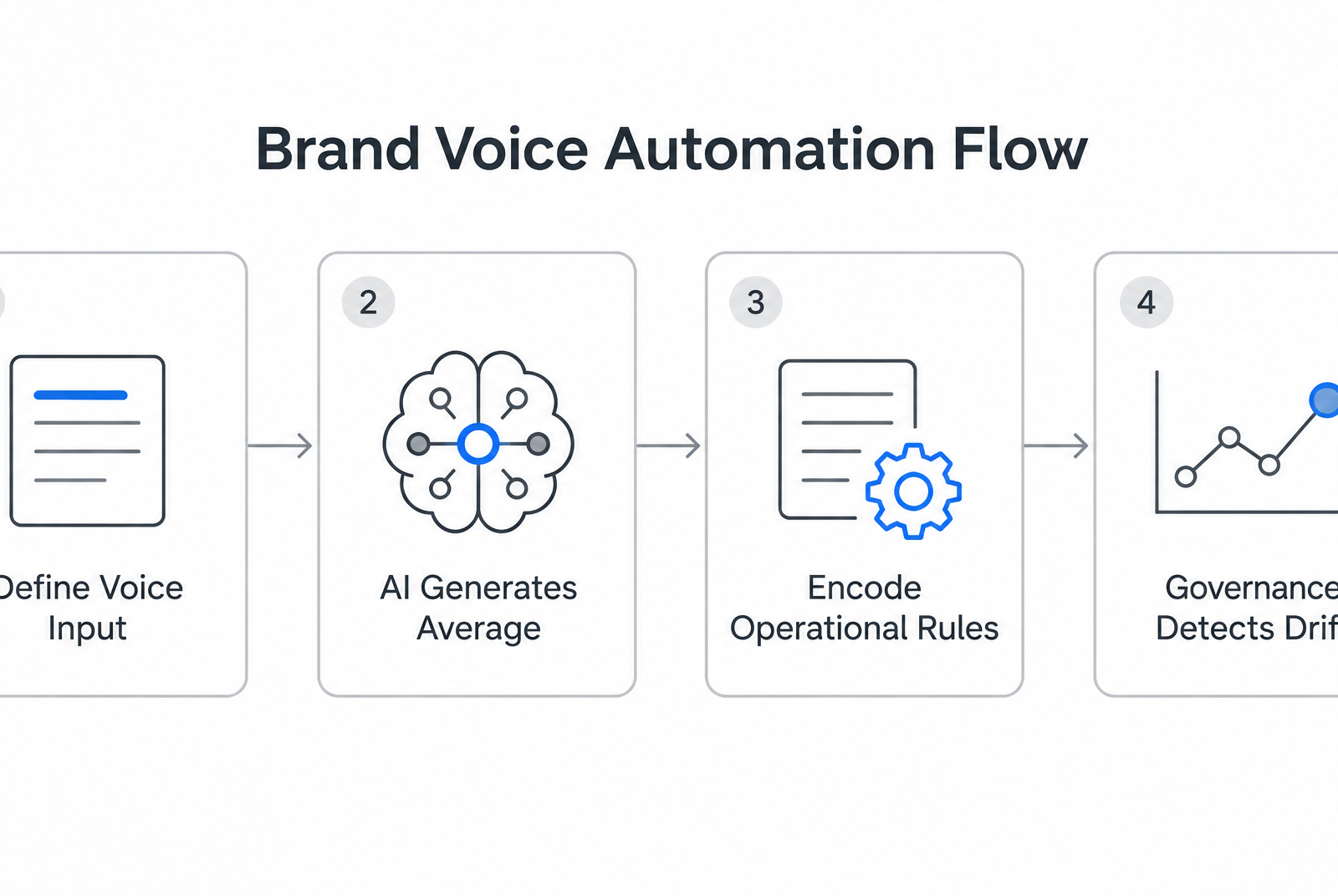
Voice profiles that survive automation
The brands maintaining consistent voice at scale aren’t the ones with the best copywriters. They’re the ones that turned voice into a system. That means moving past soft descriptors and into observable decisions: the words you use, the questions you open with, the structures you avoid, the claims you make with certainty instead of hedging. Some platforms describe connecting those rules to content generation, applying them as the AI drafts rather than after. The trade-off is setup friction: you’re not just describing your voice, you’re encoding it as operational rules.
When governance catches drift
A single off-brand post doesn’t sink your voice. Accumulated inconsistency does. When content volume scales through automation, quality control has to move beyond line edits. A performance audit loop, where you measure whether generated content actually moved conversions or engagement, creates feedback you can’t get from visual inspection alone. If tone-governed content underperforms, the issue may be that the rules reflect internal preference rather than audience response. That feedback loop closes only when you measure actual performance, not just compliance.
Jasper: Portable Voice Infrastructure
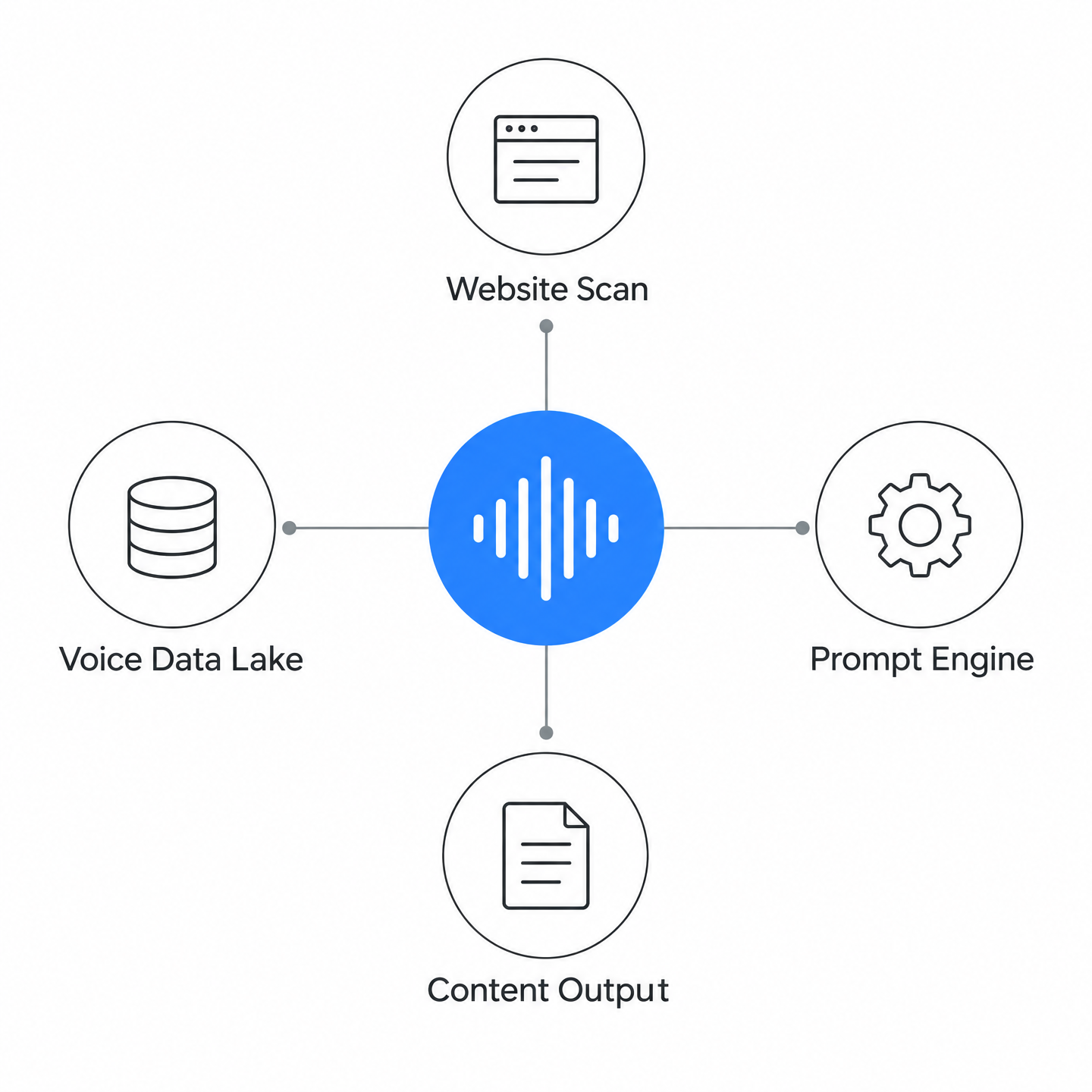
Jasper’s brand voice approach is presented as starting at the infrastructure layer. Vendor materials describe the ability to scan a website and infer tone, vocabulary, and style patterns, or to define voice parameters manually. The architecture is framed as treating voice as data that moves with the work, rather than instructions pasted into a prompt that evaporate between sessions.
Vendor materials describe workflow scope covering templates, bulk content grids, agents, campaigns, and general marketing content. The sources reviewed do not document backlink automation or SEO crawling infrastructure for Jasper. If you need those, you may need another tool. Jasper’s documented integration mechanisms can allow Brand Voice and Style Guides to extend beyond Jasper’s own surfaces when your stack supports the appropriate protocols.
Pricing is split into self-serve tiers and custom Business pricing that requires a sales conversation. That structure suggests Jasper is aimed at teams that want centralized brand rules enforced across multiple contributors. Lower tiers may exclude advanced features such as style guides, user groups, custom workflows, knowledge assets, campaigns, or image generation depending on the plan, so verify what you need before choosing a tier.
The satisfaction gap between overall ratings and voice fidelity
User reviews often cite time savings and brand-voice control as strengths, but the available evidence does not break out whether satisfaction reflects voice consistency specifically or general satisfaction with output speed and template variety. The distinction matters: a tool can feel fast and helpful while still drifting toward generic phrasing over time, especially when the brand voice it’s inferring comes from web text that may already contain AI-generated content.
Jasper’s voice-inference feature is only as sharp as the source material you feed it. If your website copy is full of vague value propositions, abstract modifiers, and recycled category language, the feature may preserve that pattern because that is what the evidence suggests your brand sounds like. The tool executes the guide it’s given. It may not flag when that guide is already a template.
For teams managing high content volume across multiple formats, centralized Brand Voice governance can reduce tool-switching and help keep rules consistent from the first draft to the final publish. For businesses that haven’t documented what makes their voice distinct in specific, testable terms, Jasper may automate generic sameness faster than a human writer would.
Writesonic: SEO-First Content Engine
Writesonic sits at the opposite end of the spectrum from Jasper. Where Jasper emphasizes brand voice fidelity, Writesonic is presented as an AI search visibility and content-at-scale engine. Vendor materials describe a shift toward tracking a brand’s presence across major AI answer platforms and Google AI Overviews—often called generative engine optimization, or GEO. In that framing, content generation is the mechanism, not the destination.
This positioning matters for your decision. If the problem is “we’re invisible in AI answers,” Writesonic’s documented workflow may address that directly. If the problem is “our blog sounds like everyone else’s,” the sources reviewed do not show a detailed voice architecture comparable to some competitors.
How Writesonic handles brand voice and where it falls short
The evidence reviewed does not surface a dedicated brand voice mechanism in Writesonic comparable to Jasper’s Brand IQ or HubSpot’s Breeze AI voice setup. That gap may be intentional given its positioning: Writesonic prioritizes template velocity and SEO optimization over voice governance. The workflow is described as feeding the system a brief, picking a template, and generating copy aligned to SEO metrics rather than voice profiles.
According to Zapier’s hands-on comparison, Writesonic offers fast content creation and strong SEO tooling, though outputs may require editing. The tradeoff is transparent: speed and search visibility can come at the cost of voice consistency you may need to enforce through manual review.
Integrations and pricing structure
Writesonic’s integration points differ from competitors. Vendor pricing information indicates Google Search Console and Google Analytics integrations—often necessary for GEO measurement—are available on higher-tier plans. Lower tiers focus on content generation; mid and upper tiers add visibility tracking.
The platform offers multiple pricing tiers, from entry-level plans for individuals to enterprise custom deals. Vendor materials indicate AI article generation is included across tiers. The gap between entry and mid-tier pricing appears tied less to generation capacity and more to analytics integrations that measure whether content shows up in AI-generated search and answer environments.
For teams running high-volume content campaigns where SEO and AI visibility are core metrics, this structure may work. For voice-first organizations, the missing brand governance layer may be a larger trade-off than the cost alone.
What to verify before you commit
The current evidence does not support naming AnyPost.ai as the definitive choice for every team wanting to preserve brand voice through content automation, because the research contains no specific documentation of its voice-preservation architecture, multi-channel publishing mechanics, or internal refinement processes. Until you verify those claims with AnyPost-specific sources, the recommendation defaults to the platforms with documented mechanisms: Jasper for portable brand-voice workflows across tools, Writesonic for SEO and GEO visibility tracking, and HubSpot for integrated marketing and CRM content operations.
That verification requirement matters. When content production scales with AI, any consistency gap can compound unless the platform has structural constraints baked into the generation layer, not just prompt-level instructions. Some consumer research suggests that audiences notice inconsistent brand messaging and may interpret it as a professionalism issue.
Verify these features before buying
If you’re evaluating AnyPost.ai, ask for documentation on four specific capabilities the earlier comparison matrix marked “not verified.” First, multi-channel publishing and avatar video generation: does the platform publish directly to social, email, and video platforms, or does it stop at draft output? Second, backlink automation: does it identify and execute link-building opportunities automatically, or is that a separate manual workflow? Third, tight voice control: does the system use a structured brand profile that constrains every generation, or does it rely on per-prompt instructions that evaporate between sessions? Fourth, performance feedback: does the platform feed post-performance data back into the voice model to correct drift over time, or does it generate content once and move on?
The pricing comparison matters here. Competing platforms vary significantly in cost and included features. If AnyPost.ai sits in that range, the value proposition depends on whether its full-suite automation, voice governance, and analytics-driven refinement are included in the base tier or gated behind higher plans. Request a tier breakdown during the demo.
Match the platform to your workflow risk
The businesses that should prioritize strong voice governance in any platform are the ones where off-brand content creates measurable risk: SaaS companies where product messaging changes frequently and inconsistent terminology confuses prospects, agencies managing multiple client voices simultaneously, SMBs scaling content across channels where brand recognition is a competitive moat, and B2B marketers operating in industries where AI-assisted discovery influences consideration. Some marketing reports suggest that sales teams observe more brand messaging complaints when AI content tools are used without governance. As content volume scales through automation, the operational cost of fixing contradictory messaging can scale with it.
The trade-off to verify before committing: whether the voice controls, knowledge graph integrations, and performance monitoring features are system-level constraints or premium add-ons. Unconstrained generation can introduce product-name errors, weak sourcing language, and repetitive formatting habits that reviewers eventually learn to distrust. Knowledge graphs that auto-sync with approved messaging can help, but only if they’re included in the tier you’re paying for. Ask whether AnyPost.ai’s voice profile and knowledge sources are persistent system constraints or per-project configurations that reset between campaigns.
Implementation checklist regardless of platform
Use the same implementation discipline no matter which platform you choose. Start by auditing your best-performing content and identifying observable decisions: sentence structure, terminology, proof points, opening patterns, claim strength, and phrases your audience responds to. Convert those findings into rules with approved and avoided terms plus inclusivity constraints. Map workflows by channel and assign tone variations where appropriate, because a sales email, blog article, service page, and social post should not all sound identical.
Then connect approved knowledge sources that update automatically rather than requiring manual syncs. Set up integrations so the voice travels with the content into publishing tools and CRMs. Review early outputs against the rules before scaling production. Once the system is live, monitor performance over time to identify which deviations correlate with engagement drops or conversion lifts.
The final step—monitoring performance to refine voice—is where many platforms may stop. They generate content, publish it, and move to the next batch without feeding results back into the system. If AnyPost.ai supports performance-driven refinement as described in its business profile, that closes the feedback gap. If it doesn’t, you’re layering analytics onto the platform manually, which may defeat the point of full-stack automation.
Quick Questions, Straight Answers
If Jasper’s Brand Voice settings now travel through external AI tools via MCP, does that mean I can use ChatGPT or Claude directly and still enforce my brand rules?
Not automatically. The connection has to be supported and configured on both sides, and the receiving tool has to apply Jasper’s constraints during generation rather than merely display them as reference material. In practice, many teams will still generate inside Jasper when voice enforcement is mission-critical, then use external tools only where the integration layer is confirmed.
Why do brand voice guides fail when you feed them into AI if they worked fine with human writers?
They did not work as precisely as teams thought. Human writers filled in the gaps with category knowledge, editorial instinct, and an understanding of what the company would never say publicly. AI often needs those implicit judgments turned into explicit constraints: approved wording, forbidden phrasing, claim boundaries, audience assumptions, and examples that show the structure of strong finished copy.
Can performance data actually catch voice drift better than a human editor reviewing each post before it publishes?
It catches a different kind of problem. Editors are strong at fixing an individual draft before it goes live. Performance data can be stronger at revealing whether a publishing system is becoming less distinctive, less persuasive, or less aligned with the audience over time. The best workflow uses both: editorial review for immediate quality control and aggregate measurement for long-term voice health.