
Content Marketing Automation: Five Stages That Run Unsupervised, and Why Most Platforms Skip Three

Quick Summary
Most content automation platforms focus on scheduling and email triggers. That may cover only part of the five stages a content operation needs. It leaves ideation, production, and measurement manual. Many teams underestimate the coordination tax before drafting begins.
Where Automation Actually Saves Time (and Where It Doesn't)
The typical content workflow has five stages: ideation and strategy, drafting and creative production, SEO optimization and publishing, multi-channel distribution, and performance tracking with optimization. Automation tends to deliver the largest gains in coordination stages: brief intake, handoff notifications, distribution triggers, and report assembly. A structured brief that would otherwise require multiple email threads can be captured in a form and routed to the right writer with context attached. Some providers report that automating individual email tasks can save time, but the larger win is usually removing the wait between handoffs.
Distribution is where many platforms stop, and it shows. Content demand continues to grow in many organizations, yet publishing is often treated as the finish line when it is only one part of distribution. The newsletter mention, social posts, internal notification to sales, addition to the resource hub—many can slip because nobody owns the checklist. Automation can handle that coordination layer reliably, but creative production and strategic optimization often remain manual even on advanced platforms.
The Three Stages Most Platforms Skip
Voice-consistent creative automation that adapts messaging by audience segment without becoming formulaic is still difficult. AI adoption in marketing has increased, yet many marketers still review AI-generated drafts before publishing. The gap reflects a trust problem: many AI-generated drafts sound robotic or produce generic content that fails to match brand voice across segments. Platforms that automate distribution but not ideation can leave teams manually creating many variations of the same message.
Real-time behavioral personalization at the brief stage—rather than only at distribution—is the second missing piece. Traditional automation often waits until a lead downloads a resource, then triggers an email sequence. More sophisticated systems can be configured to analyze behavior patterns such as repeated visits to pricing pages, engagement with specific topics, or interaction with competitor content, and surface those signals during ideation so the content brief reflects what the prospect actually cares about. That requires orchestration between analytics, CRM, and content management systems, which many platforms treat as separate workflows.
Unified measurement that connects content performance back to revenue is the third gap. Some organizations report measurable productivity gains and reductions in customer acquisition costs after implementing intelligent automation workflows, but those numbers usually require tracking beyond vanity metrics. Pulling a monthly report together by hand from multiple dashboards can consume hours that could be spent on analysis. The harder work is connecting content engagement to pipeline velocity, attribution modeling, and customer lifetime value. Automation that stops at pageviews and click-through rates leaves strategic analysis manual.
What Full-Stack Automation Actually Looks Like
A full automation stack can be measured against outcomes such as content volume per month, organic traffic growth, lead-to-MQL conversion, time from ideation to publication, and revenue attribution. Some marketing teams report that automation helps them meet content demands more consistently and supports greater revenue impact from content marketing. Those gains tend to come from automating the coordination stages that many platforms ignore.
The technology categories that power each stage include keyword-research APIs, large-language-model generators, SEO schema validators, social-publishing connectors, and analytics dashboards with attribution modeling. Budgets for marketing automation have grown in some organizations as teams validate end-to-end systems rather than point solutions. The challenge is often not whether to adopt automation, but identifying which stages need human creativity and which are mostly coordination overhead.
Organizations that still run manual workflows for ideation, approvals, and performance reporting may face structural disadvantages. Competitors may adapt campaigns in near real time while those teams conduct monthly performance reviews and quarterly workflow updates. Change management is often cited as a bigger barrier than technology capability. The gap can widen over time as automated systems accumulate learnings, creating compounding advantages for teams that commit to full-stack automation rather than piecemeal scheduling tools.
What You Need to Know
- Many content automation platforms handle only part of the workflow, leaving work around strategy, production, and revenue analysis exposed.
- Small task savings matter less than reducing stalled handoffs, unowned approvals, and forgotten distribution steps.
- Brand-safe creative automation is difficult because drafts must reflect audience context, house style, and editorial judgment at the same time.
- Measurement becomes useful when engagement data is connected to pipeline outcomes and then used to shape the next content plan.
Why Content Marketing Automation Matters
Content demand keeps climbing for many teams. If you are receiving more requests for blog posts, social updates, product pages, and email campaigns, the pressure is real. Hiring more writers does not always scale when budgets flatten and expectations keep rising.
The deeper issue is operational drag. Requests arrive in one place, product context lives somewhere else, approvals happen in a thread nobody can find, and the finished asset waits for someone to remember the next step. Many teams adopt automation for email scheduling and social posting because those tasks are visible and easy to configure, but that leaves slower workflow problems untouched.
The Hidden Tax on Content Teams
Follow one asset from request to launch and the delays become obvious. The brief lacks positioning, the draft waits for an editor who never received a clear ping, the approver misses the handoff, and the final URL never makes it into the places where sales or demand generation can use it. By the time the article is live, the team has spent more energy keeping the process moving than improving the idea.
That operational overhead is where momentum disappears. Automating intake, status changes, approval routing, and launch checklists removes the steps that require no creative judgment but still control the calendar. The best systems do not replace the strategist or editor; they remove the dead space around them.
Who Gains the Most from End-to-End Automation
SMBs and SaaS marketing teams often feel the squeeze first because they are running lean. You may not be able to afford a large content team, but the market expects a similar publishing cadence to competitors with more headcount. Agencies face the coordination problem at scale: managing editorial calendars, client approvals, and multi-channel distribution for multiple brands at once. Both groups share the same constraint: high content demand, limited staff, and workflows full of manual handoffs that stall momentum.
The payoff shows up when automation covers the whole operating model instead of a single channel. Teams can see which requests are ready, which drafts are blocked, which assets have launched, and which campaigns deserve follow-up without rebuilding the same status report every week. That visibility can make planning less reactive and give small teams leverage to maintain a larger publishing program.
The Three Missing Layers
Scheduling tools handle the obvious surface area: publish this post, send this email, queue this social update. The harder work happens before and after that moment. Intake automation turns vague requests into usable assignments. Handoff automation moves work to the next owner without relying on memory. Reporting automation keeps results available before the next planning conversation, not weeks after it.
The most demanding missing layer is adaptive creative production. A useful system has to draft in a recognizable voice, reflect the audience segment, and preserve the positioning choices that make a brand distinct. The handoff is not "AI writes, you publish." It is "AI assembles and drafts within defined boundaries, then a human sharpens the judgment calls."
The Data Dependency Paradox
Automation increases reliance on clean data rather than reducing it. Duplicate records can be common in systems fed by form submissions, list imports, and CRM syncs, and they can break personalization when automated workflows pull from corrupted source records. Send-time optimization, behavioral triggers, and segment-based messaging all depend on knowing who each contact is and what they have engaged with. If source data is stale, the workflow can still run perfectly while delivering the wrong message.
Teams that struggle with data quality, AI orchestration, or workflow coordination often report lower automation returns than those that address all three systemically. The technology stack matters less than the architectural completeness. Teams may know automation can work; the harder part is getting data clean enough and processes structured enough to maintain it.
The Five Unsupervised Stages
Many content systems automate the final click while leaving earlier decisions and later analysis to humans. That creates a lopsided workflow: publishing moves quickly, but the ideas, drafts, approvals, and learnings still depend on manual coordination.
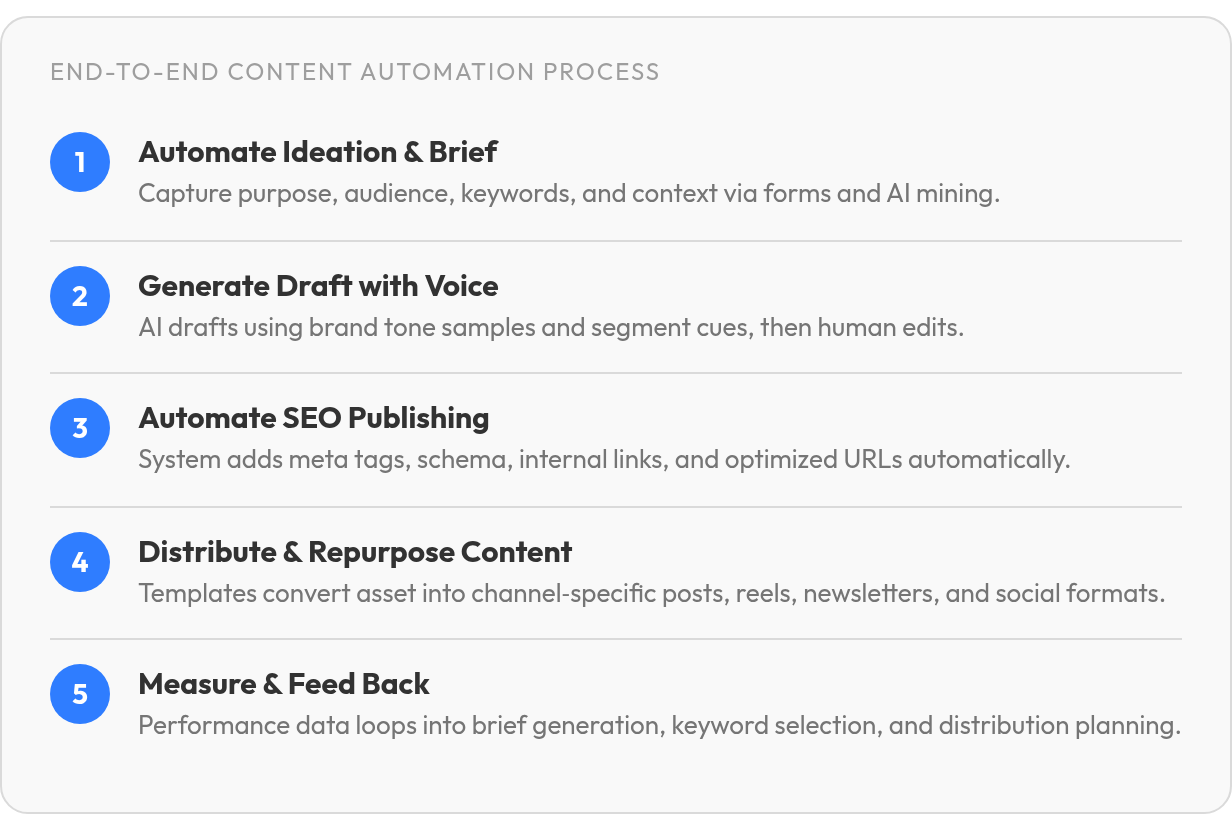
We see five distinct stages in a complete content marketing workflow. The gap between what gets automated and what stays manual is where many teams lose time. Below is how each stage functions when it runs with minimal supervision.
Stage One: Ideation and Keyword Mining Without the Three-Day Wait
The brief is where elapsed time disappears first. A simple assignment can stall because nobody has captured the purpose, audience, angle, required inputs, and approval path in a format the writer can use. Automating this stage means the request arrives with the necessary context already attached—no vague prompt, no scavenger hunt, no avoidable clarification loop.
Tools can be configured to mine search intent, competitor gaps, and trending topics and assemble what already exists before a writer opens a blank document. That includes related posts you have published, relevant product information, prior research, target keyword, and current top-ranking content for that query. A writer starting with that assembled context is starting ahead, and the assembly is mostly mechanical. The output here is not just a topic—it is a working brief with enough scaffolding that drafting can begin immediately.
Why it unlocks Stage Two: when the brief already contains the target keyword, audience segment, and approved inputs, draft generation has something to anchor on. If the brief is vague, Stage Two either stalls or produces generic output.
Stage Two: Draft Generation That Holds Your Voice, Not a Generic Template
Large-language models can produce SEO-optimized drafts, but persona consistency is where automation often falls apart. Generic prompts tend to generate generic drafts, and as more teams adopt similar content automation tools, the sameness problem can compound across competitors using similar systems. Tone-matching typically requires more than a style-transfer toggle; it often requires a persona engine or similar configuration that references your existing content or is fine-tuned to distinguish your editorial voice from many other blogs in your category.
When draft generation works, it is usually because the system is configured to reference voice samples, approved messaging hierarchies, and segment-specific talking points before writing. The mechanism is often prompt engineering layered with retrieval: the system pulls from a library of past posts, applies a structural pattern that performed well, and adapts phrasing to match the audience segment in the brief. The output still needs editing, but you are editing a coherent draft instead of staring at a blank page.
Why it unlocks Stage Three: a draft that already holds voice and uses the target keyword makes the publishing step routine. If Stage Two output is off-brand or unstructured, the next stage requires manual rewriting before any technical publishing automation can be useful.
Stage Three: SEO-Ready Publishing That Populates the Markup You'd Forget
The publish step carries more technical detail than many editorial teams want to manage manually. Platforms can be configured to auto-populate meta tags, schema markup, internal linking, and URL structures without requiring a checklist for each article. Strong results often come from orchestration across multiple systems rather than individual tool strength.
Automated publishing can reduce skipped steps because software follows the configured checklist each time. The system can ensure every post has an optimized slug, a populated meta description, internal links to related content, and schema markup for rich snippets. If your CMS lacks native automation here, middleware tools can bridge the gap by pulling draft metadata from your content calendar and pushing it to WordPress, Webflow, or another publishing platform.
Why it unlocks Stage Four: once an asset is published with complete metadata and internal links, distribution can reference a clean URL and consistent description. If publishing is manual or inconsistent, distribution workflows often break because the source asset is incomplete.
Stage Four: Multi-Channel Distribution and Repurposing That Actually Happens
A finished post still needs to move. Automation here can turn the source article into channel-ready material: a LinkedIn carousel, a threaded summary for X, a Reel script for Instagram, a short-form video outline for TikTok, and a newsletter block for the next campaign. The goal is not to blast the same copy everywhere; it is to translate the asset into formats each channel can actually use.
The mechanism is often template-driven repurposing: the system identifies pull quotes, key stats, and visual anchors from the long-form piece, then formats each for the channel's native structure. Reach amplification happens because you are not choosing between thorough long-form and broad distribution—you can get both from a single content asset. When teams automate this layer, manual reformatting stops consuming time that should go into strategy and creative judgment.
Why it unlocks Stage Five: distribution produces engagement signals across channels. If distribution is sporadic or manual, the measurement stage has sparse data. Consistent distribution gives the system enough signals to learn which formats and channels actually perform.
Stage Five: Measurement That Feeds Back Into Ideation, Not Just a Static Dashboard
Performance tracking becomes valuable when the system acts on what it learns. Closed-loop automation can be configured so engagement metrics, dwell time, backlink acquisition, and conversion signals feed back into the ideation engine. If a topic cluster performs well, the system can queue related angles. If a headline structure converts, future briefs can default to that pattern. If a distribution channel underperforms, budget can shift without a manual reallocation meeting.
Some businesses report more qualified leads after implementing closed-loop marketing automation, but that gain depends on the system learning from its own output. The measurement stage is not just reporting—it is the feedback mechanism that makes every other stage smarter over time. When performance data stays siloed in a dashboard, you are tracking but not optimizing. When it loops back to brief generation, keyword selection, and distribution sequencing, you have a system that improves its own ROI without constant oversight.
Unsupervised Automation Checklist
Most teams think they need to automate content creation first. In practice, the process around the draft usually creates more delay than the writing itself. A useful automation build starts by removing avoidable stalls from requests, reviews, launches, and analysis, then layers creative assistance on top.
Here is an implementation checklist for a fully unsupervised content engine. Each item maps to a stage in the workflow, and the sequence matters more than speed.
Pre-Implementation Audit
Before you configure anything, map where time actually disappears in your current process. Track one piece from request to published and measure wait intervals—not work intervals.
- Document your current brief-to-draft elapsed time, separating idle time from actual writing or editing work
- Identify who approves content and how long approval typically sits in their queue
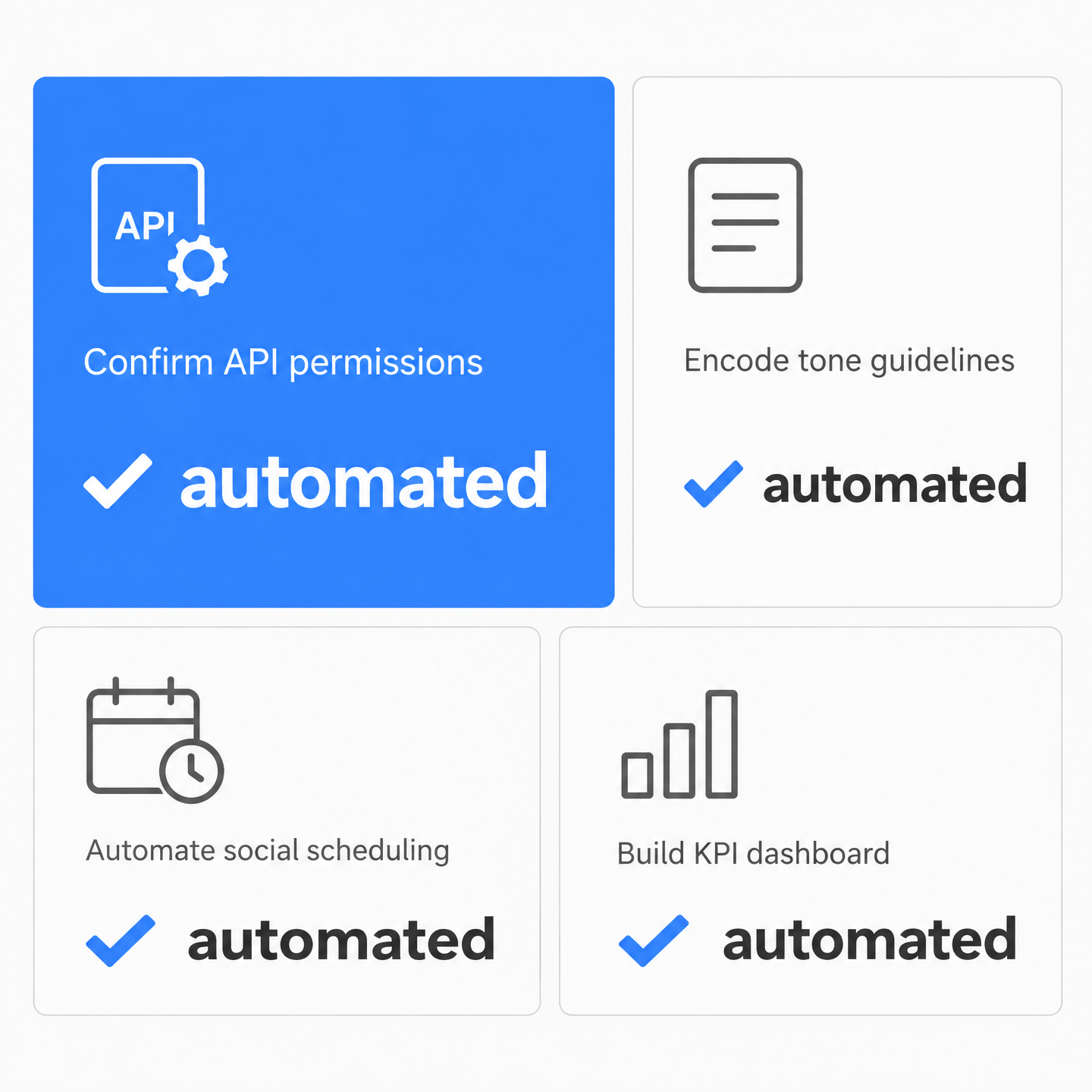
- List every distribution channel you intend to use and confirm you have API access or native integrations for each
- Audit your brand voice guidelines—if they live in someone's head rather than a shared document, automation will drift
- Establish your SEO baseline by pulling current rankings, backlink count, and organic traffic for the content types you plan to automate
- Confirm your CMS supports programmatic publishing, or decide where human approval will remain in the process
When you run this audit, the approval queue tends to be where a piece sits longest. That finding often surprises teams that have been focused on reducing writing time instead of reducing idle time.
Platform Configuration and Integration
Once you know where the operational drag lives, you can configure tools to remove it. This phase is technical but not complicated—most integration snags come from incomplete API permissions rather than architectural problems.
- Set up structured intake forms that capture audience, goal, key points, deadline, and approver in a reusable format
- Connect your CMS, analytics platform, and social media accounts through native integrations or a middleware layer
- Configure automated context assembly so writers start with related posts, product information, target keywords, and current top-ranking content for that query
- Establish naming conventions and folder structures that automation can follow without human decision-making
- Build handoff notifications that include brief, deadline, and any unusual requirements rather than a bare status update
- Create escalation rules that surface anything sitting in one state past a defined threshold—for example, if a draft sits in review beyond 48 hours, the system can notify the next owner
Integration permissions are a common rollout issue. Automation tool use in the workplace has grown in many workplaces, and marketing teams have become more willing to adopt these tools. Confirm API read-and-write permissions before you build dependencies on them.
Voice Consistency and Quality Guardrails
Fully automated content without voice drift requires upfront prompt engineering and periodic review. Many platforms skip this stage, which is why output can read generic within a few weeks.
- Encode tone guidelines into reusable templates rather than relying on manual editorial judgment for every piece
- Set up A/B testing for key messaging so the system can learn which phrasing performs better over time
- Define quality thresholds that trigger human review, such as weak readability, excessive keyword use, or sentiment mismatch
- Schedule quarterly audits where a human reviews a sample of published content to catch drift before it compounds
- Integrate plagiarism detection and fact-checking steps into the pre-publish workflow
- Build feedback loops so performance data informs future content briefs automatically
Skipping this stage can scale output that nobody reads. Teams sometimes abandon automation not because it fails to scale output, but because scaled output without quality control damages their brand faster than manual production. Some platforms include persona-engine features designed to capture brand voice and keep drafts closer to the team's style.
Distribution and Backlink Acquisition
Launch plans need their own workflow. Social posts, newsletter mentions, internal notifications to sales, and proactive backlink outreach all influence whether the content reaches anyone, yet they are easy to overlook when the team treats the live URL as the end of the project.
- Automate social media scheduling with platform-specific formatting—a LinkedIn post should not be copied verbatim into every other channel
- Set up email triggers that notify your sales team when relevant content publishes, with a pre-written snippet they can send to prospects
- Configure Google Business Profile updates so new content appears in local search results automatically
- Build backlink outreach sequences that identify relevant sites, find contact information, and send personalized pitches without manual intervention
- Create internal resource hubs that update automatically when new content goes live, so teams can find it without asking
- Establish cross-promotion workflows that suggest related posts to readers and link new content back to older, relevant pieces
This is also where small process gaps become visible. If a campaign depends on one person manually adapting posts, notifying sales, and remembering outreach, the system is not really unsupervised. It is just scheduled.
Measurement and Optimization
The final stage many platforms ignore is unified performance tracking. If you are pulling numbers from several dashboards and assembling a report by hand each month, you have not closed the loop.
- Build a single KPI dashboard that combines traffic, engagement, backlink acquisition, and revenue attribution in one view
- Set up automated reports that surface performance trends without requiring manual exports or spreadsheet wrangling
- Connect content metrics back to revenue so you can measure ROI rather than vanity metrics like page views
- Configure behavioral triggers that adjust future content strategy based on what performs—for example, if how-to guides consistently outperform listicles, the system can shift the planned mix
- Track local visibility metrics—Google Business Profile views, map pack rankings, review volume—alongside broader SEO performance
- Schedule performance reviews on a cadence that gives content time to rank and accumulate meaningful data, since fresh pages rarely show their full picture right away
Integrated tools pay off only when they actually talk to each other rather than creating new data silos. Some platforms can pull results directly from Google Search Console instead of scattering them across dashboards. If your current platform leaves creative quality, backlink development, and revenue-linked measurement outside the workflow, you may be automating the easiest steps while leaving the highest-leverage work for someone to chase manually.
FAQ
What is content marketing automation?
Content marketing automation uses software to handle repeatable tasks across ideation, drafting, publishing, distribution, and measurement. Instead of manually writing briefs, scheduling posts, and compiling reports, you configure workflows that execute those steps automatically while preserving brand voice and strategic intent.
How does content marketing automation work?
The system connects ideation, drafting, publishing, distribution, and measurement so each completed step can trigger the next. A structured brief can move to a writer with the necessary context attached. The draft can move through configured quality guardrails and approval routing. Once published, the asset can be repurposed for channels, and performance data can feed back into future briefs. When configured correctly, automation removes coordination waits and manual handoffs without replacing the editorial judgment that still belongs to humans.