
Featured Snippets: How to Win Position Zero in Google

Key Takeaways
- Featured snippets sit at Position Zero, above the first organic result, and pull a 35.1% click-through rate versus 28.5% for the top spot.
- That's roughly a 30% lift in clicks for the same ranking work. Cheap traffic, if you can get it.
- Only about 12% of Google queries return a snippet at all. The space is scarce and fought over.
- Answer boxes cluster around informational queries. Broad transactional and navigational terms rarely produce a snippet worth chasing.
- Google lifts snippets from pages that already rank on page one. Strong rankings come first, always.
- A clean 40-60 word answer placed right after a heading gives Google the shape it likes to extract.
- Modifiers like "how," "what," "best," and "vs" reliably flag snippet-friendly searches.
Quick Summary
Featured snippets are the boxed answers Google yanks to the very top of results, above the first organic listing. That's why people call it Position Zero. Win it, and your content shows up before anyone scrolls. In practice, it moves both visibility and clicks.
Here's the short version of what matters and how long it takes.
Why featured snippets are worth the trouble
They grab attention before the searcher scrolls. That top-of-page slot pulls traffic that would otherwise spread across the standard organic listings.
But these boxes don't show up for every search, so you can't chase them everywhere. Don't optimize your whole keyword list. Point your effort at question-shaped queries, where people want a direct answer instead of a place to buy something.
What it takes to win Position Zero
Content that matches intent and answers the exact question fast. Google pulls snippets from pages that already rank well, so your first hurdle is baseline visibility. Then you structure for easy extraction.
Focus here:
- Answer the query directly. Drop a concise, self-contained summary right after your subheadings.
- Read the intent. Is the searcher after a definition, a step-by-step, or a comparison?
- Match Google's format. Paragraphs for explanations, numbered lists for sequences, tables for structured data.
- Work your existing pages. Refine what already performs.
Intent is the hard part. "How to win Position Zero" wants a process. "What is Position Zero" wants a definition. Give Google the wrong shape and you lose the box.
How long this takes
Weeks, not days. Snippet wins depend on your page already ranking, so timelines track with how fast you climb into the top handful of results.
A realistic breakdown:
- Research and intent mapping: a few hours per topic cluster.
- Content formatting: 30-60 minutes per target query once you know the answer shape.
- Ranking and indexing: several weeks, depending on domain strength and competition.
The formatting is quick. The ranking is where patience pays. For teams publishing at scale, automating the structured formatting removes the slowest manual step, which is why automated content generation earns its keep on repetitive optimization like this.
The five that matter
- Snippets live at Position Zero, grabbing attention before anyone scrolls.
- They pull a real traffic bump over standard organic listings.
- They're picky, showing up mostly for specific informational searches.
- Winning needs precise intent matching, immediate answers, and structural alignment.
- You have to rank first, then optimize for extraction.
Get these five right and you turn ordinary rankings into answer-box real estate.
What I'd actually do first
Featured snippets are one of the higher-leverage SEO plays out there. They put your content above the first organic result and pull clicks before searchers scroll. The advantage compounds over time, especially on queries where the box dominates the top of the page.
The catch is effort. Snippets reward structured, direct content, and holding one takes ongoing work. But the payoff shows up in real traffic.
Start with keyword research
Focus on question-based queries. Snippets pull from searches phrased as questions or defined problems, so target terms where Google already shows a box. Those are your fastest wins.
Look for queries where your site already ranks well. A result sitting just below the top spot is a prime candidate to promote into Position Zero.
Prioritize clear informational intent. "How to," "what is," and "why does" searches trigger snippets far more than transactional terms. Build your list around those patterns.
Optimize the content to win the box
Answer the question directly and early. Put a concise summary right below the relevant heading, then expand with detail. Google extracts that tight block as the snippet.
Match your formatting to the snippet type. Numbered lists for step-by-step processes, tables for comparisons, short paragraphs for definitions. The format you provide often decides the format Google displays.
Write your headings as the questions people actually search. When your H2 or H3 mirrors the query and the answer sits right underneath, Google's extraction job gets easy. That's what separates a snippet-winning page from a buried one.
Track and scale
Watch your position and impression data to see which pages are climbing and which snippets you already hold. Position tells you where you stand. Impressions show whether the snippet is actually earning visibility.
Watch the ones you lose. These boxes are volatile, and roughly 40% change hands within a few months as competitors publish better-structured answers. Regular audits let you reclaim lost spots before the traffic drain adds up.
Scaling means repeating this across dozens or hundreds of pages, which is where consistent production matters most. Automating the creation and publishing of snippet-targeted content lets you pursue many opportunities at once instead of one at a time.
Snippets stay scarce and competitive. But the teams that commit to question-based research, tight answer formatting, and steady tracking capture a click advantage their rivals never see. Start with a handful of high-intent queries, optimize your existing high performers, and expand from there.
Why this isn't just vanity ranking
Featured snippets drive real traffic and build authority at the same time. Winning Position Zero can lift organic traffic by up to 25%, according to Ahrefs. That's a meaningful gain on content you've already published and ranked.
The benefit goes past raw clicks. Snippets answer the question fast, which improves the search experience and cuts bounce rates. When the box gives people what they need, they engage more instead of bouncing back to results.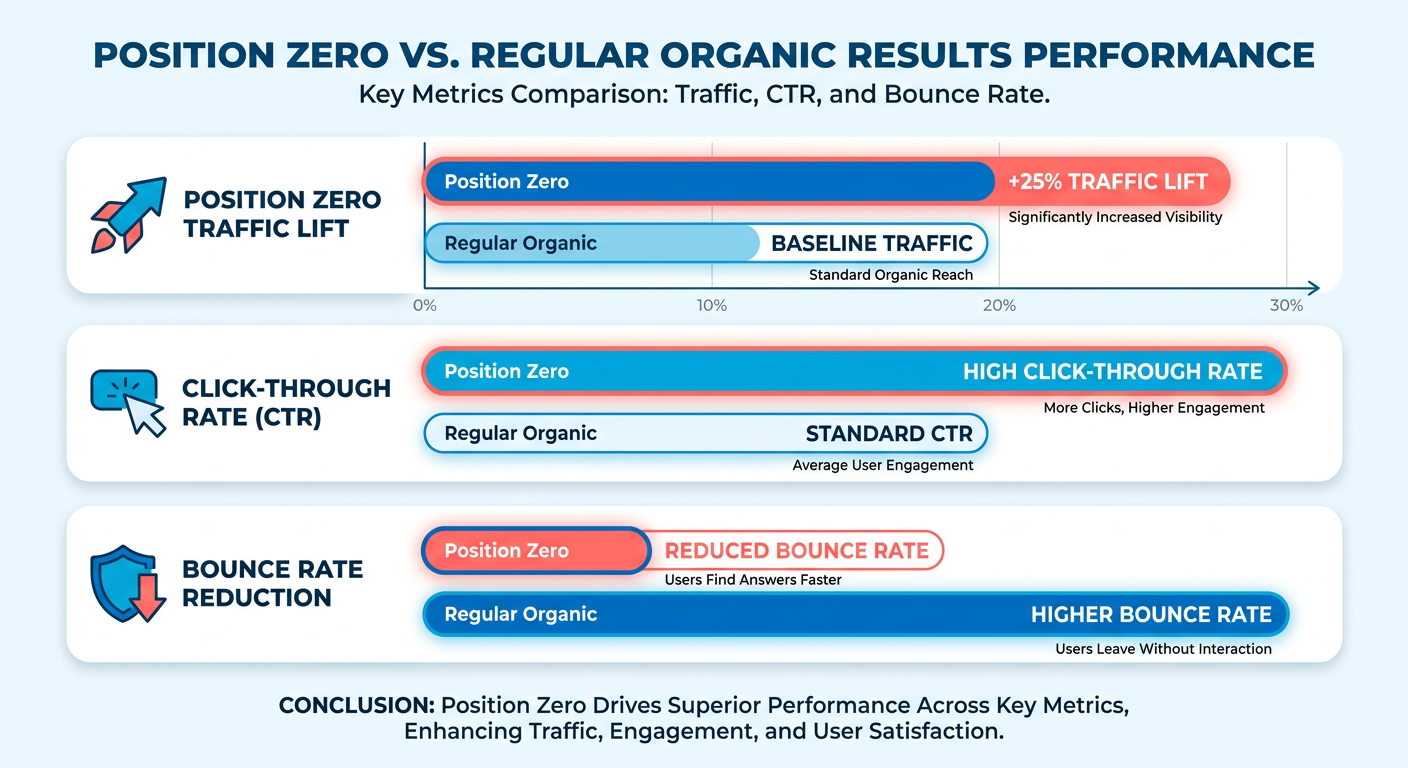
How snippets build authority
A snippet positions your brand as the definitive answer. When Google pulls your content into the box above every organic listing, that's a trust signal to searchers before they read a single competitor.
Think about what happens when someone searches a question in your niche. If your content sits in the box, you're the first voice they hear. That repeated visibility compounds. It shapes how people read your expertise, even on searches where they don't click through.
In a crowded market, that's a real differentiator. You're not just ranking. You're the source Google chose to feature. That distinction carries weight with users and with future search behavior.
What stops businesses from winning
Two things, mostly: weak content optimization and poor user experience. Google pulls snippets from pages that answer questions directly and cleanly. Bury the answer or wrap it in fluff, and you won't get picked.
Optimization is the first hurdle. Snippets reward structure: clear headers, direct answers, lists, and tables that match how the query is phrased. Plenty of pages fail here simply because they weren't written to answer a specific question in a specific format.
User experience is the second. Slow pages, cluttered layouts, and content that misses search intent all push you out of contention. Google favors pages that serve the searcher, so a frustrating experience works against you even when your content is technically relevant.
Then there's scarcity. The space is finite and competitive, so weak content loses to sharper, better-structured competitors. Simple as that.
Can automation actually help here?
For the formatting and consistency gaps, yes. Producing question-focused, well-structured content at scale is hard to do by hand across a large site. Automation handles the structural patterns Google looks for: concise answers, logical headers, clean formatting that maps to real queries.
This matters because winning snippets isn't a one-time task. You have to keep content sharp as competitors publish and Google re-evaluates. SEO-ready publishing keeps your pages positioned to capture and hold the spot.
Keyword Research for Featured Snippets
Keyword research for snippets starts with question-based queries. Google pulls answer boxes from searches phrased as questions or defined problems. Target those, and you're aiming at the queries most likely to trigger a box in the first place.
The goal isn't just high volume. It's finding queries where a box already exists or could, then matching your content to what the searcher wants.
How query modifiers reveal opportunities
Query modifiers are the words that signal a searcher wants a direct answer. The big four: what, how, why, and when. Queries built around these trigger snippets far more often than plain keyword phrases.
Think about what people actually ask. "Keyword research" is broad and hard to answer in a box. But "what is keyword research" or "how to do keyword research" gives Google a clear question to answer.
Build a list of modifier-based variations for every core topic. Start with your seed keyword, prefix it with each modifier, and you'll surface a batch of question queries where a snippet can live.
Watch the intent behind each modifier. "How" wants steps. "Why" wants reasoning. "What" wants a definition. Matching your content format to the modifier is half the battle.
Why long-tail queries win more often
Long-tail queries give you better odds at Position Zero because competition drops sharply as queries get more specific. Fewer sites target a five-word question than a two-word head term.
A study of 163,412 keywords from Google search found snippets appear across a huge range of queries. Longer, more specific searches often had a box open with weaker competition fighting for it.
Head terms are crowded. Established sites own them, and dislodging a snippet holder there takes serious authority. Long-tail questions let you compete on the quality of your answer instead of raw domain strength.
Prioritize queries with clear, answerable intent and low competition. "How long does it take to rank a featured snippet" is specific enough to own if your answer is tight and well-structured.
What tools help you find these queries
Keyword tools give you the volume and competition data to prioritize. Google's Keyword Planner shows query volume and helps you spot which modifier variations people actually search. Free, straight from Google's own data.
Ahrefs goes deeper on competition. Filter for questions, see which keywords already return snippets, check the difficulty of ranking for each. That combination tells you where the winnable opportunities sit.
Look for queries where your site already has traction. A page in the top ten is your fastest path to the box. Cross-reference your existing rankings against question queries.
Keyword and headline tools can flag snippet-friendly phrasing before you write. The tighter the match between query and content, the better your odds.
It all comes down to intent and modifiers together. Know what the searcher wants, phrase your content to answer it directly, and you set yourself up to win.
Understanding Featured Snippet Formats
Google pulls snippets in three main formats: paragraph, list, and table. Each answers a different type of query. Match your structure to the format Google wants, and you sharply improve your odds.
The format Google picks depends on what the searcher is asking. Definitional questions get paragraphs. Process questions get lists. Comparison questions get tables. Your job is to read the intent and structure your answer to fit.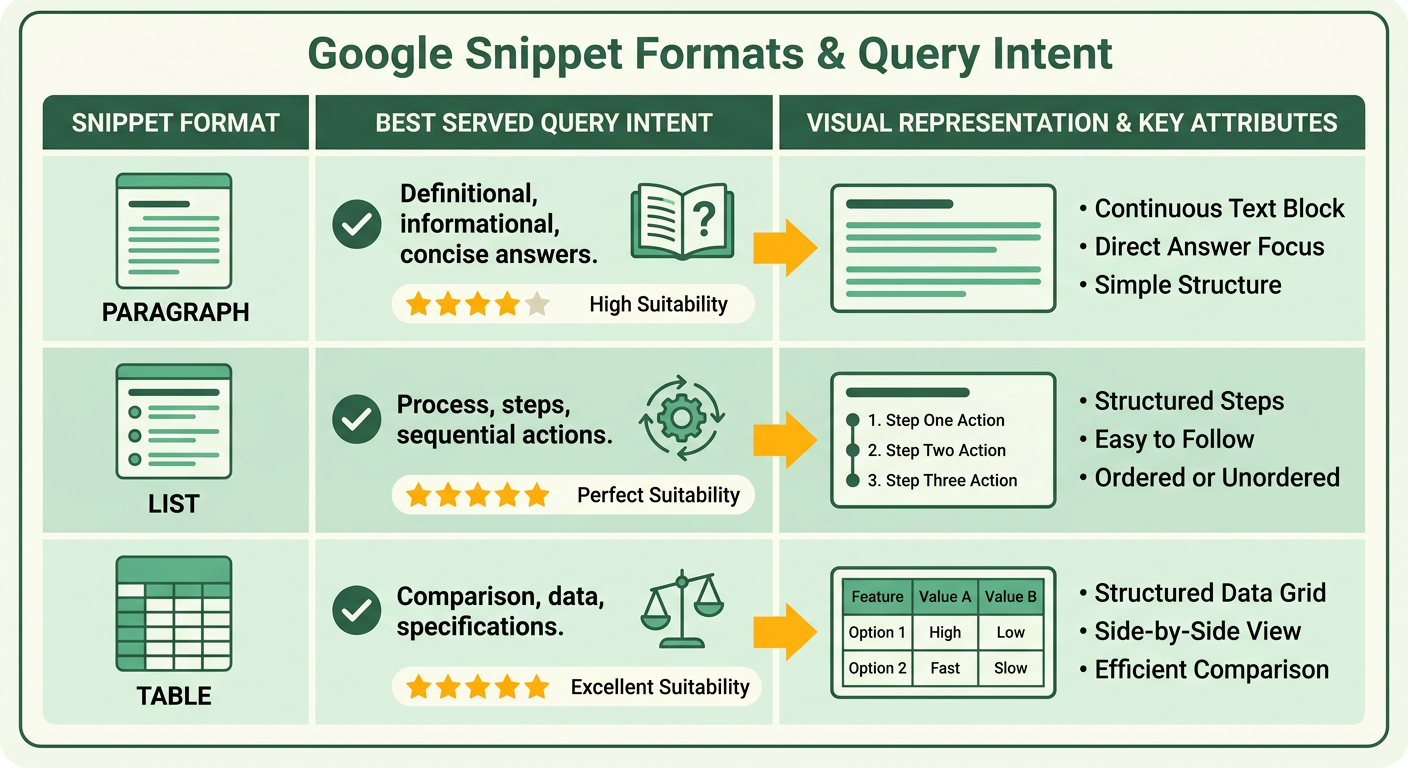
What triggers a paragraph snippet
Paragraph snippets come from definitional queries. Searches asking "what is" or "why does" something happen. Google extracts a short block of text that answers the question directly.
To win one, lead with a clear, concise answer. Put the definition in the first two sentences right under a matching header. Don't bury it three paragraphs deep.
Take a search like "what is domain authority." Google wants a tight, self-contained explanation it can lift straight into the box. Write that first, then elaborate below it. Start with the term, follow with the definition, keep sentences short. That gives Google clean text to pull.
How you win list snippets
List snippets come from process-oriented queries. Searches for steps, rankings, or sequences. Google pulls either a numbered list for ordered steps or a bulleted list for unordered items.
Structure your content with real HTML headings and list tags. Google builds the snippet from your actual page structure, so use proper <ol> and <ul> markup. Each step should carry a short, descriptive header.
For a query like "how to change a tire," the searcher wants steps in order. Break the process into clear, numbered stages, one action each. Google reads that sequence and rebuilds it in the box.
Write each list item to stand on its own. If a step needs context, put the key action in the header and the detail in the body. That helps Google decide which lines belong in the snippet.
When Google shows a table snippet
Table snippets come from comparative queries. Searches that weigh options, compare prices, or scan data across categories. Google extracts an organized table with rows and columns straight from your page.
Build your data in actual HTML table markup, not images or plain text. Google can only pull a table if it can read the structure. Use clear column headers and consistent row labels.
For a search like "iphone models compared," the searcher wants a scannable grid of features side by side. Lay your data out in a real table, one item per row, one attribute per column.
Keep tables focused. A snippet-friendly table has a handful of columns and rows, not a sprawling spreadsheet. Trim to the data that answers the query.
Matching format to intent
It comes back to user intent and query modifiers. The words in a query signal which format Google wants. "What" points to a paragraph, "how" to a list, "versus" or "compared" to a table.
Search your target query first and see what format Google already shows. Then build to match it exactly. Fighting the format Google prefers is a losing move.
None of this works without solid basic SEO underneath it. Nail your on-page fundamentals and technical health before you optimize for any specific format.
Optimizing Content for Featured Snippets
Winning a snippet comes down to structure. Google pulls boxes from content that gives a clear, direct answer backed by organized depth. Hand the algorithm a clean block it can lift, and you raise your odds of landing in Position Zero.
Google's own guidance backs this up. Featured snippets reverse the normal result, showing the descriptive answer first. The content that earns that spot answers fast and organizes the rest logically.
How to structure your content
Lead with the answer. Put a concise, direct response in the first sentence or two, then build detail below. Google scans for that self-contained block, so front-loading it is the single highest-impact move you can make.
Keep the answer tight. A definitional query wants a brief, clean explanation. A process query wants clear steps. Match the length and shape of your answer to what was asked, then expand with context and examples underneath.
Depth still matters after the answer. Google favors pages that cover the topic fully, not thin content that stops at one sentence. Give the direct answer first, then earn trust with thorough supporting sections.
Why header tags matter for snippets
Header tags tell Google how your content is organized. H2 and H3 tags break content into clear sections, help the algorithm read your hierarchy, and let it spot snippet-worthy blocks. A well-tagged page is far easier to parse and extract.
Frame your headers as the questions people search. When an H2 or H3 matches a query and the text right below answers it, you hand Google a ready-made snippet. That alignment is what pulls content into the box.
Structure the whole page around this pattern. Each subsection poses a question and answers it directly beneath the header. That repeated rhythm gives Google multiple snippet chances across a single page.
How to optimize images for snippets
Use descriptive alt text and clear file names. These help Google understand what an image shows, improve the experience for screen reader users, and add another signal that your content is organized. Snippets sometimes pull an image alongside the text.
Name files for what they contain. featured-snippet-example.png tells Google far more than IMG_4821.png. Same logic for alt text: describe the image accurately instead of stuffing keywords.
Good image work supports the whole page. It reinforces the organized signal Google looks for and keeps your content accessible. Both feed back into your odds of winning the box.
Holding the snippet once you win it
Basic SEO comes first. Before any snippet-specific work, make sure your page is properly optimized and has established authority. Strong technical and on-page fundamentals are the price of entry.
Once you win Position Zero, hold it. Keep the answer current, the structure clean, the supporting content fresh. Snippets shift often, so staying there is ongoing work.
Measuring and Maintaining Featured Snippets
Winning a snippet is only half the job. Google can swap your content out of the box anytime, so measuring performance and refreshing content keeps you in Position Zero once you've earned it.
The work splits two ways: tracking the data that tells you how a snippet performs, and re-auditing content to hold or reclaim the spot.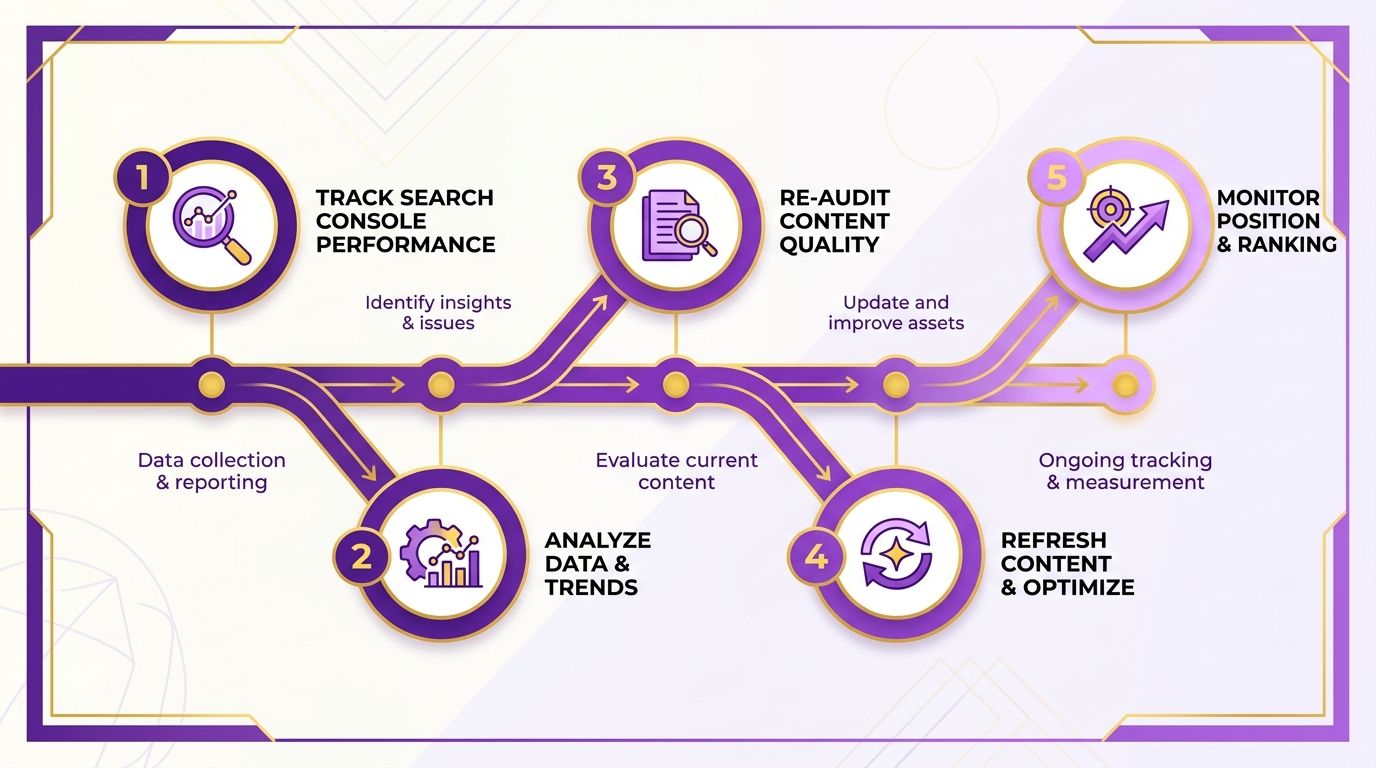
How to track position and impression data
Start with Google Search Console. It shows your average position, impressions, and clicks per query, which tells you whether a snippet is actually driving traffic or just sitting there. It also surfaces suggestions for improving content that already ranks.
Watch two numbers. Impressions tell you how often your page shows for a query. Position tells you where it sits. Strong impressions but a stalled click rate is your signal a competitor may have taken the box.
Pair that with query-level segmentation. Filter by device and country, since snippet ownership can vary across mobile and desktop for the same query. A box you hold on desktop may belong to a competitor on mobile, and that split often hides in aggregate numbers.
Real-time analytics make this faster. Watching snippet performance as it shifts lets you adjust before you lose ground, instead of finding out weeks later.
Why content freshness matters for holding snippets
Snippets are competitive, and Google rewards content that stays current. Re-auditing pages for freshness and relevance helps you keep the boxes you own and win new ones for related queries.
Set a schedule to revisit snippet-winning pages. Check that your answer still matches what searchers ask, that the data hasn't gone stale, and that the structure still leads with a clean, extractable answer. Google's own guidance points to organized, well-structured content as the kind it pulls.
Consistency counts too. Content with a steady tone and clear structure across a topic reads as authoritative to Google. A page that answers one question well, surrounded by pages answering the neighboring ones, builds the coverage that earns snippets at scale.
Don't treat this as a one-time push. Holding Position Zero takes ongoing effort. Sites that audit and refresh regularly keep their boxes longer than sites that publish and walk away.
How to scale across a question cluster
Scaling means covering a whole cluster of related questions instead of chasing one snippet at a time. Map every what, how, and why variation around a topic, then publish structured answers for each. Own the cluster, and you get multiple shots at Position Zero.
A content taxonomy keeps this organized. Group related questions, assign each a target format, track which pages hold snippets and which don't. That turns snippet optimization into a repeatable system.
Automated content creation and SEO-ready publishing let you produce that cluster faster without sacrificing structure. A consistent voice across every piece reinforces the authority signals Google looks for.
The payoff justifies the effort. Scaling takes sustained work, but covering a full question cluster drives traffic gains that one-off posts never reach.
Frequently Asked Questions
1. Can a single page win multiple featured snippets at once?
A single page can win several featured snippets simultaneously when it answers multiple related questions with proper structure. Use distinct H2 or H3 headers for each question, followed by direct, concise answers. This question-answer rhythm gives Google multiple extraction opportunities across one well-organized page.
2. Does winning a featured snippet ever reduce your total clicks?
Winning a snippet can reduce clicks when the answer box fully satisfies the searcher, causing a "zero-click search." Definitional queries suffer most, since searchers get complete answers without visiting. Process and comparison queries usually still earn clicks because users need fuller detail beyond the extracted block.
3. How is a featured snippet different from a knowledge panel?
Featured snippets pull directly from a ranking website's content and display attribution with a clickable link. Knowledge panels appear on the right side and draw from Google's own knowledge graph, Wikipedia, and databases. Snippets reward website optimization; knowledge panels rely on structured entity data Google trusts.
4. Do featured snippets work the same way on mobile and desktop?
Featured snippets can differ between mobile and desktop for the same query. Google may show a snippet on one device but not the other, or award it to different competitors. Segment Google Search Console data by device to catch these splits, which often stay hidden in aggregate numbers.
5. Can you block Google from showing your content as a featured snippet?
You can prevent snippet extraction using the "nosnippet" meta tag or the "data-nosnippet" attribute on specific text sections. The "max-snippet" tag limits character length instead. Most sites shouldn't block snippets, but publishers protecting premium content sometimes restrict how much text Google displays.
6. What should you do after losing a featured snippet to a competitor?
Audit the competitor's winning page to identify why Google switched. Compare answer length, formatting, freshness, and header alignment against your version. Refresh your content with a tighter, more direct answer, updated data, and cleaner structure. Snippets are volatile and frequently change hands, making reclaims highly realistic if you address the gaps.
7. Are featured snippets worth pursuing for local or e-commerce businesses?
Featured snippets deliver limited value for local and e-commerce businesses because search intent for these industries is typically transactional or navigational. Product and location searches rarely trigger snippets. These businesses gain more from local packs, product schema, and shopping listings, reserving snippet efforts for informational blog or FAQ content.