
Find LSI Keyword Terms From Search Results, Then Automate Publishing

Key Takeaways
- Some search-engine representatives have described "LSI keywords" as a misnomer rather than a technical ranking system. The underlying practice—covering the terms a topic is expected to include—is still treated as relevant by many SEO practitioners.
- Five zones on the results page can surface contextual terms free: People Also Ask, related searches, featured snippets, autocomplete, and "People also search for."
- The full pipeline runs six phases: research, validation, clustering, creation, publishing, and analytics. Only analytics rates as advanced difficulty.
- A lightweight custom scraper can be configured to cap extraction at the top results and pass each chunk to an LLM for suggested semantic terms.
- Some practitioners report that YouTube may weigh titles and thumbnails more heavily than body copy, while many web-page SEO sources treat semantic terms as more central.
- Harvested terms get scored on three axes: intent match, volume against competition, and channel fit. That last one is the one many teams skip.
The one filter that separates research from published pages
Most teams don't stall on semantic SEO because they can't find LSI keywords. They stall because they find three hundred of them and have no rule for deciding which ones deserve a page. That gap between research and execution is where organic traffic quietly dies.
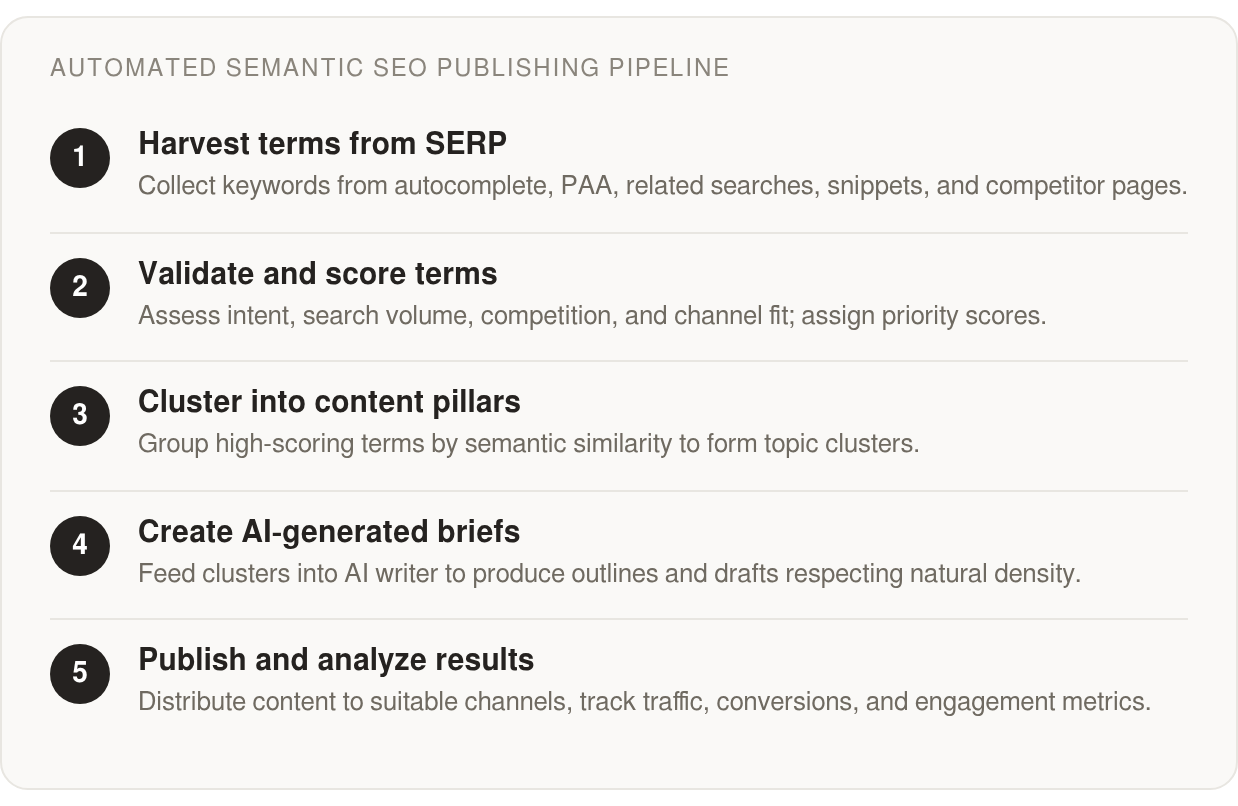
So start with the rule, not the list. A raw pile of terms is worthless without a prioritization filter. Some platforms can be configured with a taxonomy-research layer that reads business context and surfaces lower-difficulty, higher-intent terms for your niche, so you begin from words you can realistically rank for instead of chasing keywords major competitors already own.
Is "LSI" even real, and does it matter for automation?
"LSI keyword" is a misnomer. The strategy under it still works in many contexts. Search engines are widely understood to use semantic and entity-based signals rather than simple string matching, so what survives is the habit of covering contextually expected terms an algorithm ties to a core topic.
Stop treating "LSI" like a magic phrase. Aim for thorough topical coverage instead. The automation win is scaling that coverage across your whole site without hand-building every page.
Why does channel fit change the priority?
The same term can be gold on one property and dead weight on another. Some practitioners report that YouTube, despite being Google-owned, appears to weigh titles and thumbnails more than semantic terms in descriptions, while many web-page SEO guides treat contextual terms as central to ranking.
Apply one LSI treatment everywhere and you burn effort on channels that don't reward it. That's why some publishing platforms can be configured to publish to LinkedIn, X, Instagram, TikTok, and YouTube from one place, so each piece gets shaped to the surface that pays it back.
What does the pipeline actually look like?
| Phase | Primary tool | Difficulty | Main output |
|---|---|---|---|
| Research | Keyword-research platform | Beginner | Raw related-term list |
| Validation | SERP scraper | Intermediate | Scored term set |
| Clustering | Keyword-research platform | Intermediate | Topic clusters |
| Creation | AI writing assistant | Beginner | Content brief + draft |
| Publishing | Scheduling platform | Beginner | Scheduled multi-channel posts |
| Analytics | Analytics dashboard | Advanced | Traffic and lead data |
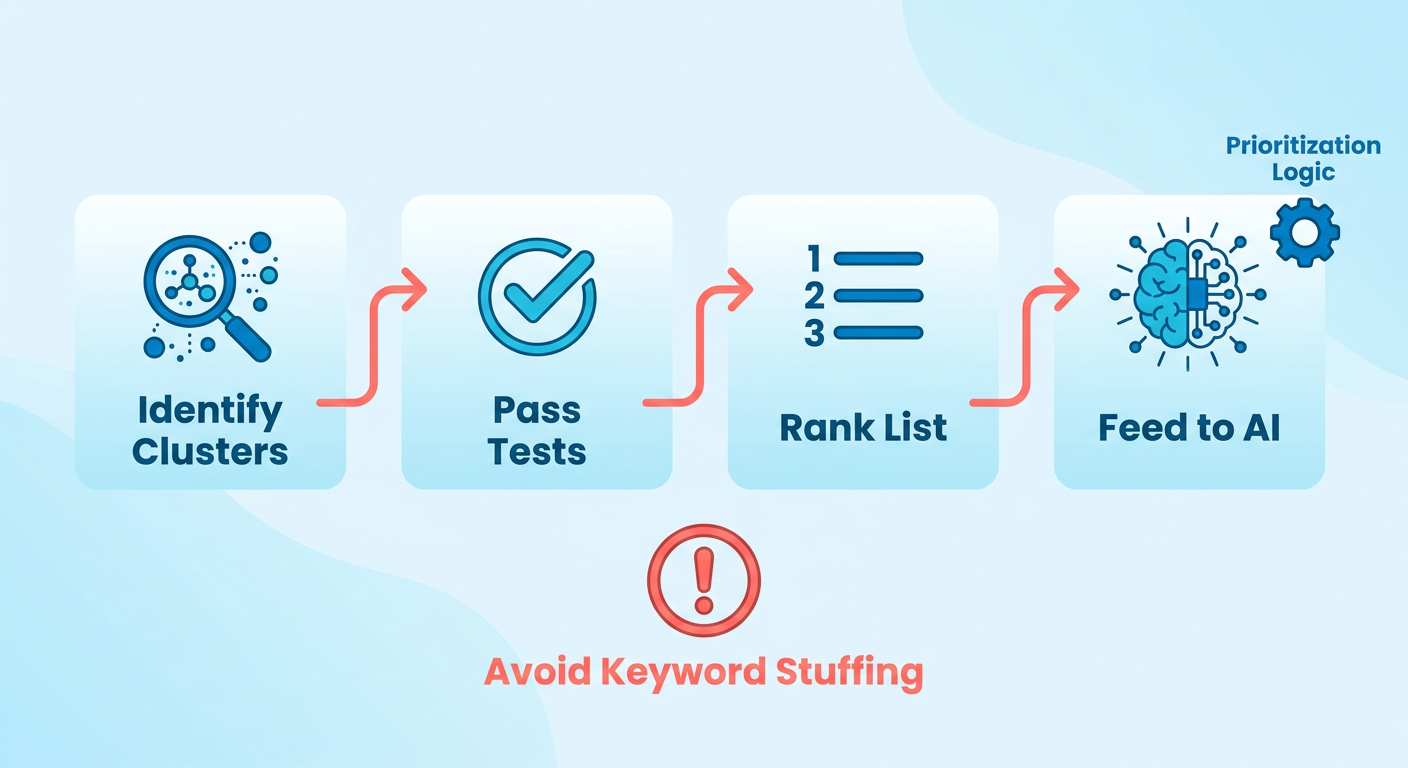
One guardrail holds it together. Natural density is a design constraint, not a cleanup pass. Tools that push term counts drift into keyword stuffing, and many search-engine guidance documents warn that unnatural density can hurt performance. Coverage helps. Density-chasing hurts.
We won't promise a traffic number. What we do see: consistent, well-scored publishing tends to compound. One lucky page doesn't.
Harvesting LSI signals from the SERP
The richest source of LSI ideas isn't a paid tool. It's the results page you already have open. Type a seed query into a search engine and the autocomplete drop-down alone surfaces related long-tail phrases before you hit enter. For a query like "getting a mortgage," those suggestions often reflect real search demand, not guesses.
But raw signals are cheap. The whole argument here is that finding LSI keywords is easy and deciding which ones to publish is hard. So treat the SERP as a collection ground, then run everything it gives you through one filter: intent, volume, and channel fit.
Where the page hands you semantic terms
A handful of distinct areas on the results page can act as a window into the search engine's semantic map. Read how each zone generates suggestions and you can trace the searcher's journey. Follow-up questions often show the logical next step someone takes. Bottom-of-page queries often point sideways to lateral topics.
Smarter tools can automate the grab by crawling top-ranking pages for co-occurring phrases. A content-assistant layer can be configured to filter out lower-traffic terms and isolate vocabulary that direct competitors appear to be winning on.
If you'd rather build your own, you can point a script at the HTML structure of these search features and feed the extracted text blocks into a language model to distill core semantic concepts quickly.
How to prioritize what you scrape
This is where the framework earns its keep. Collecting a big pile of candidate terms is trivial. Building a ranking system you trust is the real work.
Give each of the three evaluation criteria a numerical weight. Decide whether the query reads as transactional or informational, weigh volume against ranking difficulty, and judge whether the target platform values semantic depth. Standard keyword planners often hand you raw volume and difficulty. You still have to overlay intent and platform fit yourself to get a prioritization index worth using.
Does channel fit change which signals matter?
Yes, and this is the step where many automation pipelines break. Platforms often rank on fundamentally different signals. Text-heavy search engines tend to lean on contextual terms in body copy, while video-centric platforms often weight metadata like titles and engagement over keywords buried in a description.
Run one uniform strategy across all of them and you waste processing power and end up with unnatural copy. Your pipeline should route full semantic briefs to your web properties and generate lean, high-impact titles for video. This same routing logic sits behind our methods for finding low-competition keywords, so resources only go where they earn a return. One practical note: give your collection scripts strict rate-limiting and proxy rotation so the harvesting phase doesn't trip security blocks.
Validating and clustering LSI keywords into pillars
When you pull LSI candidates from the SERP, you're holding a messy pile, not a plan. Half will be near-duplicates. Some carry the wrong intent. A few belong on a channel that ignores them completely. Validation is the step that turns the pile into publishable clusters.
Start with the numbers you can pull directly. A good research tool gives you three columns side by side: search volume, competition, and importance. Some keyword planners return exactly that for a seed like "keto diet," surfacing terms such as calories, carb, weight loss, whole grains, and nutrition, each tagged with its own volume and difficulty. Those three fields are your scoring inputs.
How to score a keyword before you publish
Turn the judgment calls into a number. Score each of the three criteria from 1 to 5, then multiply them for a final priority rating.
For example, suppose you scrape candidate terms for "keto diet": "calories," "carb cycling," "weight loss," "whole grains," and "nutrition." You might score "weight loss" as high intent, moderate volume-to-difficulty, and strong web channel fit, so it gets a pillar page. "Whole grains" might be high channel fit but lower commercial intent, so it becomes a supporting section rather than a standalone page. "Carb cycling" might score low on volume and fit for your current audience, so you reject it or park it for a later cluster. The point is not the exact numbers; it's that the rubric makes the publish/reject decision explicit.
The math keeps gut feeling out of your editorial calendar. A term with massive volume but zero transactional intent and poor platform fit lands with a low overall score, which saves you from writing a useless article. A niche term with modest volume but high commercial intent and perfect platform fit bubbles to the top and signals a publishing opportunity you'd otherwise miss.
What turns clusters into content pillars?
Grouping is where semantic similarity pays off. Techniques such as TF-IDF and word-embedding methods are often used to measure how tightly terms co-occur, so "subject line tips," "A/B testing," and "deliverability" can collapse into one email-marketing pillar instead of three thin posts. These are sub-topically related concepts, not synonyms, and that distinction is what keeps a cluster coherent.
Map it as a simple matrix. One primary topic per row, its supporting cluster filling the columns. Each row becomes a pillar page. Each cluster term becomes a supporting article that links back. That internal linking can spread authority across the cluster and signal topical depth to crawlers, which may help individual pages rank for terms they'd never win alone.
You can run the same scoring at the low-competition end of your list, where a high-intent cluster is often the easiest thing to actually win.
Where's the guardrail?
Worth saying plainly: a high priority score is not a license to overload the copy. To keep automated drafts from collapsing into keyword lists, your publishing pipeline needs hard programmatic limits.
Add validation rules that check readability and strip any suggested term that won't integrate naturally. If a semantic term breaks the flow of a paragraph, the system discards it. Editorial integrity beats hitting an arbitrary keyword count every time.
Automating LSI-optimized content with AnyPost.ai
Once your LSI clusters clear the intent, volume, and channel-fit test, the work moves from research to production. This is where teams either save hours or quietly rebuild the keyword-stuffing problem they were trying to escape. Feeding validated terms into an AI writer only helps if the pipeline respects the same prioritization logic you set upstream.
We treat the content brief as the handoff. When a cluster is worth publishing, you import it as a ranked list, not a flat dump. The terms you scored highest for intent and channel fit lead the brief. The marginal ones sit in a secondary pool the model can reach for only if they read naturally.
How to structure a prompt that weaves terms in naturally
Prompt structure decides how naturally terms land in the draft. Some AI writing tools can be configured to produce search-intent-aligned headings and place primary terms in H2 and H3 tags rather than forcing them into body paragraphs.
One subhead formula from on-page SEO practice works well as a prompt rule: "Semantic Keyword + Benefit to the Audience." That instruction makes the model justify every term by tying it to user value. Build prompts around topical depth instead of word counts and the drafts come back thorough because they answer the query, not because they hit a quota.
Can the Persona Engine hold brand voice while optimizing?
Semantic coverage and brand voice pull against each other if you let them. Optimize hard enough and every draft reads like the same SEO template. A persona-based workflow can lock tone first, then layer keyword placement inside those guardrails.
Order matters. Voice is the constraint. The terms flow into it. That's what keeps a fintech client reading like a fintech client even when the draft is carrying a dozen contextual phrases it needs to rank.
This step also reshapes the output for the target platform. Rather than dropping one text-heavy template everywhere, the system restructures the core insight into visual carousels, short-form updates, or video scripts so the final asset matches the native style of each channel.
What editors should check before publishing
Automation drafts. Humans clear it. Run every AI draft through a short checklist before it ships:
- Relevance. Cut any term that got shoehorned in. Don't force a keyword where it isn't relevant.
- Density. Confirm the terms read as prose, not a list. If a sentence exists only to hold a keyword, delete it.
- Meta accuracy. Check that the title and description carry the primary term and match the page's real intent.
- Facts. Spot-check any claim, number, or name the model produced against a real source.
This is where the time savings actually land. The AI handles first-draft coverage. Your editor spends minutes on judgment calls instead of hours writing from scratch. That split is the whole point of automating semantic content without letting quality slip.
Building the end-to-end publishing pipeline
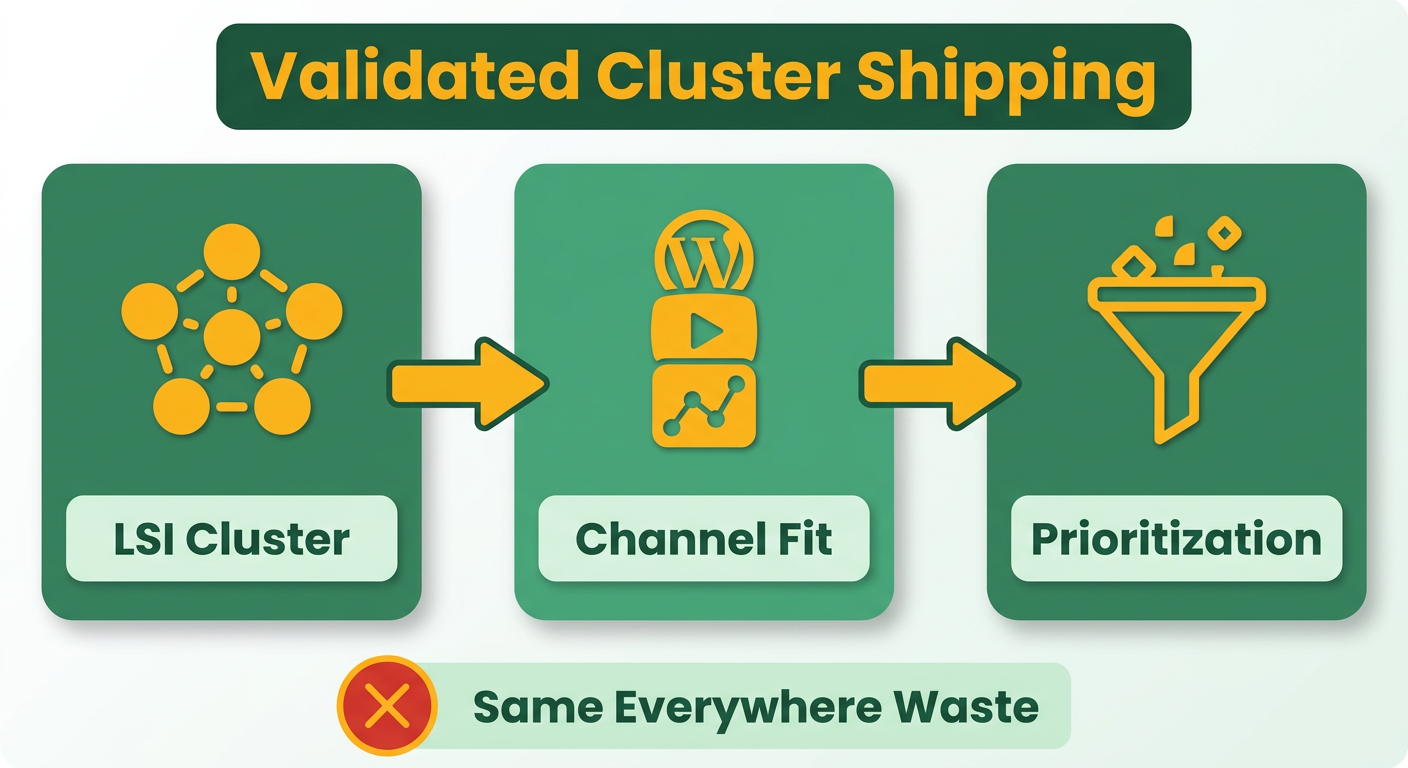
A validated cluster only earns its keep when it ships to every channel that will reward it. Here's the trap: once a cluster passes your scoring filter, it feels natural to treat it the same everywhere. That instinct wastes effort.
Channel fit is why, the third axis of the framework. The term that lifts a web page can do nothing on a video platform. When a cluster is worth publishing, you're deciding not just whether to publish but where the semantic weight belongs. The pipeline routes each cluster to the surfaces that respond to it.

Pushing content straight into your CMS
Start at the destination that tends to reward LSI most: your site. Web pages are often where contextual terms matter most, so your highest-scored clusters land there first.
An automated pipeline can connect through an API or native integration and push the finished article straight into WordPress, Webflow, or a custom CMS. No copy-paste. The draft arrives with your ranked terms already woven in, the canonical URL set, and metadata populated.
Canonicalization matters more than teams expect. When one article gets repurposed into a newsletter and five social posts, every version can point back to a single canonical page. That may help prevent duplicate signals from splitting your authority across channels.
Which channels actually reward LSI treatment?
This is where many cross-channel pipelines quietly fail. They apply one optimization strategy to every network, assuming the algorithms behave the same. They often don't. Video platforms and social feeds run on different discovery mechanics than web search.
Jam a heavily optimized cluster into a video description or a short social post and it may do little for visibility while actively hurting readability. The pipeline treats platform fit as a routing decision. Web pages and long-form posts get the full semantic cluster to maximize search visibility. Social updates and video scripts get stripped of unnecessary keyword density and built around high-impact hooks and titles instead. You only spend model tokens where they are likely to drive performance.
Scheduling across every surface at once
Repurposing is the multiplier. One published article can become a newsletter, a LinkedIn post, an X thread, an Instagram carousel, a TikTok clip, and a YouTube short, all drawn from the same validated source.
RSS-to-email automation can tie the newsletter to the moment a page goes live, so subscribers get the LSI-rich page while it's fresh. A synchronized calendar can then stagger social posts for reach instead of dumping everything at once.
Skip the full multi-channel blast for thin, low-intent clusters. If a term barely cleared your threshold, publish the page and stop there. Not every article deserves six repurposed variants, and forcing distribution on weak content can train your audience to tune you out.
The framework holds end to end. Intent decides what you write. Volume decides what's worth the effort. Channel fit decides where each cluster earns its ranking. Build the pipeline around those three axes and distribution stops being guesswork.
Measuring what worked, and re-scoring what didn't
Measurement is where the intent, volume, and channel-fit framework proves itself. You've already ranked and published your clusters. Now you find out whether the priority order you set held up in the wild.
The trap is measuring vanity. The number that matters isn't total impressions. It's whether the high-intent terms you scored at the top are the ones pulling clicks and conversions. If a low-intent term wins traffic while your commercial terms sit idle, your scoring weights were wrong, and the data just told you so.
Three dashboards, one per axis
Match each metric to the axis it validates. That keeps the review honest instead of drowning you in charts.
For intent, watch conversion tracking and dwell time. A page can rank and still fail if visitors leave quickly. Longer dwell time on a commercial cluster suggests you read the intent right.
For volume, watch ranking position on your long-tail terms in Search Console. This is where you learn whether the volume you scored turned into real impressions. A meaningful share of everyday searches may be queries no volume tool predicted, so some of your best long-tail wins will be terms you could not forecast.
For channel fit, watch engagement per surface. A cluster that earns saves on social but flatlines on your blog is telling you where its semantic weight belongs next.
Consistency beats cleverness
Here's the failure mode almost nobody measures against: consistency. Many teams abandon their SEO strategy long before it has time to compound.
Organic growth wants steady output over months, not weeks. Automated publishing can remove the manual friction that often leads to abandonment. Keep a steady cadence and the site builds a dense web of topical authority that search engines may gradually recognize, which gives your content the runway it needs to rank.
Automation earns its keep right here. It removes the human urge to bail after three slow weeks. The pipeline keeps shipping scored clusters while the compounding does its slow work in the background.
The quarterly re-score closes the loop
Every quarter, pull performance data back into your original scoring sheet and re-rank.
Terms that overperformed relative to their score get nudged up. Terms that ranked but never converted drop down or out. The clusters that showed up in Search Console as unexpected winners become fresh seeds for the next round.
So the cycle stays live. You find candidates, score them, publish, measure, and feed the results into the next scoring pass. Then push the proven winners into your prompts so the model leans harder on terms that actually moved.
Skip the full re-score for pages that have not yet gathered a full quarter of data. The data is too thin to trust, and you'll chase noise. Let a cluster run a real quarter before you judge it.
Common Questions
1. Are LSI keywords just synonyms of my main term?
No, they are conceptually related terms rather than direct synonyms. If your core topic is "strength training," related terms might include "progressive overload," "barbell," and "muscle recovery." These words do not mean the same thing, but they frequently appear together in high-quality resources about fitness. Many search engines are understood to use co-occurrence patterns to help determine whether an article covers a topic with sufficient depth and context, rather than just repeating the same target keyword.
2. Should I scrape the SERP myself or pay for a keyword tool?
Both approaches serve different parts of the workflow. Custom scraping tools can excel at capturing real-time, localized search signals directly from live search results. Established keyword databases can provide historical metrics like search volume trends and competitive difficulty. For a robust pipeline, use live scraping to discover emerging search trends and user questions, then validate those terms against database metrics to ensure they have enough search demand to justify a dedicated page.
3. Does adding more of these keywords improve my rankings?
No, stuffing your content with every related term can actively hurt performance. Many search engines advise that unnatural keyword patterns can affect how pages are evaluated. The goal of semantic optimization is to ensure your content naturally addresses the user's underlying questions. If a term feels forced or doesn't fit the flow of the article, omit it. User experience and clear writing should always take precedence over keyword checklists.
4. Why does YouTube ignore semantic coverage when Google owns it?
YouTube appears to operate on a different discovery model than Google search, with practitioners often reporting that it relies heavily on click-through rates, watch time, and viewer retention rather than deep textual analysis of descriptions. Because video discovery is driven largely by recommendation feeds and homepage suggestions, a video's title and thumbnail likely have a far greater impact on its performance than in-description keyword optimization. Therefore, your publishing pipeline should focus on creating compelling, high-click titles for video platforms while reserving comprehensive semantic optimization for written web content.
5. How soon can I tell whether a published cluster worked?
Many SEO practitioners suggest waiting at least three months to see stable results. Search engines require time to crawl, index, and test new content against existing pages. Evaluating performance too early can lead to premature adjustments based on incomplete data. Once this initial period has passed, analyze search console data to identify which terms are driving actual impressions and conversions, then use those insights to refine future content plans.
6. What's the biggest mistake teams make with automated LSI publishing?
The most common error is treating all distribution channels as a single monolithic audience. Many teams push identical, keyword-heavy text to every platform, which can alienate social media followers and waste optimization efforts on networks that do not use search-based indexing. A successful automated pipeline must differentiate its output, delivering semantically rich articles to your blog while generating native, engagement-focused formats for social channels.