
Freelance SEO vs SEO Agency: Pros, Cons, and Costs Compared

Key Takeaways
- Freelance SEO usually runs $50–$150 per hour. A full-service agency can hit $5,000 a month.
- Content automation produces SEO content at roughly one-tenth of typical agency rates, and you stay the editorial owner.
- Freelancers give you direct access to the person doing the work and tight scope control. One person can only do so much, though.
- Agencies bring full teams and structured onboarding with low day-to-day effort. You trade direct contact for resources and scale.
- The cost figures here come from industry comparisons like Clutch and BrightLocal, not internal guesses.
- The right call depends on your budget, your timeline, and how much hands-on management you actually want.
Quick Summary
Freelancers cost less and give you direct access. Agencies cost more but bring full teams and process. Automation handles the content side at a fraction of either price. Which one fits comes down to budget, timeline, and how much management you want on your plate.
Here's how the three paths stack up across the metrics that matter when you're deciding.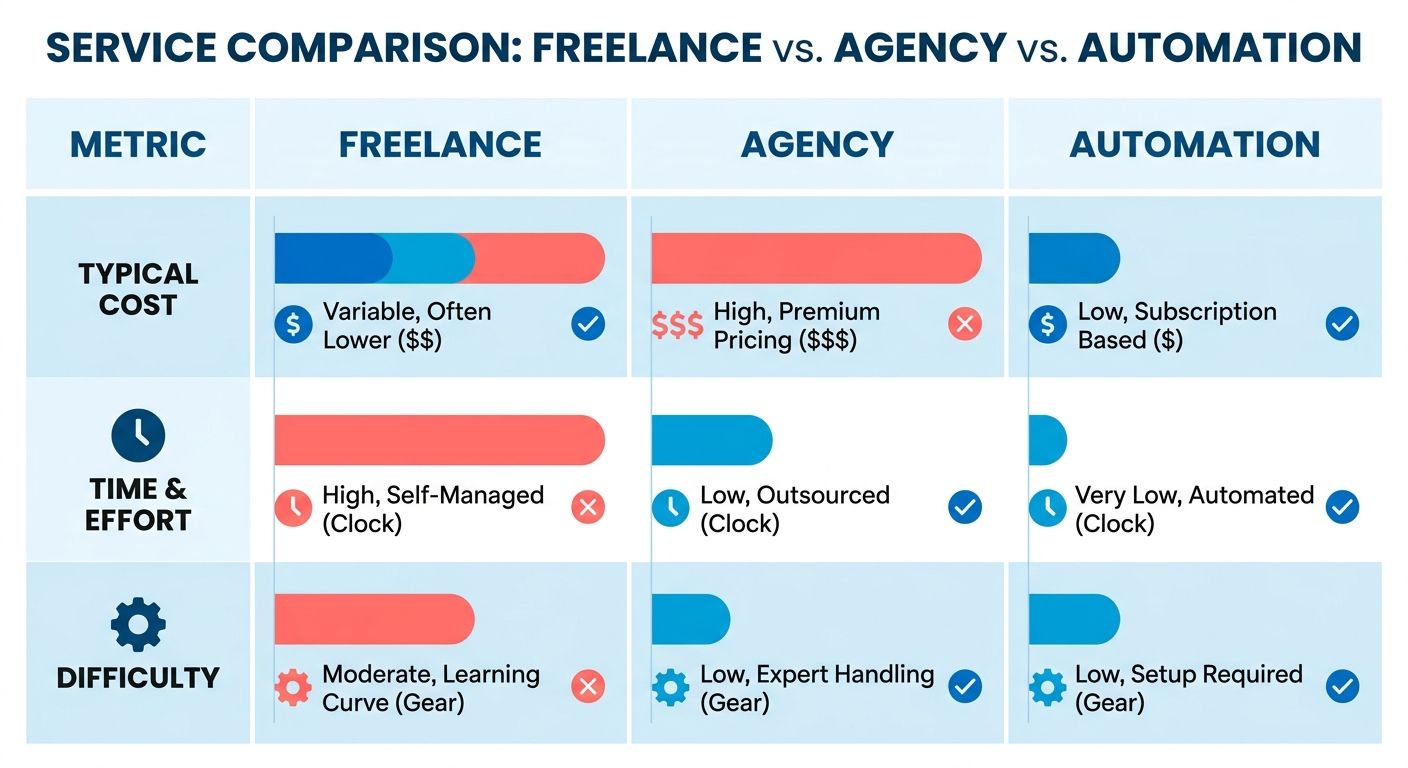
How the three options compare
| Option | Typical Cost | Time & Effort | Difficulty to Manage | Best For | Main Trade-off | |. |. |. |. |. |. | | Freelance SEO | $50–$150/hour | High client involvement; you brief and review directly | Medium | Smaller budgets, short-term tasks, personalized attention | Limited capacity; one person can only do so much | | SEO Agency | Up to $5,000/month | Low day-to-day effort; structured onboarding | Low once running | Larger budgets needing deeper resources and scale | Higher cost; less direct contact with the people doing the work | | Content Automation | ~1/10 of agency rates | Low; you approve and publish | Low | Teams scaling SEO content without manual production | You stay the editorial owner |
One detail worth flagging: local SEOs working inside agencies earn about 35% more than freelancers. That tells you something about where the cost difference actually goes. It's not all margin. A chunk of it is salaried specialists.
The real pros and cons
Freelancers win on cost and access. You talk to the person doing the work, you pay by the hour, and you keep the scope tight. The catch is capacity. One freelancer can't run keyword research, content, technical fixes, and link building all at once without something slipping.
Agencies solve the capacity problem with teams and process. You get structured workflows and broader resources. The downside is the price and the distance. You're usually a few layers removed from whoever's actually writing or building.
Automation sits in a different lane. Instead of buying someone's hours, you produce SEO-optimized content at volume and keep editorial control. This is where our SaaS, AnyPost.ai, fits. We built it to recreate the agency content workflow in one dashboard, so you generate ready-to-rank articles in your own voice without the agency invoice.
When to skip each path
Skip the agency if your budget is tight and your needs are narrow. Paying $5,000 a month for one landing page rewrite makes no sense. A freelancer or automation handles that for far less.
Skip the freelancer if you need broad, ongoing execution across many channels at once. A single contractor becomes the bottleneck, and you'll spend more time managing than you save.
Skip automation if your core problem is technical SEO or link acquisition rather than content output. Automation produces and publishes content. It won't fix broken site architecture or negotiate backlinks for you.
The honest read: most teams don't pick just one. Freelancers handle specialist fixes, agencies run full campaigns, and automation keeps the content engine going between them. Match the tool to the job and the budget tends to follow.
What an Agency Buys You, and What It Costs
Hiring an agency gives you a full team, structured processes, and the capacity to scale fast. The trade-off is cost and less direct control. Agencies make sense when your needs span technical fixes, content, link building, and reporting all at once. They're a poor fit when your budget is tight or you want one person who knows your brand inside out.
What you actually gain
Agencies bring depth of resources a single person can't match. Specialists for technical audits, content, link building, and analytics, all under one roof. That breadth is the main reason businesses go this route for complex work.
Scalability is the standout. When you want to expand into new markets or ramp up output, an agency adds people without you recruiting anyone. A freelancer's capacity caps at the hours one person can work.
You also get defined workflows, regular reporting, and account management. If one team member leaves, the work continues. That continuity matters for long-term campaigns, where momentum dies during handoffs.
The same staffing model lowers single-point risk. A solo provider who gets sick or overbooked can stall your campaign for weeks. An agency reallocates the work internally. For brands running quarterly content calendars or seasonal pushes, that reliability often justifies the premium.
Where it falls short
The biggest downside is cost. You're paying for a team, overhead, and management layers. For smaller budgets, the math rarely works.
Flexibility is the second issue. Agencies follow set processes and service tiers, so a one-off request can take longer to slot in than it would with a solo provider. You're booking into a workflow, not asking one person to shift priorities for the day.
Then there's distance. Your account may pass through several hands, and you lose the personalized attention a freelancer gives, where you brief and review directly with the person doing the work. Some businesses end up feeling like one more line item on a packed roster.
How to choose the right one
Match the agency to your actual needs, not the longest service menu. Ask what their process looks like, who handles your account day to day, and how they report results. The goal is deep resources without paying for capacity you won't use.
A growing e-commerce brand needs technical SEO, ongoing content, and link building running at once. An agency fits, because no single freelancer covers all three well. A local service business that just needs Google Business Profile optimization and a couple of landing pages? A freelancer handles that for far less.
Watch for the flexibility trap. If an agency locks you into long contracts and rigid tiers, weigh that against how much your needs actually change. The decision comes down to whether you value breadth and continuity over direct access and lower cost.
For a broader look at these models, this comparison of freelancer versus agency trade-offs walks through the decision factors in more detail.
What a Freelancer Buys You, and Where It Breaks
A freelance SEO gives you lower costs, direct access to the work, and the flexibility to scale up or down without a long contract. The downsides are real: limited capacity, single-point dependency, and inconsistency when one person juggles several clients. Freelancers fit smaller budgets and focused, short-term tasks.
Why freelancers cost less and move faster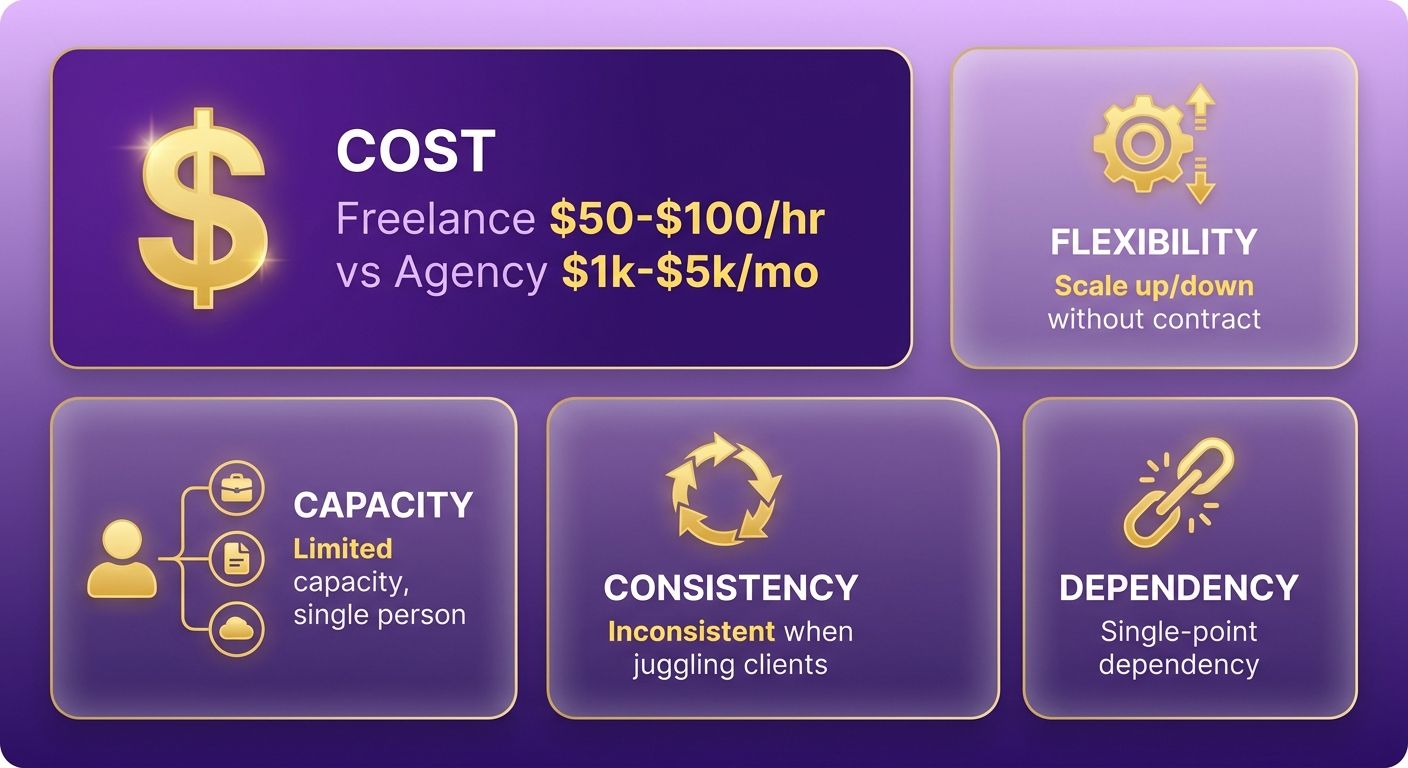
Freelancers cost less because you pay for one person, not a team with overhead. That structure also makes them flexible. You brief them directly, they execute, and you skip the account managers sitting between you and the work.
The savings show up across the board. Freelance rates often run $50 to $100 per hour, while many agencies set retainer minimums of $1,000 to $5,000 a month before any work begins. With a freelancer, more of your budget goes into the actual work instead of office space, software licenses, and management salaries.
That direct line matters for speed. Need a title tag rewrite or a quick technical fix? You message one person and it gets done. No ticket queue, no internal handoffs, no waiting for a team meeting to prioritize your request.
The drawbacks you're accepting
The two big risks are limited scalability and inconsistency. One person has a fixed number of hours, so a freelancer stalls when your needs outgrow what they can personally handle. If your campaign suddenly spans technical work, content, and link building at once, a solo operator hits a ceiling fast.
Inconsistency comes from the same place. A freelancer serving several clients splits their attention, so your turnaround slows during their busy stretches. And there's single-point dependency. If your freelancer gets sick, takes a vacation, or moves on, your SEO work pauses with them.
Skip the freelance route if your project demands a full-stack team running parallel workstreams on a tight deadline. One person can't be a technical auditor, content lead, and outreach specialist at the same time. That's the trade-off for the lower price.
How to reduce the risk
Set clear deliverables and reporting checkpoints from day one. A freelancer thrives on close, personalized work, so use that closeness. Agree on what gets done each month, how progress gets measured, and when you'll review results together.
Match the freelancer to the task. They shine on short-term, focused work and ongoing support for smaller sites. A local business that needs steady on-page optimization and monthly reporting is a strong fit. A national brand launching across five new markets next quarter probably isn't.
Protect against the dependency problem by documenting everything. Keep account access, keyword research, and strategy notes in your own hands, not locked in your freelancer's head. That way a handoff stays smooth if the relationship ends.
If you want a deeper breakdown of the trade-offs between solo experts and full teams, the same freelancer-versus-agency decision factors cover it in detail.
Why Any of This Matters
Organic search is how most people find businesses online, and both freelancers and agencies exist to win you that visibility. The difference is scale and structure. A freelancer gives you focused, hands-on work. An agency gives you a team with deeper resources. Both solve the same core problem: getting your site seen by people already looking for what you sell.
How SEO drives growth
SEO turns search traffic into leads and revenue without paying for every click. When your pages rank for the terms your buyers type, you capture demand that already exists. That stream of organic traffic compounds over time, unlike paid ads that stop the moment you stop spending.
The practical payoff is a chain. Better rankings mean more qualified visitors. More qualified visitors mean more inquiries, sign-ups, and sales. A freelancer or agency builds the technical foundation and content that make those rankings possible.
The work usually covers three fronts: fixing technical issues that block search engines, publishing content that answers buyer questions, and earning links that signal authority. Get all three right and your visibility climbs.
Who benefits most from each
Small businesses and solo founders benefit most from freelancers. Larger companies with broader needs lean toward agencies. The fit comes down to budget, scope, and how much management you want to handle yourself.
Freelancers suit smaller budgets and focused, short-term tasks. If you need a site audit, a keyword strategy, or a content push, one specialist delivers it with direct attention. You brief them, they execute, you skip the layers in between.
Agencies suit companies that need multiple disciplines running at once. When your SEO spans technical work, content, link building, and reporting across several markets, a team handles that load far better than one person. The structured processes also mean the work continues when one staffer is out.
If you're weighing the broader trade-offs beyond SEO, this same agency-versus-freelancer logic carries across other service categories too.
What problems they actually solve
Both freelancers and agencies tackle the same recurring problems: low search visibility, weak organic traffic, and content that doesn't convert. The gap they close is between having a website and having a website people find.
Most businesses hit a wall where the site exists but ranks nowhere. A freelancer or agency diagnoses why. Maybe it's slow load times, thin content, or missing keywords your buyers actually use.
They also fix the accountability problem. With a freelancer you get direct access to the work. With an agency you get defined reporting and a process that tracks results against goals.
The choice isn't about which is better in the abstract. It's about matching the option to your situation. Tight budget and a single project point to a freelancer. Broad scope and the need to scale point to an agency. Knowing where you fall saves you money and months of misalignment.
Freelance SEO vs SEO Agency: The Core Differences
The core difference comes down to structure. A freelancer is one person handling your SEO directly. An agency is a team with defined roles, set processes, and project management systems. That structural gap shapes everything else: how you pay, what you receive, and how you communicate.
How pricing differs beyond hourly rates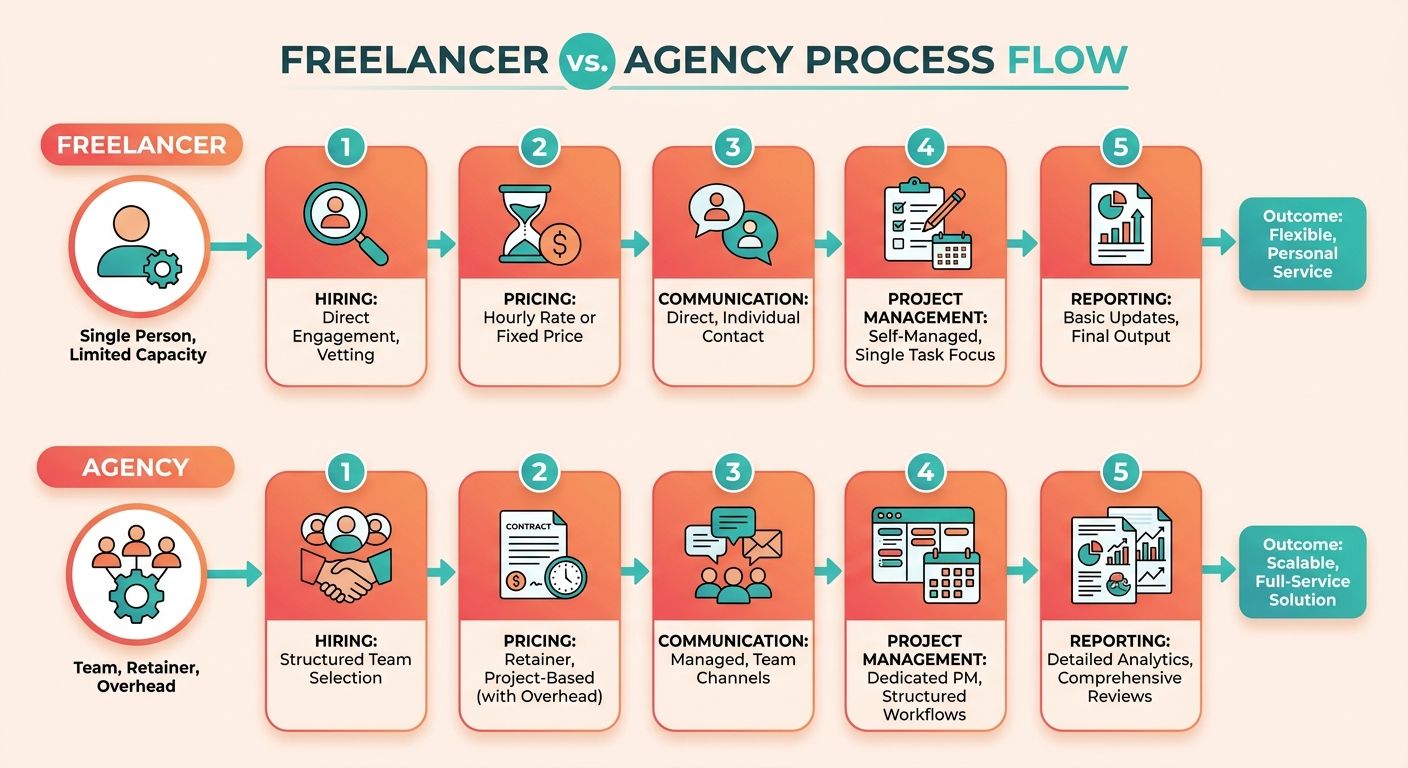
Freelancers and agencies price work differently because their cost bases differ. A freelancer charges for their time alone. An agency builds in overhead for staff, software, and account management, so its quotes run higher across the board.
Both offer project-based pricing as an alternative to hourly billing. With a freelancer, a fixed-price project might cover a one-off site audit or a batch of optimized pages. Agencies tend to package projects into monthly retainers that bundle multiple services together.
So the practical split is this. If you want a single deliverable with clear scope, a freelance project rate keeps costs predictable. If you need ongoing work across several fronts, an agency retainer spreads that effort over a team, though you pay for the privilege.
What you actually get from each
The deliverables overlap, but the depth differs. Both handle keyword research, on-page optimization, and link building. The real question is how much of each they can produce at once.
A freelancer delivers focused output. They might run your keyword research, rewrite your title tags, and build a handful of links over a month. Quality can be high, but volume is capped by one person's hours.
An agency runs these tracks in parallel. A technical specialist audits your site while a content team produces pages and an outreach team chases backlinks. You get more deliverables in the same window, which matters when you're trying to move fast across a large site.
For a small business with a tight list of fixes, a freelancer covers the work fine. For a national rollout touching hundreds of pages, the agency's parallel capacity earns its higher fee.
Who manages the work, and how
Management is where the two paths split hardest. With a freelancer, you are the project manager. You brief them, review their work, and track progress yourself. Communication goes straight to the person doing the work.
Agencies insert an account manager between you and the specialists. That layer handles reporting, coordinates the team, and runs the project management tools. You trade direct access for organized oversight.
Both models have a catch. The freelancer's direct line is fast but fragile. If that one person gets sick or overloaded, your work stalls. The agency's structure is sturdier but slower, since your request passes through an account manager before it reaches the specialist.
Expertise tracks the same pattern. A freelancer often brings deep skill in one or two areas, plus knowledge of a specific industry they've worked in repeatedly. An agency spreads expertise across a roster, so you get a broader skill set but less single-person familiarity with your brand.
Pick the freelancer when you value speed and a personal relationship. Pick the agency when breadth and structured process matter more than a direct line.
How to Evaluate the Right SEO Partner
Choosing the right SEO partner starts with matching your needs to what each option does best. Look at three things first: the expertise the partner brings, their track record with businesses like yours, and how their cost fits your budget. Get those right and the rest falls into place.
What to weigh first
Weigh expertise, experience, and cost together, not in isolation. A cheap option that can't deliver the work is no bargain. A premium one that overshoots your goals wastes money.
Start with expertise. A freelancer gives you personalized attention and direct access to the work. An agency gives you structured processes and deeper resources across technical, content, and analytics roles.
Then check experience. Ask for examples of work in your industry or with sites at your stage. A partner who has solved your kind of problem before moves faster and wastes less of your budget on guesswork.
Cost comes last, but it sets the boundaries. Freelancers suit smaller budgets and short-term, focused tasks. Agencies fit when your needs span several disciplines at once and you want a team handling them in parallel.
Questions to ask before signing
Ask questions that expose how the partner works, not just what they promise. The answers tell you whether they fit your timeline, your involvement level, and your goals.
Worth putting on the table:
- Who actually does the work? With a freelancer it's one person. With an agency, ask whether senior staff or juniors handle your account day to day.
- How will you report progress? You want clear reporting tied to traffic and rankings, not vague monthly summaries.
- What's your capacity if I scale up? A single freelancer has limits. An agency can add hands, but ask how fast.
- How much of my time will this take? Freelance work means you brief and review directly. Decide how hands-on you want to be.
These questions also surface red flags. Vague answers about deliverables or reporting usually mean trouble later.
How to assess an automation platform
Judge an automation platform by output quality, the volume it can produce, and how little oversight it demands once set up. Automation handles content at a fraction of freelance or agency cost, so the real test is whether the work holds up.
Run a small batch first. Check that the content reads well, targets the right keywords, and needs minimal editing before it goes live. If you're spending hours fixing every piece, the savings evaporate.
To get the most from any partnership, set goals upfront and review against them on a fixed schedule. Direct access works in your favor with a freelancer; structured check-ins keep an agency accountable. Pick the model that matches how closely you want to manage the work, then hold it to the metrics that move your business.
What I'd Actually Recommend
The best SEO option depends on three things: your budget, your timeline, and how much hands-on management you want. Freelancers fit lean budgets and focused tasks. Agencies fit broad campaigns that need a full team. Automation fits the content side when you want volume without the per-hour cost of either.
There's no single winner. The right call matches your situation, not the longest feature list.
Which option to pick
A freelancer gives you direct access and personalized attention for short-term or specialized work. An agency brings structured processes and deeper resources when your needs span technical fixes, content, and reporting at once. Automation handles content production at a scale neither can match cheaply.
Pick a freelancer when you have a tight budget and a clear, contained task. You brief one person and skip the account-manager layers.
Pick an agency when you need to scale fast across multiple workstreams. You get specialists for audits, links, and analytics under one roof, and you pay for that breadth.
Pick automation when content volume is your bottleneck. You produce optimized pages quickly without booking hours from a person or a team.
How to avoid overpaying
Don't buy more than the job needs. The most common mistake is hiring a full agency for work a freelancer could finish, or stretching one freelancer across a campaign that really needs a team.
Start by writing down what you actually need done this quarter. A one-off audit or a batch of pages? A freelancer covers it. An ongoing program with link building and technical work? The agency cost earns its keep.
For the content layer specifically, automation changes the math. You generate SEO-ready drafts at a fraction of human rates, then route a human only to the work that genuinely needs judgment. That split keeps your spend tied to value.
If you're an agency yourself weighing whether to bring in outside help, the trade-offs in Freelancing for Agencies — Pros and Cons line up with the same logic.
The final read
Combine the strengths instead of forcing one choice. Many businesses get the best result by pairing a strategic partner with automated content production. The partner sets direction. Automation feeds the pipeline.
Run the numbers on your own situation first. Cost, capacity, and control pull in different directions, and your priorities decide which wins. A small team with a content gap leans toward automation. A growing brand with complex needs leans toward an agency.
Want to handle the content side without per-hour costs? Try AnyPost.ai to generate SEO-optimized content automatically, then put your budget where human expertise actually moves the needle. It's a practical way to scale output while keeping a freelancer or agency focused on strategy.
Cost Comparison: Freelance, Agency, and Automation
The cheapest path depends on how you buy, not just who you hire. Freelancers bill by the hour or by project. Agencies lean on monthly retainers. Automation runs on a subscription that handles content without per-hour labor. Each model spreads cost differently, so the "best value" changes with the size and length of your work.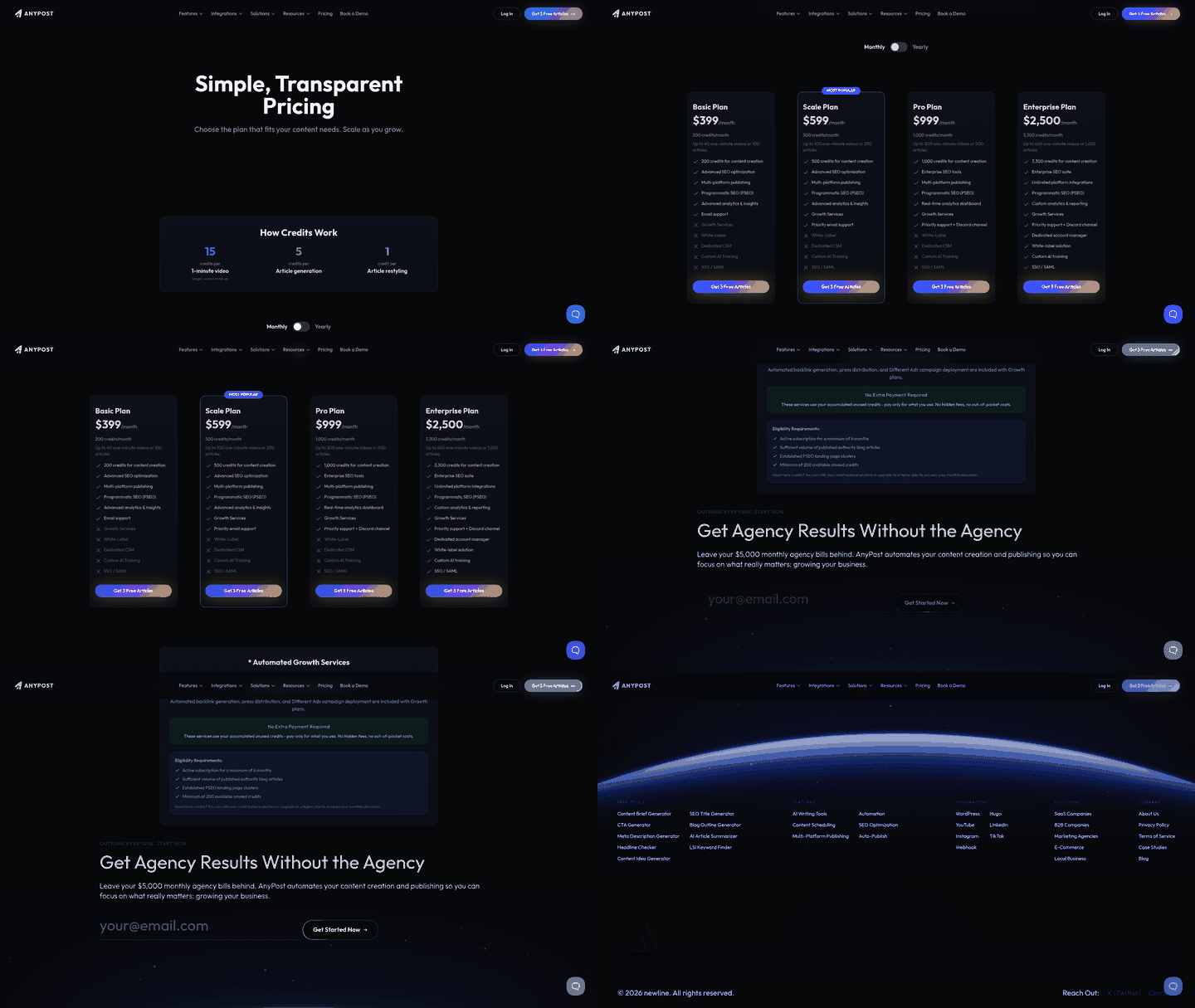
Hourly vs project rates
Hourly billing fits short, defined tasks. Project pricing fits work with a clear start and end. The split matters because it changes how predictable your spend is.
A freelancer charging by the hour works well for a quick technical fix or a one-off audit. You pay only for the time used. The risk is open-ended jobs. Hours pile up when scope drifts.
Project-based pricing caps that risk. You agree on a fixed fee for a defined deliverable, so a site audit or a batch of optimized pages costs what the quote says. Agencies package work this way too, but their fixed fees run higher because they fold in account management, software, and a team of specialists.
The rule is simple. Use hourly for small, contained tasks. Use project pricing when you want budget certainty on a larger piece of work.
Why agencies favor monthly retainers
Agencies prefer retainers because SEO is ongoing, not one-and-done. A retainer buys a set scope of work each month: technical fixes, content, link building, and reporting from a full team. You trade flexibility for consistency and capacity.
That structure suits broad campaigns. If you need several disciplines running at once, a retainer keeps them coordinated under one roof. The downside is commitment. You pay the monthly fee whether your needs spike or dip.
A freelancer rarely demands that lock-in. You scale work up or down without a long contract, which is why smaller budgets gravitate toward them. The trade-off is capacity. One person can only push so much through in a month.
Where automation wins on cost
Automation wins on the content side. It produces optimized pages at a flat subscription cost instead of paying per hour or per project. For volume work, that math beats both freelancers and agencies.
The reason is structural. A freelancer's output is capped by their available hours. An agency's output is capped by team size and retainer scope. Automation removes the per-unit labor cost, so producing the tenth page costs roughly what the first one did.
That doesn't make it a full replacement. Automation handles production, not strategy, relationship management, or hands-on technical audits. Use it to drive content scale, then bring in a freelancer or agency for the work that needs human judgment.
A lean business might pair an automation subscription for content with occasional freelance hours for technical fixes. That combination keeps the monthly bill low while still covering the work software can't do.
Frequently Asked Questions
1. Can you use a freelancer, agency, and content automation together?
Combining all three is common and often the smartest setup. Many teams use freelancers for specialist fixes like technical audits, agencies for full-scale multi-channel campaigns, and automation tools like AnyPost.ai to keep content production running between projects. Match each tool to the specific job rather than forcing one provider to cover everything.
2. How long does SEO typically take to show measurable results?
Most SEO work takes three to six months to produce meaningful ranking and traffic gains, regardless of whether a freelancer or agency handles it. Technical fixes can show faster, while content and link building compound over time. Set reporting checkpoints early so you can track progress against traffic and ranking goals.
3. Do SEO freelancers or agencies guarantee specific rankings?
Reputable SEO providers avoid guaranteeing specific rankings because search algorithms and competition are outside anyone's full control. Promises of guaranteed first-page placement are a red flag. Instead, look for partners who commit to clear processes, regular reporting tied to traffic and rankings, and realistic timelines based on your starting point.
4. What contract terms should you watch for before signing with an agency?
Watch for long lock-in periods and rigid service tiers that limit flexibility when your needs shift. Ask whether you can scale up or pause work, who owns your account access and data, and how exit handoffs work. Vague answers on deliverables or reporting usually signal trouble that surfaces months later.
5. How do you keep your SEO data if a freelancer relationship ends?
Keep account access, keyword research, and strategy notes in your own hands from day one rather than locked in the freelancer's head. Maintain ownership of your Google Search Console, analytics, and content management logins. This documentation protects against single-point dependency and keeps any future handoff to another provider smooth and fast.
6. Is content automation suitable for fixing technical SEO problems?
Automation handles content production and publishing, not technical SEO or link acquisition. If your core issue is broken site architecture, slow load times, or earning backlinks, you still need a freelancer or agency. Use automation to scale optimized content at roughly one-tenth of agency rates while keeping editorial ownership yourself.