
From Blog Post to Backlink Magnet: An AI Backlink Building Automation Playbook for SaaS Teams

What You Need to Know
- The pages sitting at the top of Google often carry more backlinks than the ones below them. When two companies ship equally good content, links often determine who gets the position.
- The content-to-link gap is usually a timing problem, not a volume problem. Publication and outreach often happen weeks apart, and a fresh post can be one of the strongest triggers a team has.
- Some AI-native tools have published case studies showing rapid Domain Rating growth and visibility for terms like "backlink automation" across search and AI answer engines.
- The link funnel runs five stages: find prospects, qualify, outreach, placement, monitor. In practice, few tools close all five without a human in the loop.
Why AI-Driven Backlink Automation Matters for SaaS Teams
For SaaS teams, backlinks remain one of the strongest signals available. Top-ranking pages often carry more of them than the results underneath. Two companies can publish content of equal quality, and the one building links consistently often takes the spot. That is a key reason AI backlink building automation has moved from a nice-to-have to a growth lever for many teams.
Manual outreach often stops scaling for growing teams. Link building tends to be one of the most time-consuming jobs in SEO, and many teams struggle to run a repeatable process around it. The grind can eat hours every week, and much of that effort may land only a handful of links. The same wall goes up over and over: strong content published, almost nothing pointing back to it. Plenty of pages never earn a single external link.
The Content-to-Link Gap Is a Timing Problem, Not a Volume Problem
Most teams read weak backlink numbers as a "publish more" issue. Often it isn't. The gap tends to open because publishing and outreach happen weeks apart, when outreach happens at all. A new post can be the strongest trigger a team has, and many SaaS teams let it go cold on the blog.
A common approach is to pair content generation with automated backlinking. Teams can generate voice-consistent, product-aligned articles while using a platform like AnyPost to build and run backlinking workflows that support them. The placements that tend to move rankings are the familiar ones: relevant listicles, peer SaaS mentions, digital PR. The wiring is covered in our guide on how to automate backlink building and grow traffic.
Automate the Grind, Keep Humans on Judgment
This is where the evidence genuinely conflicts. One camp warns that fully hands-off automation produces junk links that can trigger penalties. Another reports that bots can mimic natural email cadence well enough to lift reply rates without editing each lead by hand. Both can be right about different things.
A practical line is simple: automate volume and cadence, never judgment. Software can handle prospect discovery, contact verification, and follow-up timing. A human still decides which flagship sites get a pitch and what context you claim. High-authority editors can often spot a robotic email quickly, so save the personal touch for your dream links and let automation clear the mid-tier.
Two Funnels Now Run in Parallel
There is a second track many SaaS teams ignore completely: the AI citation funnel, the one that earns your brand mentions inside ChatGPT, Perplexity, and Google AI Overviews. That is a different game from ranking blue links.
Ignoring it may be a mistake. Backlinks are widely seen as influencing whether your brand surfaces in AI answers, and pages cited in AI Overviews often already rank near the top of search. Some AI-native tools have published case studies showing rapid Domain Rating growth and visibility for terms like "backlink automation" across both SERPs and LLM answers, off the same content engine.
So many teams choose to run both funnels at once, off the same content. The only reason to skip it is being pre-launch with no pages worth linking to yet. Everyone else may be leaving one funnel largely uncontested.
Choosing and Configuring an AI Backlink Automation Platform
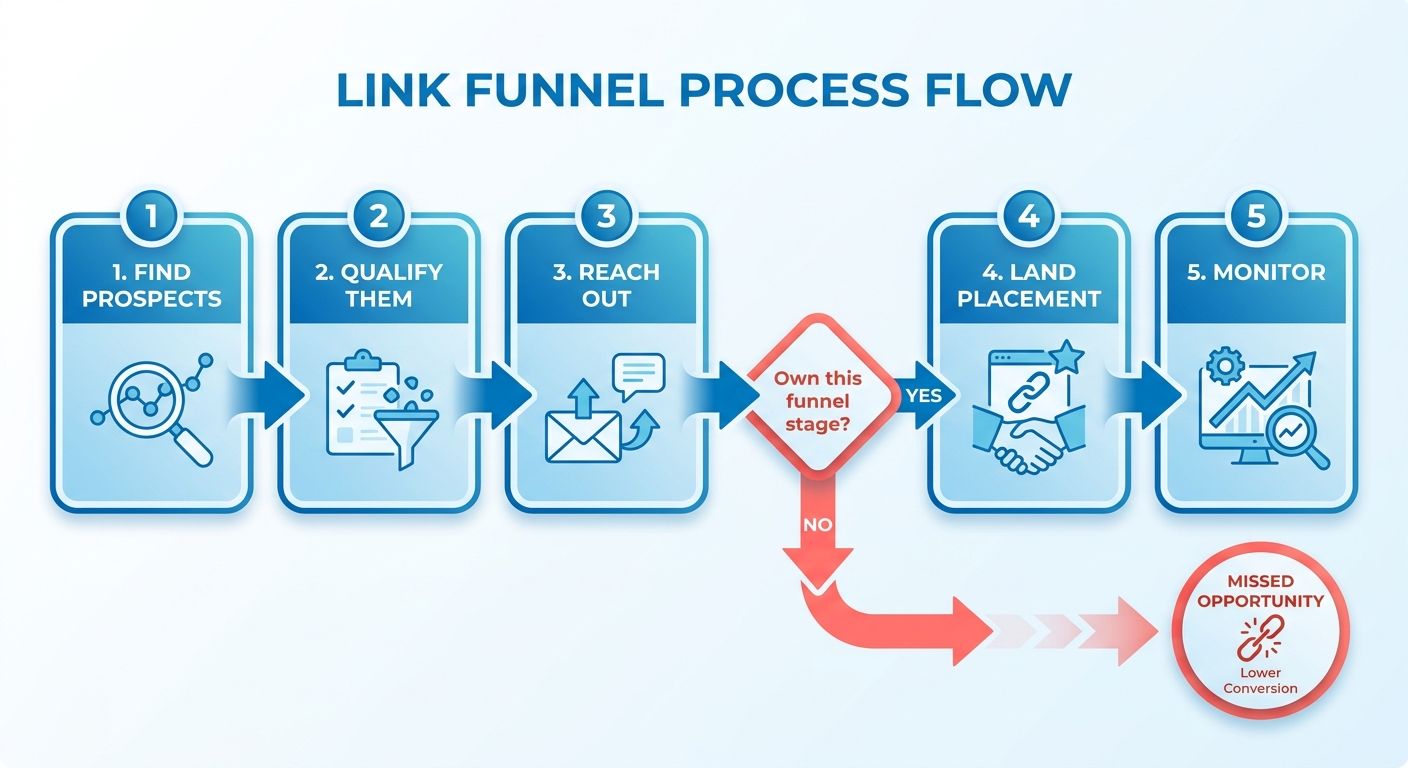
Picking a platform is where SaaS teams either save themselves months of grind or lock into a tool that automates the wrong half of the job. Score every option on one question: does it own a real stage of the link funnel, or does it just send more emails faster? That filter thins the field quickly.
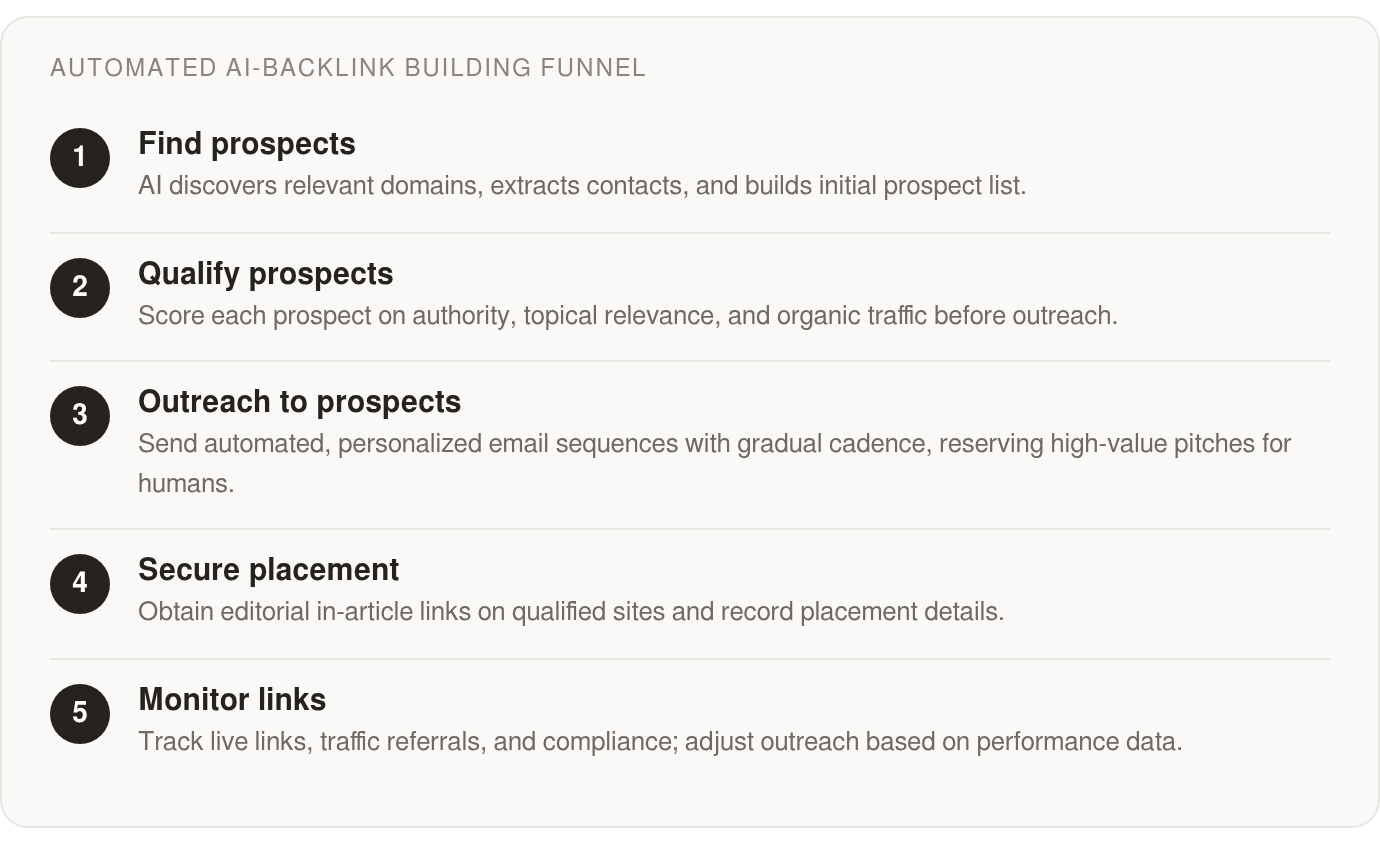
The funnel has five stages. Find prospects, qualify them, reach out, land the placement, monitor it. In practice, few tools close all five without a human in the loop, and any vendor claiming it does is one to walk away from. Good automation earns its keep by compressing the tedious majority while your team keeps the judgment calls.
The Features That Actually Matter for SaaS Teams
Qualification depth beats prospect volume. The best tools can kill weak prospects before a single email goes out, using domain authority scoring and competitor backlink analysis. That upfront filtering is what turns a raw list into a workable pipeline. A tool that hands you hundreds of unqualified domains is not helping. It is relocating the problem.
For SaaS specifically, three integration points tend to decide fit: your CMS, so new posts feed outreach automatically; your CRM, so links map to pipeline instead of vanity metrics; and analytics, so you judge link-worthiness by real traffic and relevance. Consolidation matters too. The stronger platforms fold prospecting, outreach, and monitoring into one workflow instead of making you stitch together several tools. Some platforms, including AnyPost.ai, are designed to consolidate prospecting, outreach, and monitoring alongside content generation and publishing.
The Pricing Gap Nobody Prices In
Entry-level automation and full agency retainers sit at opposite ends of a wide spread. That gap can look like a bargain until you read the fine print on cheap links. The lowest tiers often deliver thin, low-quality placements, which can make bargain link building close to pointless.
Budget for the tier that includes real qualification and monitoring, not just more send volume. Reply rates often make the case. Many teams find context-aware outreach beats generic templates because relevance is what earns a response. Volume without relevance can actively work against you.
Wire Your Content Engine Into Link Building
The real payoff comes from connecting publication to outreach, which is where many roundups stop short. Platforms like AnyPost.ai can be configured to generate voice-consistent, product-aligned content and publish it to your existing site and social channels, so your backlinking strategy has fresh, link-worthy assets to point at.
Two rules keep this safe. Automate cadence and volume, but ramp sends gradually over the first weeks so you stay clear of spam filters. Never automate judgment. Which sites to target and what context to claim stay human-approved. That line is exactly where quality slides into penalty risk.
One caveat, plainly: skip full automation if you have not tested your outreach message yet. Buying a tool to scale a pitch that does not convert just scales the failure. Nail the message, run a readiness audit, then let the system run.
Designing an Automated Outreach Workflow
The moment a post goes live is the moment your outreach clock should start, not next week when someone remembers to build a prospect list. That single choice is what many teams get backwards. Automated backlinking can be one of the core workflows a platform like AnyPost handles for you, taking on repetitive prospecting and drafting while your team keeps the judgment.
Here is why the trigger matters so much. Industry surveys repeatedly find that a large share of SEO professionals call link building their most time-intensive activity, while far fewer report having a systematic approach. Automating the hand-off from publish to pitch is one way to close the content-to-link gap competitors leave open.
Qualify Prospects Before You Ever Write a Word
Volume is not the goal. Scoring prospects before any outreach starts keeps your time on sites that would genuinely benefit from linking to you, instead of a long list that mostly will not convert.
Score every prospect on three things: domain authority, topical relevance to the post, and real organic traffic. Skip the site that looks strong on paper but lost most of its traffic after a Google update. Automation may happily suggest it. A human should catch it.
Give every page a clear keep, drop, or second-look call, and write down the reason so the decision is repeatable. Judgment over raw scores.
A tight keep rate feels brutal until you remember the alternative is pitching directories with zero editorial value. Fewer, better targets usually win.
Personalized Copy That Still Sounds Like You
Personalized outreach that references something real often beats generic templates, because the recipient can tell you actually read their work. Dynamic variables make that work, but only when they point at something real. A safe merge quotes the recipient's actual article, then ties it to your new data: "Loved your teardown of X, we just published data on Y that fills the gap." Pull the recipient name and article reference from verified page data, never a guess. A wrong variable reads more robotic than no variable at all.
This is also where AnyPost's Persona Engine can earn its place. It is designed to keep generated pitches in the same voice as the post they promote, so outreach and content do not sound like two different companies.
Sequence, Test, and Watch Deliverability
Cadence should ramp, not spike. Start low daily, raise it gradually over the following weeks, and keep spam filters calm. Run an initial pitch, a first follow-up, and one final nudge, then stop.
Watch your bounce rate the whole way. Keep it low to protect sender reputation, and A/B test subject lines against live reply data, not hunches.
Ensuring Quality and Compliance: Human Oversight and Google's Rules
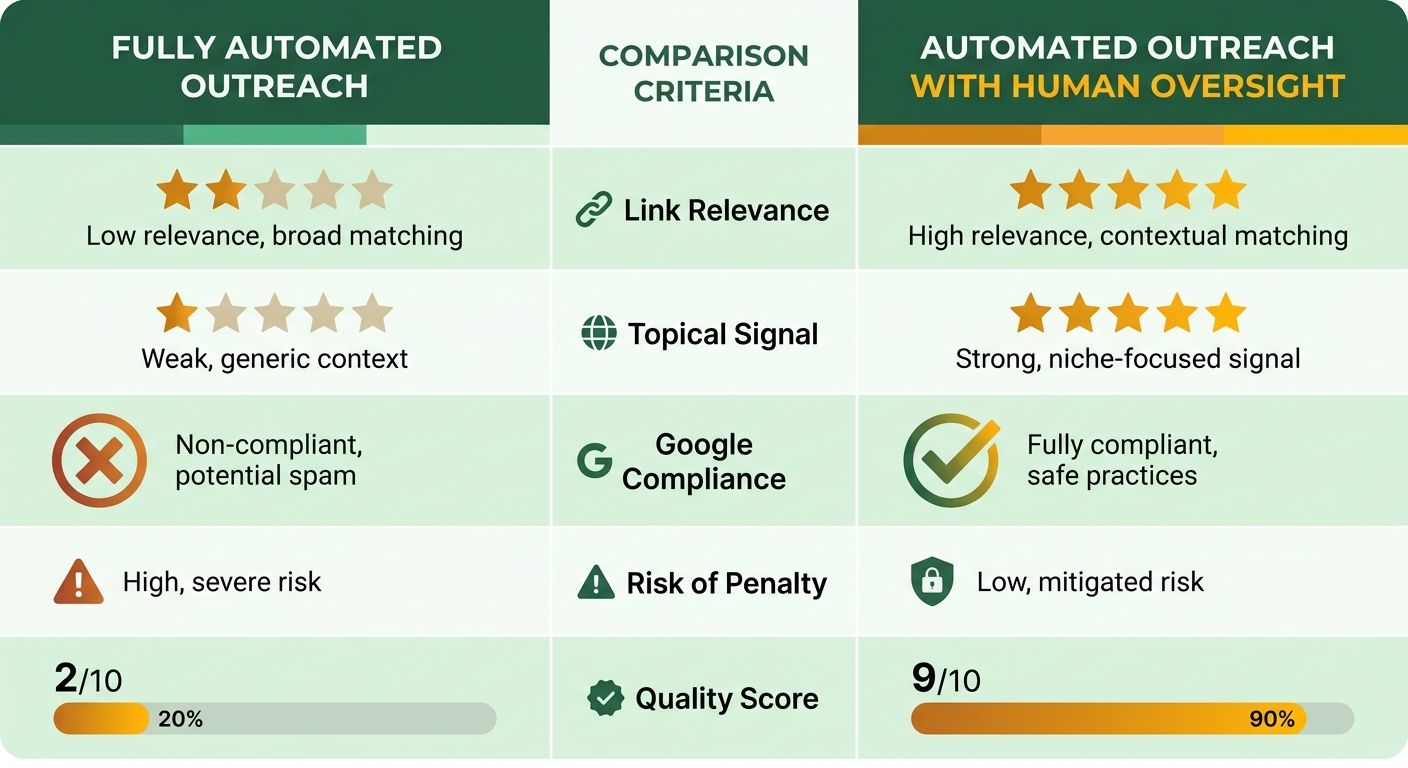
The most revealing thing about fully automated link building is not a penalty horror story. It is how quietly it can underperform. When teams skip human review entirely and let AI backlink building automation run end to end without gates, the links often cluster on low-relevance sites that look clean on a domain rating check but carry almost no topical signal. Google's policies on link schemes separate links that manipulate rankings from links that exist for genuine editorial reasons. That distinction lives in context, not metrics.
The gap between automation's speed and a human reviewer's judgment is exactly where quality can break.
What Does Google Actually Prohibit?
Google's published guidance tends to focus on whether a link represents a genuine editorial choice. It calls out link exchanges, paid placements without nofollow tags, and large-scale article campaigns built on keyword-rich anchor text. None of those need a bot to trigger a violation. A human running the same scheme by hand can hit the same wall.
In practice, discovery automation is widely considered low-risk. Finding prospects, verifying contacts, scheduling follow-ups, and monitoring placements does not touch another site's editorial decision. The risk generally starts at acquisition, when something other than a human editor decides whether a link belongs on a page.
The most useful compliance question is a plain one: did a real editor at the target site choose to include this link? If yes, how you reached them barely matters.
Building a Quality Gate Into Your Review Process
Not every link needs the same depth of review. Tier your outreach by target authority. Reserve careful, personalized pitches for higher-authority sites, and let automation handle volume prospecting at the mid-range. The logic is simple: high-authority publishers are hard to win back once a first impression goes wrong, so they deserve closer attention before anything sends.
Every placement that comes back runs through a checklist before you accept it:
- Topical relevance first. A link from a niche-adjacent article often beats one from a massive site with no topical connection. Domain rating is a proxy; topical match is the signal.
- Anchor text distribution. Over-optimized exact-match anchors in a short link profile can be one of the fastest ways to attract a manual review. Vary anchor text on purpose, and watch for the same phrase repeating in close succession.
- Traffic reality check. A prospect can look strong on DR while having lost most of its organic traffic after a core update. This is one place automated analysis often misreads value, so verify traffic by hand.
- Link placement context. Footer and sidebar links carry far less weight than contextual in-article links, and they can look worse to a reviewer. If a placement is not in the editorial body of the page, it needs a closer look.
- Site freshness. New content, recent updates, and visible editorial activity signal a real site. A static domain with no fresh posts and a clean DR is a common link-farm vector.
How to Set Up Review Gates Without Slowing the Operation
The goal is a gate, not a bottleneck. A focused human review of each prospect batch, before outreach sends, can prevent more damage than a post-placement disavow scramble.
The workflow: automation handles prospecting, qualification scoring, and sequencing. Before outreach goes to higher-authority prospects, a reviewer confirms topical fit and anchor text. Placements below that threshold run with lighter review, limited to the five-point checklist above.
Flag and skip any domain that scores low on topical relevance, whatever its DR. That filter alone can remove much of the link-scheme risk, because the sites that end up in manual actions often share one pattern: high domain authority, low contextual relevance, exact-match anchors. We cover how to structure this kind of compliant automated outreach in our guide on backlink automation and scaling without spam.
The hybrid model is not a compromise. For many teams, it is the most sustainable version of automated backlink building.
Measuring Success and Optimizing the Campaign
The fastest way to know whether your AI backlink building automation is paying off is to benchmark your link velocity against what the field actually produces. Many SEO teams still run ad hoc outreach with no repeatable process. If your pipeline delivers relevant placements on a predictable cadence, you are already ahead of many competitors.
But raw link count is the weakest KPI on its own. Track it next to other signals, because a campaign that acquires links yet moves no rankings may be failing quietly in a way a link tally will not show.
Which KPIs Actually Tell You the Campaign Is Working?
Start with acquired links, then layer in domain rating lift, referral traffic, and ranking movement on your target keywords. Watch how many target keywords enter ranking positions and how many climb into the top results, not just how your DR moves on a chart.
That ranking movement often matters more than the DR figure. It tells you the links are earning position, not just authority.
Set a realistic pace benchmark too, and track whether placements come from topically relevant, genuinely authoritative sites rather than raw volume. If the dashboard shows plenty of links but the domains are low-relevance, your filters are the problem, not your output.
How Do You Attribute Traffic and ROI to Specific Links?
Cost-per-acquired-link is the number that tends to survive a budget review. Take total spend, divide by verified live placements, and weigh it against manual outreach, which often converts at very low rates. Automation may win on both counts, but only if you count links that stay live.
Referral attribution is where a unified dashboard earns its keep. Tag each placement, watch which referring domains actually send qualified traffic, and feed conversions back to the source URL. A link that ranks but sends no trial signups is a vanity metric.
What Should You Change When the Data Tells You To?
A/B testing is where numbers turn into decisions. Run two email variants against matched prospect segments, then keep the copy with the higher reply rate. One caveat from experience: high-authority targets often detect robotic outreach, so route your best domains to human-written pitches while automation handles the volume tier.
Refine your prospect filters on the same cycle. Automated prospecting may surface a domain that looks strong but cratered on traffic after a Google update, so a live-traffic check belongs in every qualification pass. Topical relevance beats a big DR number with no subject connection nearly every time.
The move competitors miss is running both funnels at once. Your SERP funnel chases DR-weighted, outreach-driven links; your AI citation funnel chases the brand mentions and co-citation that get you named inside ChatGPT and AI Overviews. Measure them separately, because a team optimizing only for classic rankings may leave the entire pipeline for AI answers uncontested.
Scaling the Engine: From One Post to a Continuous Backlink Magnet
Most scaling advice treats the first blog post as a proof of concept. Many teams see it as the opening trigger of a multi-track outreach and distribution sequence, and the gap between those two views is where SaaS content budgets can quietly bleed.
Manual link building can hit a throughput ceiling fast. Run the math against a team publishing two or three posts a week and the wall often shows up quickly. The answer is not more outreach effort on one post. It is a system where every new asset feeds a continuous, automated pipeline from the moment it publishes.

How Does AI Backlink Building Automation Scale Beyond a Single Post?
Automation only scales when there are enough link-worthy assets to feed it. A single strong article triggers one outreach wave. A programmatic library of many targeted pages can trigger many outreach waves running in parallel over time.
Programmatic SEO is often the engine. Instead of writing each page by hand, you build templates around high-intent long-tail queries and let the content layer fill them. SaaS companies that run this well can end up with entire topic clusters indexed before a competitor publishes much on the same subject. Each page becomes its own prospect for inbound links, and an outreach tool can be configured to receive a fresh target list automatically as new pages go live.
One structural rule matters here: every page you generate needs distinct enough content to avoid duplicate-content filters. The fix is not bolting on boilerplate disclaimers. It is parameterizing the core proposition, not just the keywords, so pages in the same template genuinely answer different queries with different supporting detail.
What Formats Multiply Your Link-Earning Surface Area?
A single post buried on your domain earns links from whoever stumbles across it. The same post reformatted into several assets can earn links wherever those assets surface on their own.
The highest-yield reformats many SaaS teams skip are social carousels and YouTube scripts. Carousels on LinkedIn can pull engagement from journalists, newsletter writers, and podcast hosts who would never have found the original post. A well-structured YouTube script, narrated over a screen recording or turned into an AI avatar video, can get cited in roundups and embedded in third-party articles that link back to the source. Neither is inherently a vanity channel. They can put the original asset in front of people with both the ability and the motivation to link.
Newsletter distribution can add a different kind of lift. Drop a condensed version of a long-form post into a segment of your list, and some readers may republish or cite it in their own content within days. That secondary citation cycle often never happens if the post stays on your blog alone.
Maintaining Freshness Without Losing Link Equity
Scaling volume creates a maintenance problem many teams find too late: older programmatic pages drift out of date, thin out on quality signals, or accumulate duplicate patterns as templates evolve. Google does not forget those pages exist.
Run a content freshness queue. Flag programmatic pages by last-updated date and current ranking position on a rolling basis. Pages that ranked well and slipped often deserve a refresh and a new outreach trigger. Pages that never ranked and carry no inbound links may be candidates for consolidation or removal, not revision. Neither call needs to be manual at scale. A pipeline can be configured to surface these flags the same way it surfaces new post opportunities, not as an audit you run twice a year.
One last caveat, worth naming: if you have not yet validated which content angles earn links in your specific niche, scaling programmatic pages early can multiply a broken message. Get three or four placements on hand-written posts first, figure out what made those pitches land, then build the template logic around those patterns. Volume without validated messaging is expensive noise.
Common Questions
1. Will automated link building get my site penalized by Google?
Discovery automation is widely considered low-risk. Finding prospects, verifying contacts, and scheduling follow-ups do not touch another site's editorial decision. Risk generally concentrates at acquisition, when something other than a human editor decides a link belongs on a page. The compliance test is whether a real editor genuinely chose to include it.
2. Should I buy an automation tool before my outreach message converts?
Many teams recommend skipping full automation until your pitch is tested. Buying a tool to scale a message that does not convert just scales the failure at higher volume. Nail the message first, run a readiness audit, then let the system handle cadence and volume while you keep judgment calls human-approved.
3. Why can a high domain rating prospect still be a bad target?
A domain can score strong on DR yet have lost most of its organic traffic after a Google core update, or carry no topical connection to your post. Both make it low-value. Topical relevance and a live-traffic check often beat raw authority, and automated prospect suggestions can misread this without manual verification.
4. How do social carousels and YouTube scripts actually earn backlinks?
They can put your original asset in front of people who link. LinkedIn carousels can pull engagement from journalists, newsletter writers, and podcast hosts who would not find the source post on their own. A YouTube script narrated over a screen recording can get cited in roundups and embedded in third-party articles, each pointing back to the original.