Gym Search Engine Optimization in 2026: The Local Content Checklist That Can Lift Rankings and Tours
What You Need to Know
- Google Business Profile maintenance and review generation outrank most on-page SEO tactics because the algorithm rewards sustained weekly activity over one-time optimization efforts.
- Dedicated service pages for each class or amenity enable targeting specific local queries like "prenatal yoga in Denver" rather than competing only on broad terms.
The part most gyms get wrong
Gym SEO turns on five documented levers, and most gyms burn effort on the three that matter least. The operating thesis: GBP maintenance, review flow, and dedicated service pages do most of the ranking work; the rest only helps after those are solid. We've organized the checklist by skill barrier and maintenance pattern because a top-three placement means nothing if the page doesn't turn clicks into walk-ins.
The local content checklist: what moves rankings and tours
| Checklist Item | Time Investment | Skill Level | Ranking Impact | Tour-Conversion Relevance |
|---|---|---|---|---|
| - [ ] Dedicated page for each class/service | One-time setup | Low | Very High | High—matches searcher intent directly |
| - [ ] Google Business Profile setup & weekly maintenance | Ongoing (weekly) | Low | Very High | Very High—drives direction requests, calls, and booking clicks |
| - [ ] Review acquisition (target high rating, steady flow) | Ongoing (weekly) | Low to Moderate | High | Very High—reviews heavily influence gym selection decisions |
| - [ ] On-page SEO (title tags, city names, internal links) | One-time setup | Moderate | High | Moderate—improves click-through but won't close tours alone |
| - [ ] FAQ schema for AI Overviews | One-time setup | Moderate to High | Moderate for traditional rankings, High for AI Overviews | Moderate—answers objections before contact |
| - [ ] Local backlinks (partnerships, news coverage, community ties) | Relationship-based (ongoing) | High | Moderate | Low to Moderate—builds authority, indirect conversion path |
The items at the top share a pattern: low skill barrier, compounding returns over time, and direct conversion use. GBP maintenance and review flow build momentum because fresh activity and review responses keep the profile active. A gym that posts regularly, replies to reviews, and maintains active Q&A sections will generally be positioned better than one that optimized once and went silent.
What the ranking-to-tour path actually looks like
Search visibility only becomes useful when the next step is clear. A visitor should be able to move from a service page to a schedule, trial offer, or tour request without hunting through the rest of the site. A handful of well-ranked pages can support recurring member acquisition without requiring a paid click for every visit.
Why gym SEO matters in 2026
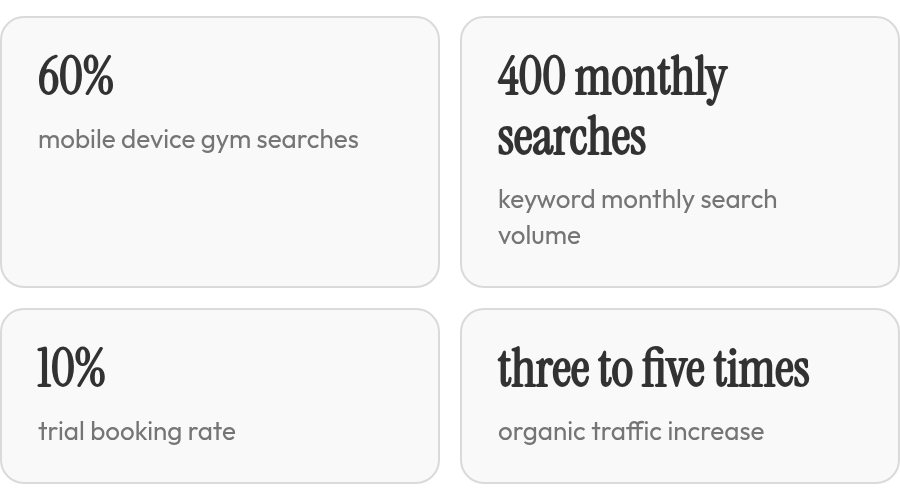
Roughly 60% of gym searches happen on mobile devices, and most carry local intent. When someone types "CrossFit near me" at 7 PM on a Tuesday, they're not browsing fitness content. They're picking where to work out this week.
The conversion math is direct. A gym ranking first for a keyword that gets 400 monthly searches will see roughly 120 to 160 clicks. Even a small share of those clicks can create a measurable member pipeline. Stack five or six of those, and organic search becomes a repeatable acquisition channel that costs nothing per click.
Gym SEO compounds over time
Paid ads stop producing the day your budget runs out. SEO keeps working. After twelve months of consistent effort, most gym websites see three to five times more organic traffic than when they started. Gyms that hold top positions in the local Map Pack capture the majority of clicks, while lower positions fight for what's left.
Local visibility drives visits and website actions
Google's AI Overviews now appear frequently on local queries. If your gym's content isn't structured to feed those overviews, you're invisible in the new search market. Boutique gyms benefit here. Big chains coast on brand recognition, but local studios win by being specific about what they offer and where they serve.
Core local content elements
Gym SEO hinges on a structure most gyms overlook: every class, service, and amenity needs its own page. A single "Classes" page can only compete for a handful of broad searches, while dedicated pages let you target the specific phrases people actually type—"prenatal yoga in Denver" or "cycling classes near me." Local SEO practitioners consistently point to dedicated service pages as one of the strongest factors in local organic rankings.
What each service page should include
Give Google enough to index and give visitors enough to decide. Each page needs class duration, schedule, a description of what first-timers can expect, photos of your space, and an embedded schedule so people don't leave the page to find a time slot. Real video matters here—a thirty-second clip of an actual class answers "what will this feel like" faster than any paragraph can. Video platforms like YouTube, Instagram, and TikTok have become places people look for local recommendations, and vertical footage of your environment builds confidence before the trial visit.
The call to action should be obvious—a trial pass or booking button, not a passive "contact us" link. Keep the copy concise. Current SEO best practice favors pages that answer the question up front instead of padding with fluff. Say what someone needs to decide, then stop.
How to use local keywords without forcing them
- Put your city name in the page title, H1 heading, and naturally in the first paragraph where it reads like normal speech
- Add geographic keywords to image alt text when describing facility photos or class scenes
- Include neighborhood names in your service descriptions if you draw from multiple areas—"serving Midtown, East Austin, and South Lamar"
- Link service pages to each other with location-specific anchor text where it makes sense, like "Our weightlifting program pairs well with our sports rehab services in Capitol Hill"
Internal linking across your whole site strengthens how search engines understand your service structure and local footprint. Organize your pages with either a dropdown menu under "Classes" or a hub page that lists every class with a short description and a "Learn More" button leading to each dedicated page. Either structure works; what matters is that every page is discoverable and linked.
Google Business Profile & review engine
Google Business Profile acts as the foundation of gym SEO, and most gyms underutilize its ranking potential. A complete profile helps connect local relevance, business information, and customer activity when prospects are comparing nearby facilities.
Claim, verify, and complete every field
Start by claiming your profile at google.com/business and verifying ownership through the postcard method. Google values complete profiles in local rankings, so fill every available field: primary category (Personal Trainer or Gym), secondary categories for specialties, service area defining neighborhoods you serve, accurate hours including holiday schedules, and a local phone number that matches what appears on your website and citations.
Your business description gives you room to differentiate—use it. Skip generic language like "premier fitness facility" and write what actually sets you apart: "24-hour CrossFit gym in downtown Austin specializing in Olympic lifting and competition prep, with dedicated space for mobility work and recovery." Geographic keywords matter here because Google's relevance signal plays a significant role in local rankings, especially when paired with dedicated service pages.
The weekly GBP maintenance routine
Post regular updates about member wins, class highlights, or equipment additions. Consistent activity signals to Google that your business is active and relevant, helping preserve visibility over time. A current profile also gives prospective members more context when they compare several gyms.
Respond to every review within a week. Thoughtful replies to negative reviews often build more community trust than the reviews themselves, and an active response pattern keeps your profile fresh. As your review count and average rating grow, you'll notice stronger visibility in local search results.
Local link building & community signals
Local partnerships earn you the backlinks that matter most for gym SEO, and the timeline is longer than most checklists admit. A local chiropractor linking to your site from theirs carries meaningful ranking weight, but those relationships take time to build. Gyms that treat backlink work as relationship work rank consistently higher than gyms that treat it as a checklist.
Building links through local partnerships
The strongest local backlinks come from businesses your members already use. A physical therapist who refers clients to your gym will link to you when you refer members back. A running store that hosts a joint event with you will link to the event page. A juice bar that stocks your lobby will link from their "partners" page. These are the links Google weights heavily because they signal real community presence, not SEO mechanics.
Gyms that rank well for competitive local searches tend to accumulate links from local businesses through genuine partnerships. You're trading value first—hosting a workshop at the chiropractor's office, sponsoring the running store's 5K, giving the juice bar's owner a free membership—and the link follows naturally when they write about the partnership. Local news coverage works the same way. A newspaper story about your charity fundraiser or a member's transformation earns a link that compounds for years.
Citation consistency and audit tools
Citation consistency means your gym's name, address, and phone number appear identically across every directory, review site, and local listing. Inconsistent citations—"CrossFit Denver" on Yelp but "CrossFit Denver Gym" on Bing Places—dilute your local ranking signal because Google can't confidently verify which listings belong to you. We recommend auditing your citations with tools like Moz Local or BrightLocal, which crawl the major directories and flag discrepancies. The research doesn't identify which 2026 citation sources carry the most weight, so focus first on the platforms your members actually use: Google Business Profile, Yelp, Facebook, and any fitness-specific directories in your area.
Backlink and citation work takes patience. The impact builds as Google crawls the new links and verifies the corrected citations. Skip the automated citation-building services; manual relationship work is what earns links that actually hold up.
Tracking, optimization & automation
Build a dashboard that shows what actually converts
Start with Google Business Profile insights. It shows the exact search terms people used to find you, how many times your profile appeared, and how many people clicked through to your website, called, or requested directions. Most gyms ignore this data. Track it regularly.
Add Google Search Console to see which pages rank for which queries and how your click-through rate compares to competitors. If you rank fifth for "CrossFit near me" but your click-through rate is half the average, your meta description or title tag isn't working.
For tour and membership conversions, track calls, bookings, and directory traffic by source. Your CRM or booking system should tie each lead back to its source.
Run audits on a recurring schedule, not once
Monitor rankings and impressions regularly. Refresh service pages when you add or change a class, update pricing, or adjust your schedule. Audit citation consistency across all directories at least once a year. Inconsistent addresses or phone numbers across listings dilute your local-search authority.
Google Business Profile changes can take time to show movement in search; on-page website changes often take longer. If you update a service page, don't expect instant movement. Track the trend, not the daily fluctuation.
Use content recency as a refresh rule for AI Overviews
AI Overviews now appear at the top of many gym-related search results, and they favor current, structured content. Update any page with outdated dates or stale seasonal references. A 2023 blog post titled "Best Gym Software 2023" gets skipped when AI engines want current information. Republish or rewrite it with recent context.
Add FAQ schema to pages that answer common questions like "How much does a CrossFit membership cost?" or "What should I bring to my first class?" These pages become citation candidates for AI-synthesized answers.
Automate scheduling and maintenance without overstating time savings
Use automation to schedule Google Business Profile posts, stage review-request emails after trial visits, and queue content updates. A workflow that publishes a regular post and sends a review request after someone's first class keeps your profile active without manual intervention each time. Consistency matters more than volume.
Quick Questions, Straight Answers
How long does it typically take to see meaningful results from gym SEO work?
Results vary based on competition, site quality, and consistency. Ranking movement from Google Business Profile updates and review responses often appears within a few weeks, while on-page changes to service pages take longer to compound. Treat early improvements as directional signals and continue monitoring the broader trend.
Should I prioritize Google Business Profile work over building out dedicated service pages?
Start with both in parallel if possible, but GBP maintenance and service pages work together rather than competing. Dedicated pages let you target specific class and amenity searches, while regular GBP activity keeps the business visible in local results. Neither works as well in isolation.
What's the minimum realistic weekly time commitment to maintain momentum with gym SEO?
A short weekly routine can cover the core maintenance tasks: posting one GBP update, responding to new reviews, and checking your Search Console data for ranking shifts or new queries. Relationship-based work like local partnerships and backlink outreach runs on a longer timeline and can't be compressed into a weekly sprint.
Do I need to hire an SEO specialist, or can I handle this internally with basic training?
The items that move rankings most—GBP posting, review replies, and building service pages—sit at a low to moderate skill level, so many gyms handle them internally once someone learns the pattern. Schema markup and citation audits require more technical comfort, and local backlink work demands relationship-building time rather than SEO expertise.
If I rank well for one keyword, how many additional keywords do I need to drive consistent member acquisition?
Build a group of relevant service and location terms rather than relying on a single phrase. Start with the classes and amenities that have the strongest demand, create useful pages for them, and track which queries actually produce trial sign-ups. Expanding from those results is more productive than chasing every possible keyword variation.