
Home Services SEO: The Master Guide for Contractors and Trades

Key Takeaways
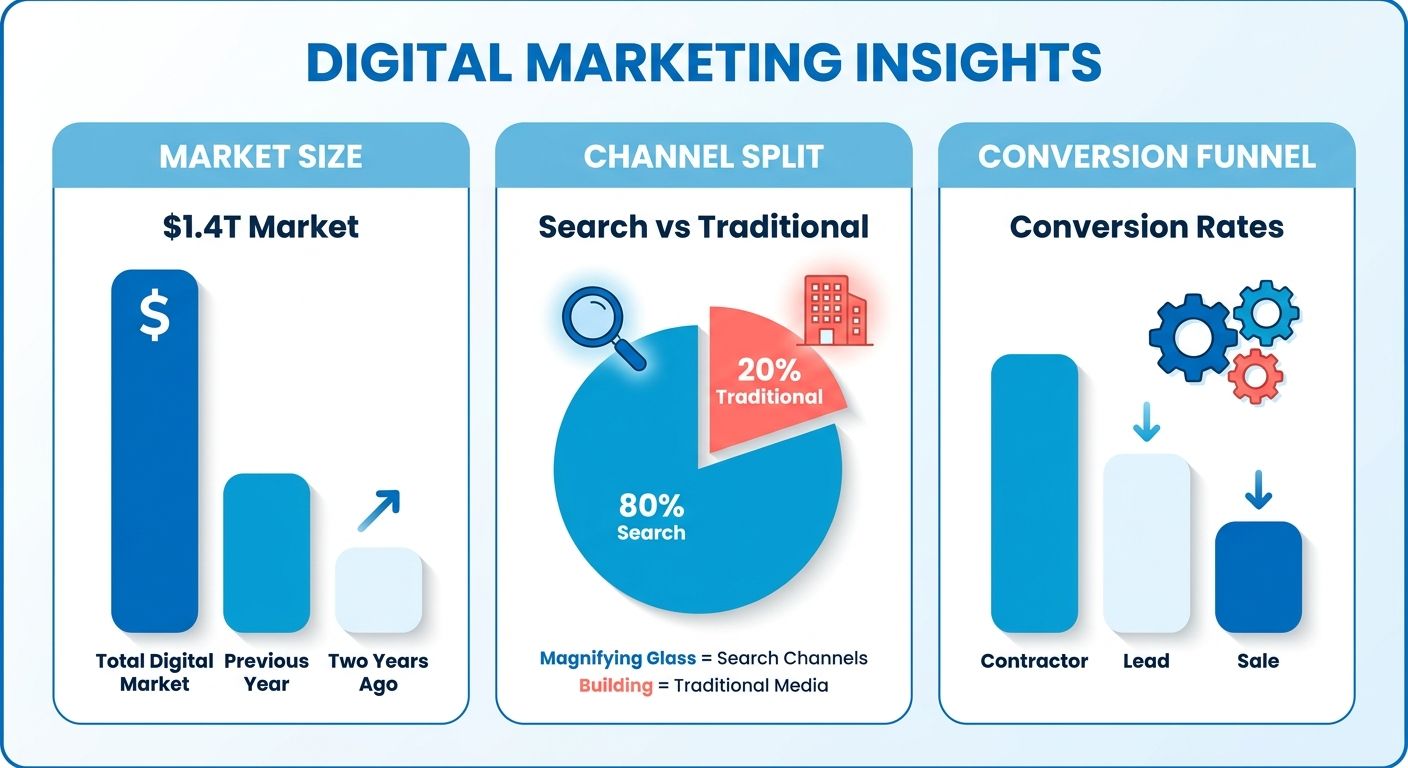
- Home services is on track to be a $1.4 trillion industry by 2025, and roughly 80% of new customers find their provider through search.
- Businesses that take SEO seriously see about a 20% revenue lift, and optimized content tends to push lead generation up around 25%.
- 76% of people who run a local search on their phone visit a business within a day. The urgency is the whole story in the trades.
- Focused optimization can raise a contractor's visibility by about 30%, which is just rankings turning into booked jobs.
- Someone searching "emergency plumber near me" acts on it now. If you're not in the results, that job goes to whoever is.
- A consistent NAP, your name, address, and phone number, is what anchors your spot in the local map pack.
Why search decides who gets the call
When something breaks in a house, nobody flips through a binder of contractor business cards. They grab their phone and search. A leak under the sink, a furnace that won't fire, an AC unit dead in July. The first move is the same every time. If you're not near the top of those results, you've handed a ready-to-buy customer to the competitor who is.
That's the whole case for home services SEO. Done right, your site stops being a digital brochure that sits there and becomes something that books work while you sleep. The output is concrete: more booked jobs, higher dispatch rates, a pipeline you can actually predict.
Why local SEO does the heavy lifting
For a home services business, local search is the highest-value channel you have, because the intent is sky-high and the timeline is short. People don't research a plumber for three weeks. They search, they scan the map pack, they call. When you rank there and your business details are clean across the web, you catch that traffic at the exact moment it converts. Want the deeper version? This guide to local SEO for home service businesses walks through it step by step.
The three problems SEO actually solves
Most contractors lose sleep over the same three things: competition, reputation, and lead flow. SEO works on all three.
Competition. Crowded markets mean a dozen companies chasing the same keywords. Service silos and trade-specific signals let a multi-trade company rank for each service it offers instead of just one.
Reputation. Earning reviews and handling them well feeds straight into local rankings and customer trust. The two aren't separate problems.
Lead flow. Tuned title tags, meta descriptions, and service-area pages are what turn a search into a ringing phone.
Who gets the biggest return
Small and mid-sized shops, mostly. SEO is the rare channel where a solo electrician or a regional HVAC outfit can outrank a national brand inside their own service area. The big players have budget. They don't have your local relevance.
Plumbing, roofing, electrical, remodeling, it's the same shape across the board. Local customer base, high intent, steady year-round volume.
How long before it works
Most home service businesses see meaningful movement in 2 to 3 months. Here's how the core work stacks up.
| Strategy | What It Does | Effort | Time to Results |
|---|---|---|---|
| Keyword research | Finds the terms customers actually search | Low to medium | 1-2 weeks setup |
| On-page optimization | Tunes title tags, meta descriptions, content | Medium | 4-8 weeks |
| Local SEO | Builds map pack visibility, consistent NAP | Medium | 1-3 months |
| Link building | Earns authority signals from other sites | High, ongoing | 3-6 months |
Start with keyword research and on-page work. They're quick to implement and they feed everything downstream. Link building takes the longest but compounds, so the sooner it starts the better. Set the expectation with your team early: this is a build, not a switch you flip.
Winning the "near me" search
Local SEO is how you win the searches that drive most of your calls. The job is to convince Google you're relevant, prominent, and physically close to whoever's searching. Three things move that needle: your Google Business Profile, your local listings, and your reviews.
Your Google Business Profile is the whole game
Your Google Business Profile is the single biggest factor in local rankings. It's what puts you in the map pack, the cluster of three results sitting above everything else. Not in the pack, not seen. It's that binary.
Claim and verify it first. Verification proves to Google you're a real business operating where you say you are, and unverified listings almost never rank.
Then fill in every field. Pick the right primary category for your trade. List all your services, set accurate hours, define your service area, and add real photos of your crew and finished jobs. A complete profile beats a bare one every single time, so don't leave blanks.
Keeping your listings consistent
The foundation of local listings is dull and non-negotiable: your business details have to match, exactly, everywhere they appear. Conflicting info confuses search engines and chips away at the trust signals you need to rank.
Audit your citations across directories, social profiles, and review sites. Hunt for old addresses, dead phone numbers, and small name variations, "LLC" on one listing and not the next. Each mismatch is a little reason for Google to doubt which version of you is real.
For multi-trade companies, splitting the site into dedicated sections per trade helps search engines understand exactly what you do in each city you serve.
Reviews: ask every time, reply every time
Reviews drive rankings and conversions at the same time, which makes them about the best return on effort you've got. Volume, recency, and your responses all factor into local ranking.
Make the ask part of the job. Request a review right after you wrap, while the customer's still happy with the work. A quick text with a direct link kills the friction and gets you far more responses than "leave us a review sometime."
Handle the negatives fast and calm. A solution-focused reply to a complaint tells every future prospect you stand behind your work. Ignoring a bad review does more damage than the review itself ever could.
A quick example
An HVAC company picked the wrong primary category, filing itself under "air conditioning contractor" when most of its winter revenue was heating repair. Switching to the accurate category and adding service-specific pages for furnace and heat pump work pushed it onto page one for several terms it had never ranked for.
That's the pattern in miniature. Verify, stay consistent, build reviews. Do those three well and you'll pass competitors who treat local SEO as an afterthought.
The technical work that quietly costs you rankings
Technical SEO is the unglamorous plumbing behind your site, the stuff that decides whether Google can crawl, read, and rank it. For a home services business it comes down to three things: how fast pages load, how well they work on a phone, and how clearly your site explains itself through schema markup. Fix these and you remove the friction that's been quietly costing you position.
Why site speed matters this much
Slow pages bleed visitors and rankings together. Someone searches "water heater repair" at 7 a.m., taps the first result, and expects it now. If your page stalls, they're back on the results page calling a competitor before your homepage finishes rendering.
Google also treats load time as a ranking signal, so a sluggish site hurts you twice. You lose the user and you lose position. Start with the basics that actually move things:
- Compress your images. Service photos are usually massive files dragging your load time down. Resize and compress before uploading.
- Cut heavy plugins and scripts. Every extra tool adds weight. Keep only what earns its place.
- Test on real devices. Check load times on a phone over cell data, not just your office WiFi.
Making your site work on a phone
Use responsive design that adapts to any screen on its own. Most "near me" searches happen on a phone, often from someone standing in a flooded basement or a pitch-dark garage. If your site fights them on mobile, you lose the job.
Responsive means your layout, text, and buttons resize for whatever device someone's holding. No pinching, no zooming, no sideways scrolling. Then sweat the small stuff that frustrates people: make your phone number tap-to-call, keep buttons big enough for a thumb, and write short, scannable content so a customer finds your service area and hours in seconds.
What schema markup is, and why bother
Schema markup is code you add to your site that tells search engines exactly what your business does, where you work, and what you offer. It changes nothing about how the page looks. It changes how clearly machines read it.
Two types do most of the work for the trades. Local business schema spells out your name, address, phone, and hours. Service schema describes the specific jobs you handle, like drain cleaning, panel upgrades, or HVAC tune-ups. The payoff is richer search results and a relevance boost that reinforces everything you're doing on the local side. You're handing Google a clean, labeled summary instead of making it guess.
Before and after you publish, run each page through Google's Rich Results Test. It flags missing fields, an incomplete address, a service area you forgot to define, so you can patch the gaps that would otherwise lock you out of rich listings. Schema gets almost no attention, but clean, validated markup is often the difference between Google reading your site at a glance and squinting at it.
Content that earns the call
Content is how you build the trust that turns a searcher into a paying customer. Good content answers the questions people have before they pick up the phone, and it tells Google your site is a real authority on plumbing, HVAC, roofing, whatever you do.
It pulls double duty. It ranks for the terms your customers search, and it convinces those customers you know your trade. You need both.
Why service pages and FAQs come first
Service pages and FAQs are the foundation because they target the searches with the clearest buying intent. A dedicated page per service tells Google exactly what you do and where. Someone searching "drain cleaning" should land on a drain cleaning page, not your generic homepage.
Build one page per service and group them logically so search engines see how your trades relate. A multi-trade company might separate plumbing, heating, and electrical into their own sections, each with its service pages underneath.
Write your FAQs the way customers actually talk, because people type full questions into search now, and answering them plainly helps you show up. Cover the real basics: price ranges, response times, what happens during a visit, and which areas you serve.
What to blog about
Blog about the problems your customers have and the questions they keep asking. The strongest topics fall into three buckets: practical how-tos, seasonal advice, and plain explanations of common repairs. A post answering "why is my water heater leaking" catches people early, before they're ready to call anyone.
Timing matters. Heating content performs in fall and winter, cooling content climbs in spring and summer, so plan your calendar around the seasons your trade follows. Tutorials and maintenance guides earn their keep here: they show expertise, keep visitors around longer, and give you natural spots to mention the services you sell. A roofing company that writes a detailed guide on spotting storm damage and links it to its inspection and repair pages might see visitors stay nearly twice as long before requesting a quote.
For how content and local search feed each other, the 2026 Complete Guide to Local SEO is worth a read.
Knowing whether any of it works
You measure it. Track your keyword rankings and organic traffic monthly so you can see which pages pull visits and which are dead weight. Skip the tracking and you're just guessing.
Set up a simple dashboard with the numbers that matter: rankings for your core services, total organic visitors, and how many of those turn into leads. Roll it into a monthly report you'll actually open. A plumbing company that reviews its analytics each month, doubles down on the service pages already gaining traction, and trims the topics going nowhere can move three core service pages onto page one within two quarters and start landing steady form fills.
Watch the trend lines, not single days. Content takes months to rank. Judge it over quarters, not Mondays.
What winning campaigns actually look like
The campaigns that work share a pattern: sharp keyword research, disciplined on-page work, then local signals that compound over time. The scenarios below are illustrative, drawn from how home services SEO typically plays out when the fundamentals line up.
A plumbing or electrical campaign, start to finish
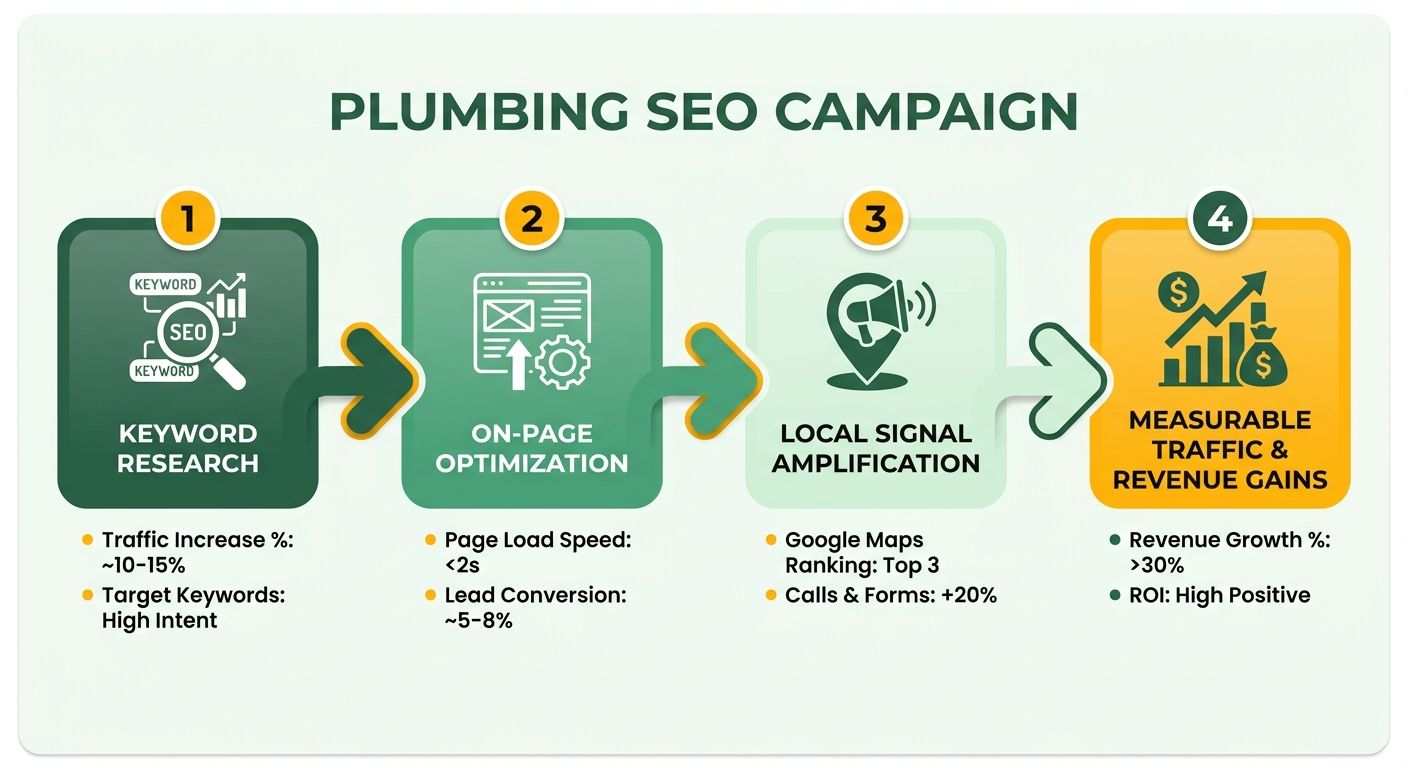
A strong electrical campaign opens with keyword research and ends with traffic you can measure. An electrical contractor maps its service pages to the exact terms customers search, tightens its on-page work, and earns a 50% jump in organic traffic over a few quarters.
The mechanics are simple and unglamorous. Build a separate page for each service and city you cover, write titles and headers around real search phrases, and keep your digital profiles fully updated. That last part matters more than people expect. When your details are uniform across the web, you stop confusing search engines and start ranking for the jobs you actually want.
Going local instead of broad
Focusing tight beats casting wide. A foundation specialist that targets basement waterproofing and crack repair in its core towns can book 35% more qualified leads in a single season by sharpening its service-area pages and answering every inquiry fast.
Foundation repair is brutally competitive, so the edge comes from specificity. The business chases waterproofing and structural-repair keywords tied to named towns, not the generic terms the big regional players already own. A page built around a named town and a specific problem converts far better than a broad one, and quick follow-up turns those clicks into booked jobs.
What carries across every trade
The lessons repeat no matter the trade. Research keywords first, optimize every page, treat reputation as a ranking factor instead of an afterthought.
- Keyword research drives everything. You can't rank for searches you never identified. Find the terms customers actually type, then build pages around them.
- On-page optimization is non-negotiable. Clear titles, useful service pages, clean structure. That's how search engines figure out what you do and where.
- Reputation is part of SEO. Reviews and consistent listings feed local rankings directly. Neglect them and you cap your own ceiling.
The obstacles are just as predictable. Competition is the big one, especially in dense trades like roofing and HVAC where established firms own the obvious keywords. The counter is to go narrower and more local than they bother to. After that comes reputation: a handful of bad reviews or inconsistent details can quietly drag your visibility down, and fixing them is often the fastest win on the board.
None of it happens overnight. SEO compounds, so the businesses that commit for the long haul are the ones that pull ahead and stay there.
Links and citations: proof beats polish
Links and citations are how you tell search engines your business is legit. Links from other sites act like votes of confidence. Citations confirm your details are accurate everywhere they appear. Together they push your authority up and your rankings with it.
Here's the uncomfortable part for anyone who just paid for a slick redesign: a roofing site with strong backlinks and clean citations will outrank a better-looking competitor that has neither. Search engines reward proof, not polish.
Why links move rankings
Every quality link from a relevant site signals that your business is credible. More authoritative links means higher domain authority, and higher authority means better rankings for the competitive terms, "roof replacement near me" and the like. It's one of the strongest off-page levers you control.
The trick is relevance over volume. One link from a respected local builders' association or a regional news site outweighs dozens of random directory links. So focus on sources tied to your trade and your service area, and skip the cheap bulk links. Search engines flag unnatural patterns, and a spammy profile drags you down instead of lifting you. Earn links the slow way and they stick.
Finding guest blogging opportunities
Guest blogging earns backlinks by publishing genuinely useful content on someone else's site in exchange for a link home. Start with adjacent industries: home improvement sites, real estate blogs, local business publications, trade outlets that take contributor articles.
Pitch topics that match your expertise. An electrician might write "How to Spot Outdated Wiring Before It Sparks" for a home maintenance blog. It has to actually help, not read like an ad with a byline. Editors smell promotional fluff and reject it fast. One well-researched post on a respected site beats ten on low-traffic blogs nobody reads, so treat each piece as a work sample.
What makes citation building work
Citations live and die on consistency and accuracy. A citation is any mention of your business details on a directory, review site, or local listing. When your core contact info matches everywhere, search engines trust the data and rank you higher locally.
Inconsistency does quiet damage. One directory lists "St." and another "Street," an old phone number lingers on a stale profile, and now Google isn't sure which version is real. Audit your listings and fix every mismatch. Prioritize the directories that matter for your trade and region instead of chasing every obscure site. For a deeper walkthrough of the local signals tied to citations and reviews, the 2026 Complete Guide to Local SEO covers the mechanics, and there's more on the same theme over on the AnyPost blog.
An HVAC company that corrects a mismatched suite number across a dozen listings and adds five trade-association citations can watch its map pack visibility for "furnace repair" double inside a quarter. Clean data does slow, steady work.
How the trades win SEO differently
Contractors play this game differently from other local businesses, because their work splits across distinct services, areas, and intents. A plumber who also does HVAC isn't running one campaign. They're running several, each aimed at a different searcher. The trades that rank treat structure, keywords, and on-page signals as trade-specific, not one-size-fits-all.
How multi-trade companies should structure a site
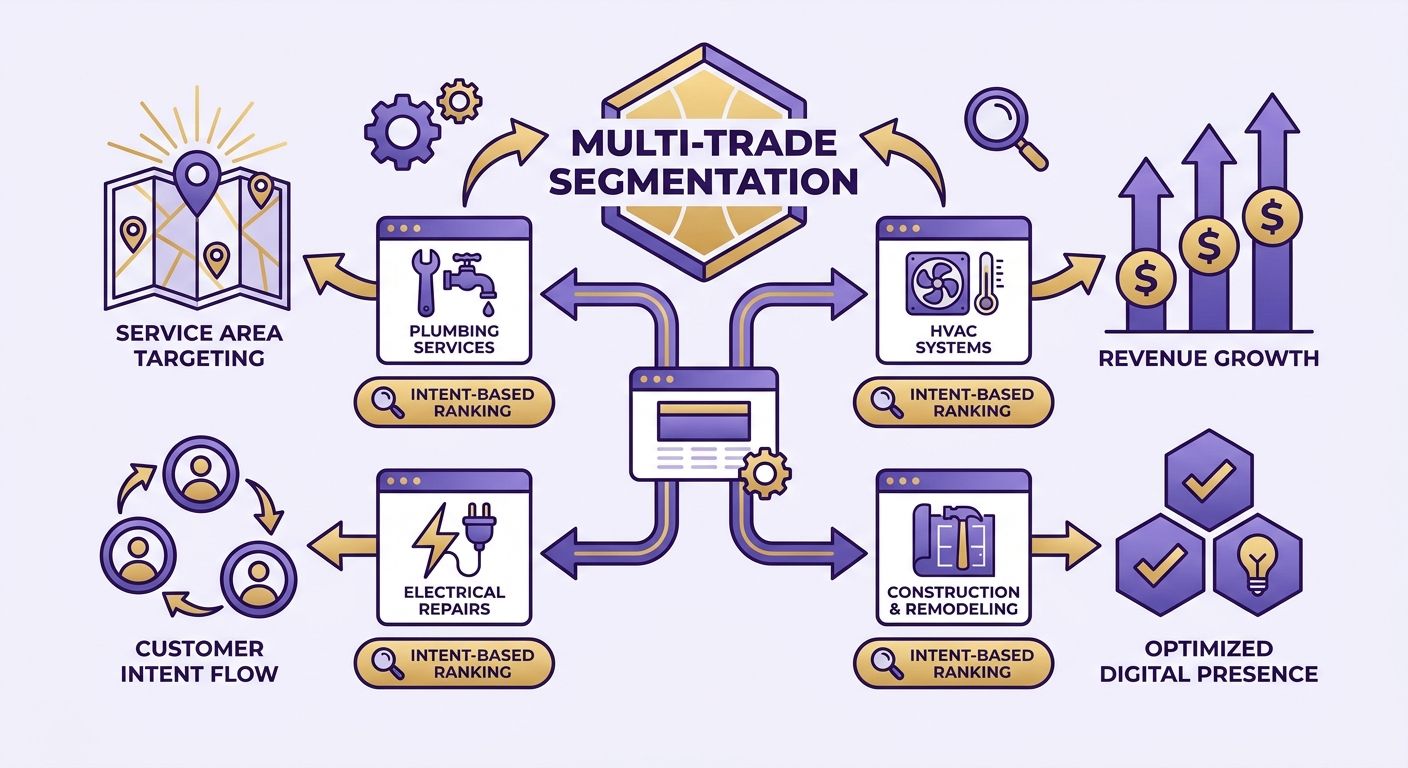
Organize the site into dedicated sections per trade. That tells search engines you have real depth in each service area, not one thin page trying to cover plumbing, electrical, and roofing at once.
In our experience this is what separates a contractor who ranks for several distinct services from one who ranks for none. Each section builds focused relevance. A dedicated roofing section with its own service pages, project examples, and FAQs proves you actually do roofing instead of just listing it.
Group pages by trade first, then by location underneath. A contractor in three cities ends up with a clean tree: roofing pages per city, HVAC pages per city, and so on. Tidy structure, high relevance.
What keywords the trades should chase
Go after long-tail keywords that pair the service with the location, because that's where buying intent peaks. "Emergency furnace repair Austin" is someone ready to hire. "Furnace" is someone killing time. The longer, more specific phrase wins the call.
Build your list around how customers actually phrase things. Mix the urgent terms, "burst pipe repair," "no heat", with the planned-project terms, "bathroom remodel cost," "roof replacement." Each phrase deserves its own page once search volume justifies it. And skip the vanity words. Ranking for "contractor" sounds impressive and pulls in searchers who'll never hire you. Location-based, service-specific terms convert better and fight less competition.
Which on-page elements matter most
For contractors, the on-page elements that move rankings are title tags, meta descriptions, and header tags, because they tell Google and the searcher exactly what a page delivers. Align them with the keyword for that page and you take the guesswork out.
Write each title tag to name the service and the city: "Drain Cleaning in Denver | Same-Day Service." It matches the long-tail search and earns the click. Your meta description won't lift rankings directly, but it drives clicks from the results page, so treat it like ad copy, name the trade, the area, one reason to pick you. Then use header tags to break each service page into scannable sections that answer the questions a customer has before booking. Keep your core business details consistent across every page so Google trusts your location data.
The pattern holds across every trade. Structure your services clearly, target specific local searches, tighten your on-page signals. Do it consistently and the rankings follow.
Frequently Asked Questions
1. How much does home services SEO cost for a small contractor?
Pricing varies widely, from $500 to $5,000 monthly depending on scope, market competition, and whether you handle work in-house or hire an agency. Solo operators can start with free tools like Google Business Profile and basic on-page work, scaling up to link building and paid audits as revenue grows.
2. Can I do home services SEO myself or should I hire an agency?
You can handle the fundamentals yourself: claiming your Google Business Profile, ensuring your business details are uniform across directories, writing service pages, and requesting reviews. These tasks require time, not technical expertise. Agencies become worthwhile for competitive markets, technical schema work, and ongoing link building, which demand specialized skills and consistent effort most owners lack.
3. What keywords should a new contractor target first?
Target high-intent, low-competition phrases that combine a specific service with a named town, like "furnace repair Springfield" rather than broad terms like "HVAC." These long-tail keywords convert better and rank faster because established regional firms ignore them. Add "emergency" or "near me" modifiers to capture urgent, ready-to-book searchers.
4. Does Google penalize businesses for having duplicate service-area pages?
Google flags pages as duplicate when they share near-identical content across cities. Avoid this by writing unique copy for each service-area page, including local landmarks, neighborhood names, specific projects completed there, and town-relevant details. Thin, copy-paste pages with only the city name swapped can hurt rankings instead of helping.
5. How do seasonal demand shifts affect a contractor's SEO strategy?
Search volume swings sharply by trade and season, so publish content ahead of demand peaks. Heating topics should go live in early fall, cooling content in late spring. This gives pages time to rank before customers search. Maintain year-round service pages while rotating blog topics to match upcoming seasonal intent.
6. What's the difference between citations and backlinks for local rankings?
Citations are mentions of your business name, address, and phone number on directories and review sites, confirming your data is accurate. Backlinks are clickable links from other websites that pass authority and act as credibility votes. Citations build local trust signals, while backlinks raise domain authority for competitive search terms.
7. Why isn't my business showing in the map pack despite good reviews?
Strong reviews alone won't rank you if other signals are weak. Common culprits include an unverified or incomplete Google Business Profile, the wrong primary category, mismatched business details across listings, or weak proximity to the searcher. Audit your category selection and citation consistency first, since these often block otherwise qualified businesses.