
How Ahrefs Automated Queries Help Teams Find AI Content Keywords Faster in 2026

Key Takeaways
- Teams using Ahrefs automated queries shorten keyword research cycles.
- Connecting Ahrefs queries to an AI content engine speeds reviews.
- Ahrefs provides 101 API endpoints for scheduled workflows.
- Automated queries help teams capture zero-search-volume and emerging topics.
- Setup requires intermediate skill with API connectors or Zapier.
- When queries run on autopilot, human review becomes the bottleneck.
- Teams publish content faster by feeding insights into pipelines.
What you're actually getting
Ahrefs automated queries schedule keyword discovery, monitor SERP changes, and feed insights directly into content pipelines. No dashboard logins every morning. Teams that connect automated Ahrefs queries to an AI content engine publish articles sooner, capturing zero-search-volume queries and emerging topics while historical competition remains low.
The table below breaks down what you're committing to when you automate Ahrefs keyword workflows in 2026, from setup difficulty to the KPIs you can expect to move.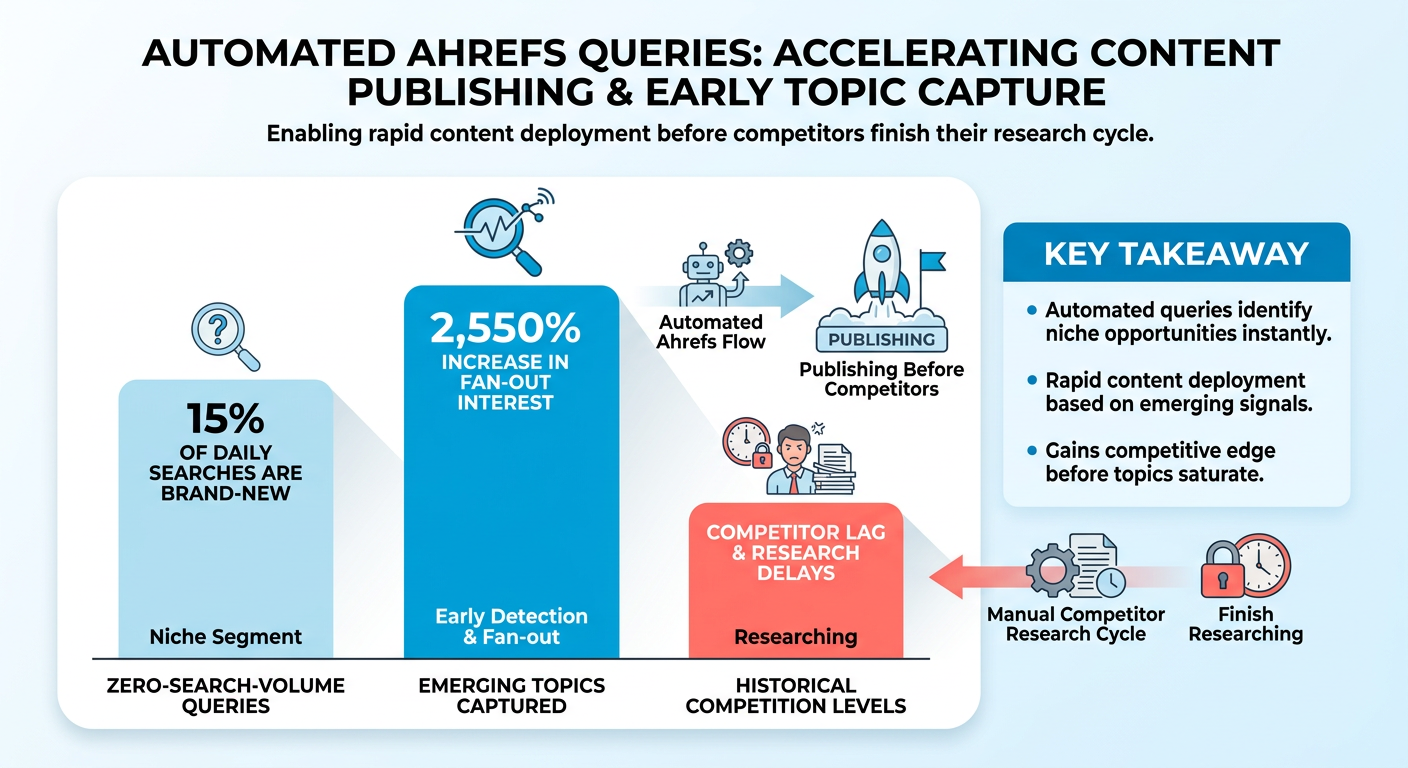
| Metric | Manual Ahrefs Use | Ahrefs Automated Queries | Automated Queries + AI Content Engine |
|---|---|---|---|
| Time per keyword cycle | 2–4 hours | 15–30 minutes | 5–10 minutes (query → draft → review) |
| Setup difficulty | Beginner | Intermediate (API/Zapier) | Intermediate (one-time integration) |
| Discovery approach | Manual SERP review | Scheduled queries | Scheduled queries + faster execution |
| Content workflow | Research + writing separate | Research automated, writing manual | Research + automated drafting |
| Primary bottleneck | Manual SERP analysis | Writing/editing bandwidth | Human review capacity |
| Recommended integrations | Excel, Google Sheets | Zapier, Make, Google Sheets | Zapier, content CMS, brand-voice AI |
What these numbers mean:
Ahrefs' programmatic access covers the full dataset, so automated queries pull the same depth of data you'd get clicking through Keywords Explorer manually: keyword difficulty, SERP features, traffic estimates, competitor gap analysis.
Automated scheduling eliminates the manual search phase entirely, but the writing process remains the core focus. That's why 97% of teams review AI content before publishing. The real win is query automation feeding brand-consistent AI drafts, not raw keyword dumps.
SEO leads close at 14.6% compared to 1.7% for outbound, which is why speed matters. Automated queries find the keyword; AI content engines turn it into a publish-ready draft; you review for voice and accuracy. The keyword-to-publish loop compresses from days to hours.
Difficulty ratings: If you can connect Ahrefs to Zapier and trigger a webhook, you're 80% there. The harder part is ensuring AI-generated content matches your brand voice at scale. Tools like AnyPost.ai use a Persona Engine that learns tone from your existing blog to keep every article sounding like you wrote it.
The workflow snapshot: Ahrefs automated query identifies keyword → triggers content brief → AI engine drafts article in brand voice → human reviews for accuracy → auto-publishes to WordPress/CMS and social channels. This pipeline helps your editorial team refine polished drafts rather than start from scratch.
Why this matters in 2026
The speed of search engine updates requires a different approach to keyword discovery. Manual, periodic research cycles leave teams trailing behind real-time search trends and emerging user intents. Automating Ahrefs queries lets you continuously scan the search landscape, supplying your content engines with fresh, high-potential topics before the competition notices the shift.
15% of daily searches are brand-new queries with zero historical data. By the time they appear in traditional keyword indexes, competitors have already claimed them.
Setting up automated queries
Establishing an automated keyword pipeline means connecting Ahrefs' data extraction capabilities directly to your content management and generation systems. Configure scheduled API requests or use no-code integration platforms to establish a hands-off data flow. This initial technical configuration lays the groundwork for a continuous, self-sustaining content discovery loop.
How to capture keywords that don't exist yet
The biggest gains from automated keyword research come not from running the same old keyword exports faster, but from capturing search patterns that didn't exist yesterday. With 15% of daily searches being brand-new queries with zero historical data, and interest in query fan-out techniques spiking 2,550% year over year, your keyword discovery logic needs to hunt for emergent topics that won't appear in traditional keyword indexes until weeks later, when competitors have already claimed them.
Teams that outpace their competition have stopped treating keyword research as a reporting tool and started using it as a real-time discovery engine that feeds directly into content production. The pipeline: Taxonomy Researcher surfaces keywords, Persona Engine tailors the voice, and content auto-publishes before the SERP gets crowded.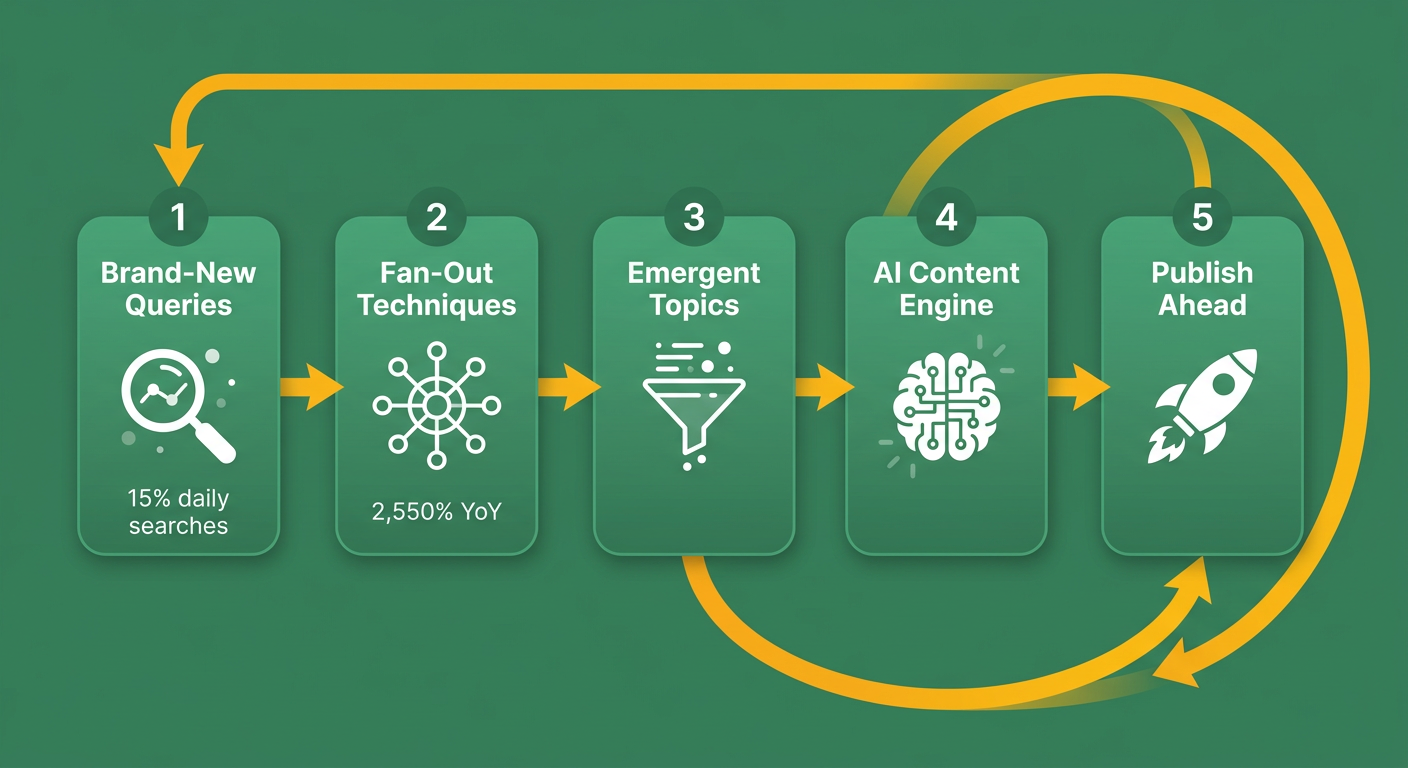
Refining query logic to catch emerging patterns
Generic seed lists pull the same tired long-tail variants everyone else finds. Topic-cluster queries map relationships between AI-centric terms rather than chasing exact-match permutations.
Modern SEO tools now provide metrics that flag which keywords will trigger AI Overviews versus traditional results. Filter your automated queries to prioritize terms with low AI Override likelihood—the queries where you still get actual clicks. AI Overviews reduce clicks to the top-ranking page by 58%, but tool-related and how-to queries with procedural steps hold up better.
Advanced API access lets you pull SERP feature data at scale. Run queries that exclude keywords already dominated by featured snippets or AI summaries. If the top result already has a zero-click answer box, skip it and move to adjacent terms where users still need to click through.
Prioritizing keywords AI Overviews won't steal
Ranking for a keyword that looks good in volume metrics but loses the majority of its organic traffic to automated search summaries is a waste of content budget. Score keywords by click retention probability, prioritizing queries that demand deeper, multi-step exploration.
Focus on queries that demand tools, downloads, or interactive elements AI can't replicate. A mortgage calculator still pulls traffic because ChatGPT can't file your application. Product comparison tables with live pricing, ROI calculators, and template libraries survive the AI Overview culling.
Emerging search terms represent a competitive edge. Because these queries lack historical data, traditional tools often overlook them. By configuring automated alerts to detect sudden spikes in search interest, teams can deploy targeted content immediately, securing top rankings before the broader market reacts.
Closing the loop from discovery to publication
The primary challenge is execution speed. Once a high-potential topic is identified, it must transition into production without delay. Automated systems route qualified terms directly into the drafting phase, aligning each topic with pre-configured audience profiles to maintain editorial momentum.
The approach isn't to review 200 keywords and manually pick 10. It's to define inclusion logic once—traffic floor, difficulty ceiling, AI Override filter—and let the system run. You're not building a list; you're building a machine that continuously publishes content at the speed of keyword discovery, not the speed of editorial meetings.
Human review comes after publication, not before. Real-time analytics track performance and flag declining posts for updates. The goal is velocity first, refinement second. Capture the query while competitors are still scheduling their content calendar meeting.
Measuring what actually moved
When you schedule Ahrefs automated queries to feed keyword opportunities into an AI content engine, the hardest question becomes: are we actually winning? Most teams track the wrong signals. They watch keyword count climb while traffic stays flat, or they celebrate rankings without connecting them to leads. The KPIs that matter for this pipeline are different from manual SEO because you're measuring discovery speed and publication velocity alongside traditional ranking lift.
Three metrics separate teams that justify their automation spend from those still guessing. Keyword-to-publish cycle time measures how many days pass between an automated query surfacing a new opportunity and a brand-voice article going live on your site. Indexation lag tracks how many hours or days Google takes to crawl and index each auto-published page—a metric that manual workflows rarely watch but that directly gates how fast rankings can start. Content ROI per keyword cluster ties organic traffic from newly published pages back to conversion events, proving that the keywords your Ahrefs queries discovered actually drive pipeline.
Setting up dashboards that show real wins
Most teams pipe Rank Tracker data into a spreadsheet and call it reporting. That misses the automation advantage entirely.
Real-time analytics tracking should surface pages published in the last 30 days alongside their current rankings and click-through rate. The CTR number matters more than position now. Recent Ahrefs research analyzing 300,000 keywords found that average CTR for informational queries dropped recently, with AI Overview keywords falling even harder. If your newly published content ranks #3 but the query triggers an AI Overview, you're capturing a fraction of the clicks a #3 position delivered two years ago.
Watch for keywords where AI Overviews appeared after you published. A page that held steady rankings but lost half its clicks overnight is a signal your dashboard should flag automatically, so your discovery logic can pivot toward queries that still send traffic—tool comparisons, implementation guides, case breakdowns—over pure definitional content that now lives inside AI-generated answer boxes. The ROI math changes when you segment by intent: pages tied to commercial-intent clusters carry a measurable lead value in your CRM, while definitional pages increasingly serve brand exposure without clicks. Track cost per lead saved, not just traffic volume.
Reporting cadence and stakeholder updates
Daily alerts feel urgent but drown teams in noise. Weekly summaries with month-over-month keyword discovery rate and ranking lift for AI-published pages keep stakeholders focused on the pattern, not the outliers.
A single-page weekly update should show four numbers: new keywords discovered by automated queries, articles published from those keywords, rankings achieved in positions 1–10, and attributed conversions from those pages. The conversion piece closes the loop. B2B SEO campaigns deliver an average ROI of 748%, but only if you can tie keyword wins to actual pipeline. When a stakeholder asks whether the automation is working, you point to the lead source field in your CRM, not a traffic chart.
One team using a similar provider's AI content tool reported a 72% traffic boost after optimizing existing pages with keyword insights. Real results from automated content engines show impression growth in the first 90 days and at scale, with gains compounding as the content library grows. The key is measuring content performance per keyword cluster—dwell time, scroll depth, and conversion rate for groups of related queries—rather than treating every keyword as an isolated event.
The reporting challenge most teams hit: data overload. Ahrefs returns thousands of keyword opportunities; your dashboard should filter for queries with publication intent—search volume under 500, low competition, and semantic overlap with your existing content clusters. Tracking discovery speed versus a manual baseline (how long it took to spot the same keyword types before automation) makes the ROI case clearer than absolute traffic numbers, especially in the first 90 days when your content library is still building authority.
FAQ
How do automated Ahrefs queries differ from manual keyword research?
Automated queries run on a schedule without requiring you to log into the dashboard, pulling keyword data, SERP features, and competitor insights via API. Manual research requires clicking through Keywords Explorer for each query. Automated workflows eliminate the time spent on repetitive SERP analysis, but the data depth is identical—you're getting the same keyword difficulty, traffic estimates, and SERP feature flags.
Can I connect Ahrefs automated queries directly to my content management system?
Yes, through Zapier, Make, or custom API integrations. You configure Ahrefs to send keyword data to a webhook, which triggers your CMS to create a content brief or draft. The integration is a one-time setup that requires intermediate technical skill—if you can connect two apps in Zapier and map data fields, you're 80% there.
What's the primary bottleneck when using automated queries with AI content engines?
Human review capacity. Once queries run on autopilot and AI drafts appear automatically, the constraint shifts to how quickly your team can review, refine, and approve content for brand voice and accuracy. 97% of teams review AI-generated content before publishing, so editorial bandwidth becomes the limiting factor.
How do I ensure AI-generated content from automated queries matches my brand voice?
Use a Persona Engine that learns tone and style from your existing blog. Tools like AnyPost.ai analyze your published articles to replicate voice patterns, so every AI-generated draft sounds like your team wrote it. The alternative—generic AI content—requires heavy editing that eliminates the speed advantage.
What KPIs should I track to measure the impact of automated Ahrefs queries?
Track keyword-to-publish cycle time (days from query discovery to live article), indexation lag (hours until Google crawls the new page), and content ROI per keyword cluster (organic traffic tied to conversion events). These metrics measure discovery speed and publication velocity, not just rankings.
Do automated queries work for zero-search-volume keywords?
Yes. Automated queries excel at capturing emerging topics with no historical data because they run continuously, detecting new search patterns before traditional tools index them. By the time a zero-volume keyword appears in manual research, competitors may have already published content.
How long does it take to see results from automated Ahrefs queries feeding an AI content engine?
Most teams see ranking lift for newly published pages within 30–90 days, with impression growth as the content library scales. The speed depends on how quickly Google indexes your auto-published content and how competitive your target keywords are.