
How AI Accelerates Content Repurposing Across Channels

Related Video
Watch: How to Repurpose Content Authentically Using AI by Wordtune
Why AI-Accelerated Content Repurposing Matters
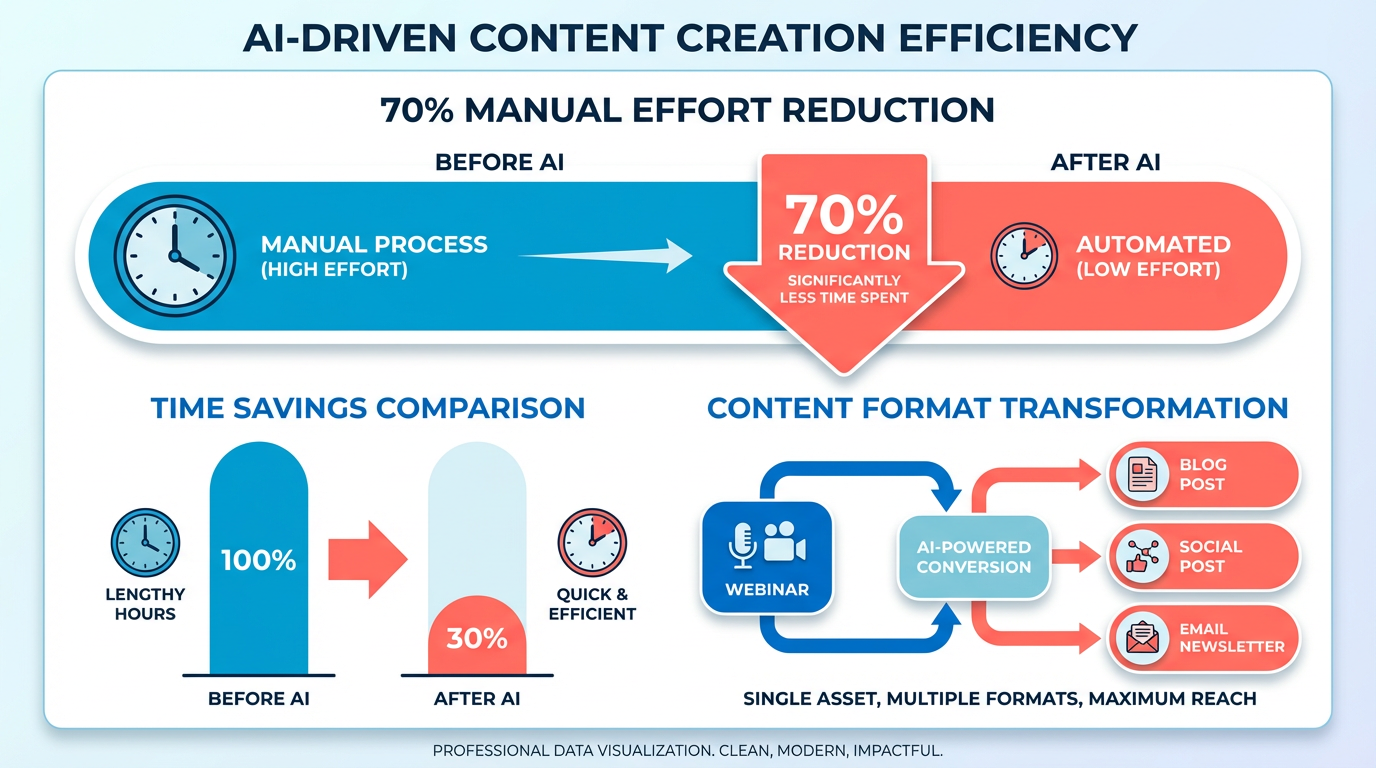
AI-driven content repurposing transforms how businesses adapt and distribute their messaging across platforms, offering measurable efficiency gains and strategic advantages. By automating tasks like format conversion, tone adjustment, and platform-specific optimization, AI reduces manual effort by up to 70% in high-volume workflows. This shift lets teams focus on strategy while ensuring content reaches the right audience in the right form. For example, a single webinar can become blog posts, social media clips, and email sequences in minutes-something that once took hours of editing and formatting.
Efficiency Gains and Cost Savings
Traditional content repurposing often involves fragmented tools and manual copy-pasting, creating bottlenecks. AI streamlines this by analyzing source material-like videos, articles, or podcasts-and generating channel-ready variations automatically. A B2B marketing team using AI tools like AnyPost.ai reports saving 30+ hours monthly by eliminating redundant tasks such as resizing images for Instagram or transcribing YouTube videos. This efficiency isn’t just about speed-it’s about scaling without sacrificing quality.
Consistency Across Channels
Maintaining a unified brand voice across platforms is a common challenge. AI ensures consistent messaging by applying predefined guidelines to every repurposed asset. For instance, a whitepaper’s core insights can be repackaged into LinkedIn articles, Twitter threads, and infographics, all while preserving the original intent. This consistency builds trust with audiences, who encounter a cohesive narrative regardless of the platform they visit. As mentioned in the Best Practices for Maintaining Brand Voice and Consistency section, defining clear brand guidelines is critical to achieving this alignment.
Who Benefits Most
While all marketers gain from AI repurposing, B2B marketers and content creators see the most value. B2B teams often deal with complex, long-form content like case studies or webinars, which AI can dissect into bite-sized, lead-generating assets. Content creators, meanwhile, use AI to adapt evergreen material for seasonal campaigns. A small agency, for example, boosted client retention by 25% after using AI to repurpose archived blog posts into YouTube shorts and carousel ads.
Real-World Applications
Consider a company hosting a podcast. AI tools extract key quotes, generate show notes, and create social media snippets-all while adapting the language for each channel’s audience. This multiplies the podcast’s reach without additional recording or editing. Another example: a SaaS brand turned a 45-minute webinar into 12 distinct assets, including a 5-minute explainer video, a 10-slide deck, and a 1,200-word blog post. These strategies not only save time but also maximize ROI on existing content, a topic explored in depth in the Measuring Impact: Engagement, Lead Generation, and ROI section.
Since integrating AI, our team delivers 3x more repurposed assets per month while keeping error rates under 1%.
By addressing inefficiencies and consistency gaps, AI-powered repurposing becomes a cornerstone of modern content strategies. Tools like AnyPost.ai embed this capability directly into workflows, letting businesses stay agile in dynamic markets. Building on concepts from the Multi-Channel Distribution Automation via AI section, these tools enable seamless cross-platform execution by automating localization and workflow integration.
Understanding AI-Driven Content Repurposing
AI-driven content repurposing transforms how marketers adapt and distribute content across channels. By automating repetitive tasks and enhancing decision-making, artificial intelligence reduces manual effort while ensuring consistent quality. Let’s break down how this works step by step, starting with the foundational role of asset discovery and tagging.
Asset Discovery and Tagging: The Foundation of Efficiency
AI identifies high-performing content by analyzing engagement metrics like views, shares, and time spent. It then automatically tags assets with metadata-such as keywords, themes, and audience segments-to streamline reuse. For example, a blog post about marketing trends might be tagged with “B2B strategies,” “2025 insights,” and “SEO tips.” This tagging system lets marketers quickly repurpose content for social media, email campaigns, or video scripts without starting from scratch.
The efficiency gains are significant. One company reported saving 50% of their content production time by using AI to sort and tag assets . Tools like AnyPost.ai automate this process, scanning repositories to prioritize evergreen content and flagging outdated material for updates. This ensures teams focus on what resonates with their audience.
Automating Format Conversion: Benefits and Challenges
Once assets are tagged, AI converts content into formats suited for different platforms. A long-form article might become a series of Twitter threads, a LinkedIn carousel, or a YouTube video script. Natural language processing (NLP) and machine learning adjust tone and structure automatically. For instance, a technical whitepaper could be distilled into a 60-second explainer video script while retaining key data points .
The benefits are clear: speed and scalability. Manual format conversion is time-consuming, but AI reduces production cycles from days to hours. However, challenges remain. Automated tools may struggle with nuanced creativity or brand-specific voice rules. A poorly converted script might lose the original’s persuasive edge, requiring human oversight. The solution? Use AI for initial drafts and refine them manually for critical campaigns. As mentioned in the Best Practices for Maintaining Brand Voice and Consistency section, strategic oversight ensures brand messaging stays aligned.
Personalizing Repurposed Content for Target Personas
Effective repurposing isn’t just about format-it’s about relevance. AI personalizes content by mapping assets to audience personas. consider a financial services firm repurposing a webinar into email sequences. AI analyzes user data to tailor messaging: a CEO-focused version highlights ROI, while a CFO-focused version emphasizes cost savings .
Strategies for success include:
- Dynamic templates: Pre-built frameworks that swap in persona-specific language.
- A/B testing: AI suggests variations for subject lines, CTAs, or visuals based on past performance.
- Persona clustering: Grouping audiences by behavior to scale personalization without overcomplicating workflows.
A real-world example: A B2B SaaS company used AI to repurpose a single podcast interview into 15 targeted assets, boosting lead generation by 30% . The key was aligning each version with the buyer journey stage-awareness, consideration, or decision.
Tools and Real-World Applications
SaaS providers like AnyPost.ai integrate these capabilities, offering end-to-end repurposing from asset discovery to format conversion. They also support multilingual content creation, adapting messaging for global audiences. Unlike generic providers, AnyPost.ai focuses on preserving brand voice while scaling output .
For teams new to AI, start small. Use AI to summarize articles for social media or generate draft outlines for repurposed videos. As confidence grows, expand to advanced use cases like real-time analytics-driven adjustments. Building on concepts from the Multi-Channel Distribution Automation via AI section, these workflows can integrate seamlessly into broader distribution strategies.
“We reduced content creation time by 40% using AI to repurpose webinars into blog posts and infographics. The tools handle the heavy lifting, but we still review for brand consistency.
By combining automation with strategic oversight, AI-driven repurposing becomes a powerful tool for maximizing content value. The next step? Experiment with workflows that balance speed and creativity to suit your team’s unique needs. For foundational guidance, refer to the Implementation Checklist: From Audit to AI Workflow Deployment section to structure your AI integration strategy.
Multi-Channel Distribution Automation via AI
AI transforms how brands distribute content by automating workflows across social media, email, blogs, and more. This automation relies on three core capabilities: localization, workflow integration, and format-specific optimization. Let’s break down how these systems operate.
AI-Powered Localization and Multilingual Repurposing
Modern AI tools analyze regional preferences and linguistic nuances to adapt content for global audiences. For example, natural language processing (NLP) identifies cultural references and adjusts tone to match local expectations without manual intervention. This isn’t just translation-AI restructures messaging to align with audience values, ensuring consistency in meaning while avoiding unintended misinterpretations.
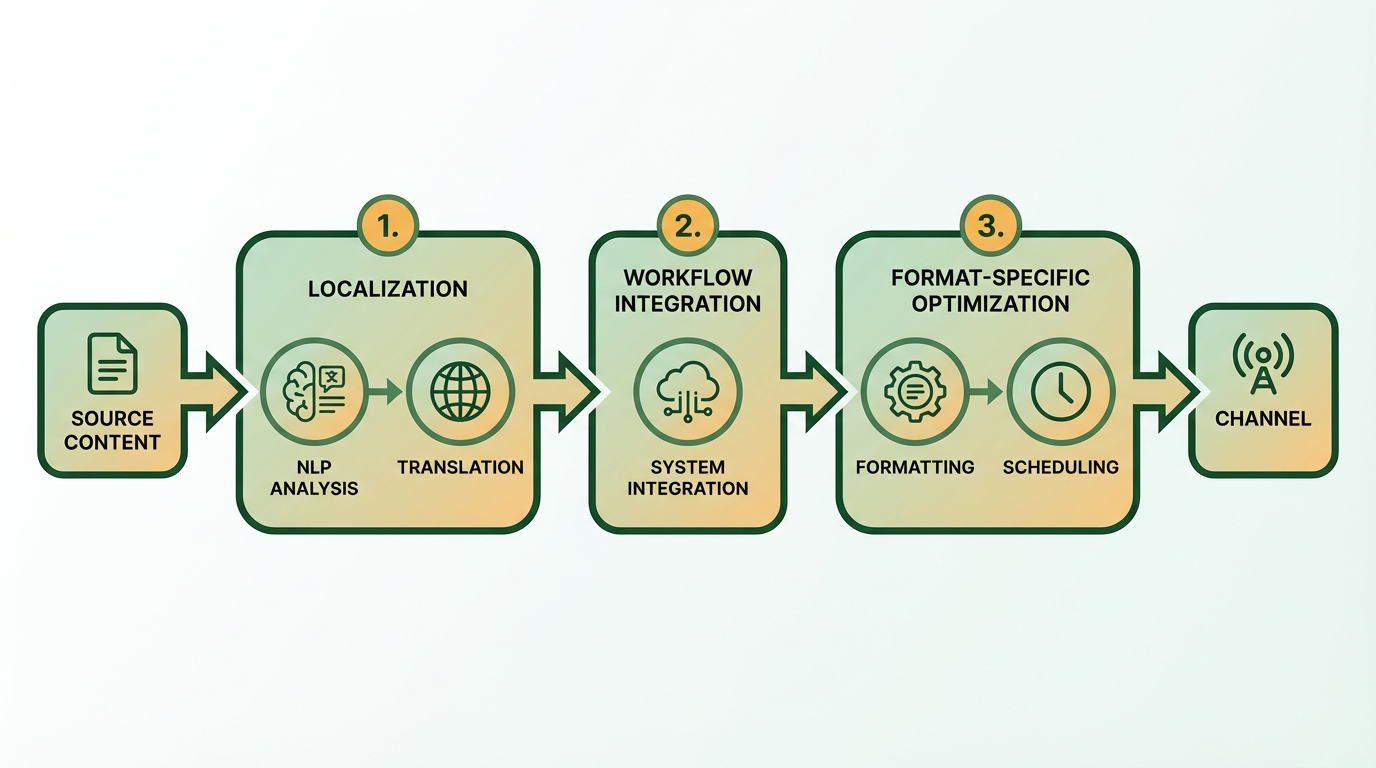
A key advantage is scalability. Instead of manually editing content for each region, AI can generate localized versions in minutes. One company saved 50% of its content production time by automating this process, repurposing a single blog post into 12 language-specific variants for international markets. The system also tracks performance data to refine future adaptations, prioritizing high-performing variations. Building on concepts from the Understanding AI-Driven Content Repurposing section, this process exemplifies how AI adapts content for diverse formats and audiences.
Integrating AI with Digital Asset Management
Digital asset management (DAM) systems become exponentially more powerful when connected to AI. Metadata tagging, powered by machine learning, lets AI automatically categorize visuals, videos, and text for reuse. For instance, a product image uploaded to a DAM might be labeled with “blue t-shirt,” “summer collection,” and “casual wear,” enabling AI to suggest it for relevant social media posts or email campaigns.
This integration streamlines workflows. Instead of searching through folders, teams use AI to fetch assets based on context. A marketing manager could request “a high-res image of our latest tech gadget for Instagram,” and the system would return pre-vetted options. This reduces delays and ensures brand guidelines are followed consistently.
Benefits, Challenges, and Best Practices
The benefits of AI-driven distribution are clear: time savings, reduced errors, and cross-channel consistency. Tools like AnyPost.ai automate scheduling, format conversion (e.g., turning blog posts into social media snippets), and analytics aggregation, letting teams focus on strategy rather than execution. However, challenges exist. Over-reliance on automation can lead to generic content if human oversight is missing. Brands must balance AI efficiency with creative input to maintain authenticity.
Best practices include:
- Using personas and blueprints (as described in the Best Practices for Maintaining Brand Voice and Consistency section) to guide AI outputs.
- Reviewing AI-generated drafts for brand voice alignment before publishing.
- Testing distribution schedules to avoid platform-specific pitfalls, like posting long-form content on Twitter.
For tools, AnyPost.ai stands out for its ability to sync with existing DAMs and automate repurposing across 15+ formats, from LinkedIn articles to podcast summaries. Unlike other providers, it prioritizes transparency in workflow customization, letting teams tweak AI parameters for niche industries.
A B2B firm using AI for content repurposing reported a 40% reduction in creation time by converting webinars into whitepapers, infographics, and email sequences. The system identified recurring themes in customer queries and generated targeted content to address them, boosting engagement by 25%. As mentioned in the Measuring Impact: Engagement, Lead Generation, and ROI section, such metrics highlight the tangible value of AI-driven strategies.
In practice, AI isn’t a replacement for human creativity-it’s an amplifier. By handling repetitive tasks, it frees teams to focus on innovation, while ensuring messages reach the right audiences in the right formats. The key is to start small, test workflows, and scale as confidence grows.
Measuring Impact: Engagement, Lead Generation, and ROI
Measuring the impact of AI-accelerated content repurposing requires a structured approach to tracking engagement, lead generation, and ROI. These metrics help you understand how effectively your content resonates with audiences, drives conversions, and justifies the time and resources invested. Let’s break down each component and explore actionable strategies for evaluating success.
Tracking Engagement for Repurposed Content
Engagement metrics reveal how audiences interact with your repurposed content across platforms. Start by monitoring social media interactions like likes, shares, comments, and saves. For example, a short-form video repurposed from a blog post might generate higher shares on TikTok, while a LinkedIn carousel version could drive more comments. Use platform-native analytics tools to track these interactions and compare performance across formats.
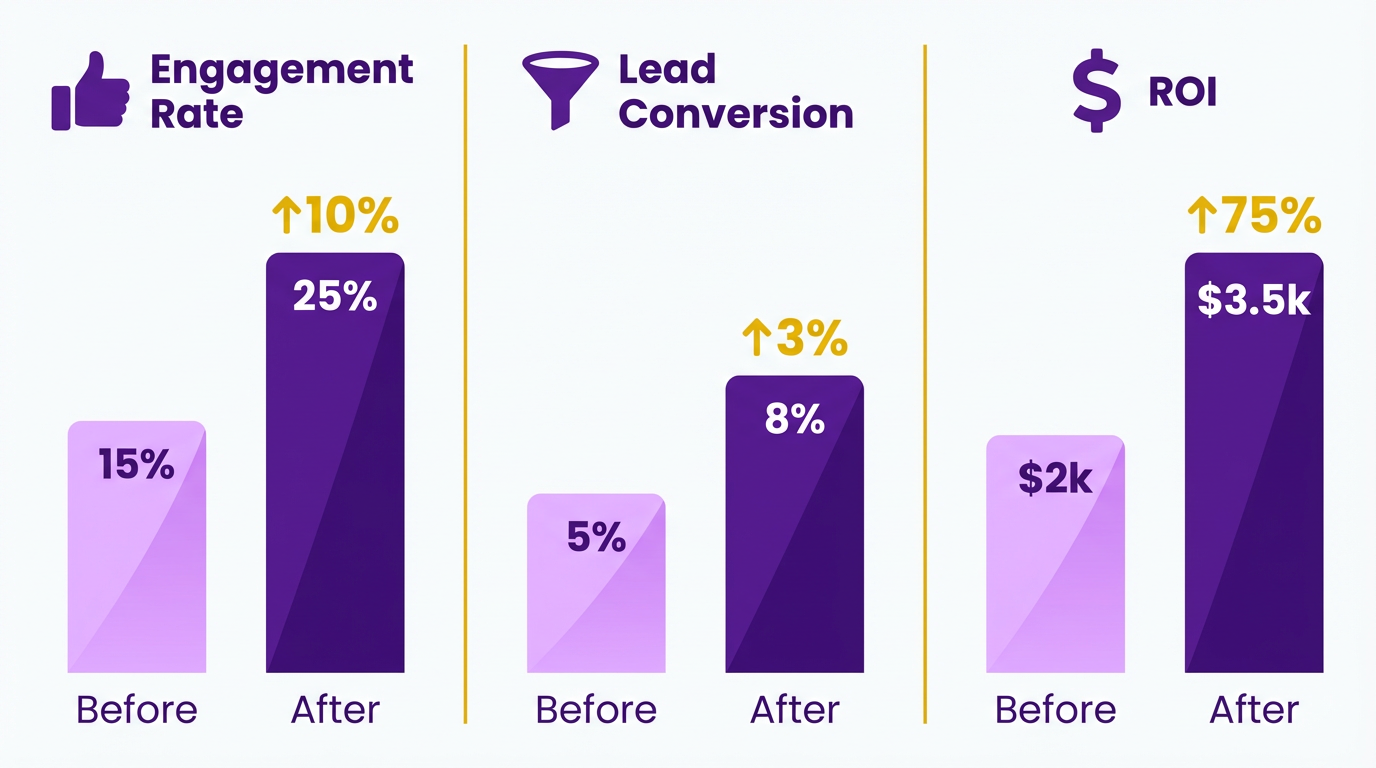
Time spent on page and bounce rate are critical for website-based content. If a repurposed article or landing page keeps users engaged longer than the original, it signals effective adaptation. Email open and click-through rates also matter: repurposed newsletters or segmented content should show improvements over generic campaigns. AI tools like AnyPost.ai streamline this process by automatically generating platform-specific content and logging engagement data in centralized dashboards, as explained in the Understanding AI-Driven Content Repurposing section.
Strategies for Lead Generation with AI-Repurposed Content
Repurposed content should include clear calls-to-action (CTAs) to capture leads. For instance, a webinar recap turned into an infographic might include a link to a related eBook, while a podcast snippet could drive traffic to a scheduling tool. Track conversion rates by embedding unique UTM parameters or tracking links in each repurposed asset.
Lead volume and quality are equally important. Use CRM integrations to monitor how many repurposed content pieces result in form submissions, demo requests, or newsletter signups. Cost per lead analysis helps compare the efficiency of AI-generated content versus manually created assets. For example, a company using AnyPost.ai to repurpose case studies into social posts might see a 30% reduction in lead acquisition costs by targeting niche audiences with tailored messaging, building on concepts from the Best Practices for Maintaining Brand Voice and Consistency section.
Calculating ROI: Challenges and Best Practices
ROI calculations for AI-accelerated content often face two challenges: attribution complexity and long-term value estimation. If a repurposed blog post drives traffic months after publication, linking it to revenue requires advanced analytics. Pair AI-powered content tools with CRM data to map customer journeys and assign revenue shares to specific assets.
A best practice is to compare content production costs before and after AI adoption. Manual repurposing might require 10 hours per asset, while AI tools reduce this to under 2 hours. Multiply this time savings by your team’s hourly rate to quantify efficiency gains, as outlined in the Implementation Checklist: From Audit to AI Workflow Deployment section. Additionally, calculate revenue lift from campaigns using AI-generated content. A B2B firm might find that repurposed whitepapers converted 15% more leads than static reports, directly boosting quarterly sales.
Tools for Measuring Impact
AnyPost.ai offers built-in analytics to track engagement and lead generation across repurposed assets. Its dashboard aggregates data from social platforms, websites, and CRMs, letting you filter by content type or campaign. For deeper insights, integrate with tools like Google Analytics or HubSpot to monitor traffic sources and conversion funnels.
Case Study: Scaling Content with AI
One company used AnyPost.ai to repurpose webinars into social clips, blog posts, and email threads. Within three months, their social engagement rose by 40%, and lead generation from these assets increased by 25%. By analyzing which formats drove the most conversions, they reallocated resources to focus on high-performing content. Another example involves a SaaS brand that repurposed customer testimonials into video testimonials using AI. This boosted email open rates by 18% and reduced support queries by 12%, proving the value of strategic content reuse.
Final Steps
To maximize impact, revisit your metrics regularly. Adjust repurposing strategies based on what resonates-whether it’s video for Gen Z audiences or in-depth guides for enterprise clients. AI tools like AnyPost.ai make it easier to iterate quickly, ensuring your content stays fresh and effective. By linking every repurposed asset to measurable outcomes, you’ll build a data-driven content strategy that scales.
Best Practices for Maintaining Brand Voice and Consistency
Maintaining brand voice and consistency in AI-accelerated content repurposing requires intentional strategies and the right tools. Start by defining clear brand guidelines that outline your tone, style, and messaging priorities. For example, a company with 100 detailed personas and 10s of blueprints ensures every AI-generated piece mirrors the original creator’s intent. These personas act as guardrails, specifying language preferences, emotional tone, and audience-specific adjustments. Without this foundation, AI tools risk producing generic or off-brand content.
Establish Centralized Brand Guidelines
Centralized brand guidelines are your AI’s roadmap. Document rules for terminology, prohibited phrases, and preferred jargon. Implementation Checklist section highlights the importance of starting with a content audit to identify gaps in existing guidelines, which directly informs how you structure AI training. For instance, if your brand avoids overly technical language, embed this rule into your AI’s training. Tools like AnyPost.ai let you upload style guides and sample content to train models, ensuring outputs align with your brand’s DNA. One company using 100+ personas reported significantly faster editing times because the AI already adhered to their documented preferences.
The articles aren’t just AI slop. Our personas and blueprints keep the tone sharp and consistent.
To centralize these guidelines, store them in a shared repository accessible to your team and AI systems. Use AnyPost.ai’s blueprint feature to map out how each persona interacts with different content formats-social posts, blog intros, video scripts-so the AI adapts without losing core messaging.
Train AI Models with Feedback Loops
AI models need continuous training to reflect evolving brand priorities. Why AI-Accelerated Content Repurposing Matters section explains how iterative improvements in AI workflows lead to measurable efficiency gains, a principle that applies to refining brand voice. Start by feeding your AI a dataset of high-quality, on-brand content. AnyPost.ai’s training process emphasizes iterative refinement: after generating drafts, teams review outputs, flag inconsistencies, and use that feedback to improve the model. For example, if an AI-generated social post feels too formal, update the training data with examples of casual, successful posts to recalibrate its tone.
A key strategy is to build a feedback loop where human reviewers score AI outputs on a 1–5 scale for brand alignment. Over time, the model learns to prioritize high-scoring patterns. One team reduced revisions by 40% after implementing weekly feedback sessions, tweaking their AI’s understanding of what “voice consistency” meant in practice.
Audit Outputs and Adjust Regularly
Even the best-trained AI requires oversight. Schedule monthly audits to compare AI-generated content against brand standards. Measuring Impact section outlines how tracking metrics like keyword usage and sentiment scores helps quantify brand alignment. Look for subtle drifts in tone or messaging that might not be obvious during initial reviews. AnyPost.ai’s reporting dashboard helps track metrics like keyword usage and sentiment scores across repurposed content, making it easier to spot inconsistencies.
For instance, a marketing team noticed their AI was overusing a specific slogan in blog posts. By adjusting the blueprint to limit slogan frequency, they preserved brand recognition without overwhelming readers. Regular audits also help ensure AI tools adapt to new brand initiatives, like a refreshed mission statement or updated product lines.
Case Study: Scaling Consistency with Personas
A company repurposing 50+ pieces of content monthly used 100+ personas to maintain voice across teams. Initially, their AI produced mixed results: 30% of outputs needed heavy edits. By refining personas with detailed tone examples and updating blueprints weekly, they reduced manual editing to under 10%. The AI now generates on-brand social posts, email subject lines, and video scripts with minimal oversight.
In another scenario, a team using AnyPost.ai’s blueprint templates discovered their AI was misapplying humor in technical content. After removing comedic examples from their training set and retraining the model, the AI produced more professional, consistent outputs across all channels.
By combining structured guidelines, active training, and regular audits, brands can use AI’s speed without sacrificing identity. Tools like AnyPost.ai provide the infrastructure to embed these practices, but success ultimately depends on your team’s commitment to refining the process. Start small: document one persona, train the AI on a single content type, and scale up as confidence grows.
Implementation Checklist: From Audit to AI Workflow Deployment
- Conduct a Content Audit Tailored for AI Integration. Start by inventorying your existing content assets, categorizing them by type (blog posts, videos, social media posts), engagement metrics, and audience reach. Use analytics tools to identify high-performing content and note gaps where repurposing could fill unmet needs. For example, if your YouTube channel has underperforming videos, flag them for AI-driven repurposing into shorter clips or transcripts. Prioritize content with strong engagement but low reach-these assets offer the most ROI when amplified across new channels.
- Design an AI-Driven Workflow with Clear Objectives. Map out how AI will streamline each stage of repurposing, from summarization to platform-specific adaptation. Begin by training your AI tools on your brand’s voice and style guidelines to ensure consistency. As mentioned in the Best Practices for Maintaining Brand Voice and Consistency section, defining clear brand guidelines is crucial for this step. Automate repetitive tasks like generating social media snippets from blog posts or creating email newsletters from webinar recordings. Integrate AI tools directly with your CMS and analytics platforms to create a seamless workflow-this reduces friction between content creation and distribution.
- Select Tools That Align with Your Repurposing Goals. Choose AI platforms based on specific features like multilingual support, format conversion (e.g., video to text), or cross-channel optimization. AnyPost.ai, for example, offers batch processing for repurposing large content libraries while maintaining SEO relevance. For video-heavy workflows, prioritize tools that extract key moments from long-form content automatically. If your team lacks in-house AI expertise, opt for platforms with intuitive interfaces and templates-this lowers the learning curve and speeds up adoption.
- Validate and Refine Your AI Output for Quality. Run a pilot test on a small content batch to evaluate accuracy and relevance. Compare AI-generated repurposed assets against manually created versions to identify gaps. One company saved 50% of their editorial time by refining their AI’s output rules after initial testing, ensuring summaries retained critical context. Use human reviewers to flag errors in tone or factual accuracy, then update the AI’s training data accordingly. Regularly audit outputs to maintain consistency as your brand evolves, aligning with strategies outlined in the Best Practices for Maintaining Brand Voice and Consistency section.
- Scale and Optimize Based on Performance Data. Track metrics like engagement rates, time saved, and content reach improvements after deployment. Building on concepts from the Measuring Impact: Engagement, Lead Generation, and ROI section, adjust your workflow to prioritize formats and channels with the highest returns. For example, if TikTok repurposed clips outperform others, allocate more AI resources to video editing tools. Update your AI models quarterly with new data to keep outputs aligned with audience preferences.
Frequently Asked Questions
1. What is AI content repurposing, and how does it work?
AI content repurposing uses artificial intelligence to automate the transformation of source material (e.g., articles, videos, podcasts) into platform-specific content. It analyzes the original content, identifies key themes, and generates tailored variations for different channels like social media, blogs, or emails. Tools like AnyPost.ai and Wordtune streamline this process by converting formats, adjusting tone, and optimizing for audience engagement. For example, a webinar can become a blog post, a Twitter thread, and an infographic in minutes.
2. How much time can AI save in content repurposing workflows?
AI can reduce manual effort by up to 70%, according to the article. Tasks like transcribing videos, resizing images, or formatting text for specific platforms are automated, saving teams significant hours. A B2B marketing team using AI tools reported saving 30+ hours monthly. This efficiency allows creators to focus on strategy rather than repetitive tasks.
3. How does AI ensure brand consistency across different platforms?
AI applies predefined brand guidelines to all repurposed content, ensuring the tone, messaging, and style align with the brand’s identity. For instance, a whitepaper’s core insights can be repackaged into LinkedIn articles or Twitter threads while preserving the original intent. This consistency helps build trust with audiences who encounter a cohesive narrative across platforms.
4. Which industries or roles benefit most from AI-driven content repurposing?
B2B marketers and content creators see the most value. B2B teams often handle complex, long-form content like case studies or webinars, which AI can break down into lead-generating assets. Content creators use AI to adapt evergreen material for seasonal campaigns or trending topics. The technology is particularly useful for scaling content production without sacrificing quality.
5. Can AI repurpose content for all types of platforms?
Yes, AI can optimize content for diverse platforms by adjusting formats and lengths. For example, a YouTube video can be converted into Instagram Reels, a blog post, or an email sequence. AI tools analyze the source material and generate variations tailored to each platform’s requirements, ensuring the content resonates with the target audience.
6. What are the limitations of AI in content repurposing?
While AI excels at efficiency and consistency, it may lack the nuanced creativity or strategic insight that human teams bring. For instance, AI might struggle with highly specialized industry jargon or emotional nuance in storytelling. Human oversight is still critical to ensure the repurposed content aligns with broader brand goals and maintains authenticity.
7. How do I choose the right AI tool for content repurposing?
Look for tools that integrate seamlessly with your workflow and support your specific platforms (e.g., social media, email, blogs). Evaluate features like tone customization, format conversion, and analytics. Tools like AnyPost.ai and Wordtune are popular for their automation capabilities, but always test free trials or demos to ensure they meet your team’s needs without forcing a one-size-fits-all approach.