
How an AI API Automates Content Creation and Media Management

Quick Answers
- AI use in content operations is now common, but adoption alone has not removed the manual steps after drafting.
- The bigger productivity leak sits after the draft, where publishing for local visibility and backlinks still happens by hand across scattered tools.
- An API-first model can run generation, SEO, media, and distribution as connected programmatic steps from a single authenticated call.
- Bouncing between separate drafting, SEO, scheduling, and directory tools rebuilds the exact fragmentation AI was supposed to kill.
- The competitive edge has moved to the front and back ends of the workflow, because the raw model in the middle is now a commodity.
- A persona or voice layer can use a team's existing material to mirror cadence, vocabulary, and structure instead of defaulting to a flat house style.
- An SEO module can build keyword optimization, search-intent headings, semantic HTML, and internal and external links into content during a connected generation pass.
The stage that eats your afternoon
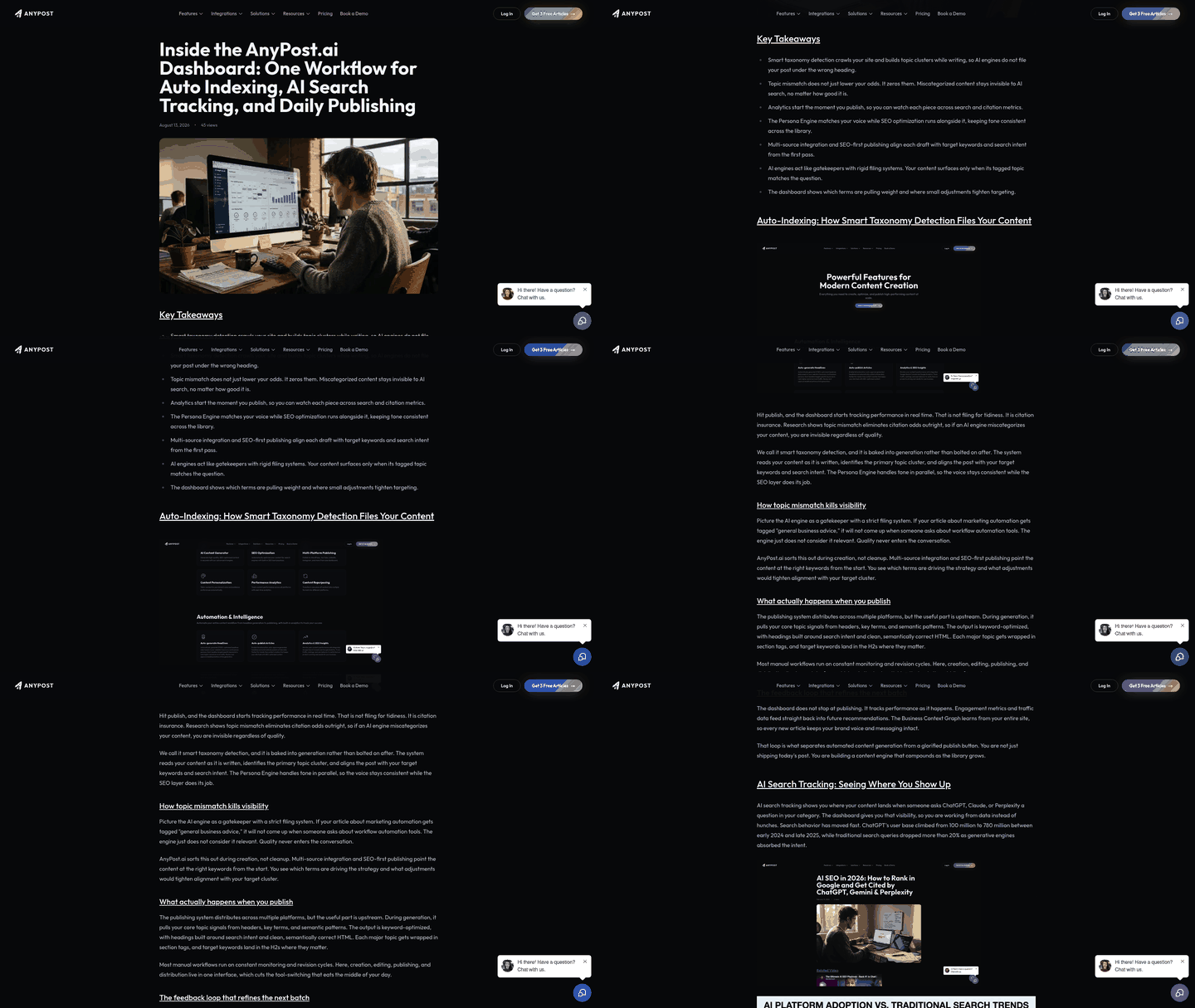
The part most teams underestimate isn't writing the content. It's everything after. Generating a draft is easy now. Getting that draft published where it actually earns local visibility and backlinks is still manual labor, and that's the stage we watch swallow whole afternoons.
Adoption is no longer the main question. Many content teams already use AI for research, analysis, and repetitive drafting tasks. So the question clients bring us isn't whether to use AI for content. It's why the results still feel manual once the draft is done.
Why stitching separate tools costs more than it saves
The hidden tax is context switching. Every time the workflow fragments, focus and momentum leak out. Your writer jumps from a drafting tool to an SEO checker to a social scheduler to a directory submission form, and you pay that tax on every single piece.
Point-tool comparisons often show the same pattern without meaning to. Each specialized tool tends to win at a different job. One tailors posts per channel, another recycles content, another handles social listening. Assemble a stack of best-of-breed point tools and you rebuild the fragmentation the AI was meant to remove.
An API-first model can collapse that. One authenticated call can orchestrate generation, SEO, media, and distribution together. The argument for consolidation is about output, not just tidiness.
What an API automates that a chatbot can't
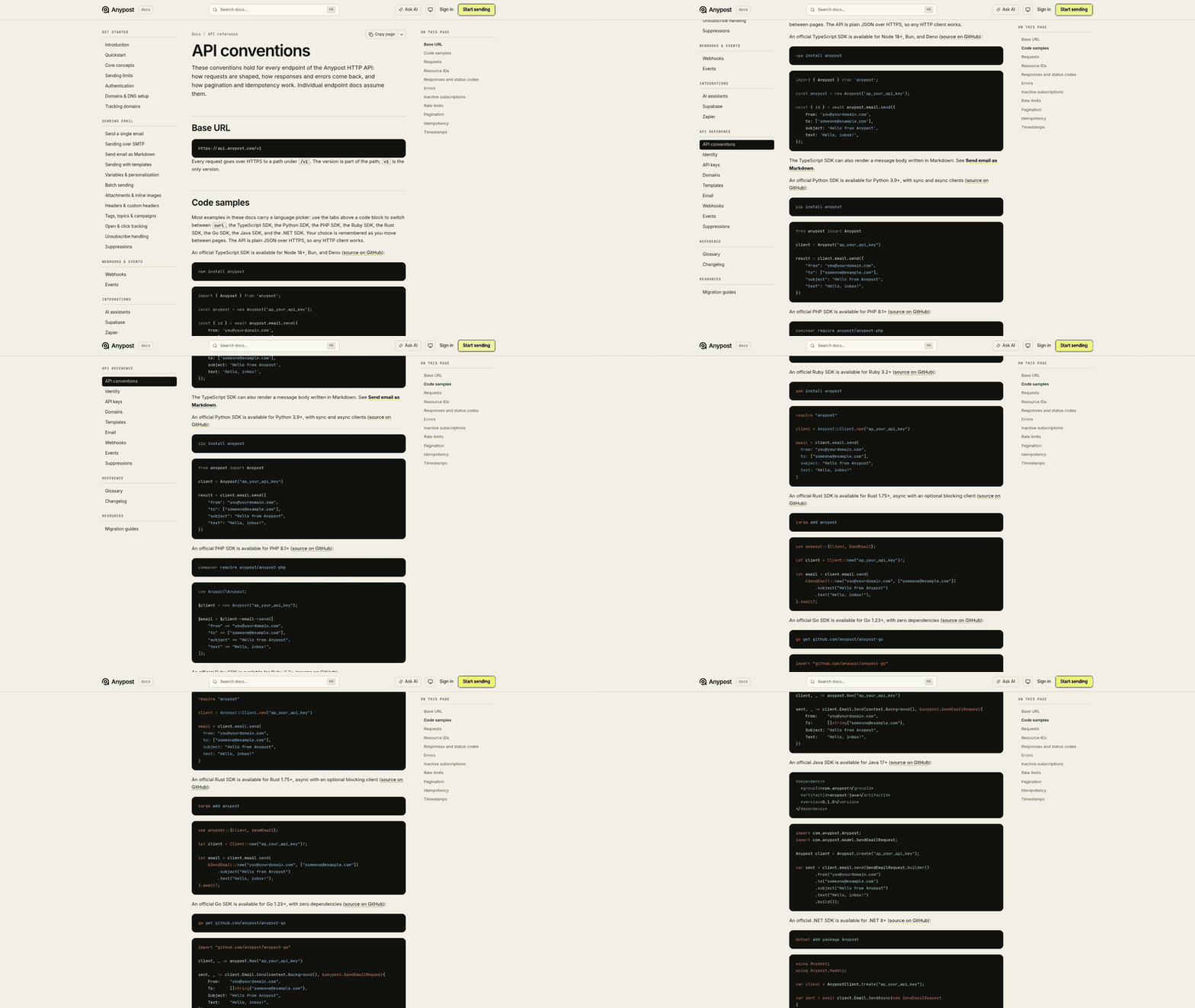
API-first content: a setup where generation and publishing run as connected programmatic steps, not copy-paste between apps. The draft, the SEO pass, the image, the backlink placement, and the local directory submission can all fire from the same workflow.
This is where the opportunity sits. Many tools stop at the draft. Some platforms push each article further, into automated backlink and local-visibility publishing, so a single piece keeps working after you generate it. That last mile separates content that sits on your blog from content that pulls traffic through directories and citations.
There's a genuine debate worth naming. One camp says the edge is structured input, feeding AI cleaner source material. Another says the edge is downstream, the recycling and distribution smarts. Both are right. The raw model in the middle is commoditized. The advantage now lives at the front and back ends, and the back end is where publishing automation earns its keep.
Where humans should stay in the loop
Automation handles the mechanical bulk: generation, formatting, scheduling, publishing. What's left is judgment. Strategy, brand voice, and final sign-off stay with your team.
We're blunt about this. AI extends human creative work, it doesn't replace it. If your content lives or dies on nuanced brand storytelling, keep a human editor on the approval gate. But hand the repetitive publishing grind to the API and reclaim those hours. For the specific strategies, our guide on how to automate content creation walks through them.
Core Components of the AnyPost.ai AI API
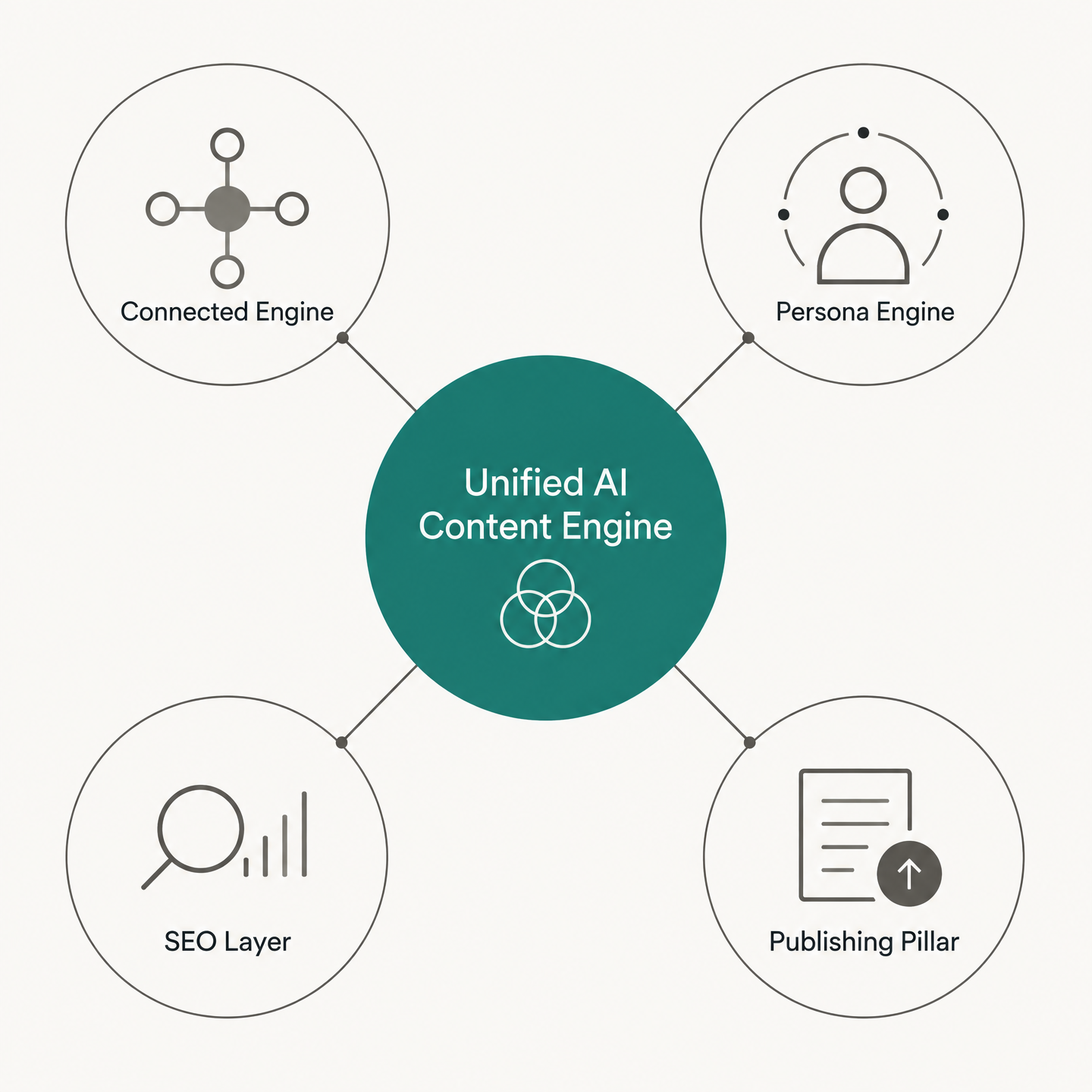
An API-driven content platform may orchestrate several services as one connected chain rather than a stack of separate tools. Content generation is the first link, but the handoff between links decides whether you end up with a published, ranking asset or another draft rotting in a queue.
Modern AI content work leans on models that can hold semantic relationships and stay coherent across a long article. That matters, because a blog post and a short caption need very different handling. A connected content engine can generate SEO-optimized long-form articles and reshape them into social posts and carousels, so both come out sounding closer to your style.
How the Persona Engine matches your voice
Tone-matching is where most AI content falls apart. Generic input, generic output. A persona engine can work from your existing material, using it as reference so the model mirrors your cadence, vocabulary, and structure instead of defaulting to a flat house style.
Think of it as feeding the system samples of how you already write, then measuring every new piece against that signature. The goal isn't to replace your judgment. The relationship between writers and these tools has shifted from plain automation toward augmentation, where the model extends what you'd write anyway rather than papering over it.
What the SEO module actually produces
The SEO layer can bake optimization into the content itself, not vague advice on the side. You can get keyword-optimized copy, search-intent-aligned headings, clean semantic HTML, and relevant internal and external links built in before the piece goes live.
The useful part is knowing you're chasing keywords you can actually win. A keyword research component may surface low-difficulty, high-intent keywords for your niche, and a competitive analysis step can study the top-ranking articles to inform a structure that can compete. Because these optimizations happen during generation, the work lands in the same pass instead of becoming a separate audit you run later in another tab.
The publishing pillar that changes the math
This is the pillar often skipped. Backlink automation and multi-platform publishing can take a finished, optimized article and distribute it outward. A workflow can be configured to build and execute backlinking strategies and syndicate the content to the platforms where your audience already looks, so a single article starts earning visibility.
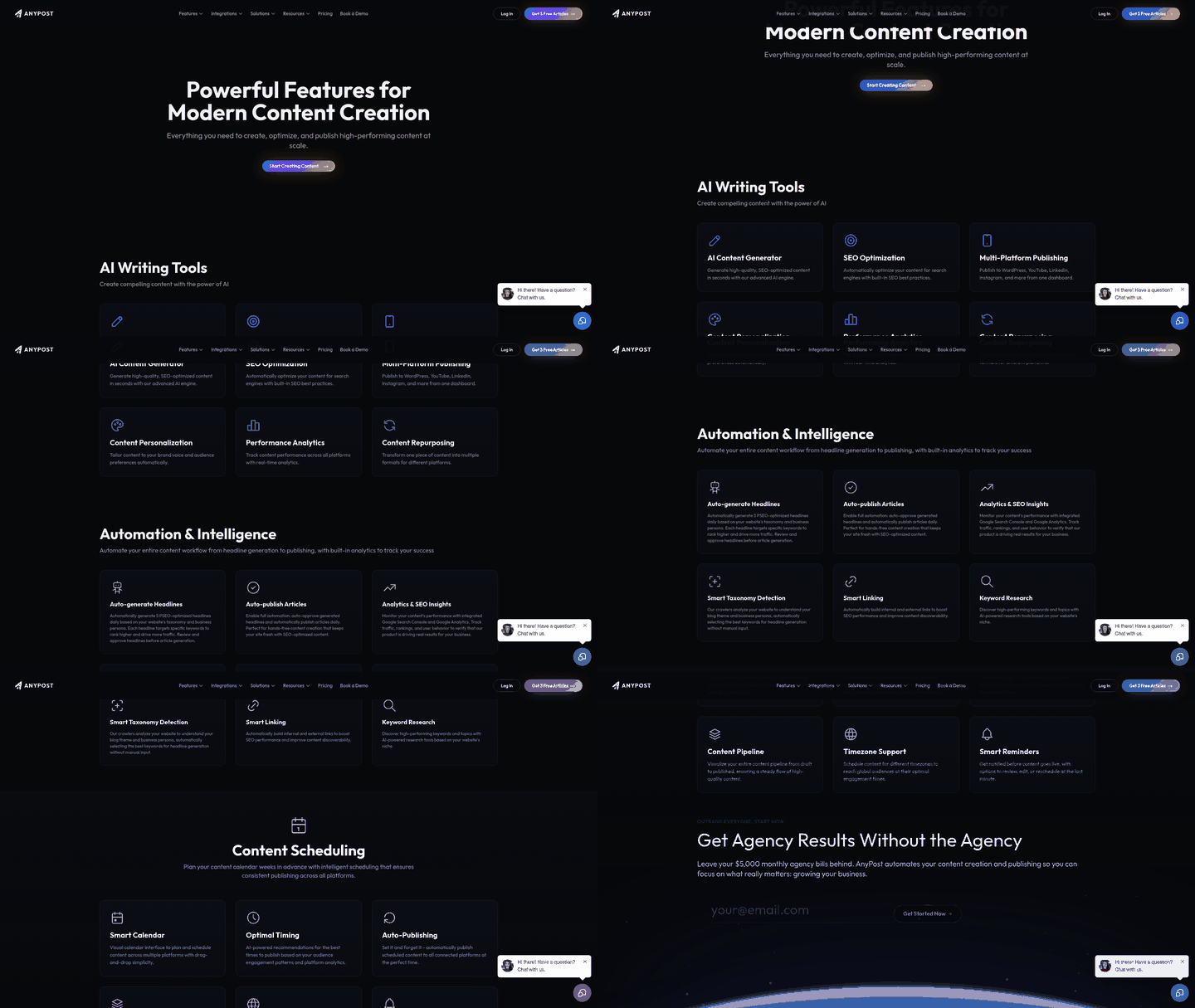
A media layer can support this. From your content, it can produce social carousels and posts, and it can generate AI avatar videos, so each destination gets a format that fits it instead of the same paragraph pasted everywhere.
This pillar also reshapes how teams budget attention. Without it, every finished article spawns a new queue of chores: resize the visual, write the post, log into the platform, submit the citation, check whether the placement went live. With it, those actions become part of the content job itself.
Skip the backlink and publishing pillars only if you're producing content purely for an internal wiki or a gated audience. For any local business chasing search visibility, that final stage is the whole point.
Automating the Content Creation Workflow
The workflow most teams build stops one stage too early. They nail content generation, then hand every published draft to a person who copies, pastes, and reformats it across channels. That manual tail is where the time goes.
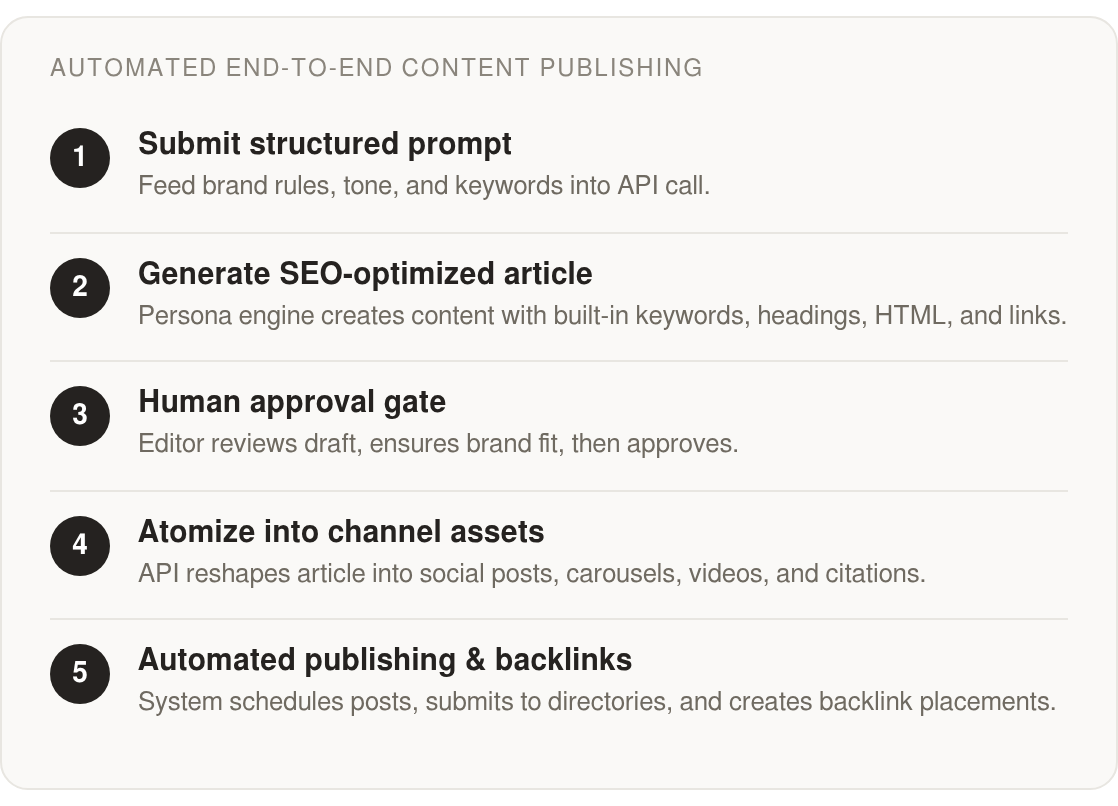
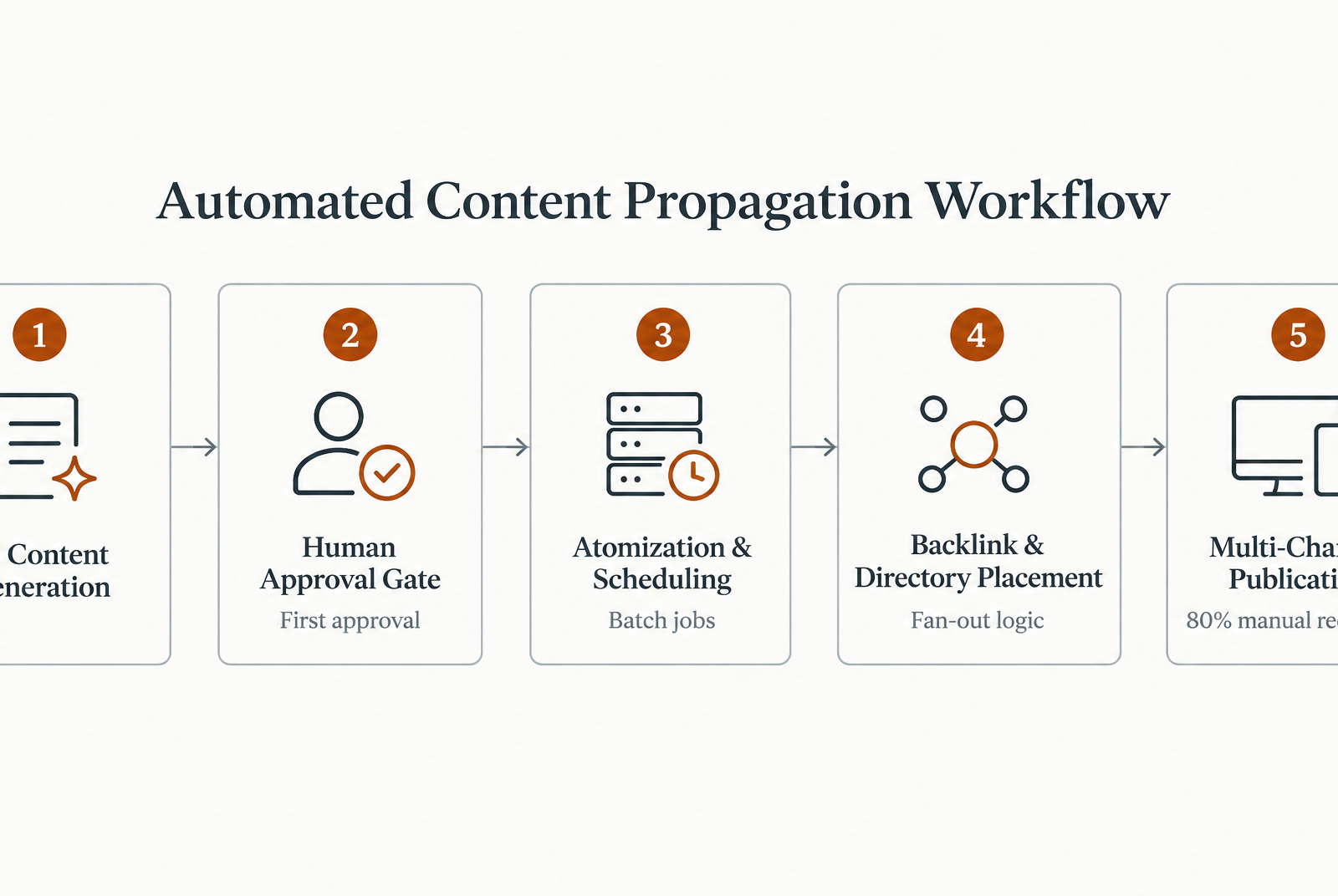
The better pattern designs the workflow so a single approved article fans out on its own. Generation produces the asset, then automation handles atomization, scheduling, and the part almost nobody automates: backlink and local-directory placement.
Designing prompts that stay on-brand at volume
The prompt is only half the equation. Structured input matters more than which model you pick. When your content lives as modular components rather than one monolithic block of HTML, the AI pulls from clean sections instead of parsing a wall of text.
Feed it your tone rules, approved terms, and messaging frameworks as a persistent constraint set, not a one-off instruction. A prompt that says "be professional" produces the generic corporate voice that makes AI posts easy to spot. Documented brand rules produce output that reads like you.
That's why capturing your brand's DNA up front pays off. A business context reference built from crawling your site can keep every article sounding consistent with your established voice. If your brand avoids jargon and superlatives, the constraints filter those out on every run, no matter who launched the job.
Batch generation without losing quality
Atomization is the multiplier. A 2,000-word blog post can become a five-takeaway LinkedIn carousel, an X thread with a punchy hook, a short-form video script, and an Instagram caption with an image prompt. One asset, a post for every platform you publish on.
Schedule these as batch jobs triggered by approval, not by hand. Some community workflow examples describe generating and publishing across multiple platforms while removing much of the mechanical drafting, formatting, and timing work. The remaining share is judgment, and that's where humans belong.
Run quality checks inside the batch. Readability scoring, plagiarism screening, and an SEO audit should gate the asset before it ships, not after the complaints roll in.
Where the human approval gate should sit
Two common approaches look like they clash here. One workflow requires double human approval before anything publishes. Another auto-places an approved post into a platform queue, so one-click cross-platform publishing pushes the asset to Instagram, X, and LinkedIn without a second round of manual formatting.
They only look opposed. The human gate belongs at first approval. After that, automation should propagate the asset everywhere without re-gating each copy. Approve once, propagate everywhere.
That principle gives the workflow its shape. Atomization creates the channel-specific versions, and automatic queue placement moves them into the right publishing lanes. Most setups use that pattern only for social channels.
Extend the same fan-out logic to backlink submissions and local business directories, and every approved article becomes an asset that plants itself where local buyers actually search. The propagation infrastructure is already built. Only the destination list is missing. For the full playbook, our guide on automating content creation covers it.
Media Management & Multi‑Platform Publishing Automation
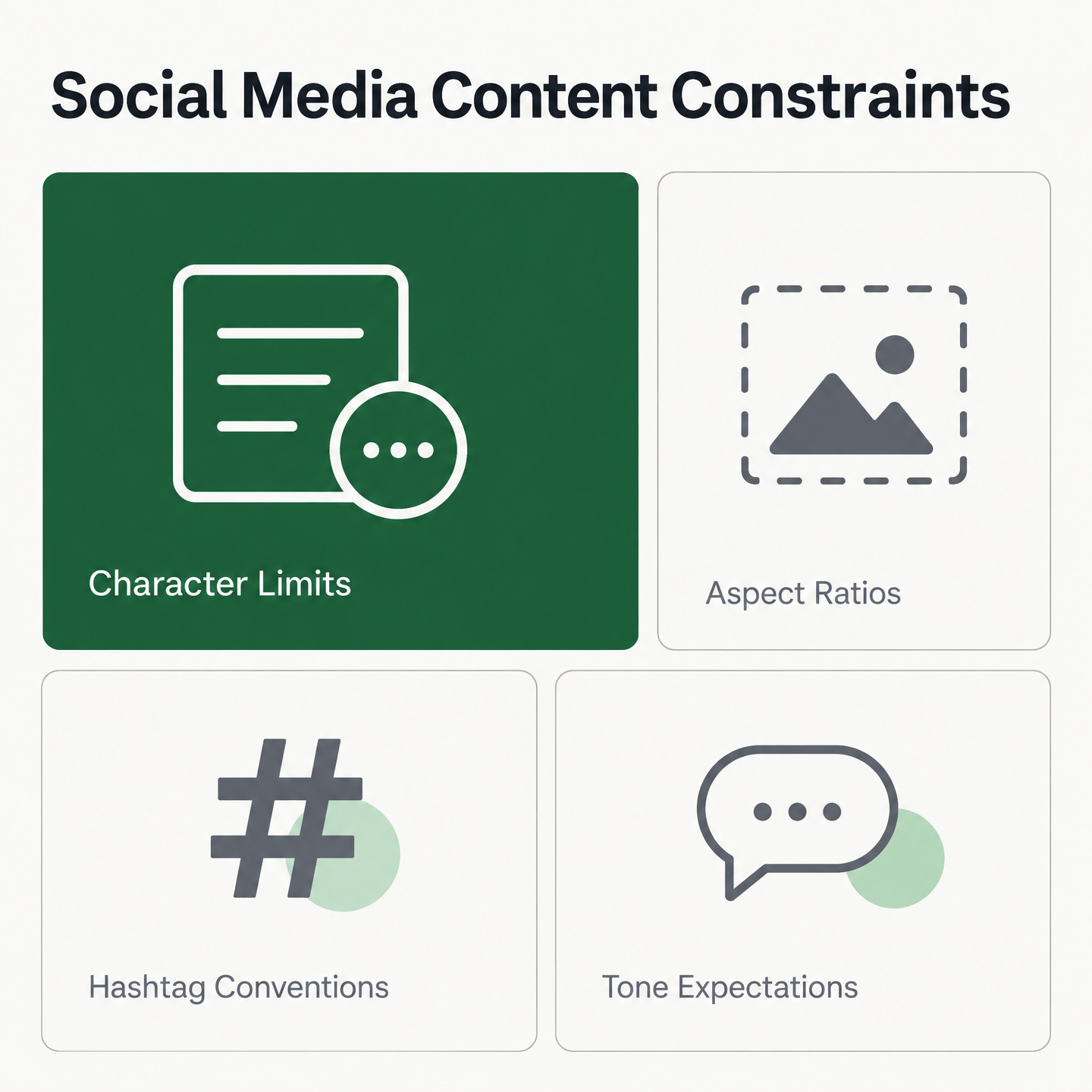
One approved article should never stop at your blog. The mechanics to fan it out already exist. Generation produces the asset, then atomization reshapes it for every channel it belongs on. The reshaping isn't cosmetic either. Each destination has its own character limits, aspect ratios, hashtag conventions, and tone expectations that a raw copy-paste ignores.
That difference is exactly where manual effort piles up. A post that works on LinkedIn falls flat on TikTok, where short and visual wins. A headline that earns clicks in an email subject line reads as spam in a push notification. Formatting for those differences by hand is where teams lose whole afternoons, and it's the first step to get skipped when a deadline tightens.

Approve once, then let it propagate
The key call is where review happens. Put approval too late and your team ends up checking the same idea over and over in slightly different formats. Put it too early and rough or incomplete assets slip into public channels before they're ready.
Place the review where it has the most leverage: after the core asset is complete and before distribution begins. From there, automation can adapt the asset for each destination, including regional language choices and channel-specific conventions, without asking a person to reopen the work for every variant.
The missing destinations are backlinks and local directories
Many tools already handle the two hard parts of propagation: turning one asset into many formats, and sending each format to the right queue at the right time. Then they stop at social channels. That's the space some platforms build into.
The same logic that turns an article into a carousel can support citation and backlink workflows. The article is already approved, its metadata is already known, and its target topic is already mapped. Extending those signals into local-visibility publishing is what lets the asset support search ranking, not just feed activity.
For a local business, this matters more than another Instagram post. A consistent set of directory citations and topical backlinks can help improve visibility in map results and organic search. Some platforms wire that into the same review-to-distribution flow, so the assets that become social posts also seed your off-page footprint automatically. If you want the mechanics of the broader chain, our guide on automating content creation lays it out.
Consolidation is a productivity argument, not just convenience
Fragmentation rarely looks expensive at first. Each specialized app solves a narrow problem, and each one seems reasonable on its own. The cost shows up later, when a team has to shuttle briefs, copy, images, approvals, links, and reporting across too many interfaces.
Running the whole chain through one connected API removes those seams. Some providers describe this as pulling context extraction, competitor analysis, content production, and multi-channel distribution into a single interface, often at a lower cost than stitching together traditional agency services. The teams pulling ahead aren't the ones with the most tools. They're the ones who consolidated the workflow until approval is the only manual step left.
Measurement, Optimization, & Continuous Learning
Most teams measure the wrong end of the pipeline. They track how fast a draft ships, then stop looking once it publishes. The numbers that actually move your business sit downstream: organic traffic lift, conversions, and how many backlinks and directory placements each piece earned on its own.
That downstream view is what turns measurement into a working loop. Connect published performance back to the next round of content generation, and the system stops guessing. It starts prioritizing the topics, formats, and placement targets that already proved they earn visibility.
The dashboard is not the deliverable
A dashboard tells you what happened. It doesn't tell the model what to do next. The more useful output is a recommendation that adjusts your next cycle before you write a word.
Wire your analytics into one view. Pull organic sessions, keyword rankings, and conversion events so you can see which articles drive leads and which just sit there. Add time-to-publish as a metric too, because the point of automation is collapsing the gap between approval and a live, ranking asset.
For local businesses, one column matters more than the rest: which published pieces generated directory citations and inbound links. That's the signal most reporting ignores, and it is one that can correlate with local search performance.
A/B testing belongs at the headline and meta level
You don't need to rebuild whole articles to improve them. The cheapest wins live in the parts search engines and scrollers see first.
Test two headline variants and two meta descriptions against each other. Watch click-through rate over a couple of weeks, keep the winner, and feed that preference back into your prompt. Do the same with image variations on social atomizations, since the thumbnail often decides whether a post gets opened at all.
Small, structured tests beat big rewrites. Change one element, measure it, lock in what works, repeat. Over a few cycles your prompts stop reading generic and start reflecting what your specific audience clicks.
Feed local placement data back into the next prompt
This is the loop worth building, and almost nobody builds it. Performance data shouldn't just recommend your next topic. It should decide which directories and backlink targets get priority in the next publishing run.
For example, say a set of local citations from one category drove measurable ranking gains. That result should push the next round of AI-generated content toward the same placement targets automatically, using webhook-based result logging to close the gap between "what worked" and "what runs next." One article's performance becomes the instruction for its successor.
That's the line between a content tool and a self-propagating engine. Each published piece reports back, and each report sharpens the next generation and the next placement call. For building that habit into your process, our guide on automating content creation covers the practical steps.
Skip heavy A/B testing if you publish fewer than a handful of pieces a month. You won't hit the sample sizes to trust the results. At that volume, focus on the feedback loop instead and let placement data guide where each article lands.
Best Practices, Pitfalls, and Future Trends
The strongest content operations treat generation as one link in a chain, not the finish line. The teams that scale cleanly set constraints up front: a written style guide, locked brand vocabulary, and a human checkpoint before anything publishes. That last part matters more than people admit.
There's a real tension in the research. One view holds that automation carries the mechanical bulk through generation and automated publishing. Another argues AI has shifted from replacing humans to augmenting them, extending creative capacity rather than swapping it out. Both hold up once you scope them. The mechanical share is drafting, reformatting, scheduling, and backlink placement. The judgment share is strategy, brand constraints, and the final approve-or-kill call. Automate the first. Guard the second.
Keeping brand voice consistent at volume
Give the model clean inputs. A documented tone guide and modular content beats a better model fed messy material. When your voice rules live as structured references, output drifts less across the tenth article than it did across the first.
Keep the human at the approval stage, not the drafting stage. Reviewing every sentence defeats the point. Reviewing the final asset against your brand rules catches the misfires without becoming the bottleneck you were trying to remove.
Pitfalls worth guarding against
Over-automation is the first trap. Publishing on a fixed schedule with zero review invites off-brand copy and duplicate-content risk, which can trigger search-quality issues. Skip full automation for anything legal, regulatory, or reputation-sensitive. The evidence for hands-off publishing in those cases just isn't there.
Rate limits are the quieter pitfall. Fan one article out across many channels and directories at once and you hit API throttles fast. Build in retry logic, stagger your requests, and paginate large batches instead of firing everything in a single burst. A failed backlink placement that silently drops is worse than a slow one that completes.
Tool sprawl is the pitfall almost nobody names. The more platforms you add, the more fragile the workflow gets. Consolidation matters because it cuts the number of places where approvals, formatting, assets, or reporting can get stuck.
Where AI-driven media management is heading
Agentic workflows are emerging as the near-term shift. Instead of running one prompt at a time, some teams are exploring workflows that chain models to plan a content calendar, draft against it, and route each asset to the right channel without a human kicking off every step. Some teams report faster production cycles once workflows are consolidated, and that speed is reshaping how content teams staff and structure their work.
The trend that matters most for local businesses is the closed loop. Some platforms can connect performance history and site crawl inputs to shape strategy. Point that same feedback at your directory and backlink targets, and published performance decides which placements to prioritize next. That application isn't standard yet, and it's where self-propagating local visibility gets real. If you want a starting framework, our guide on content creation covers the groundwork.
FAQ
What is the difference between using an AI API and an AI chatbot for content?
A chatbot is useful for producing or refining a draft in a conversational interface. An API is built for workflows: it can receive structured inputs, return structured outputs, and trigger the next step in a publishing chain without someone copying text between tools.
When should I avoid full automation and keep everything manual?
Keep tighter manual control when the content is legal, regulatory, reputation-sensitive, or otherwise high-risk. You can still use AI for research, outlining, or first drafts, but final publishing should stay behind a human review step.
How do I stop backlink and directory placements from failing when I publish to many channels at once?
Treat distribution like an engineering workflow, not a one-time upload. Use retry handling, staggered requests, and paginated batches so failed placements are visible and recoverable instead of disappearing from the process.
Is A/B testing worth the effort if I only publish a few pieces each month?
Probably not as a heavy testing program. With low publishing volume, you are better off watching directional signals from search performance, citations, backlinks, and conversions, then using those signals to choose the next topic and placement strategy.
If the API handles publishing, where does the human editor actually add value?
The editor sets the standard before automation takes over. That means checking strategy, voice, claims, offer alignment, and whether the finished asset is worth distributing. Once that call is made, the API can handle the repetitive formatting and placement work.
How is the Persona Engine different from just telling the AI to "be professional"?
A generic instruction gives the model a vague tone target. A persona engine can use your own published material as reference, so the system can learn the patterns that make your writing recognizable: phrasing, structure, vocabulary, pacing, and the kinds of claims your brand does or does not make.