How Google Ranks AI Content: E-E-A-T, Information Gain, and Topical Authority

Key Takeaways
- Google flags AI content as spam only when automation is used to manipulate rankings, not because a machine wrote it.
- Pages sitting at #6 to #10 with strong E-E-A-T get cited by AI systems 2.3x more often than #1 pages with weak signals.
- Ranking well no longer buys you AI answer visibility. 96% of AI citations come from sources with strong E-E-A-T.
- The pre-publish question has moved from "will it rank?" to "will an AI engine cite it?" Two different bars now.
- A pre-publish E-E-A-T audit weighs speed, voice, and authority in one pass, and flags trust gaps like missing authorship and undisclosed automation.
- Topical authority let a Domain Rating 15 site outrank Amazon's DR 96 domain on competitive e-bike keywords.
- Publishing AI content at volume with no authority check is the fastest way to get flagged as spam.
Why this audit exists (and why "write for humans" isn't enough)
Most guides on AI content generation for SEO tell you to "write for humans" and stop there. That advice falls apart when you're publishing at volume. You need a real-time E-E-A-T audit before you publish, so you know whether Google and AI answer engines will read your content as authoritative or as spam.
The tension is real. AI content generation is fast, but speed without an authority check is how you end up flagged. Google has said using automation to manipulate rankings violates its spam policies. It has also said the production method itself is not the concern. So the question isn't "should I use AI?" It's "does this piece pass an authority audit before it goes live?"
What you'll actually walk away with
You'll learn to score AI-generated content against citation eligibility, not just ranking potential. That distinction matters more than most marketers realize. Pages ranking #6 to #10 with strong E-E-A-T get cited by AI systems 2.3x more than #1-ranked pages with weak signals.
Set your audit's pass/fail line at "will an AI cite this?" rather than "will this rank?" Those are different bars now. Ranking in Google doesn't automatically translate to visibility in AI answers, and 96% of AI citations come from sources with strong E-E-A-T.
By the end, you'll be able to:
- Run a pre-publish E-E-A-T check that weighs speed, voice consistency, and authority in one pass.
- Spot the trust gaps AI systems key on, including missing authorship and undisclosed automation.
- Build topical authority the way low-authority sites use to beat giants. A Domain Rating 15 site outranked Amazon (DR 96) on competitive e-bike keywords through focused coverage alone.
Who this is for
Marketing teams, agencies, and SaaS companies producing content at scale who can't afford to hand-audit every piece. If you publish one deeply researched article a month, you can skip the automated framework. Manual review is fine at that volume.
Running content clusters across multiple niches changes the math. A recent Core Update pushed E-E-A-T expectations past health and finance into every content category. The authority checks once reserved for YMYL are now baseline for your product pages and your blog.
Guide overview
| Detail | What to Expect |
|---|---|
| Difficulty | Intermediate. Some SEO familiarity helps. |
| Time to read | 18–22 minutes |
| Core framework | Real-time E-E-A-T audit for AI content |
| Best for | Teams publishing at volume across niches |
| Skip if | You publish rarely and review everything manually |
One honest carve-out before we go deeper. E-E-A-T is not a confirmed direct ranking factor in classic organic search. It works indirectly, through quality-rater feedback. For AI citation, though, it behaves like a hard inclusion filter. That split is exactly why an automated audit earns its place: soft for ranking, hard for whether AI cites you at all.
We'll cover the E-E-A-T signals themselves, how information gain separates original content from rehashed filler, and how to build the topical authority that makes both Google and AI treat you as a source worth quoting.
Fundamentals
Three concepts run under this whole thing. If you're doing AI content generation for SEO at any real volume, these are the exact signals your pre-publish audit needs to score. Get them wrong and Google treats your output as spam, no matter how fast you shipped it.
Google's core systems evaluate the utility of the finished page, not the tools used to build it. The algorithmic focus is on whether a page provides genuine utility or just tries to game search signals. So your pre-publish audit shouldn't hunt for "AI footprints." It should measure whether the content clears three pillars: E-E-A-T, information gain, and topical authority.
What E-E-A-T is, and why it gates AI citations
E-E-A-T stands for Experience, Expertise, Authoritativeness, and Trustworthiness. It's the framework Google's human quality raters use to judge content, and Trust sits at the top. The other three feed into it.
For AI answer engines, these signals act as a gatekeeper. A standard search engine might index and rank an anonymous blog post on backlink strength alone. Retrieval-augmented generation (RAG) systems need verifiable entities. If an LLM can't map your claims to a trusted source, it skips your page when it builds the answer. That makes verifiable authority, structured schema, and clear authorship the metrics that decide modern visibility.
This got urgent because search engines widened their quality frameworks. Broad updates now apply rigorous standards to ordinary informational and commercial queries, so even non-YMYL niches have to show professional-grade credentials to hold their footprint.
How information gain separates good AI content from spam
Information gain is the new, original value your page adds beyond what already ranks. Google rewards original information and insightful analysis. It demotes content that copies or restates what's already out there.
This is the exact bar Google's March 2024 Core Update used to hit sites publishing generic AI text. The content wasn't penalized for being AI. It was penalized for adding nothing. As BrightEdge quoted Google: "Using AI doesn't give content any special gains. It's just content."
For a pre-publish audit, information gain is the fastest way to catch a piece that'll get flagged. If your draft says what the top three results already say, it fails before authority even enters the picture. That's why AnyPost's SERP Competitor Analyzer studies the top-ranking articles for your keyword and surfaces the gaps you can exploit, so your draft adds something page one doesn't already have.
What makes topical authority the real moat
Topical authority is your site's proven, comprehensive coverage of a subject, not just individual keyword hits. It's the signal that lets small sites punch up by owning a narrow subject end to end instead of chasing scattered keywords.
The payoff compounds. Keywordinsights.ai reports pages with high topical authority appear in AI Overviews 3x more often than weak-authority pages. The 2024 API leak even surfaced internal signals like site focus score and site radius, which measure how tightly your content clusters around one core subject.
These three concepts aren't a checklist you tick once. They're the scoring axes of every audit you run before you publish.
Core Features
An automated E-E-A-T audit for AI content scores five signals before you publish: authority verification, voice consistency, information gain, structured formatting, and citation eligibility. The point is to catch weak pages before they go live, not after they get buried. Speed is the reason you use AI in the first place. This audit is what stops speed from turning into spam.
Answer engines don't grade on a curve. A page either clears the authority threshold or it gets skipped when the system assembles its response. No partial credit for "almost cited." That binary is exactly what a pre-publish audit is built to prevent, and it's why running the check after publication is already too late.
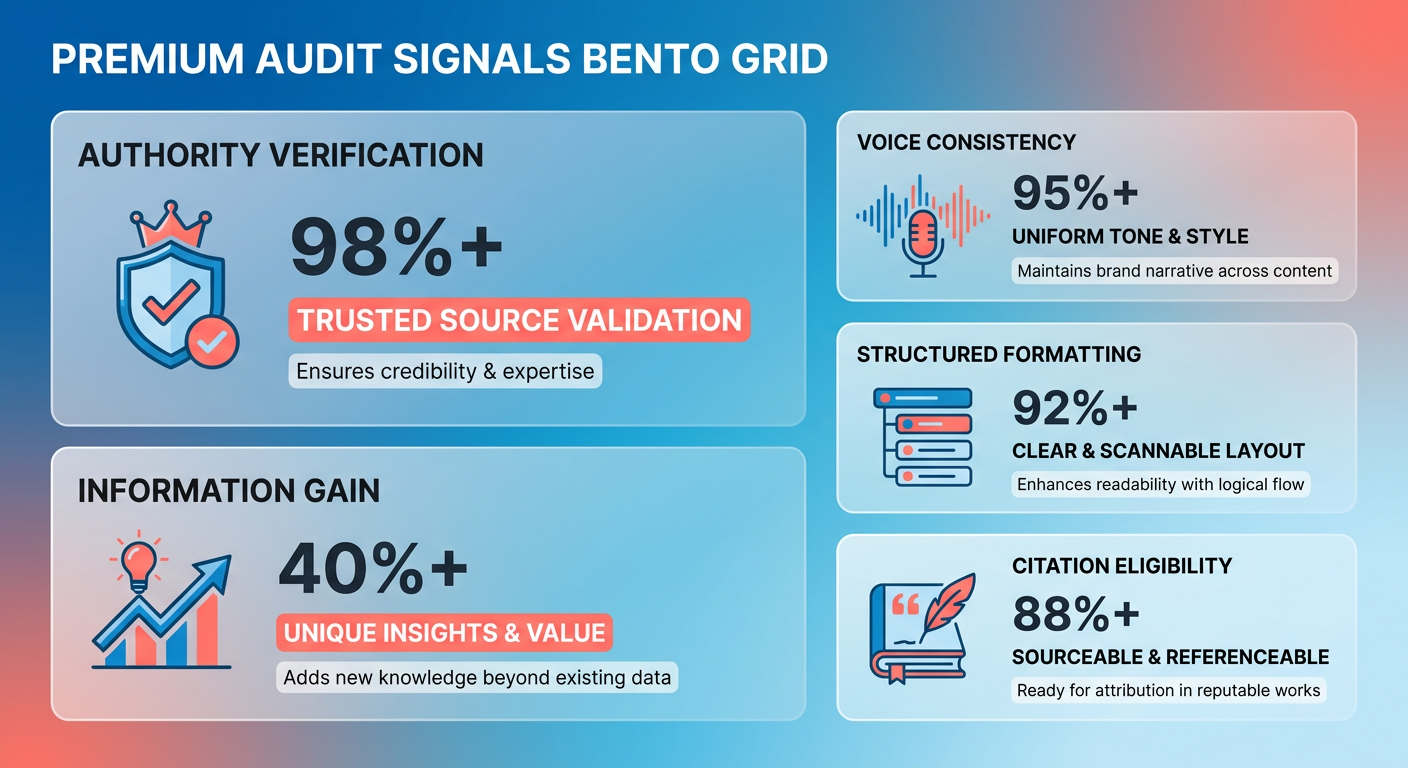
What a pre-publish audit should actually score
A modern audit measures how easily a machine-learning model can parse and verify your claims. Instead of chasing keyword density, the scoring should measure structural clarity and factual density.
The signals AI systems can actually verify are worth building any check around:
- Authority signals: Is the claim backed by earned media, external citations, or first-hand experience? This is the measurable proxy AI keys on.
- Information gain: Does the piece add something the top pages don't already say? Generic restatement fails.
- Voice consistency: Does it sound like one credible author, or three different prompts stitched together?
- Structured formatting: FAQ and Article schema help engines parse your content. Optimal passage length for extraction sits at 150–300 words.
- Trust markers: HTTPS, clear authorship, accurate sourcing.
Trust is the conceptual apex of E-E-A-T for traditional ranking. But for AI citation, externally verifiable authority is the operational gatekeeper. Treat trust as the goal and authority as the number you can actually move.
How real-time scoring changes your workflow
Real-time scoring means the audit runs as content is generated, flagging weak passages before a human ever reviews them. You get a score against citation thresholds, not a vague "looks good." That's the difference between publishing at volume safely and publishing at volume blindly.
Automating this step stops low-value pages from piling up and triggering quality demotions. When you analyze drafts programmatically during creation, you can inject unique data points, expert quotes, or proprietary insights before the page is indexed.
Skip the heavy audit for internal docs or throwaway drafts. Authority verification only pays off on content meant to rank or get cited.
The payoff is concrete. AI-referred visitors are worth 4.4x more than standard organic search traffic and show significantly higher engagement. To capture them, your content has to answer complex, multi-intent queries directly and serve as the definitive source for the topic.
Advanced Topics
Once you understand the five audit signals, the next question is how to tune them. Advanced SEO isn't about scoring higher across the board. It's about knowing which signal to weight when speed, voice, and authority pull in different directions.
Tuning your audit parameters means moving past legacy search metrics. You're optimizing for semantic relevance and factual accuracy, the primary currencies of modern discovery engines.
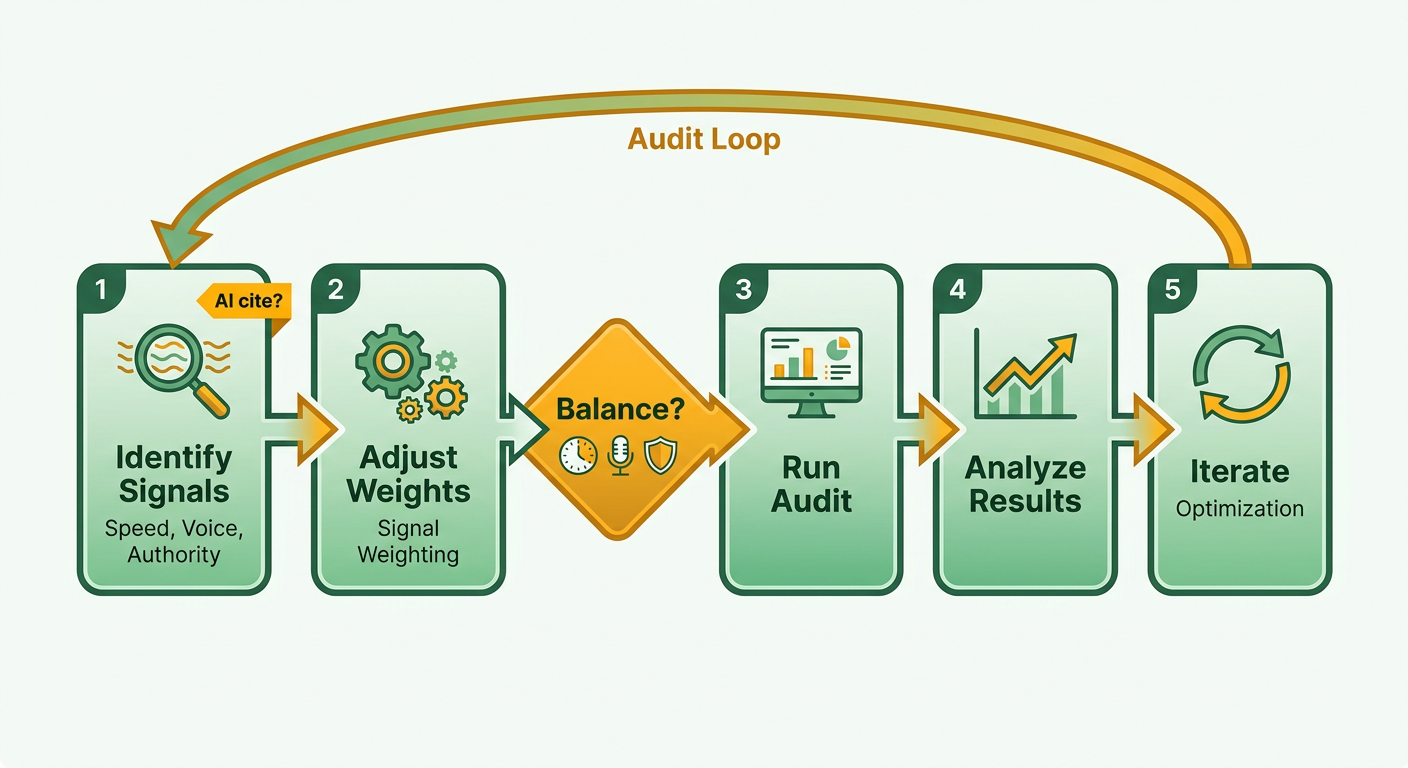
Why your audit threshold needs to change
Citation eligibility beats ranking position. An audit that only checks ranking readiness misses the more valuable target, because AI systems pull from a much deeper pool than the top three blue links. A page that never cracks the first page can still surface repeatedly inside AI answers if its claims are verifiable and its sourcing is clean.
This flips the old playbook. You don't need to be first anymore. You need to be verifiably authoritative.
The economics back it up. Visitors arriving via AI answers show highly focused intent, with a 23% lower bounce rate than traditional organic search. Prioritize citation readiness in your audit and you line your content up with high-conversion behavior.
How to resolve the trust vs. authority tension
Balance qualitative trust with quantitative authority signals. Search quality guidelines emphasize overall trustworthiness, but machine-learning models rely on concrete, extractable data points to verify claims. So your audit has to focus on hard metrics: structured citations, schema-validated author profiles, co-citations with established industry entities.
These work in tandem. Trust is an abstract quality evaluated over time. Digital authority is built through explicit connections. When your content carries verifiable references and clear entity relationships, you're handing automated retrieval systems the exact signals they use to validate information.
So treat verifiable credentials as a non-negotiable baseline. If a draft lacks clear authorship or fails to cite reputable sources, flag it for revision before publication, regardless of how well it targets specific keywords.
How to score topical concentration in your audit
Weight topical concentration alongside per-page quality. A scattered site fails the authority test even when individual pages look clean. Deep, interconnected content hubs let domains build search footprint 57% faster than sites chasing unrelated high-volume keywords. Focused coverage beats raw domain size.
The practical test is depth versus breadth. Map every published URL to your core subject cluster, then flag orphan topics that dilute focus. If more than a fifth of your pages sit outside your primary cluster, your audit should downgrade the whole domain's authority score, not just the stray pages.
One caveat, plainly. Skip aggressive citation-chasing on thin, low-intent pages. If a page has nothing new to add, no audit score saves it. Publish fewer pages that clear the citation bar. This is why AnyPost builds a Business Context Graph from your entire site before generating anything, so each article stays tightly concentrated around your core subject and adds something worth citing, rather than padding your site with generic text.
Best Practices
The best practice for SEO is simple to state and hard to execute: audit for citation eligibility before you publish, not ranking readiness. Different tests now. Strong E-E-A-T signals routinely earn citations that outrank position alone, which means a well-sourced page buried on page one can pull more AI visibility than a top result with thin credentials.
So your pre-publish check should center on machine readability and factual verification. If a search engine can't easily extract and verify your core claims, your publishing speed is wasted on content that stays functionally invisible.
How to run a pre-publish audit
Audit against modern quality standards across all categories. The rigorous criteria once reserved for medical and financial advice now apply everywhere. Consumer software, lifestyle, B2B services, it doesn't matter. The verification bar is the same.
Here's what we run before anything goes live:
- Authorship and disclosure. Add a real byline with credentials. Google's own guidance recommends disclosing AI or automation in creation rather than hiding it. Concealment is the risk, not the AI.
- Verifiable authority. Earned media and external citations are what AI systems key on. Pages with at least one authoritative outbound reference get pulled into answer engines noticeably more often than unsourced ones.
- Structured formatting. FAQ and Article schema help engines parse your content, giving them cleaner signals to lift and cite. AnyPost bakes semantically correct HTML and schema-friendly structure into every article it generates.
- Passage length. Structure your key takeaways and answers into concise, self-contained blocks. That formatting lets retrieval algorithms extract and display your content as a direct answer.
Trust vs. authority: which one do you optimize for?
Build verifiable digital footprints. Overall trustworthiness is the ultimate goal, but search algorithms need tangible data points to measure it. Your audit should focus on the elements you can directly control.
Treat earned authority as the odometer. You can't audit "trustworthiness" directly. You can audit whether reputable sources cite you, whether your byline carries real credentials, and whether your site stays tightly focused on its core subject.
That focus matters more than domain size. Concentrated topical coverage lets a smaller site outperform far larger competitors on niche queries. High authority alone doesn't win. Tight, subject-focused coverage does. AnyPost's Taxonomy Researcher surfaces low-difficulty, high-intent keywords tailored to your niche so you can build exactly that kind of focus.
When to skip the full audit
Skip heavy authority verification for internal docs, release notes, or automated data feeds like scores and weather. Google already accepts automation for those. There's no ranking intent to defend, so a five-signal audit is wasted effort.
Don't skip it for anything you want cited. If a page targets a competitive query or feeds an AI Overview, run the full check every time. Sites that batch-publish thin, near-duplicate pages tend to lose traffic in waves once a Core Update lands, since the same patterns SpamBrain flags cluster together. Volume without an authority gate is exactly that pattern.
One more habit worth keeping: track your visibility inside AI tools, not just organic rank. Ranking in Google no longer guarantees LLM visibility. If your audit passes but citations don't follow, your authority signals need work. AnyPost shows you what actually changed straight out of Google Search Console, so you can see how your published content performs and where the gaps remain.
Troubleshooting
Most audit failures trace back to one of three problems: the content reads as manipulation, the AI voice drifts off-brand, or the page adds nothing new. Each has a specific fix. At volume, these show up predictably, so build your checks around them.
Google's SpamBrain analyzes patterns and signals to identify spam regardless of how the content was produced. So your debugging job isn't hiding the AI. It's fixing the signal that trips the pattern.
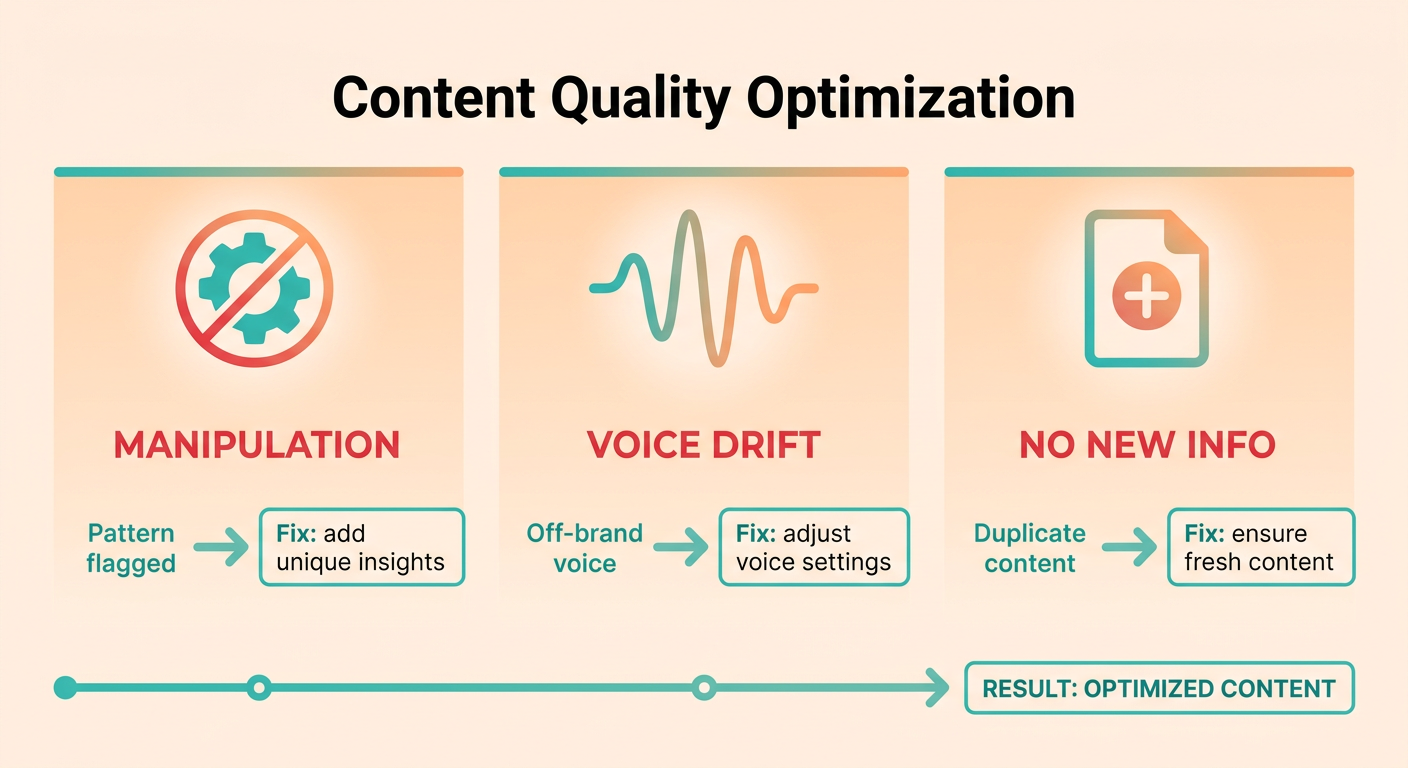
Why did my AI content get flagged as spam?
Your content likely tripped quality filters because its structure and phrasing mimicked low-effort, mass-produced pages built solely for search engines. When algorithms spot high-volume publishing patterns that offer no unique value, they apply site-wide quality demotions.
Debug step: Analyze your page's unique contributions. If the text just summarizes existing search results without introducing new data, expert commentary, or practical examples, it'll get flagged. Inject original insights that can't be found elsewhere on page one.
Automation itself is fine. Google has used automation for years to produce sports scores and weather forecasts. Those pass because they're genuinely useful. Your AI blog post has to clear the same bar.
How do I fix voice drift in generated content?
Voice drift means your AI output stopped sounding like your brand and started sounding like every other model output. The fix is a voice-consistency check run against your own published work, not a generic quality score. Feed the model your best three pages as reference, then audit new drafts for tone match before they go live.
Watch for the tells. Generic transitions, hedge phrases, and a flat "textbook" register are the signatures readers and answer engines both pick up on. One Reddit user in r/isthisAI flagged suspicious content on this instinct alone, noting they're "skeptical of anything coming from FB." That skepticism is exactly what your audit needs to pre-empt.
Debug step: Read the draft aloud. If it sounds like a dictionary entry instead of your team explaining something, the voice signal failed. Add a first-hand angle only your team would write.
What if my content passes but still isn't cited?
If a page passes your audit but earns no citations, the missing signal is almost always information gain. Your content is helpful and on-brand, but it repeats what ten other pages already said. Answer engines cite the source that adds something, not the tenth restatement.
The fix is to inject proprietary assets before hitting publish: original research, unique case studies, specialized industry perspectives. Folding in your product data and customer insights makes sure every piece carries information search engines actually want to reference.
Debug step: Search your target query. If your draft could swap places with the top result and nobody would notice, you have no information gain. Fix that before you touch anything else.
Resources and Tools
Your pre-publish audit is only as good as the tools feeding it signals. You need three categories: topical authority mapping, E-E-A-T signal checks, and voice consistency verification. Here's what each does and when it earns a place in your workflow for SEO.
No single tool scores all five audit signals. You assemble a stack. The goal is catching weak pages before they publish, so weight the tools that check the signal your content fails most often.
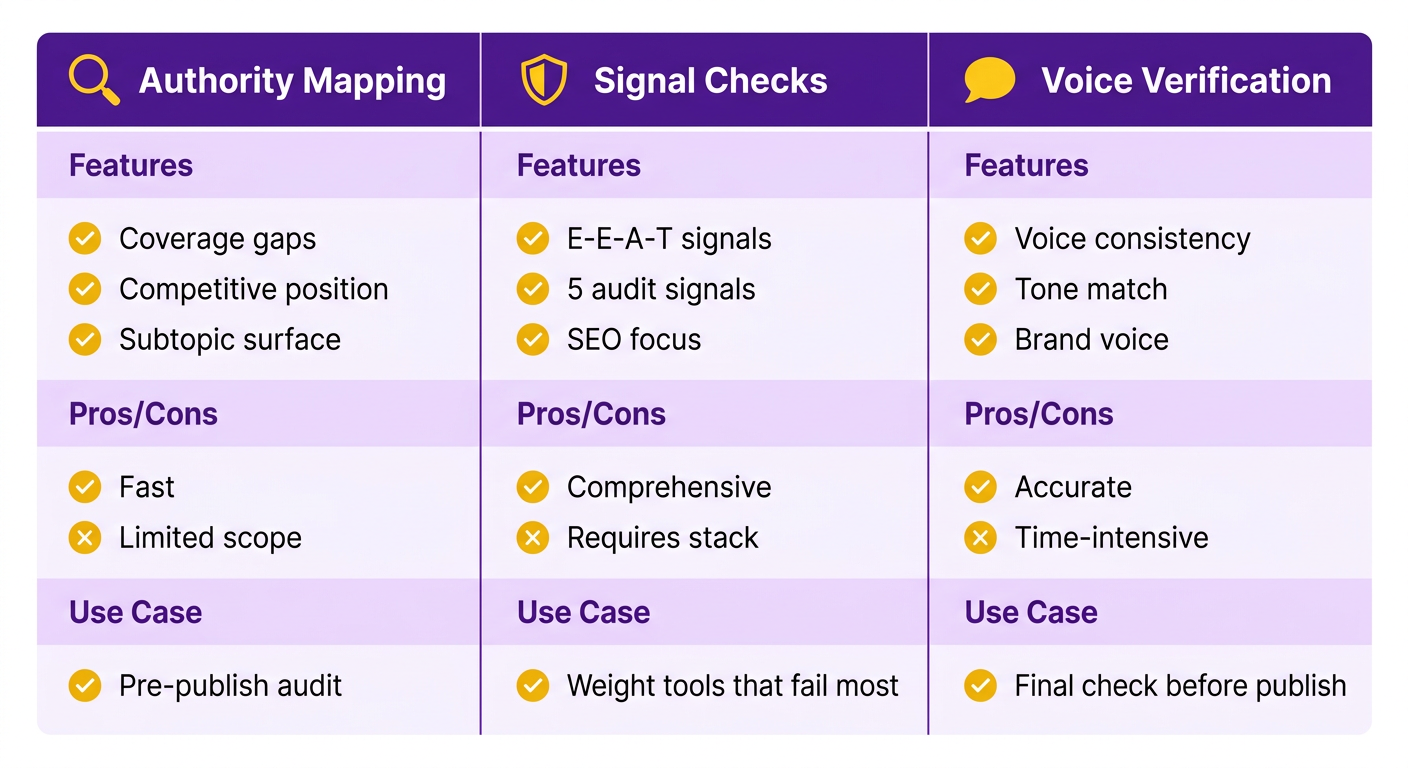
What maps topical authority before you publish?
Topical authority audit tools analyze your competitive position and surface the subtopics you haven't covered yet. They matter because coverage gaps are the fastest way to fail an authority check on AI content. You can't cite your way to authority if half the topic is missing.
The payoff shows up in your audit. A gap-analysis tool turns a vague "is this comprehensive?" into a concrete checklist of missing subtopics you can score against. Without it, you're guessing at coverage. With it, citation eligibility becomes a pass/fail line item instead of a hunch.
The classic case: a DR62 site outranked Amazon's DR95 for "dslr camera bag" purely on topical authority. Domain size didn't save Amazon. Depth of coverage won. That's the signal your tools should measure, not raw domain metrics.
Look for platforms that map semantic relationships and identify content gaps. Specialized keyword research tools let you systematically build out topical clusters, so your site covers every angle of a subject and establishes real domain expertise.
Which resources verify E-E-A-T signals?
The most useful E-E-A-T resource is Google's own documentation on helpful, people-first content. It's free, it's the actual standard your content gets measured against, and it tells you which signals matter. Start there before you buy anything.
Layer on a SERP competitor analyzer to see how top pages structure authority: author bylines, cited sources, first-hand detail. Your audit compares your draft against that structure. If the ranking pages all show experience markers and yours shows none, that's your fix list.
For repeatable checks, build a scoring rubric into a spreadsheet. Five columns, one per audit signal, pass/fail per page. It sounds low-tech. It's the fastest way to run the audit at volume without a signal slipping through.
How do you keep AI voice consistent at scale?
Voice consistency tools compare generated drafts against a reference profile of your brand's tone, vocabulary, and sentence rhythm. This is the signal AI content fails most predictably, because default model output drifts toward generic phrasing the moment you publish at volume.
Some content generation services build this in. A brand-voice engine crawls your existing site to model how you write, then holds new drafts to that pattern. AnyPost.ai runs a Persona Engine that does exactly this, matching tone to your captured voice before content ships.
If you'd rather do it by hand, maintain a style guide with your brand's specific vocabulary, preferred sentence structures, and formatting rules. Running programmatic checks against those guidelines keeps your generated content in one editorial voice across channels.
The rule holds across all three categories: pick tools that score a specific signal, then run them before you publish, not after the page gets buried.
What I'd actually recommend
Here's the whole guide in one line: SEO works when you audit for authority before you publish, not after. Speed is only an advantage if what you ship can be cited. If it can't, you shipped an invisible page faster.
A pre-publish audit gets your content to modern quality standards before indexing. Evaluate every draft systematically and you protect your domain from quality penalties while giving yourself the best shot at earning citations.
What to do next
Build the audit into your workflow, not bolt it on after. Run every AI-generated draft through the five signals before it goes live: authority verification, voice consistency, information gain, formatting, and citation eligibility. Fix the one that fails most often first.
The core objective is content that's easy to verify for both human readers and search algorithms. Make clear, machine-readable connections between your claims and reputable external sources.
Then review your recent publications through this lens. If your pages lack unique data or clear author credentials, modern discovery engines aren't likely to reference them. Raising your editorial standards toward factual depth improves search visibility fast.
When to skip the full audit
Skip heavy authority checks for internal docs, throwaway landing copy, or anything you never intend to rank. The full E-E-A-T audit is overkill when nobody outside your team will read the page.
But for any public-facing asset built to attract organic traffic, the audit is the point. Modern search algorithms apply strict quality evaluations across every industry, so even a standard informational article has to show professional-grade credibility to perform.
Where to learn more
The best further reading is Google's own material on people-first content and its guidance on AI-generated content. Both make the same point our team keeps returning to: the method of production is not the concern. The authority behind the content is.
From there, look at how topical depth shapes search visibility in your specific industry. Align your content with verified search intent, structure your articles to answer complex queries, and your site stays competitive.
Creating high-quality content means satisfying both human skepticism and algorithmic requirements. Publish thoroughly researched, well-structured, authoritative articles and you build a search presence that holds up through algorithm updates.
Frequently Asked Questions
1. Do I need to disclose that my content was created with AI to avoid penalties?
Google does not penalize content simply for using AI. However, transparency is highly valued. Providing clear disclosures about your editorial process and maintaining verified author profiles helps build trust with both readers and search quality evaluators, ensuring your content is recognized as reliable.
2. Can a page that ranks on page two still get cited by AI answer engines?
Yes. Retrieval-augmented generation (RAG) systems prioritize factual accuracy and structured data over traditional organic ranking positions. If your page contains highly precise, schema-marked answers and authoritative references, an AI engine may cite it directly even if it sits lower in standard search results.
3. How many of my pages can sit outside my core topic before authority suffers?
To maintain strong topical authority, keep your content highly focused. If a significant portion of your site consists of unrelated topics, search engines may struggle to classify your domain's primary expertise. Regularly audit your site architecture to ensure all pages align with your core topical clusters.
4. My content passed the audit but still gets no citations. What's missing?
If your content is technically sound but ignored by AI engines, it likely lacks unique value. To fix this, integrate exclusive insights such as original survey results, hands-on product testing, or unique expert interviews. AI systems seek to synthesize diverse perspectives, so providing a novel angle makes your page highly citable.
5. Is it ever fine to skip the full E-E-A-T audit?
You can bypass rigorous authority checks for non-indexed pages, policy documents, or basic transactional copy. However, any content designed to capture organic search traffic or appear in AI-generated summaries must undergo a thorough quality review to ensure it meets modern search standards.
6. How do I catch AI voice drift before publishing?
Establish a programmatic review process using custom style guidelines. Look for common automation markers such as overly formal language, repetitive sentence structures, and a lack of brand-specific terminology. Having an editor review the tone ensures the writing remains engaging and authentic.
7. Should I track anything beyond my Google ranking position?
Yes, monitor referral traffic from AI platforms and track how often your brand is mentioned in conversational search queries. Analyzing these modern discovery metrics alongside traditional search console data provides a more accurate picture of your overall digital footprint.
