How to Automate SEO Reports for Clients: A Simple Agency Workflow for 2026

Key Takeaways
- Agencies that automate SEO report delivery can reduce reporting labor time, as one firm managing 160+ clients demonstrated.
- Automated data connectors solve the pipeline problem efficiently, but they produce no client-ready narrative — the interpretation of what changed and why still requires a separate, often manual step.
- Ranking data and traffic metrics are inputs to a report, not its deliverable; the value clients need is the explanation of what the numbers mean and what action to take.
- Agencies reducing reporting time through automation are reallocating those hours to strategy work rather than slide assembly.
- The dominant workflow gap for agencies in 2026 sits at the "last mile" — the translation from clean data into a written, client-facing document with recommendations.
- Tools that move data between sources and destinations are mature and widely adopted, but none of them ship a narrative or ready-to-publish output on their own.
- The reporting workflows stalling most often are those that solved the data-pipeline side without addressing how the final written deliverable gets produced.
Related Video
Watch: Build Automated SEO Reporting Slides with Google Search Console and GA4 by Markifact
Quick Summary
Agencies that try to automate SEO reporting typically solve the technical side fast. The data flows. The dashboard looks clean. Then an account manager is still up at 10pm drafting commentary, and the bottleneck becomes obvious.
Data compilation is a solved problem. Connect Google Search Console, GA4, Ahrefs, and SEMrush into a dashboard, schedule the pulls, get clean numbers. That step matters, you can't scale manual spreadsheet updates, but it only gets you halfway.
What Raw Metrics Can't Do
A client receiving a spreadsheet of keyword positions can't easily tell which movements are seasonal noise and which need an immediate call. Without a narrative, data generates questions instead of answering them.
Pipeline tools are good at consolidating metrics. They're not good at explaining them. Strategists still have to log in, read the charts, and write the executive summary. That manual step is where most agency reporting time actually goes.
The Last Mile: From Data to Deliverable
The workflow gaining traction in 2026 has three stages: a validated data layer (connectors and dashboards), an AI content layer that turns ranked metrics into voice-consistent narrative, and a branded delivery step that packages it for the client. AnyPost.ai addresses that middle layer. Its Persona Engine is built to match tone and brand voice, so the same keyword movement produces a different narrative for a local retailer than it does for a SaaS company — not a generic data export.
A content brief generated directly from search data only becomes a usable client update when it reflects how your agency communicates. The final report has to translate raw numbers into strategic advice the client can actually act on.
What This Workflow Looks Like in Practice
| Stage | Tools / Sources | Setup Time | Recurring Effort |
|---|---|---|---|
| Data layer | GSC, GA4, Ahrefs, SEMrush | 2-4 hours | Near-zero (scheduled pulls) |
| Dashboard | White-label reporting tool | 1-2 hours | Minimal (template-based) |
| Content brief | AI content layer (voice-matched) | Varies by platform | Reduced vs. manual drafting |
| Delivery | Branded PDF or client portal | 30 min setup | Automated |
Pricing across the full stack depends on what you choose and how your reporting platform structures fees. Some charge per client, others per seat. Per-seat pricing scales badly as the book of business grows, so factor that in before committing to a connector-heavy setup.
Three outcomes agencies consistently report after making this shift: higher client retention (clients who understand their results stay longer), more upsell opportunities (narrative reports surface work that needs doing), and internal efficiency gains that let the same team handle a larger book of business.
Skip this if your clients only want raw dashboard access and don't read written reports. The content layer earns its cost when clients expect a human-readable update. For technically sophisticated clients who pull their own data, it's overkill.
Why the Reporting Bottleneck Is Actually a Strategy Problem
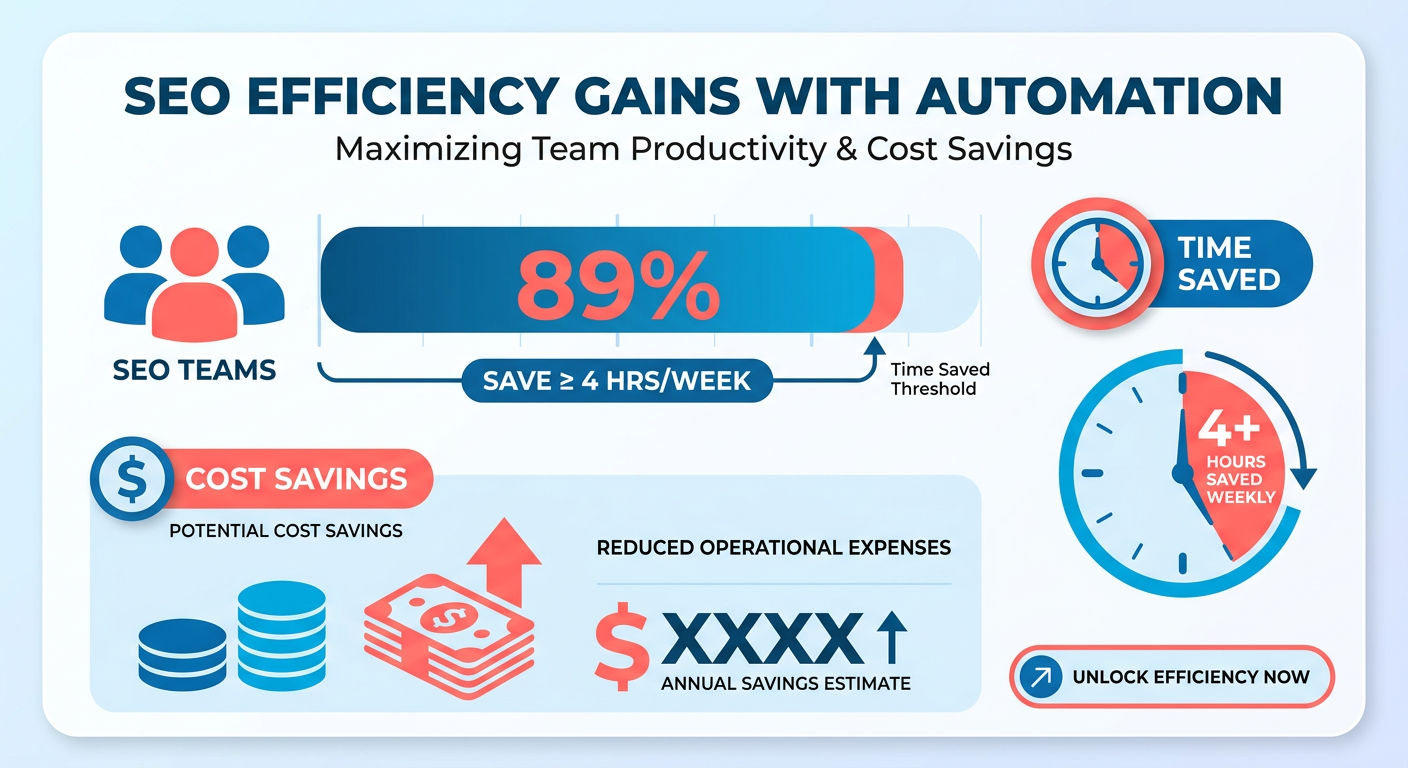
Moving to automated reporting directly affects agency profitability and team morale. Research shows 89% of SEO teams save at least four hours per week with AI. Teams without these systems absorb that time directly, pulling senior strategists away from client work to do formatting.
The compounding cost is the one that stings. When senior people spend Fridays building ranking tables, they're not refining keyword strategies or identifying content gaps. The payroll cost is visible. The opportunity cost isn't — until a client churns because their strategy felt generic.
Why the Data Layer Alone Doesn't Solve It
Most agencies have already automated the data layer. The harder problem is what happens after the data lands. 87% of SEO teams use AI regularly, but only 1% report fully automated workflows. The pipeline is mature. The content layer isn't.
That gap is real. As one agency respondent put it: "The vast majority of the work can be performed by AI, but the context and understanding of humans play a big role in making sure the raw inputs and outputs are aligned."
Data collection has become commoditized. Agency differentiation now depends on what happens next: converting validated metrics into structured, clear content that clients can understand and act on.
What Clients Actually Expect in 2026
Client expectations have outpaced most agency workflows. Clients who once accepted a monthly PDF are now asking about AI search visibility, channel-level attribution, and keyword-level content recommendations. Tracking AI-generated traffic has moved from differentiator to baseline expectation.
The deeper issue isn't a shortage of data. It's a communication problem. Clients aren't asking for more dashboards. They're asking for a clear explanation of what the numbers mean and what to do next. SEO consultant Victor André Enselmann framed it well: "The real edge in SEO comes from deciding what not to do: which keywords to ignore, which pages to prioritize, and how to allocate effort across content, links, and technical. That's not a data problem, it's a strategy problem."
Agencies with the strongest client retention aren't the ones with the most data sources. They're the ones whose reports arrive already shaped into a story, with ready-to-act recommendations attached.
Where the Real ROI Lives
The financial case for automation holds up even before you account for output quality. One team reduced a reporting task from 10 hours to 20 minutes by connecting their marketing data to an AI assistant. Agencies using automated reporting tools have cut hundreds of hours per month previously spent on manual data work.
But the time savings understate the compounding benefit. When your team stops formatting reports and starts writing strategy, clients notice. That improvement traces to the quality of the narrative layer, not just the speed of delivery.
The agencies getting the most from automation aren't treating it as a cost-cutting move. They're using it to put strategic thinking back into every report at scale, without adding headcount. That's where the retention improvement comes from.
Core Components of an Automated SEO Reporting System
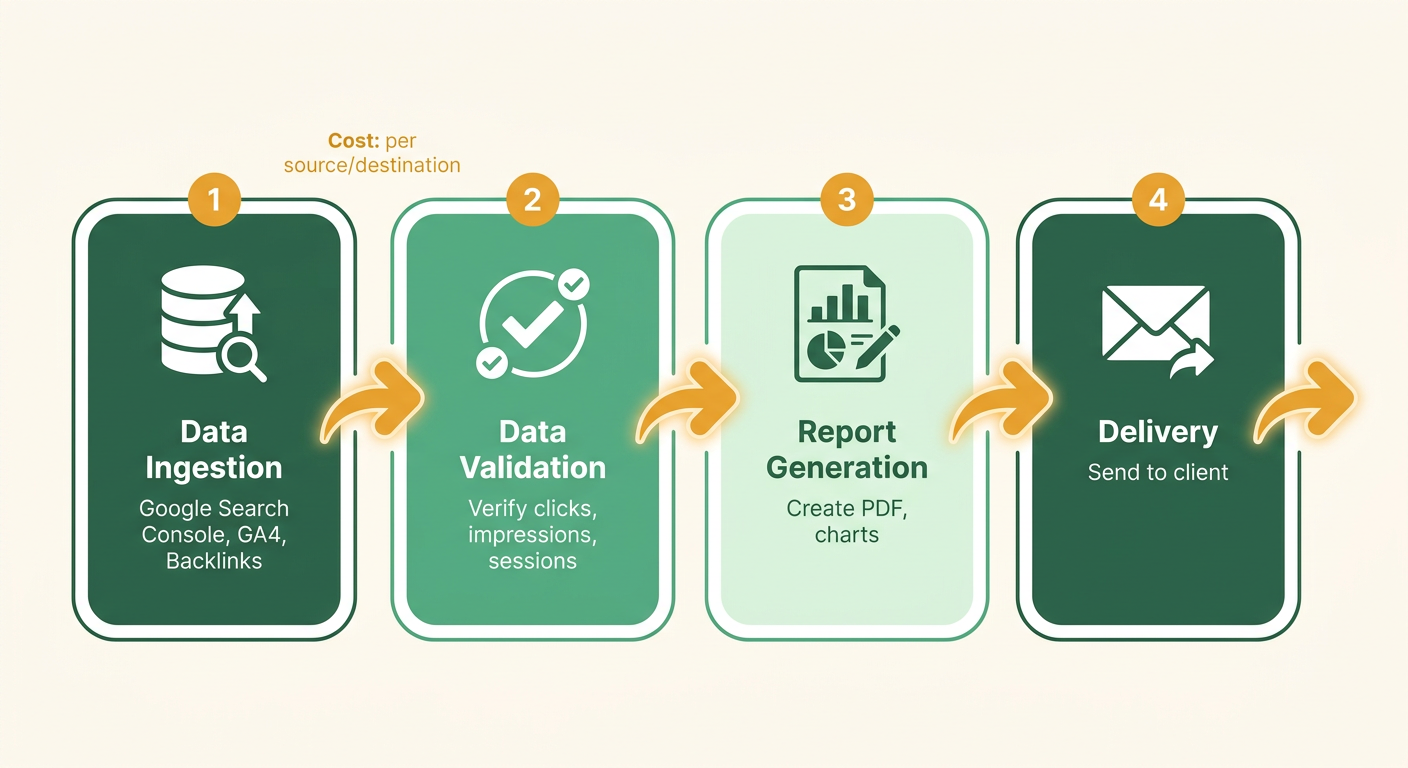
The pipeline breaks into four distinct layers. Each has to work before the next one becomes viable. A failure at any stage produces either a broken delivery or a wall of numbers the client ignores.
Layer 1: Data Ingestion — What You Connect and What It Costs You
Data ingestion is the foundation. Pull from Google Search Console (clicks, impressions, position), Google Analytics 4 (sessions, engagement, conversions), and at least one third-party source for backlinks and competitive data. The connections themselves are mature technology.
Managing multiple API connections requires attention. When pulling across platforms, watch API rate limits and token usage. Raw connectors alone can leave you with fragmented data silos — you still need a centralized layer to unify metrics before they're interpretable.
Google Data Studio connects to over 1,000 data sources and refreshes automatically, making it a strong free option for the ingestion-to-visualization path. Programmatic access is gated behind enterprise tiers on most connector platforms, so check that before building around it.
Layer 2: KPI Selection — Measuring What the Client Actually Cares About
The right KPIs tie SEO activity to business outcomes, not just rankings. Keyword positions are inputs. What your client cares about is revenue, leads, or local visibility. Engaged organic traffic tells a cleaner story than rank position, because rank fluctuates with personalization, device, and SERP feature changes that have nothing to do with your work.
A practical KPI stack: organic sessions and engagement rate (GA4), click-through rate and average position for target queries (Search Console), indexed page count, crawl health, and backlink growth. In 2026, tracking brand mentions within LLM responses and AI-driven search engines belongs on that list too — these platforms increasingly drive high-intent referral traffic.
Skip rank tracking as a primary KPI for clients in highly volatile or informational niches. It creates noise without signal, and you'll spend more time explaining position swings than discussing actual performance.
Layer 3: Reporting Engine — Where Data Becomes a Deliverable
The reporting engine is where agencies most often stall. Most platforms handle the dashboard layer well. Where they stop is written interpretation. Templates generate tables. They don't generate the paragraph that says "your blog content drove a 22% increase in top-of-funnel sessions this month, and these three posts are ready for internal link consolidation." That's where an AI content layer fits — sitting between validated data and the client-ready brief.
A BrightEdge study found SEO teams spend an average of six hours per report on manual data interpretation and narrative writing. Automation hasn't touched that yet, because tooling has focused on data movement rather than insight generation. The teams getting the most from automation treat the data layer and the narrative layer as separate problems requiring different tools.
A human-in-the-loop model still makes sense here. Algorithms can draft initial summaries based on performance spikes, but an experienced strategist reviewing that output is what keeps it aligned with the client's actual business goals. A reporting engine that stops at visualizations solves only half the problem.
Layer 4: Delivery Format — Whether Clients Actually Read Your Reports
Format determines engagement more than most agencies admit. PDF reports suit compliance-focused clients and formal retainer check-ins. Interactive dashboard links work for hands-on clients who want to explore the data themselves. Email summaries with a linked dashboard drive the highest engagement for time-poor clients who want to stay informed without digging.
A tiered delivery approach often works best: a brief email summary weekly, a comprehensive PDF monthly with narrative interpretation, and a live dashboard for self-service. That structure respects different client preferences rather than forcing everyone into the same format.
White-labeling matters here too. Reports sent under your agency's branding reinforce your relationship with the client. Reports that look like they came from a third-party tool do the opposite.
For a closer look at how these components connect into a working workflow, AnyPost.ai's real-time analytics tracking ties directly into this kind of reporting structure, surfacing the performance data that feeds each layer of the pipeline above.
Step-by-Step Automation Workflow Using AnyPost.ai and Complementary Tools
Building an efficient reporting system means integrating data pipelines with a structured content generation process. The four stages below connect data collection, validation, and narrative creation into a single operation.
The Four-Stage Pipeline
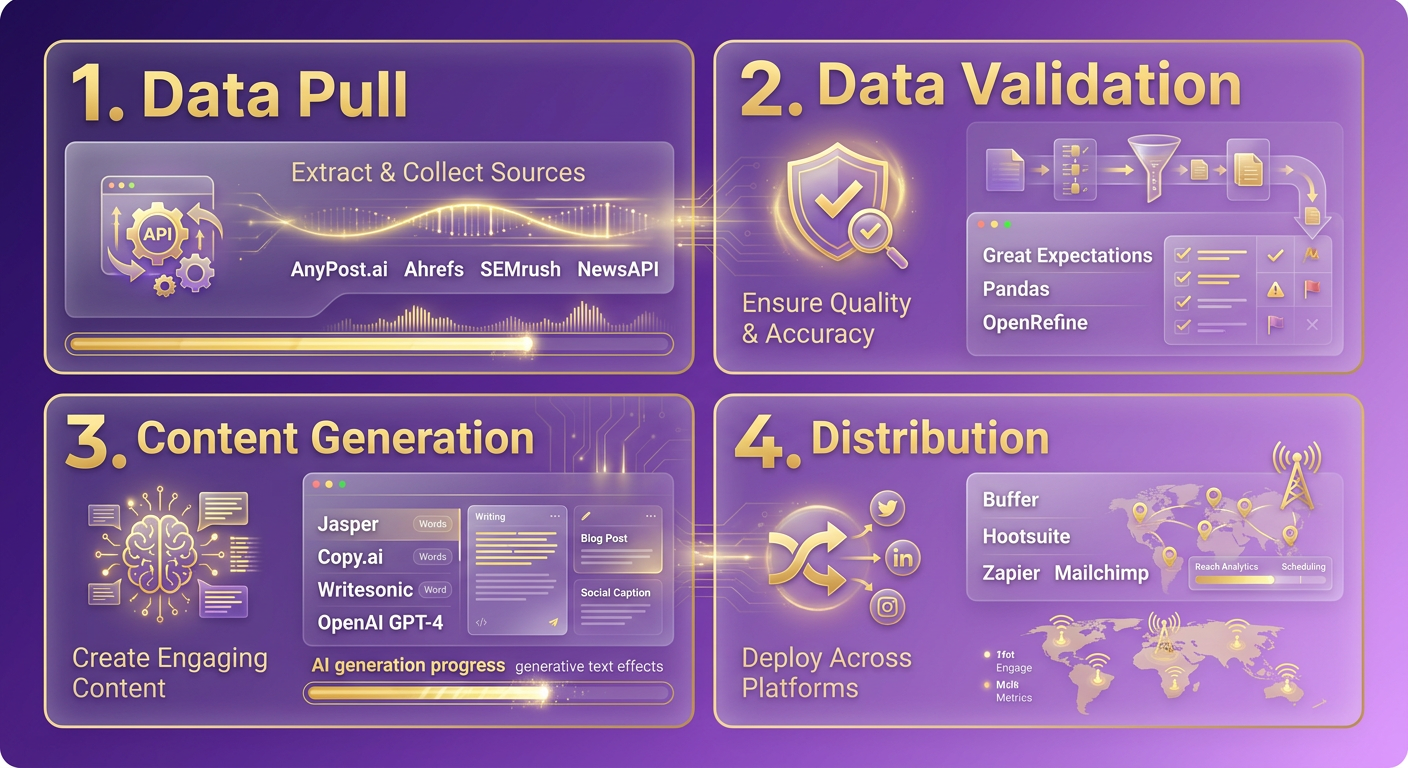
The credible 2026 workflow isn't a single platform. Survey data shows 91% of SEO teams use at least two AI tools, and 65% use three or more. That's not tool sprawl — it reflects how the pipeline actually breaks down: data layer, validation layer, content layer, delivery layer. Each stage needs the right tool, and none of them does all four.
Stage 1: Data ingestion. Connect Google Search Console and GA4 as your baseline. Add a third-party source for backlink and competitive data. The key decision isn't which connectors to use. It's refresh cadence. Starter-tier connector plans typically refresh weekly, which is fine for monthly client reports but breaks down for anything more frequent. If your workflow requires daily pulls, budget for it before committing to a tool.
Stage 2: Pipeline validation. This is the stage most teams underinvest in, and the downstream cost shows up fast: mismatched totals, stale data passed off as current, and client trust that takes months to rebuild. The fix is simpler than it sounds. Run a sanity check comparing automated totals against raw source exports for two or three clients each week until the variance is consistently negligible. Teams that build this into their standard operating procedure report significantly fewer client escalations over data accuracy. It doesn't have to be elaborate, but it has to be consistent.
Stage 3: Content generation with voice consistency. Validated performance data feeds into AnyPost.ai to generate contextual summaries and strategic recommendations. The platform's voice-matching capabilities mean the resulting reports read as though your senior strategists wrote them, not a generic AI layer. Instead of presenting clients with raw charts, you deliver actionable insights and ready-to-publish content ideas aligned with their brand guidelines.
Stage 4: Scheduling and delivery. Once the content layer outputs a draft, automated scheduling handles the rest. Daily, weekly, or monthly delivery cadences are standard. The trigger can be a cron job, a webhook fired by the data connector on successful refresh, or a platform scheduler. The human touch point is review and approval — not assembly.
Handling Ad-Hoc Client Questions Without Breaking the Workflow
The workflow above handles scheduled reporting well. It doesn't handle the Tuesday afternoon Slack message: "Why did our traffic drop last week?"
The answer is a live data layer sitting alongside the scheduled pipeline. Connect your validated data store to a shared dashboard clients can access directly, or route ad-hoc queries through a lightweight AI layer that pulls live figures on request. Some teams build this with no-code tools like Make or n8n triggering a query against their data warehouse. Others use a shared Looker Studio view with a natural-language query widget on top.
For most agencies under 50 clients, the shared dashboard is sufficient and far simpler to maintain. The AI query layer pays off at scale, or when clients are technically comfortable enough to use it without hand-holding.
Version Control and Client Onboarding
Report templates drift. An account manager adds a metric for one client, forgets to remove it, and six months later your "standard" template has fourteen variations. Version-control your templates in a Git repository or a structured Google Drive folder with dated snapshots. When you onboard a new client, pull from a clean master — not the most recently edited version.
Onboarding should take under an hour if the pipeline is properly parameterized. The inputs are client data source credentials, brand voice notes for AnyPost.ai, and the report cadence. Everything else, template selection, scheduler setup, delivery address, should populate from a new-client intake form feeding directly into the workflow. If onboarding still takes a half-day, the bottleneck is usually a step that requires someone to copy-paste values between systems. That's a Make or n8n automation waiting to happen.
For a deeper look at building this pipeline end-to-end, AnyPost.ai's multi-platform publishing and backlinking automation features cover the distribution layer in detail. Explore how they fit your agency's stack at anypost.ai.
Designing Client-Centric Reports That Build Trust and Drive Upsells
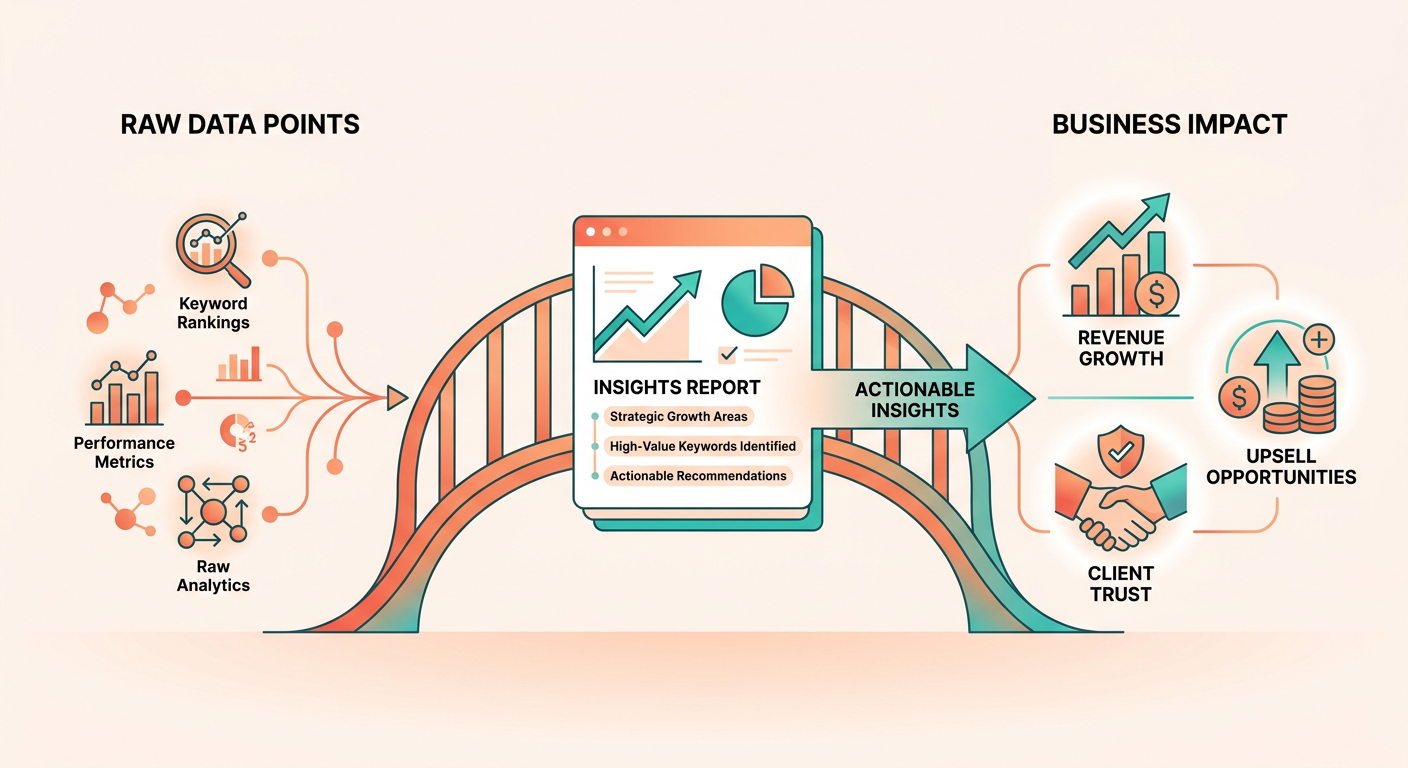
A simple list of rankings only shows current positioning. A high-value report explains what those positions mean for the business.
That distinction is what drives renewals. Clients don't renew contracts over keyword positions. They renew because they see the connection between your work and their revenue. If your reports don't draw that line explicitly, clients fill in the gap themselves — and they rarely fill it in your favor.
Frame Metrics Around Business Outcomes
The default instinct is to lead with rankings and impressions. Skip it. Lead with outcomes instead: qualified sessions, leads generated, content pieces published, and the revenue pipeline those represent.
Rankings are early indicators, not final goals. When a target keyword cluster moves up in search results, that shift is a precursor to business value — not the value itself. The report should connect that movement directly to downstream metrics like conversion rates and organic lead volume, giving the client a clear line from search visibility to business growth.
One honest tension worth acknowledging: some practitioners describe AI-generated report narratives as completely reliable after proper data validation. Others point to quality control as a real limitation across their teams. Both are true, and the difference is governance. Reliability is earned by validating your pipeline before you trust it at scale. Morten Kleven, AI and Automation Lead at Layer, spent weeks stress-testing his data pipeline before shipping automated reports and found zero hallucinations. The teams that struggle skipped that step.
What a Growth Opportunities Section Actually Looks Like
The structural move that converts a status report into an upsell conversation is a dedicated "Growth Opportunities" section placed after the performance summary. Surface:
- New keyword clusters: topics adjacent to existing rankings where the client has no content yet. Automated content gap analysis can flag these; a voice-consistent content brief turns the gap into a ready-to-publish asset.
- Backlink gaps: competitor domains linking to pages the client doesn't have. The data is available from any backlink tool; the report should translate it into a specific recommendation, not just a table.
- AI search visibility: opportunities to optimize existing content for inclusion in LLM-driven search engines and conversational AI platforms, keeping the brand visible across emerging search behaviors.
- Programmatic SEO opportunities: high-volume, low-competition patterns in the keyword data that suggest template-driven content as the right response.
The upsell mechanism is built into the structure. When a client sees a clearly identified keyword cluster with no coverage, the logical next question is "can you fix that?" — and it's far easier to answer when the content brief is already attached to the report.
Embedding Content Briefs Directly in the Report
This is the move that separates an automated status report from an automated deliverable. When the pipeline detects a ranking opportunity or a content gap, it doesn't just flag the data point — it generates a voice-consistent content brief inline, formatted so the client can see exactly what addressing that opportunity would look like.
The practical effect is meaningful. Agencies consistently report that automation reclaims significant hours each month that would otherwise go to manual analysis and brief writing. The bigger opportunity isn't the cost savings, though. It's converting that reclaimed time into new billable work. A report that surfaces three content briefs each month gives the client a concrete reason to expand scope.
Visual hierarchy matters for the report to hold up under scrutiny. Trend lines work for showing trajectory over time (organic traffic growth, ranking momentum). Waterfall charts communicate the "why" behind a change when multiple factors contributed. Keep primary data visualizations to one per section; more than that and clients start managing the report instead of reading it.
The governing principle is summary clarity over data volume. A client who sees six charts and fourteen tables walks away knowing less than a client who sees one trend line, one growth opportunities list, and one recommended next action. Every additional metric competes with the ones that actually drive the conversation you want.
FAQ
What tools do I need to automate SEO reports for clients?
The core stack is Google Search Console, GA4, a backlink tool (Ahrefs or SEMrush), a dashboard layer, and an AI content layer for narrative generation. Connector tools like Google Data Studio or Looker Studio handle the data-to-visualization path. AnyPost.ai handles the voice-matched content layer between validated data and client-ready brief. No single platform covers all four stages.
How long does it take to set up an automated SEO reporting workflow?
The data and dashboard layers typically take three to six hours of initial setup. The content and delivery layers add a few more hours depending on how many client voice profiles you configure. Ongoing maintenance drops to near-zero for scheduled reports once templates are validated.
Can automated reports replace human strategists?
Not entirely. Automation handles data movement and initial narrative drafts well. Strategic context, why a trend matters for this specific client's business, which opportunity to prioritize given their budget, still needs a strategist's judgment. The best workflows use automation to eliminate assembly work so strategists can focus on that judgment layer.
How do I handle clients who want to see raw data instead of narrative reports?
Give them both. A live dashboard for self-service access alongside a monthly narrative report serves both preferences without doubling your workload. The dashboard handles ad-hoc exploration; the narrative report handles the strategic conversation at the regular check-in.
What's the biggest mistake agencies make when automating SEO reporting?
Skipping pipeline validation. Automating broken or stale data at scale is worse than manual reporting, because errors go unnoticed longer and client trust erodes faster. Validate automated totals against raw source exports consistently before trusting the output at scale.
How does AnyPost.ai fit into an automated reporting workflow?
AnyPost.ai addresses the narrative gap between clean data and client-ready deliverable. Its Persona Engine generates voice-matched summaries and content briefs directly from validated performance data, so reports reflect your agency's communication style rather than a generic AI output. It sits between your data layer and your delivery layer.
Do automated reports work for small agencies with just a few clients?
Yes, though the ROI math looks different. For a five-client agency, the value is consistency and professionalism rather than scale efficiency. Templated, branded reports with embedded content briefs look sharper than hand-assembled ones, and they're faster to produce regardless of client count.
