
How to Build an Internal SEO Team: Roles, Hires, and Org Structure

Key Takeaways
- An internal SEO team that works rests on three roles: a technical SEO, an SEO content lead, and an analytics specialist.
- Hiring one generalist to do everything, from site audits to blog briefs, usually stalls rankings instead of growing them.
- Internal teams move faster than agencies because they sit inside the business and skip procurement and retainer cycles.
- The technical SEO owns crawlability, site speed, indexing, and structured data. The engineering-adjacent fixes that let content rank at all.
- The content lead owns keyword strategy, briefs, and editorial quality, and makes sure output matches search intent.
- The analytics specialist tracks performance, builds reporting, and figures out what's actually moving the needle.
- Tiny startups still testing whether SEO moves their numbers are better off with a fractional specialist or contractor than a full in-house build.
The short version
Building an internal SEO team means hiring dedicated specialists who own your search strategy instead of farming it out. Done right, search becomes a predictable channel for organic traffic, qualified leads, and revenue.
Most companies start the same way: hand one marketer everything, from technical audits to blog writing. That bottleneck caps growth fast. No single person scales multiple search disciplines at once.
Why build in-house instead of outsourcing
In-house teams move at a speed agencies rarely match. Your people are embedded in daily operations, so they actually understand the product roadmap and the brand voice. They ship optimizations immediately instead of routing every change through agency email threads.
The catch: a real in-house department costs money and takes time to ramp. Early-stage companies still validating search as an acquisition channel should lean on flexible, short-term help first. Full-time hires only make sense once you have evidence that organic search can drive the business.
The three roles you actually need
Three roles form the backbone of any internal SEO team. Each owns a distinct slice of the work, and the overlap between them is where most teams break.
- Technical SEO: Crawlability, site speed, indexing, structured data. The engineering-adjacent fixes that let your content rank at all.
- SEO content lead: Keyword strategy, content briefs, editorial quality. This person decides what you write and makes sure it matches intent.
- Analytics specialist: Tracks performance, builds reporting, tells you what's actually driving results so you stop guessing.
On a small team, one person may wear two of these hats. That's fine early on. Just be honest about it. A content lead doing technical audits in spare hours will do neither job well past a certain scale.
Structuring the team so roles don't collide
A clear structure keeps roles from colliding and gives the team one owner. Most internal teams go hierarchical, run pods, or organize around brands, products, or markets. The right pick depends on your size and how your company is already set up.
Hierarchical works for smaller teams: one SEO lead, a few specialists reporting up. Pods suit larger orgs that want cross-functional units each owning a vertical or market. Either way, the point is the same. Someone owns the outcome, and reporting lines are obvious.
Track three metrics from day one: organic traffic, keyword rankings, and content velocity. Traffic tells you if the work is paying off. Rankings show momentum before traffic catches up. Velocity keeps the team honest about output.
One pressure point worth naming early: content velocity is usually the bottleneck. Production is slow and manual, and a small team hits a ceiling fast. Automating drafting and publishing frees your specialists for strategy and technical work instead of churning out copy.
Why Building an Internal SEO Team Matters
The math on building in-house is simpler than most teams assume. Internal SEO teams correlate with a roughly 25% lift in organic traffic compared to companies that hand the work off. That number reflects something structural: people who live inside your business move faster on the decisions that compound over time.
This section is about what an internal team actually fixes. Not abstract benefits. The three concrete problems most companies hit when search lives outside their walls.
What internal control actually buys you
Control means you own the strategy and the tactics, not just the reports. When SEO sits inside the company, you decide which pages get optimized first, which technical fixes ship this sprint, and how search goals map to revenue. You stop waiting on a retainer cycle to act.
That ownership turns into speed. When search specialists sit alongside product managers and developers, they advocate for critical updates in real time. Instead of waiting on a monthly agency review, they adjust tactics daily off live performance data and shifting priorities.
The deeper win is prioritization. An internal team weighs an SEO change against everything else the business is shipping. They know whether a site migration collides with a product launch. An outside vendor rarely has that context.
Fixing the cross-department friction
A well-structured internal team improves communication between departments that usually talk past each other. SEO touches engineering, content, product, and analytics. When those handoffs happen inside one org, briefs get clearer and fixes ship instead of stalling in a queue.
Take a technical recommendation that needs developer time. With an internal SEO function, that request lives in the same backlog, the same standups, the same planning cycle as the rest of engineering's work. The friction of explaining context to an outside party disappears.
This is also where a strong internal communication culture pays off. Teams that document decisions and share wins across functions keep everyone clear on why a given page or keyword matters.
The three problems an internal team solves
An internal team hits three recurring problems head-on: lack of expertise, limited resources, and poor communication. Each one quietly drains organic growth when SEO is treated as a side task.
- Lack of expertise: A dedicated team brings specialists who know technical audits, content strategy, and analytics. You stop relying on a generalist guessing at half the work.
- Limited resources: Defined roles spread the load, so no single person owns everything from crawl errors to editorial calendars.
- Poor communication: Shared ownership inside the company keeps SEO connected to the people who execute it, instead of trapped in vendor email threads.
There's also institutional knowledge. When an agency contract ends, their understanding of your site's history walks out the door. In-house specialists document findings, build historical context, and leave behind a permanent repository of search insight the whole org can use.
Defining the SEO Team's Mission and Scope
A clear mission and scope tells your SEO team what they own and what they don't. It defines the goals, the audience, and the boundaries before a single audit or content brief gets assigned. Skip it, and the team drifts into reactive tasks and loses the thread on what actually drives organic growth.
Most companies skip this step. They hire, then figure out the mission later. Reverse that order.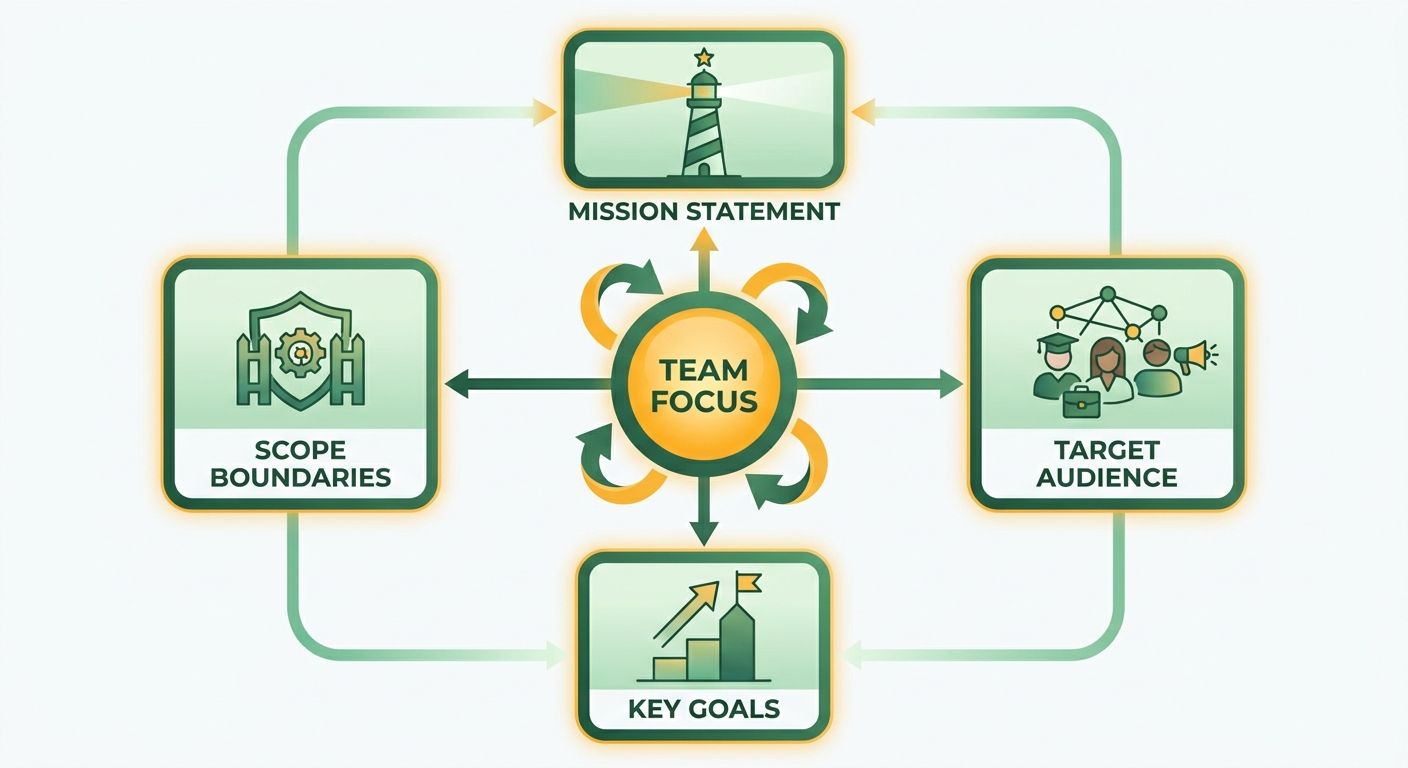
Why scope matters more than you think
Boundaries keep your search specialists from becoming a general-purpose support desk for every other department. When every internal request becomes a priority, the high-impact work, like site migrations or core keyword campaigns, gets shoved aside. A documented scope keeps resources pointed at the work that pays.
Clear boundaries also build accountability. When people know exactly which metrics and deliverables they own, they work independently without stepping on each other. That autonomy matters more as the team scales.
It also helps when other departments come asking for favors. With a documented scope, your team can push back on requests that don't fit, or route them properly. That protects the work that matters.
How to actually define it
Start by naming three things: your target audience, your priority keywords, and your content strategy. These anchor every decision downstream. Get specific. Vague inputs produce vague output.
Your audience shapes everything from keyword selection to tone. Define who you're trying to reach and what they search for. Then map your priority keywords to that audience and to your business goals, not to vanity metrics that look good in a slide.
Content strategy ties it together. Decide what topics you'll cover, how often you'll publish, and who owns each stage. A documented strategy keeps writers, editors, and technical staff working the same plan instead of in silos.
Editorial guidelines matter just as much. Define your quality standards, brand voice, and any compliance requirements upfront so everything you publish clears both the search bar and your own.
What a well-defined team looks like
A well-defined team has roles that map directly to the mission, with no overlap and no gaps. Each specialist knows their lane, and the leader connects those lanes to revenue. The structure reflects the goals, not some org chart someone inherited.
Take a software company that wants to grow organic signups. The mission is narrow: rank for high-intent product searches and convert that traffic. The technical SEO keeps the site fast and crawlable. The content lead builds comparison pages and use-case guides. The analytics specialist tracks which pages drive signups.
That alignment doesn't happen by accident. It comes from writing the mission down, agreeing on scope, and revisiting both as the business shifts. A mission you set once and ignore is no better than no mission at all.
Review your scope each quarter. Goals change, search behavior changes, and your team should change with them.
Choosing the First SEO Leader to Hire
Your first SEO hire should be a leader, not a junior specialist. This person sets strategy, prioritizes the work, and builds the team underneath them over time. Get this hire wrong and every role you add later inherits the same blind spots.
For large and enterprise companies, SEO leadership is one of the three roles you can't skip, alongside technical SEO and content SEO. Start at the top.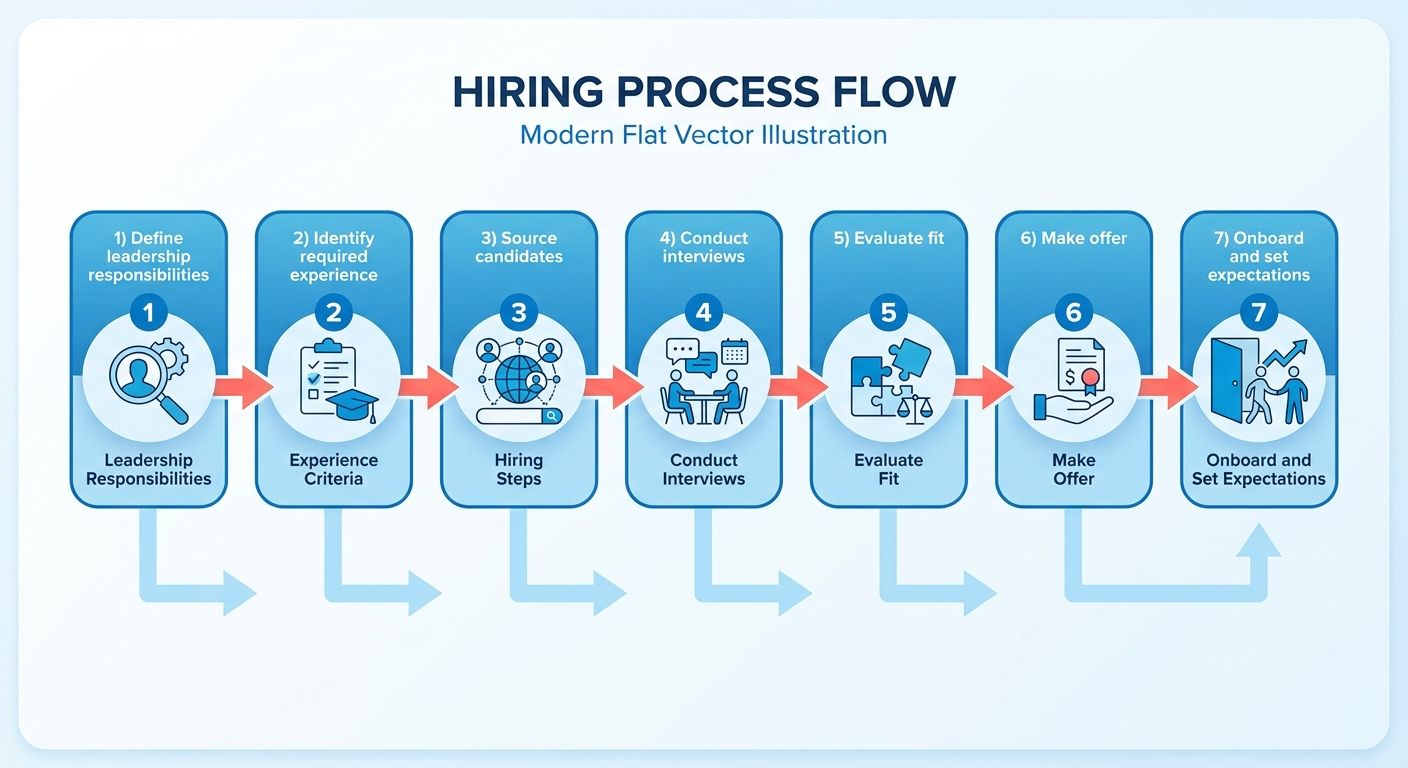
What to look for in a first SEO leader
You want proven experience in both SEO strategy and tactics. They need to think at the channel level while still understanding how a title tag or a site migration actually works. The best first leaders prioritize around growth levers, not vanity metrics.
Three things matter most when you evaluate candidates:
- Experience: They've owned organic search as a channel before, not just executed tasks handed to them. Ask about programs they built from scratch.
- Skills: They blend strategic thinking with hands-on technical and content fluency. A leader who can't read a crawl report or judge a content brief can't direct the people who do.
- Culture fit: They work across product, engineering, and marketing. A strong leader influences teams they don't manage directly.
Favor the candidate who can name the growth levers specific to your business. A SaaS leader chases different levers than someone scaling an e-commerce catalog.
What an SEO leader costs
The average SEO manager salary sits around $115,000 a year, per Glassdoor. That shifts with location, company size, and scope. Treat it as your baseline, not a ceiling.
A senior leader who's built a program before lands at the higher end. That premium pays off. They make fewer expensive mistakes on migrations, redirects, and content strategy. One bad call on a site move can cost you months of traffic.
Budget for the experience you actually need. If you want someone to build a team and own revenue, you're hiring a director-level thinker, not a coordinator.
What this looks like in practice
A strong leader builds repeatable systems instead of chasing one-off wins. Moz's SEO team is a decent benchmark here: they turned search into a structured, well-documented discipline rather than a scramble of disconnected tactics. That's the standard your first hire should aim for.
In practice, your leader spends their early months auditing the site, defining priorities, and deciding what to build versus what to fix. They translate search opportunities into a roadmap your executives can understand.
They also lock in the foundational tech stack early. With the right crawling, keyword research, and rank-tracking tools, a single leader can map the whole site's opportunities and start executing before any specialists come on board.
The non-negotiable: your first hire needs the authority and the budget to execute. Secure executive buy-in and clear operational budgets from day one, and every hire after them has a real shot.
Hiring the Core SEO Roles in the Right Order
Once your leader is in place, hire the three core roles in this order: technical SEO, SEO content lead, then analytics specialist. Together they cover the work that drives organic growth: site health, content production, performance measurement. Skip one and the other two start compensating for gaps they were never built to fill.
The sequence isn't arbitrary. Technical SEO comes first because content built on a broken foundation never ranks. Content comes second because rankings need pages worth ranking. Analytics comes third because you can't measure what doesn't exist yet.
The three core roles
Technical SEO: Owns site architecture, crawlability, page speed, and the fixes that keep search engines reading your site cleanly. This person ships changes with engineering and catches problems before they tank rankings.
SEO content lead: Runs keyword research and optimizes the content that fills your pages. They decide what gets written, brief the work, and make sure each page targets real search demand.
Analytics specialist: Monitors performance across on-page and off-page signals. They turn traffic and ranking data into decisions about where the team spends its next hour.
These map cleanly onto the three questions every SEO program answers: how the site gets optimized, what content gets built, and where performance lands.
What to look for when hiring
Look for practical problem-solving over credentials. Ask technical candidates to walk through a past site migration or a crawl budget fix. For content leads, dig into their portfolio for pieces that rank for competitive, high-intent terms, not just high-volume vanity keywords.
You also want cross-functional empathy. A technical SEO has to translate complex search requirements into clear engineering tickets. A content lead has to work with designers so on-page layouts support both readability and search.
Tailor the criteria to your actual bottleneck. Years of unoptimized blog posts? Your content lead needs deep experience in content audits and historical optimization. Launching a massive database-driven site? Prioritize a technical hire who's strong on programmatic SEO and indexation.
What a well-structured team looks like
As the program matures, the division of labor sharpens. What starts lean becomes a specialized department where people focus on their core strengths instead of splitting attention across disciplines.
High-performing teams set clear service-level agreements between roles. The technical SEO signs off on the staging environment before the content lead publishes a campaign. The analyst delivers post-launch reports within a set window. Everyone knows the handoff.
Documentation keeps it running. Shared wikis, optimization checklists, and historical log files mean people collaborate without friction and new hires onboard without derailing live campaigns.
Avoiding Blind Spots: Balancing Technical, Content, and Analytics
A balanced SEO team covers technical, content, and analytics without leaning too hard on any one. A Search Engine Land study found 60% of companies with an internal SEO team have all three covered. The other 40% run with blind spots that quietly cap their growth.
That balance is what keeps a strong content engine from publishing onto a broken site. It's also what stops a technically perfect site from sitting empty.
What an unbalanced team produces
An unbalanced team produces work that fails for reasons nobody on the team can diagnose. A content-heavy team writes great briefs but misses the crawl errors burying those pages. An analytics-heavy team measures everything and ships nothing.
The disciplines work best in a feedback loop. Technical optimizations get new content indexed fast. Content performance data points the analyst toward high-value search patterns. The analyst's findings tell the content lead and technical SEO where to spend next. Break the loop and you waste effort on optimizations no data ever asked for.
When one discipline dominates, the team compensates for gaps it was never built to fill. That compensation looks like progress on a status report. It doesn't move organic traffic.
Balancing the three when you hire
Map your current team's skills before you open a role. If your staff writes well but struggles with data, your next hire brings strong quantitative chops. Look for T-shaped people: deep in one area, broad enough to collaborate across all three.
Run regular skills audits. As algorithms shift, your team's needs shift with them. A team that was balanced last year may now need deeper expertise in structured data or UX to hold its rankings.
A few things that help:
- Test cross-functional fluency: Does a technical candidate understand how site architecture hits user experience? Can a content candidate read a basic crawl report?
- Hire complements, not copies: Don't clone your existing team. Seek specialists who bring fresh perspective and distinct capabilities.
- Use real scenarios: Put candidates from different disciplines on a complex search problem in the interview and watch how they work it.
What a balanced team looks like in practice
A balanced team runs the three disciplines as one coordinated unit, not three silos. SEMrush's SEO team is a useful model here: technical, content, and analytics work in sync, so each reinforces the others instead of fighting for priority.
In that model, projects move through a clean pipeline. The technical specialist preps the infrastructure. The content lead deploys the targeted pages. The analyst measures business impact. Nothing launches without technical support or performance tracking behind it.
That loop is the whole point. Content informs technical priorities. Analytics informs content. Technical health makes both visible to search engines.
For smaller orgs, balance means versatility. Cross-train people in adjacent disciplines so your content lead can handle basic on-page fixes and your technical SEO understands keyword intent.
Audit your coverage every quarter. Ask which of the three disciplines is carrying the others. Then hire or reallocate to close that gap before it costs you rankings.
Deciding Where the SEO Team Should Sit in the Org Chart
Where your SEO team sits determines how much influence it has over the work that drives organic growth. Most companies put SEO under marketing, but that's not the only option. The right placement depends on your size, your industry, and what you want search to accomplish.
A Forbes study found 70% of companies with an internal SEO team have it report to marketing. That's the default for a reason. SEO shares goals, budgets, and audiences with the rest of marketing, so reporting lines stay clean.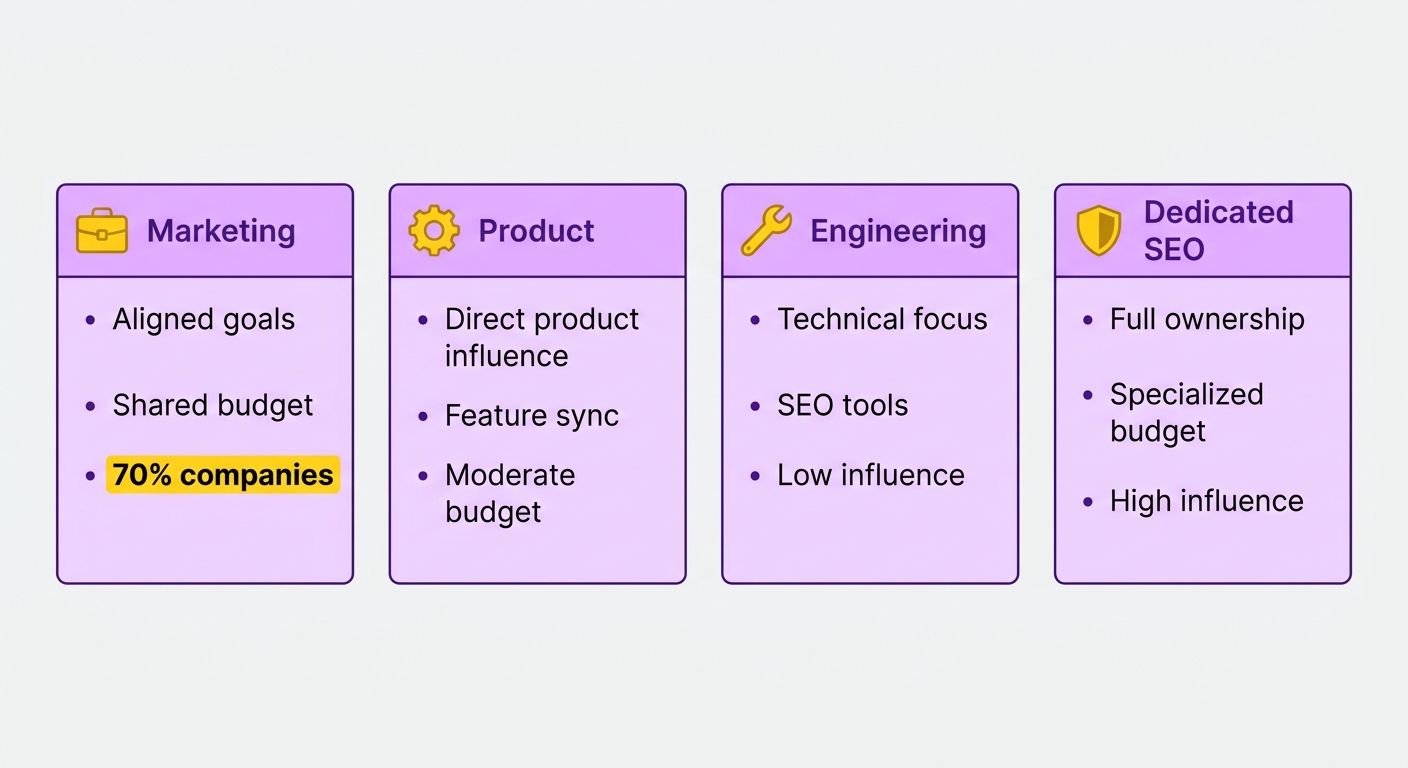
Where the team should report
For most companies, marketing. SEO feeds the same funnel as content, paid media, and demand gen, so a shared reporting line keeps priorities aligned and keeps organic search from operating as a silo.
But marketing isn't the only home. Some organizations place SEO closer to product or engineering, especially when technical work dominates. If your biggest wins come from site architecture and page speed, sitting near engineering shortens the path from decision to deployment.
The reporting line dictates daily focus. Report to marketing and SEO aligns with brand messaging and lead gen, which makes content budget easier to secure. Report to product or engineering and SEO gets baked into the technical roadmap, so site health and performance get prioritized alongside core features.
What should drive the decision
Three factors: company size, industry, and goals. A small business with one or two SEO hires has different needs than an enterprise running pods across multiple markets.
Complexity dictates how specialized your reporting lines need to be. A smaller company might have a single SEO manager reporting to a VP of Marketing, handling both content and basic technical work. A massive enterprise may need dedicated SEO leads embedded in separate product divisions to run complex, localized strategies.
Industry shapes the emphasis. A media company leans content-heavy and fits naturally under marketing. A large e-commerce or SaaS business with deep technical needs may benefit from tighter ties to product or engineering.
Then align the reporting line with your primary KPIs. If success is organic revenue and lead acquisition, keep the team under marketing. If it's platform stability, site speed, and technical compliance, put them inside engineering.
Getting the structure right
Start by identifying your primary bottleneck, then place the team where they have direct access to whatever solves it. The best structure puts search strategists in constant contact with the execution teams, whether that's copywriters, web developers, or data analysts.
Wherever the team lands on the org chart, it needs cross-departmental authority. An SEO team that can't get developer time or editorial approval won't show results. Set clear escalation paths and shared priorities early so search recommendations get treated as core business requirements, not optional suggestions.
Building Workflows with Product, Engineering, Design, and Content
SEO doesn't ship in a vacuum. The work your team plans lands across product, engineering, design, and content. Cross-functional workflows connect those teams so a recommendation moves from a ticket to a live page without stalling. When SEO depends on other people's roadmaps, the handoffs decide whether a fix ships this sprint or sits untouched for a quarter.
Why these workflows matter for SEO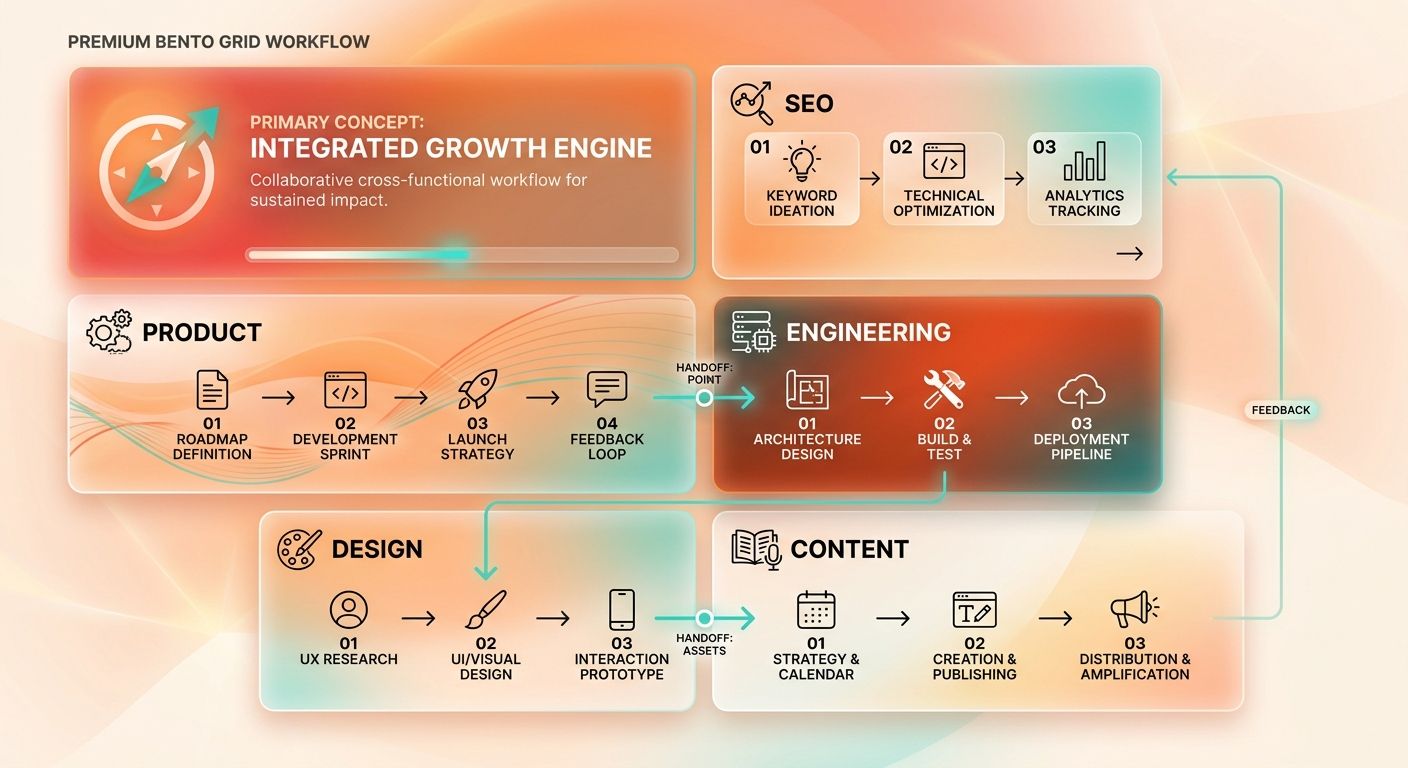
SEO can't execute alone because the wins live in other people's domains. A technical fix needs engineering. A new template needs design. A content brief needs writers and editors. Without shared workflows, recommendations pile up in a backlog nobody owns.
The most reliable fix is putting search specialists directly into existing product and engineering sprints. When SEOs sit in daily standups and sprint planning, they catch technical requirements before code ships, instead of patching issues after launch.
Whatever your model, set clear channels. Dedicated Slack channels, shared project boards, and regular syncs keep search recommendations from getting lost in the noise of everyone else's day.
What to build into the workflow
Three things keep cross-functional work moving: clear communication, active collaboration, and shared goals. Each function should know what it owns, who it hands off to, and what success looks like for the whole group, not just their slice.
Communication: Every team in the workflow needs visibility into what SEO is requesting and why. A recommendation with no business context gets deprioritized fast.
Collaboration: Engineers and designers should sit close enough to SEO planning to catch problems early. A new page template reviewed before launch beats fixing crawl issues after.
Shared goals: When product, engineering, and content all measure against the same organic targets, the work stops competing for priority. Everyone pulls toward the same number.
You can keep these threads visible with an internal company blog or a shared hub that documents requests, decisions, and progress across functions.
How strong teams make this work
The best cross-functional SEO teams hire people who understand both technical constraints and creative processes, so they can speak the language of every department they touch. Airbnb's SEO team gets cited a lot as this kind of integration, where search is woven through product and content instead of bolted on at the end.
Look for that dual fluency when you hire. A specialist who only knows tactics struggles to explain priorities to a product manager. A strategist who can't talk specifics loses credibility with engineering.
Smoothing the publishing pipeline cuts friction between content and technical teams too. With automated deployment and clear CMS permissions, your content lead publishes updates directly instead of pulling a developer in for every minor change. That keeps engineering focused on high-impact work.
Start small. Run one pod on a single shared goal, prove the workflow ships faster, then expand the model across the rest of your search program.
Frequently Asked Questions
1. When should a company transition from a fractional SEO contractor to a full in-house team?
Transition when your search channel demonstrates consistent, predictable ROI and the volume of work exceeds a contractor's bandwidth. If you find that strategic opportunities are stalling due to a lack of dedicated internal resources, or if your content production needs require full-time editorial oversight, it is time to invest in a permanent in-house team.
2. Can one person cover two of the three core SEO roles effectively?
While a generalist can manage basic tasks across multiple disciplines early on, this approach limits long-term growth. A content specialist tasked with managing complex server configurations or javascript rendering issues will struggle to keep up with both editorial demands and technical site health, leading to critical errors in both areas.
3. How long does it take a new SEO leader to show meaningful impact?
Expect a timeline of three to six months to see measurable shifts in organic performance. An in-house leader focuses on establishing foundational workflows, resolving legacy technical debt, and aligning content strategies with business goals. Because organic search is a compounding channel, the structural changes implemented in the first quarter will drive exponential traffic and revenue growth in the quarters that follow.
4. What's the difference between a pod structure and a hierarchical SEO team?
A hierarchical structure centralizes decision-making under a single search director, which is ideal for maintaining consistent brand standards across a small team. A pod structure decentralizes authority, embedding search specialists directly into cross-functional product or regional units. This allows pods to execute optimizations rapidly without waiting for top-down approvals.
5. Should SEO ever report somewhere other than the marketing department?
Yes, particularly in organizations where organic growth is heavily dependent on platform engineering, programmatic page generation, or complex site architecture. Placing the search team within the Product or Engineering department ensures that technical SEO requirements are integrated directly into the core product development lifecycle rather than treated as external marketing requests.
6. How often should an SEO team revisit its mission and scope?
Revisiting your team's focus every quarter ensures alignment with broader business shifts and search engine algorithm updates. These regular check-ins allow you to reallocate resources to high-performing search terms, adjust content production schedules, and ensure your technical roadmap addresses the most critical site health issues.
7. What tools help a lean SEO team produce content at scale without burning out?
Lean teams should leverage modern content operations platforms to streamline their publishing pipelines. Utilizing tools like AnyPost.ai for drafting assistance and automated scheduling allows a small team to maintain a high publishing frequency. This automation frees your content lead to focus on high-level strategy, keyword research, and rigorous editorial review, ensuring that scaled output never compromises brand quality.