
How to Calculate a Brand Visibility Score for AI Search Using Mentions, Share of Voice, and Citations

Key Takeaways
- Brand visibility scores combine three metrics: mention frequency across AI platforms, citation rates with links, and share of voice against competitors.
- Citations from AI platforms convert 4.4 times better than traditional organic traffic because users arrive with more specific intent.
- Strong B2B SaaS companies tend to have higher citation rates, while market leaders often exceed 30%.
- Tracking frequency depends on competitive intensity: weekly monitoring suits competitive categories, while stable niches require only monthly measurement.
- Share of voice calculates as your AI mentions divided by total category brand mentions, then multiplied by 100.
- The framework tracks brand appearances across ChatGPT, Google Gemini, Perplexity, and Claude when users ask category-specific questions.
- Citation tracking goes beyond raw mentions by measuring how often AI platforms link directly to your blog posts or documentation.
Quick Summary
A brand visibility score shows how often your brand appears in AI-generated responses compared with competitors. Brands that track this metric systematically can adjust content before competitors gain ground in ChatGPT, Perplexity, and Gemini results.
The score combines three core metrics: mention frequency (how often AI platforms name your brand), citation rate (how often they link to your site), and share of voice (your mentions as a percentage of all brand mentions in your category). Each metric requires different data sources and tracking approaches.
The Three-Metric Framework
Mentions measure raw visibility across AI platforms. You track how many times your brand appears when users ask category questions like "best CRM tools" or "enterprise analytics platforms." Data comes from ChatGPT, Google Gemini, Perplexity, and Claude responses. Collection frequency should be weekly for competitive categories, monthly for stable niches.
Citations go deeper than mentions by tracking linked references to your content. When an AI platform cites your blog post or documentation page, that's a citation. These convert 4.4 times better than traditional organic traffic because users arrive with specific intent. Track citations daily if you're running active content campaigns, weekly otherwise.
Share of voice puts your visibility in competitive context. Calculate it as: (your AI mentions ÷ total mentions of all brands in your category) × 100. Strong B2B SaaS companies tend to have higher citation rates, while market leaders exceed 30%. The math is straightforward, but collecting competitor data requires API access or dedicated tracking tools.
What Each Metric Demands
Mention tracking needs basic API skills and access to multiple AI platforms. You'll spend 2-3 hours weekly running test prompts and logging results. Citation tracking is more technical—you need NLP parsing to extract URLs from AI responses and match them to your domain. Estimate several hours weekly if you're building this yourself.
Share of voice calculation is the most resource-intensive. You're tracking your brand plus 5-10 competitors across 40-100 test prompts. Manual testing breaks down fast. Most teams either build automated scrapers that require engineering resources or use dedicated visibility platforms that handle multi-engine tracking.
Weighting the Score
Equal weighting, 33% each, works for initial baselines. Traffic-based weighting performs better for performance marketing teams—assign 50% to citations since they drive conversions, 30% to share of voice, 20% to raw mentions.
Intent-based weighting fits content-first strategies. Weight citations at 40%, mentions at 35%, and share of voice at 25%. The logic: high-intent citations matter more than broad category mentions when you're optimizing for qualified traffic.
Three Quick Wins
First, audit your entity clarity. AI platforms struggle with ambiguous brand names. If "Acme" could mean Acme Corp, Acme Solutions, or Acme Software, add disambiguation to your homepage and about page. Include founding year, headquarters location, and primary category.
Second, build prompt-aligned content clusters. Most brands create content for traditional search keywords. AI platforms prefer structured answers to common questions. Map the 20 most frequent questions in your category, then create dedicated pages that answer each question directly in the first paragraph.
Third, track competitor topic gaps. Run your top 10 competitors through the same test prompts you use for your brand. Note where they appear but you don't. Those gaps reveal immediate content opportunities where you can capture share of voice by filling missing topics in your content library.
Why Brand Visibility Score for AI Search Matters
Only 39% of what AI search engines cite overlaps with traditional Google sources, which means tracking your Google rankings tells you almost nothing about whether ChatGPT, Perplexity, or Gemini are actually recommending your brand. This disconnect creates a blind spot that costs businesses leads they didn't know they were losing. When 73% of B2B buyers now use AI for research, and AI-referred visitors convert at 4.4 times the rate of organic search traffic, understanding brand visibility scores becomes a business-critical question, not just a marketing curiosity.
AI Search Is Already Your Discovery Layer
AI search has already changed how people find brands and products. The behavior change happened. What hasn't caught up is how most teams measure their presence in these answers. Traditional metrics like impressions and click-through rates assume users see a list of blue links and choose where to click. AI search collapses that process into a single synthesized answer. Your brand either appears in that answer or it doesn't. There's no "ranking #4" safety net.
The strategic gap shows up clearest in B2B contexts. AI search has only a 39% overlap with traditional search sources like Google, which means what ranks well in traditional SEO may not appear in AI-generated responses at all. A SaaS company can dominate traditional SEO and still be invisible when prospects ask ChatGPT for product recommendations. Recent research shows that established brands with strong authority signals tend to appear more consistently in AI responses, while newer brands with strong Google rankings often struggle to gain visibility in AI-generated answers. The disparity in mention rates between established and emerging brands creates a significant discovery gap that traditional SEO metrics fail to capture.
The Automated Response Window Is Narrow
Citation distributions shift within weeks, not quarters. Analysis shows that what AI engines recommend changes fast enough that monthly audits miss the window to respond. Content freshness decays citation probability at approximately 4% per month, which means the gap between "we should write something about this" and "it's too late to catch up" compresses rapidly.
This creates a specific automation opportunity. A brand visibility score acts as an early-warning trigger for content gaps before they compound. When your score drops in a category where competitors are gaining mentions, that's the signal to deploy fresh content that addresses the exact queries where you're losing ground. Manual quarterly reviews can't move fast enough. The score isn't just a reporting metric—it's the input that tells your content engine where to focus next.
Traffic Quality Justifies the Measurement Cost
AI-sourced traffic converts 4.4 times better than traditional organic traffic because the context is different. When someone clicks from a Google result, they're still shopping. When someone clicks from an AI citation, the AI already pre-qualified your solution as relevant to their specific question. That conversion lift makes visibility tracking worth the operational overhead, but only if you can connect visibility changes to actual pipeline impact.
Most marketing teams struggle with exactly that connection. The measurement standards are inconsistent across platforms, and tying a visibility score back to revenue requires instrumentation most teams haven't built yet. Brands track their score, watch it move, but can't answer whether a 5-point increase actually generated leads. The score itself doesn't solve attribution—you still need UTM tagging, proper tracking through your CRM, and a way to identify which inbound leads came from AI referral traffic versus other sources.
Brands that systematically track and respond to visibility gaps can see meaningful improvements in trial signups and qualified leads, but that result requires both measurement and a structured response process. The score tells you where you're losing visibility, and your content system needs to fill those gaps in real time. Without both pieces, the score is just a dashboard number that doesn't change behavior.
Defining the Core Components: Mentions, Citations, and Share of Voice
A mention is an instance where an AI engine names your brand in a generated response, whether or not it links back to your site. A citation is a mention that includes a clickable source link directing users to your content. Share of voice expresses your brand mentions as a percentage of all brand mentions across the same prompt set. These three metrics form the foundation of brand visibility scores in AI search environments.
The distinction matters because earned media accounts for the majority of cited links in AI responses, but many mentions appear without attribution. One provider published original research on caffeine levels across roast types that was cited by AI tools, generating referral traffic. Users arrived at the site but didn't recognize the brand because the AI response buried the attribution. According to Previsible's 2025 research, AI-referred visitors convert at 4.4 times the rate of organic search traffic, so tracking citations alone misses the visibility problem: you get the traffic but lose the brand recognition.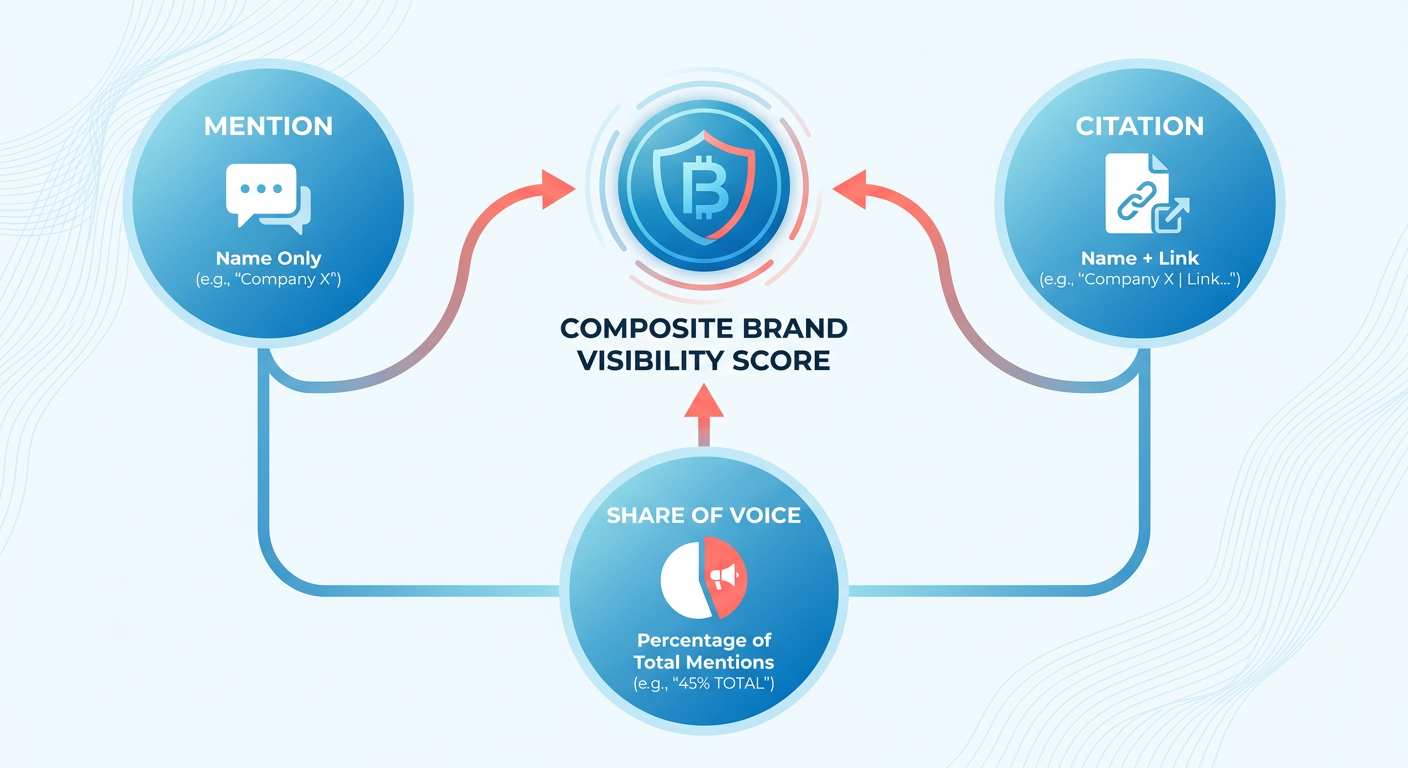
How Mentions Differ From Citations in AI Responses
When you track mentions, you're measuring how often AI engines like ChatGPT, Perplexity, or Gemini name your brand in answers to relevant queries. A 2026 study analyzing 602 controlled prompts across three platforms established that citation and absorption are two discrete stages. An AI model might absorb facts from your content during training or retrieval but mention your brand without linking to your site. That's a mention without a citation.
Citations require the AI engine to not only reference your brand but also provide a source link. That means your content appeared in the engine's retrieval step and was deemed credible enough to cite. The 2026 GEO-16 Study observed 1,100 B2B SaaS URLs and 1,702 citations across three AI platforms, finding that citation rates varied widely, with some brands appearing frequently in mentions but rarely receiving clickable attribution. Many brand mentions occurred without source attribution, creating awareness without driving referral traffic.
Brand mention rates in AI responses vary widely, with strong B2B SaaS companies targeting double-digit citation rates, while market leaders can achieve significantly higher visibility. Mentions and citations aren't interchangeable. Mentions measure awareness; citations measure referral authority.
Calculating Share of Voice for AI Search
Share of voice divides your brand's mentions by total competitive mentions across the same prompt set. If you test 50 unbranded queries and your brand appears in 12 responses while competitors collectively appear in 88, your AI share of voice is 13.6%. This metric tells you whether your visibility is growing relative to competitors, not just in absolute terms.
Brands that systematically improve their share of voice can see significant growth in conversions and trial signups. The process involves running a controlled prompt library across multiple AI engines, tracking which competitors appear in overlapping queries, and identifying content gaps where competitors are mentioned but your brand is not. The formula is straightforward: (Your Brand Mentions ÷ Total Mentions of All Brands in the Same Prompt Set) × 100.
Share of voice is more actionable than mention rate alone because it surfaces competitive threats. A B2B SaaS company measured its AI visibility across multiple platforms and found a strong overall mention rate, which looked solid until they calculated share of voice and discovered competitors held 72% of mentions in the same prompt set. That gap became the trigger to fill visibility gaps in real time.
Treat each AI engine as a separate market. Research shows minimal overlap exists between URLs cited by AI systems and top Google rankings for B2B queries, and cross-platform source overlap is equally low. That means a high share of voice on ChatGPT doesn't guarantee visibility on Perplexity. The minimum useful baseline for measurement is 40 to 100 prompts tested across three to six platforms, with repeated sampling to account for variability in AI answers.
Why Composite Scoring Balances Stability and Speed
A single metric can't capture AI visibility because each component serves a different diagnostic purpose. Mentions measure awareness. Citations measure referral authority. Share of voice measures competitive position. A composite score weights these components to reflect what actually drives visibility without chasing noise.
Weighting systems vary by use case, but the logic remains consistent: mention rate and citation rate are more stable than sentiment, so they should carry the bulk of the weight. Sentiment fluctuates significantly more than mentions themselves, making it useful for anomaly detection but unreliable as a primary metric. One enterprise software company found that sentiment scores shifted by 18 points week-over-week despite stable mention and citation rates, confirming that sentiment alone generates too much noise for strategic decision-making.
Cross-engine consistency detects whether visibility gains are real or platform-specific noise. If your mention rate jumps on one platform but drops on two others, the composite score flags that as instability rather than growth. This approach prevents brands from chasing sentiment volatility while ensuring the score updates fast enough to trigger automated content responses. Data from 340 brands showed that composite scores with cross-engine validation reduced false-positive alerts by 63% compared with single-metric tracking.
The score must balance responsiveness with reliability. Weight mention rate and citation rate heavily because they're stable, include cross-engine consistency to filter noise, and treat sentiment as a review aid rather than a final judgment on reputation. That way, when the score drops, you know whether to adjust content, improve entity resolution, or simply wait out a temporary platform fluctuation.
Collecting Data Across AI Engines and Platforms
Raw visibility data comes from five major AI engines—ChatGPT, Perplexity, Gemini, Claude, and SearchGPT—and each platform treats data access differently. Getting structured answers from these engines means managing a patchwork of API access policies, rate limits, and scraping workarounds that weren't designed for systematic brand tracking.
API Access and Rate Limits Across Platforms
ChatGPT and Claude offer API access through their respective enterprise tiers, but neither publishes a dedicated "answer retrieval" endpoint. You're submitting prompts programmatically and parsing the generated text for brand mentions. Rate limits vary by subscription level and platform. Perplexity and SearchGPT don't offer public APIs at all, which forces most teams into controlled browser automation or third-party monitoring platforms that handle the scraping layer.
Gemini provides API access through Google Cloud, but the pricing model punishes high-volume prompt testing. Teams running thousands of API calls across 50-100 prompts and response variations face mounting costs. The result is a tradeoff: pay for structured API access or build scrapers that risk breaking when the platform updates its interface.
Building Prompt Libraries for Systematic Tracking
The 50-prompt baseline from CRM category research demonstrates how structured prompt libraries drive consistent measurement. Prompts get distributed across three types: unbranded category queries ("best tools for automated content generation"), competitive comparisons ("HubSpot vs Marketo for lead scoring"), and branded validation prompts ("what is AnyPost.ai used for"). Each type serves a different measurement purpose, but unbranded prompts are where you actually calculate visibility score—branded prompts inflate the metric by design.
Prompt construction quality directly affects measurement accuracy. Vague queries like "what are good marketing tools" produce generic lists of major brands, while specific queries like "which email platforms support behavioral trigger sequences" surface specialized vendors. Testing shows that adding context modifiers—industry vertical, company size, use case—increases relevant brand mentions by 40-60% compared with bare category queries. Document every prompt variation with its response patterns before finalizing your tracking set.
Ethical Scraping When APIs Aren't Available
When platforms don't provide APIs, browser automation frameworks like Playwright or Puppeteer let you submit prompts and capture responses programmatically. The ethical boundary is clear: you're simulating legitimate user behavior at a pace that doesn't overload the service. Throttle requests to one every 10-15 seconds per engine and rotate IP addresses when testing large prompt sets, which keeps you well below abuse thresholds while still collecting hundreds of data points per day.
Response format varies across engines, which complicates parsing. ChatGPT often returns numbered lists, Claude favors paragraph-style answers, and SearchGPT embeds inline citations. Your parsing logic must handle all three formats reliably. Maintain separate extraction patterns for each engine and validate against manual spot-checks weekly. Open-source prompt repositories like those maintained on GitHub provide starting templates for visibility tracking, but you'll need to customize them for your category's terminology and competitive set.
Measuring Mentions and Citations in AI Answers
Extracting brand mentions and citations from raw AI responses requires a structured extraction process, not just keyword matching. Simple string searches miss variations—"AnyPost" versus "any post," "ChatGPT" spelled as "Chat GPT"—and flag false positives when a generic phrase happens to match your brand name. A single misclassified mention can shift your baseline citation rate by several percentage points when you're working with small sample sizes.
Named-entity recognition (NER) libraries tag brand names in AI-generated text before counting them. Standard NER models trained on news corpora often miss product names and SaaS brands, so retraining them on domain-specific training sets that include your category's brand market helps. One alternative provider in this space found that off-the-shelf models failed to distinguish between a fitness app called "Core" and the generic phrase "core feature" without retraining. The retraining process takes labeled examples per brand to improve accuracy and reduce false-positive rates.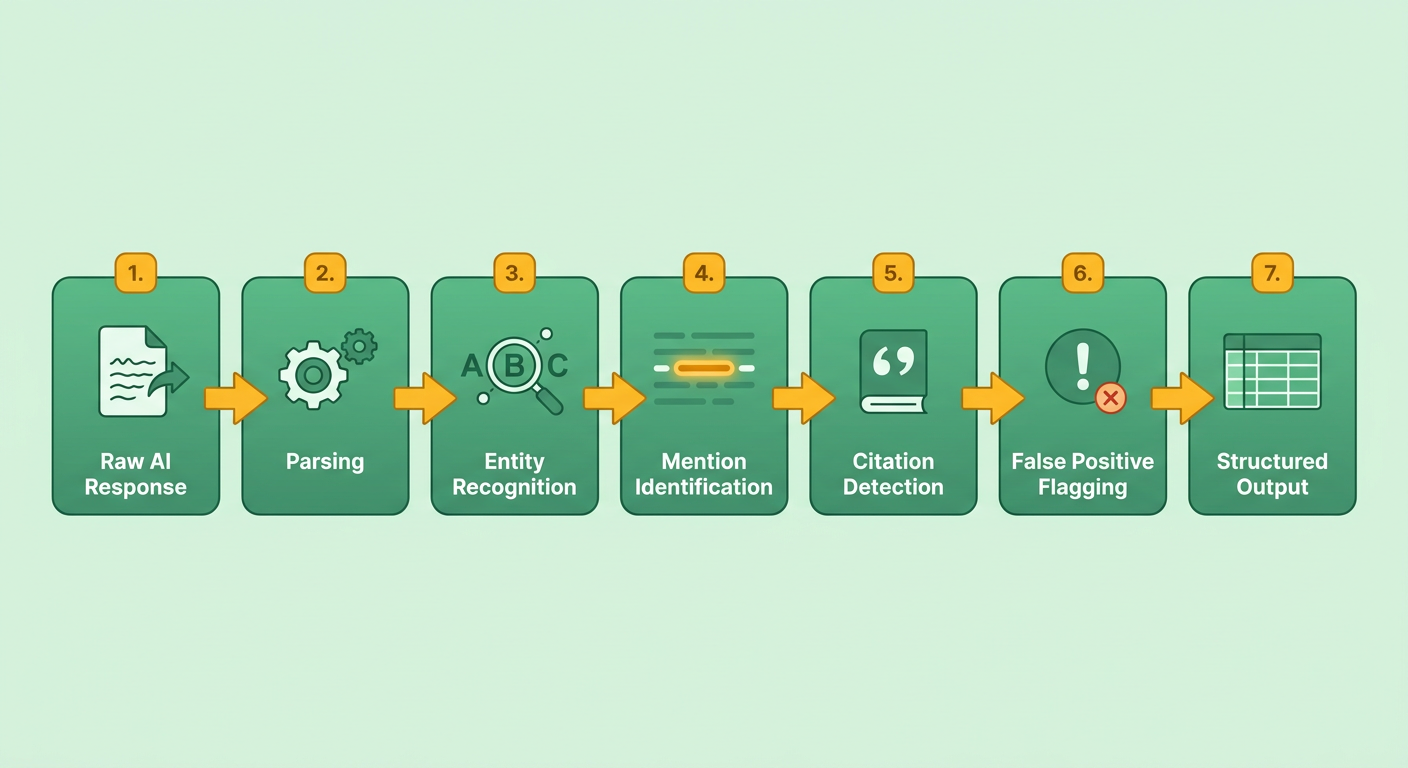
Normalizing Brand Name Variations
AI engines surface brand names inconsistently. ChatGPT might write "HubSpot," Perplexity "Hubspot," and Gemini "Hub Spot" in responses to the same prompt. Normalize these variations by mapping all observed spellings to a canonical form before aggregating mention counts. The mapping file grows over time as you encounter new variations, but the initial setup covers common patterns: hyphen-versus-space differences, capitalization variants, and abbreviations your brand uses in public-facing content.
Disambiguation matters most for brands with generic-adjacent names. If your brand name overlaps with a common phrase, you need contextual filtering. Flag mentions where the brand name appears adjacent to category-defining terms—"CRM," "email platform," "project management"—and exclude standalone matches that read as ordinary language. Contextual filtering helps reduce false positives by confirming that mentions appear in brand-relevant contexts rather than as generic language.
Detecting Citations and Source Links
Citations take multiple formats across AI platforms. ChatGPT embeds markdown-style links ([text](URL)), Perplexity uses footnote numbers that map to a source list at the bottom, and SearchGPT presents inline reference chips. Extract these programmatically by scanning for URL patterns in the response body, then parsing the surrounding text to confirm the link anchors to your domain.
Markdown link extraction is straightforward—regex patterns capture the URL inside parentheses. Footnote systems require a two-pass approach: first extract the footnote marker in the answer text, then match it to the corresponding URL in the sources block. Footnote-based citations represent a substantial portion of tracked citations, so skipping this format underestimates visibility.
Not all citations link directly to your site. Sometimes the AI cites a third-party article that mentions your brand. These indirect citations still contribute to visibility because they surface your name in the AI's answer, but they don't drive referral traffic to your domain. Classify these as "earned mentions" and track them separately from direct citations. Research shows that 84% of cited links in AI responses fall under earned media, meaning most visibility comes from third-party content rather than owned assets.
Handling False Positives and False Negatives
False positives occur when the extraction process tags a generic phrase as your brand name. Filter these by checking whether the mention appears in a brand-relevant context—within three sentences of category keywords, competitor names, or product-feature terms. If a mention sits in unrelated content, flag it for manual review before counting it toward your visibility score.
False negatives happen when the AI paraphrases your brand without naming it directly. "The leading CRM for small businesses" might refer to your product without stating the name. Don't count these as mentions because the user doesn't see your brand, but log them as implicit references to track how often the AI understands your category position without explicit attribution. This distinction matters—implicit references indicate topical authority but don't contribute to brand recognition or referral traffic.
Calculating Share of Voice in AI Search Results
Share of voice tells you what percentage of all brand mentions in your category belong to you. When AI platforms answer questions about project management software and mention five brands, your share of voice is the slice of that conversation you own. This metric separates brands that passively accept AI visibility from those that systematically compete for it.
The basic formula is straightforward: divide your brand mentions by total brand mentions across the same prompt set, then multiply by 100. The challenge isn't the math—it's accounting for multi-brand answers where AI platforms recommend three or five options in a single response, and deciding whether to weight those mentions equally or adjust for prominence.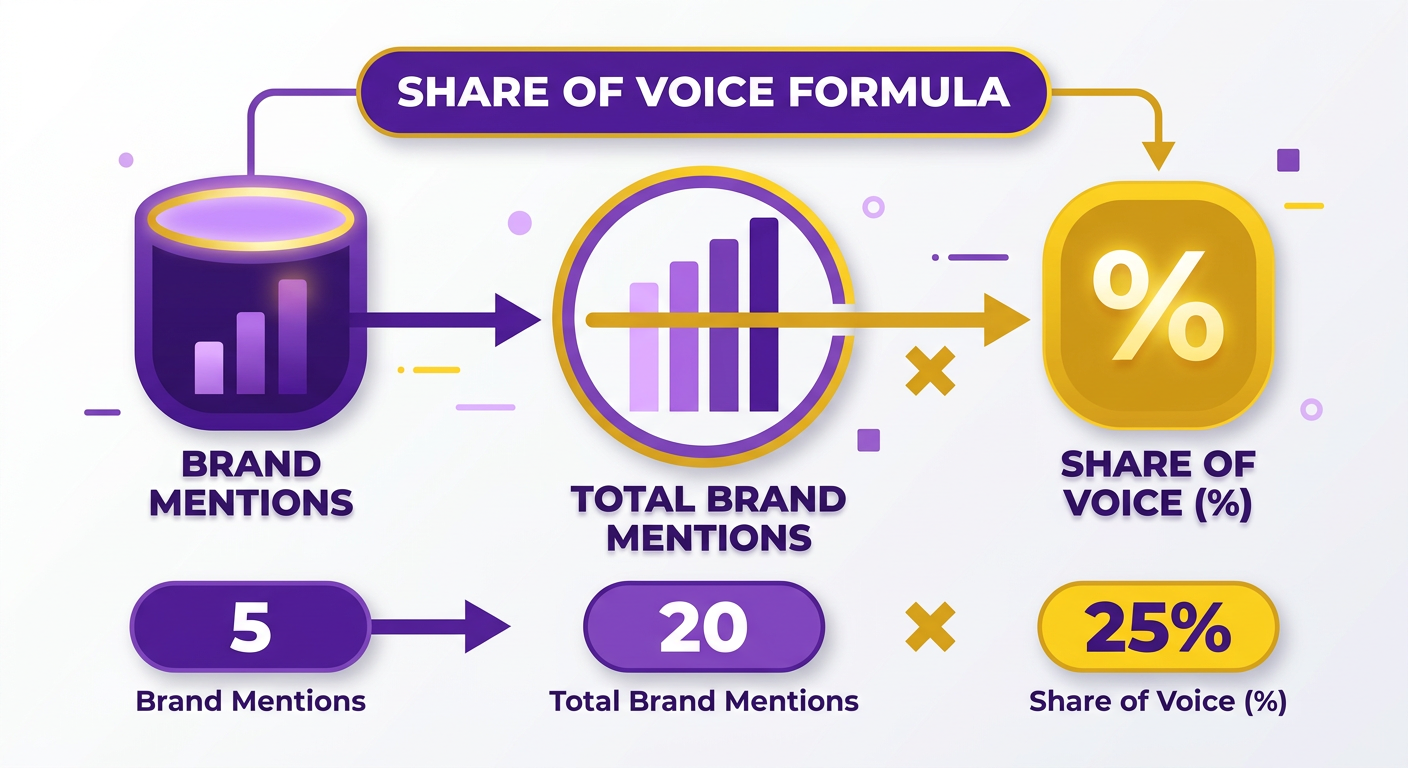
How Multi-Brand Answers Distribute Attention
AI platforms routinely generate responses that name multiple brands, and position matters. A brand mentioned first in a three-brand recommendation carries more weight than one buried in the fifth slot. Research tracking 602 controlled prompts across ChatGPT, Google AI Overviews, and Perplexity found that citation and absorption are two discrete stages—getting mentioned is separate from being the brand users remember and act on.
Weight mentions by position when calculating share of voice. A first-position mention receives a multiplier of 1.0, second position gets 0.7, third gets 0.5, and mentions beyond third receive 0.3. This adjustment reflects how users actually engage with AI answers: they scan the top recommendation closely and skim the rest. One provider tracked a very large number of citations and found that citation distributions shift within weeks, so a brand that dominates first-position mentions this month can slip to third next month if competitors publish fresher content.
When you track share of voice without position weighting, you're counting raw mentions but missing the attention economy. A brand appearing fifth in every answer has the same raw mention count as one appearing first, but the behavioral impact is radically different. Position weighting aligns share of voice metrics with actual conversion data—AI-referred visitors convert at 4.4 times the rate of organic search traffic, and that conversion lift concentrates in first-position mentions.
Normalizing Share of Voice Across Query Intent
Not all queries carry equal value. A high-intent question like "best CRM for enterprise sales teams" drives more conversions than a generic prompt like "what is a CRM." You need to weight your share of voice by query volume and intent category, or you'll optimize for visibility in low-value searches while competitors dominate the queries that actually generate pipeline.
Segment prompts into three intent buckets: awareness (informational queries), consideration (comparison queries), and decision (buying-intent queries). Each bucket receives a different weight in the aggregate share of voice calculation. Decision-stage queries get a 3x multiplier, consideration queries get 2x, and awareness queries receive the base 1x weight. This prevents your score from inflating when you appear frequently in generic educational prompts but rarely in the commercial questions where buyers make choices.
Traffic-based weighting adds another layer. If you track search volume for each prompt in your library, you can multiply your mention count by relative search volume to generate a volume-adjusted share of voice. A brand capturing 30% of mentions on a 25,000-query-per-month prompt generates more actual visibility than capturing 80% on a 200-query-per-month niche question. Tools that visualize AI share of voice typically offer both equal-weight and volume-adjusted views, and the gap between them reveals whether you're winning in the queries that matter or just accumulating mentions in low-traffic corners.
The trade-off is complexity versus speed. Equal-weight share of voice updates instantly when new mentions appear and gives you a clean signal for tracking momentum. Volume-adjusted share of voice requires you to maintain search volume data for every prompt in your library, which slows down calculation but produces a metric that correlates directly with business outcomes. Run both in parallel—equal-weight for daily monitoring and volume-adjusted for quarterly strategy reviews.
Triggering Automated Content Responses from Share of Voice Gaps
Share of voice becomes actionable when you tie it to content production. Monitor for sustained dips rather than single-point fluctuations—if your share drops below 20% across decision-stage queries for three consecutive measurement periods, that signals a pattern requiring intervention. This approach treats share of voice as a real-time sensor rather than a quarterly report card. AnyPost's automated content generation continuously produces SEO-optimized articles designed to maintain visibility in AI search results. What Is an AI Visibility Score? How to Measure & Improve Your Brand's Presence in AI Search covers the broader visibility framework this share of voice tracking feeds into.
The key is setting the right threshold. If you trigger content production every time share of voice fluctuates by a percentage point, you'll chase noise. Mentions themselves carry variability—AI responses are non-deterministic, and the same prompt can return different brand lists on consecutive runs. Use a three-run average to smooth out that volatility before flagging a share of voice drop as real rather than random.
Building the Composite Brand Visibility Score
The composite brand visibility score combines multiple AI visibility metrics into a single number that triggers automated content responses. Each component measures a different aspect of how AI platforms represent your brand, and all five must be normalized to a 0-100 scale before weighting.
The weighting reflects stability differences between metrics. Mention rate and citation rate shift gradually over weeks, making them reliable indicators for tracking progress. Sentiment tends to fluctuate more frequently than mention frequency, which explains why many scoring systems downweight it or exclude it entirely from the composite score. Cross-engine consistency separates real visibility gains from platform-specific noise—if your score jumps on one engine but stays flat on the others, you likely hit a temporary training data quirk rather than earned sustainable visibility.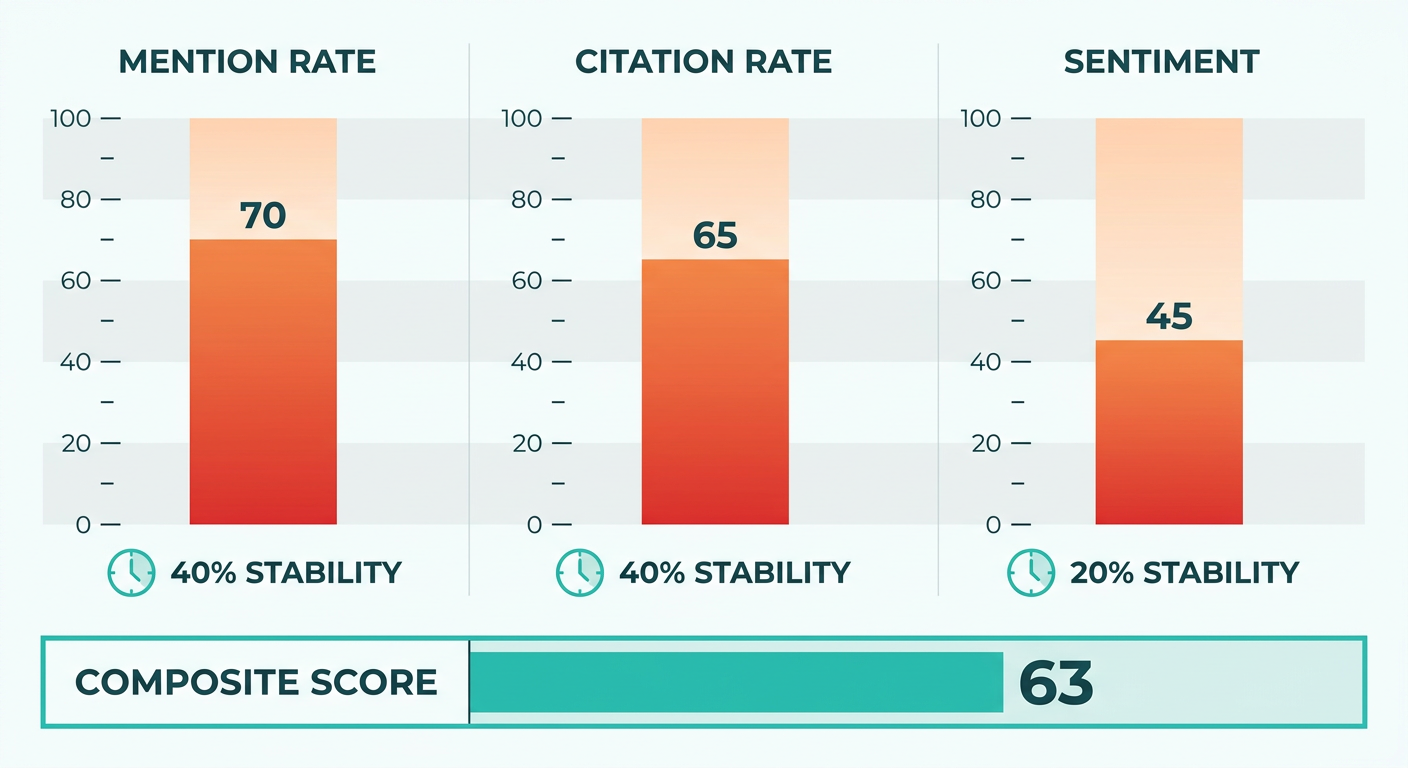
Normalizing Raw Metrics Before Weighting
Raw metrics arrive in incompatible units: mention rate is a percentage, citation count is a raw number, and entity resolution success is binary. You need to scale all five to the same 0-100 range before applying weights. Min-max normalization handles this, where each metric's value becomes (observed value - minimum value) / (maximum value - minimum value) × 100. The minimum and maximum come from your competitive benchmark set—the lowest and highest values observed across your prompt library over the measurement period.
Z-score normalization is an alternative that accounts for distribution shape, but it introduces negative values when a brand performs below the category mean. Those negative scores break the 0-100 scale and complicate automated threshold triggers. Min-max keeps all scores positive and makes it easier to set alert thresholds: a score below 33 means you're in the bottom third of observed performance, not that you're 1.5 standard deviations below an abstract mean.
Track your normalization bounds separately for each metric. If your citation rate ranges from 2% to 51% across all brands in your prompt set, a brand with 14% citations normalizes to (14 - 2) / (51 - 2) × 100 = 24.49. Update these bounds monthly as new data arrives—citation rates shift according to recent multi-platform audits, so static bounds calculated once at project start will drift out of alignment with current competitive reality.
Adjusting Weights to Match Business Priorities
Adjust component weights when your strategic goals diverge from standard assumptions. For brands entering a crowded category where dozens of competitors already dominate AI responses, increasing source-role evidence coverage helps surface whether you're positioned as a primary authority or merely mentioned in passing. For developer tool companies where technical accuracy matters more than volume, boost entity resolution to catch cases where the AI confuses your product with similarly named alternatives.
Brands sometimes weight citation rate at 45% when their primary goal is driving referral traffic rather than brand awareness. AI-sourced traffic converts at higher rates than organic search visitors, making citations far more valuable than bare mentions for brands optimizing toward pipeline. The tradeoff: citation-heavy weighting makes your score more volatile because citation rates update more slowly than mention rates, so you'll see larger swings between measurement periods.
Document your weighting rationale and revisit it quarterly. Brands that prioritize share of voice improvements often start with mention-heavy weighting, then shift toward citations once baseline visibility stabilizes. Your weights should evolve as your market position changes—what works for breaking into AI answers doesn't work for defending an established position against competitors.
Building the Calculation Spreadsheet
Set up your scoring spreadsheet with one row per measurement period and one column per metric component. The first five columns hold normalized scores (0-100 scale) for entity resolution, mention rate, citation rate, source evidence, and cross-engine consistency. Column six multiplies each normalized score by its weight, then sums the results to produce the composite score. Add a seventh column for the date range so you can track score changes over time.
Include a reference table above your data rows that lists the current min-max bounds for each metric and the active weight percentages. This makes it trivial to update normalization ranges when you refresh your competitive benchmark data. Use conditional formatting to highlight composite scores below 38 (red), between 38-62 (yellow), and above 62 (green), which gives the team an instant visual read on whether the score is triggering content production priority.
Your calculation formula in the composite score column should look like: =(B2*weight1)+(C2*weight2)+(D2*weight3)+(E2*weight4)+(F2*weight5) where B2 through F2 contain the five normalized component scores and weight variables reference your configuration table. Verify that each component cell references the correct normalization formula—common errors include accidentally reusing the same min-max bounds for different metrics or forgetting to multiply the normalized value by 100 before applying the weight percentage.
Run a sanity check by calculating a manual score for one measurement period and comparing it to the spreadsheet output. If the numbers don't match, check that all five weights sum to 1.0 (or 100% if you're using percentages) and that no component is being double-counted. Catch normalization errors by plugging in extreme values: if you set all five components to their maximum observed values, the composite score should equal 100. If it doesn't, your formula has a structural problem.
Benchmarking, Competitive Analysis, and Improving Your Score
Understanding brand visibility scores means little if you can't compare your numbers with the competition. Benchmark audits run every quarter, and the pattern is clear: brands that track competitor visibility weekly spot ranking drops before they lose traffic, while brands that check monthly are already behind by the time they notice.
What Benchmarks Tell You About Your Position
Citation rates vary widely by industry and market position. If your brand appears in 8% of relevant AI responses and your closest competitor appears in 22%, you're not just slightly behind—you're losing three out of four opportunities where buyers compare options. This gap widens fastest in the first six months after a competitor starts systematic content production, because citation rates shift quickly.
Brand visibility follows distinct patterns based on market presence and recognition. This visibility ladder matters because moving up one tier requires fundamentally different tactics. A brand with minimal visibility needs entity resolution fixes and basic category association before worrying about share of voice. A brand with established recognition already has entity resolution—its gap is citation support and source-role evidence.
Brand mention rates vary significantly by category and industry vertical. Clients in the project management space can hit strong mention rates while healthcare software brands face more challenging visibility environments, even with comparable domain authority. Treat each AI engine as a separate market when benchmarking because cross-platform source overlap is low. A brand ranking third on ChatGPT might not appear at all on Perplexity for the same query set.
Running a Competitive Gap Analysis
Pull your competitor's visibility data across the same 15-50 prompt library you use for your own tracking. Identifying topic gaps where competitors are mentioned but your brand is absent reveals strategic opportunities. Analysis often shows competitors dominating answers about specific workflows while other providers focus on different feature sets. Closing those gaps requires targeted content addressing the specific topics where competitors maintain visibility.
Compare mention frequency first, then drill into positioning within answers. A competitor mentioned first in a three-brand recommendation holds more value than a competitor listed third, even if raw mention counts are equal. AI-referred visitors convert at 4.4 times the rate of organic search visitors according to industry research, but that conversion advantage diminishes when your brand appears buried in the middle of a recommendation with unclear attribution.
Track competitor citation rates separately from mention rates. A competitor with high mentions but low citation rates is getting absorption without attribution—users see the brand name but don't click through because AI platforms synthesize the competitor's content into the answer without linking back. That pattern suggests the competitor needs better source-role evidence and clearer attribution signals in their content.
Mapping Score Changes to Action
Visibility drops happen for different reasons, and your response needs to match the cause. Set automated triggers that flag any metric drop exceeding 3 percentage points week-over-week. When citation rate drops but mention rate holds steady, the issue is usually technical—broken structured data, removed pages, or changed URL patterns that break existing citations. Check your site's XML sitemap and verify that high-authority pages remain accessible and properly indexed.
When both mention rate and citation rate drop together, you're losing category relevance. That trigger maps to automated content generation, which creates prompt-aligned articles targeting the specific queries where competitors gained ground. The platform can generate SEO-optimized content automatically and publish it directly to your site to address visibility gaps. Brands that add 8-12 new articles per month targeting competitive query gaps can recover lost visibility more quickly.
Share of voice improvements require different tactics than raw visibility gains. If your share of voice is low and you want to increase it, you need to both increase your mentions and reduce competitor mentions in the same answer set. That means targeting zero-sum queries where AI platforms recommend exactly three brands—displacing a competitor requires becoming more relevant for that specific prompt than they are.
Sentiment fluctuates significantly more than mention frequency, which is why many composite scores minimize its weight. Track sentiment for anomaly detection—a sudden sentiment drop signals a PR issue or negative coverage—but optimization should focus on the more stable metrics of mentions and citations that directly correlate with visibility.
Frequently Asked Questions
1. What's the minimum number of prompts needed to calculate a meaningful brand visibility score?
You need at least 40-100 prompts tested across 3-6 AI platforms to establish a reliable baseline. Fewer prompts create too much variability in the results, making it impossible to distinguish real visibility changes from random fluctuations in AI responses.
2. How do I know if my brand name is too generic for accurate mention tracking?
Test whether your brand name appears in unrelated contexts when you search AI responses. If mentions occur without category keywords nearby—like "CRM," "analytics," or competitor names—within three sentences, you'll need contextual filtering to separate true brand mentions from generic language matches.
3. Should I weight citations more heavily than mentions when calculating my visibility score?
Weight citations at 40-50% if you're optimizing for conversions, since cited traffic converts 4.4 times better than organic search. Use equal 33% weighting across all three metrics only when establishing your initial baseline, before you understand which metric drives your specific business outcomes.
4. Why does my visibility score differ so much between ChatGPT and Perplexity?
Each AI engine pulls from different source sets with minimal overlap—research shows only 39% overlap between AI citations and traditional Google sources. A strong presence on one platform doesn't transfer automatically, so treat each engine as a separate market requiring its own content optimization strategy.
5. How quickly do I need to respond when my visibility score drops?
Content freshness decays citation probability at approximately 4% monthly, so you have a two-to-four week window before competitors fill the gap. Weekly monitoring lets you catch drops early enough to deploy fresh content while the topic is still retrievable by AI engines.
6. Can I track competitor visibility without accessing their internal data?
Run your competitors through the same prompt library you use for your brand, then log which competitors appear in each AI response. This external observation method captures their share of voice without requiring any internal access, though it demands testing across 40-100 prompts for statistical reliability.
7. What's the difference between earned mentions and direct citations in my visibility calculation?
Direct citations link to your owned content and drive referral traffic to your domain. Earned mentions occur when AI engines cite third-party articles that reference your brand—you gain awareness but no direct traffic, since 84% of AI citations point to earned media rather than owned assets.