
How to Choose an Automated Rank Tracker for SEO Teams

Key Takeaways
- The first organic result gets 40% of search traffic. Position matters.
- One agency cut reporting time 30% after switching to API-based tracking instead of manual checks.
- Manual tracking breaks at scale. Tracking 5,000 keywords manually burns hours on data entry instead of analysis.
- API tracking closes the timing gap. You can measure SERP impact an hour after publishing new content.
- Fixed-schedule trackers running daily or weekly scans measure yesterday's SERP, not today's content impact.
- Automated trackers let you measure content velocity, not just position. That matters for AI publishing workflows.
- Teams publishing fifty posts monthly instead of five cannot maintain manual rank checking without creating bottlenecks.
Why Automated Rank Tracking Matters
We track rankings because search visibility drives organic traffic. But when you're publishing AI-generated content at scale, manual rank checking becomes a bottleneck. You can't wait a week to see whether Monday's batch moved the needle. An automated rank tracker removes that lag and gives you the feedback loop you need to iterate.
Why Manual Tracking Breaks Down for AI Content Workflows
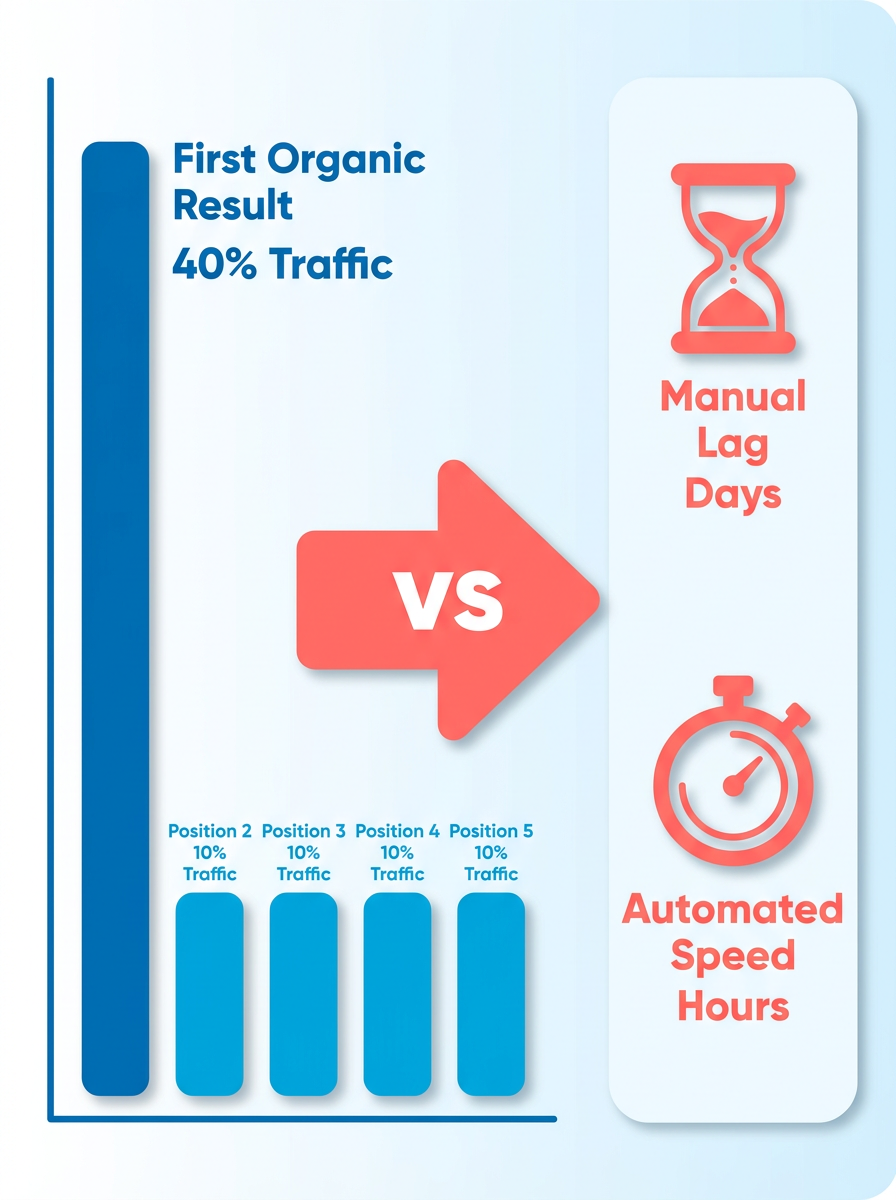
Manual rank checks work fine for low-volume publishing. They collapse under high-frequency content schedules. When tracking thousands of search terms manually, teams spend their time copying and pasting data instead of analyzing trends. By transitioning to automated tracking through an API, teams can redirect those hours to strategy work that actually moves rankings.
The other issue is data delay. Standard tracking tools run scans on rigid schedules. If you publish a batch of posts right after a scan completes, you wait for the next scheduled run to see any movement. On-demand tracking solves this by allowing immediate updates. You verify indexing and initial placement shortly after publishing.
What Automated Tracking Enables for AI-Generated Content
Automated rank trackers let you measure content velocity, not just position. When you're generating posts automatically, you need to know which topics, formats, or keyword clusters perform fastest. A tracker that pipes data back into your content workflow through an API or webhook turns ranking results into input for the next publishing cycle. You see that location-specific how-to posts rank within 48 hours, so you generate more of them. That feedback loop does not exist when you're downloading CSV files once a week.
Scale is the other benefit. Tools that handle bulk keyword tracking, some allowing up to 5,000 keywords for under $50 per month, mean you can monitor every post you publish without blowing the budget. Compare that to manual tracking or legacy software priced per keyword: you'd either cap your content output or ignore half your URLs. Neither works when your competitive edge is publishing volume.
One pattern we see: teams running automated content generation hit the same rate-limit and reporting-cadence problems agencies managing 50+ clients already know. If your tracker cannot handle API calls at the pace your content engine publishes, you're back to batching and delays. That's why API keyword capacity and refresh frequency become primary selection criteria, not afterthoughts. A tool with 99.9% tracking accuracy across 107,000+ locations sounds impressive until you realize it only refreshes daily, which is fine for most SEO work but inadequate for fast-iteration AI workflows.
Tracking AI Visibility, Not Just Blue-Link Position
Modern search results require tracking more than traditional organic positions. As AI-generated summaries, featured snippets, and knowledge panels dominate the top of the page, standard position metrics miss the full picture. If conversational engines surface your content in their answers but your software only monitors standard links, you miss a significant portion of your actual search footprint.
We see this gap growing: 42% of agencies now prioritize workflow flexibility when evaluating SEO tools, because they need to track rankings in AI platforms alongside traditional search engines. The tracker you choose should monitor where your AI-generated content appears, not just where it ranks. That means coverage across YouTube, Google AI Overviews, and conversational engines, not just organic positions 1 through 10. If your content is designed to feed AI answer engines, your tracker needs to measure whether it's succeeding.
Select a rank tracker that integrates directly with your content workflow and measures modern SERP features. For teams leveraging automated content generation, this requires API access, on-demand refresh capabilities, and visibility tracking that extends beyond standard organic listings.
Key Features of Automated Rank Trackers
When you're publishing AI-generated content at scale, the automated rank tracker you choose needs to close a feedback loop manual tools cannot handle. We need to see which posts moved rankings within hours or days, not weeks, so we can adjust prompts, update topic clusters, and retrain models before publishing the next batch. That means looking past the standard daily-refresh schedule and finding tools that offer on-demand updates, API access for programmatic workflows, and AI-surface visibility beyond blue-link positions.
Real-Time Feedback vs. Scheduled Reporting
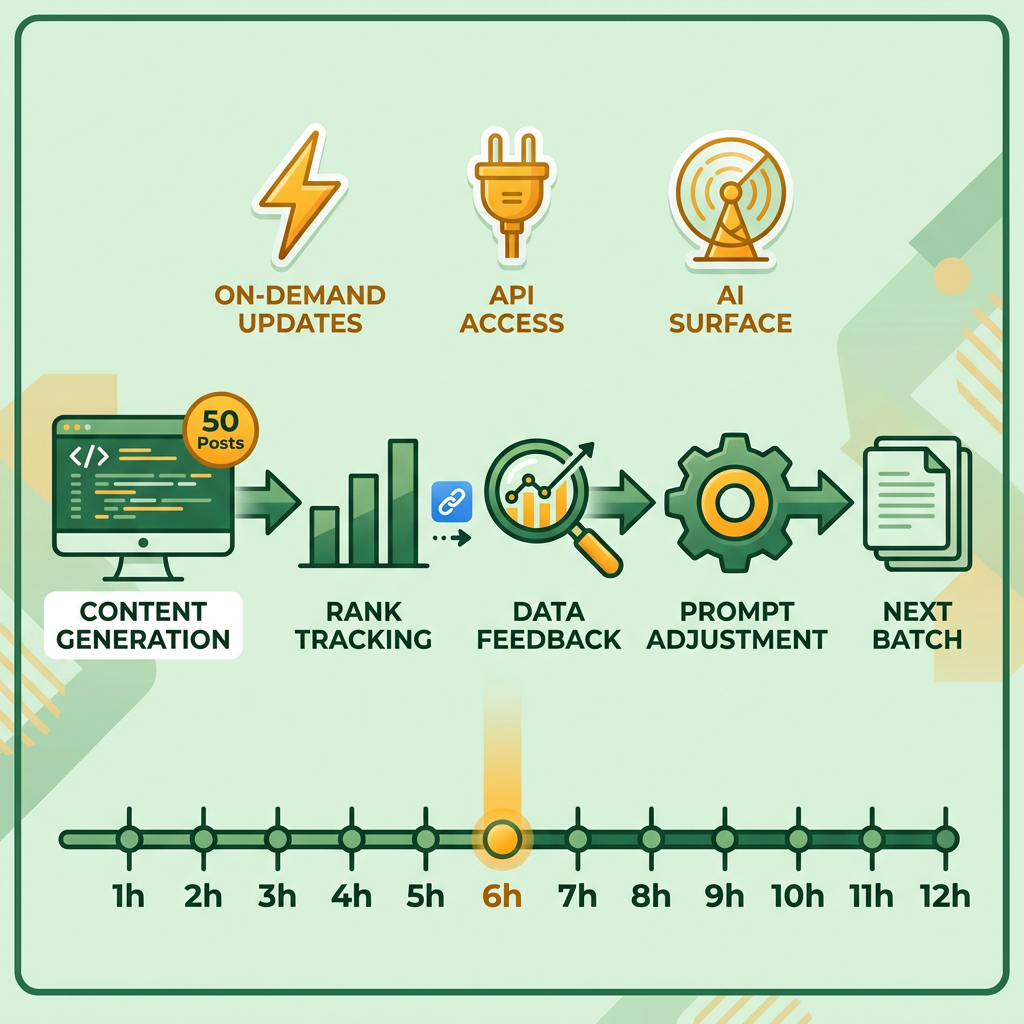
Most rank trackers refresh positions once a day at a fixed time. While a daily cadence is standard, it makes it difficult to correlate ranking movement with specific content drops. On-demand ranking updates allow you to trigger a refresh immediately after pushing new content, piping the results back into your pipeline via API. This turns rank tracking into an active quality-control step, helping you identify underperforming keyword clusters before the next batch of content is generated.
In practice, that means prioritizing API capacity over dashboard polish. Compare that to traditional software pricing, where the same keyword count might cost three times as much because you're paying for UI features your automated pipeline does not use. Teams running content at volume care less about a polished interface and more about whether rank data flows cleanly into BI tools, custom dashboards, and content-generation scripts.
Tracking AI Surfaces Alongside Traditional SERPs
Blue-link position still shapes where clicks land, but when you're creating content specifically for AI platforms, position alone answers the wrong question. Search behavior is fragmenting across ChatGPT, Claude, and Google's AI Overviews. Roughly a quarter of informational queries now trigger an AI-generated summary before any organic result loads. A tool that only reports traditional SERP positions misses whether your AI-generated posts show up in those AI surfaces at all.
We track both. The best automated rank trackers now cover AI platform visibility alongside Google, Bing, and YouTube, letting you see whether a post ranks in classic search and whether it surfaces in conversational AI responses. A capable tracker pulls localized results down to the city and zip-code level, then layers AI-platform coverage on top. That granularity matters when you're testing localized AI content. You need to know whether a geo-targeted post ranks in the right zip code and whether it appears in AI answers for users in that area.
Position matters where blue-link SERPs dominate, but AI surfaces and rich results are rewriting the SERP layout. For AI-generated content workflows, you need both metrics. Track position to measure traditional visibility. Track AI-surface presence to measure whether your content feeds the models that increasingly mediate search.
API Limits and Scale Thresholds
Automated content generation and automated rank tracking collide at scale. When publishing hundreds of posts per month, you trigger API rate limits and reporting-cadence constraints that restrict data flow. If you cannot refresh rankings fast enough to inform the next content batch, you lose the ability to optimize on the fly.
Check API documentation before committing. Look for providers that publish clear rate limits, offer bulk-query endpoints, and support real-time tracking throughout the day instead of locking you into a single daily refresh. If the provider treats API access as an enterprise add-on rather than a core feature, it wasn't built for programmatic workflows. Tools designed for agency scale, where one account manages multiple projects and each project tracks thousands of keywords, map cleanly onto AI content workflows, where one content engine generates posts across multiple topic clusters and each cluster needs independent rank monitoring.
Evaluating Top Automated Rank Trackers
Picking an automated rank tracker feels harder than it should. As one review team put it, choosing between tools is "like picking the best loaf of sourdough, since every one is just some combination of the same ingredients." That parity held for years. It breaks the moment AI-generated content enters your workflow, because now you need a tracker that can measure post-level impact fast enough to feed the next batch.
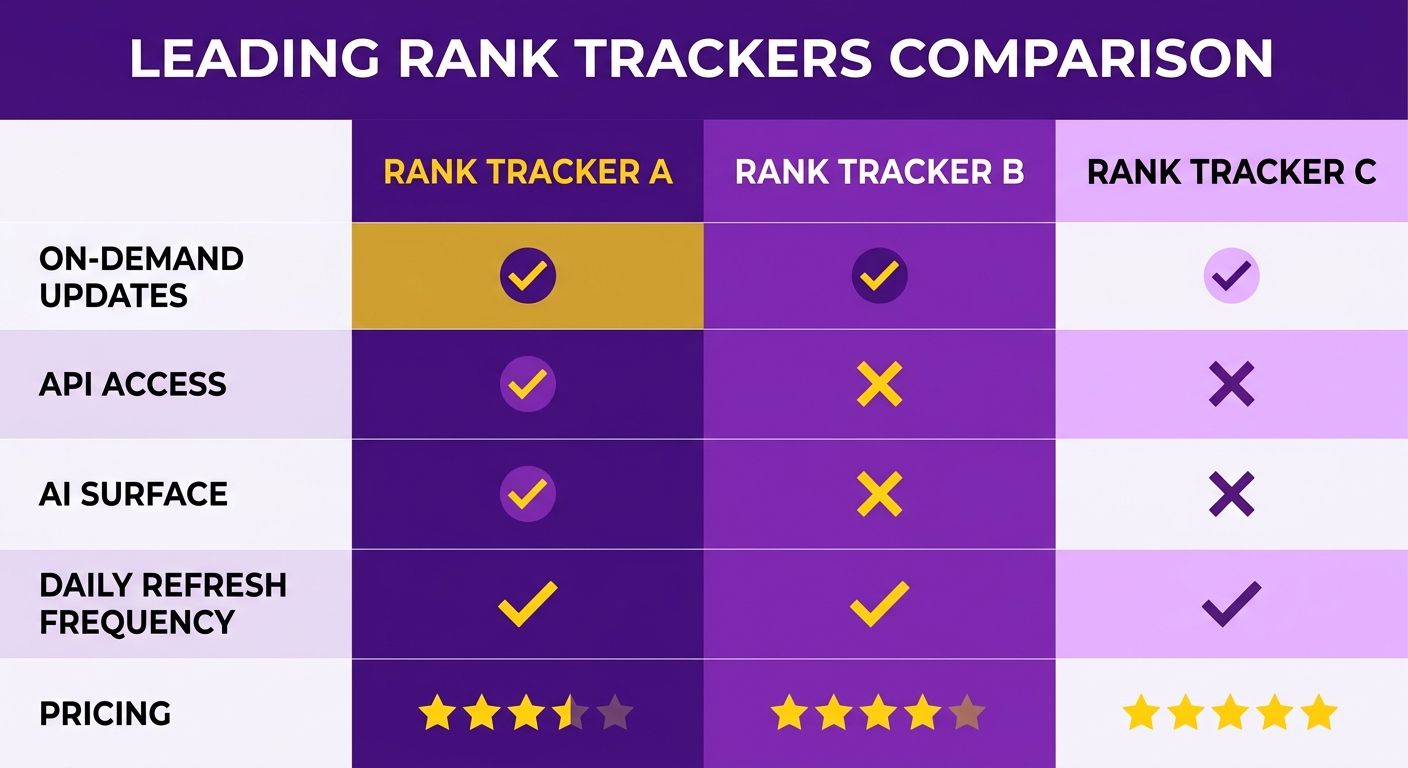
We evaluate an automated rank tracker on a narrower set of criteria than most roundups use. Update cadence, API keyword capacity, and AI-surface coverage matter more than the feature checklist everyone advertises. Below is how the leading categories of tools stack up against those three questions.
Which Trackers Actually Support Real-Time Feedback?
The trackers built for fast iteration share two traits: on-demand refreshes instead of fixed daily schedules, and an API that pipes results straight back into your pipeline. One reporting-heavy tracker is favored for its scheduled white-label PDFs and on-demand updates. A separate workspace-focused platform lets teams track 10,000 keywords across unlimited projects while maintaining sub-hour refresh windows for priority terms.
Scheduled-report tools cannot deliver the loop an AI content engine needs. If your tracker only refreshes once a day and won't expose results via API, you're stuck waiting instead of adjusting prompts. Combining on-demand updates with API access is what closes this gap.
Does AI-Surface Coverage Change the Verdict?
Yes, and this is where standard feature comparisons fall short. One agency guide argues that focusing solely on traditional organic links ignores how users actually interact with modern search results. Another guide counters that classic position still drives most clicks. Both perspectives are valid depending on your target audience.
Traditional position tracking remains a core metric, but it must be paired with newer visibility indicators. Where standard search layouts dominate, organic tracking tells most of the story. When publishing content designed to feed answer engines, you need a tracker that monitors LLM surfaces directly. Tools with native answer-engine monitoring let you compare visibility across traditional search and AI chat interfaces in a single dashboard, helping you allocate your content budget more effectively.
What Trips Up High-Volume Publishers?
API rate limits and keyword caps present significant hurdles. High-volume publishers frequently hit the same ceilings that multi-client agencies encounter. Check the per-plan keyword allowance and refresh limits before committing. A tracker that throttles your API at scale disrupts the feedback loop. Test these limits during the trial period, before building out your integration.
One enterprise SEO platform hit this exact wall after onboarding a publisher managing 200 local franchises. Their existing plan capped API calls at 500 per day, which meant waiting nearly two weeks to refresh the full keyword set.
Implementing and Optimizing Automated Rank Tracking
Setting up an automated rank tracker the right way takes more than importing a keyword list and hitting go. The setup decides whether your tracking data actually feeds your content workflow or just piles up in a dashboard nobody reads. When you publish AI-generated posts at volume, that connection is the whole point.
Get this wrong and you end up with the classic trap one industry team named well: "SEO is about doing the right work at the right time, not just more work." A poorly configured automated rank tracker generates a lot of the wrong work.
How Do You Set Up Automated Rank Tracking?
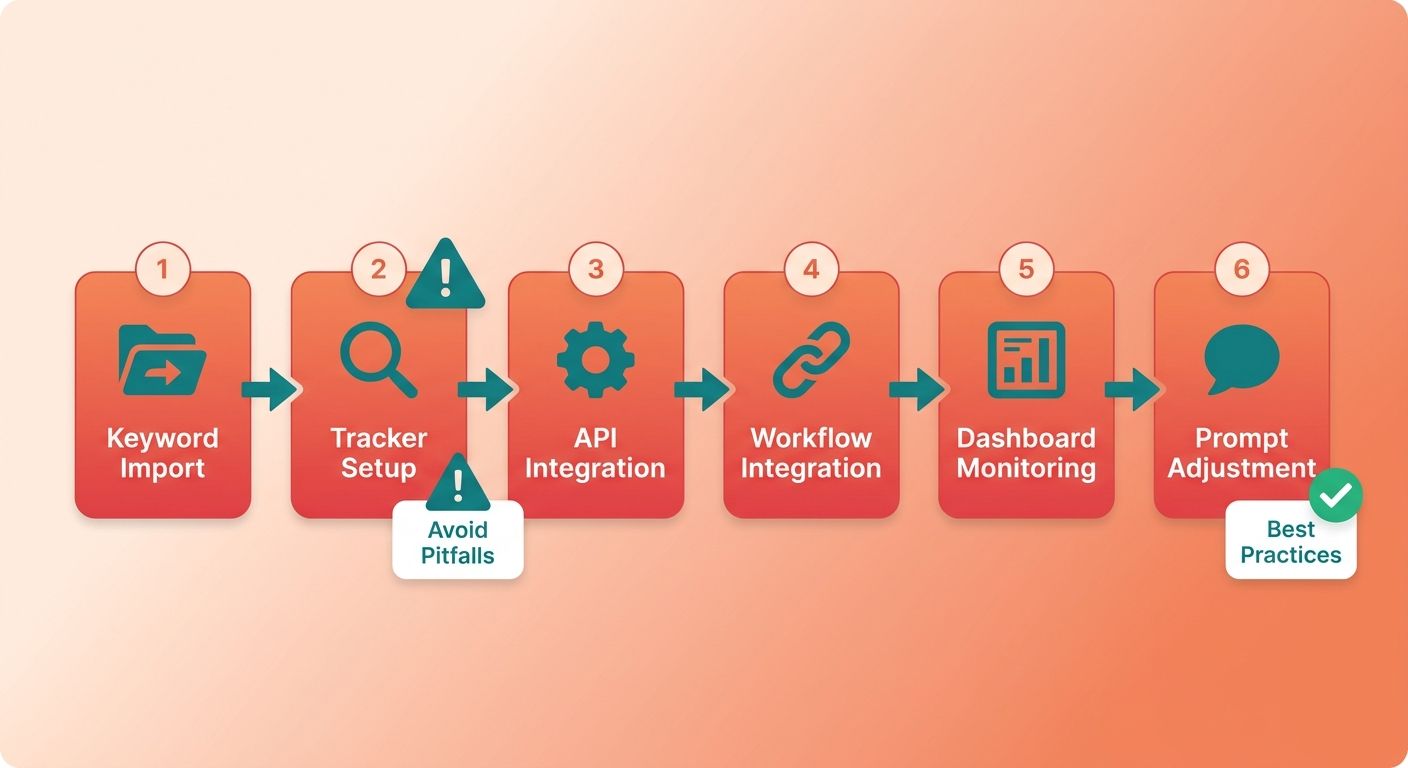
Start by pointing tracking at the keywords tied to specific published posts, not a bloated master list. Group keywords by content cluster so you can see which AI-generated batch moved which positions. Then wire the output back into your pipeline through an API or a reporting connector.
Three steps get you most of the way:
- Map keywords to posts. Tag every tracked keyword with the URL and publish date it belongs to. This lets you correlate a ranking shift with a specific batch instead of guessing.
- Set your refresh cadence to match your publish cadence. If you ship content weekly, daily refreshes are fine. If you ship daily, you want on-demand pulls after each batch goes live.
- Pipe results downstream. Connectors that push data into Google Sheets, BI tools, or your content engine turn raw positions into feedback. Teams using automated exports report spending 70% less time on manual data collection, which redirects hours toward content optimization.
For local campaigns, configure geo-coordinate tracking early. Some tools offer extensive global and regional coverage, which is essential if your content targets multiple geographic markets. Research your local SEO automation options to understand the specific setup requirements for multi-location tracking.
What Mistakes Should You Avoid?
A common pitfall is ignoring API rate limits until they disrupt your reporting. If you are tracking thousands of keywords with frequent refreshes, verify the API keyword cap and rate limits before committing to a plan.
The second mistake is treating position as the only signal. Google held 90.39% of worldwide search share recently, but the SERP itself changed. Track blue-link position and AI-surface citations together, or you'll declare a post a failure that's actually getting cited in AI answers.
A third overlooked mistake: tracking keywords in isolation from search intent shifts. A keyword that ranked #3 last month might still rank #3 today, but if the SERP flipped from informational to commercial, your informational post now competes in the wrong context. Configure your tracker to flag SERP feature changes, such as featured snippets, local packs, and video carousels, so you catch these shifts before they hurt your click-through rate.
Does the ROI Justify the Cost?
Yes, when tracking closes the feedback loop fast enough to change what you publish next. That's the real return, not the reporting hours saved.
Enterprise teams tracking 50,000+ keywords across multiple brands typically see tracking costs represent 2-4% of total SEO spend, but the visibility prevents much larger waste. One SaaS company testing two content templates found that their tracker identified the winning format after just 200 published posts, saving an estimated 800 hours of wasted production on the losing approach.
Calculate ROI on decision speed, not data volume. If your tracker tells you a batch flopped within days instead of weeks, you save a whole publishing cycle of wasted effort. That's where the money is.
Frequently Asked Questions
1. How often should I refresh rankings if I publish content on different schedules?
Align your refresh frequency with your publishing schedule. Weekly publishers can rely on standard daily updates. For daily or batch publishing, trigger on-demand updates immediately after content goes live to capture the immediate impact of your updates.
2. If AI surfaces are taking over, is blue-link position tracking still worth it?
Traditional position tracking remains essential because standard search results still drive significant traffic. However, for content optimized for conversational search, you must also monitor visibility within AI-generated summaries and chat interfaces to get a complete view of your performance.
3. What should I check in a tracker's API documentation before committing?
Verify the provider's rate limits, support for bulk queries, and options for real-time data retrieval. Ensure these features are included in your plan rather than locked behind enterprise tiers, and test the API's capacity during your trial period.
4. Should I pay extra for a polished reporting dashboard?
For automated workflows, prioritize data access and API reliability over visual dashboards. Paying for complex user interfaces is often unnecessary if your primary goal is routing ranking data directly into your internal databases, spreadsheets, or content generation tools.
5. How do I connect rank tracking output to my content pipeline?
Use APIs or webhooks to send ranking data directly to your content management system or database. Organize your keywords by topic cluster and map them to specific URLs and publication dates, allowing you to automatically track performance trends without manual exports.
6. Can automated trackers handle content targeting multiple regions?
Yes, provided you select a tool that supports precise local tracking. Look for platforms that allow you to specify coordinates down to the neighborhood or postal code level, ensuring you can verify visibility for localized search queries and regional AI responses.
7. How do I calculate whether an automated rank tracker is worth the cost?
Evaluate the tool based on how quickly it allows you to pivot. The primary financial benefit is avoiding wasted production on underperforming content strategies. For large-scale operations, the cost of tracking software is generally a minor fraction of the overall search marketing budget compared to the value of rapid feedback.