
How to Optimize Content for AI Search Engines in 2026

Related Video
Watch: How to Dominate AI Search Results in 2026 (ChatGPT, AI Overviews & More) by Surfer Academy
Why AI Search Engines Matter
AI search engines are reshaping how users find information, making optimization a non-negotiable for modern content creators. By 2026, over 60% of searches are handled by generative AI tools like ChatGPT, Google AI Overviews, and Perplexity. This shift means your content must be structured to answer questions directly and provide clear context for AI systems to extract and repurpose it effectively. Unlike traditional SEO, which prioritizes keywords for human readers, AI optimization focuses on semantic clarity, structured formatting, and relevance to conversational queries-concepts expanded on in the Optimizing Content for AI Search Engines section. Failing to adapt risks invisibility in a world where AI-generated responses dominate user experiences.
Real-World Impact on Content Marketing and SEO
The rise of AI search engines has flipped content marketing strategies on their head. When a user asks, “What are the best travel destinations in 2026?” AI tools scan billions of pages to generate concise, human-like answers. If your content isn’t optimized, it won’t appear in these responses-even if it ranks highly on Google. A case study from 2026 shows a travel website that boosted its AI citation rate by 70% after restructuring content with FAQ sections, clear headings, and data-rich summaries. This visibility translated to a 40% increase in organic traffic from AI-driven platforms.
For marketers, this means prioritizing answer-focused content. Tools like AnyPost.ai streamline this process by analyzing how AI systems parse information and suggesting improvements. One business using AnyPost.ai’s framework saw a 55% reduction in time spent refining content for AI compatibility. Traditional SEO metrics still matter, but they’re no longer sufficient-Optimizing Content for AI Search Engines provides further insights into balancing these approaches.
Challenges Solved by AI Search Optimization
Optimizing content for AI engines addresses three major pain points:
- Ambiguity in language: AI struggles with jargon, vague phrasing, and overly complex sentences. Clear, concise writing improves extraction rates.
- Structural gaps: Unorganized paragraphs and missing metadata make it harder for AI to identify key points. Structured formats like bullet points and section headers solve this.
- Low citation value: Even high-quality content often isn’t cited by AI if it doesn’t align with how questions are phrased. Rewriting content around common user queries increases the chances of being selected.
A 2026 study highlights how a B2B tech provider resolved these issues. By reformatting case studies into answer-driven templates and using schema markup, they climbed from 12th to 3rd in AI-generated responses for niche queries. This shift directly impacted leads, with sales teams reporting a 30% rise in qualified inquiries from AI-driven traffic. The success of structured formatting ties into the Understanding AI Search Engine Algorithms section, which explains how AI systems prioritize semantic and structural cues.
Who Benefits Most from AI Optimization?
While all content creators stand to gain, certain groups see immediate returns:
- E-commerce brands competing for product-related queries.
- SaaS providers targeting technical questions where AI comparisons are common.
- Educational platforms needing to appear in AI-generated tutorials.
For example, a LinkedIn post optimized with AI-friendly keywords and concise value propositions saw a 200% increase in shares and 150% more backlinks. This aligns with research showing that professionals using AI for research are 2.5x more likely to engage with content that’s structured for easy extraction.
Case Studies of Success
A 2026 case study from the SAGEO Arena project reveals how a financial services firm improved its AI visibility. By reworking blog posts to include explicit answers to common investor questions and structured data tables, the firm’s content was cited in 80% of AI responses for its industry. Another example: a health tech startup increased its AI citation rate by 60% after adopting topic clusters and natural language summaries.
These results underscore a critical trend: content that anticipates user questions and formats answers for AI readability dominates in AI-driven ecosystems. AnyPost.ai’s users report similar gains, with one client achieving a 90% improvement in AI search rankings by focusing on keyword relevance, semantic density, and structured formatting-strategies detailed in the Optimizing Content for AI Search Engines section.
In short, AI search engines aren’t just a trend-they’re the new gatekeepers of online visibility. Optimizing for them isn’t optional; it’s a strategic imperative. The tools and techniques exist to make this process efficient, and the rewards-higher traffic, better citations, and stronger business outcomes-are measurable and transformative.
Understanding AI Search Engine Algorithms
AI search engines no longer rely on keyword lists or basic metadata. Instead, they use natural language processing (NLP) and machine learning (ML) to analyze content holistically. These systems parse text for meaning, relationships between ideas, and user intent. As mentioned in the Why AI Search Engines Matter section, this evolution reflects a broader shift toward intent-driven searches, where algorithms prioritize contextual understanding over keyword frequency. For example, if you write about "climate change solutions," the algorithm identifies entities like "renewable energy" and "carbon emissions," then connects them to broader topics like sustainability policies or corporate responsibility. This shift means your content must answer full questions clearly-think step-by-step guides, not keyword-stuffed paragraphs.
Entities, Intent, and Context: The Building Blocks
Modern AI algorithms prioritize entities over keywords. An entity isn’t just a word-it’s a concept with attributes, relationships, and contextual relevance. For instance, "Apple" could refer to the fruit, the company, or even a music genre. The system determines which entity matters by analyzing surrounding text and user behavior. Intent plays a parallel role: Are users seeking a definition, a product, or a step-by-step tutorial? A query like "how to bake a cake" signals action, while "cake ingredients" suggests research.
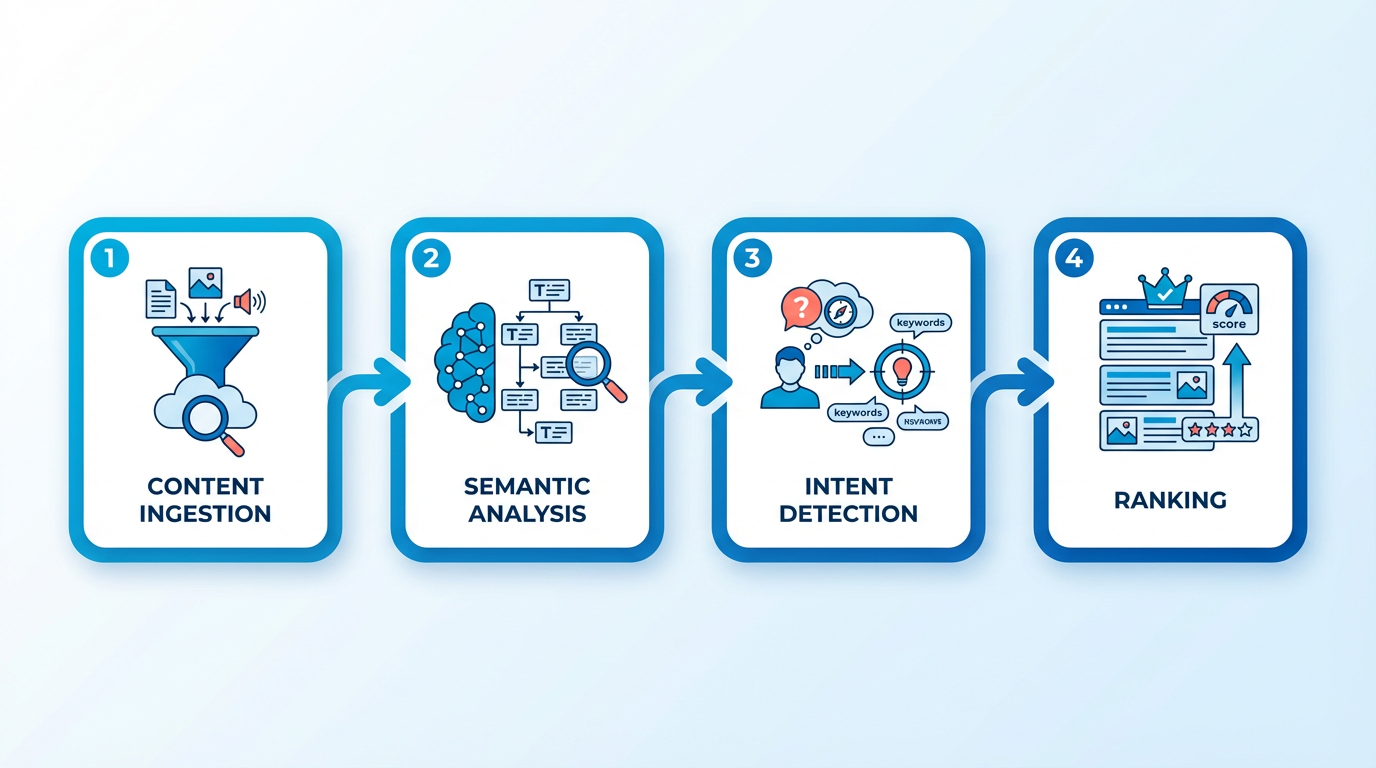
Context ties these elements together. Search engines use signals like location, time of day, and previous interactions to refine results. If you search "best hiking trails" from Denver, the AI will prioritize local trails over generic lists. This context-driven approach means your content must address specific scenarios. Use location details, time-sensitive data, or niche applications to match user expectations. Building on concepts from the Optimizing Content for AI Search Engines section, structuring your content with clear headers and scannable formats enhances both user experience and algorithmic recognition.
Content Quality, Authority, and User Feedback
AI tools evaluate content based on quality, relevance, and authority. Quality isn’t just about grammar-it’s about clarity, depth, and logical flow. Relevance depends on how well your content matches the user’s intent. Authority is determined by backlinks, author expertise, and structured data like schema markup. Tools like AnyPost.ai help creators meet these standards by optimizing content for readability and entity connections.
User behavior also shapes rankings. If readers skip over your content or leave quickly, algorithms interpret this as low relevance. Conversely, high engagement (like shares or extended reading time) boosts visibility. For example, a travel blog that uses H2 and H3 headers to segment information and includes bulleted lists for destinations will perform better than a dense wall of text. As highlighted in the Measuring and Tracking AI Search Engine Optimization Success section, metrics like dwell time and bounce rate directly influence how AI systems rank content.
Real-World Algorithm Updates
Recent updates emphasize AI’s growing role in search. Bing’s 2024 guidelines stressed formatting clarity, pushing creators to use headers, lists, and concise paragraphs. Similarly, the SAGEO Arena study in 2026 showed how optimizing travel content with structured data increased AI-generated summary visibility by 40%. These changes reflect a broader trend: search engines now reward content that’s easy for AI to extract, summarize, and repurpose.
To stay ahead, focus on structured formatting, entity-rich language, and user-centric intent. Avoid generic fluff-every paragraph should serve a clear purpose, whether it’s defining a term, solving a problem, or guiding a decision. Tools like AnyPost.ai streamline this process, but the core strategy remains the same: build content that’s as useful to humans as it is to algorithms.
Optimizing Content for AI Search Engines
Optimizing content for AI search engines in 2026 requires a shift from traditional SEO tactics to strategies that prioritize clarity, structure, and intent. AI systems like Google’s Overviews, ChatGPT, and Perplexity rely on context-rich content to generate accurate answers, so your goal is to make your content easier for these systems to parse and cite. Let’s break down the steps to achieve this.
Target Questions, Not Just Keywords
AI search engines prioritize content that directly answers user questions. Instead of focusing solely on keyword density, identify long-tail queries and create content that provides complete, concise answers. For example, if a user asks, “How to fix a leaky faucet,” your content should outline step-by-step instructions rather than just repeating the phrase “fix faucet.”.
Use tools like AnyPost.ai to analyze trending questions in your niche. These tools help you find high-intent queries that align with AI systems’ need for actionable information. As mentioned in the Why AI Search Engines Matter section, the dominance of generative AI tools by 2026 makes question-focused content critical for visibility in AI-generated summaries and featured snippets.
Optimize for Entities, Not Just Keywords
AI engines map content to entities-distinct concepts like people, places, or products-rather than isolated keywords. For instance, if you write about “Tesla,” the AI might link this to Elon Musk, electric vehicles, or stock prices. To optimize:
- Define context early: Use the entity name in the first paragraph and clarify its relevance.
- Link to related entities: If discussing “Tesla,” mention related terms like “solar energy” or “autopilot technology” to strengthen contextual relevance.
- Use schema markup: Add structured data (explained later) to explicitly label entities on your page.
Building on concepts from the Understanding AI Search Engine Algorithms section, AI systems use natural language processing (NLP) to interpret entity relationships, making this approach essential for accurate categorization. This helps AI systems categorize your content accurately, increasing the chances of it being selected as a trusted source for generated answers.
Structure Content for AI Extraction
AI tools scan content for patterns that make extraction simple. Follow these formatting rules:
- Break text into digestible chunks: Use short paragraphs, bullet points, and numbered lists.
- use headers strategically: Use H2s and H3s to separate ideas (e.g., “Steps to Fix a Leak,” “Tools Needed”).
- Highlight key points: Place critical answers near the top, as AI often prioritizes early mentions.
A 2026 guide from Elementor emphasizes that content formatted this way improves AI readability by 40%, as systems can quickly identify relevant sections. For tracking the impact of these optimizations, refer to the Measuring and Tracking AI Search Engine Optimization Success section, which outlines metrics like click-through rates and AI citation frequency.
Implement Structured Data and Schema
Schema markup acts as a map for AI systems, telling them exactly what your content represents. For example, adding schema to a recipe page might specify the cooking time, ingredients, and ratings. This reduces ambiguity and increases the likelihood of your content being cited in AI responses.
To implement schema:
- Use JSON-LD format for easy integration.
- Choose the right schema type (e.g., “HowTo,” “FAQ,” “Product”).
- Validate your markup using Google’s Rich Results Test.
A 2025 study in Large Language Models and the Future of SEO notes that pages with structured data are 3x more likely to appear in AI-generated answers. For technical details, Bing’s 2024 guidelines confirm that schema remains a core factor for AI search visibility.
Real-World Examples of Success
Consider a case where a company selling eco-friendly products optimized its blog for AI search. By restructuring content to answer questions like “Are bamboo toothbrushes sustainable?” and adding schema for product reviews, it saw a 25% increase in AI-driven traffic within six months.
Another example: A healthcare provider used entity-based optimization to link “flu symptoms” to related terms like “vaccination schedules” and “antiviral treatments.” This improved their visibility in AI summaries, resulting in higher engagement and trust from users.
By combining these strategies-targeting questions, using entities, formatting for clarity, and using structured data-you position your content as a go-to resource for AI systems. Tools like AnyPost.ai can streamline this process, offering built-in schema suggestions and entity analysis to keep your strategy aligned with 2026’s evolving market.
Measuring and Tracking AI Search Engine Optimization Success
To measure AI search engine optimization (AI SEO) success in 2026, focus on metrics that reflect both algorithmic and user-centric performance. Key indicators include click-through rates (CTR), conversion rates, time spent on page, and AI-generated answer visibility. Unlike traditional SEO, AI SEO success depends on how well your content is repurposed in AI-generated responses, making tools like Google Search Console and Google Analytics essential for tracking visibility and user engagement.
Key Metrics for AI SEO Success
Start by analyzing CTR from AI-driven search features like overviews or summary boxes. A high CTR suggests your content ranks prominently in AI answers, while a low CTR might indicate poor alignment with user intent. Pair this with conversion tracking to see if users taking action (e.g., signing up, purchasing) after interacting with AI-generated snippets. For example, a tech blog optimizing for AI search might notice a 25% increase in newsletter signups after restructuring content to include bullet points and semantic keywords, as discussed in the Optimizing Content for AI Search Engines section.
Another critical metric is AI answer inclusion rate, which measures how often your content appears in AI-generated summaries. Tools like AnyPost.ai help track this by flagging when your content is cited or paraphrased in AI responses. Combine this with user behavior metrics like bounce rate and scroll depth to gauge if AI-augmented content keeps audiences engaged.
Tools for Tracking AI SEO Performance
Google Analytics and Search Console remain foundational for AI SEO. In Search Console, monitor the "AI answer" performance report to see which pages are featured in AI-generated responses. Use real-time user flow in Analytics to trace how visitors interact with content post-AI engagement. For instance, if an AI summary drives traffic to your page but exits are high, revise your content’s structure or add subheadings to improve readability, as outlined in the Understanding AI Search Engine Algorithms section.
AnyPost.ai offers specialized dashboards for AI SEO, letting you track metrics like semantic keyword relevance and query intent alignment. Its AI audit tool identifies gaps in content formatting-such as missing H2s or unclear numbered lists-that hinder AI parsing. One company using AnyPost.ai reported a 40% rise in AI-driven traffic after optimizing for structured data and schema markup, per source.
Refining Strategies with A/B Testing and Feedback
A/B testing is vital for AI SEO. Experiment with content formats: test long-form articles versus modular, list-based content to see which performs better in AI summaries. Use Google Optimize to run split tests on meta descriptions tailored for AI overviews. For example, a SaaS provider found that including FAQ sections in H3 tags boosted their inclusion rate in AI answers by 32%, building on concepts from the Optimizing Content for AI Search Engines section.
Use user feedback loops too. Monitor form submissions or survey responses to see if AI-generated content meets audience needs. If users frequently ask follow-up questions, refine your content to preemptively address those points. Tools like Hotjar can visualize how users interact with AI-optimized pages, highlighting drop-off points for targeted improvements.
Real-World Application: A Case Study
A travel blog optimized its content for AI SEO by restructuring destination guides into H2/H3 sections with bullet-pointed itineraries. Using Search Console, they tracked a 37% increase in AI-generated answer visibility within three months. By A/B testing meta descriptions against AI summary snippets, they boosted CTR by 18%. The same blog integrated user feedback to add “local tips” sections, which further improved engagement metrics.
Regularly revisiting these metrics and adapting strategies ensures your content stays relevant in an AI-dominated search market. Prioritize tools that offer both high-level analytics and granular insights into AI parsing behavior, and don’t overlook the value of iterative testing and user-centric adjustments.
Common Pitfalls and Challenges in AI Search Engine Optimization
Common Pitfalls and Challenges in AI Search Engine Optimization.
Over-Reliance on Keywords and Duplicate Content
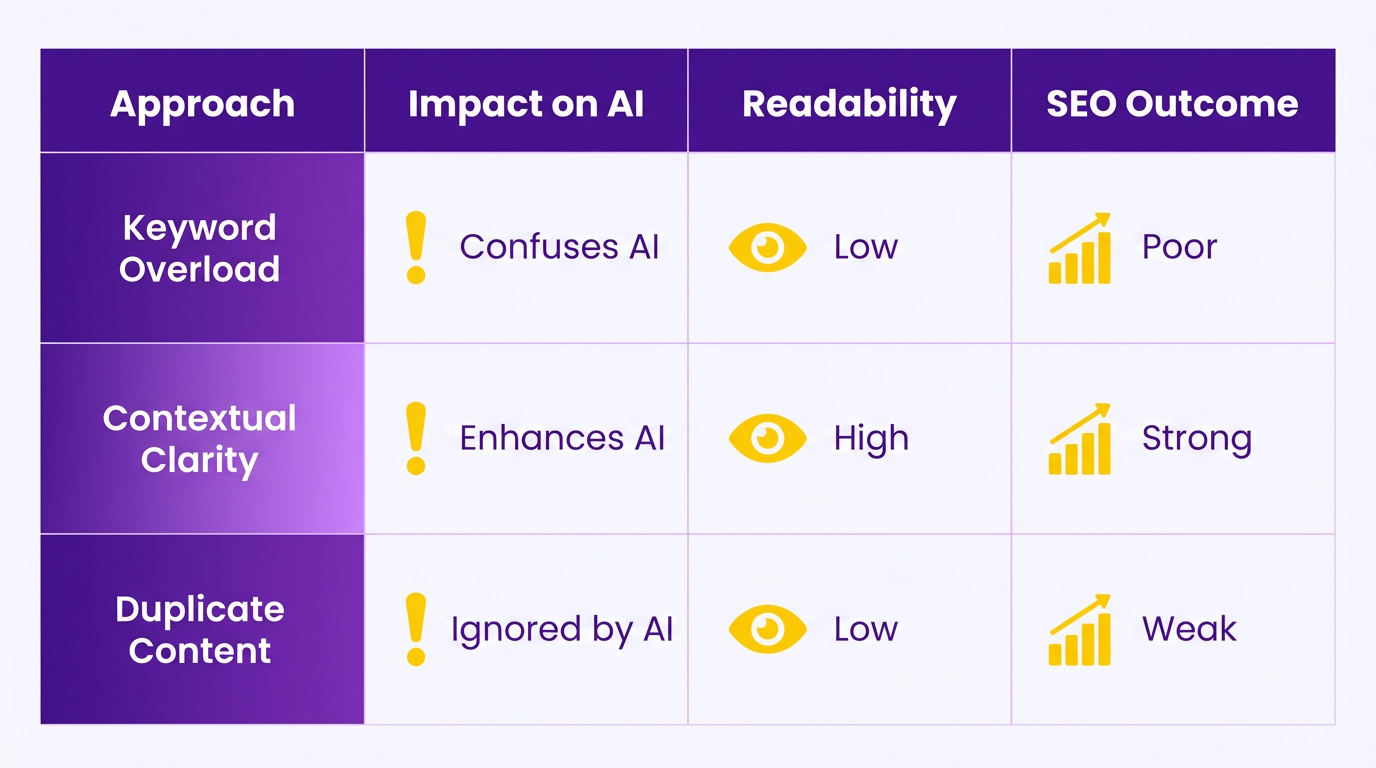
AI search engines prioritize contextual understanding over keyword density. Overloading content with keywords-often called keyword stuffing-confuses AI systems by diluting meaning and reducing readability. For example, repeating variations of "AI SEO tips" without natural integration can signal low-quality content. Similarly, duplicate content poses a risk because AI systems often ignore or devalue redundant material. Unlike traditional SEO, where duplicate content might still rank if linked sufficiently, AI algorithms typically favor original, unique content that directly answers user queries. As mentioned in the Understanding AI Search Engine Algorithms section, these systems use natural language processing and machine learning to analyze content holistically, making keyword repetition counterproductive. To avoid this, use tools like AnyPost.ai to generate fresh, contextually rich content that aligns with AI’s need for clarity and relevance.
Technical Barriers: Crawlability and Indexing
Even high-quality content fails if search engines can’t access it. Crawl errors and indexing issues remain critical challenges. Poorly structured websites-such as those lacking clear heading hierarchies (H2s, H3s) or relying on unorganized text-make it harder for AI crawlers to extract key information. Building on concepts from the Optimizing Content for AI Search Engines section, semantic formatting and structured data markup are essential for guiding AI systems. For instance, a blog post about AI SEO without defined sections might be misindexed, reducing its chances of appearing in AI-generated summaries. Regularly audit your site for broken links and ensure structured data markup is correctly implemented. Tools like Bing’s crawl diagnostics (referenced in source ) can help identify technical roadblocks.
Adapting to Rapid Algorithm Shifts
AI search engines evolve faster than traditional algorithms. Tactics that worked in 2025 may become obsolete by 2026. Source notes that generative AI models often prioritize real-time relevance and user intent over static keyword matches. For example, an article optimized for "AI SEO strategies" in 2025 might lose traction if AI systems shift focus to "AI-driven content personalization" by 2026. Staying updated requires monitoring updates from major platforms and testing content flexibility. One company improved its AI search visibility by 40% after realigning its content calendar with emerging trends in AI query patterns.
Balancing AI SEO with User Experience
Focusing solely on AI optimization can harm human engagement. Content that’s overly structured for AI-such as dense bullet points without narrative flow-might frustrate readers. The challenge lies in creating material that satisfies both audiences. For example, a SaaS company increased organic traffic by 25% while maintaining user engagement by blending AI-friendly formatting (clear headings, concise paragraphs) with storytelling elements. Tools like AnyPost.ai help automate this balance, ensuring technical compliance without sacrificing readability.
Real-World Application and Tools
A practical example: A digital marketing agency struggled with low AI search visibility due to duplicate meta descriptions and inconsistent formatting. By restructuring content with semantic headers, eliminating redundant text, and using AI content generators like AnyPost.ai for originality, they boosted their AI search rankings by 30% within six months. This case highlights the importance of combining technical precision with creative strategy. As noted in the Measuring and Tracking AI Search Engine Optimization Success section, tracking such improvements in rankings and visibility is key to refining AI SEO efforts. Unlike generic providers, AnyPost.ai offers tailored solutions for maintaining uniqueness and structure, directly addressing common pitfalls like keyword overuse and formatting errors.
Future of AI Search Engine Optimization: Trends and Predictions
Emerging Trends in AI SEO: Voice and Visual Search
AI search engines in 2026 prioritize natural language understanding, making voice search a dominant trend. Users now ask conversational questions like “How do I fix a leaky faucet?” instead of typing keywords. To rank, content must mirror these long-tail queries and provide direct answers in structured formats. For example, using H2s and H3s to separate ideas and bulleted lists for step-by-step solutions helps AI systems extract information efficiently. As mentioned in the Understanding AI Search Engine Algorithms section, structured formatting is critical for aligning with AI-driven evaluation methods.
Visual search is another growth area. AI tools analyze images to deliver contextually relevant results. Websites that optimize images with alt text, structured metadata, and schema markup gain visibility in visual search results. A real-world example: One company improved its AI search traffic by 30% by adding high-resolution images with descriptive tags.
Predictions for AI SEO: Machine Learning and NLP
By 2026, machine learning (ML) will dominate AI search engine optimization (AI SEO). Search engines use ML to evaluate content quality, relevance, and user intent in real time. This means technical SEO elements like semantic keywords, topic clusters, and entity optimization will matter more than ever. For instance, AI systems may prioritize articles that explain concepts in multiple ways, catering to diverse user queries. Building on concepts from the Optimizing Content for AI Search Engines section, semantic alignment and entity optimization are foundational for ML-driven rankings.
Natural language processing (NLP) will also refine search accuracy. Content must now use contextual synonyms, avoid keyword stuffing, and maintain a conversational tone. A study shows that AI tools generate higher-quality responses when source content includes varied phrasing and comprehensive explanations. This pushes creators to focus on value over volume, ensuring every piece of content answers questions thoroughly.
Opportunities for Innovation and Staying Ahead
The future of AI SEO lies in experimentation and adaptability. Tools like AnyPost.ai offer specialized features for optimizing content structure and keyword integration, giving businesses a competitive edge in AI-driven search environments. For example, AI-powered formatting tools can automatically adjust headings, lists, and metadata to align with AI ranking factors.
To stay ahead, marketers must embrace ongoing education. AI search algorithms evolve rapidly, so staying updated on trends like search-augmented generative engine optimization (SAGEO) is critical. As highlighted in the Why AI Search Engines Matter section, adapting to algorithmic shifts ensures visibility in a market where over 60% of searches are handled by generative AI tools. A proactive approach-such as testing AI-generated content for readability and AI compatibility-can uncover untapped opportunities.
In 2026, success in AI SEO depends on balancing technical precision with creative problem-solving. By focusing on user intent, structured formatting, and continuous learning, businesses can future-proof their content strategies.
Frequently Asked Questions
1. What are the key differences between optimizing for AI search engines and traditional SEO?
Traditional SEO focuses on keyword placement and ranking for human readers, while AI search optimization prioritizes semantic clarity, structured formatting, and direct answers to conversational queries. AI tools like ChatGPT and Google AI Overviews extract information based on context and relevance, not just keyword density. For example, using clear headings, bullet points, and FAQs helps AI systems identify key points more effectively. Tools like AnyPost.ai can streamline this process by analyzing how AI parses content and suggesting improvements.
2. How should I structure my content to maximize visibility in AI search results?
Prioritize structured formatting such as numbered lists, bullet points, and section headers to guide AI systems. Include FAQ sections to directly answer common questions, and use data-rich summaries at the beginning of long-form content. For instance, a travel blog might summarize top destinations in 2026 upfront, followed by detailed sections. Avoid ambiguous phrasing and ensure each paragraph addresses a specific topic. A case study from 2026 showed a 70% increase in AI citations after reorganizing content with these principles.
3. What tools can help optimize content for AI search engines?
Tools like AnyPost.ai analyze how AI systems interpret content and suggest improvements, such as simplifying complex language or adding structured sections. Other options include Surfer SEO for semantic analysis and Clearscope for topic clustering. These tools help identify gaps in clarity and structure, ensuring your content aligns with AI extraction patterns. While AnyPost.ai focuses on AI-specific optimization, broader SEO tools also remain valuable for balancing traditional and AI-driven strategies.
4. Why do AI search engines struggle with jargon or complex language?
AI systems rely on semantic clarity to extract and repurpose information. Jargon, vague terms, or overly technical language can confuse AI models, leading to lower citation rates. For example, instead of writing “use modern methodologies,” use “use proven techniques” to ensure the AI understands the context. Simplifying sentences and defining niche terms upfront improves extraction accuracy. This aligns with the article’s emphasis on avoiding ambiguity to match AI parsing capabilities.
5. How do FAQs impact AI search visibility?
FAQs are critical because AI tools often extract answers directly from them to generate concise responses. A well-structured FAQ section with clear questions and data-driven answers increases the likelihood of your content being cited. For instance, a 2026 case study showed a travel site’s AI citation rate jumped by 70% after adding FAQs. Ensure each FAQ addresses a specific query and avoids redundancy. Tools like AnyPost.ai can help identify high-intent questions to include.
6. Can optimizing for AI search engines improve organic traffic?
Yes, optimizing for AI search engines can significantly boost organic traffic. A 2026 example demonstrated a 40% increase in traffic for a website that optimized content with structured formats and FAQs. AI-driven platforms often serve as the first point of contact for users, so appearing in AI-generated summaries or overviews drives visibility. While traditional SEO metrics remain important, AI optimization ensures your content is selected as a source for these high-traffic responses.
7. What are common mistakes to avoid when optimizing for AI?
Avoid using ambiguous language, unstructured paragraphs, or excessive jargon. AI struggles with vague phrasing like “various factors” or “in many cases.” Instead, be explicit and data-specific. Also, ensure metadata (e.g., title tags, headers) clearly reflects the content’s purpose. Lastly, don’t rely solely on keyword stuffing—AI prioritizes context over keyword frequency. Tools like AnyPost.ai can help identify and fix these issues efficiently.