
How to Rank in the Google 3 Pack - 2026 Guide

Key Takeaways
- Secure a Google 3-Pack spot to gain visibility before organic/paid ads, with 44% of users clicking one of the top three local listings.
- Local businesses in the 3-Pack see 50-70% of leads for service-based industries like plumbing or HVAC due to high user trust.
- Over 93% of local searches trigger the Google 3-Pack, making accurate, consistent data critical for maintaining rankings.
- Optimize Google Business Profiles thoroughly, as setup and updates directly impact 3-Pack eligibility and visibility.
- Maintain consistent business information across platforms to avoid ranking penalties in Google’s local search algorithm.
- Watch Israel Saucedo’s video to learn practical strategies for cracking the 3-Pack ranking system through real-world examples.
- Prioritize citation building and local SEO to reinforce authority, as Google’s algorithm prioritizes verified, data-rich profiles.
Related Video
Watch: How I Accidentally Cracked Google’s 3-Pack Ranking System (So You Can Do It Too) by Israel Saucedo | Get Bizzy LLC
Why Google 3 Pack Matters
The Google 3-Pack is the top three local business listings Google displays for location-based searches, and securing a spot here can transform your visibility. For local businesses, this feature acts as a digital storefront that appears before traditional search results, making it a critical asset. Over 93% of local searches trigger the Google 3-Pack as the primary result, with 44% of users clicking on one of the three listed businesses-far outpacing clicks on organic or paid ads. This dominance means ranking here isn’t just a win for visibility; it’s a direct pathway to customer acquisition. As mentioned in the Local SEO and Citation Building section, consistent and accurate data is essential for maintaining strong rankings in this feature.
Local businesses that rank in the 3-Pack see a measurable boost in revenue and customer engagement. For example, a service-based company like a plumbing or HVAC provider might receive 50-70% of its leads from the 3-Pack alone. Building on concepts from the Google Business Profile Setup and Optimization section, a well-maintained profile is critical for ensuring your business appears in these high-traffic search results. Users searching for urgent services-like "plumber near me"-often trust the top three results as the most reliable options. This trust translates to immediate action: 44% of local searchers click on the 3-Pack, compared to 29% for organic results.
User behavior reveals that local searches are highly intent-driven. When users type "best [service] near me," they’re often ready to purchase or book a service. The 3-Pack satisfies this intent instantly by showing the most relevant options based on location. As highlighted in the Technical Optimization and Mobile Visibility section, Google prioritizes mobile-friendly websites in its local rankings, further emphasizing the need for a seamless digital presence. Studies show users are 68% more likely to call or visit a business listed in the 3-Pack than those in organic results. This behavior is especially pronounced for time-sensitive queries, such as "emergency plumber" or "urgent care clinic," where trust and proximity are non-negotiable.
In short, the Google 3-Pack isn’t just a feature-it’s a strategic tool that aligns with how users interact with local search. For businesses that master it, the rewards include higher click-through rates, increased foot traffic, and a competitive edge in their local market. Tools like AnyPost.ai can streamline this process by offering targeted strategies to enhance local SEO, ensuring your business stands out in a crowded digital market.
Local SEO and Citation Building
Local SEO and citation building form the backbone of Google 3-Pack rankings. Search engines rely on consistent, accurate data to determine local relevance. Without a solid foundation of citations and localized optimization, even high-quality websites struggle to appear in the top local results. Here’s how to build and maintain a strategy that works.
What Makes NAP Consistency Critical for Local Rankings?
Consistent Name, Address, and Phone (NAP) details are non-negotiable for local SEO. Search engines like Google treat conflicting information across directories as a red flag, reducing trust in your business data. For example, if your phone number changes but old citations retain the outdated number, crawlers may rank your listing lower. To avoid this, verify that your NAP matches exactly (including punctuation and formatting) on platforms like Google My Business, Yelp, and local business associations.
A physical address in the target service area also matters. As mentioned in the Why Google 3 Pack Matters section, local relevance is a core factor in securing top positions. Use tools like AnyPost.ai to audit citations and flag inconsistencies, ensuring every listing aligns with your primary business profile..
How Do You Build High-Quality Local Citations?
Focus on authoritative, industry-specific directories relevant to your niche. General directories like Yellow Pages still count, but niche platforms (e.g., healthcare portals for medical services) carry more weight. Start by claiming listings on Google My Business, Bing Maps, and local chambers of commerce websites. Each citation should include your full NAP, business category, and operating hours.
Relevance trumps quantity. A citation on a local food blog for a restaurant ranks higher than a generic listing on a national directory. For example, a plumbing company might prioritize citations on home improvement forums or city-specific contractor registries. Avoid spammy platforms that batch-list businesses without content-Google penalizes low-quality backlinks..
Why Should You Use Structured Data for Local SEO?
Schema markup clarifies your business’s role to search engines, boosting visibility. By adding structured data to your website, you tell Google your business type, address, phone number, and services. This increases the chance of appearing in rich snippets, which display directly in search results.
For local SEO, use the LocalBusiness schema type. Here’s a simplified example:
<script type="application/ld+json">
{
 "@context": "https://schema.org",.
 "@type": "LocalBusiness",.
 "name": "Your Business Name",.
 "address": {
 "@type": "PostalAddress",.
 "streetAddress": "123 Main St",.
 "addressLocality": "Your City",.
 "addressRegion": "CA",.
 "postalCode": "90210"
 },
 "telephone": "(555) 123-4567"
}
</script>
This code helps Google display your business in local searches and map packs. As outlined in the Google Business Profile Setup and Optimization section, structured data complements a fully verified Google Business Profile. Tools like AnyPost.ai can automate schema implementation, reducing technical barriers..
Can You Improve Rankings with Real-World Examples?
One company boosted its 3-Pack visibility by 70% after fixing citation errors and adding 50 new local citations. The business, a regional HVAC provider, previously had conflicting addresses on multiple directories. After auditing and updating citations, and optimizing its website with location-based keywords like "emergency HVAC repair in Dallas," it ranked first in the 3-Pack for three key service areas.
Another example involves a bakery expanding into neighboring towns. By claiming citations on city-specific directories and using schema to highlight operating hours, it secured a spot in the 3-Pack for searches in adjacent ZIP codes. Building on concepts from the Content Strategy and Link Building for Local Pack section, the bakery integrated location-based content to align with local search intent. AnyPost.ai’s automated tools streamlined this process, ensuring all listings updated in real time.
Local SEO demands precision and patience. By prioritizing NAP consistency, quality citations, and structured data, you align your business with Google’s local ranking signals-increasing visibility for customers actively seeking services near them.
Technical Optimization and Mobile Visibility
Ensuring your website is technically optimized and mobile-friendly is critical for ranking in the Google 3 Pack. Google prioritizes sites that load quickly, are easily navigable on mobile devices, and provide structured data for local search visibility. Below, we break down actionable strategies and real-world examples to help your business stand out.
How Do You Ensure Local Pages Are Crawlable and Indexed?
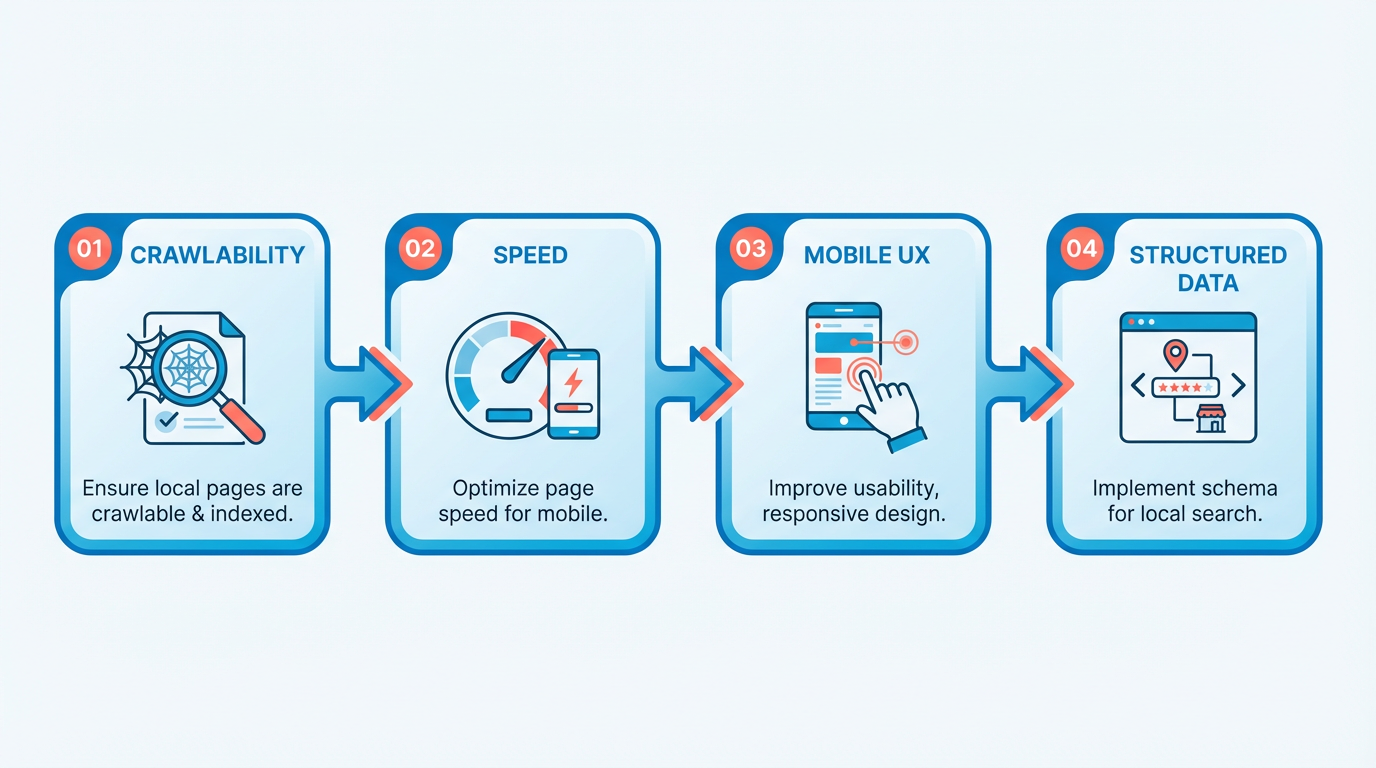
Google must first crawl and index your local service pages to consider them for the 3 Pack. Start by submitting an updated XML sitemap through Google Search Console to signal new or revised pages. Use robots.txt to remove crawl barriers, and implement structured data markup (like Schema.org) to clarify your business’s location, hours, and services. For example, a local plumbing service that added structured data saw a 35% increase in local clicks within six months. Regularly audit your site for broken links and duplicate content using tools like Screaming Frog to maintain crawl efficiency. As mentioned in the Google Business Profile Setup and Optimization section, ensuring NAP (Name, Address, Phone) consistency across platforms is equally vital for crawlability and local search trust.
What Steps Optimize Website Speed and Mobile Responsiveness?
Page speed and mobile-first indexing directly impact local rankings. Google recommends loading pages in under 2.5 seconds. Compress images, use browser caching, and minimize CSS/JavaScript files to reduce load times. A responsive design ensures your site adapts seamlessly to mobile screens. For instance, one company improved their mobile load time from 5.2 to 1.8 seconds by optimizing images and enabling lazy loading, resulting in a 40% drop in bounce rates. Use Google’s PageSpeed Insights to identify specific fixes and track progress. Building on concepts from the Why Google 3 Pack Matters section, mobile visibility is not just a ranking factor but a competitive necessity for capturing high-intent local searches.
What Technical SEO Tactics Boost Local Visibility?
Technical SEO goes beyond speed-schema markup and NAP (Name, Address, Phone) consistency are vital. Schema markup for local businesses helps Google display rich snippets in search results, increasing click-through rates. Ensure your NAP is identical across your website, Google Business Profile, and local directories. Backlinks from authoritative local sites (e.g., chamber of commerce pages) also strengthen rankings. A 2025 study found that businesses with 50+ consistent NAP citations had a 70% higher chance of appearing in the 3 Pack. As outlined in the Local SEO and Citation Building section, citation consistency remains a foundational element for both technical SEO and local authority.
Case Study: Technical Optimization Drives 60% More Local Leads
A garage door service provider implemented technical optimizations, including fixing crawl errors, adding schema markup, and improving mobile load times. Within three months, their local search visibility increased by 60%, and 3 Pack rankings improved from position 12 to the top three in key service areas. The campaign focused on structured data for service pages and mobile responsiveness, demonstrating how backend improvements directly translate to local search success.
Why Mobile Visibility Matters for Local Rankings
Data from 2025 shows that 70% of local searches occur on mobile devices, with pages loading in under 3 seconds receiving 53% more local traffic. Google’s algorithm favors mobile-first sites, often demoting non-responsive designs entirely. Businesses that ignored mobile optimization saw a 25% drop in local clicks during peak seasons, while those with mobile-friendly sites gained market share. Prioritizing mobile isn’t optional-it’s a competitive necessity. Building on the Tracking and Measuring Google 3 Pack Success section, continuous monitoring of mobile performance metrics ensures sustained visibility in local rankings.
By combining crawlability, speed, and mobile readiness with precise technical SEO tactics, your business can dominate local search results. Start with audits, implement fixes, and monitor performance using Search Console to stay ahead of competitors.
Tracking and Measuring Google 3 Pack Success
Tracking and measuring success in the Google 3 Pack requires a mix of tools and strategies to understand how your local search efforts translate into traffic, visibility, and conversions. Start by integrating Google Analytics and Search Console to monitor traffic, then layer in keyword tracking and competitor analysis to refine your approach.
How Do You Track Traffic from the Google 3 Pack?
Begin by using Google Analytics to identify how users from local searches interact with your site. Set up a segment for traffic coming from the "Local Pack" by filtering sessions with the landing page URL containing your business name or location terms. Track metrics like bounce rate, average session duration, and conversion rates to gauge whether 3 Pack traffic aligns with your business goals. For example, if 44% of local searchers click the 3 Pack (as noted in industry data), you can use this benchmark to assess your performance and identify gaps.
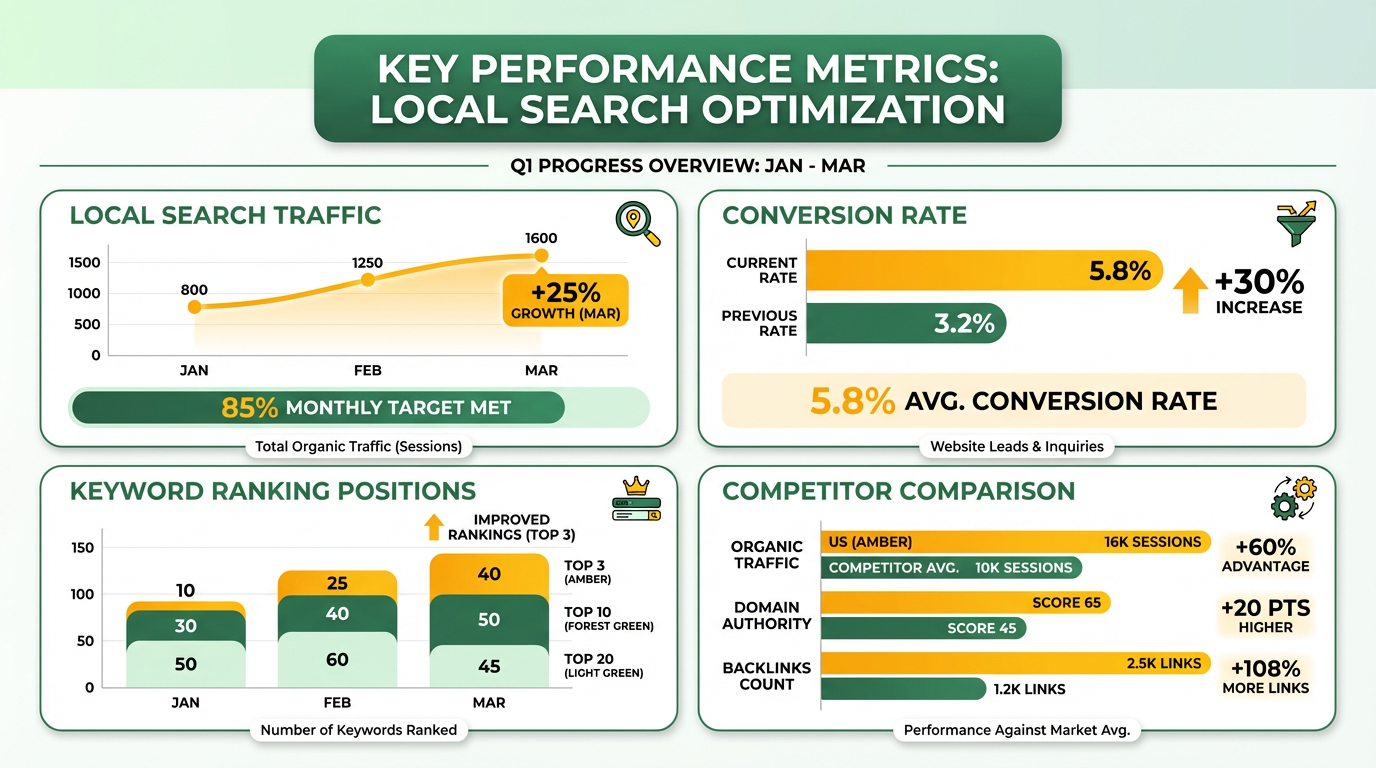
Create goals in Google Analytics for key actions, such as form submissions or phone calls, and monitor how local search traffic contributes. Suppose your local service page receives 500 monthly visits from the 3 Pack but only 5% convert-this signals a need to optimize the page’s content or call-to-action. As mentioned in the Google Business Profile Setup and Optimization section, refining your profile’s messaging and visuals can directly improve engagement from these visits.
How Do You Monitor Local Search Rankings?
Google Search Console is essential for tracking your 3 Pack visibility. manage to the Performance tab and filter by "Local" search type to see how often your site appears in local results. Focus on impressions and click-through rate (CTR) for keywords tied to your service area. For instance, if your "plumber in Chicago" keyword has 1,000 impressions but a 10% CTR, you might improve title tags or meta descriptions to match user intent better.
Search Console also highlights position data for specific queries. If your site consistently ranks in the top 3 for high-intent terms like "emergency HVAC repair," this confirms your 3 Pack presence. Use the URL Inspection tool to check how Google views your landing pages, ensuring there are no indexing errors that could harm visibility. Building on concepts from the Technical Optimization and Mobile Visibility section, ensure your site loads quickly and is mobile-friendly to maximize local search performance.
What Tools Help Analyze Local Keyword Competitors?
To stay ahead, track how competitors rank for shared keywords using tools like local SEO software (e.g., AnyPost.ai). These platforms let you monitor rankings for terms like "dentist near me" and compare your position to rivals. For example, if a competitor ranks #1 for "best Italian restaurant in Boston" with optimized reviews and photos, you can replicate their strategy by enhancing your Google Business Profile with similar content.
AnyPost.ai’s tools simplify this process by aggregating data on competitors’ keywords, review trends, and content updates. Suppose you notice a rival gains traction by posting weekly updates to their Google Business Profile-this signals the need to refresh your own listings regularly. Unlike generic providers, AnyPost.ai offers customizable tracking dashboards that highlight shifts in local rankings and competitor activity in real time. As discussed in the Local SEO and Citation Building section, consistent citation management and localized content creation are critical for maintaining a competitive edge.
What Does a Successful 3 Pack Campaign Look Like?
A real-world example: One service business improved its 3 Pack visibility by 20% over six months by refining its Google Business Profile and adding location-specific blog content. Using Google Analytics, they found that 30% of their conversions originated from local search traffic, up from 15% previously. By analyzing Search Console data, they identified low-CTR keywords and revised title tags to include service-area modifiers like "Austin" or "Dallas."
Another case study shows how a local gym boosted its 3 Pack CTR by optimizing its website’s load speed and adding schema markup for reviews. After these changes, organic traffic from local searches increased by 35%, with a 25% rise in phone call conversions. These results highlight the value of combining technical SEO with user-focused content.
Why Is Ongoing Optimization Critical?
The Google 3 Pack is highly competitive, with 93% of local searches resulting in a Local Pack win. Rankings can shift rapidly based on competitor actions, review activity, or algorithm updates. Schedule monthly audits of your Google Business Profile, website content, and backlink profile to maintain visibility. For example, if a new competitor earns 100+ reviews in a month, respond by accelerating your own review collection and addressing negative feedback promptly.
Use A/B testing to refine elements like Google Business Profile descriptions or local landing pages. If data shows a 20% drop in 3 Pack impressions for a key term, investigate whether competitors have claimed stronger positions or if your content needs updating. Continuous tracking ensures you adapt to changes in user behavior and search trends.
By combining Google’s native tools with local SEO analytics, you can measure your 3 Pack success with precision. Focus on actionable metrics like CTR, conversion rates, and keyword positions to refine your strategy. Tools like AnyPost.ai streamline this process, offering insights that generic solutions lack-ensuring your business stays visible in a crowded local market.
Google Business Profile Setup and Optimization
To rank in the Google 3 Pack, your Google Business Profile must be fully verified, optimized, and actively maintained. Start by claiming your business on Google My Business. This establishes your digital footprint and signals legitimacy to Google’s local search algorithm. Verification typically involves confirming ownership via mail, phone, or email, depending on your business type. Once verified, your profile becomes eligible for local search visibility.
How Do You Verify Your Business on Google My Business?
Google prioritizes businesses with accurate physical addresses in their target service areas. If your business operates in multiple locations, create separate profiles for each. During verification, ensure your address matches the location you want to rank for. For example, if a plumbing company serves neighboring towns, each town’s address must be verified individually to avoid ranking penalties.
After verification, focus on completing your profile. As mentioned in the Local SEO and Citation Building section, Google evaluates Name, Address, Phone number (NAP) consistency across the web to determine trustworthiness. Inconsistent data-like a mismatched phone number on your website versus your Google profile-can dilute your local rankings. Use Google’s suggested categories to classify your business, as this helps Google match your profile to relevant searches. For instance, a bakery might select “Bakery” and “Catering Service” to capture diverse queries.
What Should You Include in Your Optimized Profile?
Your profile’s description should include keywords your customers use to search for your services. Building on concepts from the Content Strategy and Link Building for Local Pack section, a gym targeting seniors might write: “Senior-friendly fitness programs with expert trainers in [City].” Pair this with high-quality photos and videos showcasing your space, team, and customer experiences. Google reports that 44% of local searchers click the 3-pack, so visually engaging content increases your chances of standing out.
Responding to customer reviews is equally vital. Address negative feedback promptly and professionally to demonstrate accountability. Positive reviews with specific details-like “Great service from a knowledgeable team!”-signal relevance to Google. Tools like AnyPost.ai can streamline review management, ensuring no feedback falls through the cracks.
How Do Optimized Profiles Impact Real-World Results?
As highlighted in the Tracking and Measuring Google 3 Pack Success section, one company improved its local visibility by optimizing its Google Business Profile with targeted keywords, updated photos, and consistent NAP data. After six months, it saw a 30% increase in website traffic from Google Maps searches. Another example: a local restaurant added “lunch specials” and “outdoor seating” to its categories, aligning with popular search terms. This adjustment boosted its 3-pack rankings for “best lunch spots in [City].”.
Avoid generic placeholders like “...” and focus on actionable steps. For instance, if you run a landscaping business, include service areas explicitly in your profile (e.g., “Serving [City] and surrounding neighborhoods”). Google’s algorithm favors businesses that clearly define their geographic reach. Regularly update your profile with seasonal promotions or events to stay relevant.
By treating your Google Business Profile as a dynamic marketing tool-rather than a static listing-you align with Google’s goal of delivering precise, trustworthy results to local searchers. Use AnyPost.ai’s review management tools to maintain consistency and engagement, and prioritize the elements that directly influence 3-pack rankings: accuracy, relevance, and customer satisfaction.
Content Strategy and Link Building for Local Pack
To dominate the Google 3 Pack, your content strategy must align with local search intent while building authority through targeted link-building efforts. Start by mapping content to the specific needs of local searchers, then reinforce rankings with high-quality backlinks and optimized internal linking. Below, we break down actionable steps to achieve this. As mentioned in the Why Google 3 Pack Matters section, securing a spot in this feature can significantly boost visibility for local businesses.
How Do You Develop a Local-Focused Content Strategy?
Google prioritizes content that directly answers local questions. Begin by auditing local search intent using tools like AnyPost.ai to identify keywords with high local search volume, such as "plumbers near me" or "best coffee shops in [City]." Create content that addresses these queries, including location-specific guides, "near me" service pages, and neighborhood-focused FAQs.
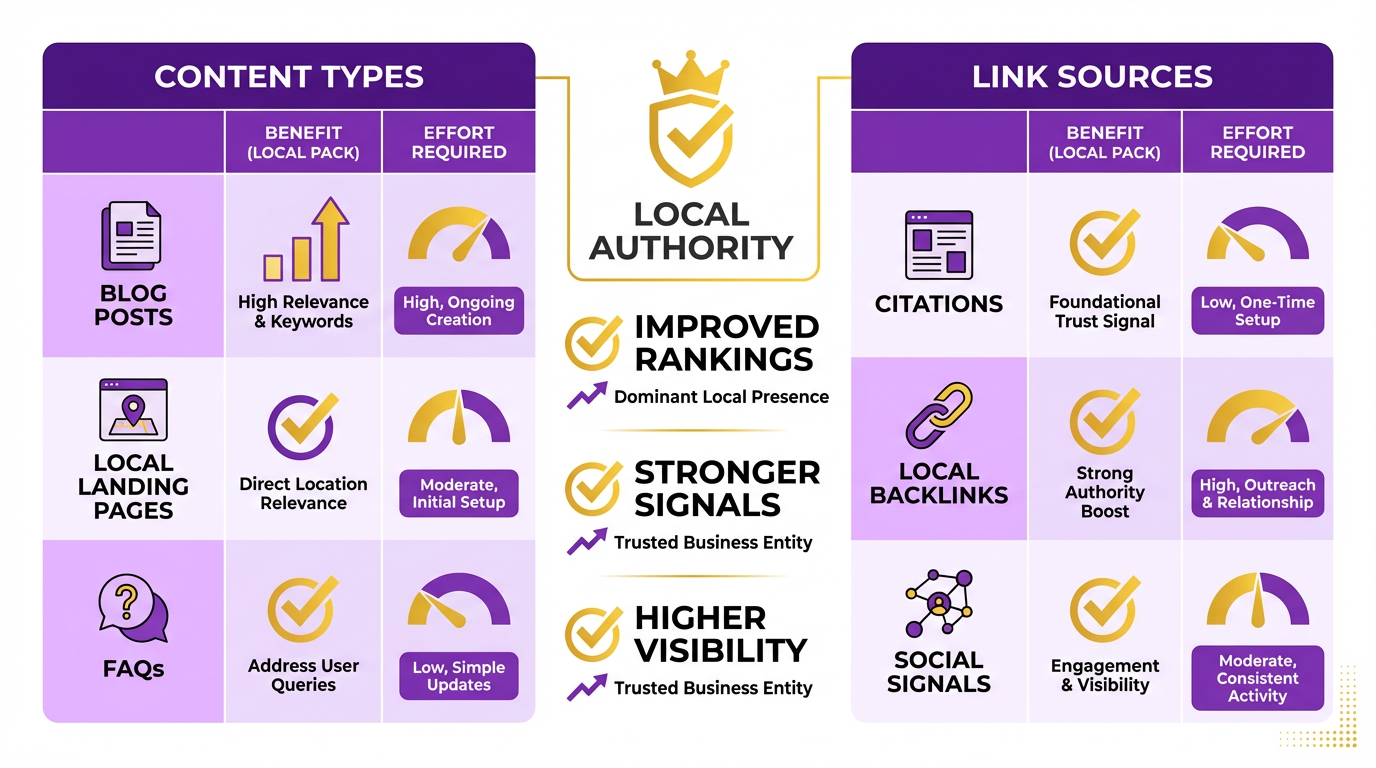
For example, a landscaping business might publish "Top 10 Spring Plants for [City] Gardens" or "How to Prepare Your Lawn for Winter in [Region]." These pieces target local intent while naturally incorporating geographic terms. Pair this with a content calendar that updates seasonal guides and local event coverage to maintain relevance.
What Tactics Build Authority for Local Pack Rankings?
Authority signals-like backlinks from trusted local sources-are critical. Focus on three pillars:
- Local Citations: List your business on directories like Google My Business, Yelp, and industry-specific platforms. Building on concepts from the Local SEO and Citation Building section, consistent citations across platforms enhance local relevance.
- Community Partnerships: Sponsor local events or collaborate with nearby businesses to earn backlinks. A bakery partnering with a café for a joint event might secure mentions on the café’s website and local press coverage.
- Content Outreach: Use AnyPost.ai to identify local blogs, news sites, or influencers for guest posting opportunities. A plumbing company, for instance, could write a blog post on "Avoiding Frozen Pipes in [City] Winters" for a home improvement blog.
A 2025 study found that 44% of local searchers click the 3-pack, making these efforts worth the investment. For example, one company increased its local rankings by 30% after publishing 12 localized guides and securing 50+ backlinks from regional directories and community sites.
How Do You Optimize Internal Linking for Local Visibility?
Internal linking strengthens your site’s relevance for local keywords. Structure your content so local pages (e.g., service area pages) link to each other, and backlink to in-depth guides from high-traffic pages. Use anchor text that includes location terms, such as "AC repair in [City]" or "SEO services near [Neighborhood]."
For example, a nationwide HVAC company might create subpages for each city it serves, linking to a central guide on "How to Choose an HVAC System in [Region]." This approach distributes authority while reinforcing local relevance.
A garage door business case study from 2025 demonstrated this strategy’s effectiveness: by interlinking service pages with location-based blog posts and optimizing anchor text, the company boosted its 3-pack visibility by 40% in six months.
What Role Does AnyPost.ai Play in Local SEO Success?
Unlike generic providers, AnyPost.ai offers tools tailored to local SEO, such as keyword research for hyperlocal terms and outreach templates for local link-building campaigns. Its analytics dashboard tracks backlink performance, helping you refine strategies in real time.
One company used AnyPost.ai to identify a gap in local content about eco-friendly pest control in [City]. By publishing a detailed guide and securing backlinks from local environmental blogs, it climbed from position 12 to the 3-pack in under three months.
By combining targeted content, strategic link-building, and AnyPost.ai’s localized tools, you can systematically improve your chances of earning a spot in the Google 3 Pack. Focus on consistency, relevance, and local authority to outperform competitors who overlook these fundamentals.
Frequently Asked Questions
1. Why is securing a Google 3-Pack spot important for local businesses?
Ranking in the 3-Pack drives 44% of users to click one of the top three listings, generating 50-70% of leads for service-based businesses. It appears before organic/paid ads, offering unmatched visibility for local searches.
2. How does Google determine which businesses appear in the 3-Pack?
Google prioritizes businesses with accurate, consistent data across platforms, verified Google Business Profiles, and strong local SEO. Citation building and proximity to the search location also influence rankings.
3. What role does a Google Business Profile play in 3-Pack rankings?
A fully optimized Google Business Profile with updated hours, detailed categories, and positive reviews is critical. Incomplete or inconsistent profiles reduce eligibility for the 3-Pack.
4. Why is consistent business data across platforms essential?
Inconsistent data, like mismatched addresses or phone numbers, triggers penalties in Google’s algorithm. Over 93% of local searches rely on accurate data to display relevant 3-Pack results.
5. How do citations impact Google 3-Pack rankings?
Citation building reinforces authority by verifying business details across directories. Google’s algorithm favors data-rich profiles with citations from reputable, industry-specific sources.
6. What percentage of local searches trigger the Google 3-Pack?
Over 93% of location-based searches display the 3-Pack as the primary result, making it a dominant feature for local visibility and customer acquisition.
7. Can any business rank in the Google 3-Pack?
Only local businesses with verified Google Business Profiles and strong local SEO qualify. Niche or national brands typically cannot compete for 3-Pack spots due to algorithmic prioritization of local relevance.