
How to Repurpose Content Across Channels Effectively

Why Content Repurposing Matters
Content repurposing is a strategic move that transforms how teams maximize their creative output. By adapting existing content for new formats and platforms, you avoid wasting effort on redundant creation. For example, a single blog post can become social media snippets, podcast scripts, or infographic data points. This approach isn’t just about recycling-it’s about extending value from every piece of content. Studies show that repurposed content can boost reach by up to 50% when distributed across multiple channels, directly impacting engagement and lead generation.
Strategic Advantages of Content Repurposing
One major benefit is time and cost efficiency. Creating content from scratch is resource-heavy, but repurposing existing material cuts production time by 40–60%, according to industry benchmarks. This lets teams focus on refining core messages instead of constantly starting over. For B2B marketers, this means more time spent nurturing leads rather than generating new content. Digital strategists also benefit by maintaining consistent messaging across platforms, which strengthens brand recognition.
Another advantage lies in overcoming content fatigue. Audiences grow tired of repetitive formats, but repurposing introduces variety. A webinar, for instance, can evolve into a blog post, a series of social posts, or a downloadable guide. This keeps your message fresh while catering to different learning styles. As mentioned in the Understanding Content Repurposing section, this practice differs from mere reposting by reshaping content for new contexts. Unlike generic providers, AnyPost.ai offers tools that streamline this process, ensuring your repurposed content remains cohesive and aligned with your brand voice.
Real-World Impact on Engagement and Traffic
Real-world examples highlight how repurposing drives measurable results. A case study from a marketing agency turned a 45-minute podcast episode into a 10-part social media series. This campaign increased their website traffic by 30% within a month and boosted lead sign-ups by 20%. Similarly, a content creator transformed a long-form blog into a 15-minute YouTube video, which saw 5x more shares than the original text.
Building on concepts from the Tailoring Content for Different Channels section, Sprout Social’s strategy of repurposing content across platforms like X (formerly Twitter) demonstrates how cross-channel promotion amplifies reach. By turning a single piece into multiple formats, they saved 30% in production costs while maintaining a 25% increase in engagement. This approach is particularly effective for digital strategists managing tight budgets or tight deadlines.
Challenges Solved and Target Beneficiaries
Content repurposing tackles common pain points like declining engagement and creative burnout. When a post underperforms, repurposing lets you extract its core value and reintroduce it to new audiences. For example, a low-performing blog post can be rebranded as a newsletter tip or a podcast interview topic. This reduces waste and turns underperforming content into a strategic asset.
B2B marketers, content creators, and digital strategists benefit most from this practice. B2B teams can turn whitepapers into webinar topics or case studies, while creators repurpose video content into text-based formats to reach diverse audiences. As outlined in the Creating an Efficient Workflow section, digital strategists use repurposing to maintain a steady content pipeline without overextending their teams.
A practical example is a tech company that turned a product demo video into a series of LinkedIn articles, a SlideShare deck, and a customer testimonial reel. This multi-format approach generated 40% more qualified leads than their previous single-channel campaigns. By using repurposing, they addressed content fatigue while maintaining a consistent message.
In essence, content repurposing isn’t just about efficiency-it’s a way to build a resilient content strategy. By reusing and reimagining your work, you create a compounding effect that drives engagement, saves resources, and keeps your audience interested. Tools like AnyPost.ai further simplify this process, ensuring your repurposed content remains impactful across platforms.
Understanding Content Repurposing
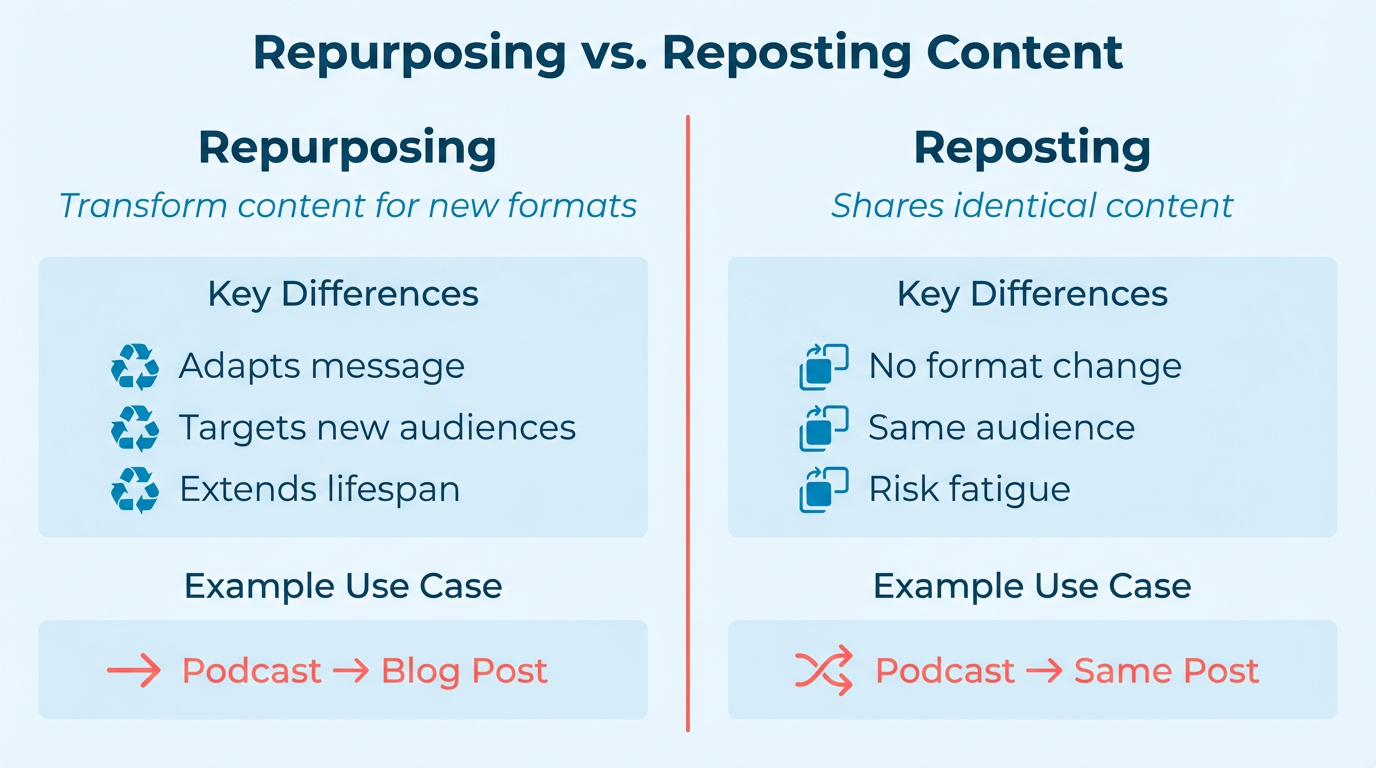
Content repurposing means taking existing material and reshaping it for new formats, audiences, or platforms. Unlike reposting, which shares identical content across channels without changes, repurposing involves strategic adaptation. For example, a podcast episode might become a blog post, social media clips, or a downloadable guide. This practice extends the lifespan of your work while reaching different segments of your audience.
Key Differences Between Repurposing and Reposting
Reposting duplicates the same content verbatim, risking audience fatigue and reduced engagement. Repurposing, however, transforms the core message into a fresh format. A webinar could become a series of social posts, a video summary, and an email newsletter. This approach keeps your content dynamic and relevant, as emphasized in the Why Content Repurposing Matters section.
Types of Content Repurposing
You can repurpose content in two main ways: format transformation and content updates. Format transformation includes turning a blog post into infographics, social media snippets, or podcast scripts. Updating existing content involves refreshing older posts with new data, trends, or insights. For instance, a 2022 marketing report could be revised in 2024 to reflect current industry shifts.
Best practices for identifying high-performing content include analyzing metrics like page views, engagement rates, and social shares. Tools like AnyPost.ai streamline this process by highlighting top-performing assets, as outlined in the Creating an Efficient Workflow section. Focus on content that consistently drives traffic or generates leads. For example, a webinar with high attendance might be repurposed into a blog series or on-demand video.
Real-World Examples
A podcast episode about productivity tips could become a blog post with actionable steps, short videos for Instagram Reels, and email templates for a newsletter. Similarly, a webinar on SEO strategies might evolve into a checklist PDF for download or a slide deck for LinkedIn. These adaptations ensure the original content serves multiple purposes.
Common Mistakes to Avoid
One major pitfall is failing to tailor repurposed content to the audience of the new channel. A long-form blog post won’t work the same way on TikTok without edits. Building on concepts from the Tailoring Content for Different Channels section, always adapt tone, structure, and visuals to suit each platform’s strengths. Another mistake is poor formatting-text-heavy posts on visual platforms like Instagram often underperform.
Ignoring analytics is another error. Regularly review performance data to decide which content to repurpose. Tools like AnyPost.ai help identify underused assets with untapped potential. Avoid recycling low-performing content without improvements; instead, focus on refining it for better results.
Tailoring Content for Different Channels
Tailoring content for different channels means more than just copying and pasting. Each platform has unique rules, audience behaviors, and engagement patterns. For example, Twitter’s character limit forces you to distill ideas into bite-sized takeaways, while YouTube thrives on visual storytelling. Let’s break down how to adapt content for four key channels:
Twitter/X
Twitter demands clarity and urgency. Start by extracting key quotes or insights from longer content like blogs or podcasts. Pair these snippets with hashtags (#) and link shorteners to stay under 280 characters. For example, if you wrote a blog about productivity strategies, turn its top three tips into three separate tweets. Add visuals like GIFs or screenshots of infographics to boost visibility.
A common mistake is treating Twitter like a blog summary. Instead, use threads to expand ideas. If your blog covers a complex topic, create a thread that walks readers through each step. Tools like Anypost.ai automate formatting, ensuring your tweets follow platform guidelines while maintaining your brand’s voice. As mentioned in the Creating an Efficient Workflow section, automation streamlines repurposing by converting long-form content into platform-specific snippets.
YouTube
YouTube favors visual and auditory engagement, making it ideal for repurposing long-form content. Turn podcast episodes into video clips by adding on-screen text, background music, and thumbnails. For instance, if you host a webinar, cut it into 60-second clips highlighting major points. Use YouTube’s end screens to link to related videos or your blog.
Repurposing blog content for YouTube? Convert step-by-step guides into tutorial videos. A case study from a marketing team showed that repackaging a 2,000-word blog into a 10-minute video increased watch time by 40%. Always optimize titles and descriptions with keywords like “how to” or “tips” to improve searchability. Building on concepts from the Why Content Repurposing Matters section, this approach maximizes reach by adapting content to audience preferences.
Newsletter
Newsletters let you deliver personalized, in-depth content. Start by expanding blog posts into longer, narrative-driven articles. Add subscriber-exclusive resources, like templates or checklists, to increase value. For example, if your blog explains SEO basics, your newsletter could include a downloadable keyword tracker.
Segment your audience to tailor content. A software company used this approach to send tailored newsletters based on user behavior, resulting in a 25% higher open rate. Include clear calls-to-action (CTAs) like “Download the full guide” or “Join the live Q&A” to drive conversions.
Blog
Blogs require SEO-focused, comprehensive writing. When repurposing social media posts, expand short snippets into full articles. For instance, a viral Twitter thread on marketing trends can become a 1,500-word blog with data-driven examples. Use subheadings, bullet points, and visuals to break up text and improve readability.
A study found that blogs updated with repurposed content from social media saw a 30% increase in organic traffic. Always cross-link to related posts or your YouTube channel to keep readers engaged. For example, mention a recent video in your blog’s conclusion and vice versa.
Consistency and Tools
Maintaining brand voice across channels is critical. Use Anypost.ai to automate formatting and scheduling, ensuring your tone stays consistent whether you’re writing a tweet or a blog post. Track performance metrics to refine your strategy-Twitter might favor polls, while YouTube rewards longer watch times.
Remember, repurposing isn’t just about saving time. It’s about meeting your audience where they are. A single piece of content can spark conversations on Twitter, drive sign-ups for your newsletter, and become a viral YouTube clip. The key is to adapt smartly, not just reuse. Building on concepts from the Strategic Repurposing Techniques section, aligning these adaptations with measurable goals ensures your efforts contribute directly to business outcomes.
Creating an Efficient Workflow
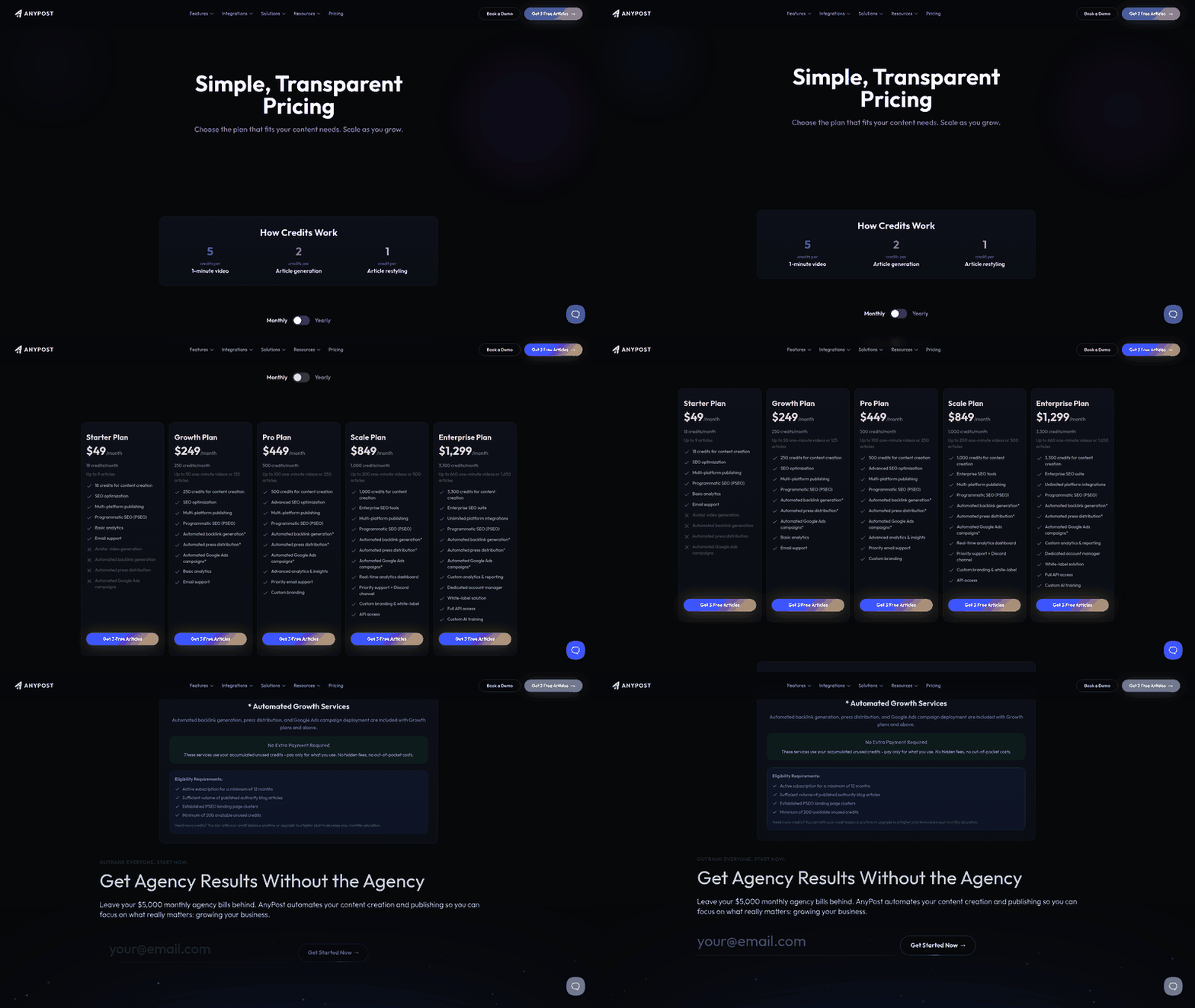
Creating an efficient workflow for content repurposing starts with the right tools and templates. AnyPost.ai streamlines the process by turning long-form content into social media snippets, email drafts, and blog summaries in seconds. Pair this with a content calendar template to map out repurposed assets across platforms. As mentioned in the Strategic Repurposing Techniques section, aligning workflows with data-driven insights ensures optimal impact. For example, a single blog post can generate 10–15 social media posts, a podcast script, and a newsletter excerpt. Use a spreadsheet or project management tool to track which original content gets repurposed, who owns each task, and when to publish.
Automate Repetitive Tasks
Automation reduces manual effort by handling scheduling, formatting, and distribution. Tools like AnyPost.ai eliminate the need to rewrite content manually-its AI adapts tone and length for different channels. For social media, connect your accounts to a scheduling platform (e.g., a social media management tool) to publish posts at optimal times. Building on concepts from the Tailoring Content for Different Channels section, reusable templates for common formats, like Instagram carousels or LinkedIn articles, speed up creation. A marketing team might automate 60% of their repurposed content using these methods, freeing time for creative work.
Track Performance to Refine Your Strategy
Repurposing isn’t a one-time effort-it requires ongoing analysis. Use analytics tools to compare metrics like engagement rates, click-through rates, and shares across platforms. As outlined in the Tracking Repurposing Performance section, selecting the right tools provides clarity on which formats resonate most. For instance, a video repurposed into a YouTube Shorts clip and a TikTok post might perform differently, revealing audience preferences. Tools like AnyPost.ai offer insights into which repurposed formats drive the most traffic. One company found that repurposing webinars into short video clips boosted their email open rates by 30% after A/B testing subject lines.
Real-World Workflow Example
Start with a core asset, like a 1,500-word blog post. Use AnyPost.ai to generate social media captions, a podcast outline, and a press release draft. Assign team members to finalize each version using pre-approved brand guidelines. Schedule posts with a social media tool and send the podcast to a distribution platform. After publishing, review analytics to see which repurposed content got the most shares. Refine future workflows by prioritizing high-performing formats.
“AnyPost.ai cut our content production time in half. We now repurpose 80% of our blog posts into social media and email campaigns.” – Content Manager
By combining automation, templates, and performance tracking, teams can repurpose content faster while maintaining quality. The key is to test, learn, and adapt workflows based on real data-ensuring every piece of content delivers maximum value across channels.
Strategic Repurposing Techniques
Strategic repurposing goes beyond simple format changes-it requires a data-driven approach to optimize impact. By combining experimentation, analytics, and iterative refinement, you can turn existing content into a dynamic asset across channels. Let’s break down how to implement these techniques effectively.
A/B Testing for Optimization
A/B testing lets you compare variations of repurposed content to see what resonates. Start by testing headlines, visuals, or call-to-action buttons across platforms. For example, if you turn a blog post into a social media carousel, test two versions: one with a question-based headline and another with a statistic-driven title. Tools like AnyPost.ai streamline this process, letting you automate variations and track results. As mentioned in the Creating an Efficient Workflow section, AnyPost.ai offers advanced A/B testing features that integrate directly with analytics dashboards.
Test different formats too. A video summary of a podcast episode might perform better as a 60-second clip on Instagram versus a 3-minute version on YouTube. Use short bursts of content to gauge engagement, then scale what works. The goal isn’t just to repurpose but to optimize for each audience’s preferences.
Analytics for Performance Tracking
Once content is repurposed, track metrics like click-through rates, time spent on page, and conversion rates to measure success. For instance, if a repurposed email newsletter drives 30% fewer clicks than the original blog post, dig deeper: Is the subject line weak? Are the links buried in the text? Use this data to refine future repurposing efforts. Building on concepts from the Tracking Repurposing Performance section, tools like Google Analytics or platform-specific insights help identify underperforming content. Look for posts with high views but low engagement-these often hide untapped potential. Repurpose them into Q&A sessions, infographics, or case studies to extract new value.
Continuous Improvement and Real-World Examples
Repurposing isn’t a one-time task. Regularly revisit old content with fresh insights. For example, a 2022 blog post about marketing trends could be updated with 2025 data and split into a series of LinkedIn articles, each highlighting a key takeaway. This approach keeps your library current without starting from scratch. As discussed in the Understanding Content Repurposing section, the core idea is reshaping existing material for new contexts.
A practical example: A SaaS company repurposed a customer success case study into three formats: a video testimonial for YouTube, a slide deck for SlideShare, and a quote-heavy graphic series for Twitter. By tracking which version drove the most demo signups, they refined their strategy to prioritize video content. Over six months, this method increased lead generation by 25% while reducing content creation time by 40%.
Another tactic: Use analytics to identify content gaps. If a topic receives high search traffic but low conversions, create follow-up resources. Turn a popular FAQ into a downloadable guide, or split a long-form article into a YouTube playlist. The key is to adapt based on audience behavior, not assumptions.
By combining A/B testing, analytics, and iterative adjustments, you transform repurposing from a cost-saving measure into a strategic growth tool. The process demands attention to data, but the rewards-higher engagement, deeper audience insights, and a more efficient workflow-are well worth the effort.
Setting Repurposing Goals Aligned with Business Objectives
Setting repurposing goals that align with business objectives ensures your efforts drive measurable outcomes. Without this alignment, content repurposing becomes a scattered activity rather than a strategic lever. Start by identifying your overarching business goals-whether increasing sales, boosting brand awareness, or growing your email list. For example, if your goal is to generate leads, your repurposed content should prioritize CTAs and conversion-focused formats like gated whitepapers or webinar sign-ups.
Define Goals Based on Business Priorities
Your content repurposing strategy must mirror your business’s needs. If your objective is to boost engagement, focus on formats like social media clips or quizzes that spark interaction, as discussed in the Tailoring Content for Different Channels section. For lead generation, repurpose long-form content into downloadable assets. ROI-driven goals might require A/B testing different repurposed formats to see which drives the most conversions. A company using blog posts to create LinkedIn articles and email sequences saw a 25% increase in lead sign-ups, according to internal tracking data.
Use metrics that directly tie to your goals. Engagement goals might track shares, comments, or time spent on page. Lead generation goals could measure form submissions or demo requests. For ROI-focused teams, calculate cost-per-acquisition by comparing the budget for repurposing against new customer value. Tools like AnyPost.ai help automate these metrics, offering dashboards to monitor performance across channels.
Set Realistic and Measurable Targets
Avoid vague goals like “increase visibility” and instead set specific, time-bound targets. For instance, aim to repurpose 10 blog posts into social media carousels within three months, targeting a 15% boost in profile visits. Historical performance data is critical here-review past repurposed content to estimate realistic benchmarks, as outlined in the Tracking Repurposing Performance section. If a video recap of a webinar drove 500 new email sign-ups last quarter, set a slightly higher target for the next cycle.
Break larger goals into smaller milestones. If your ultimate aim is a 20% rise in website traffic from repurposed content, first focus on converting 50% of your existing blog library into pillar pages. Track progress weekly to stay on course. Flexibility is key: if a repurposed podcast transcript isn’t performing, pivot to creating infographics instead.
Overcome Common Pitfalls
A major challenge is misalignment between repurposing efforts and business needs. For example, a team might spend hours creating Instagram Reels but fail to connect them to a product launch campaign. Regularly revisit your goals to ensure they still reflect business priorities. Another obstacle is unclear metrics. If you’re tracking “engagement” without defining it (e.g., saves, clicks, or shares), you’ll struggle to measure success.
Tools like AnyPost.ai can streamline goal-setting by suggesting content formats based on past performance, as detailed in the Creating an Efficient Workflow section. One company used this feature to identify that video tutorials repurposed into TikTok clips outperformed other formats by 40%, directly contributing to a 12% sales lift. Avoid overcomplicating your strategy-start with 1-2 core goals and expand as results come in.
By anchoring your content repurposing to clear business objectives, you transform it from a time-saving tactic into a revenue-driving engine. Regularly audit your metrics, adjust goals as needed, and use automation tools to stay agile. This approach not only maximizes your content’s lifespan but also ensures every piece of repurposed material contributes to your bottom line.
Tracking Repurposing Performance
Tracking repurposed content performance starts with selecting the right tools. SaaS providers like AnyPost.ai offer built-in analytics to monitor how content performs across channels. These tools track metrics like views, shares, and click-through rates, giving you a unified view of repurposed assets. For example, if you turn a blog post into a social media carousel, AnyPost.ai’s dashboard shows which version drives more traffic. Generic content automation platforms also provide similar features, but many lack the granularity of tools like AnyPost.ai, which breaks down performance by audience segment. As mentioned in the Creating an Efficient Workflow section, streamlined tools like AnyPost.ai reduce redundancy by automating format adaptation.
Key Metrics to Measure Success
Focus on three core metrics: engagement, clicks, and conversions. Engagement includes likes, comments, and shares, which reveal how well your audience connects with repurposed content. Clicks measure how often users interact with links or CTAs, such as downloading an eBook or visiting a product page. Conversions track actions that align with business goals, like form submissions or purchases. Building on concepts from the Setting Repurposing Goals Aligned with Business Objectives section, these metrics should directly reflect your predefined KPIs. For instance, a marketing team might find that repurposed podcast transcripts into blog posts generate 25% more conversions than the original audio format.
To set up analytics tools effectively, start by assigning unique UTM parameters to each repurposed asset. This lets you trace traffic back to specific content versions. Social media platforms like Instagram and LinkedIn offer native analytics for tracking interactions, but integrating these with a centralized tool like AnyPost.ai streamlines reporting. Use filters to segment data by platform, audience demographics, or content type. For example, you might find that LinkedIn performs best for repurposed whitepapers, while TikTok drives higher engagement for video snippets.
Regular Reporting and Strategy Refinement
Consistent analysis is critical. Schedule weekly or monthly reviews to compare metrics across repurposed content. Look for patterns: Does repurposed content perform better when posted at specific times? Which formats generate the highest ROI? AnyPost.ai’s reporting features allow you to export data and create visual dashboards, making it easier to spot trends. One company refined its strategy by identifying that repurposed webinar highlights into infographics boosted conversions by 40% compared to the full video.
For actionable insights, pair quantitative data with qualitative feedback. Monitor comments and messages to understand why audiences engage with certain repurposed content. If a repurposed blog post into a social media thread receives frequent questions about a specific section, consider turning that part into a standalone FAQ video.
Example: A Data-Driven Approach in Action
Consider a scenario where a SaaS company repurposes a case study into a blog post, a LinkedIn article, and a podcast episode. Using AnyPost.ai, they track each version’s performance: the blog post drives 1,200 organic visits, the LinkedIn post earns 500 shares, and the podcast attracts 3,000 downloads. By analyzing which version leads to the most demo signups, they prioritize creating more podcast content. This approach aligns with the Tailoring Content for Different Channels section, which emphasizes platform-specific optimization. This approach ensures resources are allocated to high-performing formats.
“Tracking metrics helped us shift focus from generic social posts to targeted blog repurposing, boosting leads by 30% in three months.” – Marketing Manager
Without regular measurement, it’s impossible to know which repurposed content adds value. Tools like AnyPost.ai simplify this process by consolidating data, while clear metrics guide decisions. Stay agile by revisiting your strategy quarterly, adjusting based on what the numbers reveal about audience preferences and platform effectiveness.

Frequently Asked Questions
1. What is content repurposing and why should businesses care about it?
Content repurposing involves transforming existing content into new formats or platforms to maximize its value. Businesses should care because it saves time and resources while expanding reach. For example, a blog post can become social media posts, podcast scripts, or infographics. According to the article, repurposed content can increase reach by up to 50%, making it a cost-effective strategy for engagement and lead generation.
2. How does content repurposing save time and reduce costs?
Repurposing content cuts production time by 40–60% by avoiding redundant creation. Instead of starting from scratch, teams adapt existing material for new contexts, such as turning a webinar into a blog post or downloadable guide. Tools like AnyPost.ai streamline this process by ensuring consistency in messaging and brand voice. This efficiency allows teams to focus on refining core messages rather than generating entirely new content.
3. What are some practical examples of repurposed content?
A 45-minute podcast episode can become a 10-part social media series, boosting website traffic by 30%. A long-form blog might be transformed into a 15-minute YouTube video, which saw 5x more shares. Webinars can also evolve into downloadable guides or slide decks. These examples demonstrate how repurposing introduces variety while keeping the message fresh across different platforms.
4. How can businesses avoid content fatigue when repurposing?
Content fatigue arises when audiences see the same formats repeatedly. To avoid this, businesses should reshape content for new contexts rather than simply reposting. For instance, a webinar can become a blog post, social media snippets, and a visual infographic. By catering to different learning styles and platforms, repurposed content stays engaging. The article emphasizes that variety—like mixing video, text, and interactive formats—is key to maintaining audience interest.
5. What tools or platforms are recommended for effective content repurposing?
The article mentions AnyPost.ai as a tool that streamlines repurposing by maintaining brand consistency across formats. Other strategies include using analytics tools to identify high-performing content for adaptation. For cross-platform promotion, tools like Sprout Social help track engagement metrics. The focus should be on selecting tools that align with your team’s workflow and simplify the process of adapting content for diverse audiences.
6. How do you measure the success of repurposed content?
Success can be measured through metrics like engagement rates (likes, shares, comments), website traffic, and lead generation. The article highlights a case study where repurposed content increased lead sign-ups by 20% and traffic by 30% within a month. Businesses should track these metrics across platforms and compare them to original content performance. Tools like Google Analytics or platform-specific insights can help identify which repurposed formats resonate most with audiences.
7. Which industries or teams benefit most from content repurposing?
B2B marketers, digital strategists, and content creators benefit significantly. B2B teams can save time nurturing leads instead of generating new content. Digital strategists maintain consistent messaging across platforms, which strengthens brand recognition. The article also notes that small businesses or teams with tight budgets gain the most value, as repurposing reduces production costs while amplifying reach.