
How to Wire AI Content from Keyword to Published Post Without Manual Handoffs

Quick Answers
- A keyword-to-published pipeline hides its real time cost in tab switching, reformatting, re-prompting, and manual CMS upload. Drafting is rarely the main bottleneck.
- Some surveys report that long-form blog posts can take several hours, and drafting is only part of that total time.
- Re-optimizing an existing article can take less effort than a new post and may help protect visibility you already have, but many end-to-end guides omit that loop.
- Some marketers describe multi-agent workflows that research, outline, draft, and optimize blog posts using small markdown instruction files.
- Showing the model a few example passages can teach brand voice faster than telling it to "write conversationally" or relying on tone rules alone.
The writing problem is really a handoff problem
Most teams don't have a writing problem. They have a volume and coordination problem. This can show up when a content lead, agency head, or SaaS founder tries to automate content marketing with AI. They may expect drafting to be the bottleneck. The real time sink often sits in the gaps between tools.
Some survey data points in this direction. Long-form blog posts can take several hours to produce, and some practitioners say drafting is only one part of that time. Disconnected AI tools can reduce some of that time, but copy-pasting between tabs can still consume significant effort.
Where the time actually goes
Handoffs between keyword research, briefs, drafts, optimization, and CMS upload can create a hidden tax. A keyword-to-published pipeline can be configured to remove many of those handoffs. Some marketers describe multi-agent workflows that research, outline, draft, and optimize blog content. In those setups, small process files with clear instructions can keep each step consistent.
Those process files don't have to make the workflow autonomous. The hidden costs can still show up as tab switching, reformatting, re-prompting, and manual upload. Copying a draft into a CMS, fixing headings, adding links, and resizing images can sometimes consume more time than the writing itself.
A typical keyword-to-published pipeline touches several stages, each with its own failure point:
- Keyword research. A weak keyword can waste every downstream step.
- Research and outline. AI can help aggregate competitor gaps faster than a person, but the angle still needs human judgment.
- Draft and optimize. Once you have strong voice examples, this often gets faster.
- Publishing. CMS wiring is where copy-paste busywork can hide.
- Updates and re-optimization. The stage that can keep content from decaying.
What happens after the post goes live
Post-publication updates can be a high-value stage, and one that many end-to-end guides leave out. A keyword-to-published workflow can include article refreshes and re-optimization from day one. This is often where content can compound instead of decaying.
The same pipeline can be aimed at refreshes, not just net-new posts. Search intent can shift, stats can go stale, and competitors may rewrite their pages. Re-optimizing an existing asset may take less time than a new post and may help protect visibility you already earned. If you publish sporadically or never refresh old posts, this level of automation may be overhead rather than an advantage.
Drafting and voice matching: skills, not one giant prompt
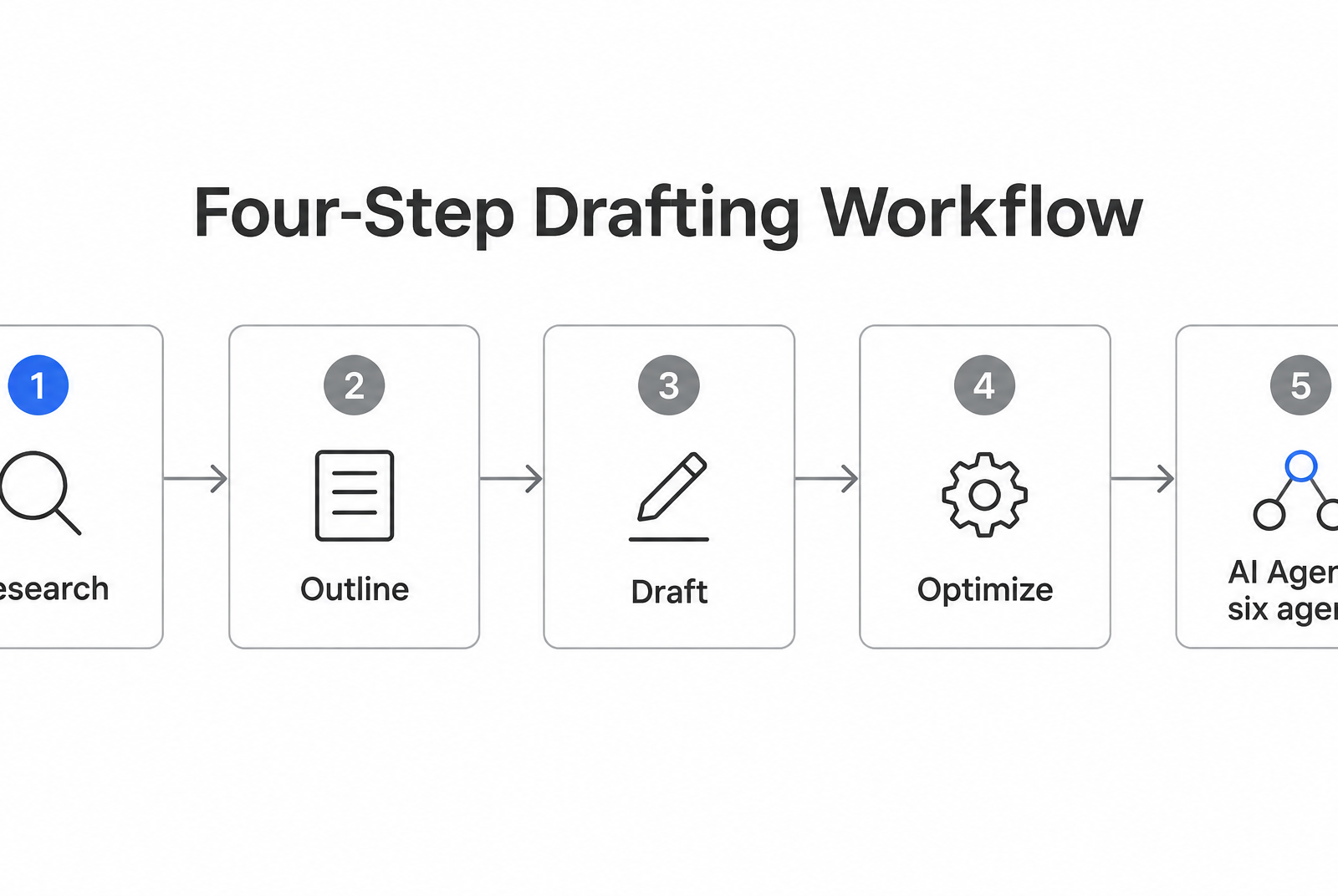
The part many teams underestimate isn't writing the content. It's separating drafting from one giant prompt. In well-structured systems, drafting is a sequence of discrete skills: research, outline, draft, and optimize. That separation is often what makes the first pass close to publish-ready.
When you automate content marketing with AI, it can help to break drafting into those moves. Some multi-agent setups rely on small markdown instruction files for each job rather than one oversized prompt. The result can be a draft ready for review with fewer manual handoffs. The speed comes from removing handoffs, not from asking a single model to do more at once.
Sequencing skills beats stacking prompts
The single-prompt trap can produce generic output because it asks one pass to research, structure, write, and optimize all at once. Multi-skill drafting gives each pass a narrower job. A researcher pass can gather facts and source material. An outline pass can build a structure that covers every angle without overlap. A writer pass can draft paragraphs. An optimize pass can check keyword usage, headings, and internal links.
You can skip this level of sequencing for a one-off post where you already have a strong draft. Multi-skill drafting may earn its keep when you publish consistently and update existing articles. The same skill files can drive updates. In some configurations, an optimize pass can re-check an existing article against current search results instead of starting over. That becomes a refresh pass, not a new project.
Voice matching works by example, not by rules alone
A one-line tone description often won't solve brand voice. Preferred phrasing, prohibited terms, and tone rules can live directly in the prompt, and our Persona Engine is built for tone matching. But the bigger lever can be example passages. Showing the model a few paragraphs that sound like you can teach voice faster than telling it "write conversationally."
A research pass can aggregate sources faster than a person, but it still needs a human check on source links before publish. That guardrail can live in the optimize step, not in the draft step. For most client work, prompt-level guidance can be easier to update, audit, and reuse across campaigns than model-level tone fine-tuning. When you automate content marketing this way, the voice file can become an asset you can version and refine as the brand shifts.
Automated SEO and one-click publishing: the publish button gets too much credit
Many teams focus on the publish button. Our experience is the opposite. The step just before publish, a separate optimization pass, can determine whether the article is ready or just fast. A draft can look finished and still need a formatting and on-page check before anyone approves it.
In some pipeline configurations, the system can move from a keyword through research, outline, draft, and a final optimization and formatting sequence. A run can produce a review-ready draft quickly, not a final CMS entry. The output may include on-page work already done. That speed only matters because the handoff is wired into the workflow, not pasted together through separate tools.
What the draft-to-publish handoff actually includes
The short answer is a structured sequence that ends with formatting for publish. We keep on-page claims broad here. An automated pass can be configured to check title structure, heading order, keyword placement, and internal linking cues. It does not replace human editorial judgment.
Some teams running similar workflows report they are still in the early stages, with a modest number of published articles and a similar number in progress. We would not extend that into promises around automated backlink building, local SEO updates, CMS integrations, or social syndication. The evidence does not support those.
Why the update loop matters more than the initial publish
The same workflow that produces a new draft can also be re-run against existing pages. Some practitioners report using the same automation for article updates, not just net-new posts. That is the part many teams leave on the table.
Refreshing an older article can mean running the same optimization pass on live content, rechecking search intent, and updating on-page elements before traffic decays. The article can stay current without a full rewrite. For many teams, the post-publish update loop is the real payoff of wiring AI content from keyword to published page.
The bottom line on post-publish updates
Publishing is where many teams stop, but the real loop can begin after the page goes live. You can reuse the same workflow you use to automate content marketing with AI from keyword to published post for ongoing article updates. Closing the loop means treating every published post as a draft that may need a future refresh.
The update loop is not a separate project. It can run through the same sequence you already use for new posts: research, outline, draft, and optimize, pointed at an existing page instead of a blank one.
What stays human in an automated update loop
The human gate can shrink, but it doesn't disappear. We don't mean a rewrite. A quick sanity check for brand voice, a fact spot-check, and a glance at the updated headings can be enough before pushing changes live. If a pipeline produces a draft quickly, a lightweight review keeps the quality bar without dragging the process back into manual mode.
AI can handle broad strokes of an update well, but details like headings, bullet points, and correct sourcing can drift. That's not an argument against automation. It's a reason to keep the review gate lightweight and specific. Many teams check for tone shifts and factual errors, not sentence-level edits.
What you can actually claim from the update loop
The supported outcome is repeated article updates. We can't turn that into claims about traffic alerts or measurable ranking improvements. The evidence doesn't go there yet. What you can do is feed whatever performance signals you already have back into prompt refinements and keyword clusters.
You don't need a dashboard to start that loop. A simple list of underperforming or outdated pages is enough. Each update round can give you small prompts to refine, a keyword cluster to adjust, or a formatting rule to add. Over time the same automated workflow can get better at keeping content current, and you can avoid restarting the manual grind.
Frequently Asked Questions
What is the difference between using one large prompt and a multi-agent pipeline for AI content?
A single prompt often asks one pass to research, structure, write, and optimize at once, which can flatten voice and produce generic copy. A multi-skill sequence separates those jobs so each pass can focus on one task, and the draft may arrive closer to publish-ready without manual handoffs.
How do you get AI to match brand voice without expensive fine-tuning?
Example passages can teach brand voice faster than tone rules alone. Showing the model a few paragraphs that sound like you can be more effective than saying "write conversationally." Our Persona Engine supports tone matching, but example passages can remain the easier lever to update and audit across campaigns.
When does a full keyword-to-published workflow make sense?
A full workflow may earn its keep when you publish consistently or refresh posts regularly. For sporadic publishing or one-off strong drafts, it can become overhead. The same skill files can handle both new content and updates.
What stays human once the automated update loop is running?
A lightweight review gate remains: check brand voice, spot-check facts, and glance at updated headings. The aim is to catch tone shifts and sourcing drift, not to rewrite sentences. That keeps quality without pulling the process back into manual editing.