
HubSpot Keyword Tool vs Ahrefs Keywords Explorer for Topic Clusters

Key Takeaways
- HubSpot retired its keyword research tool in 2018, choosing topic clusters over deep keyword data.
- The old HubSpot tool gave basic search volume and difficulty scores.
- Those numbers often lagged behind real search trends.
- Ahrefs Keywords Explorer bets on data depth. HubSpot bet on content structure.
- Most teams use both: Ahrefs for keywords, HubSpot for clusters.
- HubSpot's competitive analysis stayed shallow, which pushed the company toward its Content Strategy Tool.
- Neither platform closes the loop from research to published pages.
- You still write every article yourself.
- HubSpot's original appeal was research, drafting, and publishing in one place.
Where HubSpot's keyword tool went
When HubSpot sunset its keyword features in favor of the Content Strategy Tool, it was saying something about organic growth. The bet was simple: topic clusters beat raw keyword mining. That shift left marketers without the granular metrics they needed for discovery. Compare the HubSpot keyword tool with Ahrefs today, and you see two philosophies that never merged. HubSpot optimized for structure. Ahrefs doubled down on data.
That split created a workflow gap that has lasted for years. Teams pull high-value terms from Ahrefs, map them into HubSpot's cluster framework, then hit the wall of drafting each piece. Planning and publishing still live in separate worlds.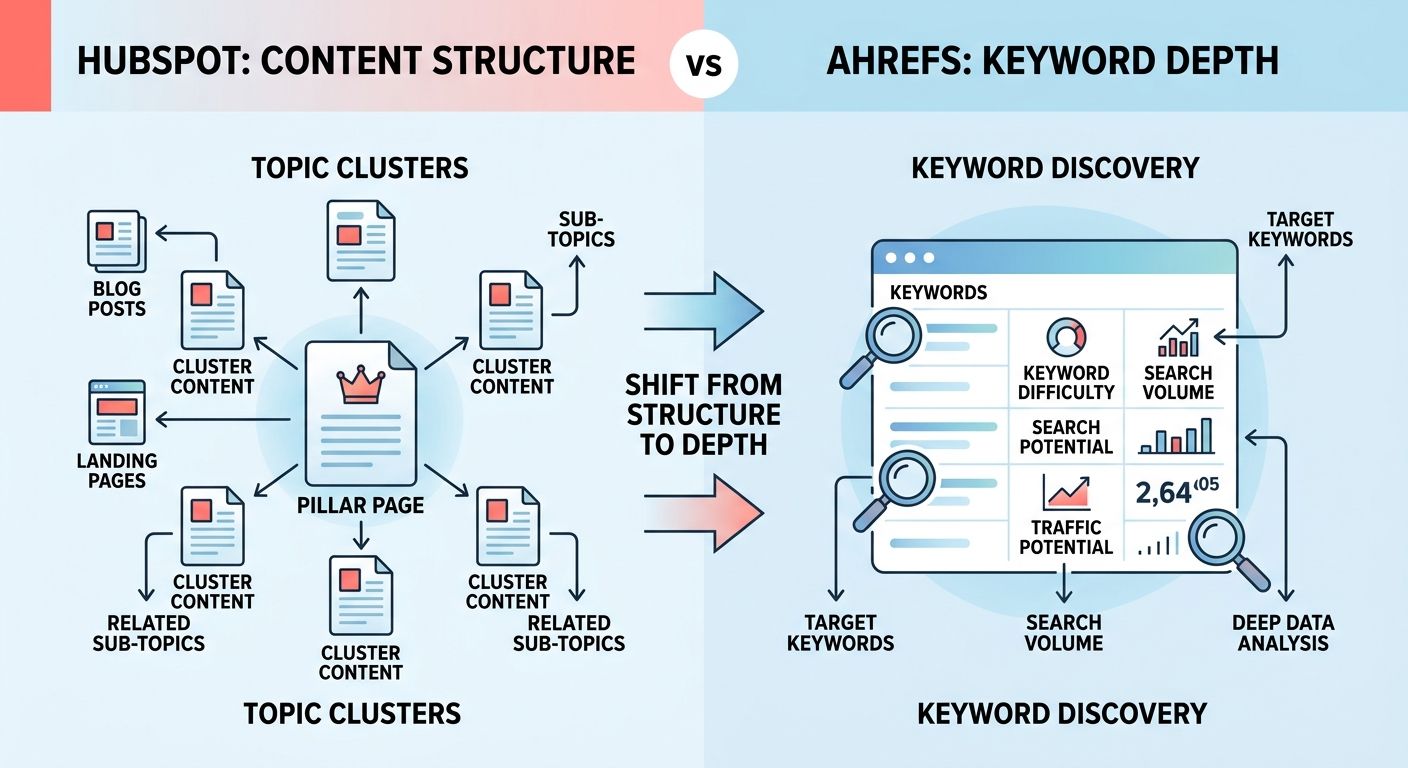
What the old HubSpot keyword tool actually did
In its original form, HubSpot's native keyword feature offered basic search volume and difficulty scores inside the platform. It plugged into the blog editor and landing page builder, so you could optimize while drafting. It suggested related keywords as you worked, then tracked rankings after publishing.
One workspace. No tab-switching. That was the pitch, and it worked for creation. The data underneath did not match dedicated SEO platforms, though. Monthly volumes often lagged actual trends, and competitive analysis stayed surface-level. Rather than chase the data depth of specialized tools, HubSpot leaned into topic clusters instead.
Why HubSpot killed keyword research
HubSpot's official line was that pillar content strategies drive more durable organic growth than keyword-by-keyword optimization. The Content Strategy Tool asks you to define broad topics, then suggests subtopics and questions to cover. You build a pillar page, link supporting cluster articles to it, and signal topical authority to search engines.
The theory is sound. Google does reward comprehensive coverage over isolated keyword plays. But HubSpot left two problems unsolved: you still need keyword data to know which subtopics people actually search, and you still have to write every page. They handed you the blueprint and left the construction crew out of the picture.
This is where most teams stall. The cluster model makes sense on a whiteboard. Finding time to produce 15 interlinked articles is the hard part.
How it stacked up against Ahrefs before retirement
Ahrefs Keywords Explorer lets you analyze up to 10 seed keywords in one report, pulling keyword difficulty, monthly search volume, click data, and full SERP history. You see which pages rank, their backlink profiles, and which content angles own the first page. It's built for marketers who want the competitive landscape before spending resources.
HubSpot gave you the basics and skipped the intel. You'd see a volume figure and a difficulty score, but not why a keyword was hard or what ranking would take. Ahrefs shows the whole battlefield. HubSpot showed a target with no context.
| Feature | HubSpot Keyword Tool (Pre-2018) | Ahrefs Keywords Explorer |
|---|---|---|
| Search Volume Data | Basic monthly estimates | Detailed volume with click metrics |
| Keyword Difficulty | Simple 0-100 score | Difficulty + backlink requirements |
| Competitive Analysis | Limited | Full SERP breakdown with DR scores |
| Related Keywords | Auto-suggestions | Deep keyword clustering |
| Integration | Native HubSpot CMS | Export to any platform |
| Content Publishing | Built-in editor | Requires external CMS |
The real trade-off was never data versus convenience. It was depth versus closure. Ahrefs owns the research layer. HubSpot owned the publishing layer. Neither one gets you from knowing what to write to having pages ready to ship.
What replaced it, and why the gap didn't close
The Content Strategy Tool swapped keyword research for topic modeling. You enter a core topic, and it generates subtopics based on what people search and ask. That is useful for sketching cluster architecture. It will not tell you search volume, competition, or difficulty for those subtopics. You're drawing a content map without knowing which roads carry traffic.
So most teams end up running three disconnected steps: validate subtopics in Ahrefs, map them into HubSpot's clusters, then spend weeks producing articles. Every handoff bleeds momentum. Research finds the opportunities. Planning structures them. Writing becomes the bottleneck, because it needs human writers or a content team with spare capacity you probably do not have.
AnyPost.ai targets that last step. It automates content generation and publishing, producing SEO-optimized articles that match your brand voice and pushing them to your chosen platforms. The idea is to get from keyword research to deployed content without the manual writing phase in between.
What Ahrefs Keywords Explorer gets right
Open Keywords Explorer and the depth gap shows up immediately. Ahrefs built its name on keyword data that goes well past search volume, and the investment shows. Where HubSpot moved away from keyword depth, Ahrefs went the other direction. A single seed term can surface over 1.7 million keyword ideas, each with metrics that show not just whether people search for something, but how hard it will be to rank and how much traffic you'd actually capture.
Teams gravitate to Ahrefs because it solves the discovery problem HubSpot's cluster planner ignored. You get search volume estimates, keyword difficulty scores (0-100), traffic potential, and SERP history in one dashboard. Run up to ten seed keywords per report and you can map a whole topic area in minutes instead of querying one term at a time. For anyone trying to decide which subtopics deserve their own page, that bulk view saves real hours.
Filtering by intent, and reverse-engineering competitors
For cluster planning, the standout is filtering by search intent. You can isolate informational queries, which feed pillar pages, from transactional ones, which fit product pages better. That matters because a clean cluster needs internal consistency. Every spoke should align with the pillar's purpose. Ahrefs gives you that filter upfront, so you're not sorting thousands of mixed-intent keywords by hand.
Content gap analysis is the other practical win. Point it at your domain plus two competitors, and it surfaces the keywords they rank for and you do not. In practice, you can reverse-engineer a competitor's topic cluster by spotting the subtopic pages they've published and you have not. It is faster than brainstorming from a blank page, especially in a niche where you're not yet the category expert.
Where Ahrefs still leaves you stuck
Ahrefs tells you what to write. It does not write anything. Export 40 subtopic keywords, map them into your cluster, and you're staring at 40 empty documents. For teams without in-house writers, that's exactly where momentum dies. The research was quick, the map is solid, and then turning it into published, voice-aligned articles becomes the bottleneck.
The tool also assumes you already know what you're after. Drop into an unfamiliar niche and the sheer volume of data can paralyze rather than help. You need a hypothesis about which subtopics matter before the filters do anything useful. Skip that, and you'll burn time wading through irrelevant longtail variations.
Ahrefs vs HubSpot: what each one actually solves
The two sit at opposite ends of the same workflow. Ahrefs handles the front end: finding keywords, scoring difficulty, reverse-engineering competitor clusters. It will not organize those keywords into a linked structure or suggest internal links between spoke pages. HubSpot handles the middle. It gives you a built-in pillar-and-cluster layout with automatic internal linking suggestions, but assumes you've already sourced your keyword data elsewhere. No volume figures. No difficulty scores.
So the split is clean. Ahrefs for deep research and competitive intel. HubSpot for organizing content you've already researched into a coherent cluster. The catch is that both stop short of creation. Ahrefs stops at the data layer, HubSpot stops at the structure layer, and the writing still lands on your desk.
That's the gap AnyPost.ai was built to bridge, taking the keyword data you pull from tools like Ahrefs and turning it into ready-to-publish cluster content in your brand voice. The goal is not ending up with a great research file and a folder of empty documents.
What AnyPost.ai does differently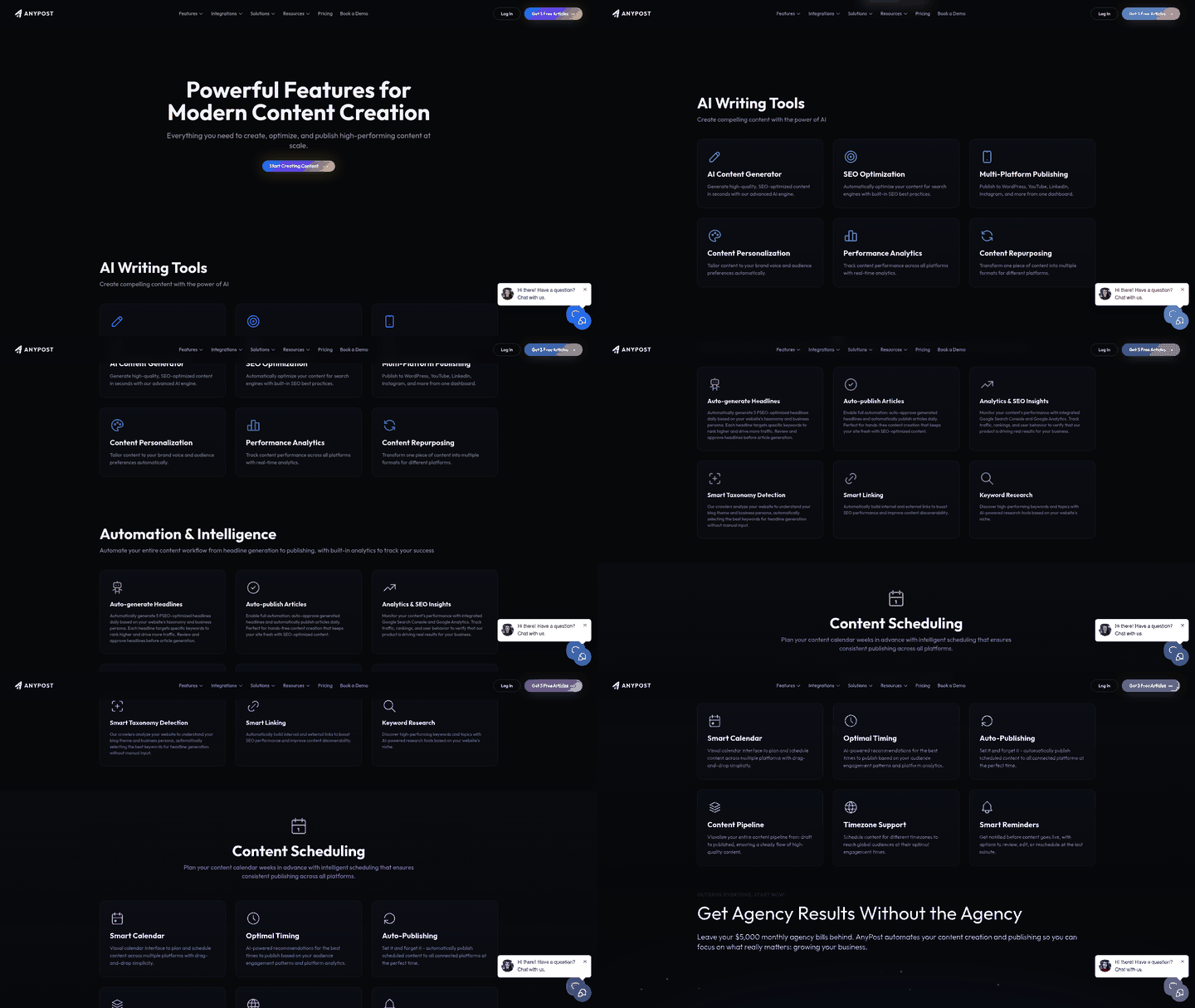
Our approach breaks from the split above. We built the keyword tool to close the one gap neither platform touches: the jump from research to a finished, publishable page. When people weigh HubSpot's structure against Ahrefs' data, they're really deciding which half of the workflow to prioritize. We decided you shouldn't have to.
The tool starts with keyword discovery, then carries that data straight into content generation and publishing. You find the terms worth targeting, group them into a cluster, and get draft pages written in your brand voice. No manual handoff across three apps.
What the AnyPost.ai keyword tool actually does
It combines keyword research, automated content generation, and one-click publishing in a single flow. Enter a seed topic, and the tool surfaces related keywords and cluster suggestions, then generates full articles tuned to your voice settings. The output is ready to review and publish, not a raw data export.
That last part is what matters most for lean teams. Marketers without in-house writers get stuck at the writing stage. Ahrefs hands you a spreadsheet. HubSpot hands you a diagram. Both leave you at a blank page. We generate the pages themselves, mapped to the cluster you just built.
The tool also connects to our optimization and publishing features. Once a draft exists, you can refine it for on-page signals and push it live to your CMS without leaving the platform. Keyword to live URL in minutes.
How it compares to HubSpot and Ahrefs
Each tool wins at a different stage. Ahrefs owns raw keyword depth. HubSpot owns cluster organization inside its ecosystem. We win at turning research into written, voice-matched pages fast.
| Capability | HubSpot | Ahrefs | AnyPost.ai |
|---|---|---|---|
| Keyword discovery depth | Limited (legacy tool phased out) | Deep, millions of ideas | Moderate, discovery-focused |
| Topic cluster mapping | Strong | Manual | Built-in |
| Automated article writing | No | No | Yes |
| Voice-aligned output | No | No | Yes |
| One-click publishing | Within HubSpot CMS | No | Yes |
Read the table honestly. If your only goal is exhaustive keyword data with backlink and traffic metrics, Ahrefs still goes deeper than we do. We're not trying to out-index a tool that pulls seven-figure keyword lists.
When to skip our tool
Skip it if pure research depth is the end goal and you already have a writing team. Five experienced writers who just need better data are better served by a dedicated research tool. Our strength is compression: research to published cluster without a writer in the chair.
We built this for lean teams. If you're a growth lead or solo strategist who needs ranked pages this week, not a research report to hand off, that's the fit. HubSpot and Ahrefs each cover one half of the trade-off. We carry discovery through to a voice-matched, published page in one flow. The industry treated research and writing as separate jobs for a decade. For marketers without writers, joining them is the whole point.
Keyword idea generation, head to head
Test idea generation directly and the HubSpot vs Ahrefs comparison stops being close. Ahrefs pulls an enormous list of ideas from a single seed. HubSpot's Content Strategy Tool does not try to compete on raw ideas at all. It surfaces related subtopics to build a cluster, not thousands of ranked queries.
That's not a flaw in either one. It's two bets on where the work happens. Ahrefs bet on discovery depth. HubSpot bet that organizing content beats mining terms. Both bets left the same gap: turning ideas into finished pages.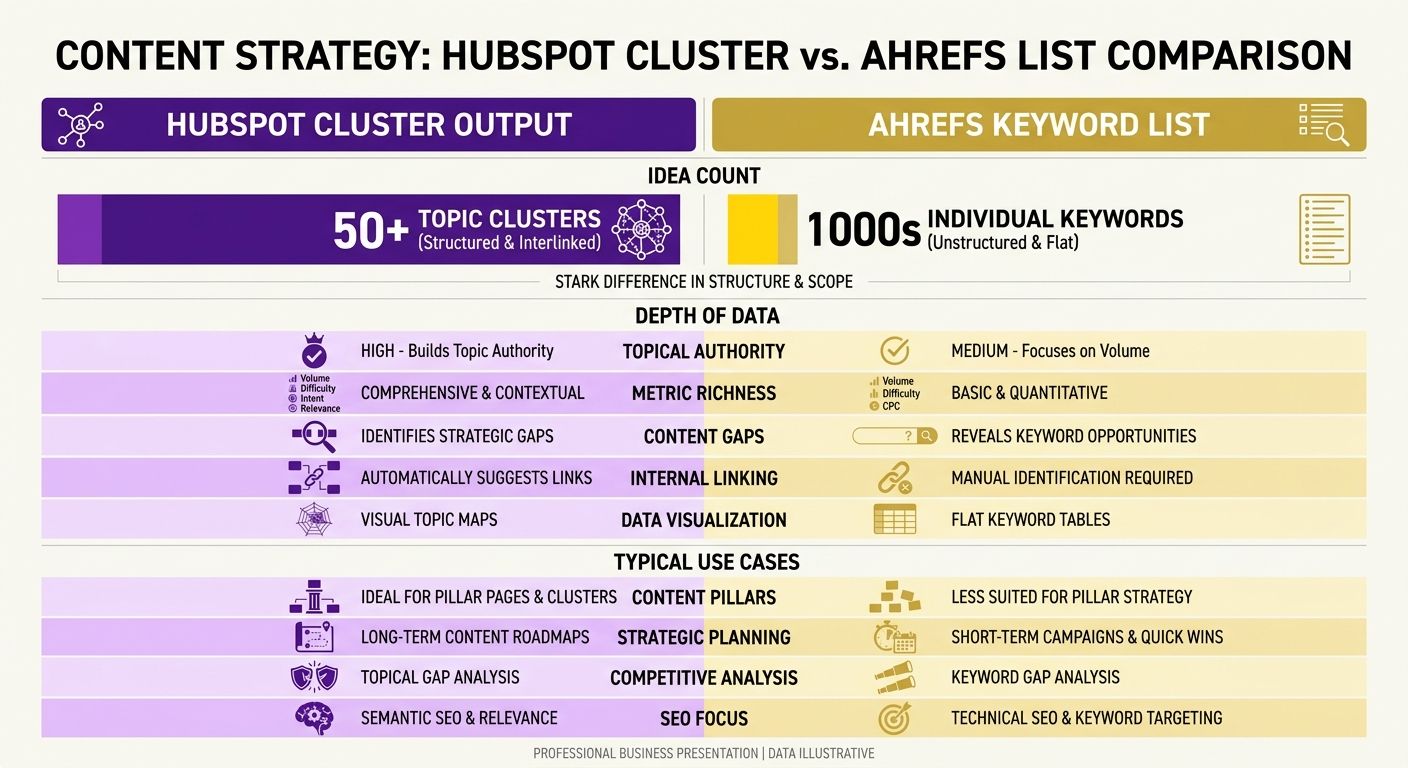
How the two engines differ
Ahrefs generates ideas from a massive clickstream and search database, then scores each one. You analyze up to 10 seed keywords per report and filter by volume, difficulty, traffic potential, and intent. HubSpot generates ideas from topical relationships, suggesting subtopics that link back to a pillar.
One gives you data-ranked breadth. The other gives you structure. Neither writes a word.
And here's the number that reframes the debate: a study of over 1 billion pages found 90.63% get no organic traffic from Google. Finding keywords was never the bottleneck. Producing enough ranking pages to fill a cluster is.
Which tool handles clusters and content gaps best?
HubSpot is built for clusters. It maps subtopics to a pillar but gives you shallow keyword metrics. Ahrefs is not cluster-native, but its intent filters and parent-topic grouping let you assemble far richer, data-backed clusters by hand. AnyPost.ai generates the cluster and drafts every page in your brand voice from the same flow.
The gap widens once you count how many pages a real cluster needs. A single pillar can require dozens of supporting articles to cover intent variations and rank sitewide. Ahrefs can name every one of those subtopics through its parent-topic view. HubSpot can slot them into a structure. But naming and slotting still leave you with an empty brief. Backlinko's analysis put the average first-page result at roughly 1,447 words, so a comprehensive cluster means tens of thousands of words waiting on a writer before a single URL goes live.
The contradiction in the field is real. Ahrefs argues its metric depth makes it superior for cluster strategy. HubSpot argues the strategy matters more than the data. A practical read: use Ahrefs when you need to know exactly which terms are winnable, HubSpot when you already have writers and just need structure. Skip both as a complete solution if no one on your team can produce the pages.
What fills the gap between ideas and published pages
That production gap is where we focused. Run discovery, group terms into a cluster, get draft pages written in your voice. The map becomes publishable content in minutes, not weeks of handoffs. For marketers without a writing team, the winning tool is not the one with the most ideas. It is the one that turns those ideas into ranking pages.
Search volume and trend accuracy
For most teams, volume accuracy is the deciding factor. Ahrefs pulls estimates from clickstream data across millions of users, so the numbers reflect actual behavior rather than projections. HubSpot never prioritized volume precision. It surfaces subtopics to organize your cluster, not forecasts you can bank on. Teams default to Ahrefs when they need to justify budget or decide which pages to write first, because guessing wrong means hours wasted on content nobody searches for.
That data gap matters more than it sounds. Without reliable numbers, you're building on assumptions, and most failed content initiatives trace back to targeting keywords with inflated or imaginary search counts.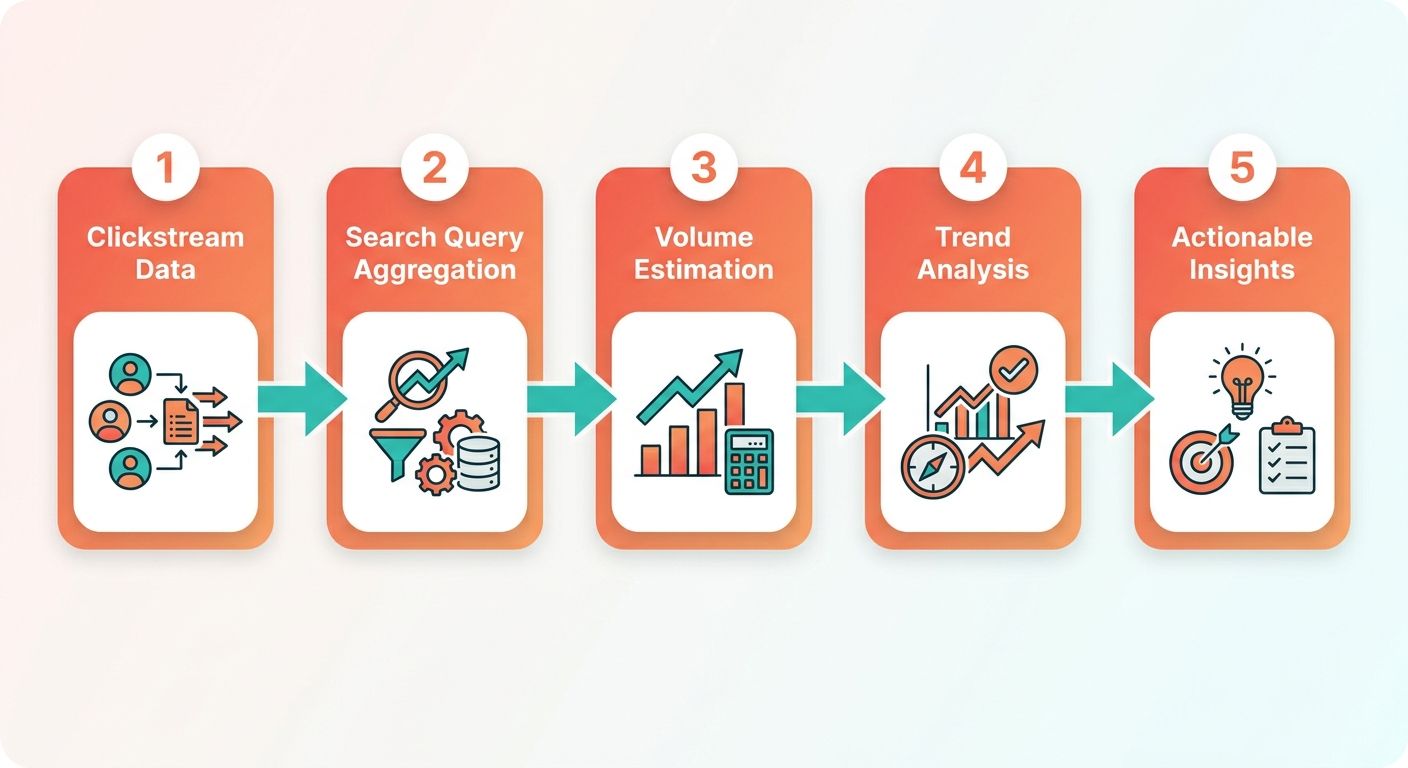
How the volume estimates stack up
Ahrefs gives you monthly volume for every keyword, broken down by country and refreshed regularly from its clickstream panel. You see the number, compare it across related terms, and make the call on what justifies the work. It also flags traffic potential, how much traffic the top-ranking page actually gets, which often diverges from raw volume depending on how Google displays results.
HubSpot skips volume entirely in its current tool. You get subtopic suggestions organized into pillars, but no forecast of how many searches each attracts. Fine if you're mapping a cluster for organizational clarity. Less fine when you need to decide whether a subtopic deserves 2,000 words or a footnote.
We built our tool to carry volume data straight into content decisions. You see which terms in your cluster have real demand, then generate pages for the high-value ones first. No spreadsheet handoff. No manual triage. A ranked list that turns into publishable drafts.
Trend detection and seasonal signals
Ahrefs shows a search-trend sparkline next to every keyword, so you can spot seasonal spikes or fading interest before you commit. A term that peaked two years ago and flatlined? Skip it. One that spikes every December? Plan your calendar around it. The tool also surfaces rising topics by filtering for upward momentum, which helps you catch emerging demand before competitors flood in.
HubSpot does not track trends or seasonality. Its cluster model assumes pillar content stays relevant indefinitely, which works for evergreen industries but misses the timing advantages Ahrefs users exploit. You could map a cluster around a term that is already declining, and HubSpot will not warn you.
Our Taxonomy Researcher reads your business context and surfaces low-difficulty, high-intent keywords for your niche. You see volume alongside difficulty scores, so you can prioritize based on real demand and your ability to rank. That keeps you from chasing high-volume terms you cannot win, or investing in content around a keyword that looked promising but has already lost steam.
Why volume accuracy stalls without publishing built in
Accurate volume data is only half the battle when execution stays manual. Ahrefs gives you reliable metrics and leaves you to draft each article. HubSpot gives you a framework but lacks the data to prioritize. Either way, you end up with a well-researched plan that is hard to execute.
We connect the two ends. You identify the high-volume terms, decide which are worth targeting, and generate drafts in your brand voice, complete with internal links to the rest of the cluster. The volume data does not just inform strategy. It decides what gets published first. That's the execution bottleneck that usually stalls teams right after research.
What I'd actually recommend
The choice between HubSpot and Ahrefs comes down to whether you need discovery depth or structure guidance, and whether you have the resources to turn research into published pages. We've worked with teams stuck in both camps. Some have Ahrefs data sitting unused because no one writes the articles. Others have HubSpot clusters mapped but stalled, with no keyword validation to say what to write first.
Ahrefs wins on discovery. HubSpot wins on organization. Neither completes the workflow from keyword to live content. That gap is where most cluster strategies die.
Match the tool to your team
| If You Are | Choose Ahrefs When | Choose HubSpot When | Consider AnyPost.ai When |
|---|---|---|---|
| Small team, no writers | You need data to justify hiring a writer or agency | You already have a content calendar and need to map existing posts | You need both keyword validation and finished draft pages without hiring |
| Agency or consultant | Clients expect detailed keyword reports and competitor analysis | You're mapping cluster architecture for a client's existing content hub | You're delivering finished content, not just strategy docs |
| In-house content team | You have writers who need prioritized keyword lists to work from | Your CMS is HubSpot and your team prefers native tools | Your writers are overwhelmed and you need to scale output fast |
| SEO-first strategist | You're building a data-backed business case for content investment | You're reorganizing legacy content into pillar structures | You want to test cluster ideas with live pages before committing to a full buildout |
Skip Ahrefs if you don't have the budget or team to act on what it surfaces. Raw discovery without execution just wastes the subscription. Skip HubSpot if your site isn't on HubSpot CMS, or if you need numeric volume to prioritize. It will not give you the depth to compete in crowded niches.
Where each tool fits in the funnel
Ahrefs belongs at the top, during research and validation. Use it to find low-difficulty keywords, confirm intent, and audit what competitors rank for. Export that data and hand it to whoever writes your content, or face the reality that a CSV doesn't create pages.
HubSpot fits mid-funnel, after you've decided what to write. It organizes existing or planned content into pillar-and-cluster structures. If your team already publishes regularly and you need to impose topical authority on scattered posts, the Content Strategy Tool maps that architecture. It will not help you decide what to write in the first place.
The handoff between those two steps is where we see most strategies break. Teams finish research, then stall for weeks waiting on writers. Or they map a beautiful cluster, then realize they can't afford to produce dozens of supporting articles. The tool that closes this gap, turning validated keywords into ready-to-publish drafts, is what clears the bottleneck.
The bottleneck decides the tool
If your bottleneck is knowing what to target, use Ahrefs. Its difficulty scores, traffic estimates, and SERP analysis give you the data for smart bets. You'll know which terms are worth fighting for and which to skip.
If your bottleneck is organizing existing content, use HubSpot. It surfaces coverage gaps and links related posts into coherent clusters. No search volume, but you'll get a map.
If your bottleneck is producing the actual pages, you need a tool that writes them. Research and mapping are pointless if the articles never ship. We built our workflow to take validated keywords straight to draft pages in your brand voice, then push them live without a manual handoff. That's the piece missing from both platforms, and the reason most cluster strategies stay in spreadsheets instead of ranking in search.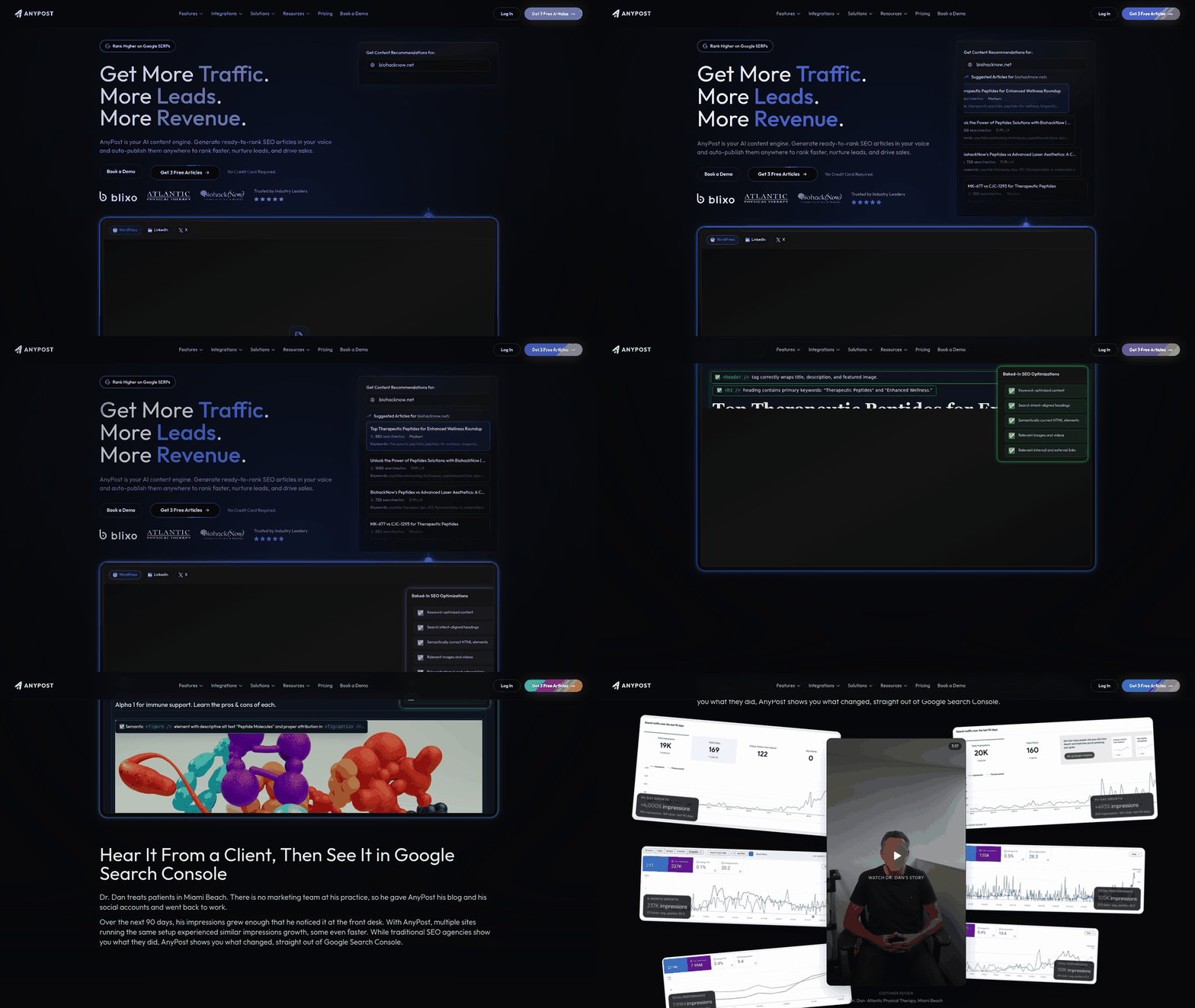
Frequently Asked Questions
1. Can I still use HubSpot for keyword research if I'm on a current plan?
No. HubSpot phased out its legacy keyword research features to focus on the Content Strategy Tool. This newer tool suggests subtopics for cluster organization but provides no search volume or difficulty data. All current HubSpot plans lack native keyword discovery features.
2. Does Ahrefs automatically build topic clusters from my keyword research?
No. Ahrefs identifies keywords and shows parent-topic grouping, but you must manually map them into a cluster structure. The platform stops at data and competitive analysis. It will not suggest pillar-spoke architecture or internal linking patterns between your pages.
3. What happens if I pick keywords with high volume but ignore difficulty scores?
You'll waste resources writing content you can't rank for. Ahrefs shows both volume and difficulty scores because high-traffic terms often require backlink profiles and domain authority most teams don't have, making them poor targets despite appealing search numbers.
4. Why do teams still use both HubSpot and Ahrefs if they don't integrate?
Because each solves half the workflow. Teams use Ahrefs to validate which subtopics have real search demand and competitive feasibility, then switch to HubSpot to organize those validated terms into a cluster with internal linking suggestions. The manual handoff is inefficient but unavoidable without a bridge solution.
5. How does AnyPost.ai handle brand voice when generating cluster content?
AnyPost.ai generates articles matched to your configured voice settings, turning keyword research into draft pages that reflect your brand tone. This removes the bottleneck of manually writing dozens of supporting articles per cluster while maintaining stylistic consistency across your content hub.
6. Do I need a separate CMS if I use Ahrefs for keyword research?
Yes. Ahrefs provides keyword data and competitive intelligence but has no content editor or publishing capability. You must export your research to a CMS like WordPress, HubSpot, or another platform to draft and publish the actual pages.