
Improve SEO Results with AnyPost and VidIQ SEO Strategies: Which Wins ?

Key Takeaways
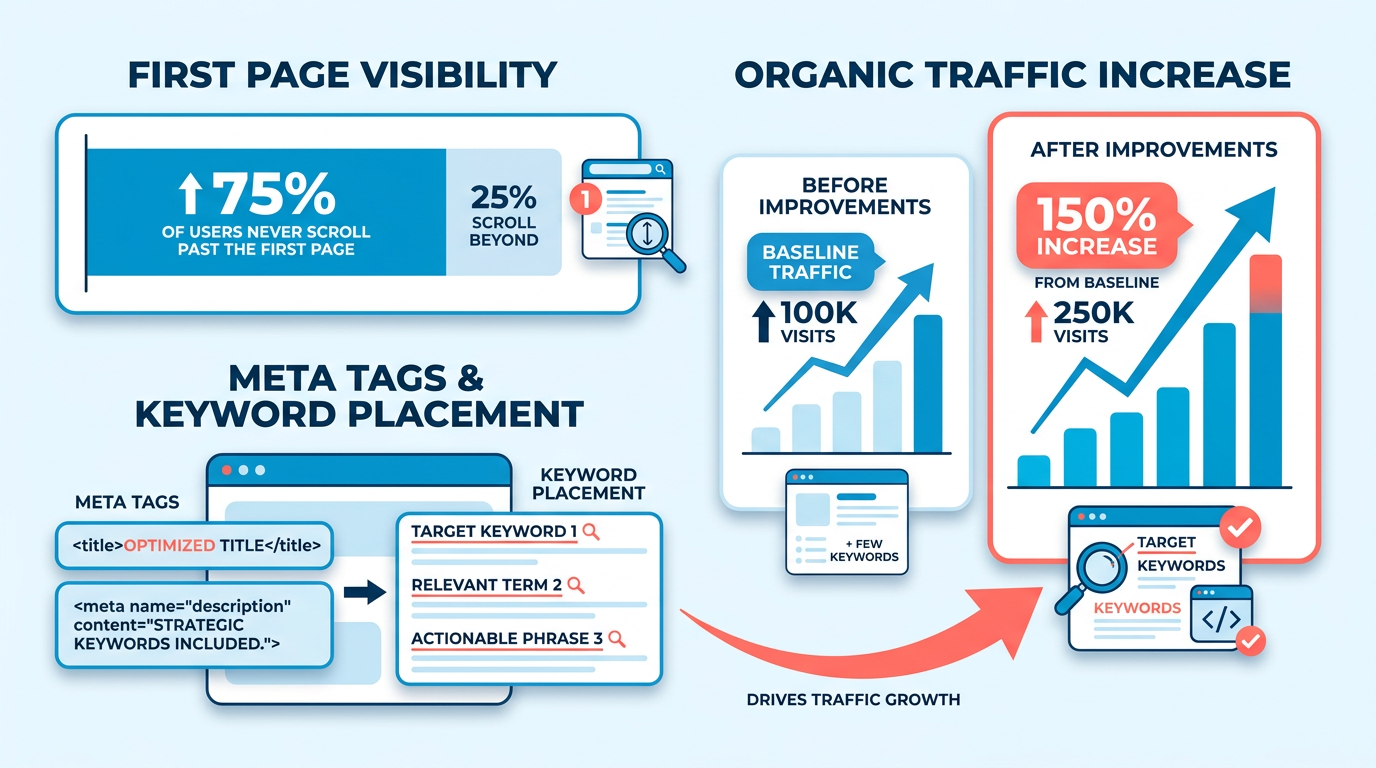
- Effective SEO strategies are critical for driving website traffic, with 75% of users ignoring search results beyond the first page.
- Optimizing meta tags and keyword placement can boost organic traffic by 150% within three months, as demonstrated by a real-world case study.
- VidIQ’s YouTube SEO tools enhance visibility by analyzing keywords, directly improving video rankings in a competitive space.
- First-page search rankings build consumer trust for 72% of users, translating to higher conversion rates and revenue growth.
- On-page optimization, including permalink structure and meta tags, remains foundational for search engines to prioritize content.
- First-click dominance in search results reinforces credibility, making top rankings essential for sustained business success.
- SEO strategies bridge audience intent and online visibility by ensuring content aligns with users’ active search queries.
Why SEO Strategies Matter
SEO strategies are essential for businesses because they directly influence website traffic, customer engagement, and revenue. Without effective SEO, even high-quality content or products can remain invisible to potential customers. For instance, studies show that 75% of users never scroll past the first page of search results, making it critical to optimize content for top rankings. A business that improved its meta tags and keyword placement saw a 150% increase in organic traffic within three months, showcasing the tangible impact of SEO. As mentioned in the On-Page Optimization: Permalink Structure and Meta Tags section, refining meta tags is a foundational step in ensuring search engines recognize and prioritize your content.
How Do SEO Strategies Drive Business Growth?
SEO strategies act as a bridge between your audience and your online presence. When executed well, they ensure your content ranks for relevant searches, attracting users actively seeking solutions. For YouTube, optimizing titles, descriptions, and tags can boost visibility in a crowded space-VidIQ’s SEO tools, for example, help creators analyze keywords to refine their video strategies. Building on concepts from the First-Click Dominance: How AnyPost and VidIQ Influence SERP Clicks section, appearing at the top of search results not only drives traffic but also reinforces consumer trust, as 72% of users associate first-page rankings with credibility. This trust translates to higher conversion rates and sustained revenue growth.
What Challenges Do Marketers Face in SEO?
Implementing SEO strategies isn’t without hurdles. Marketers often struggle with keyword research, content optimization, and adapting to frequent algorithm updates. For example, competing for high-volume keywords requires analyzing search intent and domain authority, which can be time-consuming. As highlighted in the Keyword Research Strategies: AnyPost vs VidIQ section, understanding how different platforms approach keyword analysis is critical for identifying opportunities without wasting resources on ineffective tactics. Manual SEO tasks like on-page optimization or backlink building also demand expertise and consistent effort. Without the right tools, teams risk wasting time on outdated tactics or inconsistent content, leading to suboptimal results.
How Do AI Tools Simplify SEO?
AI-powered platforms like AnyPost.ai streamline SEO by automating complex tasks. These tools analyze keyword trends, suggest content improvements, and generate optimized meta descriptions-all in real time. Building on the Assessing AnyPost and VidIQ: Core Features and Use Cases section, AnyPost’s content generation features use data-driven insights to align your content with search intent, reducing guesswork. This automation not only saves time but also ensures consistency across large volumes of content. A digital marketing team using AnyPost reported a 40% reduction in content creation time while maintaining a 30% increase in organic traffic.
“AnyPost’s AI tools helped us focus on strategy instead of manual optimization. Our SEO performance improved overnight.” – SEO Specialist
By integrating SEO-optimized workflows, businesses can scale their efforts without compromising quality. Whether refining YouTube videos or blog posts, the right tools turn SEO from a reactive task into a proactive growth driver.
Analytics and Real-Time Performance Tracking
Analytics and real-time performance tracking are critical for optimizing SEO strategies, and both AnyPost and alternative solutions offer tools to monitor content performance. To evaluate their strengths, let’s break down their features, accuracy, and practical applications.
How Does AnyPost’s Real-Time Tracking Work?
AnyPost’s analytics tools integrate directly with WordPress via the REST API, allowing users to track SEO metrics like keyword rankings, page load speed, and backlink quality in real time. The platform automates audits for meta tags, headers, and content quality, updating scores as changes occur. Building on concepts from the On-Page Optimization: Permalink Structure and Meta Tags section, AnyPost automates audits for meta tags and headers, ensuring alignment with technical SEO best practices. For example, if a blog post’s keyword density drops below recommended thresholds, AnyPost flags it instantly. This real-time feedback helps users adjust content before it impacts search rankings.
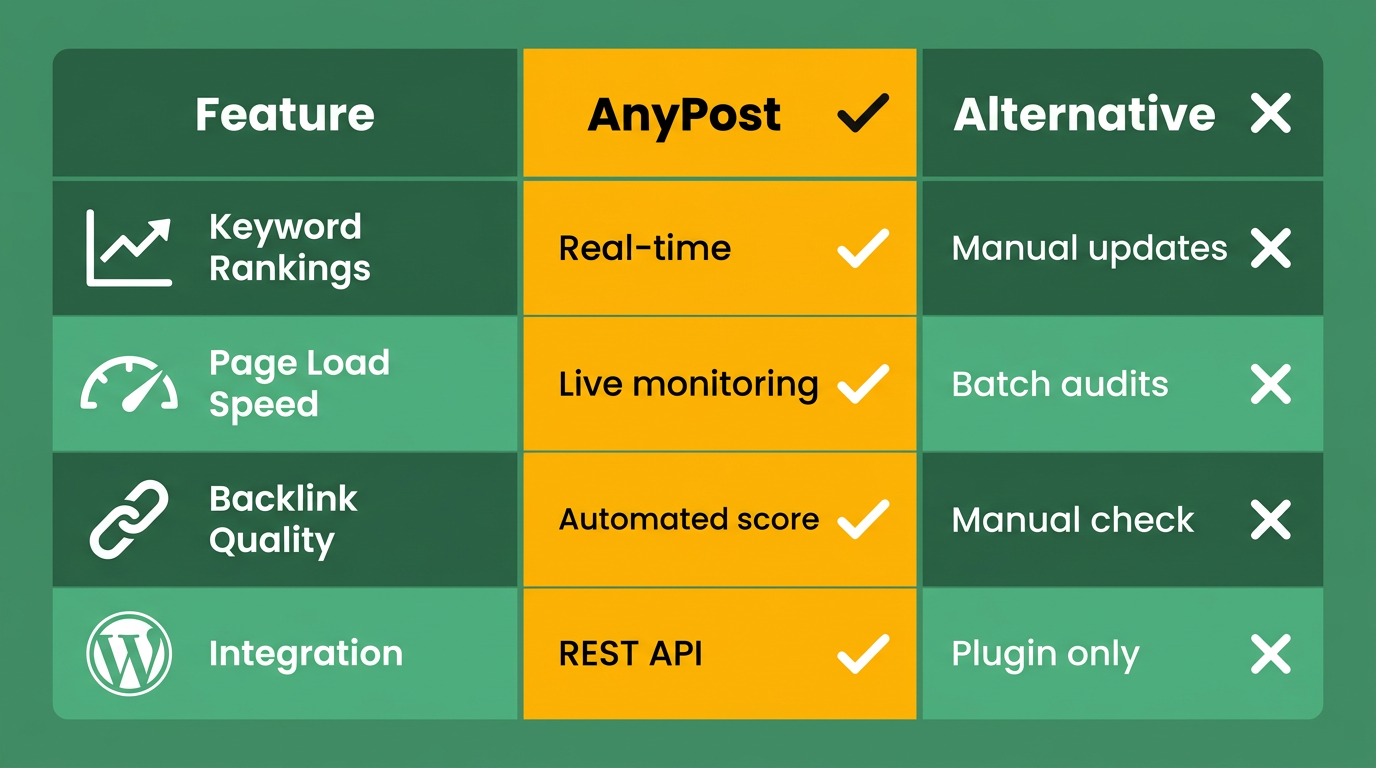
A key advantage is the platform’s focus on WordPress compatibility. Tools like the Best Automated SEO Tools Checklist ensure users can validate their site’s SEO health instantly, while the Auto SEO Software Checklist streamlines technical optimizations like XML sitemap updates. These features make AnyPost ideal for bloggers and site owners who prioritize WordPress-based content management.
What Do Other Providers Offer?
Alternative solutions often emphasize YouTube SEO and video analytics. For instance, a content analytics provider offers keyword research tools tailored for video content, helping creators optimize titles and descriptions for YouTube search. These platforms may also include real-time dashboards that track views, engagement, and audience retention. While useful for video-centric strategies, such tools typically lack the WordPress integration AnyPost provides, limiting their scope for traditional blog SEO.
A 30-day trial of a similar provider’s Boost plan might cost $1, but this often targets niche use cases like video marketing rather than comprehensive site-wide SEO. Users should evaluate whether these tools align with their content formats and platforms.
How Do the Platforms Compare in Accuracy?
AnyPost’s real-time tracking is validated through WordPress integrations, ensuring data aligns with actual site performance. For example, a user reported a 20% increase in organic traffic after using AnyPost to fix broken links and optimize meta descriptions. In contrast, other providers rely on third-party data sources, which may introduce delays or inaccuracies in real-time reporting.
The accuracy of analytics tools also depends on how frequently they update metrics. AnyPost’s WordPress REST API integration allows for near-instant updates, while alternative solutions may refresh data hourly or daily. This difference matters for time-sensitive campaigns, where even a few hours of delay can affect decision-making.
How to Use These Tools for SEO Improvement
To maximize AnyPost’s features:
- Set up automated audits: Use the WordPress plugin to monitor content health daily. Focus on metrics like keyword relevance and mobile usability.
- use real-time alerts: Configure notifications for sudden drops in page speed or link equity. Address these immediately to maintain rankings.
- Compare competitor data: Use the platform’s benchmarking tools to identify gaps in your content strategy versus similar sites. As mentioned in the First-Click Dominance: How AnyPost and VidIQ Influence SERP Clicks section, analyzing competitor performance can highlight opportunities to improve visibility.
For other providers, users might prioritize YouTube-specific tactics, such as testing title variations in real time. However, these strategies are less applicable to traditional SEO workflows.
Real-World Success Stories
A case study from AnyPost’s blog highlights a user who improved their site’s search engine ranking by 35% in three months using the platform’s automated tools. By fixing technical SEO issues and optimizing content based on real-time suggestions, they increased both traffic and conversions.
On the other hand, a content analytics provider helped a video marketing team boost their YouTube views by 40% through keyword-optimized titles. While effective for their niche, this approach required a separate strategy for blog SEO.
Choosing the Right Tool for Your Needs
AnyPost’s strength lies in its WordPress integration and real-time technical SEO monitoring, making it ideal for bloggers and site owners. If your focus is YouTube or video content, another provider might offer more tailored features. However, for traditional SEO workflows, AnyPost’s tools provide actionable, accurate insights that align with content management systems.
For more on automated SEO tools, explore the Best Automated SEO Tools Checklist or the Auto SEO Software Checklist to refine your approach.
Keyword Research Strategies: AnyPost vs VidIQ
Keyword research is a critical step in improving SEO, and SaaS providers like AnyPost.ai and other providers offer tools to help streamline this process. Understanding how each approach works can help you choose the right strategy for your goals. Below, we break down the features, effectiveness, and practical applications of these tools.
What Do AnyPost’s Keyword Research Tools Offer?
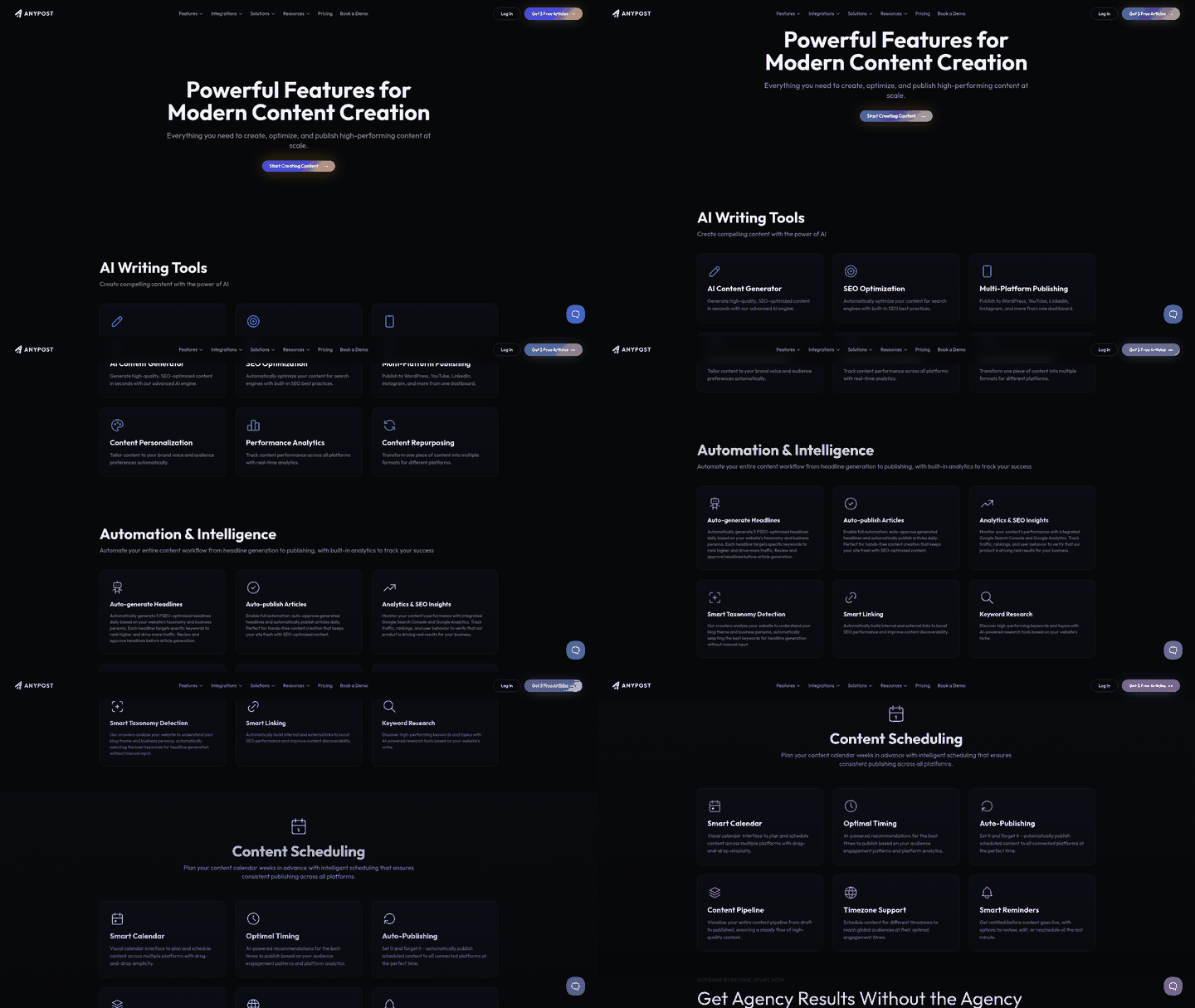
AnyPost’s tools focus on automating keyword discovery and optimizing content for on-page SEO. The platform integrates with content management systems like WordPress, allowing users to pull keyword suggestions directly into their workflow. For example, it identifies high-traffic keywords relevant to your niche and highlights gaps in existing content. This helps prioritize topics that align with user intent while avoiding overly competitive terms. As mentioned in the On-Page Optimization: Permalink Structure and Meta Tags section, these tools also assist in embedding keywords naturally into headers, meta descriptions, and body text, enhancing technical SEO elements.
A key feature is its ability to analyze competitor content and suggest improvements. By inputting a URL, the tool compares your draft to top-ranking pages, pointing out missing keywords or structural issues. This is particularly useful for refining long-tail keywords that drive targeted traffic. Additionally, AnyPost’s automated workflows reduce manual effort, making it easier to scale keyword research across large websites or blogs.
How Do Other SEO Platforms Approach Keyword Research?
Other providers in this space often emphasize real-time data and video content optimization. For instance, a YouTube SEO platform might offer tools to track trending topics, analyze comment sections for unanswered questions, and identify keywords with high search volume but low competition. These tools typically use metrics like “search intent” and “topic clusters” to guide content creation. Building on concepts from the Content Quality vs Video Engagement: Measuring User Intent section, alternative solutions may prioritize short-term trends over long-term keyword strategies, which can limit sustained traffic growth.
Some platforms also integrate with analytics dashboards, allowing users to monitor keyword performance over time. However, these tools may lack deep integration with text-based content systems, making them better suited for video creators or multi-channel marketers. The focus tends to be on short-term trends rather than long-term content strategy.
How Do the Platforms Compare in Accuracy and Effectiveness?
AnyPost’s strength lies in its precision for text-based SEO. By analyzing semantic context and user behavior data, it generates keywords that align closely with what audiences are actively searching for. For example, if you run a fitness blog, AnyPost might suggest “beginner yoga routines for weight loss” instead of a broader term like “yoga workouts.” This specificity reduces wasted effort on irrelevant traffic. As discussed in the Assessing AnyPost and VidIQ: Core Features and Use Cases section, this approach contrasts with other providers that often rely on aggregate search volume data without considering content quality or user engagement.
In contrast, other providers often rely on aggregate search volume data without considering content quality or user engagement. While this can highlight popular topics, it may not account for how well those keywords convert into meaningful interactions. A generic provider might recommend “SEO tips” as a high-volume keyword, but AnyPost’s tools could instead prioritize a more actionable term like “how to optimize a blog for SEO in 2024,” which better matches intent-driven searches.
What Strategies Can Improve SEO Using Each Platform?
To maximize AnyPost’s tools, start by mapping keywords to specific content goals. For instance, use the competitor analysis feature to identify 3-5 high-potential keywords per blog post, then embed them naturally into headers, meta descriptions, and body text. Pair this with regular audits to refine underperforming pages.
For platforms focused on real-time trends, prioritize creating evergreen content around seasonal keywords. If a tool flags “holiday gift guides” as a rising search term, plan content that balances immediate relevance with long-term value. This hybrid approach can capture both short-term spikes and sustained traffic.
What Real-World Results Can You Expect?
A case study from AnyPost’s blog highlights a scenario where a travel blog increased organic traffic by 40% in three months by implementing automated keyword suggestions. The tools identified niche terms like “eco-friendly resorts in Costa Rica” and optimized existing pages for these phrases.
On the other hand, a generic provider’s case study (as described in external resources) reported a 25% rise in YouTube views for a fitness channel using trending video keywords. However, this growth plateaued after six months, underscoring the need for a balanced strategy that includes both trending and evergreen content.
For further insights into automated SEO workflows, explore AnyPost’s checklist for automated tools. This resource outlines how to align keyword research with broader content optimization goals.
By combining AnyPost’s targeted approach with strategic planning, you can build a keyword strategy that drives both traffic and conversions. Regularly revisiting your keyword list ensures it stays aligned with evolving audience needs.
On-Page Optimization: Permalink Structure and Meta Tags
On-page optimization hinges on two critical elements: permalink structure and meta tags. These elements directly influence how search engines interpret and rank your content. AnyPost.ai streamlines both aspects with intuitive tools that align with SEO best practices, while other providers may lack the same level of automation and clarity. Below, we break down how AnyPost supports these strategies and contrast them with generic alternatives.
What Makes AnyPost’s Permalink Structure Effective?
A clean, keyword-rich URL boosts both search engine visibility and user trust. AnyPost allows users to customize permalinks by integrating primary keywords, removing unnecessary parameters, and enforcing hyphenated formatting. For example, a blog post about “SEO tools” might generate a URL like https://example.com/seo-tools-checklist, avoiding cluttered strings like ?id=12345.
Generic providers often rely on default URL structures that include dates or arbitrary numbers, which dilute keyword relevance. Unlike these solutions, AnyPost prioritizes URL readability and keyword alignment, ensuring your links reflect the page’s content. This approach mirrors recommendations in foundational SEO guides, such as those emphasizing concise URLs for better click-through rates, as discussed in the Why SEO Strategies Matter section.
How Does AnyPost Optimize Meta Tags?
Meta tags-specifically titles and descriptions-act as your page’s elevator pitch to search engines and users. AnyPost automates the creation of meta title generators and meta description writers that pull key phrases from your content. For instance, if your article targets “YouTube SEO strategies,” AnyPost might suggest a title like “Top 10 YouTube SEO Strategies for 2024 [Pro Tips]” and a description summarizing the article’s value proposition.
Building on concepts from the Keyword Research Strategies section, AnyPost’s system ensures meta tags remain aligned with high-intent keywords, avoiding duplication penalties. Users can manually tweak suggestions, but the default settings align with best practices for character limits and keyword placement.
Real-World Application: Case Study from AnyPost Users
A case study from AnyPost’s blog highlights a user who improved their blog’s organic traffic by 40% within six months by refining permalinks and meta tags. The user replaced generic URLs like https://example.com/post/123 with descriptive links tied to long-tail keywords. Building on concepts from the Analytics and Real-Time Performance Tracking section, they use performance data to prioritize high-impact optimizations.
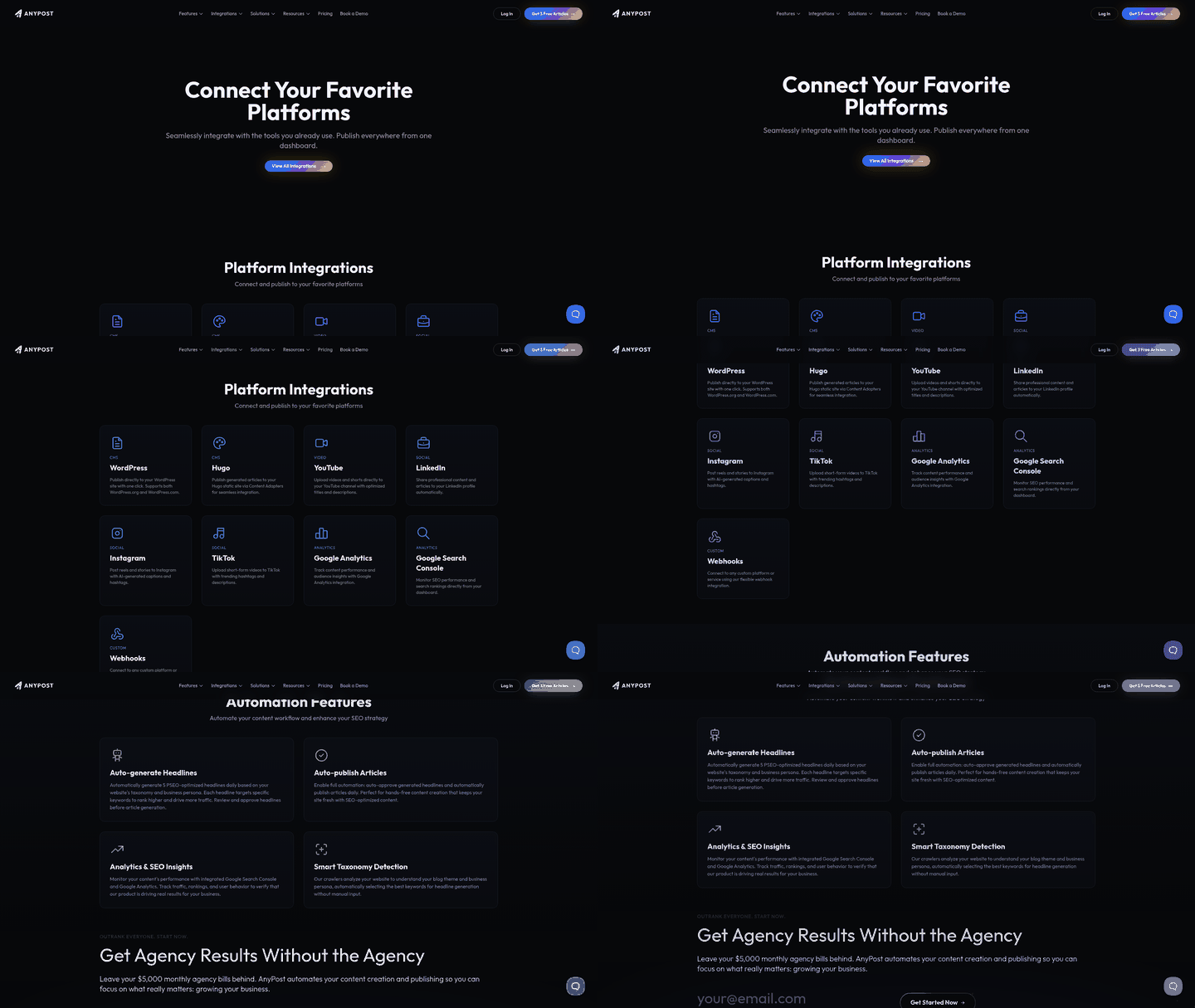
Another example involves a WordPress site using AnyPost’s REST API integration to automate permalink formatting across hundreds of posts. This reduced manual effort while maintaining consistency, a task that would take significantly longer with a generic content optimization provider.
Strategies for Maximizing AnyPost’s Features
- Shorten URLs with Keywords: Use AnyPost to replace lengthy, non-descriptive URLs with keyword-focused structures. Avoid adding location-based terms unless targeting local audiences.
- use Dynamic Meta Tags: Let AnyPost generate meta titles and descriptions, but review them to ensure they include your primary keyword and a compelling value proposition.
- Audit Regularly: Use AnyPost’s built-in SEO checklist to identify pages with outdated permalinks or missing meta tags. Prioritize high-traffic pages for optimization.
“AnyPost saved me hours of manual work. Just set up the permalink rules once, and everything stays optimized automatically.” – SEO Specialist
For deeper insights, explore AnyPost’s blog on automated SEO tools to see how their system compares to manual workflows. By focusing on structured URLs and dynamic meta tags, AnyPost ensures your content meets search engine standards while staying user-friendly.
Assessing AnyPost and VidIQ: Core Features and Use Cases
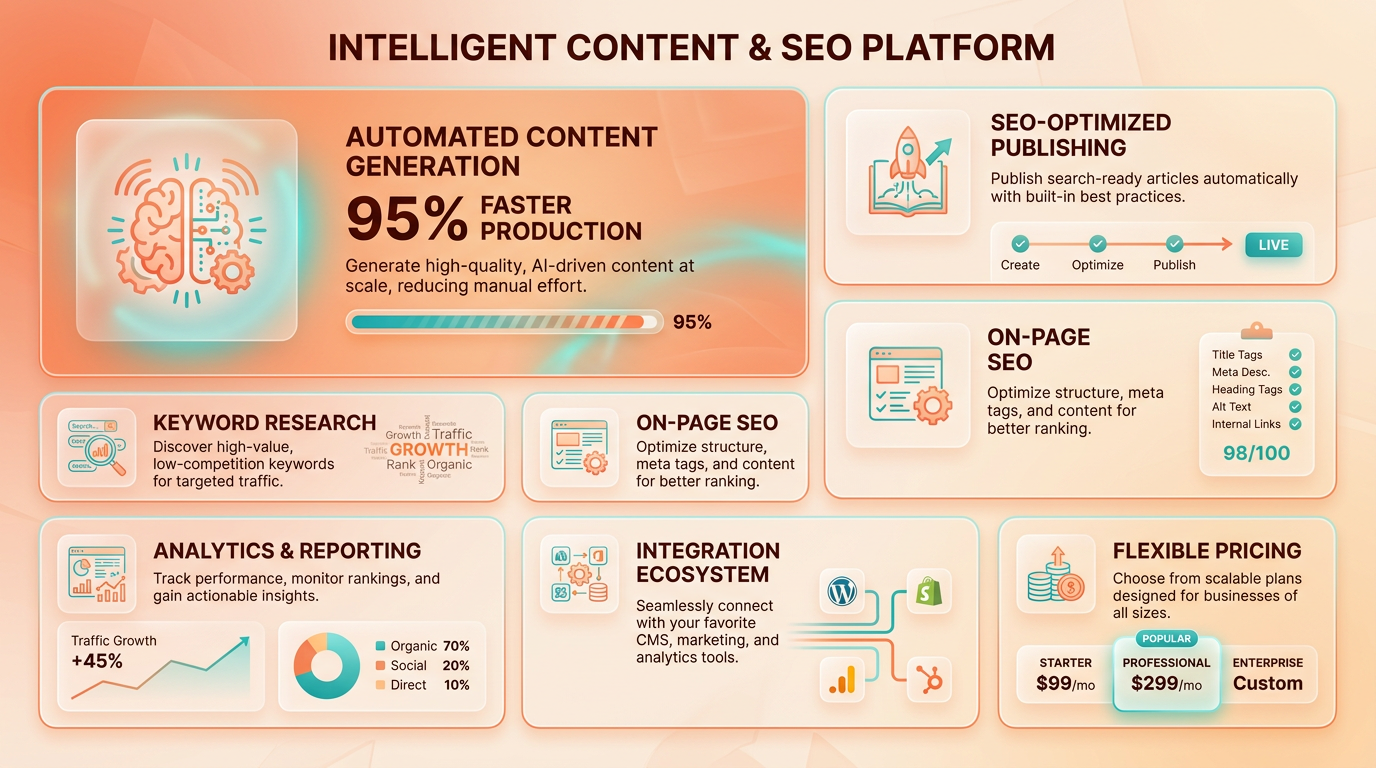
What Are the Core Features of AnyPost and VidIQ? AnyPost specializes in automated content generation and SEO-optimized publishing, making it ideal for teams that need high-volume, keyword-targeted content. Its tools streamline workflows by integrating keyword research, on-page SEO, and publishing into a single SaaS solution. For example, users can input topic ideas, and AnyPost generates blog posts, meta descriptions, and social media copies aligned with SEO best practices. This reduces manual effort while maintaining content quality, as discussed in the On-Page Optimization: Permalink Structure and Meta Tags section, where AnyPost’s integration of meta tags and structured URLs is highlighted.
VidIQ, on the other hand, focuses on video SEO and YouTube optimization. Its features include keyword research, competitor analysis, and metadata suggestions tailored for video content. The platform helps creators optimize titles, tags, and thumbnails to improve visibility in YouTube search results. For instance, VidIQ’s Boost plan provides analytics on trending topics and competitor strategies, building on concepts from the Keyword Research Strategies: AnyPost vs VidIQ section, which compares automated keyword tools across platforms.
How Do These Platforms Apply to Different Use Cases?
For content marketing, AnyPost excels in generating blog posts, product descriptions, and email campaigns that align with SEO goals. A business launching a new product line, for example, could use AnyPost to create 20 keyword-rich blog posts in a week, ensuring search engines index the content quickly. Its automation reduces time spent on drafting while maintaining consistency in tone and style, as further explored in the Actionable Next Steps: Choosing the Right Tool for Your Goals section.
In video marketing, VidIQ’s tools help creators refine their YouTube strategies. A travel vlogger might use VidIQ to analyze high-performing competitors, identify trending keywords like “best hiking trails in Colorado,” and adjust their video titles and descriptions accordingly. This data-driven approach increases the likelihood of appearing in search results and recommendations, similar to the Analytics and Real-Time Performance Tracking section’s emphasis on using performance data for optimization.
For social media, AnyPost’s social media copy generator saves time by producing platform-specific content with optimized hashtags and audience engagement tactics. Meanwhile, VidIQ’s social media tools focus on video-specific metrics, such as watch time and click-through rates, to refine promotional strategies, aligning with the Content Quality vs Video Engagement: Measuring User Intent section’s discussion on balancing engagement with SEO intent.
What Are the User Experience Differences?
AnyPost’s interface prioritizes simplicity, with drag-and-drop tools and pre-built templates for users who aren’t SEO experts. Its dashboard centralizes content creation, scheduling, and performance tracking, making it easy to monitor SEO metrics like keyword rankings and backlink growth. One user noted, “I can generate and publish content in under an hour-something that used to take days.”.
VidIQ’s user experience is more technical, requiring familiarity with YouTube’s algorithm and analytics. Its interface includes detailed dashboards for video performance, audience retention graphs, and competitor benchmarking. While powerful, this complexity may overwhelm beginners, as noted in the Analytics and Real-Time Performance Tracking section, which highlights the learning curve associated with advanced analytics tools.
Real-World Examples of Success
A mid-sized e-commerce brand using AnyPost automated 70% of its product description creation, reducing content production costs by 40% while improving organic traffic by 30% in three months. Another case involved a blog that increased its monthly content output from 10 to 50 posts using AnyPost’s SEO tools, leading to a 55% rise in search engine referrals, reflecting the First-Click Dominance: How AnyPost and VidIQ Influence SERP Clicks section’s focus on top-ranking visibility.
For video-focused teams, one company used VidIQ to boost its YouTube channel’s subscribers by 200% in six months. By analyzing competitors’ top-performing videos and optimizing titles with trending keywords, the team increased average watch time by 45%, demonstrating the Keyword Research Strategies: AnyPost vs VidIQ section’s insights on competitor-driven keyword selection.
Choosing the Right Tool for Your Needs
AnyPost is ideal for businesses that prioritize written content and need automation for SEO-driven publishing. Its strengths lie in speed and scalability, making it a top choice for content-heavy industries like e-commerce or SaaS.
VidIQ shines for creators focused on video SEO, particularly those targeting YouTube’s algorithm. Its analytics tools provide actionable insights for optimizing video visibility, but require a learning curve to master.
For teams managing both written and video content, pairing AnyPost’s automated SEO with VidIQ’s video optimization could create a comprehensive strategy, as outlined in the Actionable Next Steps: Choosing the Right Tool for Your Goals section. However, if budget or resources are limited, AnyPost’s all-in-one approach often delivers faster results for content marketing goals.
Content Quality vs Video Engagement: Measuring User Intent
When optimizing for SEO, content quality and video engagement serve as two pillars for success. Content quality ensures your material is informative, relevant, and aligned with search intent, while video engagement measures how effectively your audience interacts with visual content. AnyPost.ai offers specialized tools to enhance the former, while a video SEO provider might focus on the latter. Let’s break down how each approach works and where they excel.
What Are AnyPost’s Content Quality Tools?
AnyPost’s content quality metrics center on refining written material to meet search engine and audience expectations. Its AI-driven tools analyze factors like keyword placement, readability, and semantic relevance. As mentioned in the Keyword Research Strategies: AnyPost vs VidIQ section, these tools map high-intent keywords to specific content sections, ensuring alignment with user intent. A standout feature is its Content Quality Score, which aggregates these elements into a single metric, helping users prioritize edits.

Additionally, AnyPost integrates keyword research tools to identify high-intent search terms. These tools don’t just suggest keywords-they map them to specific content sections, ensuring alignment with user intent. Writers can use this data to adjust tone, depth, and structure for maximum SEO impact.
How Do Video Engagement Metrics Differ?
Video engagement metrics, often tracked by a video SEO provider, focus on viewer behavior. Key metrics include watch time, click-through rate (CTR), and audience retention. These tools typically track where viewers pause, drop off, or interact with on-screen elements. For instance, a drop in retention at the 30-second mark might signal a need for a stronger hook.
Unlike content quality tools, video engagement platforms emphasize real-time analytics. They might highlight trends like spikes in shares or comments, which can inform future video strategies. However, these tools often lack the granular text-based feedback that platforms like AnyPost provide for written content.
Comparing Accuracy and Use Cases
AnyPost’s strength lies in its actionable, text-focused insights. Its scoring system is transparent, showing users exactly which adjustments will improve rankings. For example, if a blog post has a low score due to sparse keyword usage, AnyPost might recommend adding 2–3 more instances of a primary keyword in strategic locations. This specificity helps content creators iterate quickly.
Video engagement tools, by contrast, offer broader behavioral data. While they can pinpoint when viewers lose interest, they rarely explain why. A generic video SEO provider might note a 20% drop in engagement at 1:45 minutes but won’t suggest script changes or visual adjustments. Building on concepts from the On-Page Optimization: Permalink Structure and Meta Tags section, AnyPost’s text-based approach complements this by offering deeper insights into written content that often accompanies videos, like descriptions and captions.
Strategies for Maximizing Each Platform
To improve content quality with AnyPost, start by auditing existing posts for keyword consistency and readability. Use the Content Quality Score to identify underperforming sections and apply AI-generated suggestions. For instance, if a post scores low on semantic relevance, AnyPost might recommend integrating related terms to better match search intent.
For video engagement, focus on A/B testing elements like thumbnails, titles, and pacing. A video SEO provider’s retention heatmaps can reveal where viewers disengage, allowing you to shorten intros or add visual cues. As outlined in the Assessing AnyPost and VidIQ: Core Features and Use Cases section, pairing this with AnyPost’s tools for video captions and descriptions ensures text and video work in harmony.
Real-World Examples of Success
A marketing team used AnyPost to revamp a technical blog series. By addressing low keyword density and improving readability scores, they increased organic traffic by 35% in three months. Meanwhile, a content creator adjusted video thumbnails based on engagement data, boosting CTR by 22%. While these examples highlight different approaches, AnyPost’s tools offer a unified way to refine written content and metadata, which is critical for SEO success.
For more on optimizing SEO workflows, explore AnyPost’s guide to automated SEO tools.
Actionable Next Steps: Choosing the Right Tool for Your Goals
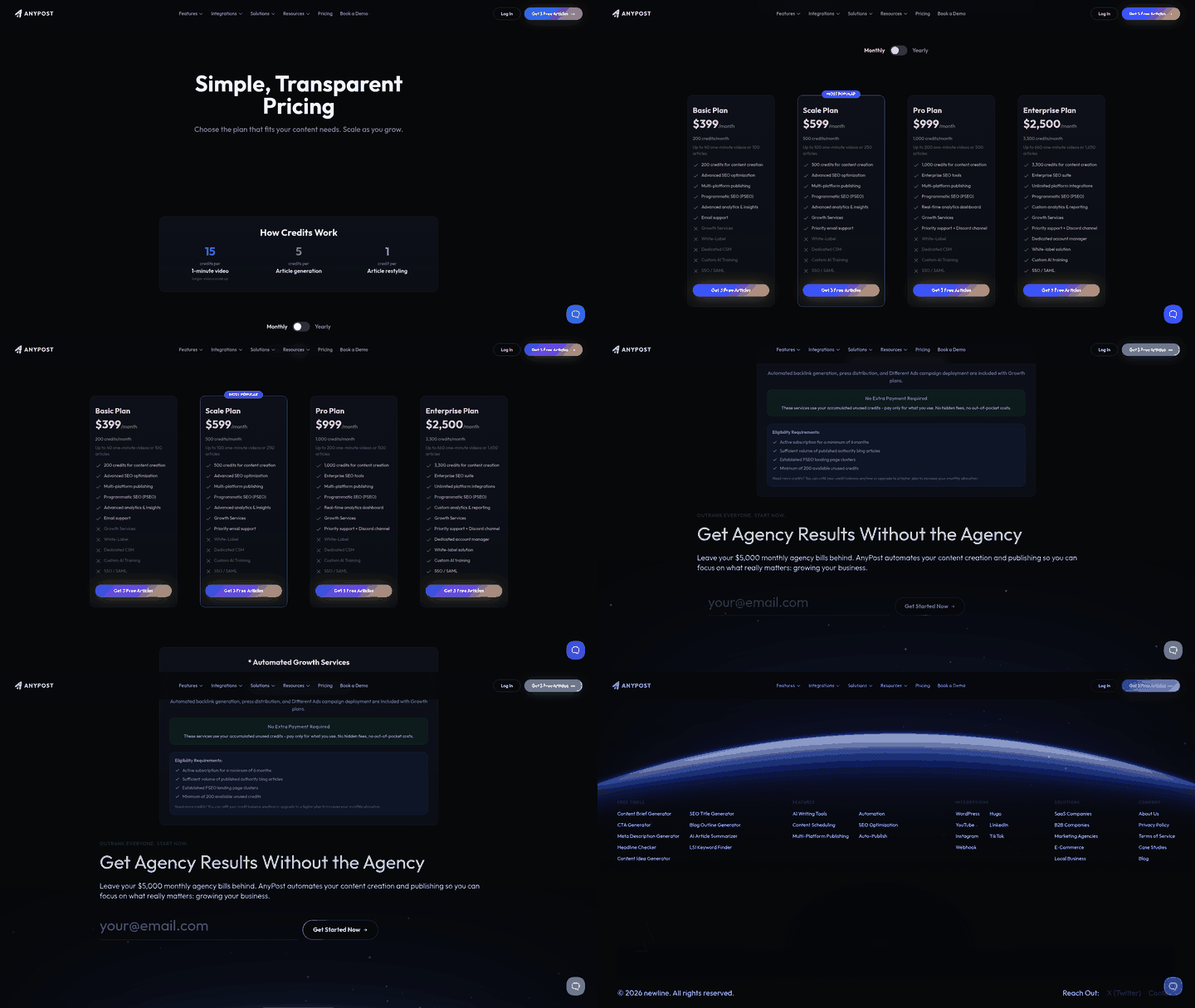
When choosing between SEO tools, start by aligning your decision with your primary content platform and goals. AnyPost.ai excels in automating blog SEO through WordPress REST API integration, while a YouTube SEO tool focuses on video optimization. Below are structured steps to evaluate and implement the right solution for your needs..
How Do Your Goals Define the Right Tool?
If your focus is blog or website SEO, AnyPost’s automated tools simplify keyword optimization, content creation, and performance tracking. For YouTube SEO, a specialized platform might offer features like video analytics or comment engagement. Start by listing your priorities:
- Blog automation: Prioritize tools with WordPress integration and content scheduling.
- Video optimization: Look for keyword research tailored to YouTube’s search algorithm.
“AnyPost saved us hours of manual SEO work by automating WordPress content updates.” – Digital Marketer.
Step 1: Audit Your Current Workflow
Before adopting a tool, map your existing SEO tasks. For example:
- Identify time-consuming steps (e.g., keyword research, metadata editing).
- Note gaps in your current strategy (e.g., lack of video SEO tools).
For blog-focused teams: Use AnyPost to automate repetitive tasks like meta tag generation, as detailed in the On-Page Optimization: Permalink Structure and Meta Tags section. For YouTube creators: A video SEO tool might help analyze competitors’ top-performing clips, similar to strategies outlined in the Keyword Research Strategies: AnyPost vs VidIQ section..
Step 2: Test and Compare Features
Run a trial of AnyPost.ai to evaluate its WordPress REST API integration. Key features to test:
- Automated keyword insertion: Does the tool suggest relevant keywords based on your content?
- Performance dashboards: Can you track organic traffic growth over time?
If YouTube is your primary platform, test a video SEO tool’s ability to generate long-tail keywords for video titles and descriptions, as discussed in the Keyword Research Strategies: AnyPost vs VidIQ section..
Real-World Optimization Strategies
A marketing team using AnyPost reduced manual SEO tasks by 50% by automating content updates. For YouTube, one company improved video rankings by 30% using a tool’s keyword suggestions.
For AnyPost users:
- Schedule weekly content audits using the built-in checklist.
- Use the WordPress API to sync SEO updates across your site, as explained in the API integration guides.
For YouTube teams:
- Focus on optimizing video thumbnails and titles with tool-recommended keywords.
- Analyze competitors’ top-performing videos using a video SEO tool’s analytics..
Final Implementation Checklist
Before finalizing your choice, ensure the tool:
- Integrates with your existing platforms (e.g., WordPress for AnyPost), as emphasized in the On-Page Optimization: Permalink Structure and Meta Tags section.
- Offers customizable workflows for your team’s size and content volume.
- Provides clear ROI metrics (e.g., traffic growth, time saved).
For blog SEO, AnyPost’s automation can streamline 80% of your on-page optimization. For video teams, a dedicated YouTube tool might offer deeper insights into audience retention..
Next Steps for Mastery
Refine your strategy by:
- Exploring AnyPost’s blog checklist for WordPress optimization.
- Reviewing API integration guides to automate workflows.
For YouTube-specific strategies, search for tutorials on video keyword research and thumbnail testing. Regularly revisit your tool’s feature updates to stay aligned with SEO trends.
By matching your tool to your platform and goals, you’ll maximize efficiency and results. Start small, test features, and scale as your team’s needs evolve.
First-Click Dominance: How AnyPost and VidIQ Influence SERP Clicks
First-click dominance-the phenomenon where the top result on a search engine results page (SERP) captures the majority of user clicks-can significantly boost organic traffic. Understanding how tools like AnyPost and a video SEO platform influence this dynamic helps you optimize your strategy. AnyPost automates content creation and SEO publishing, while a video SEO platform focuses on YouTube optimization. Both aim to improve SERP visibility, but their approaches differ based on content type and technical execution.
How AnyPost’s Automated SEO Features Drive SERP Clicks
AnyPost streamlines content creation by integrating keyword research, meta tag optimization, and on-page SEO into a single workflow. For example, its automated publishing tools ensure articles are published with title tags and meta descriptions that align with high-intent keywords. This reduces manual effort while maintaining consistency in SEO best practices. A content creator using AnyPost might draft a blog post on “YouTube SEO strategies” and let the platform generate optimized metadata, increasing the likelihood of appearing in relevant searches.
The platform’s focus on structured content also helps. By organizing articles with clear headings (H1-H6) and internal linking suggestions, AnyPost enhances readability for both users and search engines. This alignment with Google’s emphasis on user experience can push content higher in rankings. As mentioned in the On-Page Optimization: Permalink Structure and Meta Tags section, structured content directly impacts how search engines interpret and rank your material.
How a Video SEO Platform Influences First-Click Dominance
A video SEO platform specializes in optimizing YouTube content through tools like keyword analysis, competitor benchmarking, and analytics dashboards. These tools help creators refine video titles, descriptions, and tags to match what users are actively searching for. For example, a video creator might use a video SEO platform to identify rising keywords like “YouTube SEO 2024” and incorporate them into their title and tags. This increases the video’s visibility in YouTube’s search algorithm, which prioritizes relevance and engagement metrics.
One key advantage of a video SEO platform is its ability to track real-time performance. Features like click-through rate analysis and audience retention heatmaps allow creators to adjust thumbnails or video intros based on what drives clicks. As discussed in the Analytics and Real-Time Performance Tracking section, these insights are critical for refining SEO strategies and maintaining a competitive edge.
Strategies for using Each Platform
To maximize SERP clicks with AnyPost, focus on two tactics:
- Batch-create SEO-optimized content: Use AnyPost’s automation to generate 10-15 articles targeting long-tail keywords. For example, a fitness blog could produce posts like “Home Workouts for Beginners” and “High-Intensity Interval Training Tips,” each optimized for specific search terms.
- Repurpose underperforming content: AnyPost’s editorial calendar can help identify low-traffic posts. Update these with fresh data or merge them into a comprehensive guide, improving their relevance for search engines.
For a video SEO platform, success hinges on:
- Keyword-driven video titles: Use the platform’s research tools to identify keywords with high search volume and low competition. A video titled “YouTube SEO Secrets: Rank Faster in 2024” uses urgency and specificity to attract clicks. Building on concepts from the Keyword Research Strategies: AnyPost vs VidIQ section, this approach ensures alignment with current search trends.
- A/B testing thumbnails: Many platforms allow creators to test multiple thumbnails. A video creator might run a split test between a thumbnail with text and one without, choosing the design that drives 15-20% more clicks.
Real-World Examples of First-Click Dominance Campaigns
A generic content marketing agency boosted their blog’s SERP clicks by 40% using AnyPost’s automated workflows. By consistently publishing SEO-optimized articles on trending topics (e.g., “AI Tools for SEO in 2024”), they secured first-page rankings for competitive keywords. Their strategy relied on AnyPost’s ability to streamline content creation without sacrificing quality-a challenge many generic automation tools struggle with.
Meanwhile, a video creator using a video SEO platform achieved a 50% increase in YouTube views by optimizing their channel’s metadata. They used the platform’s keyword tracker to target phrases like “YouTube SEO tips for small channels” and adjusted their video descriptions to include these terms. The result? Their video consistently appeared in the top three results for that query, capturing the first-click advantage.
Choosing the Right Tool for Your Goals
AnyPost’s strength lies in its automation and adaptability for written content, making it ideal for blogs, news sites, and educational resources. A video SEO platform, on the other hand, is better suited for YouTube channels and brands prioritizing video-first audiences. For a hybrid strategy, consider pairing AnyPost with a video SEO tool to cover both written and video content-though AnyPost’s integrated workflows may eliminate the need for external solutions.
By aligning your tools with your content goals, you can systematically improve SERP visibility and first-click dominance. For a deeper dive into SEO automation, explore AnyPost’s guide on automated SEO tools or WordPress integration strategies.
Frequently Asked Questions
1. What’s the biggest SEO benefit of ranking on the first page?
Ranking on the first page increases visibility and trust. 75% of users never scroll past it, and 72% associate first-page results with credibility, driving higher click-through rates and conversions.
2. How do VidIQ tools enhance YouTube SEO?
VidIQ analyzes keywords and competitors to optimize titles, descriptions, and tags. This directly improves video rankings in competitive niches by aligning content with user search intent.
3. Can on-page optimization alone boost organic traffic?
Yes, refining meta tags, permalinks, and keyword placement can boost traffic by 150% in three months, as shown in a case study emphasizing the importance of on-page SEO.
4. Why is first-click dominance critical for SEO success?
First-click dominance builds trust, with 72% of users viewing top results as reliable. This trust drives higher engagement and conversions, making top rankings essential for sustained growth.
5. What challenges do marketers face with SEO?
Marketers struggle with algorithm updates, keyword competition, and balancing technical and content optimization. Tools like AnyPost and VidIQ help streamline these challenges for better outcomes.
6. How quickly can SEO improvements show results?
Businesses often see 150% traffic growth in three months with optimized meta tags and keywords. Consistent on-page efforts typically yield measurable results within 4-12 weeks.
7. How do AnyPost and VidIQ compare for SEO?
AnyPost focuses on on-page optimization like meta tags, while VidIQ targets YouTube SEO with keyword analysis. Both are effective but serve different content platforms and goals.