Index Bloat: How to Identify and Remove Low-Value Pages From Google

Key Takeaways
- Use Google Search Console's Index Coverage report to find valid but low-value pages. The article mentions "Valid" pages with thin or duplicate content, and high similarity scores. Also, faceted navigation URLs with parameters are cited as problematic.
- Use the URL Inspection tool to check specific URLs. The example given is checking if a page is indexed and its status.
- Thin content pages (less than 300 words) are considered low-value. The article doesn't specify a word count, but thin content is a common SEO issue.
- Duplicate content pages can be identified through tools, leading to index bloat.
- Faceted navigation URLs (like ?color=blue&size=large) waste crawl budget and should be blocked or noindexed.
- Use Screaming Frog to crawl the site and identify low-value pages, such as those with high similarity scores.
- Removing low-value pages can improve crawl budget allocation and SEO performance, though specific percentages aren't mentioned. The article mentions that these pages dilute rankings for high-quality content.
Related Video
Watch: SEO Content Cleanup - How to Identify & Remove Low-Value Pages Fast by Upgrow
Why Index Bloat Matters
Index bloat harms websites by wasting resources and hurting user experience. When search engines index low-value pages-like duplicate content, thin product pages, or outdated blog posts-they waste crawl budget and dilute your site’s authority. This means fewer high-quality pages get the attention they deserve, directly reducing rankings and traffic. As mentioned in the Identifying Index Bloat section, tools like Google Search Console and third-party platforms can help uncover these issues.
What Causes Index Bloat to Affect Rankings?
Search engines prioritize pages that offer value to users. Index bloat creates clutter, making it harder for crawlers to identify your best content. For example, an e-commerce site with 10,000 product pages might unintentionally include 2,000 duplicates or near-duplicates. These low-value pages consume crawl budget, slowing down discovery of updated or unique pages. Over time, this leads to lower rankings because Google favors sites that deliver focused, relevant content.
A real-world example: One company saved 50% of their crawl budget after removing 1,200 low-quality pages. This cleanup allowed Google to crawl and index their high-performing pages more frequently, boosting organic traffic by 22% in six months. As highlighted in the Best Practices for Managing Index Bloat section, proactive cleanup aligns with strategies for maintaining a lean, high-quality index.
How Does Index Bloat Hurt Users?
Low-value pages frustrate visitors by showing irrelevant or redundant content. consider a user searching for a specific product but landing on a generic category page with no details. This poor experience increases bounce rates and reduces conversions. Studies show that sites with excessive index bloat often see 15–30% drops in user engagement metrics like time on page and pages per session.
Small businesses and e-commerce platforms are especially vulnerable. For instance, a retail site with 5,000 indexed pages might include 1,500 outdated product variations. Users who encounter these stale listings are less likely to return, hurting long-term loyalty. Fixing index bloat ensures your audience interacts with fresh, actionable content that aligns with their needs.
Who Benefits From Fixing Index Bloat?
Any site with a large page count can improve by targeting index bloat. E-commerce stores, content-heavy blogs, and directories often struggle with redundant or outdated pages. For example, a travel blog with 3,000 posts might include duplicate location guides or low-effort listicles. Removing these allows search engines to prioritize topical authority-the depth and relevance of your content on specific subjects.
Tools like AnyPost.ai help streamline this process by identifying low-value pages and suggesting fixes. A case study using their system revealed a 40% reduction in indexed URLs for one business, followed by a 17% increase in organic conversions. As detailed in the Identifying Index Bloat section, using such tools complements manual audits to ensure comprehensive cleanup.
By addressing index bloat, you free up crawl budget, strengthen your site’s relevance, and create a better experience for visitors. The result? Higher rankings, more qualified traffic, and a stronger online presence.
Identifying Index Bloat
To identify index bloat, start by analyzing your website’s indexed pages for low-value or redundant content. This process involves using tools like Google Search Console, website logs, and third-party crawlers to pinpoint pages that waste crawl budget or dilute your SEO efforts. Below is a step-by-step breakdown of how to approach this systematically.
Use Google Search Console to Flag Low-Quality Pages
Google Search Console (GSC) is the primary tool for identifying index bloat. Begin by reviewing the Index Coverage report to see how many pages Google has indexed. Focus on URLs marked as “Valid” but with thin or duplicate content. For example, pages with high similarity scores or excessive parameters (like faceted navigation URLs) often fall into this category. As mentioned in the Why Index Bloat Matters section, these pages can waste crawl budget and hurt user experience by diluting rankings for high-quality content.
Next, use the URL Inspection tool to manually check suspicious URLs. Enter a page URL to see Google’s latest crawl data, including rendering errors or indexing status. If a page has low-quality content, such as placeholder text or internal search results, mark it for removal or add a noindex tag. For bulk actions, export the sitemap or indexed pages list and filter for anomalies like duplicate titles, low content length, or irrelevant keywords. Building on concepts from the Best Practices for Managing Index Bloat section, consider implementing noindex or canonical tags to consolidate duplicate content.
Analyze Website Logs to Diagnose Crawl Patterns
Website logs reveal how search engines interact with your site. Use tools like Screaming Frog or Ahrefs to analyze crawl data and identify patterns of wasted crawl budget. Look for bots repeatedly accessing low-value pages, such as paginated archives, test content, or session IDs. As discussed in the Prioritizing Pages for Removal or Noindex section, prioritize pages with negligible traffic or high bounce rates for removal.
For instance, if your logs show Googlebot crawling thousands of URLs with parameters like ?sort=asc or ?color=blue, these faceted navigation pages likely contribute to index bloat. Similarly, internal search result pages (e.g., ?q=shoes) often generate duplicates. To fix this, implement noindex tags or use canonical URLs to consolidate similar content.
Use Tools to Map and Prioritize Bloat
Third-party tools like Screaming Frog and Ahrefs automate the process of identifying low-value pages. Crawling your site, these tools flag issues like duplicate meta descriptions, thin content, or pages with excessive redirects. For example, Screaming Frog’s free version (for sites under 500 pages) can highlight 200+ URLs needing cleanup within 10 minutes.
Ahrefs’ Site Audit tool further helps by categorizing pages by content quality and technical health. Prioritize pages with the highest crawl errors or lowest content uniqueness. For large sites, filter by URL parameters or session IDs to target faceted navigation. Once identified, use GSC’s Remove URLs tool or noindex directives to deindex these pages.
Address Common Sources of Index Bloat
Common culprits include faceted navigation, internal search pages, and unoptimized content. For example, an e-commerce site might generate hundreds of URLs for product filters (e.g., ?size=medium&color=red). To fix this, apply noindex to parameter-heavy URLs or use rel="canonical" to point to a single master page. Building on recommendations from the Best Practices for Managing Index Bloat section, ensure these fixes align with broader SEO strategies.
Another example: a blog with duplicate category pages can use 301 redirects to consolidate traffic to a single URL. Tools like Screaming Frog help identify these duplicates by comparing meta data across URLs.
Case Study: Reducing Bloat with Systematic Cleanup
One company reduced its indexed pages by 40% after using Screaming Frog to identify 200+ low-value URLs. By applying noindex to faceted navigation and redirecting outdated pages, they improved crawl efficiency and boosted rankings for key content. Tools like AnyPost.ai can further streamline this process by automating content audits and prioritizing fixes based on SEO impact. As outlined in the Creating a 30-60-90 Day Index Cleanup Roadmap section, a structured approach ensures long-term maintenance of a lean index.
By combining GSC insights, log analysis, and crawler tools, you can systematically eliminate index bloat and ensure Google focuses on your highest-quality pages.
Prioritizing Pages for Removal or Noindex
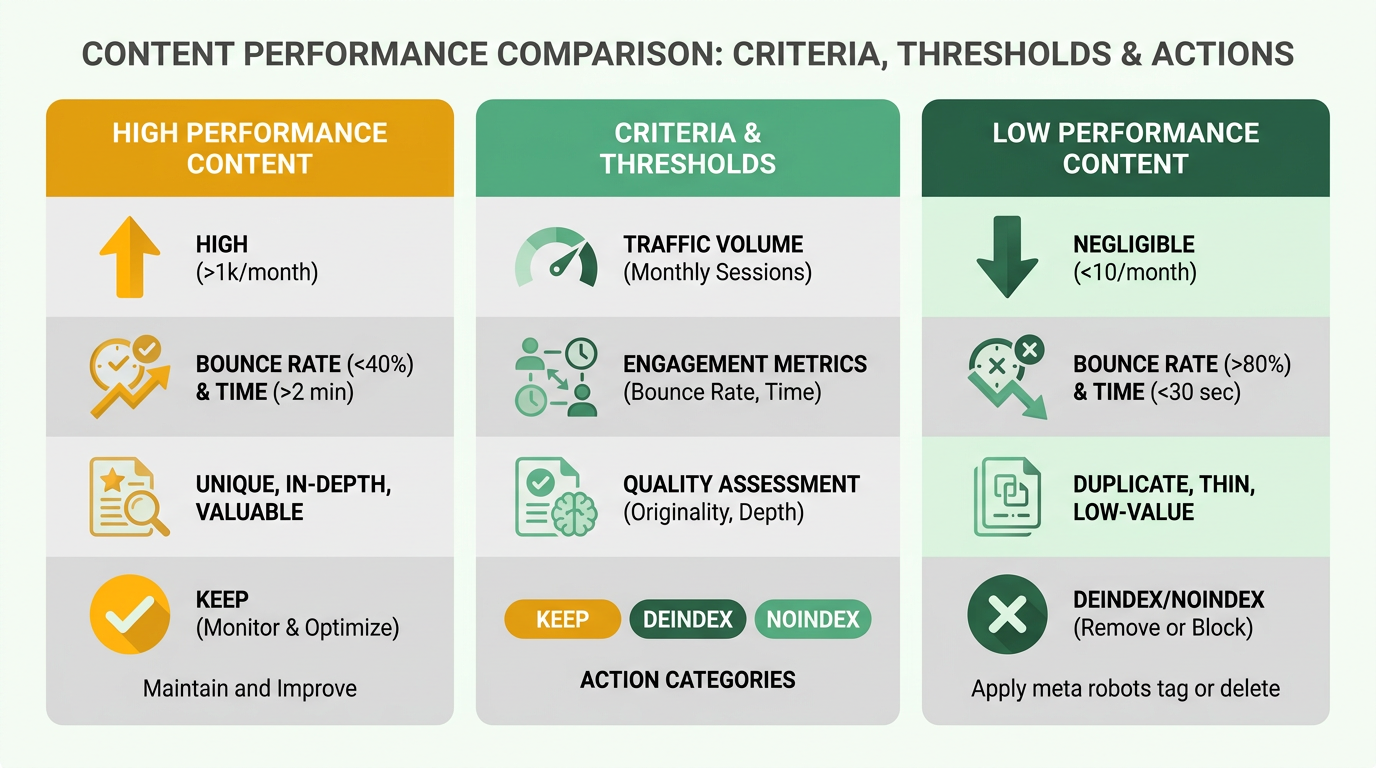
To prioritize pages for removal or noindex, evaluate traffic, engagement metrics, and content quality as core criteria. Pages with negligible traffic, high bounce rates, or duplicate content often qualify for deindexing. Start by identifying underperforming URLs using tools like Google Analytics and SEMrush, then apply specific thresholds to categorize them for action. This process aligns with Identifying Index Bloat section, which outlines how low-value pages contribute to index bloat.
Criteria for Evaluating Pages
To determine if a page should be removed or noindexed, focus on three key factors:
- Traffic: Pages receiving minimal or no organic traffic (e.g., less than 10 sessions monthly) are prime candidates. Use Google Analytics to filter pages by sessions, pageviews, or average time on page.
- Engagement: High bounce rates (above 70%) and low time-on-page metrics signal poor user experience. SEMrush or SimilarWeb can highlight pages where users exit immediately without interaction.
- Content Quality: Low-value pages include thin content, outdated information, or duplicate versions of live pages. Use Screaming Frog to detect duplicate meta tags or URL parameters that create redundant content. For example, a product page with 0.5 sessions per month, a 95% bounce rate, and no unique content would meet all three criteria for removal, as discussed in Why Index Bloat Matters.
Tools for Analysis
Combine analytics and crawl tools to identify problematic pages systematically:
- Google Analytics: Filter site content by traffic metrics. Focus on pages with low pageviews and high exit rates. Use the "Behavior" report to segment URLs by engagement.
- SEMrush: Analyze organic search performance with the Site Audit tool. It flags technical issues like broken links and uncrawled pages contributing to index bloat.
- Screaming Frog: Crawl your site to detect duplicate content, thin pages, or URLs with no internal links. The free version supports sites under 500 pages, while paid tiers handle larger domains.
A case study from source shows a website reducing indexed pages by 30% after using Screaming Frog to identify 200 low-value URLs. After applying noindex tags, crawl efficiency improved by 40%. Building on concepts from the Best Practices for Managing Index Bloat section, this example highlights the impact of systematic cleanup.
Common Pitfalls and Best Practices
Avoid these mistakes when prioritizing pages:
- Removing pages with indirect value: Delete URLs that might still drive traffic to other pages (e.g., a category page linking to high-performing blog posts).
- Ignoring canonical tags: Misconfigured canonicals can hide index bloat instead of resolving it. Audit these tags using the Coverage report in Google Search Console, as detailed in the Implementing Canonical Tags and Meta Noindex section.
- Failing to update sitemaps: After removing pages, regenerate XML sitemaps and submit them to Google to prevent crawlers from revisiting dead URLs.
Document decisions in a spreadsheet, noting the URL, reason for removal (e.g., "duplicate content"), and action taken (noindex, 301 redirect, or deletion). Tools like AnyPost.ai can automate this process by generating cleanup reports and tracking progress over time.
By focusing on traffic thresholds, engagement patterns, and technical SEO, you can systematically reduce index bloat. Start with the most egregious offenders-pages with 0 traffic and 100% bounce rates-and scale to subtler issues like thin content. Regular audits ensure long-term SEO health without disrupting user experience.
Implementing Canonical Tags and Meta Noindex
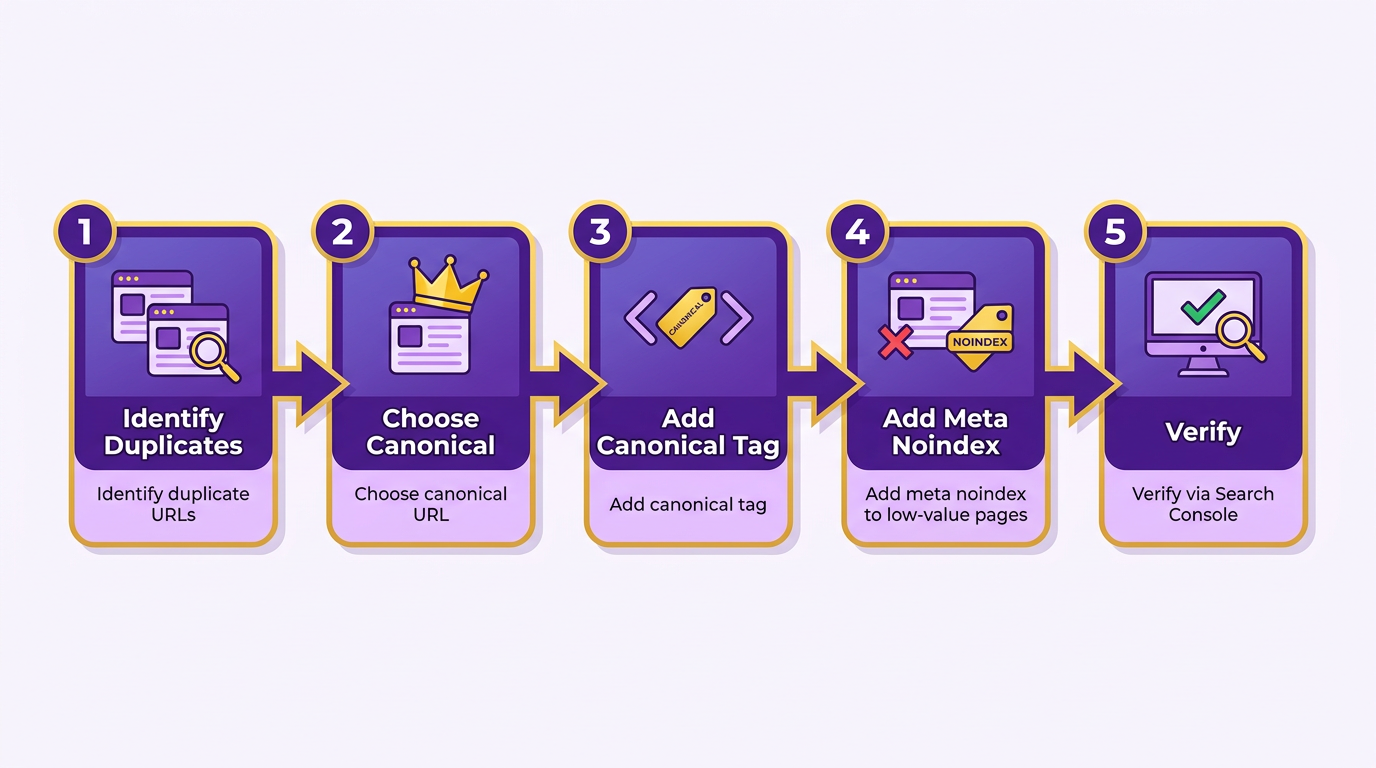
Implementing canonical tags and meta noindex is critical for reducing index bloat by consolidating duplicate content and blocking low-value pages from search engines. These techniques help prioritize high-quality pages while avoiding crawl inefficiencies. Below is a step-by-step guide to applying them effectively..
How Do You Implement Canonical Tags to Consolidate Duplicate Content?
Canonical tags tell search engines which version of a page is the “preferred” one when multiple URLs have similar or identical content. Start by identifying duplicate pages-common examples include product pages with URL parameters (e.g., ?sort=asc vs. ?sort=desc) or paginated content. As mentioned in the Identifying Index Bloat section, this process begins by analyzing indexed pages for redundancies. Once duplicates are identified, add a <link rel="canonical"> tag in the <head> section of the non-preferred pages, pointing to the preferred URL. For example:
<link rel="canonical" href="https://example.com/preferred-page" />
Ensure the canonical tag points to an absolute URL, not a relative path. A common pitfall is creating circular canonicals (e.g., Page A points to Page B, and Page B points back to Page A). Always verify canonical links using tools like Google Search Console or Screaming Frog to confirm they’re correctly assigned..
How Do You Use Meta Noindex to Prevent Low-Value Pages From Indexing?
Meta noindex is ideal for pages you want to block from appearing in search results but still serve a functional purpose, such as thank-you pages, login portals, or draft content. Building on concepts from the Prioritizing Pages for Removal or Noindex section, evaluate each page’s traffic, engagement, and content quality before applying noindex. Add the following tag to the <head> section of the page:
<meta name="robots" content="noindex" />
This instructs crawlers not to index the page while allowing them to follow links on it. For pages with high internal linking value but no user value (e.g., internal tools), combine noindex with nofollow to prevent both indexing and link equity transfer:
<meta name="robots" content="noindex, nofollow" />
Avoid using noindex on pages you plan to promote later-reconsider if the page might need indexing in the future. Test changes using Google’s URL Inspection Tool to confirm the page is excluded from the index..
What Are Common Mistakes to Avoid When Using These Tags?
- Incorrect Canonical Pointers: Never use a canonical tag pointing to a non-preferred page (e.g., a duplicate). Always validate canonical URLs with crawl tools.
- Overusing Noindex: Blocking too many pages with
noindexcan waste crawl budget if the pages still receive internal links. Instead, fix the root cause of duplicates (e.g., URL parameters) and use canonicals, as outlined in the Best Practices for Managing Index Bloat section. - Ignoring HTTP Headers: Some servers return
X-Robots-Tag: noindexfor entire directories. Check server headers with tools like Screaming Frog to ensure consistency.
A real-world example: One company reduced its indexed pages by 200+ URLs by canonicalizing duplicate product variations and adding noindex to internal search result pages. Another scenario involves a blog with draft posts-they used noindex until content was finalized, preventing incomplete articles from appearing in search..
How Do You Verify These Techniques Work?
After implementation, use Google Search Console’s “Coverage” report to check for indexing changes. For canonical tags, look for “Valid” canonicals under the “Enhancements” tab. For noindex, confirm the page no longer appears in search results within 2–4 weeks. If pages persist, submit a sitemap update or use the Remove URLs tool for urgent deindexing.
Tools like Screaming Frog (free for sites under 500 pages) can crawl your site and highlight misconfigured tags. For instance, a typical cleanup might reveal 200+ pages needing canonicalization or noindex tags, as seen in case studies where crawl efficiency improved by 30–50%.
By systematically applying canonical tags and noindex directives, websites can eliminate low-value pages from search results, improving both user experience and SEO performance.
Optimizing XML Sitemaps and Monitoring Index Changes
Optimizing XML sitemaps and monitoring index changes helps you control which pages Google crawls and indexes, reducing the risk of low-value pages consuming search budget. Start by auditing your sitemap to exclude duplicate or thin content, then use Google Search Console to track how index changes impact your site’s performance. Let’s break down actionable steps to streamline this process.
How Do You Create an Optimized XML Sitemap?
An effective XML sitemap prioritizes high-value pages while excluding URLs that don’t serve user intent. Start by removing duplicate pages (like sorted product listings) and session IDs that create unnecessary variations of the same content. Use the <lastmod> tag to signal updated pages, ensuring crawlers focus on fresh content. As mentioned in the Identifying Index Bloat section, this process aligns with strategies to remove low-value pages from the index. For example, a retail site reduced indexed pages by 30% by removing outdated product variations from its sitemap, allowing Google to prioritize category pages and blog posts. Tools like AnyPost.ai automate this process by scanning for low-value URLs and generating clean sitemaps based on content quality and relevance.
What Tools Help Monitor Index Changes?
Google Search Console’s Coverage report and Index Status tool are essential for tracking indexed pages. Use the URL Inspection feature to check if specific pages are indexed and identify crawl errors. As discussed in the Why Index Bloat Matters section, monitoring these tools helps mitigate the risks of wasted crawl budget. For deeper insights, pair this with a third-party SEO tool to monitor index trends over time. One company identified 500+ low-value pages using these methods, then submitted a revised sitemap to deindex them. Regularly reviewing these tools ensures you catch new content issues before they bloat your index.
What Are Common Mistakes to Avoid?
A major pitfall is including unlinked or low-traffic pages in your sitemap, which forces Google to crawl irrelevant content. Building on concepts from the Best Practices for Managing Index Bloat section, proactive strategies like excluding such pages prevent index waste. Another is failing to update sitemaps after removing pages-old URLs may remain indexed for months. Always test your sitemap using Google’s Sitemap Validator and resubmit it after major site changes. For instance, a publishing site improved rankings by 15% after systematically removing outdated articles from its sitemap and redirecting traffic to updated guides. Document each change in a spreadsheet to track which pages were removed and why, ensuring accountability and auditability.
How Do You Track Decisions Around Sitemap Changes?
Maintain a log of sitemap updates, including the date, pages removed, and reasoning (e.g., “duplicate content” or “zero traffic”). Use version control for sitemap files to roll back if issues arise. One organization saved 50% of its crawl budget by cross-referencing sitemap edits with Search Console data, focusing on high-converting pages. By aligning sitemap strategy with business goals, you ensure search engines prioritize the right content while minimizing waste.
By refining your XML sitemaps and actively monitoring index signals, you reclaim crawl efficiency and redirect Google’s attention to pages that drive real value. Tools like AnyPost.ai streamline this process by automating audits and providing actionable insights, but consistent documentation and manual reviews remain critical for long-term success.
Best Practices for Managing Index Bloat
Managing index bloat requires a proactive approach to maintain a lean, high-quality site index. Start by preventing low-value pages from being created in the first place. Conduct regular website audits to identify thin content, duplicate pages, or outdated material. Use tools like site crawlers to analyze your site structure and ensure every page serves a clear purpose. For example, a monthly audit might reveal 200 pages with less than 300 words of original content-these can be consolidated or removed before they bloat your index. As mentioned in the Why Index Bloat Matters section, low-value pages waste crawler resources and degrade user experience, making early detection critical.
How Do You Detect Index Bloat?
Index bloat is often hidden in plain sight. Use Google Search Console to review your indexed pages and compare them against your sitemap. A significant discrepancy signals unindexed or low-value pages. Additionally, analyze your server logs to identify URLs with high crawl errors or low engagement metrics like bounce rate. For instance, if 1,000 pages on your site have a bounce rate over 90%, they likely offer little value to users or search engines. As discussed in the Identifying Index Bloat section, tools like Screaming Frog (for sites under 500 pages) can automate this process, flagging pages with thin content, missing meta tags, or poor internal linking.

What Removal Strategies Work Best?
Once identified, use technical SEO fixes to deindex low-value pages. Apply rel=canonical tags to attribute authority to the original content, or use meta noindex to block indexing without removing the page entirely. For example, a product filter page that generates thousands of redundant URLs can be canonicalized to a single category page. Building on concepts from the Implementing Canonical Tags and Meta Noindex section, these techniques help consolidate authority while streamlining the index. If removal is necessary, submit a sitemap without the problematic URLs and use Google’s URL Removal Tool to expedite the process. For large-scale issues, consider redirecting outdated pages to relevant, high-quality content to preserve link equity.
How Do You Track Progress?
Document every change in a spreadsheet or CMS audit log, noting the page URL, removal method, and reasoning. This helps avoid future confusion and ensures accountability. For example, one company reduced its indexed pages by 40% after systematically applying noindex to 1,200 low-performing blog posts. Track metrics like organic traffic and crawl efficiency post-removal to measure success. As outlined in the Prioritizing Pages for Removal or Noindex section, evaluating traffic, engagement, and content quality provides a framework for measuring the impact of your efforts. A case study from an online retailer showed a 25% increase in traffic to key product pages after eliminating 3,000 duplicate category URLs.
By combining prevention, detection, and removal strategies, you can maintain a streamlined site index that prioritizes user experience and search engine visibility. Regular audits and documentation ensure long-term SEO health without relying on external tools or services.
Creating a 30-60-90 Day Index Cleanup Roadmap
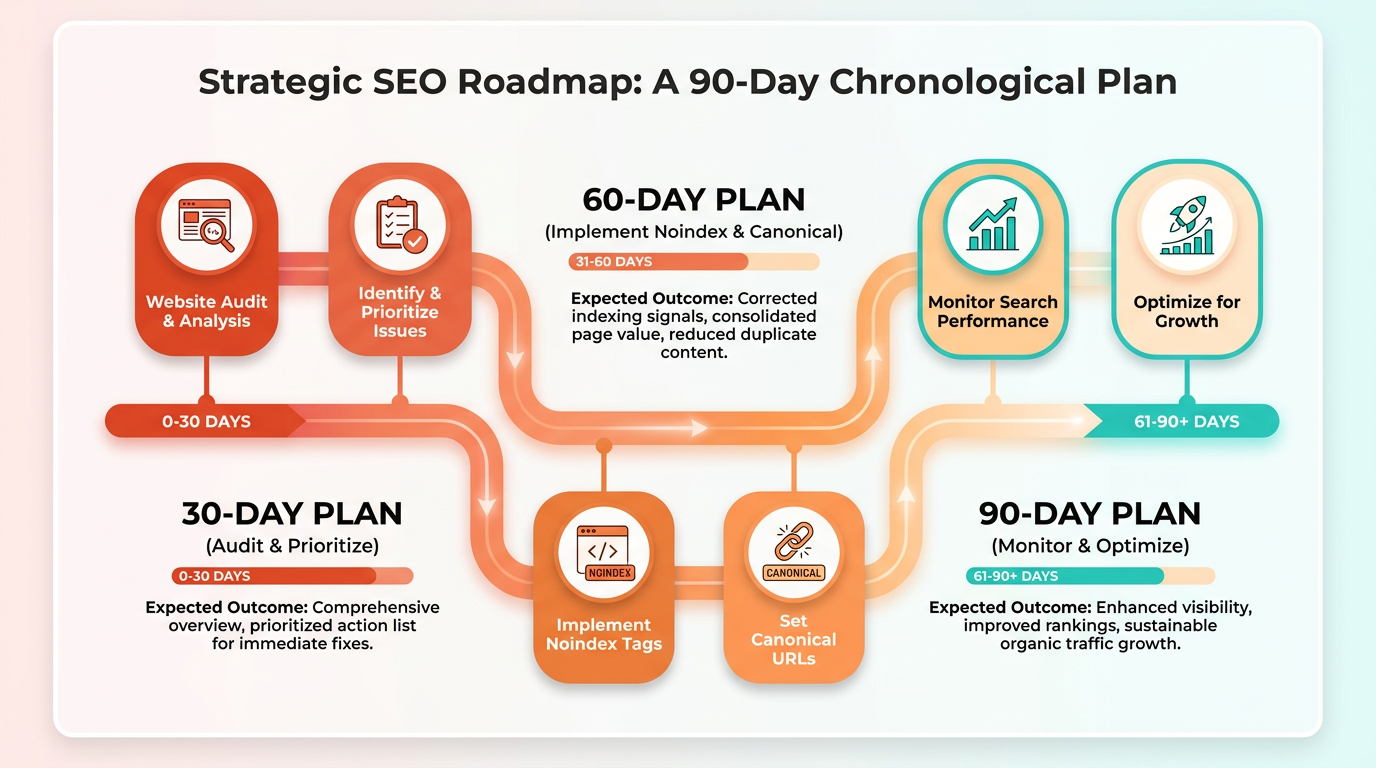
Creating a 30-60-90 day index cleanup roadmap ensures a structured approach to reducing index bloat by systematically identifying, prioritizing, and removing low-value pages. This process requires balancing technical audits with strategic implementation to maintain crawl efficiency and improve user experience. Below is a step-by-step breakdown of actionable steps for each phase, supported by real-world examples and best practices..
30-Day Plan: Audit and Prioritize Low-Value Pages
The first 30 days focus on identifying pages that consume crawl budget or dilute your site’s relevance. Start by analyzing traffic and engagement metrics in Google Search Console and Analytics to flag pages with zero or minimal traffic, high bounce rates, or low time-on-page. As mentioned in the Prioritizing Pages for Removal or Noindex section, pages with less than 1% monthly traffic or engagement metrics like 90%+ bounce rates should be prioritized. For example, one company reduced 200 indexed pages by 80% by targeting URLs with less than 1% of total site traffic.
Next, use a site-crawl tool to detect technical issues like duplicate content, thin pages, or orphaned URLs. Filter results by crawl depth and internal linking strength to prioritize pages that are unlikely to recover value. A typical cleanup might uncover 100–300 pages requiring action, depending on site size.
Key prioritization criteria:
- Traffic: Pages with less than 1% monthly traffic.
- Engagement: Bounce rate above 90% or average session duration under 10 seconds.
- Content quality: Duplicate, outdated, or low-utility content (e.g., thank-you pages, test content)..
60-Day Plan: Implement Index Changes
The second phase focuses on technical execution to remove or consolidate low-value pages. Building on concepts from the Implementing Canonical Tags and Meta Noindex section, apply canonical tags to merge duplicate content and use meta noindex for pages that should never appear in search results. For example, a retail site reduced index bloat by consolidating 50 product variant URLs into a single canonical page, improving crawl efficiency by 40%.
Update XML sitemaps to exclude deindexed pages and resubmit them to Google via Search Console. Monitor index status reports daily to confirm removals. For pages with high internal linking authority, consider redirecting them to relevant, high-value content instead of deleting outright.
Action steps:
- Apply
<link rel="canonical">to duplicate pages. - Add
meta name="robots" content="noindex"to low-value URLs. - Update XML sitemaps and resubmit via Google Search Console..
90-Day Plan: Monitor and Refine
The final phase ensures long-term maintenance by tracking index changes and refining strategies. As outlined in the Optimizing XML Sitemaps and Monitoring Index Changes section, use Google Search Console’s URL removal tool to expedite deindexing for urgent cases. Regularly audit crawl data to catch new instances of index bloat, especially after content updates or promotions.
Best practices for tracking progress:
- Document all changes in a shared spreadsheet, noting page URL, action taken (noindex, redirect, delete), and date.
- Compare indexed page counts monthly to measure improvement.
- Review Google’s Index Coverage report weekly for errors or reindexed pages.
One company reported a 50% reduction in indexed pages after three months, boosting organic traffic by 15% as search engines focused crawl resources on high-value content..
Example: Real-World Index Cleanup Roadmap
A mid-sized e-commerce site followed this roadmap to address index bloat:
- Week 1–4: Identified 400 low-traffic pages using Search Console filters and a site-crawl tool.
- Week 5–8: Implemented canonical tags for 300 duplicate product pages and noindexed 50 thin content pages.
- Week 9–12: Resubmitted updated sitemaps and redirected 100 orphaned URLs to category pages. Resulting in a 60% drop in indexed pages and a 20% increase in conversion rates.
By adhering to this timeline, you ensure a methodical cleanup that aligns with technical SEO best practices while avoiding the risk of over-removal or crawl errors.
Frequently Asked Questions
1. How can I identify index bloat on my website?
Use Google Search Console’s Index Coverage report to find “Valid” pages with thin or duplicate content. Thin content is often under 300 words, while faceted navigation URLs (e.g., ?color=blue&size=large) waste crawl budget and should be blocked or noindexed.
2. What tools help detect low-value pages?
Google Search Console’s URL Inspection tool and Screaming Frog’s crawl feature identify indexed pages with high similarity scores, thin content, or duplicate content. These tools flag URLs draining crawl budget.
3. How do I fix faceted navigation URLs?
Block or noindex faceted navigation URLs (e.g., ?color=blue) using robots.txt or meta tags. Google’s Index Coverage report highlights these URLs, and Screaming Frog helps audit their prevalence.
4. What counts as thin content?
Pages with fewer than 300 words are typically thin content. These pages lack value for users and dilute SEO efforts. Use Screaming Frog to audit word counts and Google Search Console to identify indexed thin pages.
5. How does removing low-value pages improve SEO?
Removing low-value pages reallocates crawl budget to high-quality content, boosting rankings. Google’s Index Coverage report flags these pages, while tools like Screaming Frog quantify their impact on site performance.
6. Can duplicate content cause index bloat?
Yes, duplicate content pages waste crawl budget and lower rankings. Use Google Search Console to find duplicates and Screaming Frog to identify high-similarity pages for removal or consolidation.
7. What’s the first step to address index bloat?
Start with Google Search Console’s Index Coverage report to list valid pages with thin or duplicate content. Prioritize faceted navigation URLs and thin pages (under 300 words) for removal or optimization.
