
Inside the AnyPost.ai Dashboard: One Workflow for Auto Indexing, AI Search Tracking, and Daily Publishing

Key Takeaways
- Smart taxonomy detection crawls your site and builds topic clusters while writing, so AI engines do not file your post under the wrong heading.
- Topic mismatch does not just lower your odds. It zeros them. Miscategorized content stays invisible to AI search, no matter how good it is.
- Analytics start the moment you publish, so you can watch each piece across search and citation metrics.
- The Persona Engine matches your voice while SEO optimization runs alongside it, keeping tone consistent across the library.
- Multi-source integration and SEO-first publishing align each draft with target keywords and search intent from the first pass.
- AI engines act like gatekeepers with rigid filing systems. Your content surfaces only when its tagged topic matches the question.
- The dashboard shows which terms are pulling weight and where small adjustments tighten targeting.
Auto-Indexing: How Smart Taxonomy Detection Files Your Content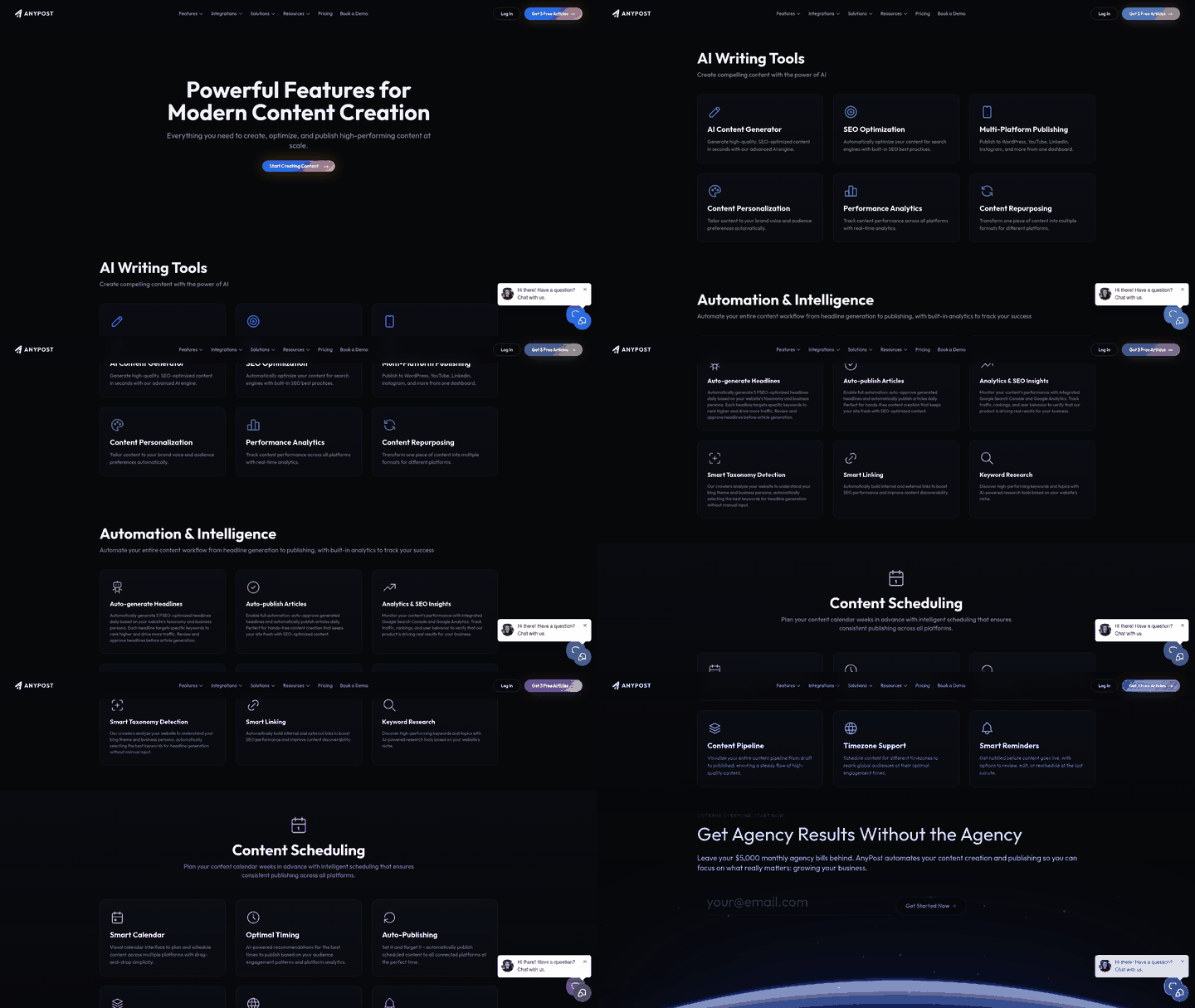
Hit publish, and the dashboard starts tracking performance in real time. That is not filing for tidiness. It is citation insurance. Research shows topic mismatch eliminates citation odds outright, so if an AI engine miscategorizes your content, you are invisible regardless of quality.
We call it smart taxonomy detection, and it is baked into generation rather than bolted on after. The system reads your content as it is written, identifies the primary topic cluster, and aligns the post with your target keywords and search intent. The Persona Engine handles tone in parallel, so the voice stays consistent while the SEO layer does its job.
How topic mismatch kills visibility
Picture the AI engine as a gatekeeper with a strict filing system. If your article about marketing automation gets tagged "general business advice," it will not come up when someone asks about workflow automation tools. The engine just does not consider it relevant. Quality never enters the conversation.
AnyPost.ai sorts this out during creation, not cleanup. Multi-source integration and SEO-first publishing point the content at the right keywords from the start. You see which terms are driving the strategy and what adjustments would tighten alignment with your target cluster.
What actually happens when you publish
The publishing system distributes across multiple platforms, but the useful part is upstream. During generation, it pulls your core topic signals from headers, key terms, and semantic patterns. The output is keyword-optimized, with headings built around search intent and clean, semantically correct HTML. Each major topic gets wrapped in section tags, and target keywords land in the H2s where they matter.
Most manual workflows run on constant monitoring and revision cycles. Here, creation, editing, publishing, and distribution live in one interface, which cuts the tool-switching that eats the middle of your day.
The feedback loop that refines the next batch
The dashboard does not stop at publishing. It tracks performance as it happens. Engagement metrics and traffic data feed straight back into future recommendations. The Business Context Graph learns from your entire site, so every new article keeps your brand voice and messaging intact.
That loop is what separates automated content generation from a glorified publish button. You are not just shipping today's post. You are building a content engine that compounds as the library grows.
AI Search Tracking: Seeing Where You Show Up
AI search tracking shows you where your content lands when someone asks ChatGPT, Claude, or Perplexity a question in your category. The dashboard gives you that visibility, so you are working from data instead of hunches. Search behavior has moved fast. ChatGPT's user base climbed from 100 million to 780 million between early 2024 and late 2025, while traditional search queries dropped more than 20% as generative engines absorbed the intent.
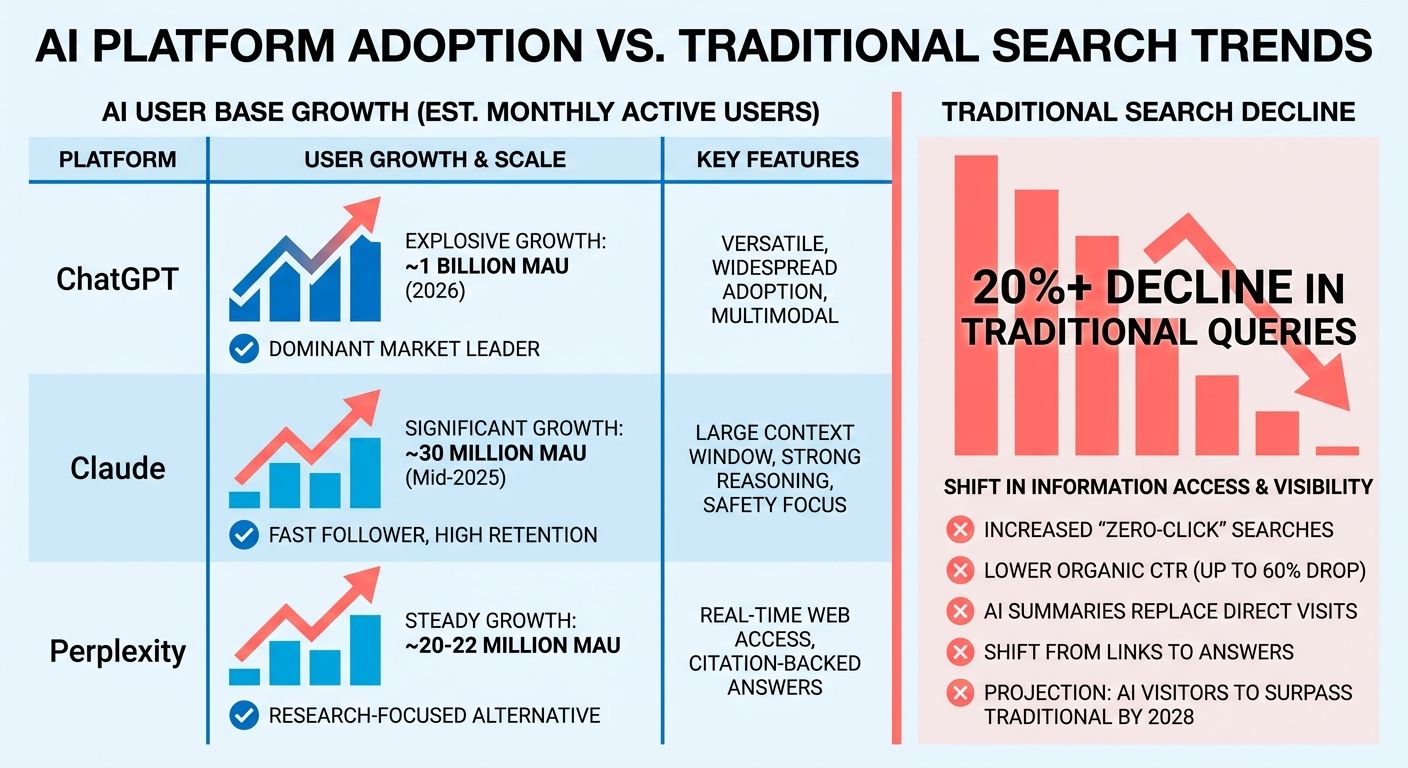
Then it gets harder. Google's market share slipped below 90% for the first time in a decade in late 2024, but the new engines do not agree with each other. They cite largely non-overlapping sources, and brand visibility swings day to day. A single audit gives you a snapshot that is often wrong. Reliable measurement takes at least seven runs per prompt per day. So real-time tracking is not a nice-to-have. It is the only honest way to know where you stand.
Why continuous tracking beats a one-time audit
Because AI visibility is probabilistic, not fixed. One observation over- or underestimates your true presence. GEO is a stochastic pipeline where results vary by engine and by run.
Two research findings collide here. One shows AI search favoring earned media so heavily that a fixed authority playbook should win. In automotive queries, earned content hit 81.9% in AI answers versus 39.5% on Google. Another warns that the headline 40% visibility gain from foundational work is context-dependent and does not generalize across engines.
Our read: both are right. Earned-media bias is real in specific verticals, but you cannot exploit it with a static plan, because engines differ and answers shift. Measure, do not assume. That is the entire reason the feedback loop exists.
What an AI visibility report actually shows
An AI visibility report is a running record of how often and how prominently your content gets cited across multiple AI engines, tracked over time instead of once.
Your starting position depends on your tier. Research on more than 100,000 prompt responses found 73% of large household brands appear on their first tracking run, 44% of mid-market brands, and only 11% of niche and small brands. If you are small, a snapshot tells you you have failed. Continuous tracking tells you the moment a new post finally breaks through.
| Method | Engines covered | Update cadence | Handles run variance | Feeds content strategy | Setup effort |
|---|---|---|---|---|---|
| Manual spot-checks | 1-2 you remember | Ad hoc | No | No | Low |
| Rank-tracking tools | Traditional SERPs | Daily | No | Partial | Medium |
| One-time GEO audit | Multiple | Once | No | No | High |
| Dashboard AI tracking | Multiple AI engines | Real-time | Yes, repeated runs | Yes, auto-refines | Low |
Setup stays low-effort because AnyPost runs it all from one dashboard, with no specialized technical or SEO expertise required. Compare that to standing up your own multi-engine measurement, which the research pegs as high-effort and easy to get wrong.
Where it earns its keep: a SaaS team confirming a new comparison post gets cited, a niche brand watching for its first breakthrough, or a content lead catching stale-timestamp drops before they cost citations.
Daily Publishing: Never Going Dark
Daily publishing means the dashboard generates, optimizes, and schedules content on a set cadence so you never go quiet. It automates the pieces that usually eat your morning: SEO headlines, article drafts, calendar scheduling. Instead of publishing when someone remembers, you publish on a rhythm the system holds for you.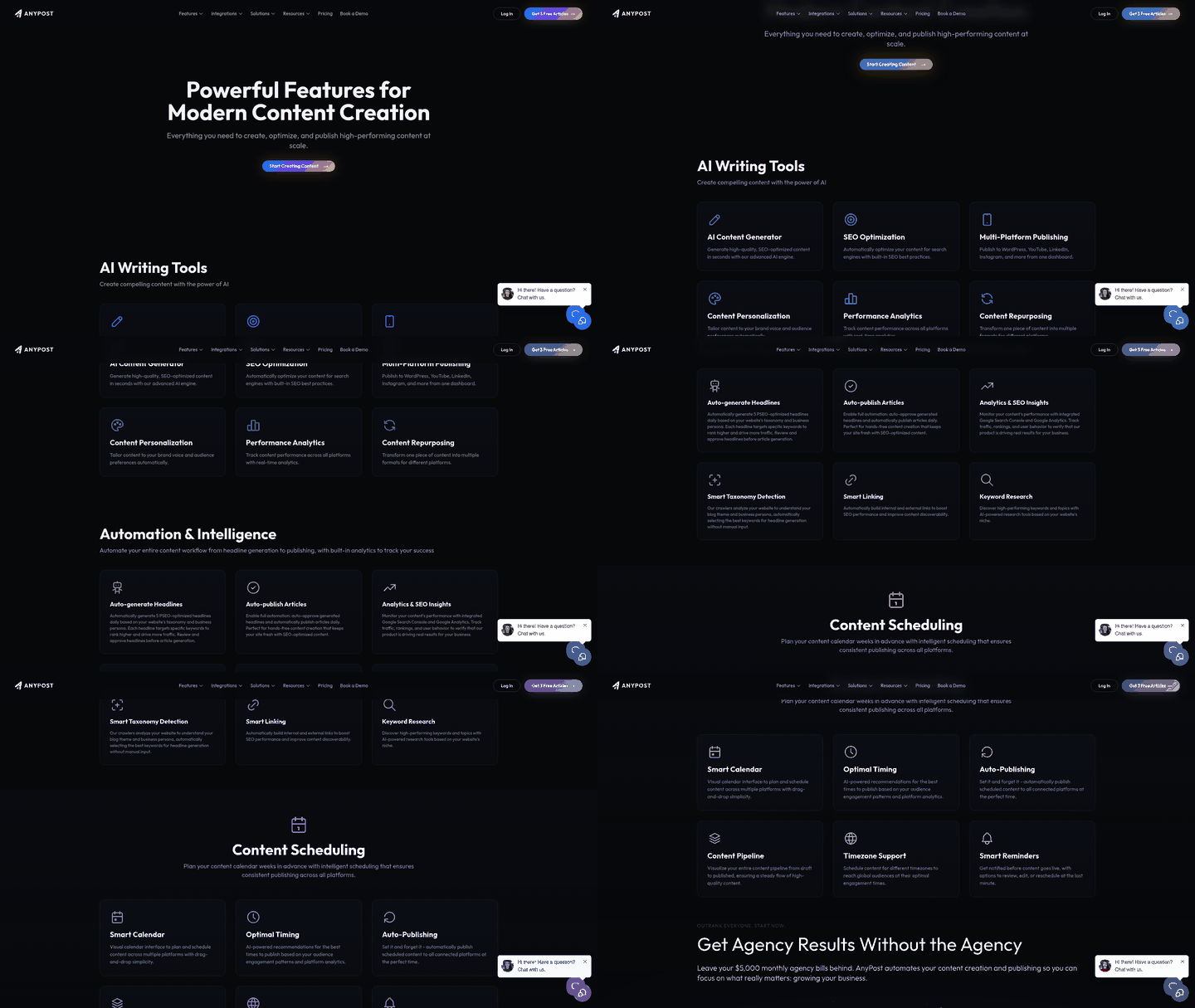
Why does cadence matter beyond raw volume? Because freshness is a citation gatekeeper. A recent-versus-old timestamp is one of the factors deciding whether AI engines cite you at all, and failing it can zero out your odds no matter how sharp the writing is. Daily publishing keeps your timestamps current, which is why we treat cadence as a citability lever, not a vanity metric.
How auto-generated headline optimization works
The dashboard writes search intent-aligned headings, with <h2 /> tags that fold in target keywords and semantic variations. You get a headline matched to your topic cluster and query without hand-writing a dozen variants.
A practical run-through. Say you run a mid-market analytics tool and want coverage on "self-serve reporting." The Taxonomy Researcher reads your business context and surfaces low-difficulty, high-intent keywords around that topic, and the SERP Competitor Analyzer studies the top-ranking articles to build a winning structure. The dashboard then produces a headline built around that intent and publishes it. The upfront research is the real edge over one-and-done manual titling.
Daily vs manual publishing: what actually changes
Manual publishing caps out at the hours your team has. Automated daily publishing removes that ceiling and, more to the point, keeps a steady stream of fresh, optimized content flowing to the surfaces where you want to get cited.
The time math is stark. A manual cycle runs briefing, drafting, editing, SEO passes, scheduling. Hours per piece. The dashboard compresses that into a generate-and-schedule flow, so the marginal cost of one more well-optimized post drops toward zero. For a lean team, that is the gap between two posts a week and one a day.
There is a deeper reason consistency pays off right now. AI answer volume keeps climbing: Gartner projects a 25% drop in traditional search engine volume by 2026 as users move queries to AI assistants and chatbots. Every query that shifts to an AI engine is decided by whether your content is fresh and cited, not by where you rank on page one. Steady publishing keeps you in the consideration set day after day. Sporadic posting leaves long gaps where engines have nothing recent of yours to pull.
Why live tracking beats a fixed playbook
Static optimization rules are a losing bet when generative algorithms update constantly. Instead of running a rigid checklist, you adapt your output based on active performance data.
Pair a consistent schedule with live monitoring and you can spot which topics gain traction almost immediately, then adjust the upcoming queue. Rather than guessing which angles resonate, you use direct feedback to steer the calendar, keeping your output aligned with what the engines are actively indexing.
Analytics & SEO Insights: Reading Performance as It Happens
The dashboard pulls diverse performance metrics into one place, so you can judge the impact of every published article without stitching reports together by hand. Traffic and engagement signals arrive right away. No more waiting to find out whether a new page is doing its job.
That single view matters because ranking on Google and getting cited by AI engines are not the same outcome. A page can hold a solid position in traditional search and still go unmentioned inside ChatGPT or Perplexity answers. AnyPost is built to generate content designed to rank and get cited, and the dashboard pairs that with real-time analytics so you are optimizing against how your content actually performs.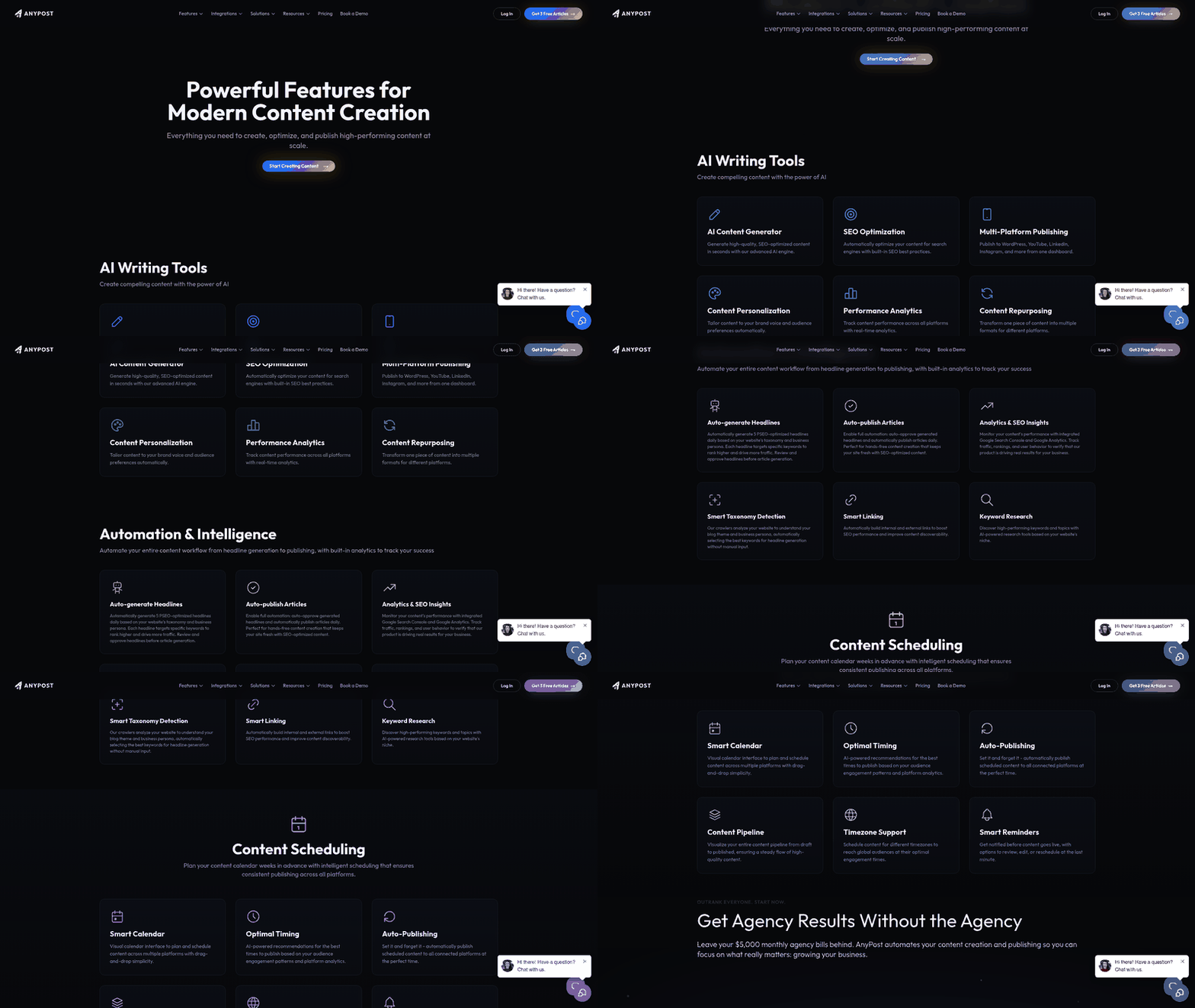
Why single snapshots mislead you
Isolated audits cannot capture how volatile generative search is. Because AI engines process queries dynamically, a single check catches a temporary state rather than a reliable trend.
A controlled study of 252,000 trials across six language models put numbers on it. The content factors driving citations reached statistical significance in four or more models only 61% of the time. So tactics that succeed in one model frequently fail in another. Static reports go stale, which is what makes continuous observation necessary if you want to understand your real footprint across platforms.
What real-time analytics actually do
They turn measurement into your next move. When the metrics show a topic underperforming, you feed that straight into the next content batch and adjust targeting yourself, all from the same dashboard.
Watch how fast the citation window moves. Generative engines re-crawl and re-rank far more often than traditional search, and some queries pull content published within the last 24 to 48 hours into cited answers. That speed cuts both ways. A page you thought was locked in can drop out overnight, and a new competitor page can displace you before a traditional monthly report even ships.
Monitor those shifts as they happen and you can update your approach on the spot to hold visibility. That continuous loop is what our automated SEO approach is built around, so you react to algorithmic changes in real time instead of leaning on outdated summaries.
Content Personalization and Repurposing: Persona Engine and Multi-Format Output
Content personalization means shaping each post around who reads it and where it lands, instead of pushing one generic draft everywhere. In the dashboard, the Persona Engine handles the voice side and multi-format output handles distribution. Together they let you take one piece of research and ship it in the shape each channel rewards.
The process ties directly to your performance data. Watch how different channels respond to specific formats and angles, and you can keep refining your personalization settings. The strategy adapts to actual engagement rather than static assumptions.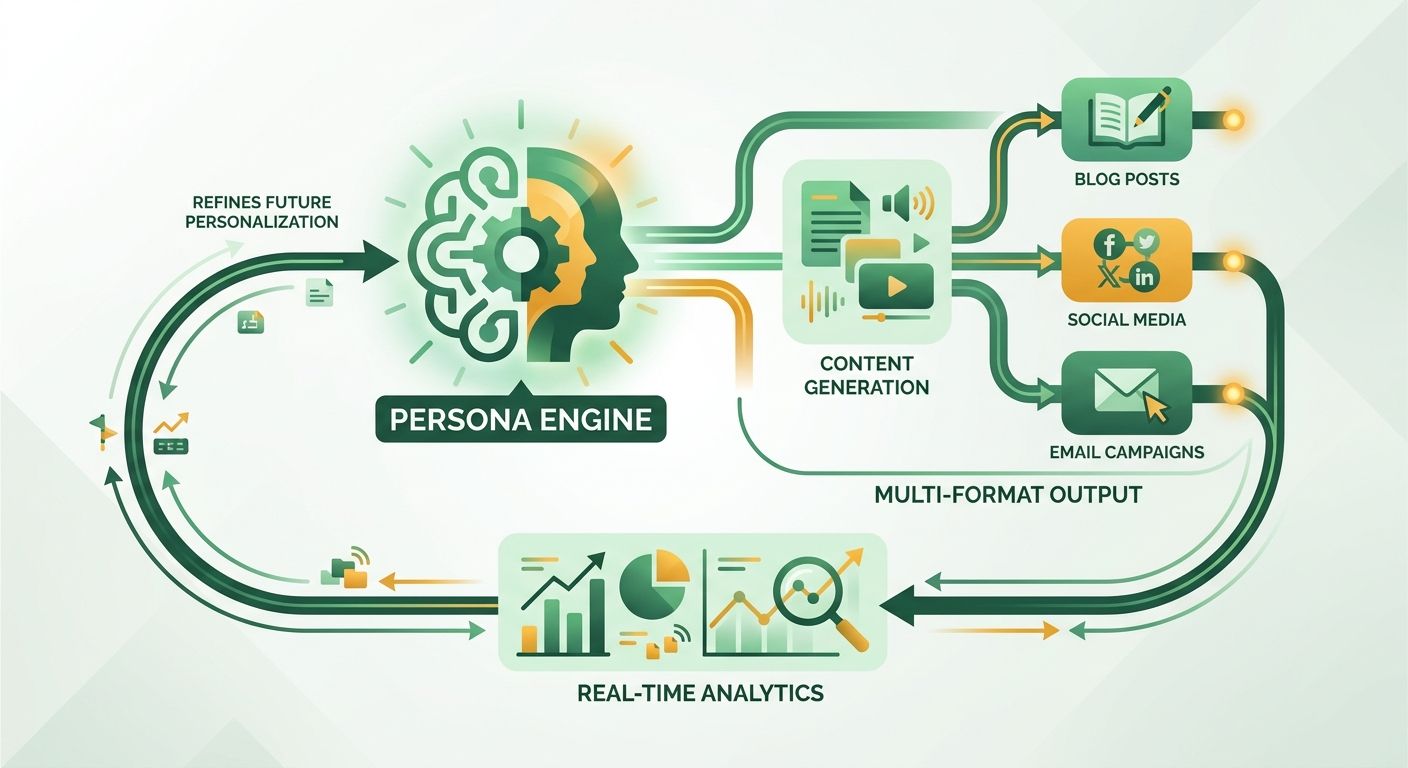
How the Persona Engine matches your voice
The Persona Engine studies your existing content to build a voice profile, then writes drafts that sound like you rather than a generic model. It picks up your word choices, sentence rhythm, and the way you frame an argument, so a reader cannot tell what you wrote from what the system generated.
It works by mapping your site's historical content to establish a baseline for your terminology and style. Holding that consistency matters because tone mismatch is a quiet engagement killer. If a team publishes a technical guide in a crisp, engineer-first tone, the system keeps that exact register across every asset after it. No jarring shifts in voice between pieces.
What multi-format output actually does
Multi-format output takes one approved article and reshapes it for each destination automatically. The dashboard can push a long-form post to WordPress, a condensed take to LinkedIn, and a punchy version to X, each formatted for that channel's norms.
This solves a real cost problem. Repurposing by hand is slow, and most teams give up after one or two channels. Automating the reshape means a single research effort covers more ground without extra headcount. One source turns into many channel-ready formats.
The angle we care about: more formats means more entry points for AI engines to cite. Since generative engines pull from largely different source pools, a post that exists in three formats gets three chances to surface instead of one.
How this differs from manual repurposing
Manual repurposing treats each version as a fresh writing task. This treats them as outputs of one source, tuned by live data. That is the gap.
Most tools stop at generating a draft. Here the loop closes. Real-time analytics show which formats are performing, so you steer the next round of personas and formats with actual data instead of guesswork. Skip this level of automation if you only publish one piece a month to a single channel. The payoff shows up when you are running real cadence across several platforms.
Frequently Asked Questions
1. Why does AnyPost.ai track AI visibility across multiple runs per day instead of once?
Generative search engines use dynamic retrieval pipelines that produce different results based on real-time algorithm updates and query context. Checking your visibility only once a day gives you a narrow snapshot that fails to account for these fluctuations. By tracking performance continuously throughout the day, the dashboard captures these shifts, giving you a reliable average of your true search presence.
2. What happens if my content gets the topic cluster wrong during creation?
When an AI engine misclassifies your content, it fails to index it for relevant user queries. For example, if a detailed guide on predictive maintenance is categorized under broad manufacturing tips, it will not be retrieved when a user searches for specific equipment monitoring tools. The platform's taxonomy detection prevents this by analyzing semantic signals during drafting to ensure the content is correctly categorized from the start.
3. Can I use AnyPost.ai if I only publish one article per week?
Yes, the platform supports any publishing schedule. However, a more frequent schedule accelerates your results because it provides more data points for the analytics loop to analyze. Regular updates help establish a broader footprint across search indexes, making it easier for AI models to discover and reference your site as an active authority in your niche.
4. How does the Persona Engine differ from asking ChatGPT to match my tone?
Unlike standard AI tools that require you to manually prompt them with style guides for every run, the Persona Engine is directly integrated with your site's content history. It automatically extracts stylistic markers from your published work to apply them systematically. This ensures that every generated draft matches your established editorial standards without requiring constant manual adjustments.
5. Do I need SEO expertise to use the dashboard effectively?
No, the platform is designed to automate the technical aspects of search optimization. The system handles tasks like structuring headers, identifying keyword opportunities, and formatting metadata behind the scenes. This allows you to focus on reviewing and approving content rather than managing complex SEO configurations.
6. Why does AnyPost.ai prioritize earned media if research shows it does not generalize across engines?
Rather than relying on a single type of content, the platform adapts to how different search engines respond to your specific industry. Because visibility patterns shift across platforms, the dashboard tracks live performance to show you exactly which content types are earning citations. This allows you to adjust your strategy based on active data rather than theoretical industry generalizations.