
Marketplace SEO: How to Rank Products on Amazon and Etsy
Key Takeaways
- Most marketplace buyers never scroll past the first page, so an unranked listing on Amazon or Etsy might as well not exist.
- Shoppers on these platforms show up ready to buy. That's a different animal from the casual reader skimming a Google blog post.
- Small handmade Etsy sellers and third-party Amazon sellers gain the most, because ranking is often their only path to visibility without a big ad budget.
- On Etsy, SEO drives your listing quality score and how often your items surface. External traffic pushes those listings higher.
- Amazon's own advice for better rankings comes down to keyword research, sharper titles, and stronger descriptions.
- The core problem here is simple: products that exist but never get seen.
- Optimized listings also fix weak conversion rates, badly targeted keywords, and thin descriptions that don't answer the questions buyers actually have.
Why This Actually Moves the Needle
Marketplace SEO decides your products' shelf space. The algorithm is the gatekeeper on Amazon and Etsy, and your visibility hangs on how well your listings line up with each platform's ranking factors. Get your titles, backend keywords, and images right, and your inventory shows up at the moment a ready-to-buy shopper types a query.
That last part matters more than most sellers realize. A search on Amazon or Etsy isn't like an informational query on Google, where someone's hunting for a guide or a blog post. Marketplace searches are transactional. People are there to spend money. So the traffic converts at a much higher rate, and your focus shifts from teaching anyone anything to matching the product and closing the sale.
Who gets the most out of it
If your products keep getting buried, this is for you. For independent merchants and brands without a big marketing budget, organic optimization levels the field. Instead of bleeding cash on sponsored placements, you learn the algorithm and pull sustainable, high-margin sales straight from organic results.
Selling handmade, vintage, or one-of-a-kind items? Your job is to prove to Etsy that your inventory matches specific buyer tastes. Line your listings up with Etsy's search criteria and you signal reliable fulfillment and solid customer interactions, which helps lift your items above the mass-produced stuff.
On Amazon, top organic placement is how you take market share from entrenched competitors. That takes a systematic approach: every technical field populated with terms people actually search. Fully optimize your product detail pages and you improve your odds of winning the buy box and pulling organic clicks.
What it fixes
Marketplace SEO is really about diagnosing why good products fail to show up. It finds where your funnel is leaking.
The usual culprits:
- Low placement from missing or vague keywords in titles and descriptions
- Weak listing quality dragging down your Etsy ranking
- Bad keyword targeting that attracts the wrong shoppers, or none
- No external signals from off-platform content and traffic
Each one quietly costs you sales. Fix them and the gains compound as your rankings climb.
Amazon vs. Etsy: same discipline, different math
Both platforms reward relevant keywords and strong listings. They just weigh the signals differently. Amazon leans hard on conversion and sales performance. Etsy factors in a listing quality score and rewards external traffic that brings visitors to your shop.
| Factor | Amazon | Etsy |
|---|---|---|
| Core ranking driver | Keyword relevance and sales performance | Keyword relevance and listing quality score |
| Title strategy | Front-load key terms in product titles | Descriptive, keyword-rich titles |
| External traffic | Supports rankings | Directly rewarded, drives higher placement |
| Difficulty | Moderate to high, high competition | Moderate, niche-dependent |
| Time to results | Weeks of testing and refinement | Weeks, faster in less crowded niches |
Budget a few hours per listing upfront on keyword research and copy. Then keep at it. This isn't one-and-done. You'll test titles, watch rankings, and adjust.
Same rules on both: clear keywords, complete listings, steady off-platform traffic. If you want to sidestep the usual mistakes, this guide on marketplace SEO optimization walks through what sinks most sellers.
Optimizing Product Listings on Etsy
Etsy ranks listings on how well your keywords match what shoppers type, plus a quality score built from clicks and sales. So your job is two-sided: fill every field with relevant terms, and make the listing appealing enough to convert. Nail both and you climb.
Titles and tags: front-load and fill every slot
Put your most important keywords at the front of the title, and use all 13 tags. Etsy scans titles, tags, and descriptions for matches, so leading with the terms buyers actually type gives you the best shot.
Write titles that read naturally but pack in specific phrases. Not "Necklace." Try "Personalized Birthstone Necklace for Mom." People search in phrases, not single words. Match how they type.
Fill all 13 tag slots with multi-word phrases. Single-word tags waste the space. Use variations like "boho wall art" and "neutral wall decor" to cover different intents. Repeat your strongest keywords across title, tags, and description to reinforce relevance.
Keep tags fresh, too. Rotate seasonal terms through the year and test which phrases pull traffic. Plenty of sellers swap in holiday and trend tags to catch demand spikes.
Attributes and categories are free keywords
Attributes and categories act as extra keywords and help Etsy filter your product into the right searches. Every attribute you fill gives the algorithm more to match against. Skip them and you shrink your own visibility.
Pick the most specific category available. A precise category tells Etsy exactly where your product belongs, which improves how it shows up in filtered searches. Vague categories bury you among unrelated items.
Set every relevant attribute: color, material, occasion, style, size. Buyers use these as filters, and complete attributes mean your listing appears when they do. Think of attributes as tags you don't have to spend a slot on.
Sell a silver hoop earring? Selecting the metal, style, and occasion attributes lets you rank for shoppers filtering by "silver," "hoops," and "everyday wear" without cramming any of it into your title.
Why images and descriptions carry the conversion
Good photos and keyword-rich descriptions boost your listing quality score, which feeds ranking directly. Etsy watches how shoppers interact with your listing. Strong photos earn clicks and sales, and those signals push you up.
Use clear, well-lit photos showing the product from multiple angles. First impressions decide whether someone clicks or scrolls. Sharp, detailed images build trust and cut the guesswork that kills conversions.
Write descriptions that answer buyer questions and work in your keywords naturally. Etsy reads the first few lines for relevance, so lead with what matters most. Cover size, materials, use cases, personalization options.
Off-platform traffic matters here too. Point targeted visitors from social campaigns or your newsletter to your Etsy store and more of them buy on the spot. That influx of active buyers improves your conversion-to-click ratio, which the algorithm reads as a strong signal of product desirability.
Optimizing Product Listings on Amazon
Amazon ranks through its A9 algorithm, which weighs keyword relevance alongside sales performance. Your listing needs the right terms in the right fields, plus enough conversion signals to prove it deserves the top spot. Get both and you climb page one.
The system pulls keywords from your title, backend search terms, bullets, and description. Every field is real estate. Waste it and you're leaving rankings on the table.
How to structure your Amazon title
Put your primary keyword near the front, then add brand, product type, and key features. Amazon titles run up to 200 characters in most categories, but readability still counts. A cluttered title buries the terms shoppers care about and tanks your click-through rate.
Lead with what people search. "Stainless Steel Water Bottle, 32oz Insulated, Leak-Proof Lid for Gym and Travel" front-loads the search term and stacks specifics after it.
Don't stuff every keyword in. Amazon can suppress listings that read as spam. Include the essentials, save the rest for other fields.
Backend search terms: the hidden real estate
Backend search terms are hidden keyword fields that help Amazon match your product to searches without cluttering the visible listing. You get roughly 250 bytes. Invisible to shoppers, fully indexed by the algorithm.
Selling a leather wallet? Add "billfold," "cardholder," "minimalist purse," "pocket organizer." Cover the different ways buyers describe the same thing.
Skip repetition. Repeating words already in your title wastes bytes and adds nothing. And don't include competitor brand names. Amazon prohibits it, and it can get your listing flagged.
Fill every byte with distinct, relevant terms. Empty backend fields are missed rankings.
Why bullets and descriptions matter
Bullet points and descriptions drive both keyword relevance and conversions. Amazon indexes the text, so they help you rank. They also sell the product, which feeds the sales signals A9 rewards. A wall of text with no structure loses buyers fast.
Write five bullets that each lead with a benefit. Cover materials, dimensions, use cases, and what sets you apart. Shoppers scan bullets before they read anything else, so make each one count.
Your description gives you room to expand. Weave in secondary keywords naturally while answering the questions a buyer asks before checkout. Short paragraphs and clear sections, not one dense block.
Reviews reinforce all of it. Strong review counts and ratings push rankings higher because they prove the listing converts. Optimize the copy, then keep earning reviews to hold your spot.
Get the fields right, and the algorithm does the rest. Match how buyers search, then give them a reason to click.
How Etsy's Search Algorithm Actually Works
Etsy's search runs in two stages. First, query matching pulls every listing whose fields contain the words a shopper typed. Then a ranking pass sorts those matches by relevance and quality. Once you see the split, you know where to spend effort: get found first, then earn the top spot.
How Etsy matches queries to listings
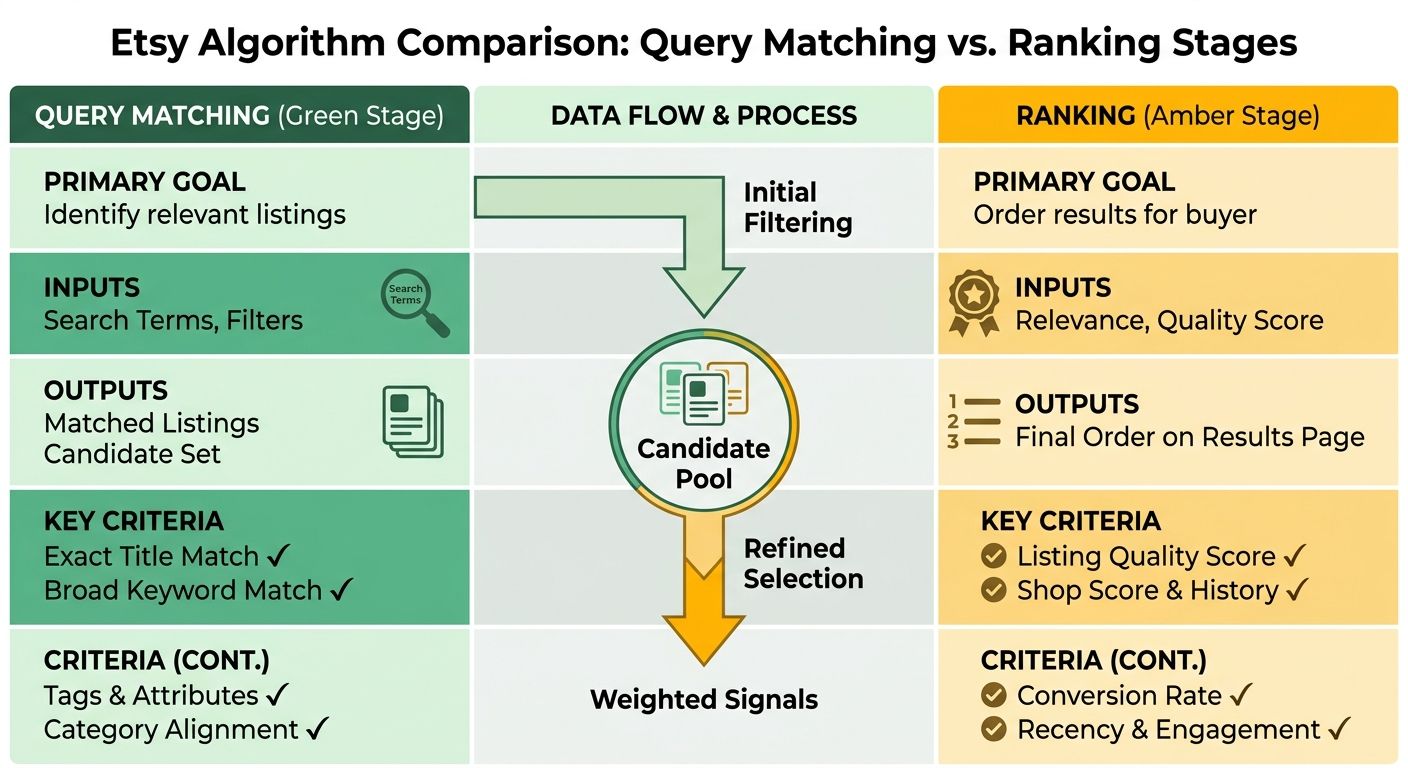
Etsy compares the shopper's words against the text in your listing fields, then filters down to what fits. If your words don't appear anywhere Etsy reads, you never enter the running. Coverage comes before ranking.
Your categories and attributes act as structured search fields, not just labels. Assign a listing to a specific category and fill in attributes like color, material, or occasion, and Etsy treats those as extra matching signals. A shopper filtering for "sterling silver" or "wedding" only sees listings that carry those attributes.
Pick the most specific category Etsy offers instead of a broad parent one. A ring listed under a precise jewelry subcategory matches tighter, more valuable queries than one dumped in a generic bucket. Every attribute you leave blank is a query you can't win.
What the listing quality score really measures
Listing quality score is a measure of how often shoppers click, favorite, and buy your listing after it appears in results. Etsy uses that engagement to decide which matching listings deserve higher positions. Strong keywords get you into the pool. Strong conversions move you up.
That's why relevance alone won't carry you. Two listings can match the same query word for word, but the one that turns views into sales climbs above the other. Your photos, price, and reviews all feed that signal.
Recent Etsy guidance for 2026 pushes on this score directly. Clear photos, honest titles that match the listing, fast responses to buyers. The algorithm rewards listings that keep shoppers on the page and get them to check out.
Does outside traffic help? Yes.
Directing external visitors to your shop helps you bypass the brutal competition of internal search pages. When Etsy detects traffic from external domains, it rewards the listing for bringing new customers to the platform, which can temporarily lift your organic placement.
Think of it as a feedback loop. Outside visitors who click and buy raise your engagement metrics, which lifts your rank inside Etsy search, which then exposes you to more organic shoppers. One channel feeds the other.
You don't control Etsy's algorithm, but you control the inputs. Fill your categories and attributes completely, write listings that match what buyers expect, and send your own audience to the pages you want to rank.
Treat search as a system with two doors. Match the query to get in. Convert the click to rise. Work both and your listings stop getting buried.
How Amazon's Search Algorithm Actually Works
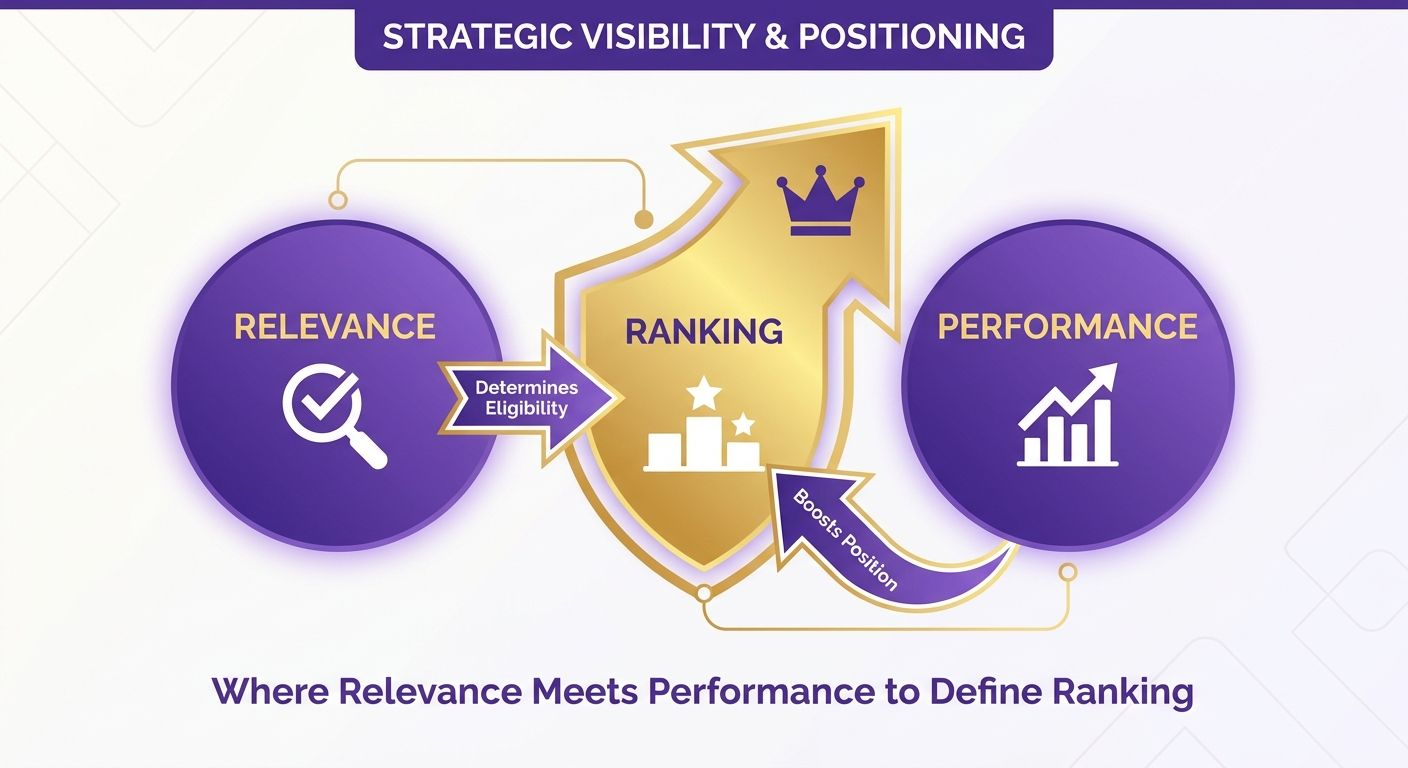
Amazon ranks products on two things: relevance and performance. Relevance decides whether your product shows up for a search at all. Performance decides how high it ranks once it qualifies. You need both working together to reach page one.
The performance side is what most sellers underestimate. Amazon is a sales machine. It pushes products that convert because every sale earns Amazon money. That one fact explains most of how ranking works.
How Amazon weighs performance
Amazon prioritizes products that sell. The three signals that matter most: click-through rate, conversion rate, and sales velocity. Together they tell the algorithm your listing turns searches into purchases, and that pushes you up.
Click-through rate measures how often shoppers click your listing after seeing it in results. A strong main image and a clear title drive that first click. If nobody clicks, Amazon assumes your product doesn't match the search and drops you.
Conversion rate measures how many of those clicks turn into orders. This is where pricing and images earn their keep. Competitive pricing removes hesitation, and multiple sharp images answer questions before shoppers bounce.
Sales velocity tracks how many units you move over time. Steady, growing sales signal momentum. That's also why stock supply matters so much. Run out of inventory and your velocity craters, which drags your ranking down even after you restock.
Why reviews and ratings move your ranking
Reviews influence ranking because they drive conversion. Products with more reviews and higher ratings win more clicks and more orders, and Amazon rewards that conversion strength with better placement. Reviews are a trust signal for buyers and a performance signal for the algorithm at the same time.
Think about your own habits. You scroll past the product with 12 reviews and buy the one with 3,000 at 4.6 stars. Amazon watches that behavior across millions of shoppers and ranks accordingly.
New listings hit a cold start here. Without reviews, your conversion rate stays low, which keeps you buried, which keeps reviews scarce. Break that loop early. Push for legitimate reviews from real buyers as soon as sales begin.
What to actually do about it
Optimize for the click first, then the conversion. Get shoppers to click with a strong image and title, then close them with pricing, detailed images, and social proof. Every improvement to conversion feeds back into higher rankings.
Start with a clean main image and a title that leads with the term buyers search. Then fill your backend search terms with relevant keywords you couldn't fit elsewhere. Those hidden fields expand your relevance without cluttering what shoppers see.
Structure your product detail page for fast scanning, especially on mobile. Concise bullets that lead with clear, bolded benefits, then brief supporting details. That layout keeps shoppers engaged and stops them bouncing from information overload.
Healthy inventory levels and competitive pricing compound your sales velocity over time. They're not separate levers. They pull on the same rope.
Running Marketplace SEO at Scale
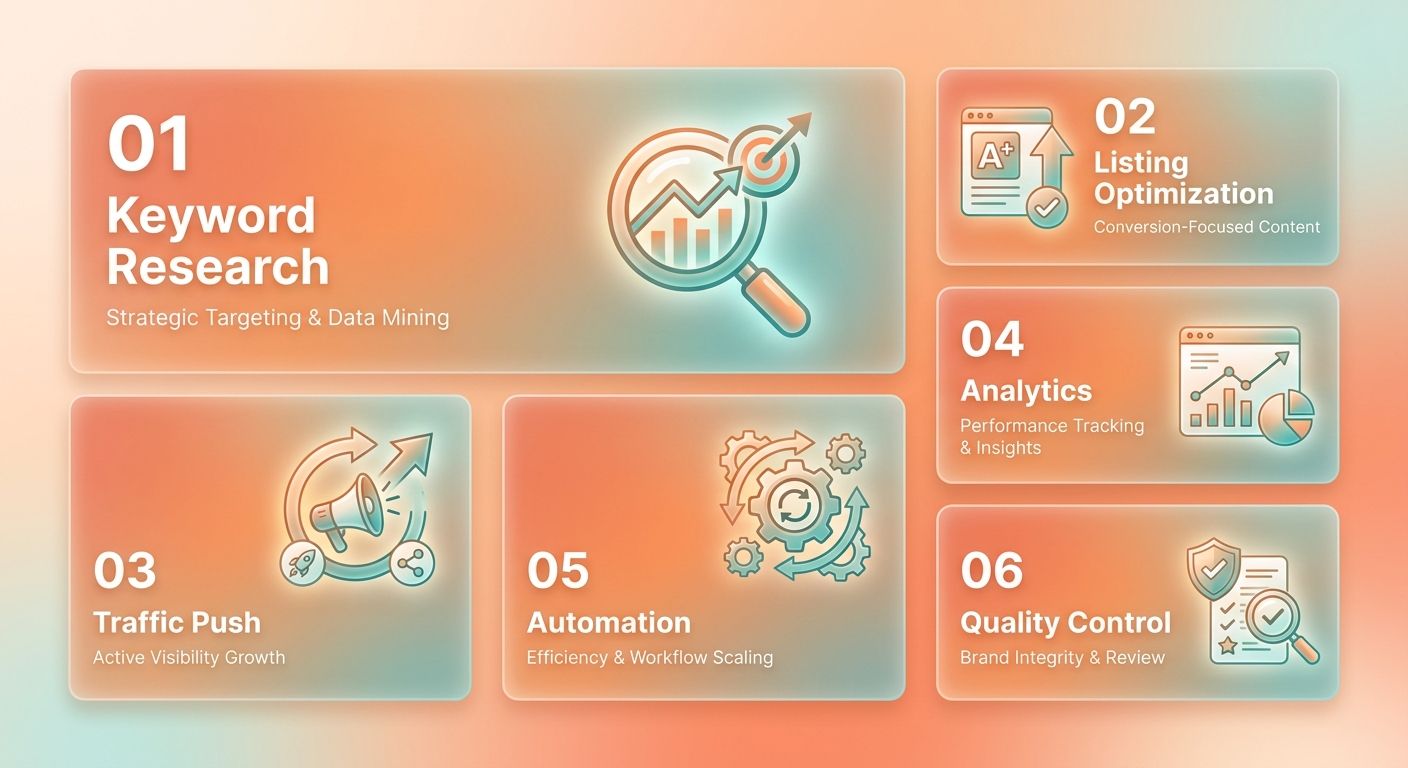
One listing is easy. Hundreds across two marketplaces breaks manual workflows fast. Scaling means building repeatable systems so every listing gets the same keyword research, the same optimization, and the same external traffic push without you touching each one by hand.
Sellers who win at scale treat listings like a production line. Standardize the work, delegate the repeatable parts, drive outside traffic back to the pages. Here's how to build that.
Build a repeatable workflow
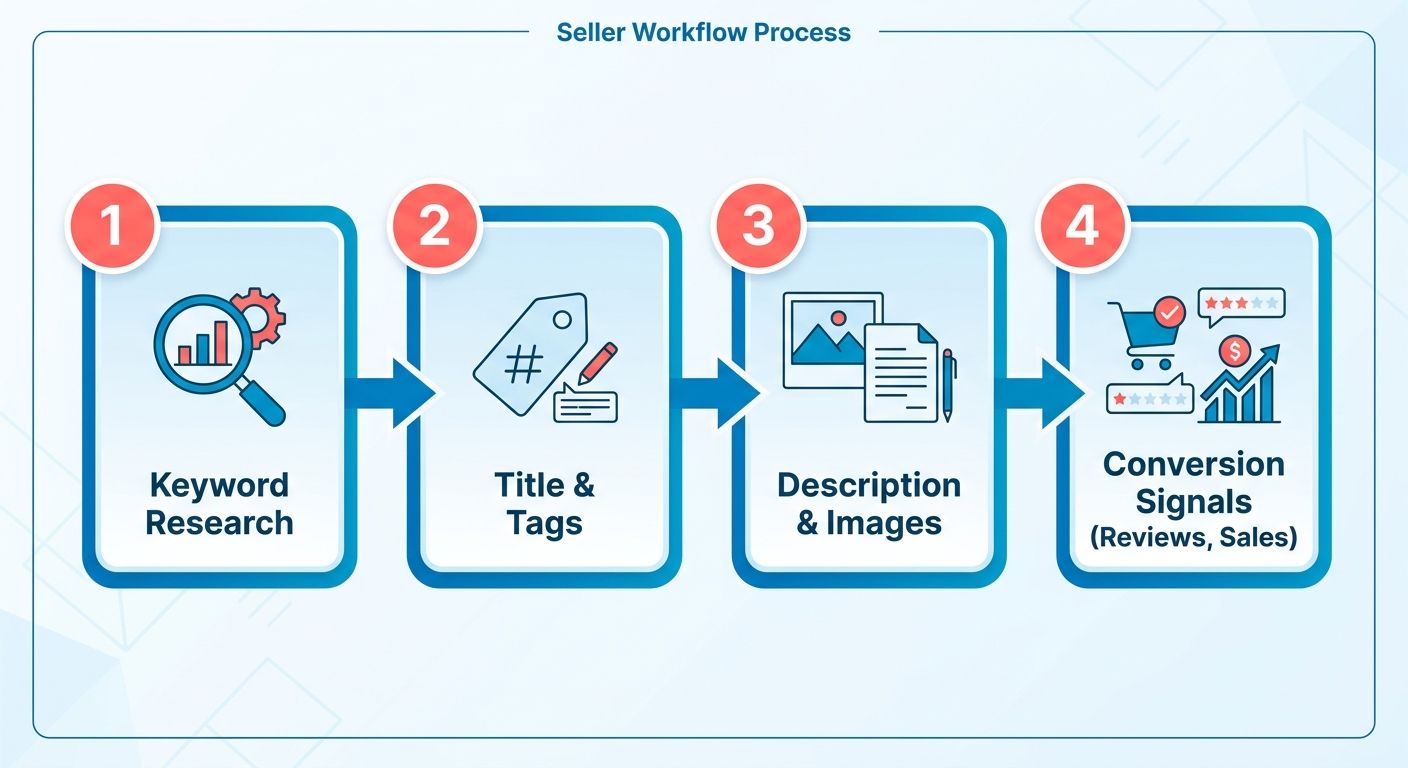
Start with a template every listing passes through before it goes live. Standardize your keyword research, title formula, tag and backend fields, and image checklist. When the process is fixed, quality stays consistent no matter who does the work.
Break the workflow into stages. Research keywords. Write the title and fill every field. Add optimized images. Publish and track performance. Assign each stage to a person or a tool so nothing gets skipped.
Content generation is usually the slowest stage, especially when you're writing dozens of descriptions and supporting blog posts. That's where automation earns its keep. Tools like AnyPost.ai handle the repetitive drafting and publishing so your team spends time on strategy instead of copy.
Track results in one place. If you're editing listings and never checking whether rankings move, you're guessing. Build a simple sheet or dashboard showing keyword position, click-through rate, and sales for each listing.
Why external content drives marketplace sales
External traffic tells Amazon and Etsy your listings deserve attention. When shoppers arrive from a blog post, an email, or a social link and then buy, that outside traffic boosts your rankings and your sales at once.
Diversifying your traffic sources also cuts your reliance on internal marketplace search. Independent channels give you a steady stream of pre-qualified buyers, which stabilizes your sales velocity and makes you more resilient to sudden algorithm shifts on either platform.
Blog posts work because they target keywords the marketplaces can't reach. Write a guide that ranks on Google, then link straight to your product page. A "best gifts for new moms" post can funnel buyers to your Etsy listing all season.
Email is the channel most sellers ignore. If you already have buyers, you already have an audience. A short email announcing a restock or a new product drives an immediate spike in sales, and that velocity pushes your rankings up right when you want it.
What to skip when scaling
Don't automate keyword research for a brand-new product with no data behind it. When you're still learning what your buyers search for, manual research beats any template. Automate only after you know which terms convert.
Skip external content for one-off products you won't restock. Building a blog post and email flow around a listing you'll sell out and never make again is wasted effort. Save that for your evergreen bestsellers, where the traffic compounds over months.
Scale the parts that repeat. Keep the judgment work human.
Frequently Asked Questions
1. How much does it cost to run marketplace SEO on Amazon versus Etsy?
While the process of optimizing your listings requires no direct payment, you must account for platform fees. Etsy requires a $0.20 listing fee alongside transaction costs, whereas Amazon operates on a $39.99 monthly professional subscription or individual per-item fees. Budgeting for specialized keyword research software or rank-tracking tools is also recommended as your catalog grows.
2. Can I sell the same product on both Amazon and Etsy at once?
Selling on both platforms simultaneously is possible and often smart, but each requires separate optimized listings. Etsy restricts you to handmade, vintage, or create supplies, while Amazon accepts most product categories. Duplicate your keyword research, then adapt titles and descriptions to match each platform's specific ranking signals.
3. What happens to my ranking if I run out of stock?
When inventory is depleted, Amazon temporarily suppresses your listing from search results, halting your sales momentum. Upon restocking, you often face a 'cold start' period where the algorithm treats the listing as lower priority. To recover your previous organic position, you may need to temporarily lower prices or run aggressive PPC campaigns to rebuild your sales history.
4. How many keywords should I actually target per listing?
Aim to optimize for a single high-volume primary keyword and a small cluster of secondary long-tail phrases. For Etsy, distribute these terms strategically across your metadata fields and tags. For Amazon, place your primary term in the title and map secondary synonyms to your backend fields. This structured approach prevents keyword dilution and ensures search engines index your product accurately.
5. Do negative reviews permanently hurt my marketplace ranking?
Negative reviews lower your conversion rate temporarily, which affects ranking, but the impact fades as newer positive reviews accumulate. A single one-star review among dozens of positive ones carries little weight. Amazon and Etsy weigh overall rating averages and review volume, so consistent quality recovers your position.
6. How do I know if my optimization efforts are actually working?
Monitor your organic impressions, click-through rates, and unit session percentages over a multi-week testing window. When making optimization adjustments, change only one element at a time—such as the main image or the primary title keyword—so you can accurately attribute any shifts in search visibility or conversion rates to specific modifications.
7. Should I pay for ads or focus on organic marketplace SEO first?
Build organic SEO foundations first, since ads amplify listings that already convert well. Running ads to a poorly optimized listing wastes budget on clicks that won't purchase. Once your title, images, and keywords are solid, paid placement adds sales velocity that reinforces organic rankings in a compounding loop.