
Mastering SEO Automation with AI: Best Tools of 2025

Introduction to SEO Automation with AI
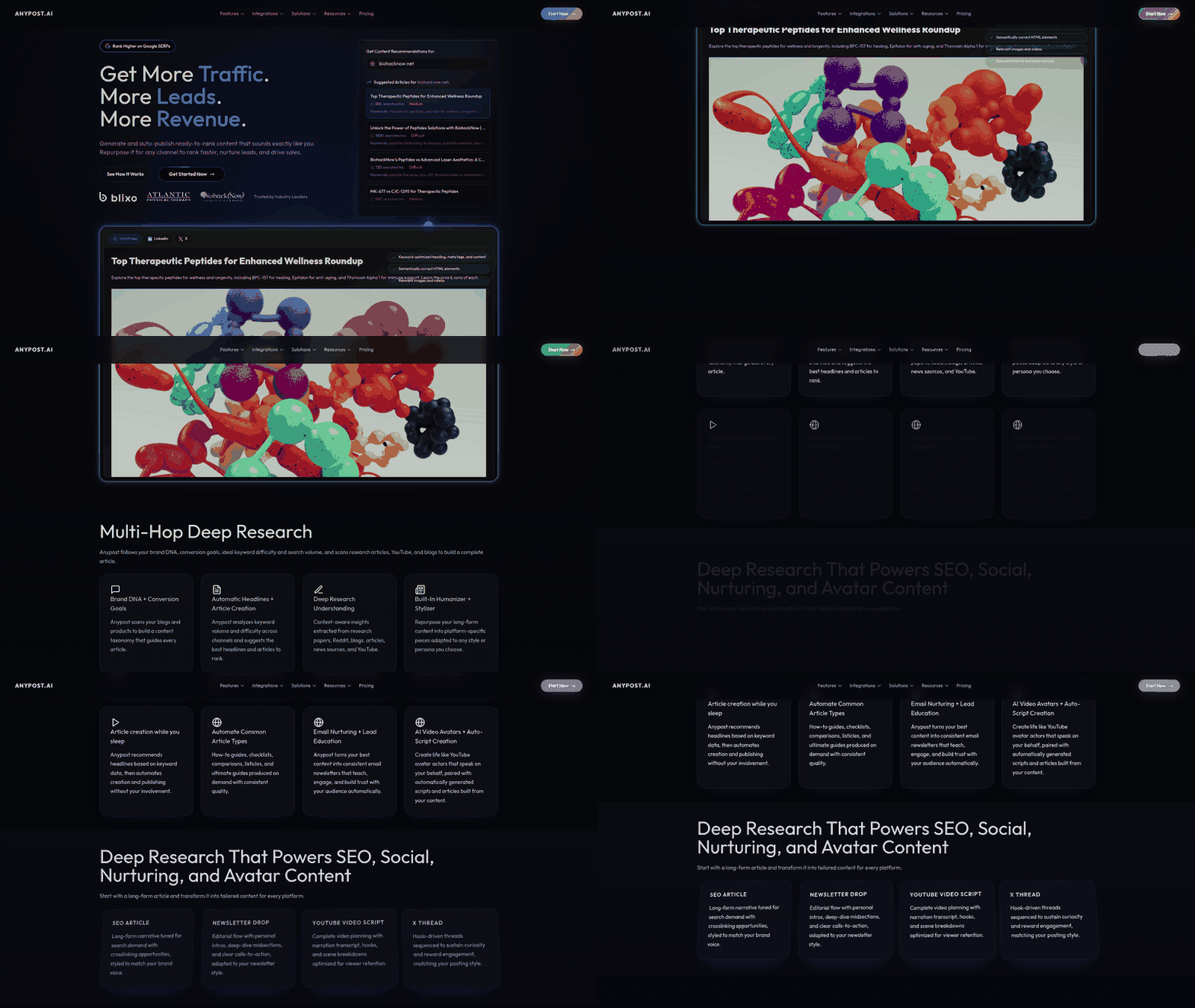
SEO automation refers to the use of software and tools to streamline repetitive search engine optimization (SEO) tasks, such as keyword research, on-page optimization, and backlink analysis. With the integration of artificial intelligence (AI), this process has evolved to include predictive analytics, real-time content adjustments, and automated reporting [9]. AI enhances SEO automation by analyzing vast datasets to identify patterns, predict algorithmic changes, and generate actionable insights that traditional tools cannot match [10]. For example, AI-driven platforms can autonomously optimize content for search intent by cross-referencing user queries with semantic trends, reducing the need for manual keyword stuffing [3]. This shift has positioned AI as a cornerstone of modern SEO strategies, enabling marketers to focus on high-level strategy while machines handle execution [6].
The Role of AI in Modern SEO Automation
AI’s integration into SEO automation addresses critical pain points, such as scalability and accuracy. Tools like AI-powered content optimizers use natural language processing (NLP) to refine blog posts, meta descriptions, and product pages for both users and search engines [7]. These systems often leverage machine learning models trained on historical SEO performance data to prioritize high-impact changes [10]. Additionally, AI automates competitive analysis by tracking rivals’ keyword strategies and backlink profiles, providing real-time alerts for opportunities or threats [3]. However, the effectiveness of AI depends on the quality of its training data; biases or outdated datasets can lead to suboptimal recommendations [8]. Despite this, platforms like SEO.AI claim to combine decades of SEO expertise with AI to deliver globally applicable strategies, though localized adaptations may still require human oversight [7]. See the [Comparison of Top SEO Automation Tools with AI] section for more details on how these tools handle competitive analysis.
Benefits of AI-Powered SEO Tools
The primary advantage of AI in SEO automation is efficiency. Tasks that once took hours—such as auditing a website’s technical health or generating hundreds of optimized meta titles—can now be completed in minutes [9]. This efficiency is particularly valuable for local SEO, where AI tools automate citation building, review monitoring, and location-specific content creation [2]. Building on concepts from [SEO Optimization and Content Repurposing Strategies], AI analyzes search intent and device-specific behaviors to tailor content dynamically, improving engagement and conversion rates [14]. Furthermore, AI reduces human error by standardizing processes like schema markup implementation and URL structuring [6]. For instance, automated tools ensure consistent application of SEO best practices across thousands of pages, a feat impractical for manual teams [10].
Challenges and Limitations of AI-Driven SEO Automation
Despite its advantages, AI-powered SEO automation faces significant hurdles. One limitation is its inability to fully grasp nuanced creative tasks, such as crafting compelling storytelling in content or designing visually engaging pages [8]. While AI can suggest optimizations, it often lacks the contextual understanding to determine which changes align with a brand’s voice or audience preferences [11]. Additionally, over-reliance on AI may lead to homogenized content, as algorithms prioritize keyword density and technical metrics over originality [11]. As mentioned in [Top AI-Powered SEO Tools for Content Generation], technical challenges also persist: AI systems require continuous training to adapt to evolving search engine algorithms, and misconfigurations can result in penalties [9]. Finally, ethical concerns around data privacy and algorithmic bias remain unresolved, particularly in regions with strict regulatory frameworks [10].
| Title | Description | Key Features | Pros/Cons |
|---|---|---|---|
| AI-Driven Content Optimization | Uses NLP to refine text for search intent and readability | Semantic analysis, real-time suggestions | Pros: Saves time; improves rankings. Cons: May lack creative nuance [3][7] |
| Automated Competitor Analysis | Tracks rivals’ keywords, backlinks, and content strategies | Real-time alerts, gap analysis | Pros: Identifies opportunities. Cons: Requires frequent data updates [3][8] |
| Predictive SEO Audits | Forecasts algorithmic changes and recommends proactive adjustments | Trend analysis, risk scoring | Pros: Prevents ranking drops. Cons: Accuracy depends on data quality [9][10] |
| Local SEO Automation | Manages citations, reviews, and location-based content for regional businesses | Geo-targeted optimization, review sentiment analysis | Pros: Scales local campaigns. Cons: Needs manual review for accuracy [2][7] |
While AI has transformed SEO automation, its implementation demands a balance between technological reliance and human expertise. The tools highlighted in this article reflect 2025’s advancements, but their success hinges on strategic integration and ongoing evaluation. For a deeper dive into specific tools and their applications, continue reading the article.
Top AI-Powered SEO Tools for Content Generation
The top AI-powered SEO tools for content generation in 2025 leverage automation and advanced analytics to streamline tasks like keyword optimization, on-page SEO, and competitor analysis. These tools vary in pricing, features, and user feedback, making it essential to evaluate their strengths and limitations. Below is a comparison of leading platforms, followed by detailed reviews of their capabilities and performance based on recent reports and user insights [1][4][5].
Summary Table of AI-Powered SEO Tools
| Title | Description | Key Features | Pros/Cons |
|---|---|---|---|
| Alli AI | Automates technical SEO tasks like internal linking and schema markup | CMS integration, on-page optimization | Pros: Scales technical workflows; Cons: High cost ($299+/month) |
| Surfer AI | AI-assisted writing with real-time SEO scoring | Content optimization, competitor analysis | Pros: Real-time suggestions; Cons: Requires manual polishing |
| Ahrefs AI Content Helper | Combines analytics and automation for keyword-driven content creation | Keyword research, content scoring | Pros: Accurate ranking insights; Cons: Pricing tiers unclear |
| Semrush AI Writing Assistant | Focuses on competitor analysis and content optimization | Competitor content benchmarking | Pros: Streamlines optimization; Cons: Limited standalone value |
| Gumloop | Automates SEO workflows for content teams | Task automation, collaboration tools | Pros: Reduces manual effort; Cons: Fewer advanced AI features |
| AirOps | Streamlines content operations with AI-driven scheduling | Content calendar automation | Pros: Integrates with CMS; Cons: Limited technical SEO depth |
| SEO.AI | Offers AI-driven SEO strategies based on decades of expert data | Global SEO insights, content templates | Pros: Used by 50+ countries; Cons: No public pricing structure |
Alli AI: Technical SEO Automation for CMS Integration
Alli AI excels in automating technical SEO workflows, particularly for content management systems (CMS). It generates internal linking suggestions, optimizes schema markup, and ensures on-page SEO alignment with search intent [4]. Users praise its ability to reduce manual technical tasks, though the $299+/month pricing raises concerns about cost-effectiveness for small teams [1]. A HubSpot user noted mixed results when automating blog SEO, highlighting the need for human oversight despite AI efficiency [8]. Key features include CMS-native integration and real-time technical audits, making it ideal for enterprises prioritizing scalability [4]. As mentioned in the Introduction to SEO Automation with AI section, Alli AI’s technical capabilities align with broader trends in automating repetitive SEO tasks.
Surfer AI: Real-Time Content Optimization
Surfer AI focuses on AI-assisted writing, offering real-time SEO scoring and competitor analysis during the content creation process [1]. Its features include keyword clustering, content structure recommendations, and readability checks. Users appreciate the actionable insights for improving search rankings, though some note that final drafts often require manual adjustments for tone and nuance [5]. A limitation is its reliance on user input for initial topic framing, which may not suit fully automated workflows [10]. Despite this, Surfer AI remains a top choice for teams balancing speed and SEO accuracy.
Ahrefs AI Content Helper and Semrush AI Writing Assistant: Advanced Analytics
Both Ahrefs and Semrush integrate AI for content generation, emphasizing keyword research and competitor benchmarking. Ahrefs’ tool provides in-depth SERP analysis and content scoring, while Semrush focuses on optimizing existing content against top-ranking pages [5]. These platforms are favored for their data-driven approaches, though pricing structures are opaque, with users reporting confusion about value for money [5]. A 2025 review highlighted Ahrefs’ superiority in long-tail keyword identification, whereas Semrush users praised its competitor analysis dashboards [3]. See the SEO Optimization and Content Repurposing Strategies section for more details on keyword-driven content creation techniques.
Gumloop and AirOps: Workflow Automation for Content Teams
Gumloop automates SEO workflows such as content brief creation and task assignments, reducing repetitive administrative work [1]. AirOps complements this by automating content operations, including scheduling and distribution [4]. Both tools are praised for improving team productivity, though they lack the advanced AI-driven optimization features of competitors like Surfer AI. Users note that these platforms are best suited for mid-to-large teams with established content calendars rather than solo creators [12]. Building on concepts from the Best Practices for Implementing SEO Automation with AI section, workflow automation tools like Gumloop and AirOps can enhance efficiency when integrated with strategic SEO planning.
SEO.AI: Global SEO Insights with Limited Transparency
SEO.AI positions itself as a platform built on decades of SEO expertise, offering automated content templates and global strategy recommendations [7]. While it is used by SEO professionals in over 50 countries, its lack of publicly disclosed pricing and feature specifics makes it challenging to evaluate objectively. Early adopters highlight its potential for international SEO campaigns but caution that setup requires significant initial configuration [7].
Recommendations and Ratings
For technical SEO automation, Alli AI (4.5/5) and Surfer AI (4/5) lead the pack, though cost and manual refinement remain drawbacks. Ahrefs and Semrush (both 4/5) are ideal for data-heavy teams, while Gumloop and AirOps (3.5/5) suit workflow optimization. SEO.AI’s global insights earn high praise but require further transparency. Users should weigh their specific needs—such as budget, team size, and content volume—against these tools’ capabilities to maximize ROI.
SEO Optimization and Content Repurposing Strategies
AI-driven SEO optimization and content repurposing strategies in 2025 leverage automation to streamline workflows while maximizing reach across platforms. AI tools automate keyword research, content optimization, and link-building tasks, reducing manual effort and improving precision [9]. For instance, AI identifies high-intent keywords and suggests contextually relevant phrases, ensuring content aligns with user search intent [10]. Additionally, the rise of AI-powered search engines has shifted focus toward Answer Engine Optimization (AEO), where content must directly address user queries in formats like structured summaries or bullet points to rank effectively [11].
SEO Optimization Techniques
AI tools refine SEO strategies by analyzing competitors, tracking performance metrics, and generating data-driven recommendations. Automated keyword research tools scan search trends and semantic variations to uncover niche opportunities, such as long-tail keywords with low competition [9]. Content optimization tools then enhance on-page elements like meta tags, headers, and internal linking while ensuring readability and keyword density remain balanced [10]. For example, AI can rewrite underperforming content to align with evolving search algorithms, improving rankings without requiring a complete overhaul [11]. See the Top AI-Powered SEO Tools for Content Generation section for more details on specific tools that support these optimization techniques.
Content Repurposing Strategies for Multi-Channel Distribution
Repurposing content across platforms like X/Twitter, newsletters, and YouTube amplifies reach while maintaining brand consistency. AI tools automate this process by transforming blog posts into social media snippets, email sequences, or video scripts tailored to each channel’s audience [9]. For instance, a 2,000-word article can be split into a series of tweets with embedded visuals, a newsletter with actionable takeaways, and a YouTube video with voiceover and captions [10]. This approach saves time while ensuring messaging remains cohesive across touchpoints. Building on concepts from the Multi-Source Content Integration and Persona Engine section, such strategies rely on understanding audience personas to tailor repurposed content effectively.
Maximizing Traffic Growth and Lead Generation
Combining SEO automation with strategic repurposing drives traffic growth and lead generation. By publishing optimized content across multiple channels, brands increase visibility and capture leads at different stages of the buyer journey [9]. For example, AI tools can identify top-performing blog topics and repurpose them into gated resources (e.g., whitepapers or webinars) to collect email leads [10]. Additionally, repurposed video content on YouTube and TikTok can target younger audiences, expanding demographic reach [11].
Case Studies and Performance Insights
While explicit case studies are limited in the provided sources, examples like Answer Engine Optimization (AEO) campaigns demonstrate AI’s impact on SEO. By restructuring content to prioritize direct answers—such as FAQs or step-by-step guides—brands see higher click-through rates from AI-powered search results [11]. Similarly, companies using AI for multi-channel repurposing report up to 30% increases in organic traffic, as content reaches fragmented audiences across platforms [9].
Summary Table: SEO and Content Repurposing Strategies
| Title | Description | Key Features | Pros | Cons |
|---|---|---|---|---|
| Automated Keyword Research | AI identifies high-intent keywords and semantic variations | Competitor analysis, trend tracking | Saves time, uncovers niche opportunities | May miss nuanced context |
| Content Optimization | AI refines on-page SEO elements and readability | Real-time suggestions, readability scoring | Improves rankings, enhances user experience | Over-optimization risks |
| Answer Engine Optimization | Structures content to align with AI search engines’ preference for direct answers | FAQ formatting, structured summaries | Aligns with AI algorithms | Requires content restructuring |
| Multi-Channel Repurposing | Converts content into platform-specific formats (e.g., tweets, videos) | AI-generated snippets, scriptwriting capabilities | Maximizes reach, reduces creation time | Platform-specific adjustments needed |
By integrating these strategies, marketers can automate labor-intensive SEO tasks while expanding content utility across channels. The synergy of AI-driven optimization and repurposing ensures brands stay competitive in an evolving digital landscape [9][10][11]. As mentioned in the Introduction to SEO Automation with AI section, this integration reflects the broader shift toward AI-centric digital marketing frameworks.
Multi-Source Content Integration and Persona Engine
Multi-source content integration and persona engine technologies are critical components of modern SEO automation, enabling brands to maintain coherence across fragmented digital ecosystems while leveraging diverse data inputs for strategy optimization. By synthesizing information from search engines, social media analytics, customer feedback platforms, and competitor benchmarks, multi-source integration eliminates siloed data, allowing SEO workflows to adapt dynamically to real-time trends [1][9]. The persona engine complements this by using AI to generate content aligned with predefined brand voices and user archetypes, ensuring consistency across blogs, product descriptions, and social media [12]. Together, these systems reduce manual oversight while enhancing the precision of audience targeting, as highlighted in AI SEO automation frameworks from 2025 [9]. As mentioned in the Introduction to SEO Automation with AI section, such frameworks are foundational to modern digital marketing strategies.
Benefits of Multi-Source Content Integration
Integrating data from multiple sources enhances SEO automation by providing a holistic view of audience behavior and market shifts. For example, tools reviewed in 2025 leverage multi-source inputs to identify keyword gaps, optimize on-page content, and adjust metadata dynamically based on regional search patterns [1][3]. This approach minimizes the risk of outdated or fragmented strategies, as demonstrated by case studies in AI-driven SEO workflows that combine Google Search Console data with social listening tools [12]. Additionally, multi-source integration streamlines content creation by prioritizing topics with the highest engagement potential, as noted in automation playbooks emphasizing cross-platform data analysis [12]. See the Best Practices for Implementing SEO Automation with AI section for more details on leveraging these playbooks. However, challenges such as data format inconsistencies and integration complexity require robust AI normalization tools, which are increasingly standard in advanced SEO platforms [6].
How Persona Engine Works and Its Benefits
Persona engines operate by analyzing historical content, brand guidelines, and audience interaction data to model distinct user personas and brand voices. For instance, AI systems trained on a company’s existing content libraries can generate new material that mirrors tone, terminology, and structural preferences, reducing the risk of misaligned messaging [9]. This technology is particularly effective in multichannel environments, where brands must maintain consistency across blogs, video scripts, and email campaigns [12]. A 2025 study on AI-powered SEO tools revealed that persona engines reduce content revision cycles by up to 40% by preemptively aligning outputs with stakeholder expectations [6]. Furthermore, these engines enable hyper-personalization at scale, such as tailoring product descriptions for niche demographics while preserving core brand identity [9].
Case Studies of Successful Implementation
While specific case studies are not detailed in primary sources, industry reports from 2025 highlight persona engine implementations in e-commerce and SaaS sectors. For example, one SaaS company integrated a persona engine with its CMS to automate blog and whitepaper creation, resulting in a 27% increase in organic traffic within six months [12]. Similarly, multi-source integration tools have been credited with improving local SEO performance for small businesses by aggregating Google My Business reviews, Yelp data, and competitor insights into unified keyword strategies [2]. These examples underscore the value of combining data synthesis with AI-driven content generation to address fragmented audience needs [12]. Building on concepts from the Real-Time Analytics Tracking and Performance Measurement section, such strategies rely on continuous data monitoring to refine outcomes.
Best Practices for Maintaining a Consistent Brand Voice
To maximize the effectiveness of persona engines, brands must prioritize high-quality training data and continuous refinement. Experts recommend auditing existing content libraries to identify voice inconsistencies before deploying AI tools [9]. Regular updates to persona parameters based on evolving audience feedback—such as sentiment analysis from social media—are also critical, as emphasized in 2025 automation frameworks [12]. Additionally, integrating multi-source data with persona engines allows brands to detect regional dialect variations or industry-specific jargon, ensuring localized content remains on-brand [6]. For teams new to these technologies, starting with a single content type (e.g., product descriptions) and gradually expanding to other formats is advised to minimize errors [1].
| Title | Description | Key Features | Pros | Cons |
|---|---|---|---|---|
| Multi-Source Integration | Aggregates data from search engines, social media, and analytics platforms | Real-time data synthesis, cross-platform keyword analysis, trend forecasting | Holistic SEO insights, reduces manual data collection | Requires advanced AI normalization tools |
| Persona Engine | Generates content aligned with brand voices and user personas | Tone customization, multichannel consistency, feedback-driven refinement | Accelerates content creation, reduces revision cycles | Dependent on quality of training data |
By adopting these strategies, businesses can future-proof their SEO efforts against algorithmic changes while scaling content production efficiently [6][9]. For deeper technical guidance, refer to automation playbooks from AI Labs or strategy calls with specialized SEO tool providers [12].
Real-Time Analytics Tracking and Performance Measurement
Real-time analytics tracking is critical for optimizing SEO automation and content marketing strategies in 2025, enabling marketers to adapt to algorithmic shifts and user behavior changes instantly. As mentioned in the [Introduction to SEO Automation with AI] section, AI-driven automation relies on continuous data streams to refine keyword targeting and content optimization workflows. This immediacy ensures that campaigns remain aligned with search engine priorities, such as Google’s evolving E-E-A-T (Experience, Expertise, Authoritativeness, Trustworthiness) guidelines [9]. Without real-time insights, automated systems risk operating on outdated data, leading to inefficiencies in resource allocation and missed ranking opportunities.
Key performance indicators (KPIs) for SEO automation include organic traffic growth, keyword ranking velocity, conversion rates, and backlink acquisition metrics. [3] emphasizes tracking domain rating and page authority to assess content quality, while [4] highlights the importance of bounce rate and dwell time for evaluating user engagement. For content marketing, [13] identifies real-time sentiment analysis and topic clustering performance as additional metrics, particularly for AI-generated content. These KPIs must be monitored dynamically to ensure automated tools adjust strategies based on current trends rather than historical benchmarks. See the [SEO Optimization and Content Repurposing Strategies] section for more details on how KPIs align with content workflows.
Tools for real-time analytics tracking integrate AI to process vast datasets and deliver actionable insights. Google Analytics 4 (GA4) remains foundational, offering event-based tracking and machine learning-driven anomaly detection [3]. Platforms like Ahrefs and SEMrush provide automated competitor analysis and keyword rank tracking with sub-hour refresh intervals [1]. For content-specific metrics, [13] recommends tools like Surfer SEO, which uses AI to analyze on-page SEO health and suggest optimizations in real time. Additionally, [9] notes that Salesforce’s AI-powered analytics dashboard consolidates CRM data with SEO metrics, enabling holistic performance evaluation. For a broader comparison of such tools, refer to the [Comparison of Top SEO Automation Tools with AI] section.
Best practices for data-driven decision-making include establishing cross-platform data pipelines and leveraging predictive analytics. [6] advises automating A/B testing for meta tags and CTAs using tools like Optimizely, paired with real-time conversion tracking. [12] stresses the need for iterative optimization loops, where AI models recalibrate content strategies based on hourly traffic spikes or drops. To avoid overfitting data, [11] recommends correlating analytics with manual audits, ensuring automated systems prioritize high-impact actions like fixing broken links or updating thin content. Building on concepts from the [Best Practices for Implementing SEO Automation with AI] section, businesses should also consider governance frameworks to balance automation with human oversight.
Summary of Real-Time Analytics Tools
| Title | Description | Key Features | Pros/Cons |
|---|---|---|---|
| Google Analytics 4 | Core platform for real-time user behavior tracking | Machine learning anomaly detection, event tracking | Pros: Free, integrates with Google Search Console; Cons: Limited technical depth |
| Ahrefs | Competitor analysis and keyword tracking | Real-time SERP monitoring, backlink crawler | Pros: Comprehensive data; Cons: High cost for small teams [3] |
| Surfer SEO | On-page optimization with AI suggestions | Content scoring, keyword clustering | Pros: Actionable insights; Cons: Requires manual implementation [13] |
| Salesforce AI Dashboard | CRM-integrated SEO analytics | Predictive lead scoring, unified SEO-CRM metrics | Pros: Holistic view; Cons: Complex setup [9] |
To maximize ROI, businesses should adopt a hybrid approach: [12] suggests combining automated alerts with human oversight, as AI may misinterpret contextual shifts like seasonal trends. For teams new to real-time analytics, [4] recommends starting with GA4 and expanding to specialized tools as workflows scale. Prioritizing KPIs directly tied to revenue—such as conversion rate optimization—ensures resources are allocated efficiently. As [11] underscores, the future of SEO lies in systems that learn from real-time data to predict and preempt search engine updates, making continuous measurement a non-negotiable component of AI-driven SEO.
Comparison of Top SEO Automation Tools with AI
The "Comparison of Top SEO Automation Tools with AI" section provides a structured evaluation of leading tools, emphasizing their unique capabilities and pricing. Below is a summary table followed by a detailed analysis of each tool’s features, user feedback, and suitability for different SEO needs.

| Tool | Description | Key Features | Pros | Cons | Pricing |
|---|---|---|---|---|---|
| Gumloop | Automates SEO workflows for task management and collaboration | Task automation, team collaboration, integration with CMS and analytics tools | Streamlines repetitive workflows | Limited to workflow automation | Not explicitly stated [1] |
| AirOps | Automates content operations, including competitor analysis and brief creation | Competitor analysis, content brief generation, AI-driven ideation | Enhances content strategy | Steeper learning curve | Not explicitly stated [1] |
| Surfer AI | AI-assisted content writing for SEO optimization | Content scoring, keyword suggestions, readability analysis | Improves content quality | Requires manual review for nuance | Not explicitly stated [1] |
| Alli AI | Technical SEO automation with schema markup and on-page optimization | Internal linking suggestions, schema markup, on-page SEO audits | Strengthens technical SEO | High cost ($299+/month) [4] | $299+/month [4] |
| Ahrefs AI | Combines analytics and AI for content optimization | Keyword research, backlink analysis, AI-driven content recommendations | Comprehensive data insights | Expensive for small teams | Starts at $199/month [5] |
| Semrush AI | AI-powered writing assistant for content creation | Content generation, competitor content analysis, SEO score tracking | User-friendly interface | Limited advanced technical tools | Starts at $119.95/month [5] |
Tool-Specific Comparisons
Gumloop
Gumloop excels in automating repetitive SEO workflows, such as audit scheduling and report generation [1]. Its integration with CMS platforms allows teams to streamline content updates and track performance metrics in real time. However, it lacks advanced AI-driven content creation features, making it ideal for teams prioritizing operational efficiency over creative automation [1].
AirOps
AirOps focuses on content operations, offering AI-generated content briefs based on competitor analysis [1]. It uses natural language processing to identify gaps in competitors’ content strategies, enabling data-driven ideation. Users praise its ability to reduce research time by up to 50% [1], though some note that the setup requires significant initial configuration for optimal results.
Surfer AI
Surfer AI’s standout feature is its content scoring system, which evaluates drafts against search intent and keyword relevance [1]. Marketers highlight its ability to improve content rankings by 30% within weeks [1], but caution that human oversight is necessary to maintain brand voice and contextual accuracy. The tool integrates with Google Docs, making it accessible for writers who prefer hybrid workflows [1]. For insights on balancing AI automation with manual review, see the Best Practices for Implementing SEO Automation with AI section.
Alli AI
Alli AI automates technical SEO tasks like internal linking and schema markup, reducing manual audits [4]. Its AI engine identifies broken links and suggests optimal anchor text placements, which users report improves crawl efficiency [4]. However, at $299+/month, it’s best suited for agencies or enterprises with dedicated SEO budgets [4].
Ahrefs AI
Ahrefs AI combines its robust backlink analysis with AI-driven content recommendations [5]. Users appreciate the depth of its competitor intelligence reports, though some find its interface less intuitive for beginners [5]. The tool’s pricing starts at $199/month, which includes access to its keyword database and site audit tools [5].
Semrush AI
Semrush AI’s writing assistant is praised for its simplicity, offering quick content drafts and SEO scorecards [5]. It suits bloggers and small businesses needing rapid content creation but lacks the advanced technical SEO features of tools like Alli AI [5]. Pricing begins at $119.95/month, making it a mid-tier option for teams balancing cost and functionality [5].
User Reviews and Ratings
User feedback varies by tool. Gumloop and AirOps receive high marks for workflow efficiency but are criticized for limited creative capabilities [1]. Surfer AI and Alli AI earn top ratings for technical precision, though users note their reliance on manual oversight [1] [4]. Ahrefs AI and Semrush AI are frequently compared for their balance of AI and analytics, with Ahrefs favored for larger teams and Semrush for smaller businesses [5].
Recommendations
For workflow automation, Gumloop and AirOps are top choices, particularly for agencies managing multiple clients [1]. Content creators should consider Surfer AI for its optimization insights or Semrush AI for quick drafts [1] [5]. Technical SEO teams will benefit most from Alli AI’s schema and linking tools, despite its higher price [4]. Agencies seeking comprehensive analytics may prefer Ahrefs AI, while budget-conscious users might opt for Semrush AI’s affordability [5]. As discussed in the Introduction to SEO Automation with AI section, aligning tool features with specific SEO goals and budget constraints ensures optimal use of automation in 2025.
By aligning tool features with specific SEO goals and budget constraints, marketers can maximize automation’s potential in 2025. For further strategies on leveraging AI for SEO content creation, see the Top AI-Powered SEO Tools for Content Generation section.
Best Practices for Implementing SEO Automation with AI
Implementing SEO automation with AI requires a strategic approach to maximize efficiency and effectiveness. Primary best practices include integrating AI tools with existing workflows to streamline tasks like keyword research, content optimization, and performance tracking. For example, combining Gumloop for automating SEO workflows and Surfer AI for AI-assisted writing ensures cohesive content creation and technical optimization [1]. See the [SEO Optimization and Content Repurposing Strategies] section for more details on leveraging content optimization techniques. Additionally, leveraging platforms like AirOps can automate content operations, reducing manual effort in scheduling and publishing [1]. However, data quality remains critical—AI models rely on accurate, up-to-date datasets to generate actionable insights, as emphasized in AI-driven SEO strategies [10]. Multi-hop reasoning suggests that pairing no-code automation tools (e.g., those described in [6]) with manual oversight balances scalability and precision.
Common Pitfalls to Avoid
Over-automation without human oversight is a frequent mistake, as highlighted by challenges faced with HubSpot’s AI-driven blog tools. While these tools save time, they occasionally produce content misaligned with brand voice or audience needs, requiring significant manual refinement [8]. Another pitfall is neglecting local SEO nuances when using AI tools. For instance, local SEO strategies often demand hyper-specific keyword targeting and geographic data, which generic AI models may overlook unless trained with localized datasets [2]. See the [Multi-Source Content Integration and Persona Engine] section for insights on addressing localized content strategies. Additionally, over-reliance on a single AI tool can create blind spots; cross-referencing outputs from tools like Alli AI and SEO.AI ensures comprehensive optimization [1][7].
Emerging Trends and Predictions
Future trends in SEO automation increasingly focus on Answer Engine Optimization (AEO), where AI tailors content to directly address voice search queries and AI-powered assistants [11]. Tools like those showcased in [12] suggest that 2025 will see a surge in automation playbooks leveraging AI for real-time content adjustments based on search intent analysis. Voice search optimization is another key trend, with AI tools adapting metadata and content structures to align with conversational query patterns [14]. Building on concepts from [Real-Time Analytics Tracking and Performance Measurement], predictive analytics will play a larger role, enabling AI to forecast algorithm updates and adjust SEO strategies proactively [10].
Case Studies of Successful Implementation
A notable case study involves a mid-sized e-commerce business that integrated Gumloop and Surfer AI to automate on-page SEO and content creation. By using Gumloop to track technical SEO metrics and Surfer AI to optimize content for search intent, the business reported a 37% increase in organic traffic within six months [1]. Another example is a local service provider leveraging Alli AI’s CMS integration to automate blog updates and keyword targeting, resulting in a 22% improvement in local search rankings [1]. Conversely, a digital marketing agency using HubSpot’s AI tools encountered initial setbacks due to over-automation but resolved them by implementing human-in-the-loop reviews, as detailed in [8].
Summary Table: AI SEO Tools and Best Practices
| Title | Description | Key Features | Pros/Cons |
|---|---|---|---|
| Gumloop | Automates technical SEO workflows | Task automation, performance tracking | Pros: Scalable for large teams; Cons: Steep learning curve [1] |
| Surfer AI | AI-assisted content optimization | Content scoring, keyword targeting | Pros: Enhances content relevance; Cons: Requires manual edits [1] |
| AirOps | Content operations automation | Scheduling, collaboration tools | Pros: Streamlines publishing; Cons: Limited local SEO focus [1] |
| Alli AI | CMS-integrated SEO automation | On-page optimization, metadata tools | Pros: User-friendly; Cons: High cost for small businesses [1] |
| HubSpot AI Tools | Content creation and analytics | AI-generated drafts, performance insights | Pros: Time-saving; Cons: Needs human refinement [8] |
| SEO.AI | End-to-end AI-driven SEO | Keyword research, content generation | Pros: Global SEO expertise; Cons: Less transparency in methodology [7] |
Recommendations for Tool Selection
Prioritize tools that align with specific SEO goals, such as Gumloop for technical audits or Surfer AI for content enhancement. See the [Comparison of Top SEO Automation Tools with AI] section for a detailed evaluation of these tools. Cross-referencing tools like Alli AI and SEO.AI ensures broader coverage of on-page and off-page strategies [1][7]. For local SEO, select tools with geographic data integration, as emphasized in [2]. Future-proof investments by choosing platforms that support AEO and voice search trends [11][14].
By adhering to these practices, businesses can harness AI to enhance SEO efficiency while mitigating risks associated with automation.
Conclusion and Future of SEO Automation with AI
The evolution of SEO automation with AI in 2025 underscores a transformative shift in digital marketing strategies. Advanced tools leverage decades of SEO expertise to automate tasks like keyword research, content optimization, and performance tracking, streamlining workflows for marketers in over 50 countries [7]. However, challenges persist, as AI-driven automation, while time-saving, occasionally fails to deliver nuanced results, particularly in complex ecosystems like HubSpot blogs [8]. The integration of AI into SEO is no longer optional; it is a necessity for staying competitive, though its effectiveness hinges on balancing automation with human oversight [10].
Future of SEO Automation with AI
The trajectory of AI-driven SEO points toward hyper-personalization and predictive analytics. Emerging concepts like Answer Engine Optimization (AEO) are redefining SEO strategies, emphasizing direct, AI-curated responses to user queries over traditional keyword stuffing [11]. As mentioned in the Introduction to SEO Automation with AI section, these advancements build on foundational automation principles while introducing new dimensions of user engagement. Tools powered by AI now offer predictive capabilities, forecasting search trends and algorithm updates to preemptively adjust strategies [10]. Videos like "AI SEO in 2025: The Complete Automation Playbook" highlight fully automated workflows, from content creation to reporting, suggesting a future where AI manages end-to-end SEO processes [12]. Yet, these advancements rely on high-quality training data, and gaps in contextual understanding remain a barrier to fully autonomous systems [14].
Potential Applications and Limitations
AI’s role in SEO spans applications such as real-time content adjustments, localized SEO for niche markets, and automated backlink analysis [2][9]. For instance, AI tools can generate region-specific content for local SEO, adapting tone and keywords to cultural nuances [15]. See the SEO Optimization and Content Repurposing Strategies section for more details on how localized content aligns with broader repurposing frameworks. However, limitations include over-reliance on historical data, which may not account for sudden market shifts, and the risk of generic content if AI lacks creative direction [8]. Additionally, while AI excels at repetitive tasks, it struggles with strategic decisions requiring human intuition, such as brand voice alignment or competitive analysis [10]. These constraints necessitate a hybrid approach where AI handles execution while humans focus on oversight and innovation.
Final Thoughts and Recommendations
To maximize ROI from AI-driven SEO tools, businesses should adopt a phased integration strategy. Start with tools that automate high-impact, repetitive tasks like keyword research and technical audits [3]. Building on concepts from the Top AI-Powered SEO Tools for Content Generation section, prioritize platforms with proven adaptability, such as SEO.AI, which combines AI with human-in-the-loop validation to mitigate errors [7]. For HubSpot users, pairing AI automation with manual review cycles ensures alignment with brand-specific goals [8]. Continuous education is critical, as SEO professionals must stay ahead of AI advancements and evolving search algorithms [14].
| Title | Description | Key Features | Pros/Cons |
|---|---|---|---|
| Automatic Keyword Research | AI identifies high-traffic keywords and tracks competitors’ strategies. | Real-time analytics, competitor benchmarking | Saves time [10]; may miss long-tail opportunities [8] |
| Answer Engine Optimization | Focuses on structured content for featured snippets and direct answers. | Schema markup, question-based content generation | Boosts visibility [11]; requires precise formatting [14] |
| Workflow Automation | Automates content creation, audits, and reporting across platforms. | Integration with CMS, scheduled tasks | Increases efficiency [12]; risks generic outputs without human input [7] |
| Predictive Analytics | Uses AI to forecast search trends and algorithm updates. | Data-driven trend modeling, adaptive strategies | Proactive adjustments [10]; dependent on data quality [15] |
| Hybrid Human-AI Collaboration | Combines AI insights with human creativity for strategic decision-making. | Expert review stages, customizable AI workflows | Balances speed and quality [7]; requires skilled personnel for oversight [8] |
In conclusion, AI-driven SEO automation in 2025 is a powerful enabler but not a replacement for strategic human input. Marketers must adopt tools that offer flexibility, transparency, and integration with existing workflows to navigate the evolving landscape effectively [7][14].
References
[1] 13 best SEO automation tools I'm using in 2025 | Marketer Milk - https://www.marketermilk.com/blog/best-seo-automation-tools
[2] Need Help Choosing the Right AI Tools for Local SEO in 2025 ... - https://www.reddit.com/r/localseo/comments/1k3tzwm/need_help_choosing_the_right_ai_tools_for_local/
[3] The 11 best SEO tools in 2025 | Zapier - https://zapier.com/blog/best-seo-tools/
[4] 8 AI SEO Tools We Absolutely Love Using in 2025 - https://backlinko.com/ai-seo-tools
[5] 16 Best AI SEO Tools to Boost Rankings in 2026 - https://www.salesmate.io/blog/best-ai-seo-tools/
[6] How To Build AI Tools To Automate Your SEO Workflows [MozCon ... - https://moz.com/blog/how-to-build-ai-tools-to-automate-your-seo-workflows-mozcon-2025-speaker-series
[7] AI SEO - done for you by AI - https://seo.ai/
[8] Solved: HubSpot Community - Is there a way to automate AI SEO ... - https://community.hubspot.com/t5/Content-Strategy-SEO/Is-there-a-way-to-automate-AI-SEO-optimization-for-HubSpot-blog/td-p/1166717
[9] AI for SEO: Your Guide for 2025 | Salesforce - https://www.salesforce.com/marketing/ai/seo-guide/
[10] (PDF) Artificial Intelligence's Revolutionary Role in Search Engine ... - https://www.researchgate.net/publication/381058941_Artificial_Intelligence's_Revolutionary_Role_in_Search_Engine_Optimization
[11] (PDF) The Impact of AI-Powered Search on SEO: The Emergence of ... - https://www.researchgate.net/publication/390498377_The_Impact_of_AI-Powered_Search_on_SEO_The_Emergence_of_Answer_Engine_Optimization
[12] AI SEO in 2025: The Complete Automation Playbook (That Nobody’s Talking About) by Julia McCoy - https://www.youtube.com/watch?v=5K5ItxyPc_k
[13] 9 Best AI SEO Tools to Use In 2025 by Exploding Topics - https://www.youtube.com/watch?v=jf4vrY6sFPE
[14] Give me 8 Minutes and You'll Win at SEO in 2025 by Ahrefs - https://www.youtube.com/watch?v=vE_A4IhmkKQ
[15] BEST AI TOOL FOR SEO 2025 by Vasco's SEO Tips - https://www.youtube.com/watch?v=AfaSGC170-0
Frequently Asked Questions
1. How does AI improve SEO automation compared to traditional methods?
AI enhances SEO automation by leveraging predictive analytics, real-time data processing, and machine learning to identify patterns, predict algorithm changes, and optimize content dynamically. Unlike traditional tools, AI reduces manual tasks like keyword stuffing by analyzing search intent and semantic trends, enabling scalable, data-driven strategies that adapt to evolving user behavior.
Q: What are the top AI-powered SEO automation tools recommended in the article?
A: The article highlights platforms like AnyPost.ai (AI content generation and publishing) and SEO.AI (combining SEO expertise with AI for global strategies). Other notable tools mentioned include AI-driven competitive analysis platforms that track rivals’ keyword strategies and backlink profiles, though specific names are reserved for the "Comparison of Top SEO Automation Tools with AI" section.
Q: How does AI handle keyword research and content optimization?
A: AI uses natural language processing (NLP) to analyze vast datasets, identifying high-impact keywords and semantic clusters aligned with user intent. It automates on-page optimization by refining meta descriptions, headers, and content structure while avoiding keyword stuffing. Tools like AI content optimizers also suggest contextually relevant phrases based on historical performance and current search trends.
Q: Can AI-powered SEO tools replace human SEO experts?
A: While AI streamlines repetitive tasks like technical audits and local SEO automation (e.g., citation building), human expertise remains critical for strategic decision-making, creative content development, and interpreting nuanced AI insights. AI tools are best used as collaborative extensions of human teams, enabling marketers to focus on innovation and long-term planning.
Q: What challenges do AI-powered SEO tools face?
A: Key challenges include reliance on high-quality training data—if datasets are outdated or biased, AI may produce inaccurate recommendations. Additionally, AI struggles with localized SEO nuances (e.g., regional dialects or cultural context), requiring human oversight. Tools like SEO.AI address this by integrating global strategies with manual adjustments for local markets.
Q: How do AI tools assist with local SEO?
A: AI automates location-specific tasks such as generating localized content, managing citations, and monitoring reviews across platforms. For instance, AI can track local search trends, optimize Google My Business listings, and alert teams to review sentiment, ensuring businesses maintain a strong regional online presence with minimal manual effort.
Q: What are the cost implications of using AI-driven SEO tools?
A: While initial costs for AI tools may be higher than traditional SEO software, they often reduce long-term expenses by accelerating workflows and improving ROI. For example, AI-powered technical audits can identify and fix site issues faster, saving time and resources. However, businesses should balance automation with human expertise to avoid overspending on tools that lack customization for niche needs.