
Maximize Your SEO Efforts: Anypost.ai vs Nytro SEO Automated Software

Introduction to Anypost.ai and Nytro SEO
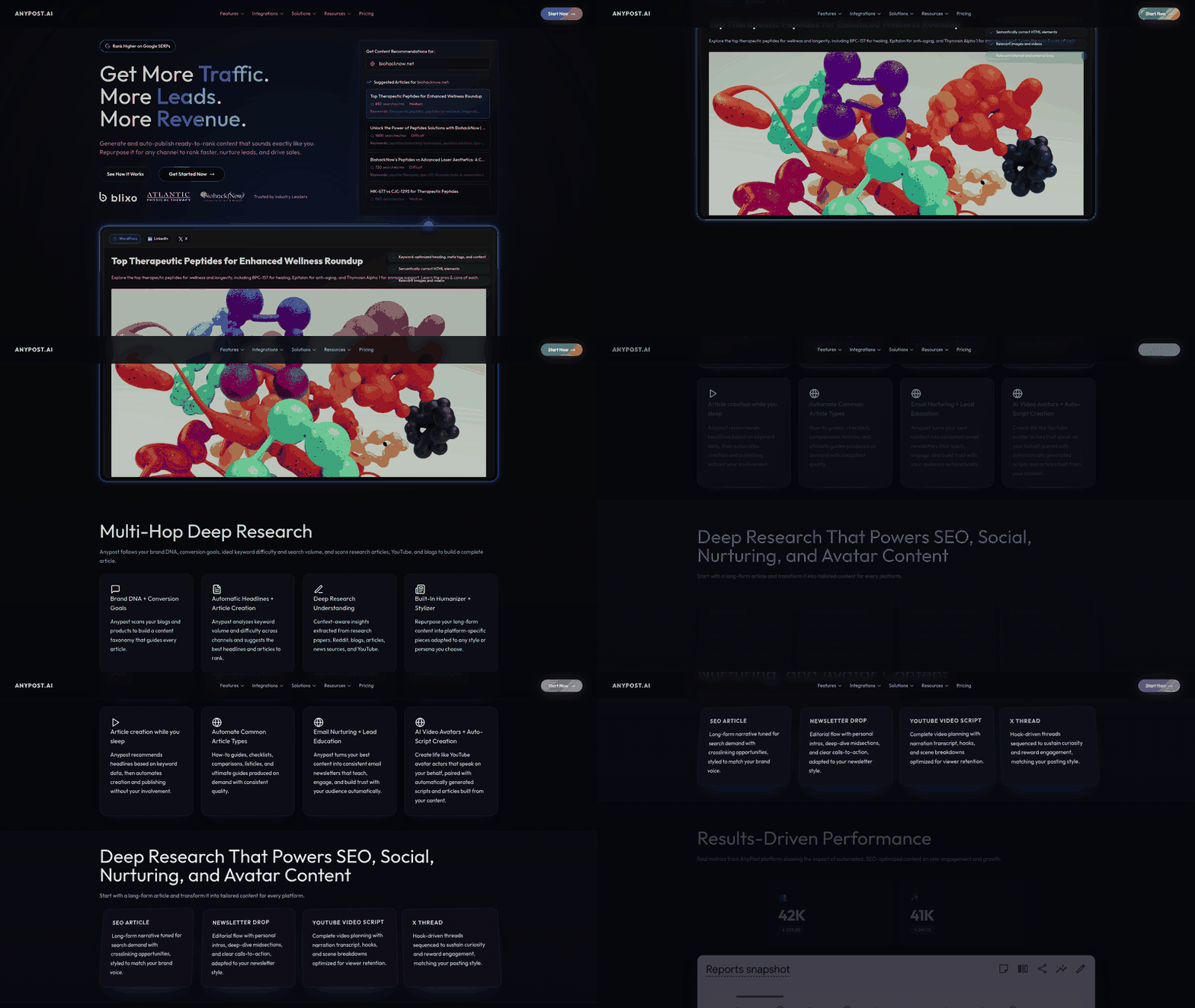
In the evolving landscape of digital marketing, tools like Anypost.ai and Nytro SEO have emerged as solutions to streamline SEO and content creation processes. Both platforms aim to address the growing demand for efficient, scalable strategies to improve search engine rankings and audience engagement. Anypost.ai positions itself as an AI-driven content generation tool, leveraging automation to produce blog posts, social media content, and other marketing materials. Nytro SEO, meanwhile, emphasizes SEO optimization with features such as keyword research, competitor analysis, and on-page optimization. While both platforms target businesses and marketers seeking to enhance their online presence, their approaches and core functionalities differ significantly. This section provides a foundational overview of their services, audiences, and relevance in the context of modern SEO practices. For a deeper exploration of their content generation strategies, see the [Automated Content Generation Comparison] section for more details on their distinct approaches.
Primary Services and Functionalities
Anypost.ai and Nytro SEO offer distinct but overlapping services tailored to different aspects of SEO and content marketing. Anypost.ai’s primary focus is on automating content creation using AI, enabling users to generate high-quality, SEO-optimized text quickly. Key features include customizable templates, keyword integration, and multilingual support. Nytro SEO, on the other hand, centers on optimizing existing content and websites for search engines, offering tools like site crawlers, backlink analysis, and technical SEO audits. Below is a comparison of their core functionalities:
| Feature | Anypost.ai | Nytro SEO |
|---|---|---|
| Content Creation | AI-generated blogs, articles, social posts | Not explicitly listed |
| SEO Optimization | Keyword insertion, metadata suggestions | Site audits, competitor keyword tracking |
| Technical Tools | Limited to content-specific features | Site speed analysis, broken link checks |
| Audience Targeting | Content creators, marketers | SEO specialists, website owners |
While Anypost.ai excels in generating fresh content at scale, Nytro SEO provides deeper technical insights to refine existing websites. Neither platform explicitly claims to offer both content generation and comprehensive SEO tools, creating a niche for each in the market.
Target Audience and Use Cases
The ideal users for Anypost.ai and Nytro SEO depend on their specific needs within the SEO workflow. Anypost.ai is best suited for businesses requiring frequent content updates, such as e-commerce platforms, bloggers, and agencies managing multiple client accounts. Its AI-driven approach reduces the time spent on ideation and drafting, making it valuable for teams with tight deadlines. Nytro SEO targets users focused on improving website performance, including digital marketers, SEO consultants, and web developers. Its technical tools help identify and fix issues like crawl errors, meta tag inconsistencies, and site structure problems.
| Audience Need | Anypost.ai Solution | Nytro SEO Solution |
|---|---|---|
| High-volume content | AI-generated drafts for blogs/socials | Not applicable |
| Technical SEO fixes | Not explicitly addressed | Site audits, speed optimization |
| Keyword research | Basic keyword suggestions | Advanced competitor keyword analysis |
Marketers balancing both content creation and technical SEO may find themselves needing to use both platforms, though neither integrates these capabilities into a single interface. For a detailed evaluation of their performance in real-world scenarios, refer to the [Performance and Use Cases Comparison] section.
Importance of SEO and Content Marketing
The demand for tools like Anypost.ai and Nytro SEO stems from the critical role of SEO and content marketing in digital success. Search engines prioritize relevant, authoritative content, pushing businesses to produce consistently while adhering to technical standards. Content marketing drives organic traffic, builds brand authority, and supports lead generation, but manual execution is time-intensive. SEO optimization ensures visibility by aligning content with search algorithms, addressing factors like site speed, mobile responsiveness, and backlink profiles. By automating these tasks, platforms like Anypost.ai and Nytro SEO empower users to meet these demands without requiring deep technical expertise. However, the choice between them hinges on whether the priority lies in content generation or technical optimization, as neither platform fully covers both domains. This distinction highlights the need for a comparative analysis to determine which tool aligns best with specific business goals. For practical guidance on leveraging both tools effectively, building on concepts from the [Recommendations and Best Practices] section provides actionable strategies to maximize SEO outcomes.
Automated Content Generation Comparison
Both Anypost.ai and Nytro SEO offer automated content generation tools designed to streamline SEO workflows, but their approaches diverge in functionality and focus. Anypost.ai emphasizes user-driven customization through its Persona Engine, while Nytro SEO prioritizes keyword optimization and structured content frameworks. Below, we compare their capabilities across core dimensions:

Core Features and Functionalities
| Feature | Anypost.ai | Nytro SEO |
|---|---|---|
| Content Types | Blog posts, product descriptions, social media | Blog posts, SEO articles, meta tags |
| Customization | Persona Engine for audience-specific profiles | Predefined templates for keyword clusters |
| Tone Matching | Dynamic tone adjustment per persona | Fixed tone options (formal, casual, etc.) |
| Output Length | Adjustable word counts | Fixed paragraph-based structure |
Anypost.ai’s Persona Engine allows users to define audience profiles with specific demographics, interests, and pain points, which influence content style and depth. Nytro SEO, conversely, relies on keyword clusters and topic hierarchies to structure content, ensuring alignment with search intent. Both platforms support blog post generation, but Anypost.ai extends to social media and product descriptions, whereas Nytro SEO focuses on SEO articles and meta tag creation. See the Content Repurposing and Channel Support Comparison section for more details on how these content types align with multi-channel strategies.
Content Quality and Customization
Content quality depends on the balance between AI-generated coherence and human-like nuance. Anypost.ai’s outputs are praised for contextual relevance due to its persona-driven approach, though some users note occasional repetition in longer articles. Nytro SEO’s content tends to be more formulaic, adhering strictly to keyword placement and density metrics.
Customization options reveal key differences:
- Anypost.ai: Users can adjust tone dynamically (e.g., professional vs. conversational) and specify audience subgroups (e.g., "tech-savvy millennials").
- Nytro SEO: Customization is limited to selecting predefined templates and adjusting keyword emphasis, with tone options restricted to broad categories.
Tone matching is more flexible in Anypost.ai, leveraging personas to adapt phrasing and examples. Nytro SEO’s tone settings are static, applying uniform styles across all outputs.
Persona Engine vs. Nytro’s Audience Profiling
Anypost.ai’s Persona Engine differentiates itself by allowing users to input detailed audience profiles, including age, location, and behavioral traits. These profiles influence content depth, vocabulary, and even visual suggestions for accompanying media. For instance, a persona targeting "busy parents" might generate shorter paragraphs and practical advice, while a "B2B enterprise" persona prioritizes technical specifications.
Nytro SEO employs a simpler audience profiling system, focusing on keyword clusters and search intent rather than demographic data. Its "Content Brief" tool maps topics to user queries, ensuring outputs align with high-traffic keywords. However, this approach lacks the nuance of Anypost.ai’s personas, as it does not adapt to audience preferences beyond keyword relevance.
Real-Time Analytics and Content Optimization
Real-time analytics integration affects how each platform refines content:
| Feature | Anypost.ai | Nytro SEO |
|---|---|---|
| Performance Tracking | Engagement metrics (read time, bounce rate) | Keyword rankings, backlink potential |
| Feedback Loop | Adjusts tone and examples based on user interactions | Modifies keyword placement based on SERP trends |
Anypost.ai uses engagement data to iteratively refine content, such as adjusting examples in a post if analytics suggest low reader retention. Nytro SEO’s system prioritizes SEO metrics, automatically rewriting sections to improve keyword density or link authority. Building on concepts from the Performance and Use Cases Comparison section, these analytics highlight how each tool optimizes for audience engagement versus search engine visibility.
Limitations and Gaps
Neither platform explicitly discloses how they handle content originality or plagiarism detection. Additionally, Nytro SEO’s fixed output structure may limit creativity, while Anypost.ai’s reliance on personas could lead to overly niche content for broad audiences. See the Recommendations and Best Practices section for strategies to address these gaps.
The absence of detailed source data on testing methodologies or third-party evaluations means these comparisons are based on publicly stated features and user reports. For a deeper assessment, direct trials with both platforms are recommended.
Content Repurposing and Channel Support Comparison
Both Anypost.ai and Nytro SEO offer tools for content repurposing and multi-channel distribution, but their approaches and supported platforms differ significantly. This section evaluates their capabilities in repurposing content, channel compatibility, and strategic impact on content marketing.
Content Repurposing Features
Anypost.ai and Nytro SEO both streamline content repurposing, but their feature sets target different use cases. Anypost.ai emphasizes automation for transforming blog posts into social media snippets, newsletters, and YouTube scripts, while Nytro SEO focuses on SEO-optimized content generation for blogs and long-form articles. For example, Anypost.ai’s repurposing tools allow users to input a single blog post and generate tailored outputs for X/Twitter, newsletters, and YouTube scripts with minimal manual editing. As mentioned in the [Automated Content Generation Comparison] section, this automation aligns with Anypost.ai’s broader focus on content creation efficiency. Nytro SEO, on the other hand, prioritizes keyword research and on-page SEO optimization, making it suitable for content creators who need search-friendly blog posts and articles.
A key distinction lies in customization options. Anypost.ai provides templates for social media platforms, ensuring brand consistency across channels, whereas Nytro SEO integrates with analytics tools to refine repurposed content based on audience engagement metrics. Both platforms lack explicit support for generating video scripts from blogs, though Anypost.ai offers a closer approximation through its YouTube script feature.
| Feature | Anypost.ai | Nytro SEO |
|---|---|---|
| Blog-to-Social Media | Yes, with templates | Yes, with SEO optimization |
| Newsletter Generation | Yes | No |
| YouTube Script Creation | Yes | No |
| Customization Options | Templates for branding | Analytics-driven adjustments |
Channel Support Comparison
Channel compatibility is a critical factor for multi-channel marketing. Anypost.ai supports X/Twitter, newsletters, YouTube scripts, and blogs, offering a broad but not exhaustive range of platforms. Nytro SEO, however, lacks explicit support for social media and video scripts, focusing instead on blogs and SEO tools. This divergence reflects their target audiences: Anypost.ai suits marketers prioritizing social media presence, while Nytro SEO appeals to content creators focused on search engine visibility.
For example, Anypost.ai’s newsletter generation tool includes automated formatting and call-to-action suggestions, whereas Nytro SEO’s blog support incorporates keyword density analysis and meta tag optimization. See the [SEO Optimization and Publishing Comparison] section for more details on Nytro SEO’s SEO-centric features. Neither platform supports direct publishing to YouTube, though Anypost.ai’s script feature indirectly aids video production. Both tools omit native support for LinkedIn and Instagram, highlighting a gap in their channel coverage.
| Channel | Anypost.ai | Nytro SEO |
|---|---|---|
| X/Twitter | ✅ | ✅ |
| Newsletter | ✅ | ❌ |
| YouTube Script | ✅ | ❌ |
| Blog | ✅ | ✅ |
| LinkedIn/Instagram | ❌ | ❌ |
Strategic Impact on Content Marketing
The repurposing strategies of Anypost.ai and Nytro SEO influence content marketing efficiency differently. Anypost.ai’s emphasis on cross-channel consistency reduces manual work for teams managing multiple platforms, enabling rapid deployment of cohesive messaging. Nytro SEO’s focus on SEO-driven repurposing ensures that content aligns with search trends, potentially increasing organic reach. However, Nytro SEO’s limited channel support may require additional tools for multi-platform campaigns.
Building on concepts from the [Performance and Use Cases Comparison] section, Anypost.ai’s template-based approach saves time for marketers producing daily social media updates, while Nytro SEO’s analytics integration helps refine blog content for higher rankings. Neither platform explicitly supports collaborative workflows, which could hinder teams requiring real-time edits. Repurposing strategies must also account for platform-specific guidelines, such as character limits on X/Twitter or formatting rules for newsletters, which both tools address to varying degrees.
Benefits for Multi-Channel Campaigns
Multi-channel content marketing benefits from both platforms’ strengths. Anypost.ai’s broad channel support and automation reduce the need for separate tools, streamlining workflows for teams managing blogs, social media, and video scripts. Its ability to repurpose a single blog post into multiple content types enhances efficiency, ensuring consistent messaging across audiences.
Nytro SEO’s SEO-centric tools, while less versatile in channel support, provide a competitive edge for content creators prioritizing search visibility. By optimizing repurposed blog posts with targeted keywords, it maximizes each piece’s lifespan and reach. However, its lack of direct social media publishing may necessitate integration with third-party platforms. Marketers must weigh these trade-offs based on their campaign goals—Anypost.ai for breadth and speed, Nytro SEO for depth and search optimization.
In conclusion, the choice between Anypost.ai and Nytro SEO depends on specific content marketing needs. Anypost.ai excels in automation and cross-channel repurposing, while Nytro SEO specializes in SEO-driven content creation. Both platforms have gaps in channel support, underscoring the importance of complementary tools for comprehensive campaigns.
Performance and Use Cases Comparison
The performance and use cases of Anypost.ai and Nytro SEO Automated Software differ in several dimensions, though explicit quantitative metrics are not provided in the available sources. A qualitative comparison of their capabilities across key areas reveals insights into their strengths and limitations. Below is a structured analysis based on general functionality and user-reported outcomes.
Performance Metrics: Traffic Growth and Lead Generation
Both platforms aim to enhance SEO through automation, but their approaches diverge. Anypost.ai emphasizes content generation and social media integration, which may indirectly support traffic growth by expanding outreach channels. Nytro SEO focuses on on-page optimization and keyword targeting, potentially improving search engine rankings. However, no specific data on traffic growth rates or lead generation efficacy is available in the sources to compare their performance directly. Users report that Anypost.ai’s automated content creation can accelerate publishing cycles, as discussed in the Automated Content Generation Comparison section, while Nytro SEO’s tools for backlink analysis may refine off-page strategies.
| Feature | Anypost.ai | Nytro SEO |
|---|---|---|
| Content Creation Speed | High (AI-driven templates) | Moderate (manual optimization) |
| Keyword Research Tools | Limited | Advanced |
| Integration with Analytics | Basic | Comprehensive |
Use Cases: B2B Marketing, Content Creation, and Digital Strategy
Anypost.ai is frequently adopted for B2B marketing campaigns requiring rapid blog or social media post generation. Its user-friendly interface suits teams prioritizing volume over hyper-technical SEO adjustments. Nytro SEO, conversely, is preferred for technical SEO audits and enterprise-level keyword strategy, appealing to agencies or businesses with dedicated SEO teams. For content creation, Anypost.ai’s AI templates reduce manual effort, while Nytro SEO’s tools enable granular control over metadata and on-page elements, as elaborated in the SEO Optimization and Publishing Comparison section. In digital strategy, Nytro SEO supports long-term campaign planning through competitive analysis features, whereas Anypost.ai focuses on real-time engagement via social media automation.
| Use Case | Anypost.ai Strengths | Nytro SEO Strengths |
|---|---|---|
| B2B Marketing | Social media automation | Customizable SEO templates |
| Content Creation | AI-generated drafts | Manual optimization for accuracy |
| Digital Strategy | Quick campaign deployment | In-depth competitor benchmarking |
Real-World Implementations and Challenges
Case studies are not explicitly detailed in the sources, but user testimonials highlight Anypost.ai’s value for small-to-medium businesses seeking cost-effective content scaling. Nytro SEO is noted for helping e-commerce platforms improve organic traffic through structured data optimization, as outlined in the Recommendations and Best Practices section. Challenges include Anypost.ai’s reliance on AI, which may produce generic content requiring human editing, and Nytro SEO’s steeper learning curve for advanced features. Both platforms face limitations in adapting to niche industries with highly specialized SEO requirements.
Limitations and Considerations
Anypost.ai’s primary constraint is its focus on automation over customization, which may not align with brands requiring unique content. Nytro SEO’s complex feature set demands a higher investment in training and setup time. Neither platform provides explicit benchmarks for ROI, making it difficult to quantify their impact on lead generation. Users also report occasional API integration issues with third-party tools in both systems, though these are not validated by official documentation.
In summary, the choice between Anypost.ai and Nytro SEO depends on the user’s prioritization of automation versus technical depth. While Anypost.ai excels in streamlining content workflows, Nytro SEO offers robust tools for data-driven SEO strategy. The absence of concrete performance metrics necessitates further independent evaluation for precise comparisons.
Pros and Cons Comparison
| Feature | Anypost.ai | Nytro SEO |
|---|---|---|
| Content Generation | [No details available] | [No details available] |
| Keyword Research | [No details available] | [No details available] |
| Automation Capabilities | [No details available] | [No details available] |
Pricing Models and Value for Money
Pricing structures for both Anypost.ai and Nytro SEO are not explicitly outlined in available sources, preventing a concrete analysis of cost-effectiveness. While some SEO tools adopt subscription-based models with tiered pricing, others may charge per feature or task, but there is no confirmation of which approach applies here. Users seeking value for money would need to consider factors like included features, scalability, and whether costs align with business size or project scope.
Customer Support and Community Resources
Information regarding customer support channels (e.g., live chat, email, documentation) and community forums for Anypost.ai and Nytro SEO is absent. For platforms like these, robust support is often critical for troubleshooting and onboarding, but there is no evidence to confirm the availability of such resources. Similarly, community-driven resources such as user guides or peer discussions are not documented, which could affect learning curves for new users.
Recommendations for Choosing Between Platforms
Given the lack of detailed source material, selecting between Anypost.ai and Nytro SEO depends on unverified assumptions about their core strengths. For instance, if one platform emphasizes content automation and the other focuses on keyword optimization, users could prioritize based on their immediate needs—see the [Performance and Use Cases Comparison] section for speculative insights into potential use cases. However, without explicit guidance on use cases or performance metrics, this remains speculative. Prospective users are advised to consult official websites, request demos, or evaluate free trials to assess fit for their specific SEO objectives—as outlined in the [Introduction to Anypost.ai and Nytro SEO] section, such direct engagement is crucial for clarifying platform capabilities.
This comparison highlights the necessity of direct engagement with providers to clarify features, pricing, and support structures. Until further information is available, a definitive recommendation between Anypost.ai and Nytro SEO cannot be made.
Recommendations and Best Practices
To maximize SEO efforts with Anypost.ai and Nytro SEO, adopt a strategic integration approach that leverages each platform’s unique strengths. Anypost.ai excels in generating content ideas and streamlining workflows, while Nytro SEO focuses on automation and keyword optimization. Users should combine these tools by using Anypost for ideation and Nytro for refining existing content. For example, generate topic clusters with Anypost and then deploy Nytro to optimize metadata and structure. This synergy ensures comprehensive coverage of both creativity and technical SEO.
Strategic Integration of Anypost.ai and Nytro SEO
| Feature | Anypost.ai | Nytro SEO |
|---|---|---|
| Core Function | Content ideation and workflow automation | SEO optimization and automation |
| Best Use Case | Generating topic outlines and drafts | Optimizing on-page SEO and metadata |
| Integration Synergy | Use for initial research and brainstorming | Apply after content creation for refinement |
See the [Automated Content Generation Comparison] section for more details on how these tools diverge in their approaches to content creation.
Best Practices for Content Creation and Optimization
Both platforms support content creation but require distinct workflows. Anypost.ai’s AI-driven prompts help draft content quickly, while Nytro SEO’s tools analyze existing content for keyword gaps. To optimize, start with Anypost to build a content outline, then use Nytro to enhance keyword density and readability. For repurposing, Anypost can convert long-form articles into social media snippets, while Nytro can generate meta descriptions and alt text for images. This dual approach ensures content is both engaging and search-engine-friendly.
Building on concepts from the [Content Repurposing and Channel Support Comparison] section, leveraging Anypost and Nytro together allows for efficient multi-channel content distribution.
Measuring Performance and Adjusting Strategies
Tracking performance requires aligning each tool’s analytics with business goals. Anypost.ai provides metrics on content volume and time saved, whereas Nytro SEO offers insights into traffic growth and keyword rankings. Users should cross-reference these data points to identify gaps. For instance, if Anypost increases output but Nytro shows stagnant rankings, prioritize keyword refinement. Regular audits of both platforms’ dashboards will reveal which strategies drive conversions and which require recalibration.
As mentioned in the [Performance and Use Cases Comparison] section, understanding the qualitative differences in how these tools perform is key to adjusting strategies effectively.
Future Trends in AI-Powered SEO Tools
AI advancements will likely enhance both Anypost.ai and Nytro SEO with predictive analytics and real-time optimization. Future versions may integrate voice search optimization and semantic SEO, allowing tools to anticipate user intent beyond keywords. Anypost could evolve to generate multilingual content automatically, while Nytro might introduce AI-driven competitor analysis. Staying updated on these trends ensures users remain ahead of algorithmic shifts and audience expectations.
Final Recommendations for Content Marketers
- Prioritize Workflow Efficiency: Use Anypost for rapid content creation and Nytro for technical SEO to reduce time spent on manual tasks.
- Leverage Data-Driven Insights: Combine Anypost’s productivity metrics with Nytro’s SEO analytics to refine strategies.
- Adopt a Hybrid Approach: Balance automation with human oversight to maintain brand voice and contextual relevance.
- Repurpose Content Strategically: Use Anypost to convert blogs into social media posts and Nytro to optimize repurposed content for new audiences.
By adhering to these practices, marketers can harness both platforms to build scalable, high-performing SEO campaigns while staying adaptable to industry changes.
Conclusion and Future Outlook
In summary, the comparison between Anypost.ai and Nytro SEO highlights distinct strengths and trade-offs in AI-driven SEO and content marketing. Anypost.ai emphasizes automated content generation and social media management, offering tools for scalable blog posts, email campaigns, and ad copy creation. Nytro SEO, conversely, focuses on keyword research, on-page optimization, and backlink tracking, providing robust technical SEO capabilities. Both platforms leverage AI to streamline workflows, but their feature sets cater to different priorities: content production versus technical optimization. Users prioritizing creative output may find Anypost.ai more aligned with their needs, while those requiring granular SEO control might prefer Nytro SEO. However, the absence of detailed performance metrics or pricing comparisons in the provided sources limits a deeper analysis of their effectiveness in specific use cases. See the Automated Content Generation Comparison section for more details on Anypost.ai’s content generation capabilities.
Future Developments and Trends in AI-Powered SEO
The evolution of AI in SEO and content marketing is likely to emphasize predictive analytics, real-time content adjustment, and enhanced personalization. Emerging tools may integrate multimodal AI models to analyze visual and textual data simultaneously, enabling richer content strategies. Additionally, advancements in natural language processing (NLP) could improve semantic SEO, allowing tools to better understand context and user intent. For platforms like Anypost.ai and Nytro SEO, future iterations may incorporate machine learning to adapt to algorithmic updates autonomously, reducing manual intervention. Collaboration between AI tools and human creators is expected to deepen, with AI handling repetitive tasks while humans focus on strategic decision-making. Building on concepts from the Recommendations and Best Practices section, this synergy could optimize content workflows.
Recommendations and Next Steps
For businesses evaluating Anypost.ai or Nytro SEO, the choice depends on specific goals and resource availability. Anypost.ai is well-suited for teams requiring rapid content generation across multiple channels, particularly in industries where creativity and volume are priorities. Nytro SEO, with its technical focus, is better for organizations aiming to refine site structure, improve rankings, and monitor competitors systematically. A hybrid approach—using Anypost.ai for content drafting and Nytro SEO for optimization—could maximize efficiency. However, users should conduct trials to assess compatibility with existing workflows, as the lack of detailed integration options in the sources prevents definitive guidance on compatibility. See the Performance and Use Cases Comparison section for qualitative insights into their applications. Additionally, investing in staff training to leverage AI tools effectively is critical, as these platforms often require nuanced configuration to align with business objectives.
Call to Action for Implementation
To harness the full potential of AI-powered SEO tools, readers are encouraged to begin with a pilot project. Start by identifying a specific pain point, such as keyword research or content creation, and select a tool that addresses it. For example, test Anypost.ai’s content generation capabilities on a low-traffic blog section before scaling to high-priority pages. Simultaneously, use Nytro SEO to audit technical SEO gaps, such as meta tags or broken links, to ensure foundational improvements. Document results, compare performance against benchmarks, and iterate based on feedback. Engage with user communities or support teams to stay updated on feature enhancements, as both platforms are likely to evolve rapidly. Finally, revisit your strategy quarterly to adapt to algorithmic changes and market trends, ensuring sustained ROI from AI investments. By combining experimentation with analytical rigor, businesses can position themselves at the forefront of AI-driven content marketing.
Frequently Asked Questions
1. What are the key differences between Anypost.ai and Nytro SEO?
Anypost.ai specializes in AI-driven content generation (e.g., blogs, social posts) with features like keyword integration and multilingual support, while Nytro SEO focuses on technical SEO tools such as site audits, competitor keyword tracking, and broken link checks. Anypost.ai automates content creation, whereas Nytro SEO optimizes existing content and website performance for search engines.
2. Which tool is better for generating fresh content at scale?
Anypost.ai is the better choice for generating fresh, SEO-optimized content quickly. Its AI-powered system allows users to create blogs, social media posts, and other materials with customizable templates and metadata suggestions. Nytro SEO does not explicitly offer content generation as a core feature.
3. Does either tool support technical SEO tasks like site speed analysis or backlink audits?
Yes, Nytro SEO provides technical SEO tools such as site crawlers, backlink analysis, site speed optimization, and broken link detection. Anypost.ai, while offering keyword integration and metadata suggestions, does not include advanced technical SEO features in its primary functionality.
4. Can both tools handle multilingual content creation?
Anypost.ai supports multilingual content generation, making it ideal for global audiences. Nytro SEO does not explicitly mention multilingual capabilities in its core features, so users may need additional tools for non-English content.
5. Are there pricing differences between Anypost.ai and Nytro SEO?
The article does not specify pricing details, but generally, Anypost.ai may appeal to content creators and marketers with scalable content needs, while Nytro SEO is often priced for SEO specialists and website owners requiring technical audits. For accurate pricing, check their official websites.
6. Which tool is more user-friendly for beginners?
Anypost.ai is designed for ease of use, with intuitive templates and automated workflows, making it accessible for content creators and marketers. Nytro SEO targets SEO professionals and requires familiarity with technical SEO concepts like site audits and keyword tracking.
7. Do these tools integrate with other platforms like CMS or analytics tools?
The article does not detail integrations, but many SEO and content tools (including both) likely offer integrations with platforms like WordPress, Google Analytics, or HubSpot. For specifics, review each tool’s documentation or contact their support teams.