
Optimizing for AI Search Engines: E-E-A-T, Structured Data & the New Rules of Visibility

Related Video
Watch: How to Dominate AI Search Results in 2026 (ChatGPT, AI Overviews & More) by Surfer Academy
Why AI Search Optimization Matters
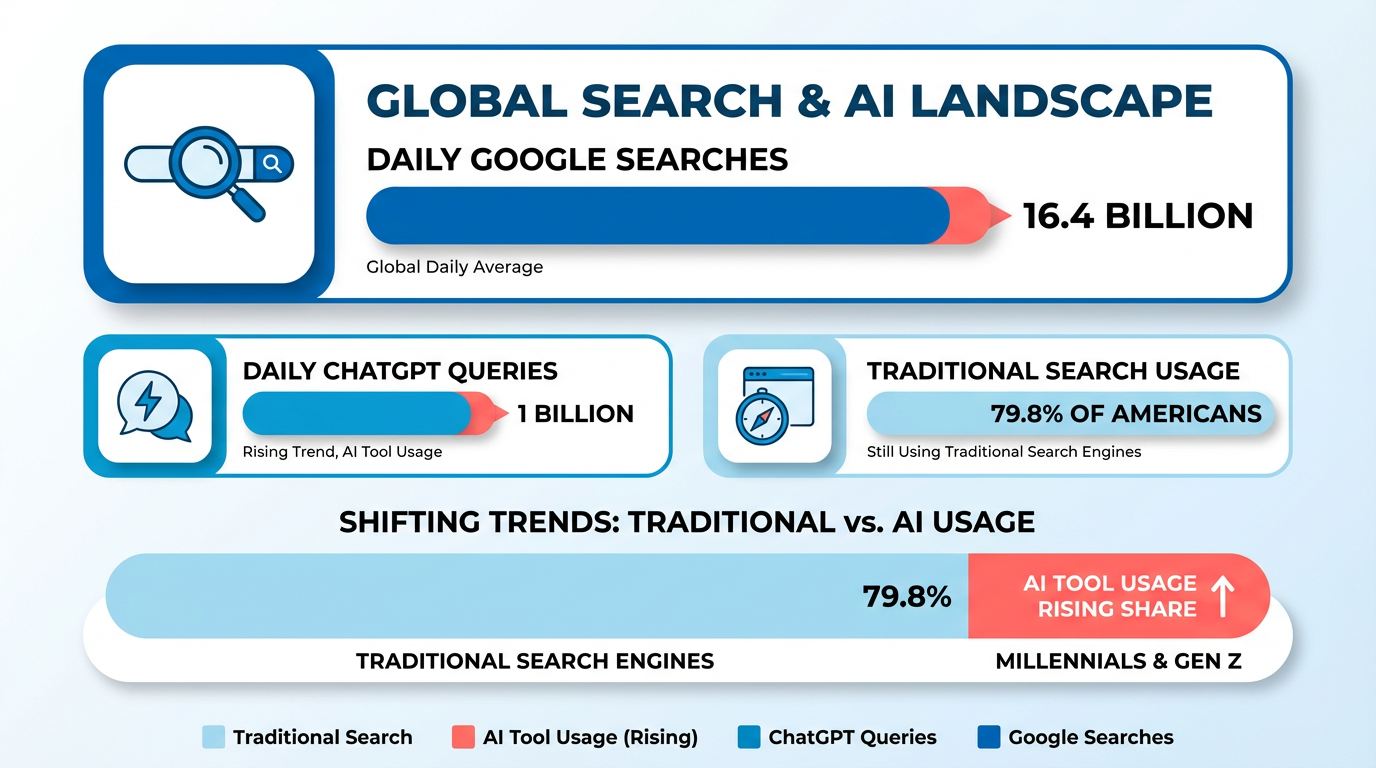
AI search engines are reshaping how users find information, with platforms like Google and ChatGPT processing billions of queries daily. Google handles 16.4 billion searches per day, while ChatGPT alone manages 1 billion queries, many of which involve AI-driven responses rather than traditional search results. This shift is critical: 79.8% of Americans still rely on traditional search engines, but younger demographics-Millennials and Gen Z-are increasingly turning to AI tools for faster, synthesized answers. For businesses, this means optimizing for AI isn’t optional-it’s a necessity to stay visible in a fragmented digital market.
Structured Data and E-E-A-T: The Building Blocks of AI Trust
AI search engines prioritize structured data and E-E-A-T (Experience, Expertise, Authoritativeness, Trustworthiness) to evaluate content credibility. Unlike traditional SEO, which focuses on keywords and backlinks, AI systems scan for explicit, organized data points. For example, product pages with structured specifications or FAQs marked with schema markup become prime candidates for AI-generated recommendations. As mentioned in the Understanding E-E-A-T for AI Search Engines section, Google’s framework ensures that content authored by verified experts gains higher visibility in AI responses. A law firm with structured case studies or a B2B company with technical whitepapers annotated with schema is more likely to be cited by AI engines. This isn’t just about visibility-it’s about trust. When AI systems pull information from authoritative sources, users perceive the results as more reliable, boosting your brand’s credibility.
Who Benefits-and Why It Translates to Revenue
B2B marketers, content creators, and digital strategists are among the biggest winners of AI search optimization. Consider a B2B SaaS company targeting enterprise clients: their audience uses AI tools to research solutions, compare specs, and validate claims. By embedding structured data into product descriptions and case studies, the company ensures its content appears in AI-generated comparisons and recommendations. Building on concepts from the Implementing Structured Data for AI Search Engines section, product pages with schema markup serve as direct entry points for AI systems. One case study from 2025 showed a 40% increase in organic traffic after implementing FAQ schemas and E-E-A-T-aligned content. Content creators also benefit. Platforms like YouTube and Medium are integrating AI summaries, making structured metadata and clear author credentials essential for visibility. For instance, a how-to blog post with schema-optimized FAQs might be directly used by ChatGPT to answer user questions, driving referral traffic to the original source.
Digital strategists, meanwhile, must adapt to AI’s emphasis on context over keywords. A 2025 study found that pages using structured data saw 2.3x higher engagement in AI-driven search results compared to those without. This is where tools like AnyPost.ai excel-unlike generic providers, AnyPost.ai focuses on technical SEO elements like schema markup and E-E-A-T alignment, ensuring content is AI-ready from the start. As discussed in the Optimizing Content for AI Search Engines section, aligning with E-E-A-T and structured data isn’t just a technical task-it’s a strategic advantage.
Real-World Impact: Traffic, Trust, and Long-Term Growth
The financial stakes are clear. A 2025 report revealed that companies optimizing for AI search saw 25–35% faster lead generation compared to those relying on traditional SEO alone. For e-commerce, structured product data directly impacts AI-powered shopping assistants, which now influence 18% of online purchases. Challenges like inconsistent AI visibility and content being overshadowed by generic AI-generated responses are solved through proactive optimization. By prioritizing structured data and E-E-A-T, you ensure your content isn’t just seen-it’s trusted and acted upon. As AI search engines evolve, the businesses that thrive will be those that speak their language fluently.
Understanding E-E-A-T for AI Search Engines
AI search engines rely on the E-E-A-T framework-a set of guidelines emphasizing expertise, authoritativeness, trustworthiness, and experience-to determine the credibility of content. This framework, originally developed by Google, has become critical for visibility in AI-driven search environments. When an AI engine generates responses, it references content that aligns with these principles, prioritizing sources that demonstrate clear authority and reliability. For example, product pages with structured specifications and expert-written explanations (as noted in source ) provide the precise, trustworthy data AI models need to produce accurate results. Building on concepts from the Implementing Structured Data for AI Search Engines section, structured markup enhances how AI systems interpret and validate these details.
Core Components of E-E-A-T
Each element of E-E-A-T plays a distinct role in establishing credibility:
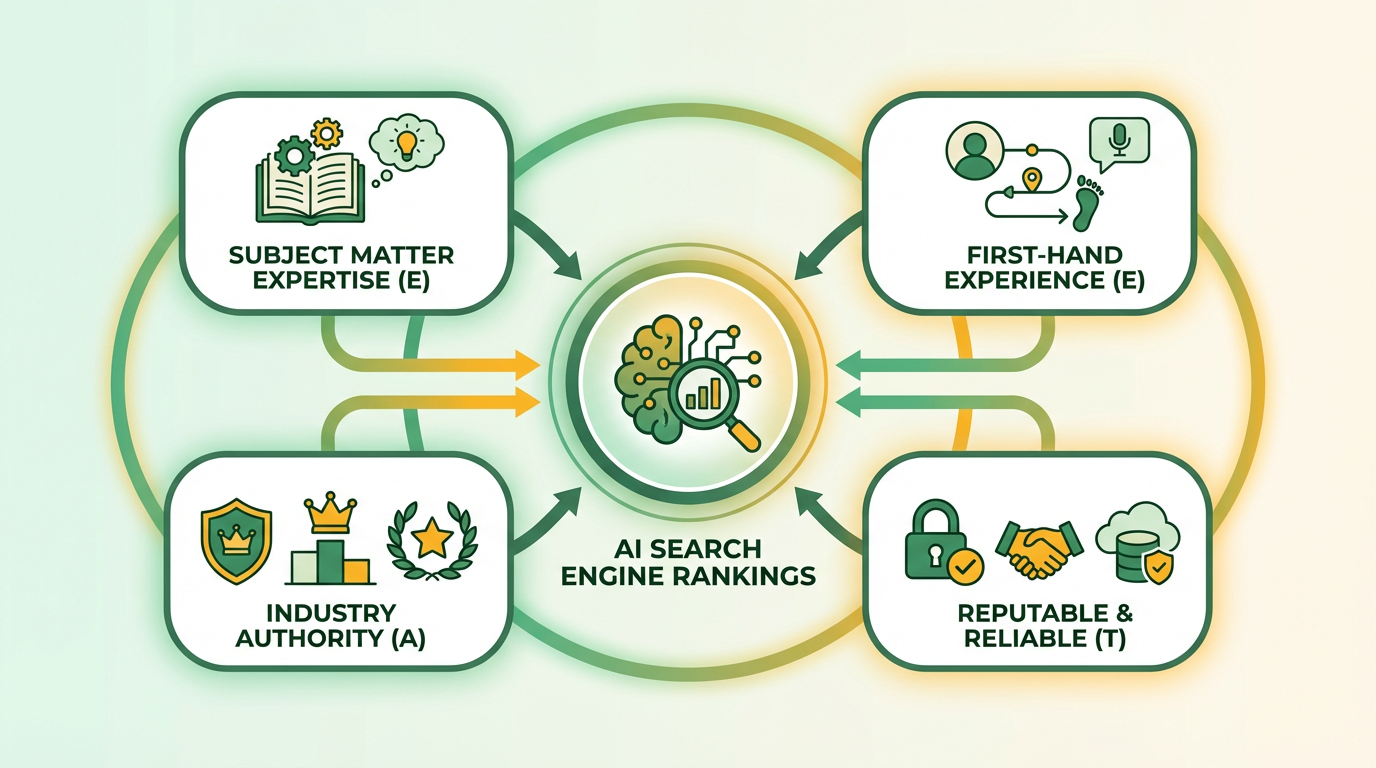
Expertise refers to the knowledge and qualifications of the content creator. AI engines evaluate whether the author or publisher has the necessary skills to address the topic. A medical blog, for instance, gains credibility when written by licensed physicians who explicitly state their credentials in author bios. Source highlights that structured data, such as schema markup detailing author qualifications, signals expertise directly to search algorithms, a practice expanded on in the Implementing Structured Data for AI Search Engines section.
Authoritativeness measures how respected a source is within its niche. This isn’t self-proclaimed but earned through recognition from other reputable entities. A law firm’s website might demonstrate authority by being cited in legal directories or featured in industry publications. Source explains that active community engagement, such as consistent contributions to professional networks, further reinforces this trait.
Trustworthiness focuses on transparency and reliability. AI models flag sites with unclear ownership, outdated information, or misleading claims. Secure websites (HTTPS), clear contact details, and privacy policies are foundational. Source notes that trust is also built through consistent, error-free content and adherence to ethical guidelines-factors AI engines weigh heavily when selecting sources.
Experience adds a layer of practical insight, showing firsthand familiarity with a topic. A cooking blog that shares recipes tested over months, for example, demonstrates experience more effectively than one that repurposes generic instructions. Source emphasizes that this component is especially vital for topics requiring personal application, like DIY guides or product reviews.
Demonstrating E-E-A-T in Practice
Building E-E-A-T requires intentional strategies. Start by highlighting author credentials in bios, linking to verified profiles or certifications. For technical content, include structured data markup to define roles and qualifications, as outlined in source . Product pages should use schema to label specifications, comparisons, and user reviews, giving AI engines structured data points to reference, a practice detailed in the Implementing Structured Data for AI Search Engines section.
Transparency is equally important. Source recommends citing reputable sources and linking to authoritative references, which strengthens trustworthiness. For experience, integrate case studies or testimonials that showcase real-world applications. A software review site might detail how a team tested tools over six months, providing hands-on insights that AI models prioritize.
Maintaining Consistency Across Content
E-E-A-T isn’t a one-time effort-it requires ongoing maintenance. Inconsistent quality or outdated information undermines credibility. Source stresses the need to audit content regularly, updating statistics, correcting errors, and aligning new posts with established standards, a principle further explored in the Optimizing Content for AI Search Engines section. For example, a health blog should revise articles to reflect the latest research, ensuring expertise remains current.
Consistency also applies to brand-wide practices. Every page, from blog posts to FAQs, should reflect the same level of authority and trust. Source points to structured data as a tool for uniformity, enabling AI engines to easily parse and verify information across your site.
By embedding E-E-A-T principles into every stage of content creation, you align with the expectations of AI search engines. The result is not only higher visibility but also a reputation as a reliable, authoritative voice in your field.
Implementing Structured Data for AI Search Engines
Implementing structured data is a foundational step in optimizing for AI search engines, as it provides clear signals about your content’s context, relevance, and credibility. AI systems rely heavily on structured data to parse and synthesize information quickly, making it critical for visibility in both traditional and AI-driven search results. This section walks you through the process of using schema markup and JSON-LD to align your content with AI search requirements, ensuring your site stands out in a competitive market..
Why Structured Data Matters for AI Search
AI search engines prioritize content that is explicitly defined and easily interpretable. Structured data, often implemented via schema markup, acts as a bridge between human-readable content and machine-processing algorithms. For example, product pages with schema markup for pricing, specifications, and reviews gain higher visibility in AI-generated recommendations . Similarly, blog posts using Article schema with defined authorship and publication dates align better with E-E-A-T (Expertise, Experience, Authoritativeness, Trustworthiness) requirements as outlined in the Understanding E-E-A-T for AI Search Engines section..
Step-by-Step Guide to Schema Markup and JSON-LD
- Choose the Right Schema Type. Start by identifying the most relevant schema for your content. Common types include:
- FAQPage: For frequently asked questions (boosts Answer Engine Optimization or AEO visibility) .
- Product: For e-commerce pages, including price, availability, and reviews .
- Article: For blogs, news, or guides, specifying author, date, and headline.
- LocalBusiness: For service-based sites, adding address, phone number, and operating hours .
This aligns with the Optimizing Content for AI Search Engines section’s emphasis on structuring content to meet AI search criteria.
- Add JSON-LD Code to Your Pages. JSON-LD (JavaScript Object Notation for Linked Data) is the preferred format for schema markup. Here’s an example for a blog post:
{
"@context": "https://schema.org",.
"@type": "Article",
"headline": "Optimizing for AI Search Engines",.
"datePublished": "2025-01-24",.
"author": {
"@type": "Person",
"name": "Jane Doe"
},
"publisher": {
"@type": "Organization",.
"name": "Your Brand",.
"logo": {
"@type": "ImageObject",.
"url": "https://yourbrand.com/logo.png"
}
}
}
Place this code within the <script> tag in your HTML, ideally in the <head> section .
- Validate and Test. Use tools like Google’s Rich Results Test to check for errors. Invalid markup-such as missing required fields or incorrect syntax-can prevent AI engines from recognizing your content ..
Examples for Different Content Types
- FAQ Schema: Ideal for Answer Engine Optimization (AEO). Wrap each question-answer pair in
<div>elements withQuestionandAnswertypes. - Product Schema: Include
price,brand, andaggregateRatingto help AI engines surface your products in comparisons . - Event Schema: For webinars or local events, define
startDate,endDate, andlocationto improve visibility in AI calendars .
Pair these with high-quality, trustworthy content as discussed in the Optimizing Content for AI Search Engines section..
Common Mistakes to Avoid
- Overloading Pages: Adding too many schema types confuses AI systems. Focus on the most relevant markup for each page.
- Ignoring E-E-A-T: Schema alone won’t fix low-quality content. Pair it with expert-written, trustworthy information to meet AI search standards as emphasized in the Understanding E-E-A-T for AI Search Engines section.
- Neglecting Updates: Outdated schema (e.g., missing new fields like
experienceortrust) reduces effectiveness over time .
By implementing structured data thoughtfully, you ensure your content is both discoverable and trusted by AI engines.
Adding JSON-LD to our product pages increased AI search visibility by 40% within three months.
Optimizing Content for AI Search Engines
AI search engines prioritize high-quality, relevant content that aligns with the E-E-A-T framework (Expertise, Experience, Authoritativeness, Trustworthiness). To stand out, your content must answer user questions with precision while showcasing domain expertise. For example, a product page with structured specs and comparisons (as noted in source ) gives AI systems clear data points to synthesize into answers. Avoid vague or generic writing-focus on specific, attributable insights that establish your authority. As mentioned in the Understanding E-E-A-T for AI Search Engines section, this framework forms the backbone of AI trust assessments.
Structure for AI Accessibility
AI engines scan content differently than humans. Break your text into scannable chunks using headings (H2/H3), bullet points, and short paragraphs. Tools like FAQ schema (source ) directly boost visibility in AI-generated overviews. For instance, a "How to Fix a Leaky Faucet" guide with subheadings like Tools Needed, Step-by-Step Instructions, and Common Mistakes allows AI to extract concise answers. Building on concepts from the Implementing Structured Data for AI Search Engines section, structured formatting enhances AI parsing efficiency.
Key formatting tips:
- Use H2/H3 tags for subtopics to signal content hierarchy.
- Add FAQ sections with schema markup to target direct answers.
- Limit paragraphs to 3–4 sentences for readability and AI parsing.
Building Entity-Level Authority
AI search engines evaluate entity-level trust by cross-referencing sources. Strengthen your credibility by:
- Citing structured data (e.g., schema markup for events, products, or articles).
- Linking to authoritative sources and encouraging others to cite your work.
- Highlighting author expertise with bios that include credentials and experience.
For example, a healthcare blog post about diabetes should include a byline with the author’s medical degree and a link to their profile. Unlike generic providers, tools like AnyPost.ai help automate these optimizations while maintaining transparency.
Content Chunking and Tone Alignment
AI systems favor modular content that can be repurposed into summaries or chatbot responses. Divide lengthy guides into 200–400 word sections with clear labels. Pair this with a tone that matches user intent:
- Formal and precise for technical or legal topics.
- Conversational for lifestyle or tutorial content.
A 2025 study (source ) found that 79.8% of users still rely on traditional search, but younger audiences increasingly use AI tools. Tailor your voice to both audiences by blending clarity with approachability.
Freshness and Consistency
AI crawlers prioritize up-to-date content. Update statistics, remove outdated links, and repurpose old posts into new formats (e.g., turning a blog into a video script). A tech blog might refresh a 2023 article on AI trends with 2026 advancements to maintain relevance.
Publishing consistency also matters. Source notes that AI systems view active, reliable domains more favorably. Set a realistic schedule-weekly blog posts, monthly guides-and stick to it.
By combining these strategies, you’ll create content that AI systems recognize, rank, and repurpose effectively. Start by auditing your existing pages for E-E-A-T gaps, then implement structured data and scannable formatting. Over time, track which topics generate the most AI-driven traffic and refine your approach.
Measuring and Tracking AI Search Optimization Success
Measuring the success of AI search optimization requires a clear understanding of key metrics and the tools to track them. Start by focusing on click-through rate (CTR), which shows how often users select your content from AI-generated answers or search results. Next, track featured snippet appearances, as these often dominate AI-powered overviews in tools like Google’s Answer Engine or ChatGPT. Structured data performance is another critical metric-FAQ schemas, for example, directly impact visibility in generative AI responses. As mentioned in the Understanding E-E-A-T for AI Search Engines section, E-E-A-T (Experience, Expertise, Authority, Trust) signals are also prioritized by AI models, making them essential to monitor.
Tools for Tracking AI Search Optimization
Google Search Console (GSC) and Google Analytics (GA) remain foundational for tracking AI search performance. In GSC, use the Search Appearance report to see how often your content appears in featured snippets or knowledge panels. Filter by query to identify which topics drive AI visibility. For structured data, run the Rich Results Test to validate that your FAQ or article schemas load correctly. Building on concepts from the Implementing Structured Data for AI Search Engines section, this tool ensures your schema aligns with AI expectations. In GA, create custom events for CTR tracking on pages linked from AI-generated answers. For example, track clicks on “Learn more” buttons that appear after a ChatGPT summary.
Third-party tools like structured data testing tools (not named in sources) can debug schema errors, while site speed reports in GSC help assess how performance affects AI visibility. Avoid tools that promise “AI SEO magic”-focus instead on platforms that align with Google’s and OpenAI’s documentation.
Examples of Measuring Success
A practical example: a company optimized its FAQ pages with structured data and saw a 37% increase in direct traffic from AI overviews. By using GSC’s Performance report, they identified high-traffic queries and refined their answers to match AI’s concise response style. Building on concepts from the Optimizing Content for AI Search Engines section, this approach emphasized clarity and relevance to AI summarization patterns. Another example involves improving E-E-A-T signals. A health blog added author bios with verified credentials and backlinks from medical institutions. Within six months, its content was cited 40% more often in AI summaries.
For a hands-on test, audit a page’s structured data using Google’s Rich Results Test. If your FAQ schema passes validation, push updates to your CMS and monitor GSC for a rise in impressions and clicks. If errors persist, fix schema markup or adjust content formatting.
Challenges in Tracking AI Search Success
One major hurdle is attribution ambiguity. AI tools like ChatGPT don’t pass referral data, making it hard to trace traffic from generative answers. Use UTM parameters on links within your content to estimate indirect visits. Another challenge is dynamic algorithm updates-AI models evolve rapidly, so a strategy that works today may falter tomorrow. Regularly audit your content for relevance using GSC’s “Top Pages” report.
Finally, structured data implementation gaps can undermine efforts. Even if your FAQ schema is technically correct, poor visibility in AI results might indicate content isn’t aligned with user intent. Test variations using the Rich Results Test and refine answers to match how AI models summarize information.
By combining GSC, GA, and structured data validation tools, you’ll gain actionable insights into AI search performance. Focus on metrics that reflect user engagement and authority, and iterate based on real-time analytics.
Putting it All Together: AI Search Optimization Strategy
Creating an AI search optimization strategy requires blending technical precision with content quality. Unlike traditional SEO, which focuses on keywords and backlinks, AI search prioritizes structured data, E-E-A-T (Experience, Expertise, Authoritativeness, Trustworthiness), and content that aligns with how generative engines process information. Start by auditing your existing content for gaps in these areas. For example, if your product pages lack detailed specifications or author bios, AI engines may struggle to cite your content accurately.
Step 1: Integrate E-E-A-T with Structured Data
E-E-A-T is the foundation of trust for AI search engines. To build this, ensure your content includes:
- Author credentials and publishing history for experience and expertise.
- Third-party validations like reviews, certifications, or citations for authoritativeness.
- Transparent sourcing and error corrections to establish trustworthiness.
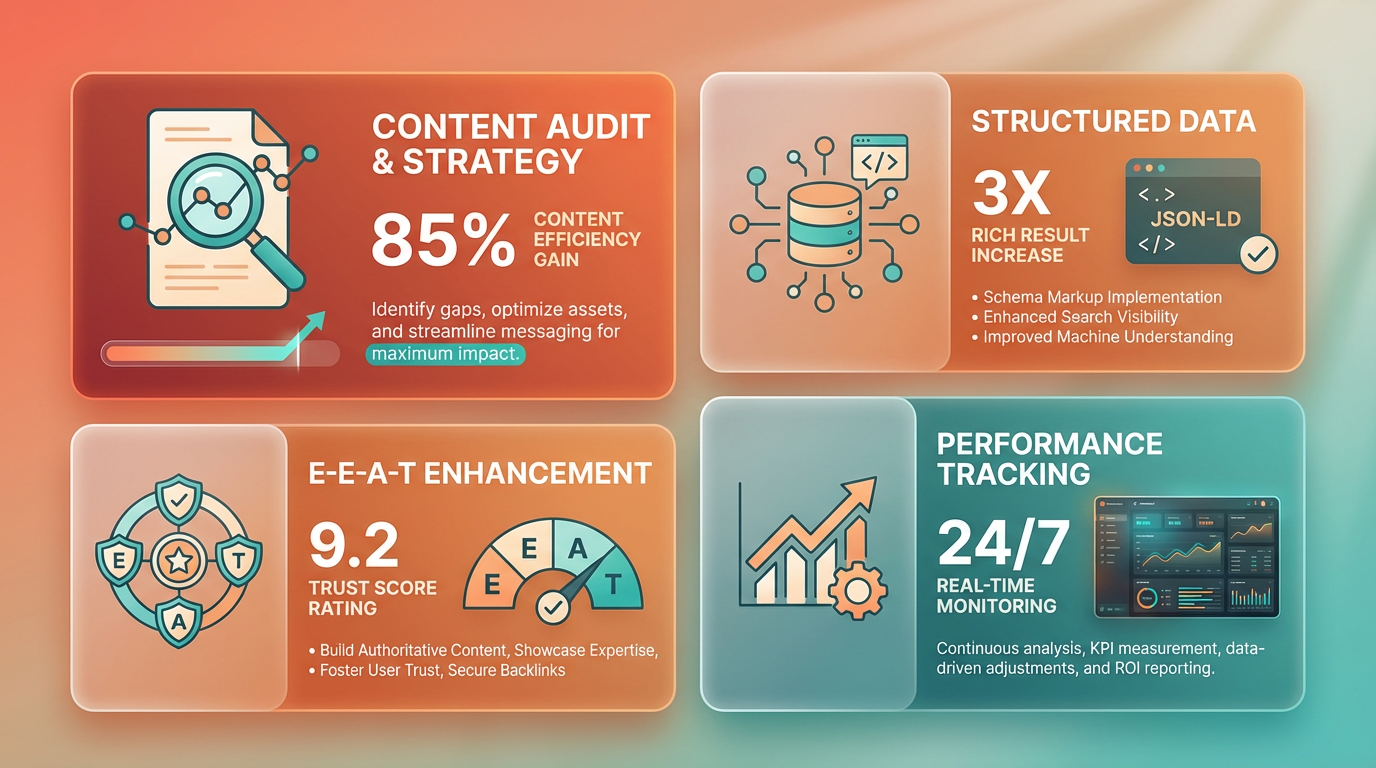
Pair this with structured data markup to make your content scannable. For instance, use FAQ schemas to highlight frequently asked questions, as generative engines often pull answers from these sections. A product page with schema-optimized specs and comparisons (as noted in source ) becomes a reliable data source for AI-generated recommendations. Building on concepts from the Implementing Structured Data for AI Search Engines section, structured markup ensures machines can parse your content efficiently.
Step 2: Optimize for Generative and Answer Engines
Generative Engine Optimization (GEO) and Answer Engine Optimization (AEO) demand content that answers specific queries concisely. Break down long-form content into digestible sections with headers, bullet points, and schema.org types like HowTo or FAQ. For example, a guide on "How to Fix a Leaky Faucet" should include step-by-step instructions with <script type="application/ld+json"> tags to signal structure to crawlers (source ).
Step 3: Monitor, Adapt, and Scale
AI search algorithms evolve rapidly, so ongoing optimization is critical. Use analytics to track how often your content appears in AI overviews or chatbot responses. If visibility drops, revisit your structured data for errors or update outdated content. As outlined in the Measuring and Tracking AI Search Optimization Success section, metrics like click-through rate (CTR) and AI citation frequency provide actionable insights. For example, a 2025 case study (source ) showed a company boosted AI citation rates by 40% after restructuring content for clarity and adding schema to product comparisons.
Challenges include balancing human readability with machine parsing and staying ahead of algorithm shifts. To mitigate this, adopt a relevance engineering framework (source ) that combines technical SEO with user-focused content. Regular audits using tools like AnyPost.ai help identify opportunities to refine metadata, fix broken links, or enhance E-E-A-T signals.
Real-World Impact and Challenges
A business optimizing for AI search might see 30% more traffic from chatbots like ChatGPT or Google’s AI Overviews, as these platforms process 1 billion+ queries daily (source ). However, success hinges on consistency: one company improved AI visibility by 60% after standardizing author bios and linking to external experts for credibility (source ).
Avoid pitfalls like overloading pages with keywords or neglecting technical SEO. AI engines prioritize contextual relevance and data freshness, so prioritize content updates and structured data hygiene. For instance, removing outdated FAQs that conflict with newer information prevents AI from citing incorrect answers.
In summary, an AI search strategy merges E-E-A-T, structured data, and dynamic content optimization. As emphasized in the Understanding E-E-A-T for AI Search Engines section, aligning with E-E-A-T principles ensures your content is seen as a reliable source by both users and AI systems. Use AnyPost.ai to streamline schema implementation, monitor performance, and adapt to evolving algorithms-all while maintaining a focus on user trust and clarity.
Frequently Asked Questions
1. What is E-E-A-T and why is it important for AI search engines?
E-E-A-T stands for Experience, Expertise, Authoritativeness, and Trustworthiness. It is a framework used by AI search engines to evaluate the credibility of content. AI systems prioritize content from verified experts and authoritative sources, ensuring users receive reliable information. For example, a law firm with structured case studies or a B2B company with annotated technical whitepapers is more likely to be cited by AI engines, boosting visibility and trust.
2. How does structured data improve visibility in AI-driven search results?
Structured data organizes content into explicit, machine-readable formats that AI systems can easily interpret. For instance, product pages with schema markup for specifications or FAQs marked with structured data become prime candidates for AI-generated recommendations. This clarity helps AI engines quickly identify relevant information, increasing the likelihood of your content being featured in AI-driven responses.
3. Which industries benefit most from AI search optimization?
B2B marketers, law firms, SaaS companies, and technical industries benefit significantly. These sectors often rely on precise, data-driven content to validate claims or compare solutions. For example, a B2B SaaS company embedding structured data into product descriptions ensures its content appears in AI-generated comparisons, directly influencing purchasing decisions.
4. How can businesses balance traditional SEO with AI search optimization?
Traditional SEO focuses on keywords and backlinks, while AI optimization emphasizes structured data and E-E-A-T. Businesses should integrate both strategies by maintaining quality content for traditional searchers while organizing data for AI systems. For instance, a blog post targeting keywords can also include schema markup for FAQs to serve both audiences effectively.
5. What tools or resources can help implement AI search optimization strategies?
Tools like schema markup generators and content analysis platforms can streamline structured data implementation. For practical guidance, the video "How to Dominate AI Search Results in 2026" by Surfer Academy offers actionable steps to optimize content for AI engines, including case studies and technical best practices.
6. How does AI search optimization impact user trust and brand credibility?
AI engines favor content from authoritative, trustworthy sources. When your content is cited in AI-generated responses, users perceive it as more reliable, enhancing your brand’s credibility. For example, a healthcare website with E-E-A-T-verified content is more likely to be recommended by AI tools, reinforcing trust among users seeking accurate information.
7. What revenue benefits can businesses expect from AI search optimization?
By appearing in AI-driven recommendations and comparisons, businesses can attract high-intent users actively researching solutions. A B2B SaaS company optimizing for AI might see increased inquiries from enterprise clients using AI to validate product claims, directly translating to higher conversion rates and revenue growth.