Post Once, Distribute to Five Channels Before Lunch

Planning writing-focused editingIdentifying specific writing issuesPlanning sentence shortening and heading preservationRewriting promotional text for neutralityRefining article phrasing and structureSplitting long sentences for clarityPlanning article rewrite and expansion

Key Takeaways
- Time-to-publish is the top constraint for 70% of B2B marketers. Repurposing tools became core infrastructure.
- Multi-channel campaigns pull 347% higher ROI than single-channel efforts. They also convert leads 24% better.
- Content success is roughly 70% distribution and 30% creation. Smarter sharing beats producing more pieces.
- Personal LinkedIn profiles generate five times the reach of company pages. That multiplier stacks across channels.
- Spread across five channels, and no single platform throttle can wipe out more than 20% of a day's reach.
- Post once, in one place, and you leave most return on the table. The reach multiplier applies per channel.
- The five-channel case rests on distribution math and platform-risk protection. It is not just a time saver.
Why posting once and publishing five times actually pays
Speed is the bottleneck, not ideas. Content teams get stuck moving drafts from done to live. That is why AI content repurposing tools became core infrastructure in most marketing teams.
Strong B2B teams flip the equation. They stop chasing volume and maximize each asset's footprint. You do not need more drafts. You need existing ideas in front of more eyes.
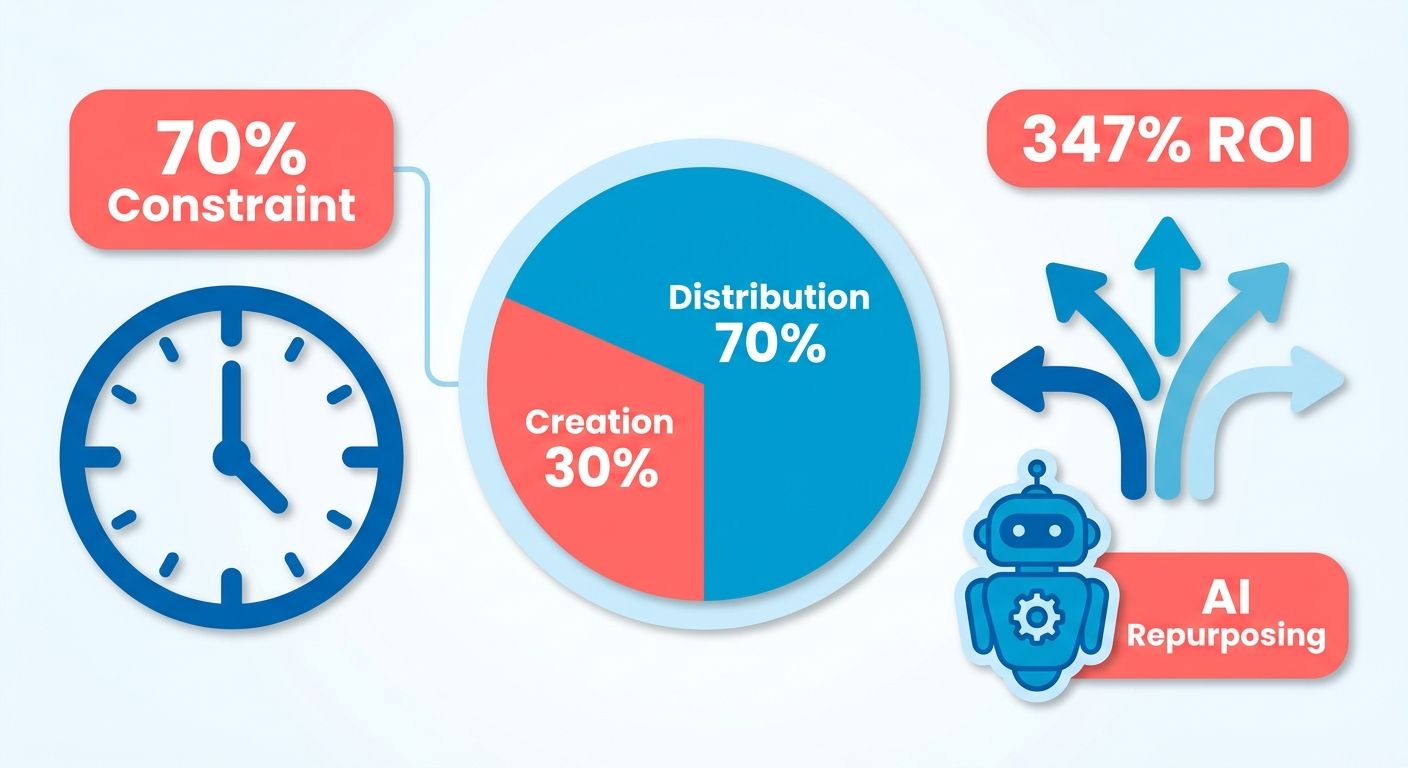
Why five channels beats one post, every time
Spreading a message across touchpoints improves campaign performance. It also speeds up lead conversion. Post the same piece once, in one place, and most of your audience never sees it.
The math compounds when you combine two facts. Employee advocacy drives far higher organic visibility than corporate brand pages. Multi-channel distribution also acts as a safety net when any single platform throttles you.
Publish from five channels at once, and the visibility multiplier applies to each channel. One algorithm change cannot erase your whole day's distribution. The floor under each piece stays higher than either insight suggests alone. That is the structural case, not a productivity pitch.
What happens when teams actually run this
The output ceiling is high. One team turned a 1-hour SME interview into one long-form article, five video clips, and eight LinkedIn posts. They published three to five times a week. Another team ran a five-channel funnel across LinkedIn, podcast, nurture email, office-hours Q&A, and sales calls. It drove 2M views and millions in pipeline over 18 months.
The reported gains stack up: lead quality up 312%, engagement duration 4.7x longer, cost per acquisition down 73%, and MQLs up 234%. You will not hit every one of those. Even a fraction changes your quarter.
But doesn't each channel need its own strategy?
Yes, and the sources openly disagree here. One camp says centralize everything under one brand account to keep it consistent. The other says each channel needs its own playbook. They argue that forcing one strategy across platforms is the biggest mistake brands make.
Both are right in different contexts. Enterprise brand safety favors centralization. B2B thought-leadership reach favors personal profiles and channel-specific tone. Manual workflows cannot satisfy both at once.
So the resolution is technical, not strategic. AnyPost's Persona Engine matches your tone across formats. Its multi-source integration auto-publishes to WordPress, LinkedIn, and X from one place. One piece reaches multiple channels in your voice, without hand-editing each one.
Lunchtime posting fits the routine. It lands your content inside the peak professional engagement window on most platforms. Ideate, publish, and analyze in one morning block. Five SEO-ready pieces finish before lunch.
The one-post, multi-channel blueprint
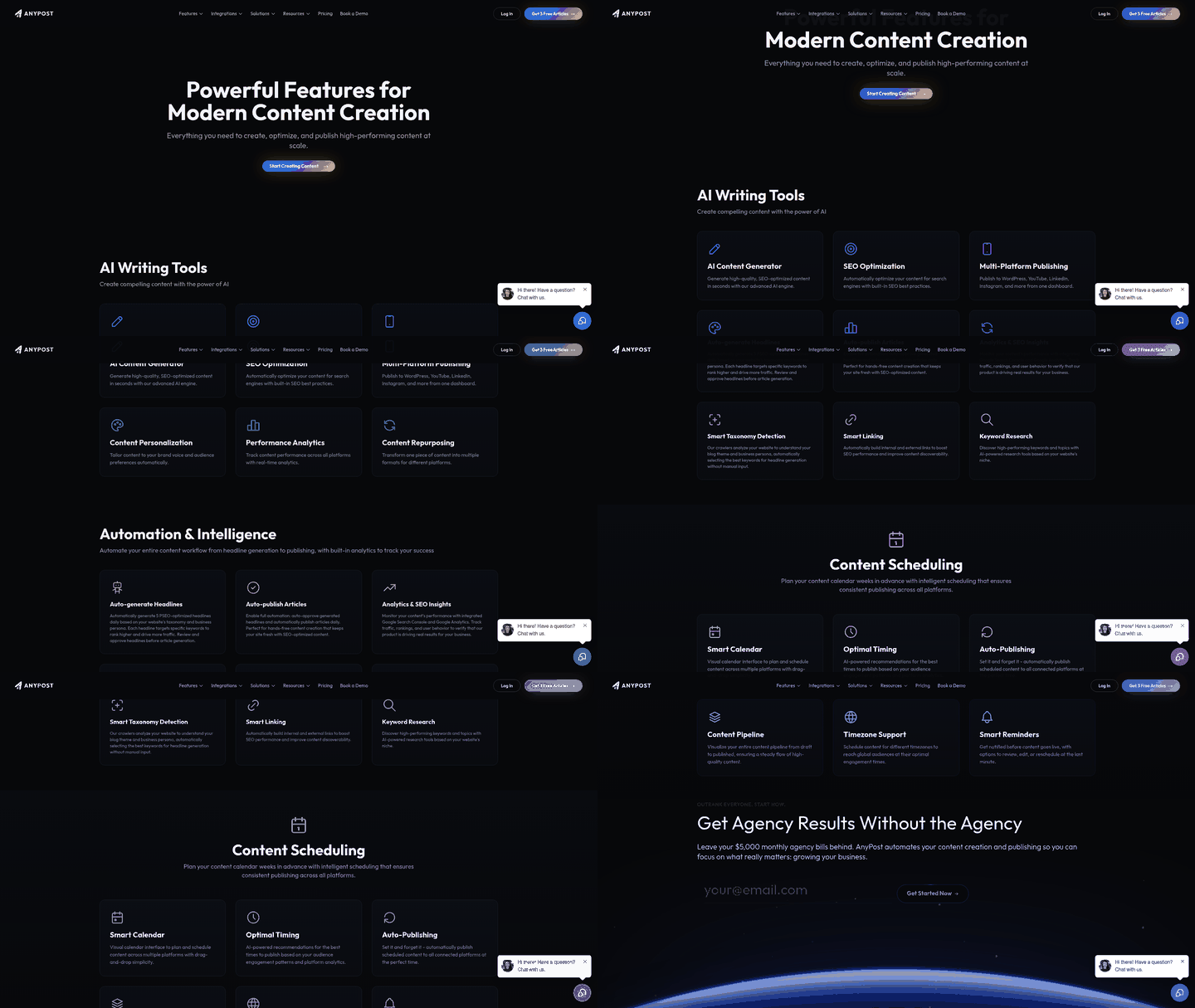
One non-negotiable rule: build a single core pillar first. Then spin it into channel-native pieces. The pillar carries the argument and the SEO weight. The spins carry the tone, length, and format each platform rewards. This is where AI content repurposing tools stop being a convenience. They make "post once, publish five times" work before lunch.
The reason to insist on that order is efficiency data. Repurposing workflows cut content creation time by 60%. 94% of B2B marketers say repurposing extends content ROI. But the time savings only appear when you write one asset with distribution baked in. They do not appear when you write five pieces and reconcile them later.
Pillar vs. spin: what's the difference
Content pillar: your single source of truth. One long-form blog with the full argument, three key points, and a conclusion. Channel spin: a platform-native cut of that pillar with its own headline, length, and tone.
Structure the pillar as a modular outline: intro, three key points, conclusion. That modularity maps cleanly to every channel. Your intro becomes the tweet-thread hook. Each key point becomes a LinkedIn post or a carousel slide. The conclusion becomes the newsletter close.
Write the headline so it can become tweetable statements and video hooks. Put your SEO keywords early in the blog and newsletter, where search intent matters most. Keep them natural in the social cuts, where keyword stuffing hurts engagement.
How you map one blog into five assets
Use a fixed mapping matrix so the split stays mechanical. Do not make a fresh decision every time. You break one draft into five formats without starting from scratch.
- Blog → tweet thread: intro hook plus your three key points as standalone statements.
- Blog → LinkedIn post: one key point expanded, first-person, written for a personal profile.
- Blog → newsletter snippet: the conclusion plus one takeaway, SEO keyword intact.
- Blog → YouTube short script: the headline as a 15-second hook, one point as payoff.
- Blog → Instagram carousel: three key points as three slides, minimal text.
A single blog on productivity tools maps this way without a word of new writing. That is the whole point.
Where voice consistency comes in
Here is the operational challenge. Adapting your message across formats matters. Posts with visuals earn 650% higher engagement than text-only updates. But tailoring those visual and textual assets for each platform can dilute your brand voice.
That is why teams lean on automated systems. They enforce brand guidelines while adjusting sentence structure and formatting for each platform's audience.
Your checklist: research → outline → AI-draft → human tweak → format split. Time-box each sub-task. Aim for under 30 minutes total across all five outlets.
Track one number: your 5-channel publish ratio. The goal is 100% of content hitting all five outlets, every time. Anything less means the split broke somewhere.
Choosing the five channels that actually pay off
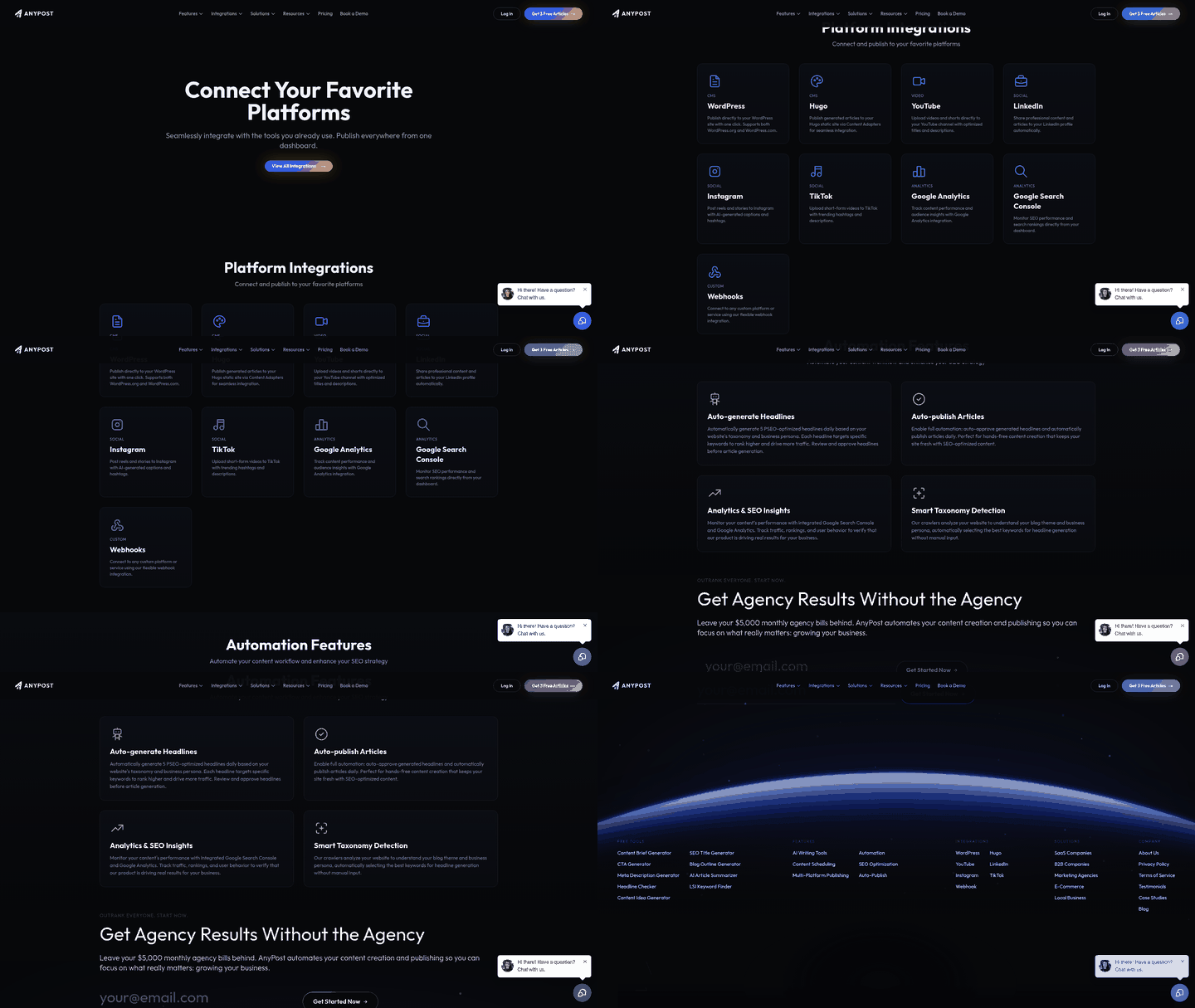
Pick five channels, not fifteen. The right mix balances where your B2B prospects spend time, what format each platform rewards, and which channels you own versus rent. A practical stack pairs major social networks with your own blog and email list. Text-heavy platforms plus owned audiences, without spreading yourself thin.
Each platform has its own ranking signals. A piece built for LinkedIn's dwell-time algorithm will not perform the same on X, where posts have a median lifespan of roughly 18 minutes. Raw distribution only pays off when each channel gets a piece that fits its native format, not a copy-paste of the same text everywhere.
Which channels earn the slot
Rank channels by audience overlap first, format fit second. For most SaaS marketers, LinkedIn and the blog carry the SEO and pipeline weight. X handles fast distribution.
Atomize a single piece of core content, and you generate a week's worth of social updates and newsletter entries. Owned channels like your blog give you full control but a capped audience. Earned reach on social builds credibility and taps into massive existing networks.
Owned vs. earned rule: anchor at least one channel in owned media, your blog, so no algorithm change can wipe out your distribution overnight.
Personal profile vs. brand page: the conflict
Two credible playbooks disagree here, and you should know which applies to you. Managing multiple individual accounts by hand is an operational nightmare. That is why many organizations default to a single corporate page, even with lower organic reach. But modern systems can ingest your brand guidelines and tailor drafts for different internal subject matter experts automatically. That is how you scale personal-profile distribution without losing brand governance or burning hours on manual editing.
How you swap a channel without breaking the workflow
Treat channels as slots, not commitments. Score each one monthly on two metrics: reach per post and pipeline influence. When a channel drops below your median for two straight months, cut it and promote an experiment into the open slot. Keep the stack lean. Do not stay locked into a platform that stopped performing.
Multi-channel distribution is a safety net. If one platform throttles you, the others keep the piece alive. Stay present across independent networks, and you insulate your traffic from sudden algorithm shifts.
Watch for channel fatigue. Post identical content everywhere, and you train algorithms to demote you as duplicate. The fix is genuine per-channel adaptation. That is exactly where AI-driven repurposing earns its place in the stack.
Using AnyPost.ai to automate creation and publishing
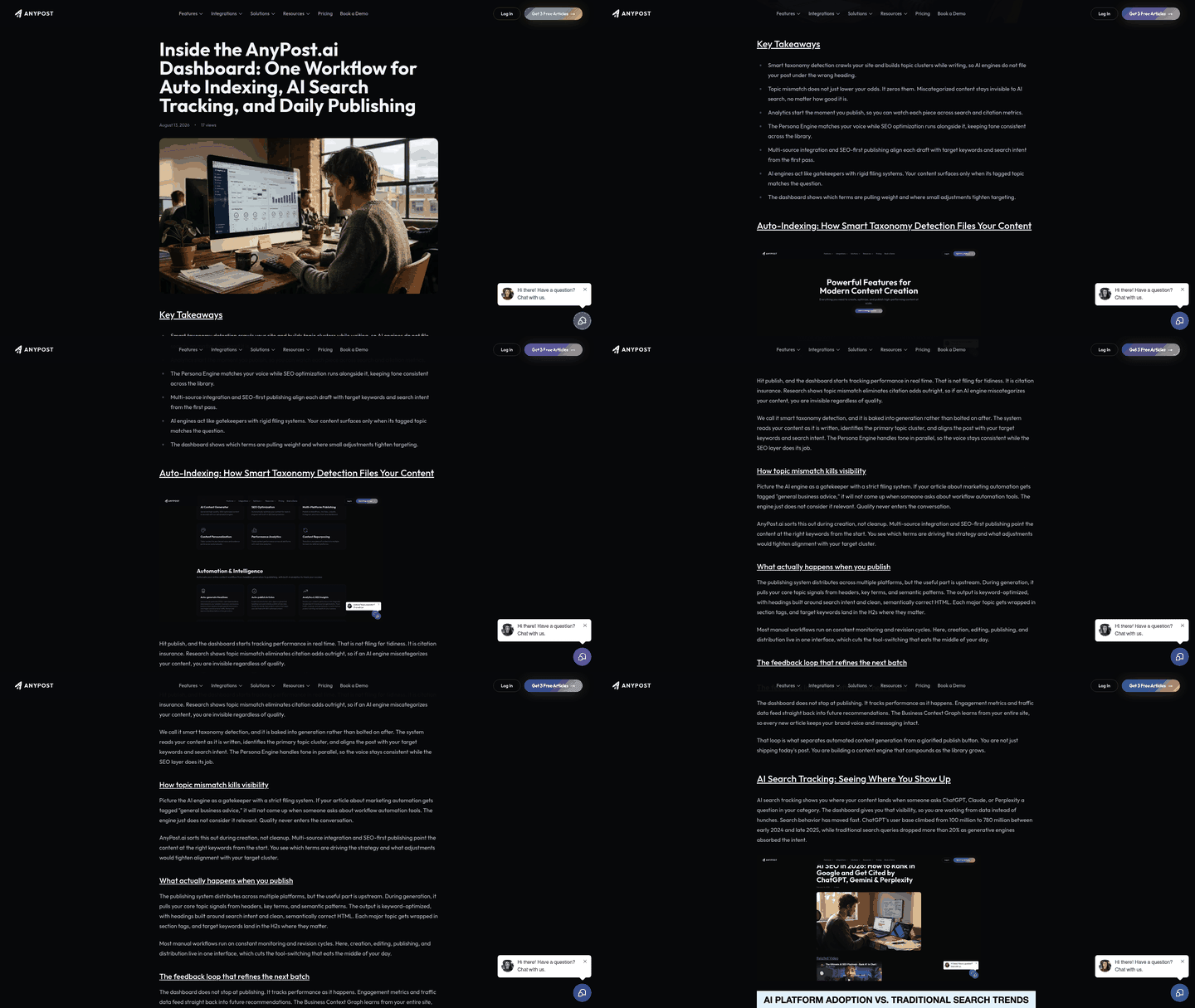
Automating the five-channel routine solves two bottlenecks at once: bloated creation time and neglected distribution. Repurposing cuts creation time, but that saving only matters if the freed hours go straight into publishing. The approach ties generation, tone-matching, and scheduling into one pass. The whole cycle finishes before lunch.
Good platforms do more than spit out five copies. They adapt tone, keywords, and meta per platform. Then they push each piece live from a single brief.
How fast you get a first draft across all formats
AI-first draft generation: one brief in, platform-native ready-to-rank drafts out, for every channel. The pillar carries the argument. Each spin carries the length and format its platform rewards.
Speed is the point. When creation drops from hours to a hands-off pass, distribution stops being the thing you run out of time for. That makes the one-post, five-channel cadence realistic every day, not just once a week.
What the Persona Engine actually does
The Persona Engine matches your brand voice to each channel with one setting. It reads your existing content to map your vocabulary, sentence structure, and formatting preferences. Whether a draft is headed for a professional network or a casual feed, it sounds like you.
Automated voice personalization scales that adaptation instantly. Keep a library of distinct writer profiles, and different team members can publish customized versions of the same core asset without manual rewriting.
This is the mechanism that turns "post everywhere" into a scalable habit. You keep brand governance without flattening every post into the same corporate register.
One-click scheduling and real-time lift
Multi-channel scheduling: one action syncs your posts across the whole stack, so all five pieces go live on the schedule you set. No manual copy-pasting, no juggling browser tabs.
Centralized publishing frees the hours you were losing to repetitive admin. Instead of logging into each platform, you manage the whole lifecycle from one interface. That gives time back to your creative team.
Then the analytics dashboard surfaces lift per channel, straight out of Google Search Console. You see which platform-adapted piece is pulling weight and reallocate fast. That feedback loop compounds. Each channel-native piece becomes its own organic entry point, indexed separately, and linking back to your canonical pillar.
Does it pay for itself?
The value comes from cadence. Repurposing extends content ROI, and AnyPost delivers the full professional SEO workflow at a tenth of traditional agency rates, which can run up to $5,000 a month. Running the same setup across multiple sites, customers have seen impressions grow steadily over 90-day and six-month windows.
The honest carve-out: skip this if you publish once a month or run a single channel. The payback depends on cadence. Automation compounds when you post often across several platforms. If you do not, a simpler setup works fine.
For a closer look at how one pillar can seed a full week of assets, see how AnyPost handles automated context extraction, taxonomy generation, and multi-channel production from a single dashboard.
Timing it right: getting all five posts live before lunch
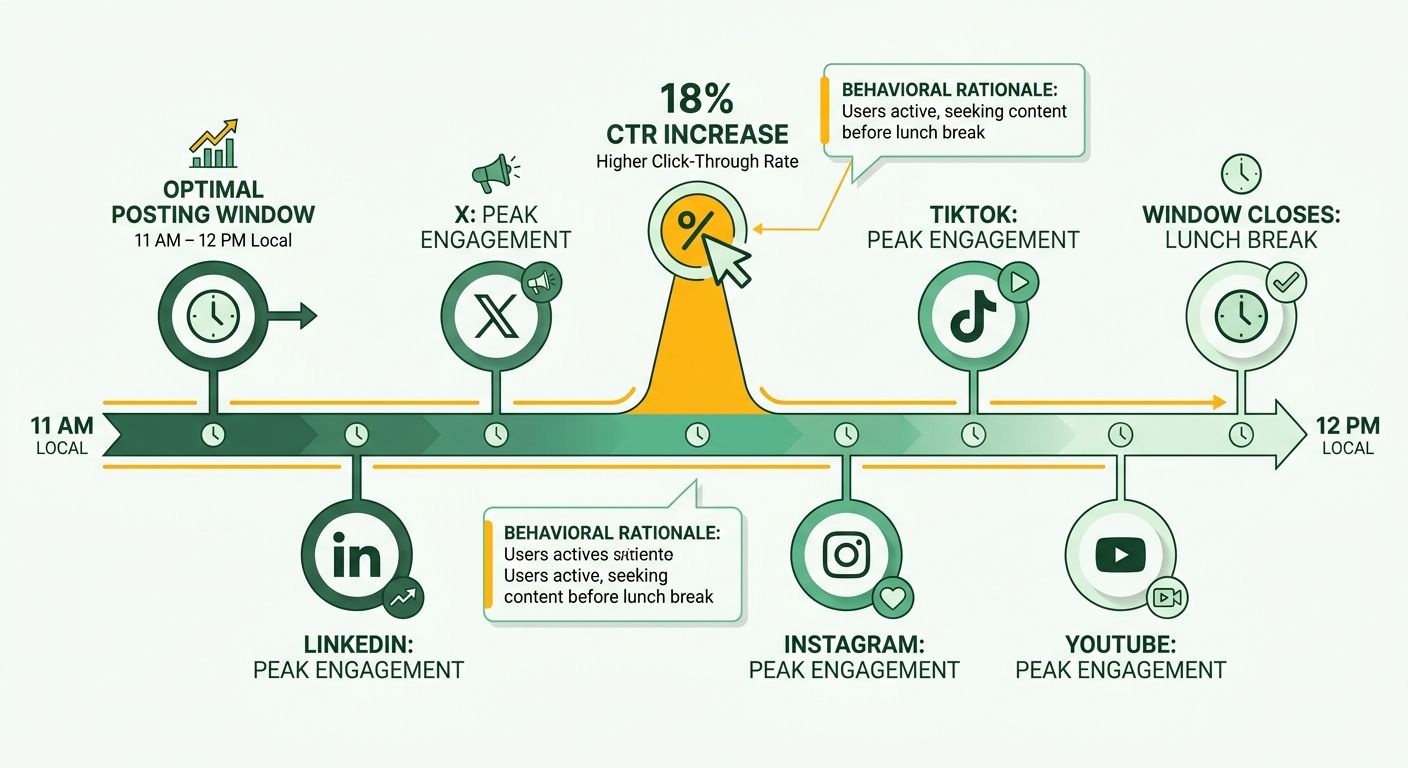
Post before lunch, and you win the click. Content published in the 11 am to 12 pm local window pulls 18% higher click-through rates than the same content pushed out in the afternoon. That is the payoff behind timing your five channel-native pieces to land together. It is also how you earn back the hours you would otherwise spend babysitting a scheduler.
How you hit the exact minute across five platforms
You need automated execution for this. Instead of watching the clock for each platform, schedule the whole campaign to deploy at once across your networks. Every tailored asset hits its peak engagement window automatically.
The system coordinates the release of your core article alongside its social variations. No manual uploads, no tab juggling. Your distribution network runs as one synchronized engine.
Bulk posting the old way meant importing hundreds of rows via CSV with captions, links, and publish times baked in. That works at enterprise volume. Acer ran over 30,000 marketing posts in six months on a centralized platform and doubled the speed of its campaign approvals. Automated multi-channel publishing gives you the same before-lunch precision without the spreadsheet.
What about global audiences in different time zones?
Cluster your time zones and plan the batch around them. The 11:45 am target is a local-time goal, so a team serving US, EU, and APAC prospects thinks in three windows, not one. Each region gets its pre-lunch spike.
Do not chase every zone. Pick the two or three where your pipeline actually lives and publish for those. Spread across a dozen offsets, and you dilute the spike you are trying to catch.
Can you see how a post performs after it goes live?
Yes. Real-time tracking lets you watch engagement as it happens. Instead of waiting for end-of-month reports, you watch immediate traffic patterns and refine your messaging for the next day's campaign.
This matters more than most scheduling advice admits. Timing decisions are only as good as the feedback loop behind them. When you see your 11:15 am LinkedIn drop outperform your 11:40 am X post by a wide margin two weeks running, you stop guessing and start front-loading the slot that converts. The window narrows to what your specific audience rewards.
That is the real argument for timing automation. Align your schedule with proven engagement windows, and distribution becomes predictable. Each campaign builds on the last.
Measuring success and optimizing across channels
Five channels means five sets of numbers, then feeding what you learn back into the next morning's post. The five-channel approach only compounds if you close the loop. That is where automated systems shift from a publishing convenience to an optimization engine.
The insight most teams miss: measurement is not about proving each channel works alone. It is about spotting rotation. Reach shifts week to week as platforms adjust their algorithms, so the channel driving results in January may go quiet by March. Your job is to spot which channel is carrying the load this week, which one is quietly dying, and reallocate before the dip shows up in your pipeline.
What KPIs to track per channel
Track five metrics per channel, not one blended average. Impressions, click-through rate, time-on-page, leads, and cost-per-acquisition each tell you something different on each platform. A blended number hides the channel that is underperforming.
- Impressions: raw reach. Your first signal that a platform is throttling you.
- Click-through rate: how well the channel-native headline is pulling. Your A/B testing target.
- Time-on-page: whether the click was worth it. Owned channels live or die here.
- Leads: the only metric your growth lead actually cares about.
- Cost-per-acquisition: what each channel costs to convert. Paid channels get fast results but overspend if you do not watch this.
Owned channels focus on website traffic. Earned channels track credibility signals like backlinks. Paid channels measure impressions against spend. Judge each on its own terms.
How you attribute conversions across five channels
Run first-touch and assisted-conversion models side by side, not one or the other. First-touch tells you which channel starts the journey. Assisted conversions tell you which ones close it. A LinkedIn post might never get the last click, but it can assist half your deals.
The mistake is picking one attribution model and defending it. First-touch over-credits your top-of-funnel channels. Last-touch over-credits your blog. Read both together, and you see the real path.
Pull comments and sentiment from each platform into one report while you're at it. Watch qualitative feedback alongside quantitative metrics, and a Monday post's reaction becomes a Tuesday adjustment. Rapid iteration beats month-end reporting.
What optimization cadence actually works
Review weekly, deep-dive monthly. The weekly pass catches CTR dips and headline losers fast. The monthly deep-dive spots slower trends: which channel's cost-per-acquisition is creeping, which format is fading.
Test headline variants across channels every week. The same pillar can carry five different headlines, each tuned to its platform. Kill the losers, promote the winners, and roll the insight into next week's batch.
Why the daily before-lunch cadence beats weekly batching for measurement: consistent publishing gives you a steady stream of diverse entry points back to your site. Run repeated optimization cycles on that setup, and you compound data and search authority at the same time. The floor keeps rising because every cycle builds on the last.
Skip this rigor for one-off campaigns. If you're not publishing on a repeatable cadence, the measurement overhead outweighs the return.
Frequently Asked Questions
1. How long should my content pillar be before I start splitting it into channel spins?
Your pillar needs enough depth to provide real value. Length matters less than structure. Create a comprehensive resource that answers one core question well. If your main piece has distinct, actionable insights, you will have enough material to adapt for different platforms without writing new copy.
2. Won't posting the same content across five channels get me flagged as a duplicate?
Yes, if you copy and paste the exact same text. Search engines and social algorithms filter identical updates to keep feeds fresh. Vary the phrasing, formatting, and hooks for each platform. Adjust the style and length to match each network's native expectations, and you avoid algorithmic penalties.
3. Which channels should I choose if I only publish through AnyPost?
Focus on platforms that match your business goals. For B2B organizations, that usually means anchoring your strategy on your self-hosted blog for long-term search value. Then use professional networks and real-time social feeds to drive immediate engagement and conversation.
4. Is this five-channel routine worth it for a small team or solo marketer?
It depends on your publishing frequency. If you produce content only occasionally, the setup and management of multiple channels may outweigh the benefits. But if you commit to a consistent, multi-day weekly schedule, automating distribution is the only way a small team can keep a broad presence without burning out.
5. How do I decide when to drop a channel that stopped performing?
Audit your distribution network regularly against your core business metrics. If a platform consistently fails to drive meaningful engagement or traffic over a multi-month period, reallocate those resources. Replace the underperforming channel with a new experimental platform to see whether it performs better.
6. Should I use first-touch or last-touch attribution to measure my channels?
A single attribution model gives you an incomplete picture. Top-of-funnel social channels often introduce prospects to your brand, while your blog or newsletter might secure the final sign-up. Analyze both the initial touchpoint and the supporting interactions to value awareness channels and closing channels accurately.
7. What if my audience spans multiple time zones for the pre-lunch window?
For a global audience, schedule posts around the peak midday hours in your primary markets. Do not try to optimize for every time zone at once. Focus on the regions that generate most of your revenue, and schedule campaigns for those high-traffic windows.
