
Revolutionize Content Creation with Semantic SEO Automation Workflows

Key Takeaways
- Structured semantic SEO workflows can cut time-to-publish from two-plus weeks to 3-5 days per asset.
- Pages you do not refresh each quarter are about three times more likely to lose AI citations.
- One financial services brand automated its refresh cadence, tripled citations, and cut content creation time by 90%.
- Automation works best for defending authority you already earned.
- Drafting is low-difficulty automation with high payoff: around 90% time saved per draft and roughly 10x output per editor.
- Keyword and taxonomy research takes 2-4 hours to set up, then saves about four hours per batch.
- Setup difficulty is a one-time cost, not a tax on every article.
Quick Summary
Semantic SEO automation means wiring keyword research, drafting, on-page optimization, and publishing into one repeatable workflow that machines run and humans steer. The payoff is measurable. Structured workflows compress publishing timelines, and teams that automate the right steps have collapsed multi-hour, three-person tasks into minutes with a single editor.
One honest framing before you commit. The biggest win from semantic SEO automation is not churning out more net-new posts. It is protecting the authority you have already built. Search visibility decays without continuous updates, which makes automated maintenance a survival move, not a nice-to-have.
What each workflow stage costs and returns
Here's the breakdown of the stages we automate, with effort and payoff estimates pulled from documented workflow results. Read difficulty as an upfront investment that pays across every future campaign, not a per-article cost.
| Workflow Stage | Time to Set Up | Difficulty | Manual Time Saved | Expected ROI |
|---|---|---|---|---|
| Keyword & taxonomy research | 2-4 hours | Medium | ~4 hrs/batch | High. Surfaces winnable, high-intent terms |
| Competitor SERP analysis | 1-3 hours | Medium | ~3 hrs/article | High. Builds ranking structure from proven pages |
| Content drafting | 3-5 hours | Low | ~90% per draft | Very high. 10x output per editor |
| On-page optimization | 1-2 hours | Low | ~2 hrs/page | Medium. Enforces semantic HTML and internal links |
| Automated refresh cadence | 2-4 hours | Medium | Recurring | Very high. 3x citation retention |
| Performance dashboards | 1-2 hours | Low | ~5 hrs/month | Medium. Pulls rankings and conversions into one view |
Why the workflow matters more than the tool
This is where the evidence splits, and it changes how you spend budget. Some case studies credit specific platforms for 472% and 277% traffic lifts, putting the tool at the center. Yet plenty of teams buy premium platforms, hire strong talent, and still stall because nobody owns the flow between steps.
Our read: tools execute, workflows decide what gets executed and when. A platform amplifies a good workflow. It cannot stand in for one. Design the sequence first, then automate it.
This bottleneck is not hypothetical. 54% of B2B marketers say they lack the resources to meet content demand. More headcount will not close that gap by itself, which is why structured automation, not hiring, tends to be the lever that moves.
Where it pays off, and where to skip it
Skip full automation for low-volume, high-stakes content like legal pages or executive thought leadership. The review overhead eats the speed gain. Automation earns its keep for high-volume teams with repeatable content needs.
Keep a human in the loop for accuracy and brand fit. One marketing team that tightened cross-functional collaboration saw a 30% jump in content quality scores. Automation multiplies a good editor. It does not replace one.
Why content demand keeps outrunning your team
Semantic SEO automation earns attention because content demand keeps outpacing the people available to meet it. Most B2B teams ship more assets than ever while headcount stays flat, and the gap widens. Volume is only half the problem. The harder half is keeping every asset on-brand as output climbs across blogs, landing pages, and knowledge bases.
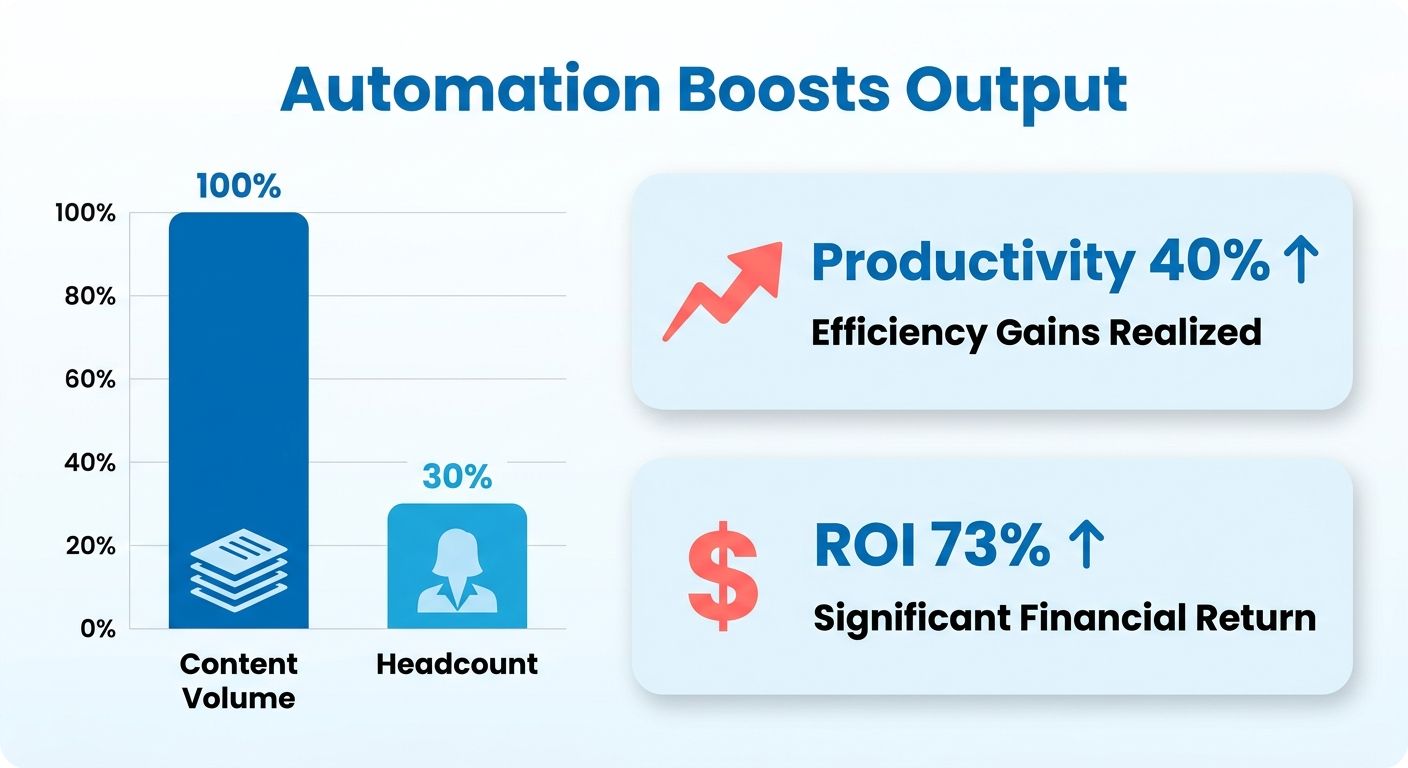
That's where automating semantic SEO earns its place. Teams running AI-based content and workflow automation report a 40% rise in workforce productivity in the first year, and 73% of executives who adopted AI in marketing saw positive ROI in under 12 months. Those gains only hold when voice stays intact. Scale that produces off-brand copy is not scale. It is cleanup work in disguise.
Why content teams stall without it
Content teams stall because manual work fragments the pipeline. Keyword research, drafting, on-page tuning, and publishing sit in separate tools and separate heads. The bottleneck is rarely talent or budget. Plenty of teams buy premium platforms, hire experienced writers, and still watch performance flatten because nobody owns the flow between steps.
Automation stitches those steps into one repeatable system. In one survey, marketers named manual handoffs and context switching as the top drag on output, with writers spending roughly 60% of their time on coordination instead of writing. Close those gaps and the same team ships more without adding people.
What automation actually fixes
Automation handles the repeatable, judgment-light tasks so your people spend their hours on strategy and voice. Keyword clustering, content briefs, technical fixes, refresh scheduling. The results are concrete: one AI content platform helped teams lift organic traffic 27% in six months. Broader reviews of AI-driven SEO tools document daily organic visitors climbing from 10 to 143 on optimized pages.
Now the honest tension. Some analyses warn that AI-generated content lacks depth and underperforms long term. Others show automation driving big traffic gains. Both are true, and the difference is scope. Unsupervised publishing risks thin pages. Automation scoped to repeatable tasks, with a human approving voice and accuracy, produces results.
Our take: put brand voice inside the automation layer, not the review queue. Train your models on a defined writing style up front so voice becomes a repeatable input rather than a drift you chase downstream. Humans still own final approval. They just approve on-brand drafts instead of rewriting generic ones. If you want a sense of which tools handle this well, our breakdown of AI SEO tools tested for 2026 covers what actually delivers.
Who gets the biggest payoff
High-volume teams with repeatable content needs win most. Publish a handful of posts a year and this is overkill. Skip it. The ROI shows up when you're producing dozens of assets across channels and voice consistency has become a real bottleneck.
B2B SaaS marketers, content strategists, and growth leaders sit squarely in that group. You're the ones managing sprawling libraries where one off-brand page chips away at the authority the rest earned. Automation defends that consistency at scale. That's the payoff worth chasing.
What semantic SEO automation actually is
Semantic SEO optimizes content around topics, entities, and search intent instead of exact-match keywords. Semantic SEO automation connects that thinking to machines. It runs the repeatable parts of the workflow, entity extraction, intent mapping, internal linking, schema generation, while people steer strategy and guard the voice.
A note on scope. Automation can handle roughly 80% of the repetitive work in semantic SEO. The other 20% is where your judgment lives: originality, editorial calls, brand voice. Voice is the one layer you should never fully hand off, even when everything upstream runs on autopilot.
The four core components
Semantic SEO automation breaks into four connected parts that feed each other without manual handoffs.
- Entity extraction: pulling the people, places, products, and concepts out of a topic so content covers a subject completely, not just a phrase.
- Intent mapping: matching each query to what the searcher actually wants, then routing it to the right content format.
- Semantic linking: modeling how your pages relate and suggesting internal links that build topical authority.
- Structured data: generating schema markup for articles, FAQs, and products automatically, which cuts the errors that creep into hand-coded JSON-LD.
Wire these together and one stage's output enters the next without reformatting. That's what separates a real workflow from a pile of disconnected tools.
How entity extraction actually works
Entity extraction reads a body of text, identifies the meaningful things inside it, then maps how those things relate. A page about "email deliverability" should surface entities like sender reputation, SPF, DKIM, and bounce rates. Miss those and search engines read the page as thin, no matter how often the keyword appears.
The shift shows up plainly here. Content built around keywords alone will not rank unless it matches search intent. Entity coverage is how a machine checks that your draft answers the full question, not just the headline.
Where NLP fits in
Natural language processing is the engine under all of it. NLP interprets meaning, extracts intent, and connects related terms so your content reads as genuinely on-topic instead of keyword-stuffed. Transformer models like BERT go further, parsing conversational and voice queries by reading the whole sentence for context rather than isolated words.
For a B2B SaaS team, that matters more than it sounds. Voice search and AI answer engines reward content that speaks in complete, natural phrasing. That's why our Persona Engine captures your brand's voice from a full crawl of your site, so every automated article still sounds like you wrote it.
Intent-based mapping in practice: a search for "best CRM" wants a comparison. "How to set up CRM" wants a tutorial. "CRM pricing" wants numbers. Automated intent classification sorts these and points each toward the right template, so you stop shipping a how-to guide to someone who wanted a shortlist. That classification is safely automatable. Deciding whether the finished piece sounds like your brand is not.
Building the workflow, stage by stage
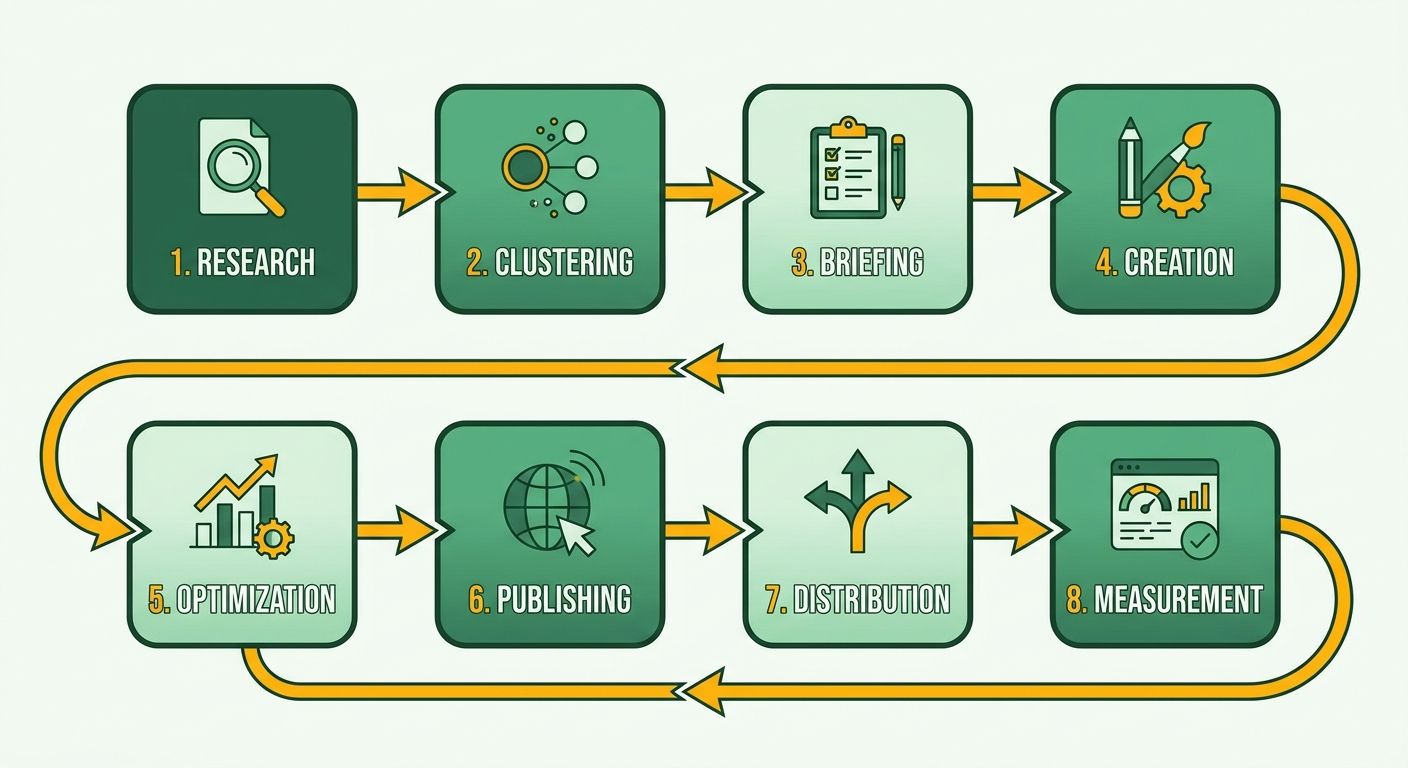
Start with the pipeline, not the tools. A working semantic SEO automation workflow connects eight stages into one continuous flow: research, clustering, briefing, creation, optimization, publishing, distribution, and measurement. Each stage's output feeds the next without manual reformatting, so data moves instead of sitting in someone's inbox.
The difference-maker is where you place your voice. Build the workflow this way and automating semantic SEO stops being a volume play and becomes a consistency play. Machines run the mechanical stages while human editors focus on final polish and strategic alignment. That's how you scale without your content sounding like everyone else's.
Setting up research and clustering
Feed raw keyword data into an AI categorization step that sorts terms by intent before anything gets written. One documented workflow groups keywords into five buckets: Quick Wins, Authority Builders, Emerging Topics, Intent Signals, and Semantic Topics. Each bucket maps to a content type, so triage happens automatically.
This is the part you can safely hand off. Intent classification is pattern-matching, and AI does it fast. The clustering output becomes a site architecture plan with hub articles and supporting spokes, which means your internal linking logic is decided before drafting starts. Skip manual keyword sorting here. The time savings are real and the judgment cost is low.
Handling content mapping and voice
Content mapping ties each cluster to a brief, and this is where voice gets built in. Train a custom model on your defined writing style, then have it draft against the brief. One team that trained custom GPTs on specific writing styles cut a two-day task to two hours, a 24x speed increase. Another compressed a four-hour, three-person workflow down to ten minutes with a single editor.
Here's the contradiction you'll run into. Some tools claim AI can analyze keyword intent "without manual intervention," implying human SEO judgment is optional. Other sources insist a human must own final review. Both are right about different layers. Intent triage and categorization automate cleanly. Creative direction still has to follow your brand guidelines, which turns brief generation into a bridge between data and style.
The pitfalls that kill these workflows
The biggest failure is automating everything instead of the right things. Fully automated pipelines with no editorial checkpoints produce generic output that does not engage readers. Keeping quality steady means scoping automation to repeatable tasks: programmatic publishing handles the mechanical work, while real-time analytics show what's actually driving organic traffic and leads.
The gap is task selection, not the AI. So automate the mechanical stages, keep the review checkpoint, and let editors have the final say. If your team publishes fewer than a handful of assets a month, this full pipeline is overkill. Build it when your volume outpaces the people you have to check it.
Putting it to work inside AnyPost.ai
Setting up semantic SEO automation inside your existing stack should feel like adding a lane to a road you already drive, not rebuilding the highway. Our approach connects the mechanical stages of the pipeline to the tools your team already publishes with, then keeps a person on the voice layer. That's the whole principle: automate the pattern-matching, guard the judgment.
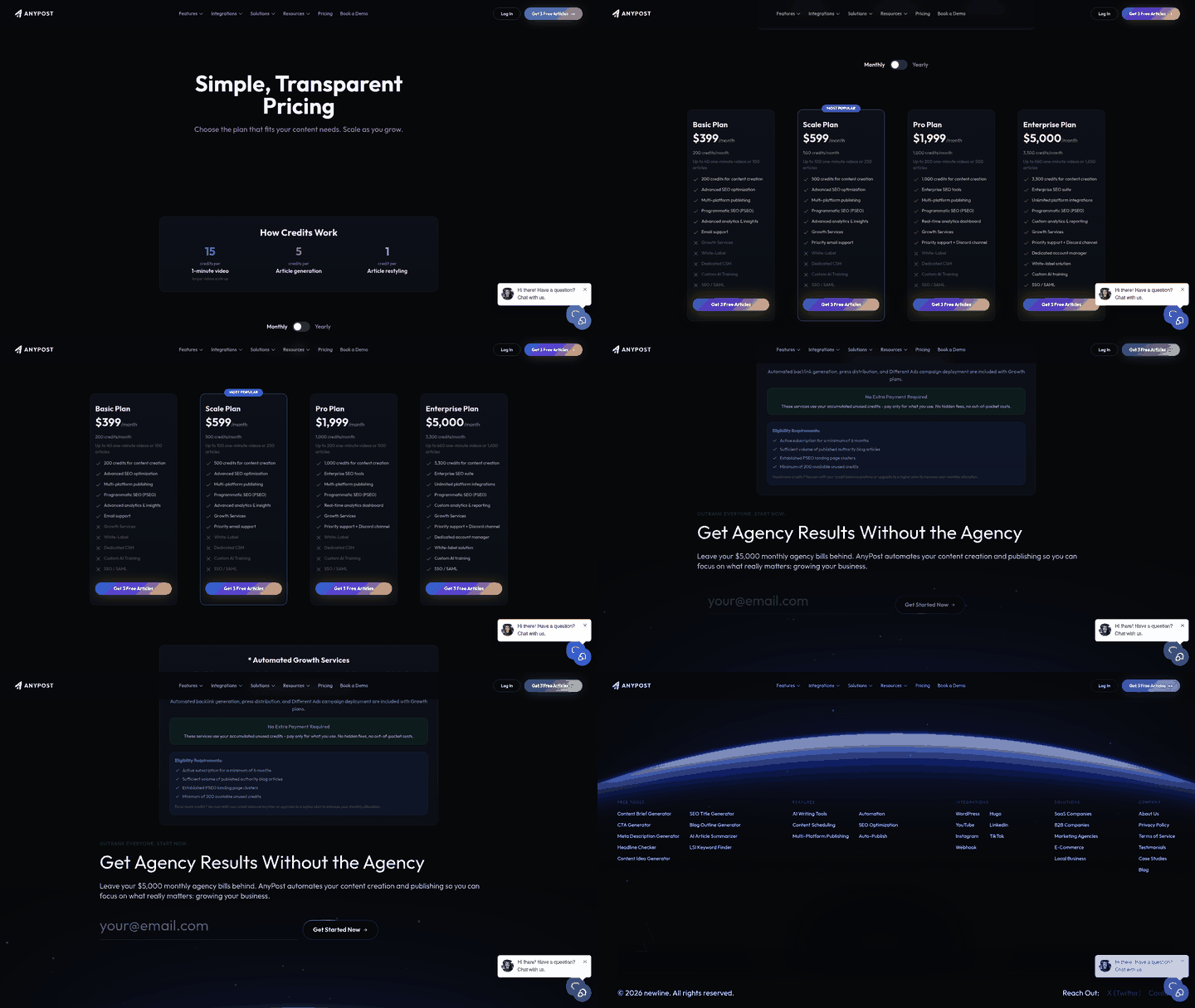
The payoff shows up fast when the plumbing is right. AnyPost automates the creation and publishing of SEO-optimized content, which removes the manual effort from research, drafting, and on-page work. That's not a volume trick. It is what happens when automation removes the handoffs between stages so data moves instead of sitting in a queue.
Connecting it to your existing platforms
Map where content already lives, then wire the automation to feed those endpoints directly. Integration means your keyword data, briefs, and drafts flow into your CMS, docs, and analytics without manual reformatting.
Three connection points to prioritize first. Connect your keyword source so raw terms get categorized automatically by search intent. Connect your CMS so approved drafts publish with schema already attached. Connect your analytics so ranking and traffic signals loop back into what gets refreshed next.
The voice layer is where we draw the line. Align the system with your brand's tone guidelines during setup, and the drafting stage produces content that mirrors your established style. That reframes editorial review from a heavy rewrite into a quick verification step, with your editor still owning final approval.
What a real implementation looks like
The strongest results come from fixing structure and content quality together, not from the tool alone. AnyPost crawls your entire site to build a Business Context Graph of your products, messaging, and audience, then uses that context to generate ready-to-rank articles in your voice. With multi-source content integration and auto-publishing across platforms like WordPress, LinkedIn, and X, the mechanical work moves through one dashboard while your team stays on strategy.
Our honest read on how this plays out: technology is only as good as the strategy behind it. Even the most capable platform stalls without a clear pipeline. Establish your operational sequence first, and automation amplifies your team's strengths instead of handing you a dashboard full of noise.
Best practices we follow
Automate the right tasks, not all of them. Intent classification and keyword categorization are safe to hand off fully. They're mechanical pattern-matching. Originality, editorial calls, and voice are not.
- Automate your refresh cadence first. Defending earned authority beats chasing net-new volume.
- Keep a validation checkpoint before publish. Structured review catches accuracy gaps without slowing the flow.
- Condense information into clear chunks on the page so answer engines parse it cleanly.
Skip full automation of keyword triage when your topics are genuinely novel. When intent is obvious, let the machine sort it. When you're staking out new ground, keep a human in the loop. That balance is where scale and voice integrity actually hold together.
Measuring what the pipeline is really doing
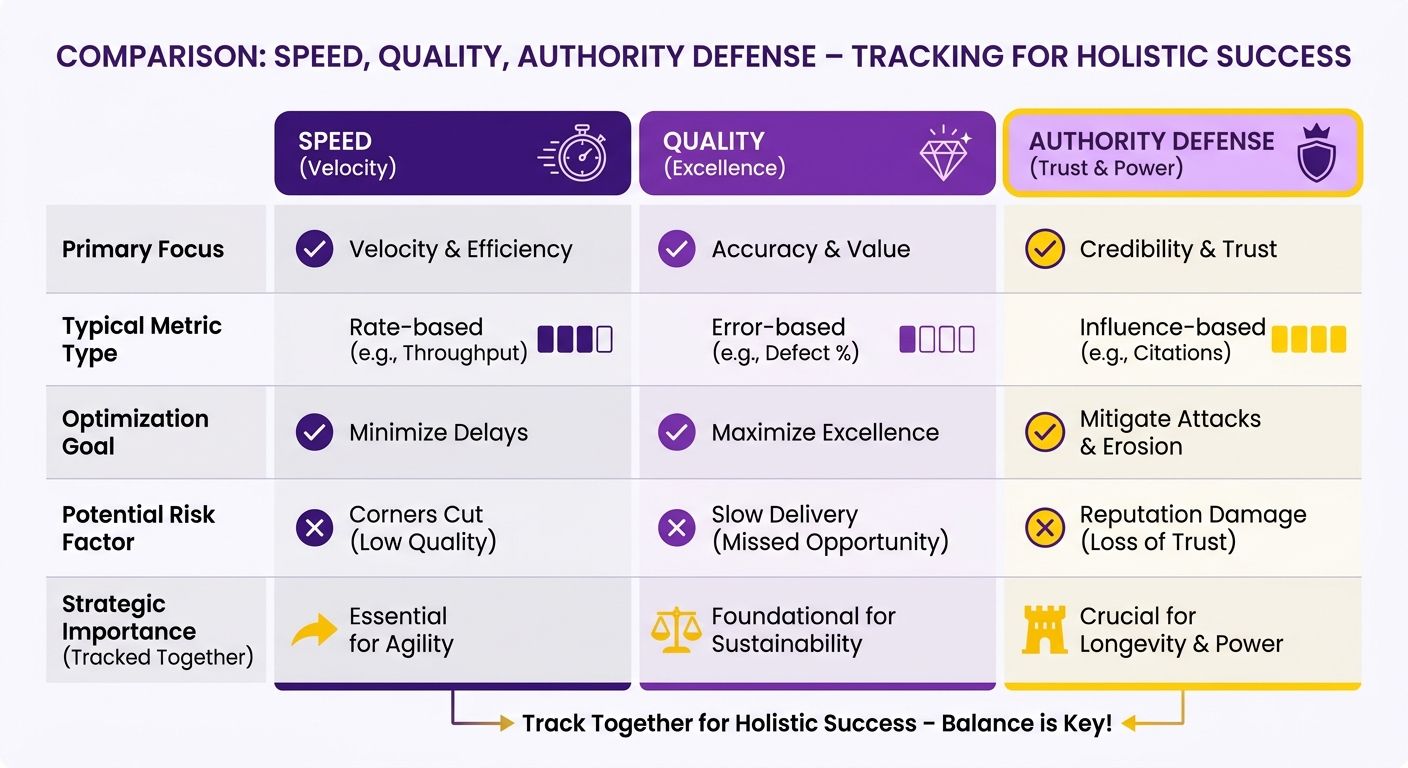
You can't optimize what you don't measure. The metrics that matter for semantic SEO automation sort into three buckets: speed, quality, and authority defense. Track all three, or you'll tune the pipeline for raw volume and quietly lose ground on the one thing that compounds.
One fact reframes the whole exercise. Measuring success means looking past raw output. The highest-value measurement tracks how cleanly work moves between stages, so efficiency gains actually land at every handoff instead of leaking out.
The metrics that actually matter
Three metric families tell you whether the workflow is working: speed, quality, and authority. Speed covers time-to-publish and per-task time. Quality covers content quality scores and editorial pass rates. Authority covers citation retention and organic traffic movement over a fixed window.
On speed, the gains are real when you scope automation tightly. Streamlining research and drafting moves teams from concept to final review in a fraction of the traditional time, provided a human still owns the final call.
On quality, watch your editorial pass rate as a leading indicator. It tells you what share of AI drafts clear review without a rewrite. A rate that climbs over time means your briefs and training inputs are getting sharper. A pass rate that stalls below 70% usually means the automation is producing volume your editors have to repair. Quality metrics catch voice drift before it ships, which is exactly the layer you never want to fully automate.
On authority, measure organic traffic against a set baseline. AnyPost analyzes competitors and identifies content gaps to generate SEO-optimized articles, an approach that helped SaaS companies increase organic traffic by 340% in six months. Pair that with citation retention so you know you're defending existing pages, not just chasing new ones.
Which tools track workflow performance
Automated dashboards are the backbone here. They pull rankings, traffic, and conversions into one visual report so you stop stitching numbers together by hand. The point is a single source of truth that updates without a human export step.
Your dashboard should connect to your CMS, analytics, and CRM. That integration is what turns scattered metrics into a feedback loop. When performance data flows back to the briefing stage automatically, your next round of content starts smarter than the last.
Optimizing without breaking voice
Our take: the biggest optimization lever is task selection, not more AI. The sources genuinely conflict. One camp shows AI content lacks depth and underperforms long term. Another shows automated workflows driving concrete traffic gains. Both are right. The split comes down to whether you use the technology to bypass editorial standards or to support them.
So optimize the scope, not the volume. Automate research, drafting, and on-page updates. Keep humans on originality and final approval.
The quiet challenge most teams miss is training data quality. If you want brand voice preserved at scale, the examples you feed your system have to represent your best work. That turns voice from a manual bottleneck you police downstream into a foundational standard. Feed the system messy or off-brand examples and every metric downstream inherits the mess. Clean training data is the difference between scale that sounds like you and scale that sounds like everyone else.
Scaling it across a full team
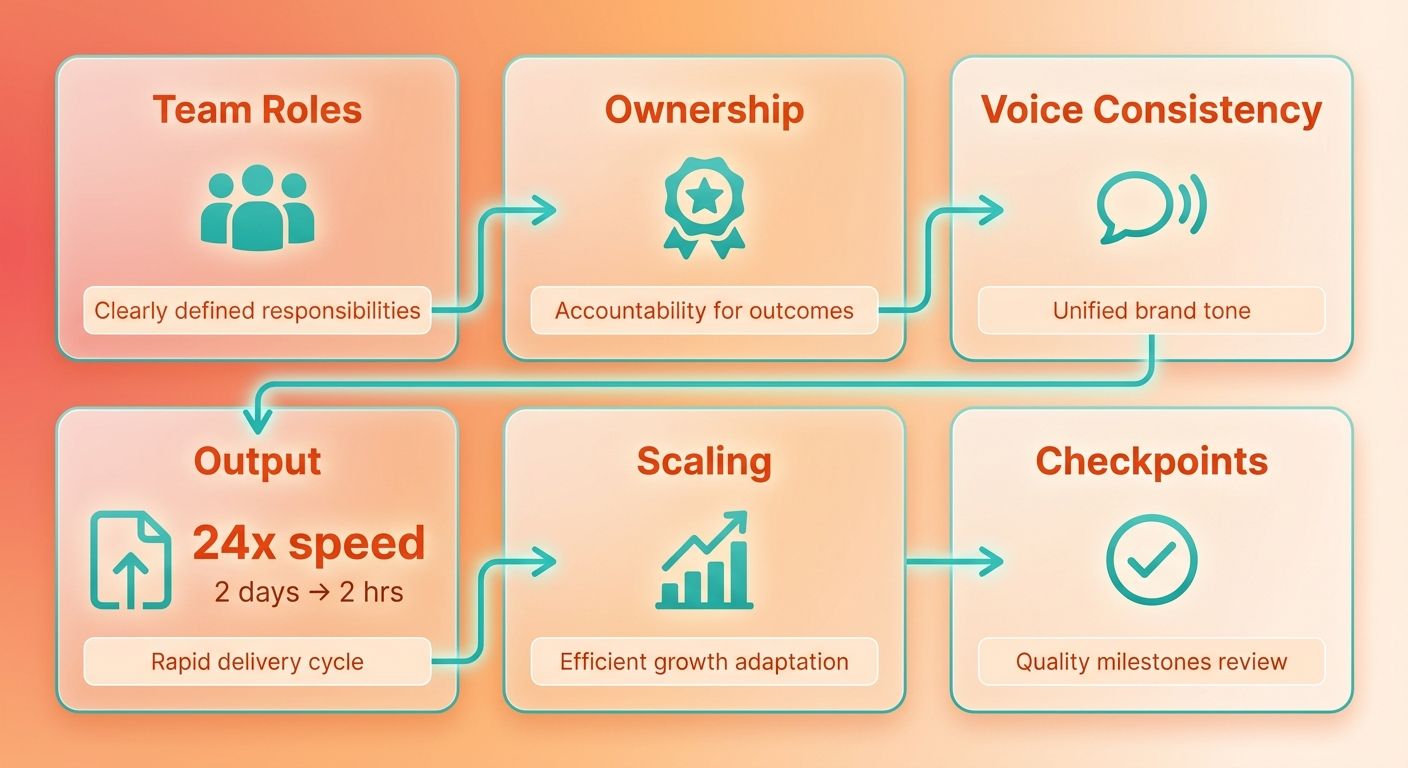
Scaling semantic SEO automation across a team is less about buying more tools and more about defining who owns what. When output climbs across writers, editors, and channel owners, voice consistency breaks first. Our approach keeps machines on the mechanical stages and puts one clear owner on the voice layer, so brand integrity does not fragment as more hands touch the pipeline.
The math is hard to ignore. Streamlining the production pipeline unlocks real efficiency gains. But that speed only helps if every asset still sounds like it came from the same brand. Automating semantic SEO at team scale means the voice standard travels with the work, not with whoever happens to be drafting.
Embedding brand voice into the automation layer
Set clear stylistic guardrails before you generate anything. Instead of correcting off-brand tone during editing, configure your generation templates to prioritize your brand's vocabulary, sentence structures, and formatting preferences. Proactive alignment turns voice from a bottleneck into a standard.
This is the shift that lets teams scale without sounding generic. When five writers feed the same voice-trained system, their drafts arrive pre-aligned. That shows up in review time: teams that standardize voice inputs often cut editing rounds from three passes to one, since editors are no longer resetting tone on every draft.
Set clear voice thresholds and let contributors self-check against them before work moves forward. A shared rubric of do's and don'ts, sample sentences, and banned phrasing gives every writer the same target and keeps the automation layer honest.
The common collaboration challenges
The biggest team problems are handoff friction and unclear ownership. Work sits in queues between stages, and nobody knows whether a brief is ready for drafting or a draft is ready for publishing. That gap is where speed dies, no matter how fast any single tool runs.
Fix it with shared briefs and defined approval gates. Automation tools that integrate with your CMS, analytics, and CRM let briefs, drafts, and sign-offs move in one system instead of scattering across inboxes. When the brief carries the voice guidelines, keyword targets, and internal linking plan in one place, every contributor works from the same source of truth.
One carve-out. If your team is under a handful of people publishing a few posts a month, this level of orchestration is overkill. The collaboration overhead only pays off once volume and headcount create real handoff cost.
What scaling looks like in practice
Scaling works when you automate the right tasks, not all of them. The teams that get this right start by mapping every stage of their pipeline, then automate only the steps that repeat identically each time: keyword clustering, brief assembly, internal link suggestions, metadata generation. One mid-market content team we watched moved from eight published pieces a month to thirty without adding writers, simply by pulling those mechanical steps off human plates.
That distinction is everything. Programmatic generation without editorial guardrails fails to build long-term authority. Structured automation paired with human oversight compounds over time. Selecting the right tasks to automate is the true difference-maker.
Frequently Asked Questions
1. Should I automate content for a legal or executive thought leadership page?
These high-stakes pages require deep personal expertise, nuanced legal compliance, or unique executive perspectives. Because the risk of error is high and the volume is low, the time spent editing automated drafts often exceeds the time it takes to write them from scratch. Focus automation instead on your broader educational and informational content library.
2. What editorial pass rate signals my automation is actually working?
A healthy target is to have the majority of your automated drafts require only light polish rather than structural rewrites. If your editors are consistently rebuilding drafts from scratch, it indicates that your initial style guidelines or brief templates need refinement. Use editing feedback to continuously update your system's instructions.
3. Why do teams with premium tools and skilled writers still stall?
Without a structured workflow, team members spend more time managing handoffs and switching contexts than actually producing content. Tools alone cannot solve coordination friction. Success requires defining clear ownership for each stage, such as research, editing, and publishing, so work moves seamlessly through the pipeline.
4. How much of the semantic SEO workflow can I safely hand to machines?
Machines excel at data-heavy, programmatic tasks like analyzing search intent, mapping related entities, and generating structured schema. Humans, on the other hand, must handle the creative and strategic elements, such as injecting original insights, verifying factual accuracy, and ensuring the final piece aligns with brand standards.
5. How do I keep brand voice consistent when five writers use the same system?
Provide your team with a centralized platform where style guidelines are programmatically applied to every brief. By standardizing the generation parameters upfront, different writers can produce cohesive drafts that share a unified tone, significantly reducing the need for editors to manually adjust style downstream.
6. Does automation mean I can publish AI drafts without human review?
An editor's role shifts from writing drafts to acting as a strategic gatekeeper. While automation handles the initial research and drafting, human review is essential to verify facts, add unique brand perspectives, and ensure the content truly serves the reader. This gatekeeping step is what protects your site's long-term search authority.
7. Why prioritize refreshing old pages over publishing new ones?
Maintaining existing rankings requires far less effort than building authority from scratch. Search engines and AI answer engines prioritize fresh, accurate information, meaning older content will naturally lose visibility if left stagnant. Implementing an automated schedule to identify and update decaying pages protects your hard-won traffic and compounds your overall search footprint.