
Semantic Pen Principles for Crafting AI Generated Content that Ranks

Key Takeaways
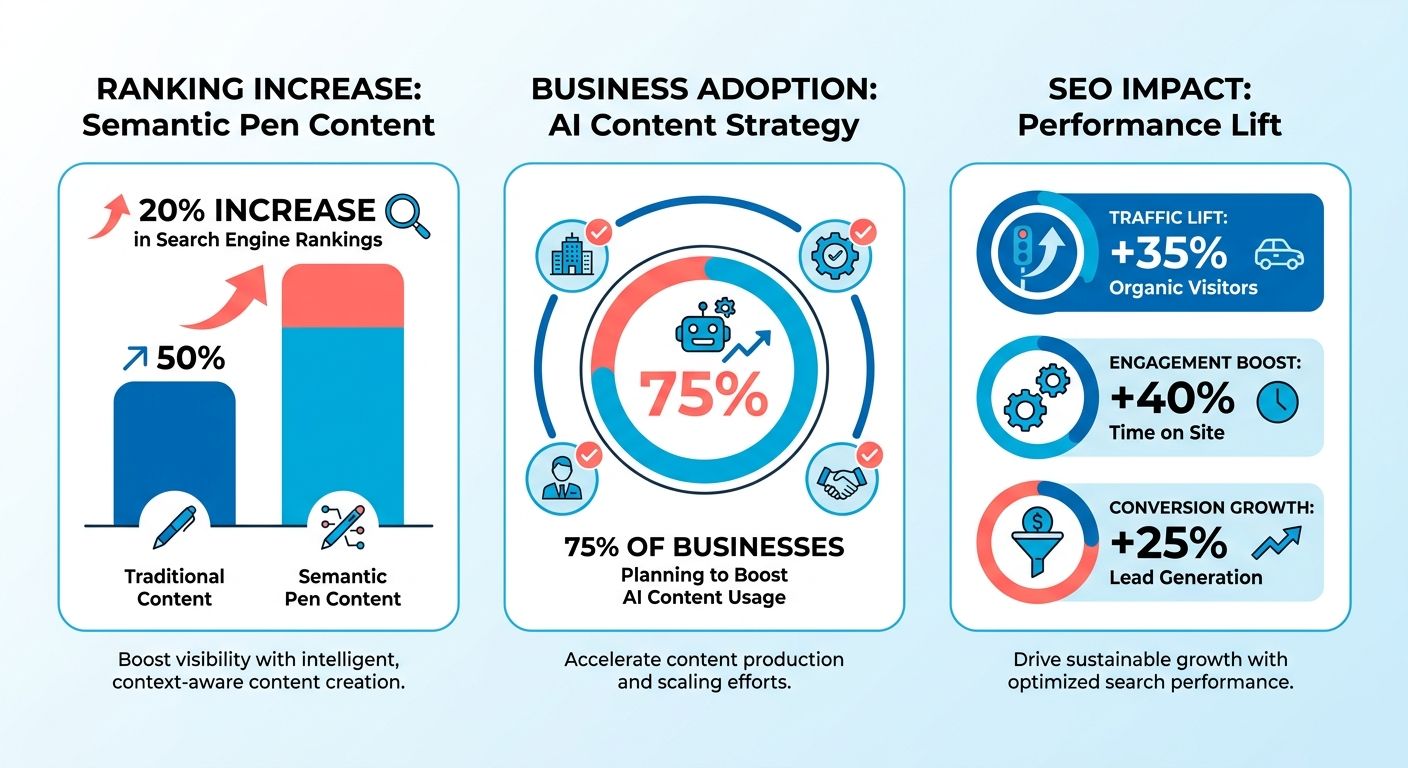
- Content built around meaning and genuine relevance sees roughly a 20% bump in search rankings, per Ahrefs analysis.
- Matching search intent instead of stuffing keywords improves ranking by about 25% on average.
- Around 75% of businesses plan to lean harder on AI-generated content over the next year, which raises the stakes on quality.
- Meaning-driven content can lift traffic and leads by up to 30%.
- Google's spam policies penalize automation built to game rankings. Meaning-first content stays on the right side of that line.
- Poor quality and weak relevance are the two things that kill AI content. Both get fixed by writing to intent.
- Competitive fields like finance and healthcare benefit most, because authority and accuracy decide who ranks there.
Why this matters more than it used to
Semantic pen principles are what separate content that ranks from content that gets buried. Build your AI drafts around meaning, context, and actual relevance, and you satisfy both the search engine and the person reading. Content that follows this approach sees roughly a 20% increase in rankings, according to Ahrefs.
The timing makes it urgent. Around 75% of businesses plan to increase their use of AI-generated content over the next year. That's a lot of filler heading for the internet. Google's guidance on this is blunt: automation whose main purpose is manipulating rankings violates its spam policies. Meaning-first content is how you avoid that penalty.
What these principles actually solve
Two problems: poor quality and lack of relevance. Write to match the intent behind a query instead of stuffing keywords, and your pages answer real questions. That relevance is what earns rankings and holds attention.
Where it pays off most:
- Competitive industries like finance and healthcare, where authority and accuracy decide who ranks.
- Content teams drowning in AI output that reads fine but says nothing.
- Businesses chasing leads, since meaning-driven content can lift traffic and leads by up to 30%.
The average lift from applying these principles is about 25%. That's the gap between page two and the top of page one on a query that actually converts.
How you know it's working
Track three things: engagement, conversions, and ROI. Engagement tells you whether readers stay. Conversions tell you whether that attention turns into action. ROI ties the whole effort back to revenue, which is the number your stakeholders actually care about.
Don't obsess over rankings alone. A page can rank and convert nothing. If your content ranks well but engagement stays flat, the relevance is off. Fix the intent match before you touch anything else.
For why meaning-based structure works so well, this overview of semantic search technology covers how modern engines read context instead of exact strings.
How long before results show up
Plan for 1 to 3 months. You need time to audit existing content, retrain your prompts around intent, and let search engines reindex the improved pages. Rankings don't shift overnight.
The difficulty is moderate to advanced. You need real SEO judgment to spot where AI output drifts into generic filler, and that skill takes practice. Teams with strong subject expertise move faster. Starting from scratch on a competitive topic? Plan for the full three months and expect to iterate on your prompts more than once.
Understanding Semantic Pen Principles
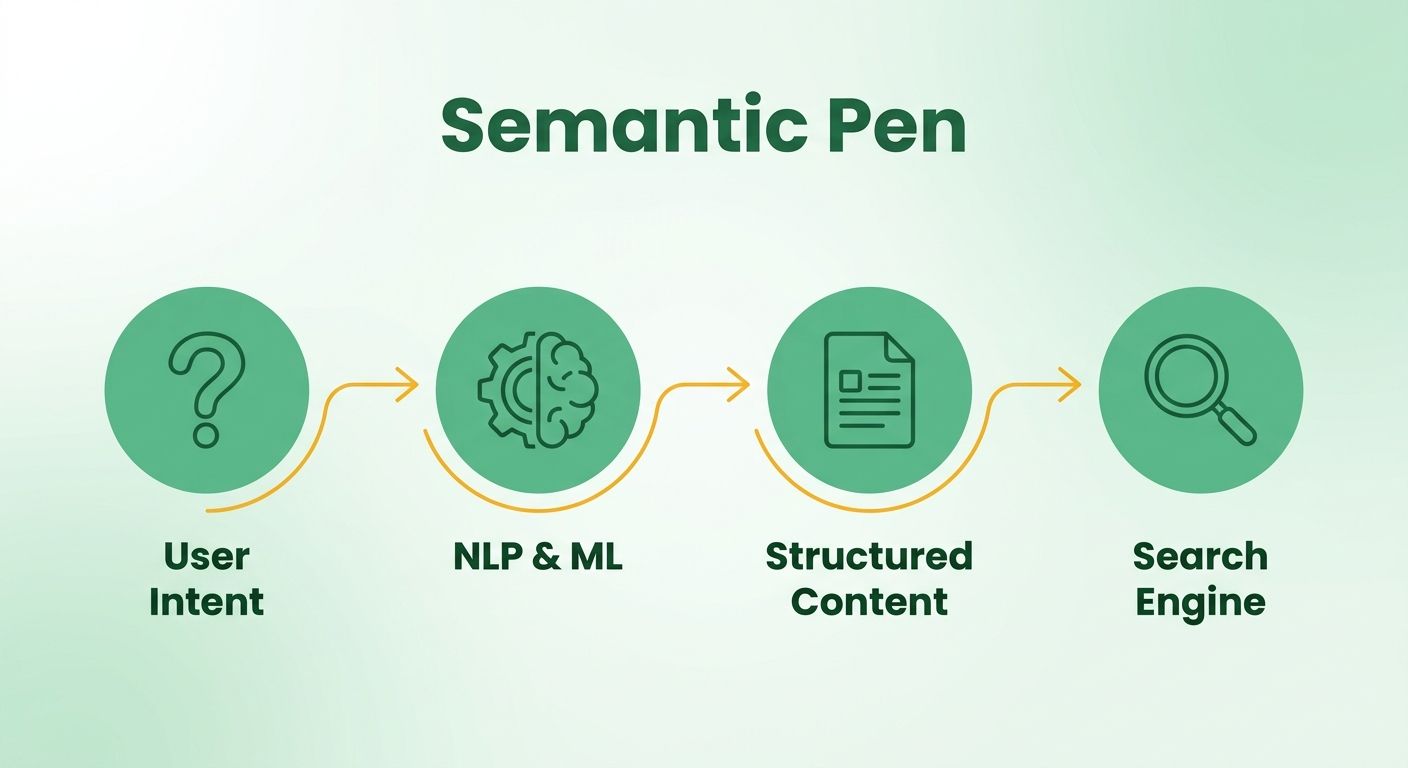
A semantic pen approach means writing content machines understand through meaning, not keyword density. It leans on natural language processing and machine learning to produce text that answers real questions with genuine relevance. The goal is content that reads well for humans and gets parsed accurately by search engines.
The focus shifts from phrase matching to full topical coverage. Organize information around core concepts and crawlers can categorize your pages cleanly. That structural clarity is what marks your site as a reliable source.
The core principles
Semantic writing prioritizes context, entity relationships, and reader intent over surface-level keyword matching. It relies on NLP to map how words connect and what they mean in context.
Three ideas anchor it.
First, context beats repetition. A page about running shoes should cover cushioning, terrain, and pronation, not repeat "running shoes" twenty times.
Second, entity relationships tell search engines how concepts link. Mention a brand, its product line, and the problem it solves, and you build a web of meaning that ranks.
Third, reader intent drives structure. Answer the question someone actually typed, then anticipate the follow-up. A tested framework for AI content stresses exactly this: write for the human first, and the machine parsing follows.
Applying this across content types
The same meaning-first logic works for blog posts, social captions, and product descriptions. Only the length and tone shift.
Blog posts benefit most from depth. Cover a topic fully, link related subtopics, answer adjacent questions in one place. That signals expertise and keeps readers on the page longer.
Product descriptions need concrete entity detail. State what the item does, who it serves, how it compares. Vague copy fails here because shoppers and algorithms both want specifics.
Social posts demand tight, intent-driven phrasing. You have seconds to match what a scroller wants. Semantic clarity beats clever wordplay when the goal is a click.
Modern search engines don't hunt for exact string matches anymore. They analyze the relationships between entities to serve the most contextually appropriate result.
Why meaning matters to language models
Semantic meaning is the difference between text that sounds right and text that answers the question. Language models produce fluent sentences easily. The hard part is making those sentences genuinely relevant and correct.
Linguists have argued for decades that meaning, not grammar alone, defines useful language. Noam Chomsky's work on how humans process semantic structure underlines why AI tools have to go beyond pattern-matching to build content that holds up.
Skip that deeper layer and you get generic, repetitive text that fails to engage anyone. Build in clear semantic structure and your content stays valuable and distinct in a crowded field.
Optimizing AI-Generated Content for SEO
Optimizing AI content for search starts with meaning, not mechanics. You earn rankings by matching real search intent, building topical authority, and earning trust signals. A semantic pen workflow makes this easier because it forces you to write around topics and entities, not scattered keywords.
The order matters. Research first, structure the content around what people actually ask, then optimize the technical layer. Follow that sequence and your drafts start ranking instead of sitting on page five. Here are the three steps that move the needle.
Keyword research that gives the AI a target
Keyword research is where you map search intent to topics before writing a single prompt. Identify the questions your audience asks, the entities tied to those questions, and the gaps competitors miss. That gives your AI a target instead of a guess.
Group related queries into topic clusters. One strong cluster beats twenty thin pages. Feed the AI the cluster, the intent behind it, and the entities that must appear. That context is what separates content that answers a question from content that circles it.
Generative search changes the math too. ChatGPT, Perplexity, and Gemini are reshaping how people find information. Optimizing for these engines means your content has to be extractable and clearly relevant, not just keyword-matched.
Why link building still matters
Backlinks remain a trust signal search engines rely on. High-quality links from relevant sites tell Google your content deserves ranking. For AI-generated content especially, external validation proves the piece is more than automated filler.
Focus on relevance over volume. One link from a respected industry site outweighs dozens from low-quality directories. Earn links by publishing content worth citing: original framing, useful data, clear answers. Easier when your writing already reads well and covers a topic in full.
When authoritative sites reference your work, it signals to search algorithms that the content provides genuine value. That's what sustains visibility over the long term.
What technical optimization actually helps
Clean structure, fast load times, and clear formatting help both search engines and readers parse your work. AI content that ignores this loses ground even when the writing is strong.
Structure your pages so answers surface fast. Use direct opening sentences, clear headings, and definition-style formatting so engines can extract your key points. That structural clarity lets crawlers index your main arguments cleanly.
Run this checklist on every AI draft before publishing:
- Match intent: confirm the piece answers the query it targets, not a related one.
- Lead with the answer: put the direct response in the first two sentences of each section.
- Format for scanning: short paragraphs, clear headers, bolded key terms.
- Verify facts: check every claim your AI produced against a real source.
Align the technical setup with clear, structured writing and you get a clean experience for both human visitors and crawlers.
Overcoming Challenges in AI-Generated Content
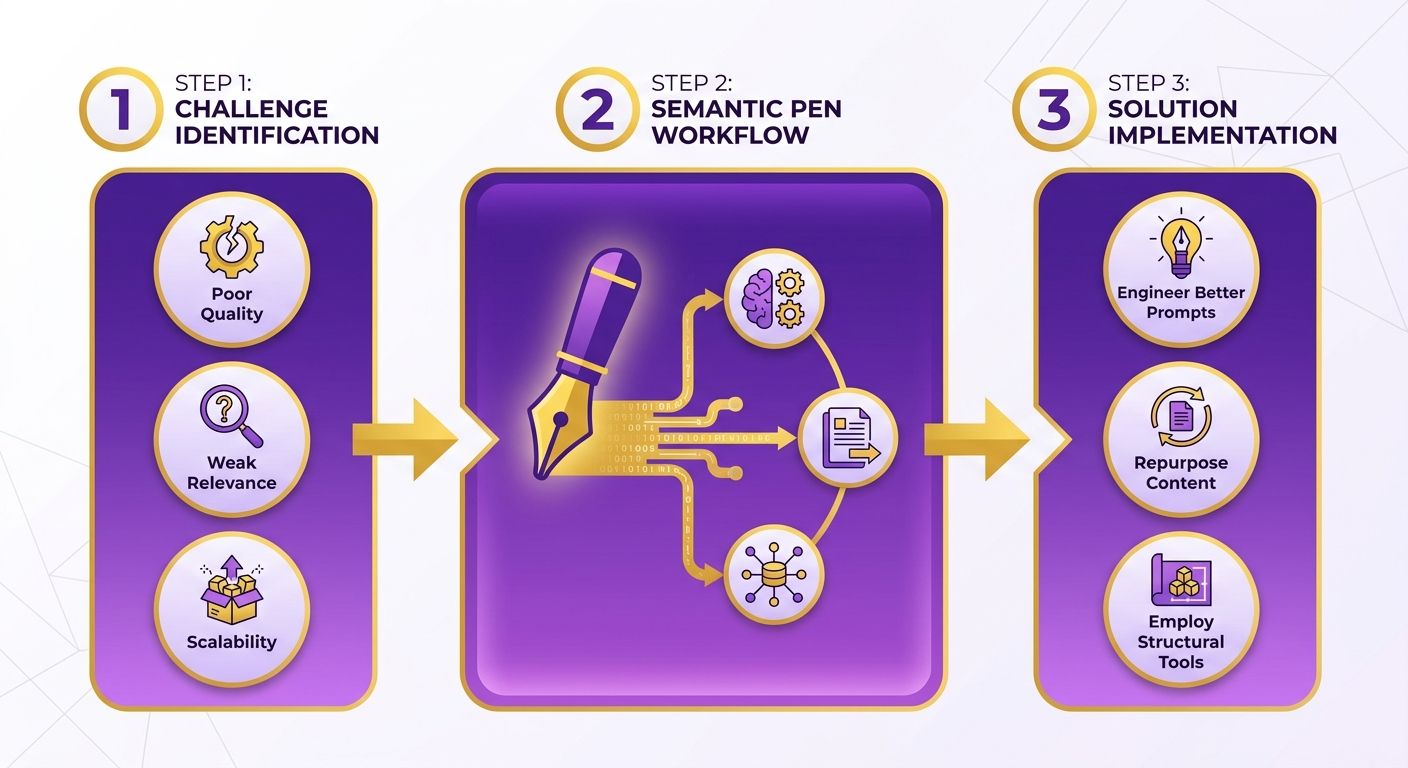
AI content fails for three predictable reasons: poor quality, weak relevance, and scale that breaks under volume. Fix those and your content earns rankings instead of clogging page five. A semantic pen workflow tackles all three because it forces meaning and structure into every draft.
Scaling means rigorous editorial standards. Cranking up publishing volume without maintaining depth just trips search engine quality filters. Structured, intent-driven writing keeps your content competitive as your library grows.
Fixing poor quality in AI drafts
Quality control starts with treating the draft as a first pass, not a finished product. Edit for accuracy, add real expertise, cut generic filler. The goal is content that reads like a person who's done the work wrote it.
The most reliable fix is human review layered on top of generation. Check every factual claim. Replace vague statements with specifics. Add the context, examples, and judgment an AI model can't supply on its own.
Iteration matters more than any single edit. Publish, measure how the piece performs, then refine your prompts and structure based on what you learn. That feedback loop is what separates content that improves over time from content that stays mediocre.
Keeping AI content relevant
Relevance comes from matching real search intent, not padding a page with keywords. Write around the questions your audience actually asks and the entities tied to them. When the content answers the query fully, readers and search engines both reward it.
Frameworks tested across the major AI models land on the same conclusion: content that ranks and reads well shares a clear structure built around meaning. Weak relevance usually traces back to a vague prompt or a shaky read on intent. Tighten the input and the output improves.
Structure reinforces relevance. Lead with the direct answer, then elaborate. Organize sections around topics rather than scattered phrases. That's the discipline that keeps AI content from drifting into repetitive, low-value patterns.
The metrics that tell you it's working
Focus on user behavior and business outcomes. How visitors interact with your pages gives you the clearest read on whether the content meets their needs.
Reviewing performance data also shows which topics land hardest with your audience. Watch those trends and you can steer your editorial strategy toward the areas that perform.
Three indicators worth watching:
- User behavior: Are visitors reading the full page or bouncing immediately?
- Action rates: Is the content guiding users toward your primary business goals?
- Resource efficiency: Does the performance justify the time spent editing and optimizing it?
Review these regularly and you turn raw drafts into assets that actually earn their keep.
Future of AI-Generated Content: Trends and Predictions
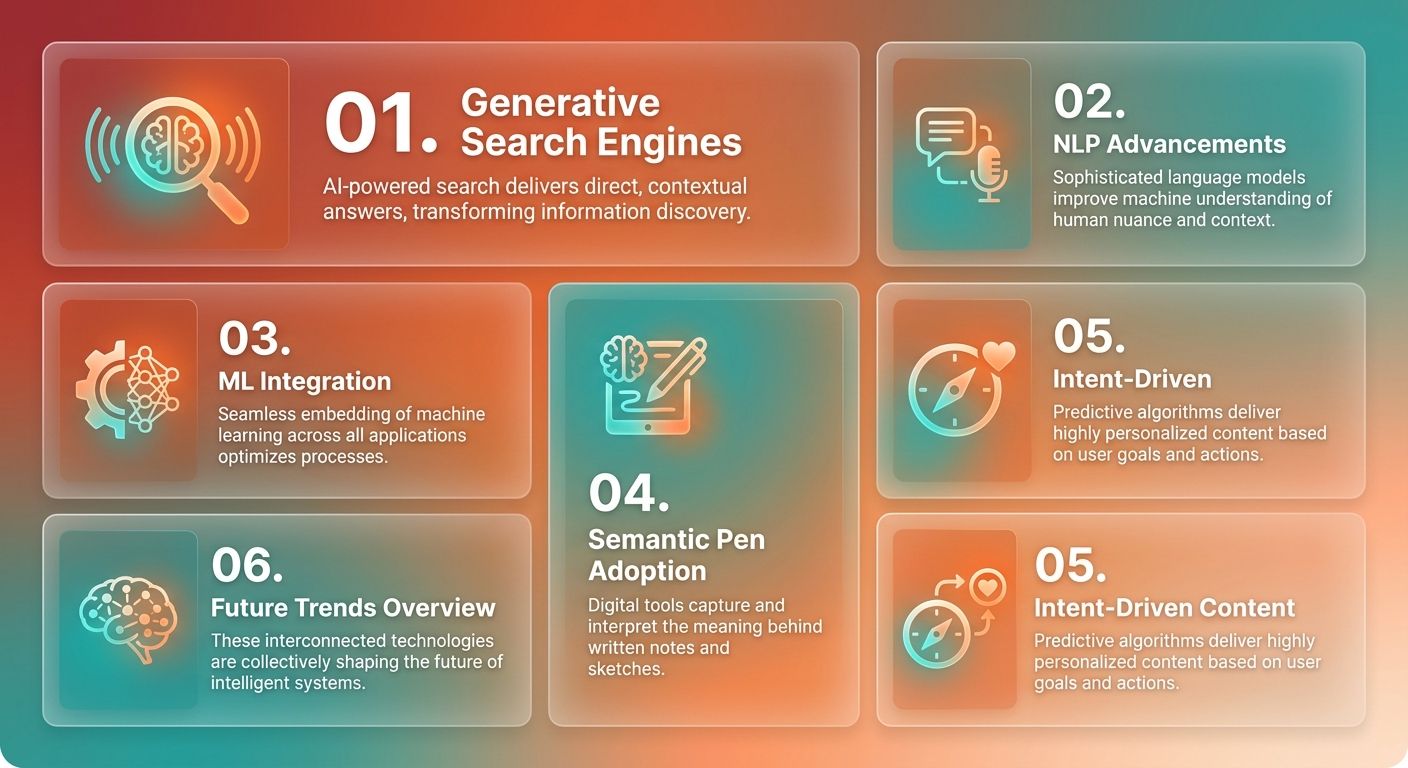
AI content is moving toward systems that understand meaning as deeply as they generate it. NLP and machine learning drive the shift, and the tools built on semantic pen principles are the ones positioned to keep ranking as search itself changes. The next few years belong to content that answers real intent, not content that games keywords.
The momentum is clear. Generative search engines are already reshaping how people find answers, which changes what "ranking" even means. Gartner predicts traditional search engine volume will drop 25% by 2026 as AI chatbots and virtual agents absorb more queries. That drop means the quality bar keeps rising, and a semantic pen workflow is what separates useful output from the flood of filler.
How generative search is changing content
Generative Engine Optimization is the practice of optimizing content so AI-powered search tools surface and cite it directly in their answers. The rapid adoption of generative AI search is reshaping how information reaches people, and that changes what creators need to build.
ChatGPT, Perplexity, and Gemini now answer questions directly instead of listing links. Your content has to be structured so these systems can parse it, trust it, and quote it. That means clear entity relationships, direct answers up front, and content built at the intersection of traditional SEO and AI-first optimization.
The practical takeaway: write self-contained answers. When an AI engine can lift a clean, accurate paragraph from your page, you earn visibility even when the reader never clicks a blue link.
The applications growing fastest
Three are pulling ahead: personalized content, chatbots, and voice assistants. Each depends on machines understanding meaning, which is exactly why semantic principles sit at the center of the shift.
Personalized content adapts to individual readers based on intent and context, not just demographics. Chatbots hold conversations that feel relevant because they parse meaning rather than matching keywords. Voice assistants answer spoken questions where there's no screen to scan, so precision and clarity matter even more.
None of this is distant. It runs on the same NLP and machine learning that already power search. The businesses building for it now are the ones that stay visible as the tech matures.
What experts predict
Ray Kurzweil argues AI-generated content will reshape how we communicate, pushing machines from tools that assist writing toward systems that genuinely understand it. That prediction lines up with what's happening in search right now.
As these systems evolve, search engines get better at spotting and rewarding original, high-value insight. The focus shifts away from keyword density toward the depth and accuracy of the information itself.
To prepare, prioritize thorough research and clear, structured formatting. Build content around well-defined entity relationships and your work stays discoverable and authoritative, no matter how the technology shifts.
Building AI Content with Semantic Pen Principles
Building AI content with a semantic-pen mindset comes down to three moves: engineer better prompts, repurpose what already works, and let real tools handle the structural heavy lifting. Get those right and your drafts arrive closer to publish-ready, dodging the generic output search engines increasingly ignore.
The workflow isn't complicated, but the order matters. Feed the model context and intent first, then shape the output around entities and reader questions, then repurpose the winners across formats. Applying semantic principles at each step keeps meaning at the center instead of chasing isolated keywords.
Engineering prompts for semantic content
Prompt engineering is the practice of giving a model enough context, intent, and structure that it produces content built around meaning rather than filler. The prompt is where semantic thinking either happens or doesn't.
Start by handing the model the specifics. Name the search intent, the entities the topic touches, the questions your reader actually asks. A vague prompt gets you a vague draft. A prompt loaded with context and audience detail gets you something you can edit instead of rewrite.
Frameworks tested across Claude, ChatGPT, Gemini, and Copilot land on the same point: content that reads well and ranks comes from prompts that force structure and relevance up front. Tell the model who's reading, what they want, and how the piece connects to related concepts. That single habit separates usable drafts from generic ones.
Why repurposing multiplies your output
Content repurposing means taking one strong asset and reshaping it for different formats and channels while keeping its core meaning intact. It's the fastest way to scale without diluting quality.
It works with semantic principles because the underlying topic and entity relationships stay constant. A pillar article becomes a set of social posts, a LinkedIn breakdown, a short explainer. Same meaning, new surface. You're not spinning thin variations. You're serving the same intent across the places your audience actually shows up.
That consistency compounds. A unified message makes it easier for both human audiences and automated discovery engines to recognize and trust your expertise.
What tools support a semantic workflow
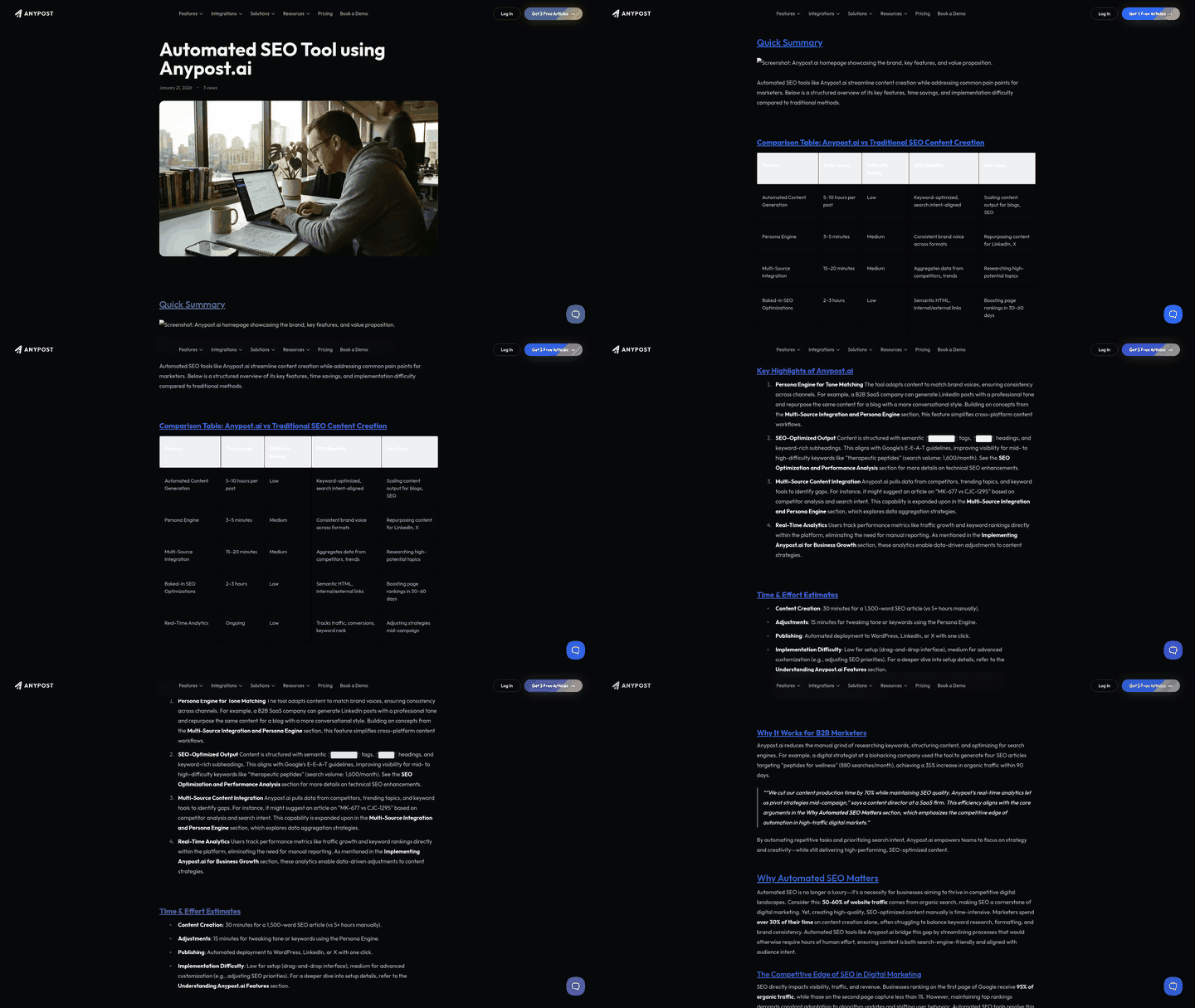
Tools that support semantic work do three jobs: extract business context, structure content around entities, and check output against search intent before you publish. The right stack turns a rough draft into something machines understand.
Look for tooling that builds a context graph of your brand, products, and audience, then wraps each topic in semantically correct structure. That's what keeps output aligned with intent instead of stuffed with phrases, so it gets parsed accurately by search engines and pulled cleanly into AI answers.
One honest carve-out: skip the heavy tooling for a one-off post you'll never update. A single quick piece doesn't need a full semantic pipeline. But if you're publishing at volume and want consistent quality, the structural support pays for itself. Quality and relevance stay the deciding factors either way. No workflow rescues content that ignores what the reader came to find.
Frequently Asked Questions
1. Can semantic pen principles help content already published that isn't ranking well?
Existing underperforming pages benefit significantly from a semantic audit. Rewrite sections to match search intent, add entity relationships, and lead each paragraph with direct answers. Retooling old content often ranks faster than fresh pages because search engines already recognize the URL and have indexing history to build on.
2. Do semantic principles work for languages other than English?
Semantic principles apply across all languages because they focus on meaning, context, and entity relationships rather than exact phrasing. Natural language processing models parse intent in most major languages. The core discipline—answering real questions with genuine relevance—stays universal, though keyword research tools and competitor gaps vary by market and region.
3. What is the difference between AI slop and semantically optimized content?
AI slop is grammatically clean text that repeats known information without adding value or answering intent precisely. Semantically optimized content maps entity relationships, anticipates follow-up questions, and includes verified facts plus real expertise. The distinction is depth: slop circles a topic while semantic content resolves it completely for readers and engines.
4. How much human editing does AI-generated content really need before publishing?
Treat every AI draft as a first pass requiring substantial review. Verify all factual claims against real sources, replace vague statements with specifics, and add examples or judgment the model can't supply. Skilled editors typically spend 30-50% of production time refining output, which is where quality separation happens.
5. Is semantic optimization worth it for small businesses with limited budgets?
Small businesses gain the most use from semantic principles because quality beats volume. One deeply relevant page outranks twenty thin ones, reducing production costs. Focus budget on subject expertise and intent research rather than mass publishing. A single authoritative article converting well outperforms scattered generic content that gets buried.
6. Can you rely on AI content tools alone without SEO knowledge?
Tools accelerate production but can't replace SEO judgment. You need human skill to spot where output drifts into generic filler and to confirm intent matches. The most effective approach pairs semantic tooling that structures content around entities with a reviewer who understands search behavior and verifies relevance before publishing.
7. Will optimizing for AI search engines hurt traditional Google rankings?
Optimizing for generative engines like ChatGPT and Perplexity reinforces traditional rankings rather than competing with them. Both reward self-contained answers, clear entity relationships, and direct responses up front. Writing extractable, well-structured content serves blue-link results and AI answer boxes simultaneously, so you don't need separate strategies for each channel.