Semantic SEO Automation: Tools and Workflows That Save Time

Key Takeaways
- InLinks handles entity clustering and automated schema, giving you deep semantic mapping. The tradeoff is a steeper learning curve.
- Surfer SEO scores content and builds SERP-based outlines in minutes. Brand voice tends to flatten out, though.
- BrightEdge Autopilot automates structured data and crawl-error fixes across thousands of URLs. Premium pricing puts it out of reach for small teams.
- Siteimprove pairs real-time SEO audits with accessibility compliance, wrapped in readable dashboards. You still implement the fixes yourself.
- AnyPost.ai generates ready-to-rank articles in your brand voice and publishes across channels. It leans toward content generation more than technical SEO.
Quick Summary
Here's the shortlist of semantic SEO automation tools, side by side. Each tool's features and tradeoffs appear below. One table helps you spot your fit faster.
| Title | Description | Key Features | Pros / Cons |
|---|---|---|---|
| InLinks | Entity-focused SEO suite that builds topic graphs and auto-generates internal links. | Entity clustering, schema markup automation, link-map visualizer. | Pros: Deep semantic mapping, strong internal-link automation. Cons: Steeper learning curve, UI can feel dense. |
| Surfer SEO | Content-optimization engine that scores articles against top SERP results. | AI-driven content scoring, keyword-density heatmaps, SERP-based outline suggestions. | Pros: Fast on-page recommendations, integrates with most editors. Cons: Less emphasis on brand-voice consistency. |
| BrightEdge Autopilot | Enterprise-grade platform that automates technical fixes and content recommendations. | Structured-data generation, multilingual support, automated crawl-error fixes. | Pros: Scales to thousands of URLs, strong data coverage. Cons: Premium pricing, overkill for small teams. |
| Siteimprove | Unified SEO, accessibility, and compliance dashboard. | Real-time SEO audits, schema validation, multilingual reporting. | Pros: Combines SEO with accessibility, easy-to-read reports. Cons: Automation limited to audit suggestions; manual action still needed. |
| AnyPost.ai | AI-driven SaaS that creates ready-to-rank articles in your brand voice and publishes them across blogs and social channels. | Brand-voice engine, multi-channel publishing, automated taxonomy extraction. | Pros: Keeps voice consistent while automating end-to-end publishing. Cons: Best for content-heavy operations; smaller teams may not need full workflow. |
Which tool balances voice consistency with automation?
AnyPost.ai pairs semantic SEO automation with a built-in brand-voice engine. You generate and publish content in your team's tone. That reduces copy-editing later.
When should you skip a tool and stick to manual processes?
Skip the full-automation suite when your site has fewer than 50 pages. Skip it too for highly niche, expert-level topics. Those need real human depth.
Automation solves for volume. It doesn't solve for authority on content that lives or dies by expertise.
How do we estimate time savings across these solutions?
Tool-driven workflows generally cut content-creation hours compared with doing it by hand. That matters most when they handle schema generation, internal linking, and publishing. InLinks, BrightEdge, and AnyPost.ai tend to show the biggest gains. Content-scoring tools like Surfer SEO mostly speed up the editing stage, not the whole pipeline.
Why Semantic SEO Automation Matters
Only a handful of tools combine entity research, schema automation, and brand-voice-aware publishing. We rank them by coverage breadth and multichannel rollout ease.
Summary table
| Title | Description | Key Features | Pros / Cons |
|---|---|---|---|
| AnyPost.ai | Multi-channel publishing engine designed to scale brand-aligned content. | Persona Engine, automated cross-network scheduling, multi-source content ingestion. | Pros: Eliminates manual copy-pasting across platforms. Cons: Requires initial brand-voice training data. |
| InLinks | Semantic SEO tool that maps site content to a centralized concept graph. | Concept association, automated internal link injection, schema generation. | Pros: Bypasses traditional keyword lists for entity-based targeting. Cons: Complex interface for beginners. |
| Surfer SEO | Real-time SERP analyzer that benchmarks drafts against top-ranking competitors. | Competitor NLP analysis, real-time content scoring, structure recommendations. | Pros: Highly actionable on-page guidelines. Cons: Lacks automated publishing features. |
| Gumloop | No-code AI agents that automate repetitive SEO tasks. | Drag-and-drop workflow builder, API integrations, schedule-based actions. | Pros: Flexible automation, low-code setup. Cons: Requires manual prompt design for tone. |
| AirOps | Content-operations platform that creates editorial calendars at scale. | Automated content calendar, bulk publishing hooks, performance dashboards. | Pros: Strong planning tools, integrates with CMS. Cons: Less focus on semantic entity mapping. |
Who actually gets ROI out of this?
Marketers who need to own a topic area while publishing across multiple channels see the biggest return. Here's how it breaks down by role:
- B2B marketers can fill a buyer-journey funnel with entity-rich pages. That reinforces one brand narrative and can compress the sales cycle.
- Content creators get a first draft that respects their voice. Time goes into storytelling instead of repeated keyword research.
- Digital strategists get a live topic graph. It flags gaps and internal-link opportunities without a manual audit.
- Growth leaders see organic lift. Structured data and semantic anchors can improve click-through rates and long-tail rankings.
Teams that run a hybrid workflow, automation for volume and human review for nuance, get steadier ranking gains and lower content overhead. They also keep the brand voice that separates them from generic AI output.
What Semantic SEO Automation Actually Covers
Semantic SEO automation means using AI to align content with the meanings, entities, and user intent search engines now evaluate. It replaces exact-match keywords with structured, intent-focused pages. That approach scales topical authority.
The scope runs from AI-generated copy that respects brand voice, through automated schema markup (Article, FAQ, HowTo, BreadcrumbList, and the rest), to semantic internal-link mapping and anchor-text creation that keeps every page tied together. Stacking these layers solves the "volume-without-depth" problem that trips up AI-only generators.
The four pillars of the workflow
A complete workflow stitches together four things: entity-level research, AI-generated copy that mirrors your tone, automated structured-data generation, and semantic linking including NLP-assisted anchor text. Each pillar can be automated. But a human reviewer stays in the loop to verify intent alignment and originality.
In practice, you start with a topic graph that clusters related entities. Then you feed those signals into a language model to produce drafts that hit the right semantic notes. The model emits JSON-LD for the relevant schema types, and a linking engine suggests internal connections, prioritizing high-relevance anchors. That means fewer manual hand-offs and a more coherent topical cluster.
What AI is genuinely good at here
AI reads patterns across billions of search results, so it surfaces entities and related questions a human might miss. NLP-assisted anchor generation, for instance, can cut creation time by 60-75% while holding over 85% semantic fidelity. The links stay contextually accurate. When AI proposes anchors, editors mostly tweak phrasing. A multi-hour task becomes a few minutes.
What AI does not do is make content unique. Automation fixes the volume problem. It doesn't fix the depth problem. You still need a human to inject nuance, brand-specific stories, and calls-to-action that actually convert. Skip the review step and you get thin, duplicate-style pages that fade fast.
Which tools cover the full end-to-end workflow?
Map the market, and only a handful run the complete pipeline from research to multichannel publishing while preserving brand voice.
| Title | Description | Key Features | Pros / Cons |
|---|---|---|---|
| AnyPost.ai (the platform) | End-to-end semantic pipeline that connects research directly to live publishing. | Automated schema injection, internal link mapping, multi-site CMS integrations. | Pros: Streamlines the entire content lifecycle. Cons: Best suited for teams with established brand guidelines. |
| InLinks | Automated schema and linking engine built on natural language processing. | JSON-LD generation, anchor text optimization, semantic relationship mapping. | Pros: Highly precise schema deployment. Cons: Requires JavaScript integration on the target site. |
| Surfer SEO | Content editor that guides writers on entity usage and keyword density. | Interactive writing assistant, keyword density heatmaps, search intent matching. | Pros: Integrates directly with Google Docs and WordPress. Cons: Does not automate technical site fixes. |
| Gumloop | No-code automation platform for building custom SEO data pipelines. | Drag-and-drop API connectors, custom LLM prompt chains, scheduled triggers. | Pros: Extremely flexible for custom workflows. Cons: Requires manual setup of logic steps. |
| AirOps | Scalable content operations platform for managing large-scale editorial calendars. | Bulk draft generation, editorial workflow automation, team collaboration tools. | Pros: Excellent for high-volume content planning. Cons: Less focus on deep semantic entity mapping. |
Pick a tool that handles every stage, especially one that respects your brand voice, and you turn "more content" into "better, searchable content" without gutting quality. For more on building these pipelines, see what semantic automation is.
Automating Keyword Research and Content Briefs
Semantic SEO automation surfaces entities, maps intent, and generates brand-voice-aligned outlines without spreadsheet juggling. The workflow pulls AI-derived topic clusters, builds structured briefs, and pushes copy straight to publishing. Minutes instead of hours.
Moving from exact-match lists to intent-focused clusters reduces the risk of thin, disconnected pages that never build topical authority. As one SEO put it, "If your whole SEO plan is exact-match keywords, you are playing a game Google moved on from ages ago." So you let AI surface entities first, then layer schema and internal-link suggestions on top. That pattern consistently lifts topical authority.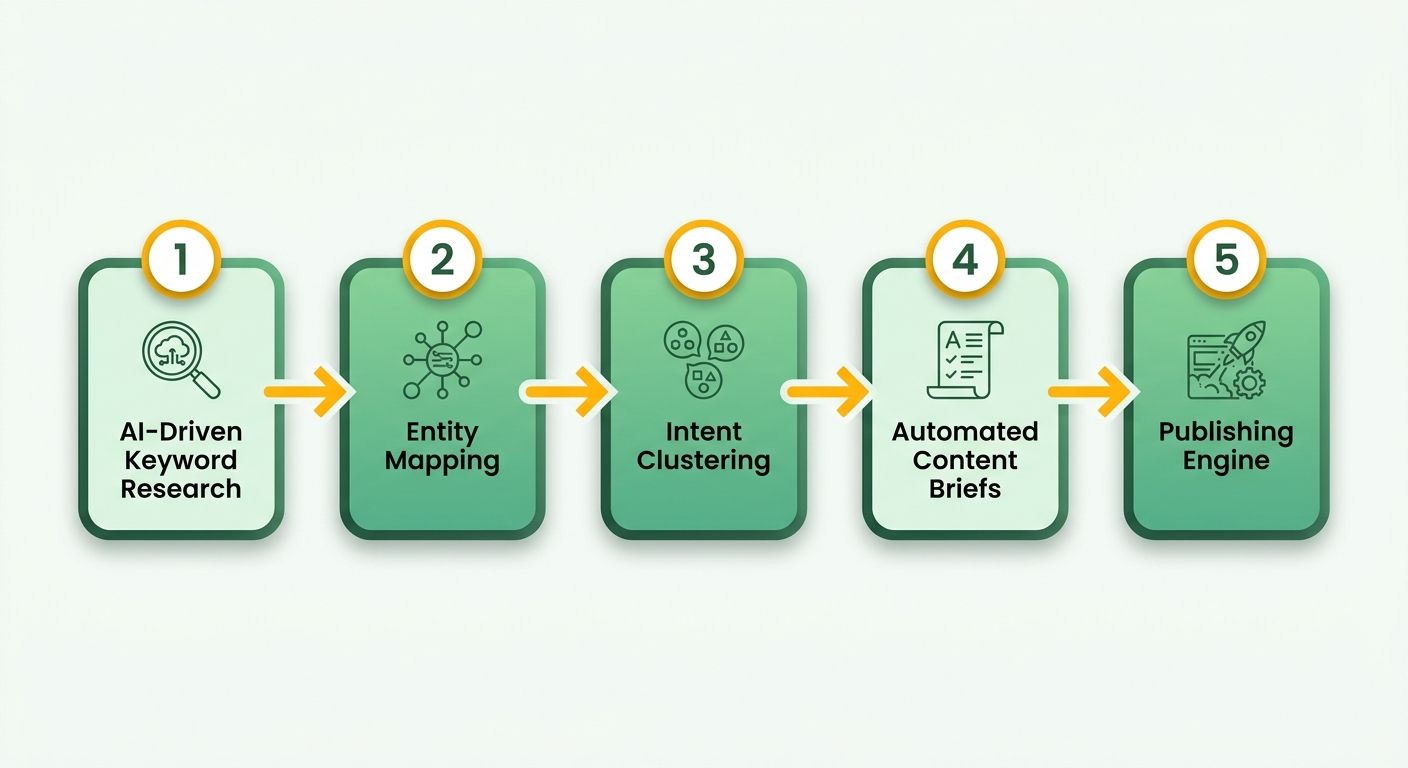
Here's how the tools stack up on research, brief generation, and multichannel publishing.
| Title | Description | Key Features | Pros / Considerations |
|---|---|---|---|
| AnyPost.ai | Content engine that translates keyword clusters into structured, voice-aligned briefs. | Intent-aligned brief templates, automated outline generation, brand-voice mapping. | Pros: Moves from brief to published article within a single interface. Considerations: Requires clear initial content parameters. |
| InLinks | Entity research tool that groups keywords by semantic concepts rather than search volume. | Entity gap analysis, topic clustering, semantic search intent mapping. | Pros: Uncovers hidden topical gaps that traditional keyword tools miss. Considerations: Does not generate full-length drafts. |
| Surfer SEO | SERP-driven outline generator that structures briefs based on competitor headings. | AI outline builder, competitor heading analyzer, target word count calculator. | Pros: Fast, data-backed outline creation. Considerations: Outlines may require manual editing to ensure unique angles. |
How automated keyword research works
You feed a seed topic into the AI, which returns a hierarchy of related entities, search-intent buckets, and long-tail variations. The model groups these into clusters that map straight to content pillars, so the manual keyword spreadsheet goes away. That topical map hands off to the brief generator for refinement.
The AI also tags each term with suggested schema types (FAQ, HowTo, Article) and proposes internal-link anchors based on entity relevance. Writers spend their time on nuance instead of rote linking.
What an AI-generated content brief looks like
A brief comes out with a headline hierarchy aligned to user intent, a list of target entities, recommended schema, and pre-filled sub-section prompts that match your brand voice. It also carries suggested internal-link anchors and a per-channel publishing schedule, so the handoff to writers or the automated queue is clean.
Because the brief inherits the same entity map used for keyword research, the copy naturally covers the full semantic field. No keyword stuffing, and every page pulls its weight in the topic cluster. That coherence is what earns authority in AI-driven SERPs.
When to skip full automation
Skip it when a piece needs deep domain expertise, regulatory compliance, or a creative narrative the AI is likely to mangle. In those cases, let the AI produce a first-draft brief, then hand it to a subject-matter expert to sharpen the nuance. Efficient without cutting corners on quality. It's the right call for long-form thought leadership and compliance-heavy content.
Automating On-Page Audits and Technical SEO Fixes
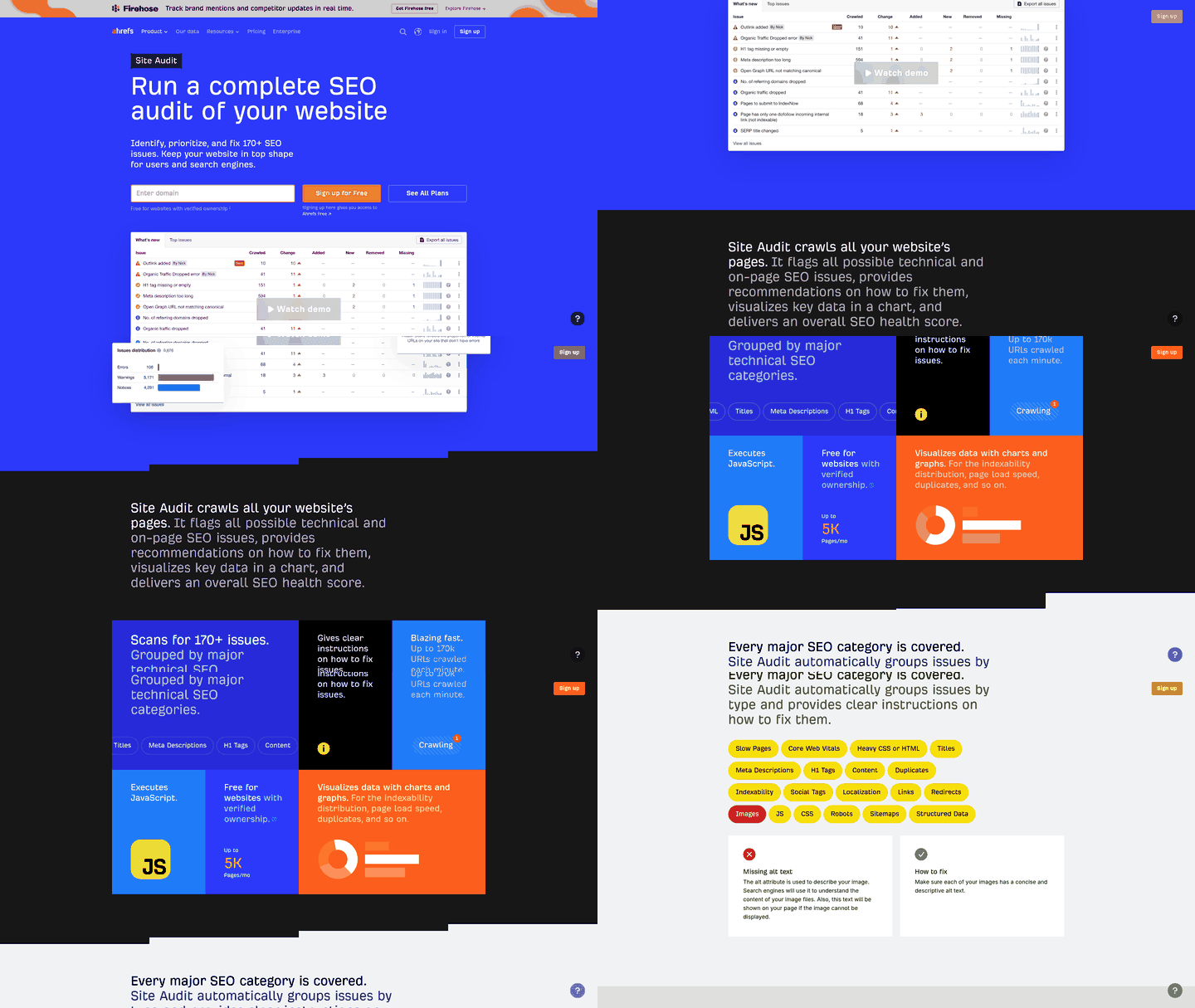
AnyPost.ai folds on-page SEO checks into the publishing workflow. As articles get generated, the platform adds the right headings, metadata, and structured-data snippets to match the content's intent. Each page ships search-ready without hand-coding.
The Persona Engine keeps brand voice steady across everything you publish, so a blog post, a product page, and a social snippet all sound like the same company.
Comparison of on-page audit & technical-fix tools
| Title | Description | Key Features | Pros / Cons |
|---|---|---|---|
| AnyPost.ai | Publishing platform that automatically applies technical SEO best practices during generation. | Automated metadata generation, real-time schema validation, automated internal link suggestions. | Pros: Ensures technical compliance before content goes live. Cons: Focuses primarily on new content rather than legacy site audits. |
| InLinks | Internal linking engine that automatically deploys anchor text across a domain. | Automated anchor text selection, link-map visualization, broken link prevention. | Pros: Eliminates manual internal linking audits. Cons: Requires active script installation to push links live. |
| Surfer SEO | On-page auditing tool that compares existing pages against current SERP leaders. | Content gap analysis, missing keyword alerts, structural element checks. | Pros: Clear, step-by-step instructions for optimizing existing pages. Cons: Requires manual implementation of suggested changes. |
| Siteimprove | Enterprise site-integrity platform that monitors SEO, accessibility, and quality assurance. | Automated site crawls, accessibility compliance checks, broken link and spelling audits. | Pros: Comprehensive view of overall site health and compliance. Cons: Does not offer automated content generation. |
What can automatically audit on-page SEO?
Tools that pair crawling with AI analysis surface SEO gaps fast. AnyPost.ai pulls the content it generates, checks it against common schema requirements, and hands you a short checklist of any missing markup. Apply the fixes straight from the dashboard. Less time in manual edits.
How does AnyPost.ai handle schema and anchor text?
The publishing engine drops in the relevant structured-data blocks based on content type, so pages get marked up correctly without extra work from you. It also flags internal-link opportunities that match the article's entities, which helps both navigation and relevance.
When manual review beats automation
Very small sites, or brands still figuring out their voice, are often better off leaning on manual review. The overhead of training the AI can outweigh the near-term speed, and a hands-on pass protects nuance. For larger, multi-channel estates where consistent tone and fast publishing are the whole game, the end-to-end workflow earns its keep.
Tool 1: Ahrefs — Semantic SEO Automation Capabilities
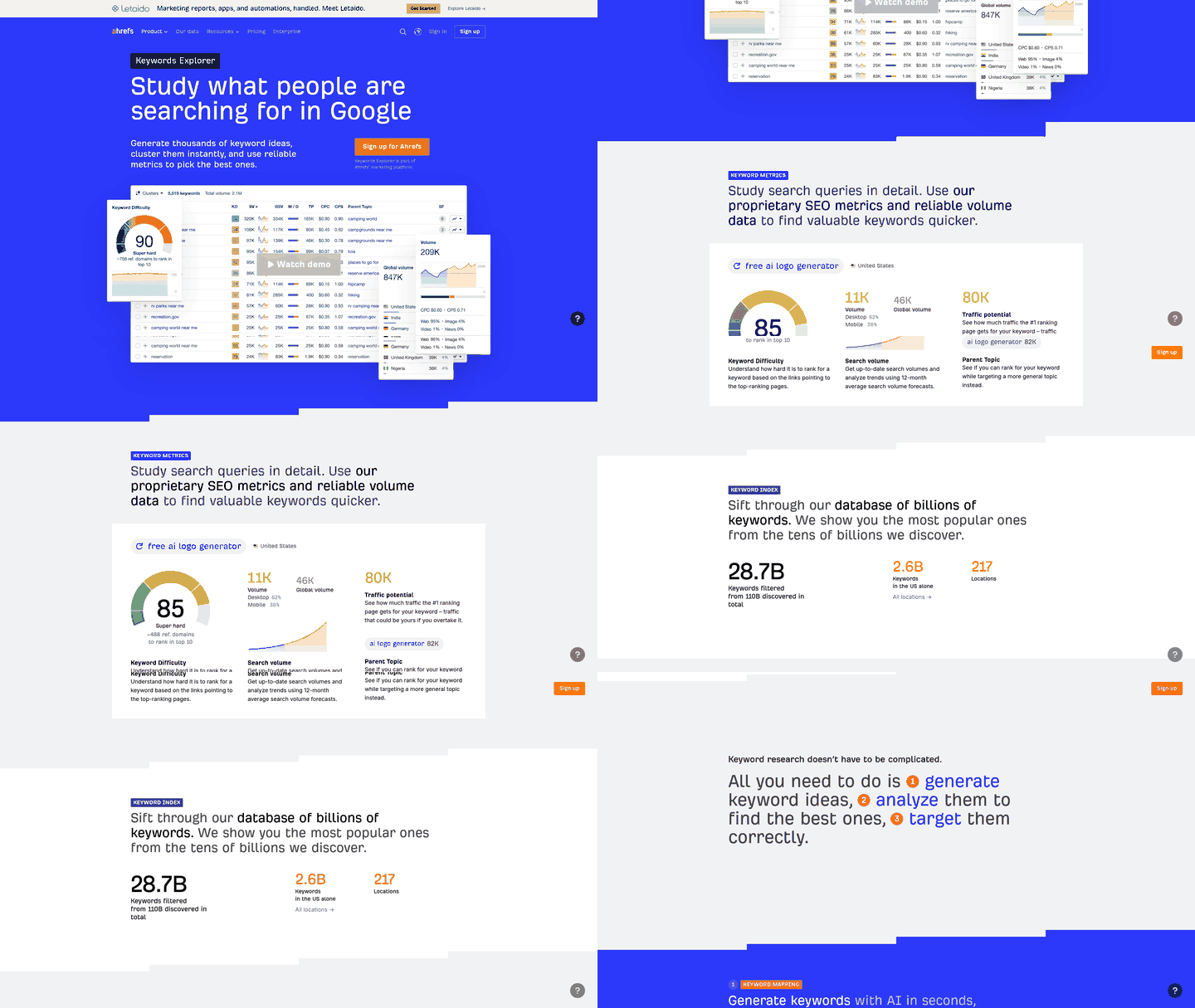
Ahrefs gives you the data foundation: entity-rich keyword clusters and competitive gap analysis you can pull through the API and stitch into a content-generation flow. Map those clusters to your internal topic graph and every article targets a distinct semantic intent while the copy stays on brand.
In practice, you run Content Explorer to surface high-performing entities, then feed the list into a brief generator. The API returns search volume, difficulty, and SERP feature presence, which becomes intent-aligned headings. Ahrefs doesn't enforce a voice, so you layer a Persona Engine on top to keep brand tone intact through the publish step. That two-step move covers the gap generic SEO tools leave when they stop at keyword lists.
Pricing and plan considerations
Ahrefs runs tiered plans: Starter, Standard, Advanced, and Agency, each raising query limits and API calls. The Starter plan handles basic keyword research fine, but the API caps at 10 requests per day. That will bottleneck a high-throughput semantic pipeline in a hurry. The Agency tier lifts that cap and adds historical SERP data, handy for tracking topical authority over time. AnyPost.ai's plans bundle the Persona Engine and multi-channel scheduler, so you get consistent output without bolting on separate tools.
Automating rank tracking and reporting
Ahrefs' Rank Tracker can be scheduled to pull daily positions for any keyword list, and the API pushes those metrics into a central dashboard for automated reporting. Pair that with AnyPost.ai's analytics to watch how newly published content performs.
The flow: after each batch of AI-generated articles goes live, Ahrefs updates rank positions for the target keywords. A lightweight reporting script builds a visual summary (trend lines, lift percentages, top-performing entities) and sends it to stakeholders on a set cadence. No more manual spreadsheet chase.
One habit worth adopting: pair rank data with structured-data health checks. Siteimprove's crawl reports flag missing schema that can suppress rankings, and fixing those in the same automation loop lifts visibility for free. Full visibility usually means combining specialized tools rather than betting on one.
Should you run Ahrefs alone for end-to-end automation?
No. Ahrefs is excellent at data collection and does nothing for brand-voice enforcement or multi-channel publishing. Pair it with a dedicated content generator like AnyPost.ai to close the loop from insight to publication, and you get scalable, intent-focused content that sounds like your brand everywhere.
Tool 2: SEMrush — Semantic SEO Automation Capabilities
SEMrush is a semantic SEO automation suite that pulls entity-rich keywords, builds topic clusters, and auto-fills SEO-ready drafts. It takes you from research to publish in minutes.
The typical workflow: import SEMrush's keyword and entity data into AnyPost, then run its Persona Engine to apply brand-voice rules before publishing across channels. SEMrush is strong on data collection. It stops short of guaranteeing tone consistency across blogs, product pages, and social feeds.
How SEMrush handles semantic content creation
The Topic Research tool surfaces related entities, questions, and sub-topics. The SEO Writing Assistant scores each paragraph for relevance, readability, and keyword density, suggests intent-aligned headings, then drops in structured-data snippets like FAQ or How-To markup. But the workflow ends at the editor. You still have to push the copy into a publishing pipeline to hold a unified voice.
Pricing tiers and who benefits most
SEMrush runs three main plans: Pro, Guru, and Business, each adding query limits, historical data, and seats. Small agencies usually start on Pro, but Guru unlocks the full Content Marketing Platform where the semantic features actually earn their keep. Large enterprises that need unlimited projects and API access land on Business, though the cost can outrun the ROI for teams that don't need exhaustive reporting.
Comparison at a glance
| Title | Description | Key Features | Pros / Cons |
|---|---|---|---|
| SEMrush | Enterprise SEO suite with deep competitive intelligence and keyword research databases. | Keyword Magic Tool, Position Tracking, Domain Overview, Backlink Analytics. | Pros: Unmatched database size and historical search data. Cons: Interface can be overwhelming for single-focus users. |
| AnyPost.ai | AI-driven publishing platform that executes content strategies in a consistent brand voice. | Persona Engine, multi-channel scheduling, automated schema generation. | Pros: Bridges the gap between SEO research and voice-consistent publishing. Cons: Requires initial setup of brand voice profiles. |
| Siteimprove | Enterprise platform that combines SEO monitoring with accessibility and content quality checks. | Automated site-wide audits, readability scoring, policy enforcement tools. | Pros: Excellent for maintaining brand standards across large, multi-department sites. Cons: Premium pricing geared toward enterprise budgets. |
When to skip SEMrush for semantic SEO automation
If your team is fewer than five writers and you already run a content engine that enforces brand voice, SEMrush's extra research layers add complexity for little gain. Skip it too when the main goal is fast multi-channel publishing; SEMrush has no native scheduling, so you're stuck with a manual hand-off that eats the time you were trying to save.
SEMrush shines as a research engine. To close the loop on voice and multichannel distribution, you need something that pushes the copy straight to every outlet. Pairing SEMrush's data depth with AnyPost's publishing engine gives you both: rich semantic insight and consistent brand storytelling across the web.
For more on where semantic automation fits into broader workflows, see our guide on semantic automation tools and best practices.
Tool 4: Moz — Semantic SEO Automation Capabilities
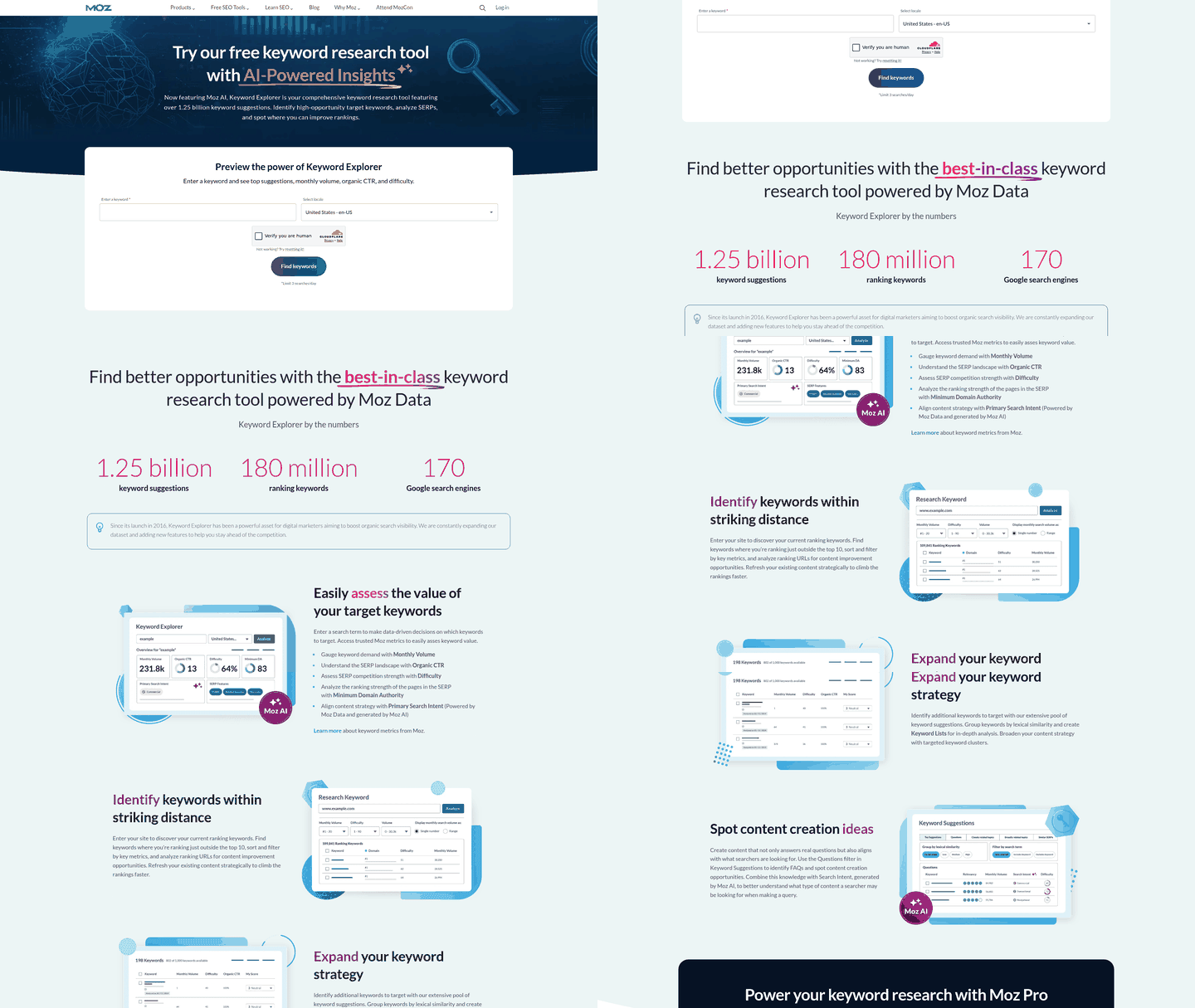
Moz automates keyword research, entity grouping, and on-page suggestions. What it won't do is generate brand-tone-aware copy or orchestrate cross-channel publishing. It clusters related terms, surfaces question-based subtopics, and recommends structured-data snippets like FAQ or How-To schema. You pull those clusters into a brief generator, then let a Persona Engine write the final copy. Clean handoff from Moz's data layer to a voice-consistent publishing engine.
Moz's strengths and weaknesses
Moz is strong on data-driven insight and readable dashboards. It's weak on end-to-end automation for voice and multichannel rollout. The upside: a friendly interface, reliable crawl reports, and a solid link-analysis suite that helps map internal-link opportunities. The downside shows up when you need consistent brand voice across dozens of pages. There's no native AI writer and no schedule-aware publishing, so you're back to copy-pasting into the CMS. Lean on one suite for everything and you end up compromising somewhere.
How Moz compares to our platform
Moz delivers solid semantic research. We take that research and add AI-generated, brand-voice-aligned copy that publishes automatically across sites and social. Feed Moz's entity clusters into the system and the AI expands them into full articles, injects schema, and ships the pages to the right endpoints without manual intervention. Teams on Moz alone handle formatting and uploading by hand; AnyPost.ai's end-to-end workflow takes those steps off your plate.
Quick comparison table
| Title | Description | Key Features | Pros / Cons |
|---|---|---|---|
| Moz | SEO platform known for proprietary metrics like Domain Authority and Page Authority. | Link Explorer, Keyword Explorer, Site Crawl, Page Optimization. | Pros: Highly reliable link equity metrics and clean, intuitive dashboards. Cons: Lacks automated content generation or publishing tools. |
| AnyPost.ai | Execution-focused platform that automates the drafting, optimization, and publishing of SEO content. | Automated internal linking, schema injection, multi-channel publishing. | Pros: Drastically reduces the time from keyword discovery to live page. Cons: Best paired with external research tools for deep historical data. |
| Ahrefs | Industry-standard tool for backlink analysis and competitive research. | Site Explorer, Content Explorer, Keyword Explorer. | Pros: Industry-leading backlink index. Cons: No native content generation or publishing features. |
| SEMrush | All-in-one search marketing platform covering SEO, PPC, and social media tracking. | Topic Research, SEO Writing Assistant, Position Tracking. | Pros: Broad feature set covering multiple marketing channels. Cons: Can be expensive for small teams. |
| InLinks | Semantic SEO tool that builds internal link structures based on entity relationships. | Entity clustering, automated schema markup, internal link map. | Pros: Automates complex internal linking structures. Cons: Steeper learning curve for non-technical users. |
| Surfer SEO | On-page optimization tool that scores content drafts against live search results. | Content Editor, SERP Analyzer, Keyword Research. | Pros: Highly actionable real-time writing feedback. Cons: No automated publishing or scheduling. |
Pair Moz's reliable semantic data with an AI-driven publishing engine and you close the loop that most SEO tools leave open. If your priority is a unified workflow that respects brand voice while still using Moz's research depth, the combined setup gets you to topical authority efficiently.
Choosing the Right Semantic SEO Automation Tool
Three pillars decide it: entity-driven insight, brand-voice consistency, and multichannel publishing. Nail all three and scaling content becomes an efficient authority engine. Miss one and you'll spend more time patching gaps than growing.
The right tool also needs human-in-the-loop safeguards. Automation generates structured data and internal links all day. It won't make content unique on its own. So you pair AI-driven research with a quick editorial pass to keep depth and originality intact.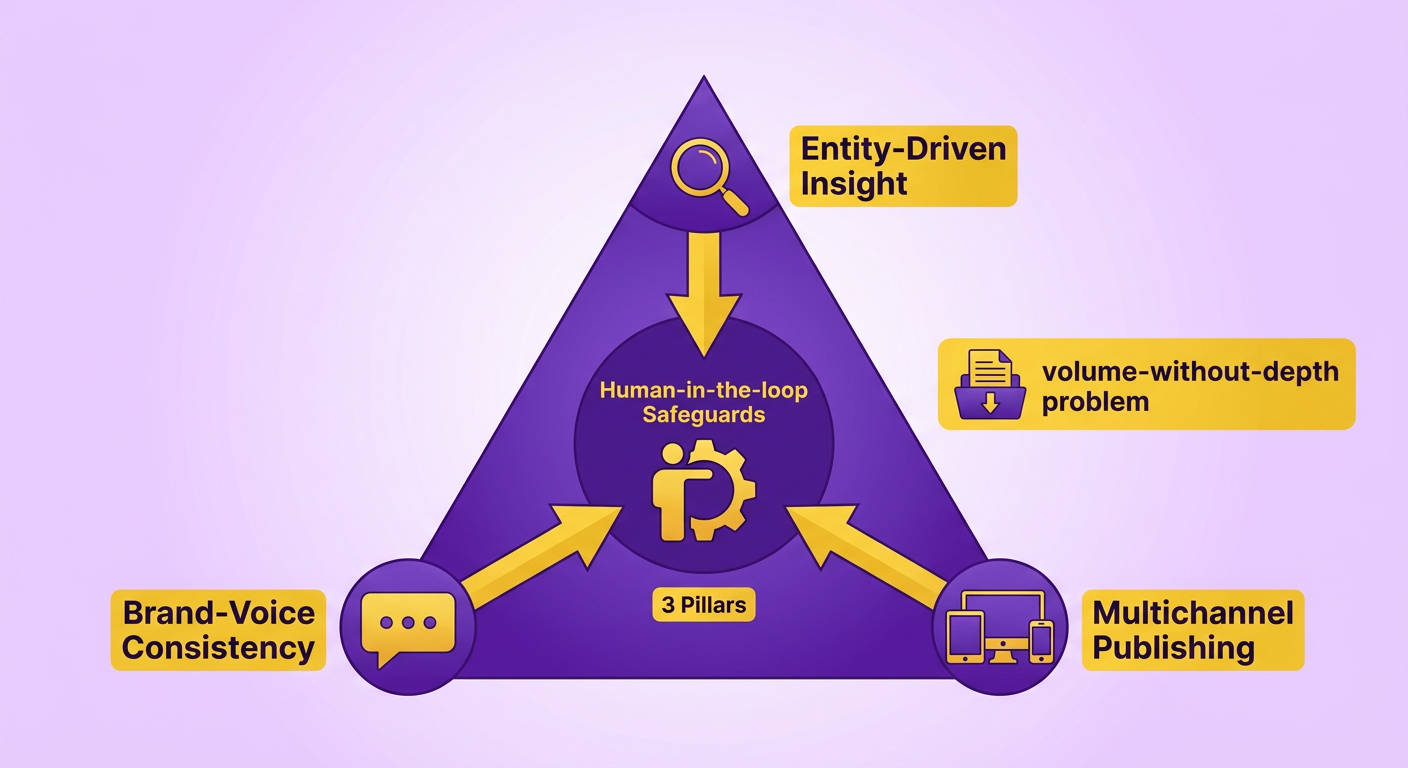
Quick comparison of leading platforms
| Title | Description | Key Features | Pros / Cons |
|---|---|---|---|
| AnyPost.ai | Unified platform that consolidates research, writing, optimization, and publishing. | Persona Engine, automated schema generation, multi-channel scheduling. | Pros: Minimizes tool sprawl by handling the entire content lifecycle. Cons: Requires initial investment in training the brand voice. |
| BrightEdge | Enterprise-grade SEO platform designed for large-scale data analysis and automated technical fixes. | Autopilot technical SEO, Share of Voice tracking, Opportunity Forecasting. | Pros: Scales technical fixes across millions of pages automatically. Cons: High cost makes it inaccessible for smaller organizations. |
| InLinks | Specialized tool for automating internal link networks and schema deployment. | Entity-based internal linking, schema generation, topic graph visualization. | Pros: Highly effective at building topical authority through structured links. Cons: Interface can feel dense and technical. |
| Surfer SEO | On-page optimization tool that ensures individual articles meet semantic requirements. | Content scoring, NLP keyword suggestions, competitor structure analysis. | Pros: Easy-to-use editor that writers adopt quickly. Cons: Does not automate site-wide technical fixes or publishing. |
| Moz | SEO suite that tracks search visibility, domain authority, and site health. | Domain Authority tracking, Site Crawl, Keyword Explorer. | Pros: Reliable, industry-standard metrics for tracking long-term progress. Cons: No built-in content generation or automated publishing. |
What makes a tool stand out
Three things: entity awareness, workflow integration, and brand-tone enforcement. InLinks nails entity clustering but stops at data. Surfer adds on-page scoring but still needs a separate publishing step. The platform that bundles generation, schema, and publishing while holding your brand voice returns the most, especially when you're pushing to blogs, product pages, and social in one click.
How to dodge the common pitfalls
Steer clear of tools that rely on AI-generated copy with no clear human review checkpoint. Automation adds volume; editorial oversight is what keeps uniqueness and depth. Also check whether the cost matches the features you'll actually use. The priciest option isn't automatically the best fit, and even the most complete platforms have gaps that need outside help.
Does BrightEdge cover the multichannel gap?
Not quite. BrightEdge's Autopilot automates technical fixes and serves up SERP-driven recommendations, but it doesn't generate brand-voice-consistent copy or push it to social. In practice teams bolt on a separate content generator, which adds cost and complexity. If you want one pane of glass for both SEO data and publishing, a platform with built-in voice control fits better.
When AnyPost.ai is the right call
If end-to-end automation that respects tone is the priority, AnyPost.ai is the fit. The Persona Engine learns your voice from a modest set of examples, then produces SEO-optimized drafts with structured data tailored to your content format. It also schedules across multiple domains and social channels, which smooths the hand-off from creation to publication.
The selection checklist
- Entity focus — does it surface clusters and map internal links?
- Voice consistency — is there a mechanism to enforce brand tone across formats?
- Multichannel publishing — can you push to web, blog, and social without manual steps?
- Human oversight — is there an easy review stage to add depth and originality?
- Cost vs. scale — does the pricing match your team size and multilingual needs?
Run every candidate through those five and you'll find the platform that turns semantic SEO automation into a growth engine you can actually measure.
Time-Saving Benefits of Semantic SEO Automation
Semantic SEO automation cuts the time-to-publish cycle hard when the workflow is fully integrated. When the AI engine hands a ready-to-go article straight to the publishing queue, the manual hand-off disappears and content moves faster.
How much time can you actually save?
Teams on end-to-end automation see a much shorter production window than a fully manual process. The biggest gains come from repetitive tasks: schema insertion, internal-link mapping, and multi-channel distribution. Each one takes seconds once the AI has the core copy.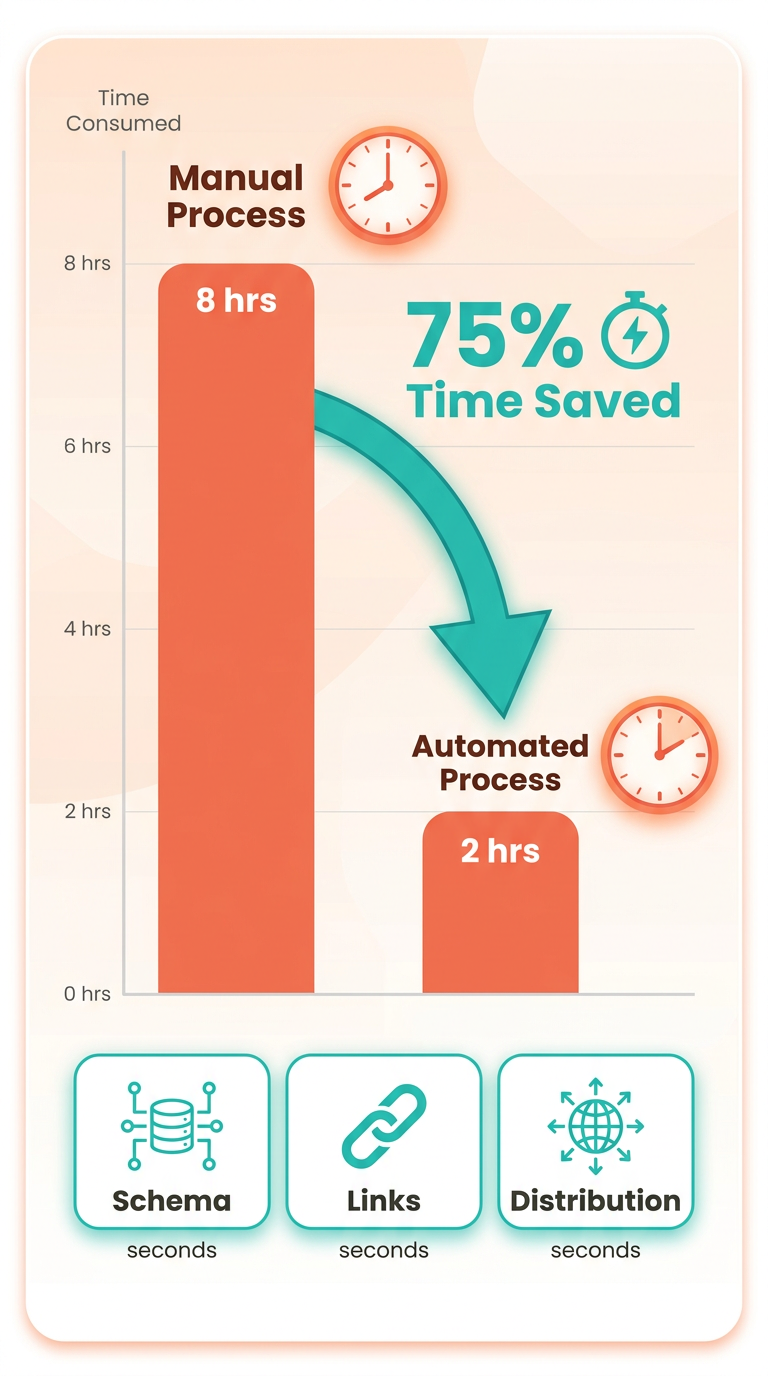
Which tasks benefit most from automation? Highest ROI: structured-data creation, anchor-text generation, and cross-platform publishing. AnyPost.ai builds in schema generation and internal-link automation, so nobody's copy-pasting snippets. NLP-assisted anchor generation speeds up contextual links too, turning what used to be a manual audit into a one-click move.
When should you skip automation? Skip full automation for highly regulated content: legal disclosures, medical guidelines, anything that has to clear compliance before it goes live. Automation handles the bulk, but it doesn't replace the judgment those domains demand. A human editorial pass stays non-negotiable for originality and compliance.
Summary of tool comparisons
| Title | Description | Key Features | Pros / Cons |
|---|---|---|---|
| AnyPost.ai | Automation platform that eliminates manual steps in the content creation and publishing pipeline. | One-click multi-channel publishing, automated schema generation, Persona Engine. | Pros: Cuts content production time from days to minutes. Cons: Requires initial setup of brand voice profiles. |
| InLinks | Semantic tool that automates internal linking and schema deployment to save manual development hours. | Automated internal link injection, schema generation, entity mapping. | Pros: Saves hours of manual internal link auditing and implementation. Cons: No built-in content generation features. |
| Surfer SEO | Optimization tool that accelerates the editing process by providing real-time writing feedback. | Real-time content scoring, NLP keyword suggestions, outline builder. | Pros: Speeds up the editing phase by giving writers clear optimization targets. Cons: Publishing and scheduling must still be handled manually. |
| NLP Anchor Generator | Specialized tool for generating contextually relevant anchor text using natural language processing. | Context-aware anchor generation, semantic relevance scoring. | Pros: Drastically reduces the time spent planning internal link anchors. Cons: Must be integrated with other tools to execute the links. |
Checklist for maximizing time savings
- Train the Persona Engine early. Feed the AI a representative sample of your brand's tone so the generated copy needs minimal edits.
- Map entities first, then generate. Let the AI build a semantic graph before drafting, so internal links and schema are ready when the article is created.
- Keep a human gate for regulated pieces. Use the automated draft as a foundation, but schedule a compliance review for anything that has to meet legal standards.
Aim the automation at the repetitive, data-heavy steps and keep human oversight where nuance matters. That's how you streamline the whole content-production process without losing the brand voice that carries across every channel.
Frequently Asked Questions
1. How can small e‑commerce sites benefit from semantic SEO automation without a large budget?
Start with a lightweight AI writer that produces entity‑rich drafts, then use a free schema generator plugin to add JSON‑LD. Pair this with a manual internal‑link spreadsheet updated monthly. The combination adds semantic signals at minimal cost while keeping control over brand tone.
2. What security or data‑privacy concerns arise when linking AI content generators to a CMS?
Data transmitted between the CMS and the AI service must be encrypted, and access tokens should be scoped to write‑only permissions. Store generated drafts locally for a limited period, and review any third‑party plugins for GDPR compliance to prevent inadvertent personal‑data leakage.
3. Can semantic SEO automation effectively manage multilingual content across several regions?
Yes, platforms that support multilingual schema can automatically generate language‑specific JSON‑LD based on the source entity map. Feed translated outlines into the AI engine, then schedule each version in the publishing queue, ensuring consistent semantic signals while respecting local linguistic nuances.
4. How frequently should the AI‑generated internal‑link map be refreshed to stay relevant?
Refresh the link map whenever a significant content batch—typically 20 to 30 new pages—is published, or after major topic‑cluster revisions. Running the update weekly for fast‑growing blogs prevents orphaned pages and keeps link equity flowing to the newest assets.
5. What is the typical learning curve for non‑technical marketers when adopting InLinks?
Most marketers require two to three weeks of guided onboarding to become comfortable with entity clustering and the visual link map. Initial sessions focus on setting up topic graphs, after which daily tasks shrink to a few minutes of link-suggestion review.
6. How can I measure the ROI of semantic SEO automation beyond traffic growth?
Track reductions in manual hours, the number of schema errors resolved automatically, and improvements in click-through rates from rich-result appearances. Combine these efficiency metrics with revenue attribution from landing-page conversions to calculate a cost-per-acquisition saving attributable to the automation suite.
