
SEO Retainer vs Project-Based Pricing: Which Is Right for You?

Key Takeaways
- The whole decision turns on one question: do you need ongoing SEO momentum, or one finite deliverable with a clear endpoint?
- Retainers are the most common model, usually £500 to £5,000 a month depending on the agency and the scope.
- A retainer flexes. Work can shift between content, technical fixes, and optimization as your priorities change.
- Project pricing suits finite jobs: site migrations, launches, content sprints, or an initial audit and setup.
- Project pricing gives you cost certainty. Scope, price, and deliverables agreed upfront, no open-ended monthly bill.
- Paying a monthly retainer for one finite task is money down the drain when you only need one thing done.
- SEO doesn't stop when a project ships, so most one-offs work best with lighter ongoing support afterward.
Quick Summary
Retainer or project pricing? It comes down to one question: do you need ongoing momentum or a finite outcome? A retainer buys continuous strategy and hands-off execution, month after month. **Project-based pricing **buys a fixed deliverable for a defined scope, with a clear start and end.
Both models work. The right one depends on where your site sits today and how involved you want to be.
When a retainer earns its keep
A retainer fits when SEO is a standing priority and you want a team running the work without your daily input. You pay a set monthly fee. The agency handles strategy, content, technical fixes, and optimization as the needs shift.
Monthly retainers are the default SEO model. They give you a predictable recurring cost that scales with the size of your site and the depth of your competition.
The big win is adaptability. Instead of being locked into a rigid deliverables list, the agency can pivot when search algorithms update or new competitors show up. Your search presence stays resilient.
But if your immediate need is specific and has a clear endpoint, a recurring monthly contract is just overhead.
When project-based pricing wins
Project-based pricing fits discrete work with a clear finish line. One-time structural overhauls, targeted campaigns, anything where you agree the scope, the price, and the final deliverables upfront.
You get cost certainty. You know exactly what you're paying and what you get. No open-ended monthly commitment.
The catch: rankings are dynamic. A one-time optimization push can lose ground fast if competitors keep publishing and updating. Without a plan for upkeep, that initial progress decays.
Retainer vs Project-Based: Quick Comparison
| Factor | SEO Retainer | Project-Based |
|---|---|---|
| Best for | Ongoing strategy and growth | Finite, defined work |
| Scope | Flexible, shifts with priorities | Fixed, agreed upfront |
| Typical cost | £500–£5,000/month | One-time fee per scope |
| Your effort | Low, hands-off execution | Moderate at scope-setting |
| Commitment | Recurring monthly | Single engagement |
| Maintenance | Built in | Needs a follow-up plan |
What changes the math now
Technology has shifted this equation. The high cost of monthly retainers used to come from slow, manual workflows. Automated content generation changes that calculation.
When keyword research, content production, and publishing run on automation, the cost of staying ranked drops sharply. You can keep the steady output a retainer promises without the steady five-figure invoice.
Our take: if your main need is consistent, ranking content month after month, automation can cover the recurring side at a fraction of agency rates. Save project spend for the specialized one-offs, like a migration, where deep technical work actually earns its fee.
The two models aren't rivals. Plenty of teams run a project to fix the foundation, then keep momentum with a lighter ongoing setup.
Why the pricing model you pick actually matters
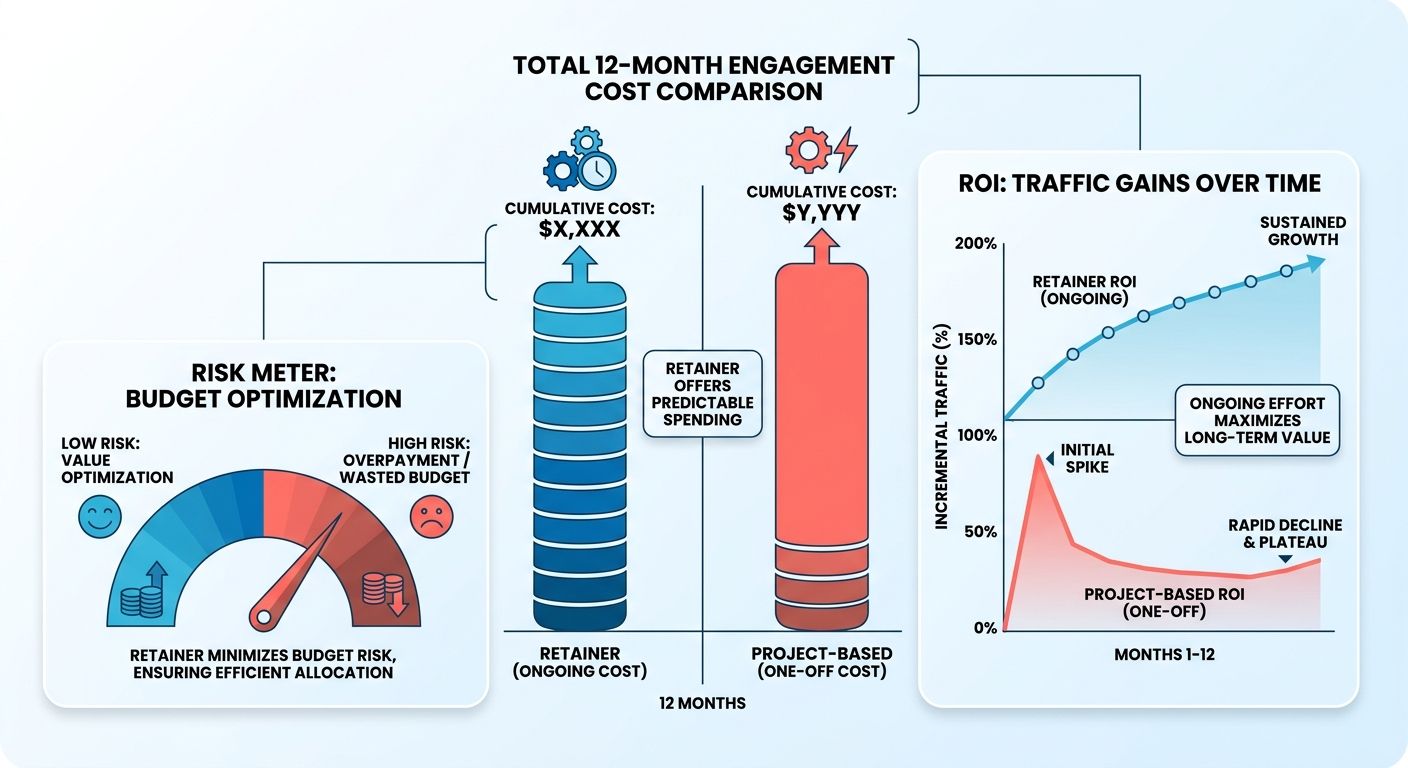
Pick the wrong model and you lose real money. Either you overpay for ongoing work you don't need, or you buy a one-off project when your site needs sustained attention. Both drain budget and stall rankings.
The model shapes how predictable your spend is, how the work flexes over time, and what kind of relationship you build with your provider. Get it right, you protect your ROI. Get it wrong, you fund effort that doesn't match your goals.
How the right model protects your budget
The right model matches your payment structure to your actual need, so you stop paying for the wrong kind of work. Project-based pricing charges a fixed fee for a defined scope, timeline, and output. Retainers buy continuous strategy that shifts as priorities change.
Treat a continuous need as a one-off project and progress stalls fast. Search engines reward consistency, so a single burst of optimization eventually fades without a systematic plan for updates and monitoring.
The reverse wastes just as much. Commit to a recurring monthly fee for a task with a defined endpoint, and you keep paying long after the work is done.
Who each model actually fits
Match the model to how you work and what you need delivered. Retainers suit teams that treat SEO as a standing priority. Project-based pricing suits teams that know exactly what they want built and when.
Retainers fit organizations that treat search visibility as a core acquisition channel. The agency acts as an extension of your team, addressing issues as they come up. Over time, that relationship aligns your search strategy with broader business goals.
Project-based pricing is for a specific, isolated problem. Restructuring site architecture, running a targeted campaign — you pay for a defined output and a clean handoff.
What to do next
Decide whether your SEO need is continuous or finite. That single answer points you toward the right model before you ever talk price. Continuous points to a retainer. A one-time deliverable points to project work.
Once you know the model, find a provider whose scope and pricing match it. Then lock the terms in a contract. For retainers, define what the monthly fee covers and how work can flex. For projects, nail down the exact scope, timeline, and output so nothing creeps.
The operational cost of maintaining rankings is shifting. Modern tools streamline a lot of the repetitive tasks that historically drove up agency fees, which means you can hold your search presence more cheaply than you used to.
Before signing any long-term agreement, look at how much of your planned work modern software can handle. That assessment helps you negotiate better terms, or pick a leaner service model in the first place.
How SEO retainer pricing works
An SEO retainer is a recurring monthly agreement: you pay a set fee, the agency handles ongoing search work. Unlike a one-off project, the retainer keeps a team attached to your site month after month, shifting effort as your priorities change. Think of it like a phone plan. Flat rate, continuous access to a set of services.
What a typical retainer covers
A retainer bundles a set number of deliverables each month across content, technical, and on-page work. The exact mix depends on your scope, but the core categories stay consistent, so you always know roughly what you're getting.
Most retainers include:
- Content production: a defined number of articles, landing pages, or blog posts each month.
- On-page optimization: title tags, meta descriptions, internal linking, content refreshes.
- Technical fixes: crawl issues, site speed problems, and indexing errors as they surface.
- Reporting: a regular summary covering rankings, traffic, and progress against goals.
The real strength is operational agility. If an algorithm update tanks your traffic, the agency can pivot resources to address it without drafting a new contract or renegotiating fees.
How the billing works
You pay a fixed fee every month for an agreed cadence of deliverables. Predictable billing cycle. Rates scale with the depth of competitive research, technical complexity, and the volume of monthly output.
The cadence matters as much as the price. A retainer might commit to four content pieces, ongoing technical monitoring, and a monthly report. You know what lands each month, the agency knows what to plan for.
This cuts both ways. Steady output, steady invoice, easy budgeting across a quarter or a year.
The benefits and the drawbacks
The biggest benefit is ongoing strategy with hands-off execution. You set the direction, the team drives the work without needing your daily input. SEO needs sustained attention, and a retainer supplies it month after month.
Retainers also build deep institutional knowledge. An agency working on your site continuously gets familiar with your technical setup and brand voice, so they execute faster than a team starting cold.
The drawbacks are real, though. Scope creep is the main one. Because the work flexes, the boundaries blur, and you can end up funding effort that drifts past your original intent. Pricing can also feel less predictable than a fixed-scope project when the monthly workload shifts.
A worked example: a growing e-commerce brand signs a £2,000 monthly retainer. Over six months the team ships consistent content, clears a cluster of crawl errors, and refreshes key product pages. The compounding effect of that steady work lifts organic visibility in a way no single project could match. That momentum is exactly what a retainer is built for.
How project-based SEO pricing works
Project-based SEO pricing charges a fixed fee for a defined scope of work with a clear start and end. You pay for a specific deliverable, not ongoing time. It's built for structured, one-off initiatives that don't need continuous intervention.
This works best when you know exactly what needs delivering. Scope, timeline, and output agreed upfront, so there are no surprises on either side.
What a typical project covers
A project-based engagement bundles a fixed set of deliverables tied to a single, measurable outcome. Usually foundational setups or major structural changes.
What you'll often see inside an initial SEO project:
- Keyword research: a defined list of target terms mapped to pages and intent.
- Technical audit: a one-time review of site health, crawlability, and indexing issues.
- On-page setup: title tags, meta descriptions, and structure for a set number of pages.
- A delivery report: findings, fixes, and recommendations handed over at the end.
The boundary here is rigid. A retainer allows ongoing adjustments; a project locks the scope to the agreed deliverables. If an audit uncovers unexpected technical issues, fixing them needs a separate agreement, not a quick pivot.
How the billing works
You agree a fixed fee for the full project rather than billing by the hour or paying monthly. The price covers a set scope, a set timeline, and a set output. Once the work ships, the engagement ends.
That makes your spend predictable. You know the cost before you start, and you keep tight control over what gets done. For a one-off like a migration or launch, that clarity is the whole point.
The trade-offs
The main benefits are predictability and control. You buy a known outcome for a known price, with no open-ended commitment. If your need has a clear finish line, you don't pay for momentum you won't use.
The main drawback is limited scope and no ongoing support. SEO needs maintenance, and a project stops the moment the deliverables land. Rankings drift, competitors move, algorithms shift. None of that gets handled once the contract closes.
To prevent that erosion, businesses often move to an internal maintenance plan or a light monitoring schedule. It keeps the structural improvements from the project intact against competitive pressure.
There's a transactional trade-off too. Because project work is finite, the provider never develops the same deep familiarity with your day-to-day. When you need help again later, you may hit onboarding delays while a new team gets up to speed.
Skip project-based pricing if your site needs sustained attention. A single audit won't fix a problem that needs months of consistent content and technical work. But for a defined, finite job, a fixed fee is cleaner and cheaper.
Comparing the two models side by side
The clearest difference is structure. A retainer charges a recurring monthly fee for ongoing work; project-based pricing charges a fixed fee for a defined scope with a clear start and end. One keeps a team attached to your site, the other delivers a specific output and wraps up.
Where they differ most
Scope and flexibility split the two models most sharply. A retainer lets the team adjust focus as your site's needs evolve. Project-based pricing locks the scope upfront, so any change to the deliverables needs a formal contract amendment.
The relationship differs too. A retainer pulls the agency into your ongoing operations, building a partnership where the team acts as an extension of your staff. Projects are more transactional by design: execute the agreed deliverables, close the contract.
How they stack up:
| Factor | SEO Retainer | Project-Based Pricing |
|---|---|---|
| Billing | Recurring monthly fee | Fixed fee for the project |
| Scope | Flexible, shifts with priorities | Defined and locked upfront |
| Timeline | Ongoing, no set end | Clear start and end point |
| Best for | Sustained, evolving work | Finite jobs like migrations or launches |
| Relationship | Long-term partnership | Transactional, single outcome |
What they have in common
Both chase the same goal: better search presence and more organic traffic. The pricing structure changes, but the work underneath stays rooted in content, technical fixes, and on-page optimization. You're investing in rankings either way.
Both also demand a clear agreement before any work starts. A retainer defines a set number of monthly deliverables. A project defines the full scope of the build. Neither works when expectations stay vague, so clarity protects both sides.
And they often run in tandem. A business might use a project to set a healthy technical baseline, then move to a recurring agreement for ongoing optimization and content updates.
How companies use both together
The smartest setups combine the two at different stages. A project handles the heavy upfront build. A retainer carries the steady work that keeps results compounding.
A national legal firm going through a brand merger, for instance, needs two legacy domains consolidated into one. They scope that complex consolidation as a fixed-fee project. Once the migration is done and the new domain is stable, they move to a monthly retainer so the agency can keep optimizing practice-area pages and monitoring visibility across regions.
This pairing reflects what both the Wix Studio guide on choosing a business model and the Accelo breakdown of retainers versus projects point to: the question isn't which model wins, it's which fits the stage you're in. Match the model to the work, and you stop paying for the wrong kind of effort.
Making the right choice for your business
The decision comes down to four things: your budget structure, your goals, how involved you want to be, and whether the work is finite or ongoing. Match those to a model and the choice makes itself.
A retainer fits ongoing priorities and predictable monthly spend. Project-based pricing fits a defined deliverable with a clear endpoint. Most sites need both at different stages.
The questions to ask before you sign
Start with the lifecycle of your current search strategy. A specific, time-bound challenge calls for a project structure. Building long-term organic market share calls for a recurring model.
Ask yourself these before signing anything:
- Is the scope fixed or evolving? If you know exactly what needs delivering, a project works. If needs change as you go, a retainer flexes with you.
- How predictable is my budget? A retainer gives you a set monthly figure. A project gives you one fixed fee for the whole job.
- Do I want to stay hands-on? Projects keep you closer to scope and timeline. Retainers hand the steering to your provider.
- Strategic partner or technical vendor? A recurring agreement aligns the provider with your long-term growth. A project focuses strictly on executing one task.
A long-term arrangement also tends to produce more proactive recommendations, since the provider has a reason to keep finding new opportunities for you.
How to run both together
The two models work well in sequence. A lot of organizations deploy a project to clear major technical hurdles, then transition to a lighter ongoing arrangement to preserve the gains.
A regional medical clinic, say, hires an agency for a one-time local SEO setup and directory cleanup. Once the local listings and clinic pages are fully optimized, they move to a light monthly retainer to monitor local rankings and manage patient reviews.
That sequence solves the biggest weakness of each model. The project delivers a clean starting point with no budget surprises. The retainer keeps momentum so rankings don't stall after the initial push.
You get the structure of a defined deliverable and the continuity of ongoing work. That's why pairing them is the default path for most growing sites.
Your next steps
Once you've picked a model, the next job is finding a provider and setting up the contract. Match the agreement to the model you chose, not the other way around.
Follow this order to keep things clean:
- Define your goal in writing. Name the specific outcome you want, whether that's a finished migration or steady monthly growth. This becomes the spine of your contract.
- Set your budget range. Establish a clear ceiling based on expected return, with enough runway to sustain the campaign for at least six months.
- Confirm the scope and deliverables. For a project, lock the scope, timeline, and output upfront. For a retainer, agree the deliverable mix and how it can shift.
- Build in flexibility where it counts. Make sure a recurring agreement includes a way to reallocate resources when search trends or business priorities move.
Get these four right and you protect both your budget and your rankings. Pick the model that matches where your site is today, then revisit it as your needs change.
Frequently Asked Questions
1. Is there a minimum contract length for an SEO retainer?
Most agencies require a three to six month minimum commitment for retainers, since SEO results compound slowly and short windows rarely show meaningful gains. Always check cancellation terms before signing. A 30-day notice clause protects you if the partnership underperforms or your priorities change unexpectedly.
2. How does hourly SEO billing compare to retainers and project pricing?
Hourly billing charges for actual time worked, offering granular control but unpredictable totals. Retainers fix your monthly spend regardless of hours, while project pricing fixes the total for a defined scope. Hourly suits small, ad-hoc tasks but becomes expensive and hard to budget for sustained work.
3. Who is accountable if rankings drop during a retainer?
Accountability should be defined in your contract through agreed KPIs like traffic, rankings, or leads. Rankings fluctuate from algorithm updates and competitor moves, so judge performance over a quarter, not weekly. A reputable provider explains drops, adjusts strategy, and reports transparently rather than guaranteeing specific positions.
4. Can a small business or startup afford either pricing model?
Startups with tight budgets often begin with a highly focused, one-time project to establish their search foundation. Once that baseline is set, they can manage basic updates internally or use specialized software to handle routine optimization tasks, avoiding the need for a large recurring agency commitment early on.
5. How do I prevent scope creep in a retainer agreement?
Define the monthly deliverable mix in writing, including content volume, technical hours, and reporting cadence. Set a clear process for requesting extra work outside that scope, with pricing attached. Review deliverables against the agreement monthly so drifting effort gets caught early before it quietly inflates your costs.
6. What should I do after a project-based engagement ends?
Once a project concludes, establish a clear plan for ongoing upkeep. This might involve training your in-house team to monitor site health, scheduling quarterly check-ins with an external consultant, or setting up automated alerts for crawl errors. Without a systematic approach to monitoring, the technical and content optimizations made during the project will gradually lose their effectiveness.
7. Can I switch from a project to a retainer with the same provider?
Switching is common and often beneficial, since the provider already knows your site from the project phase. That institutional knowledge means faster execution and less onboarding. Discuss the transition before the project closes so the team can recommend a maintenance scope that builds directly on the foundation delivered.