
Top 5 SEO Tools for Best Automated SEO

Section 1: Introduction to Automated SEO
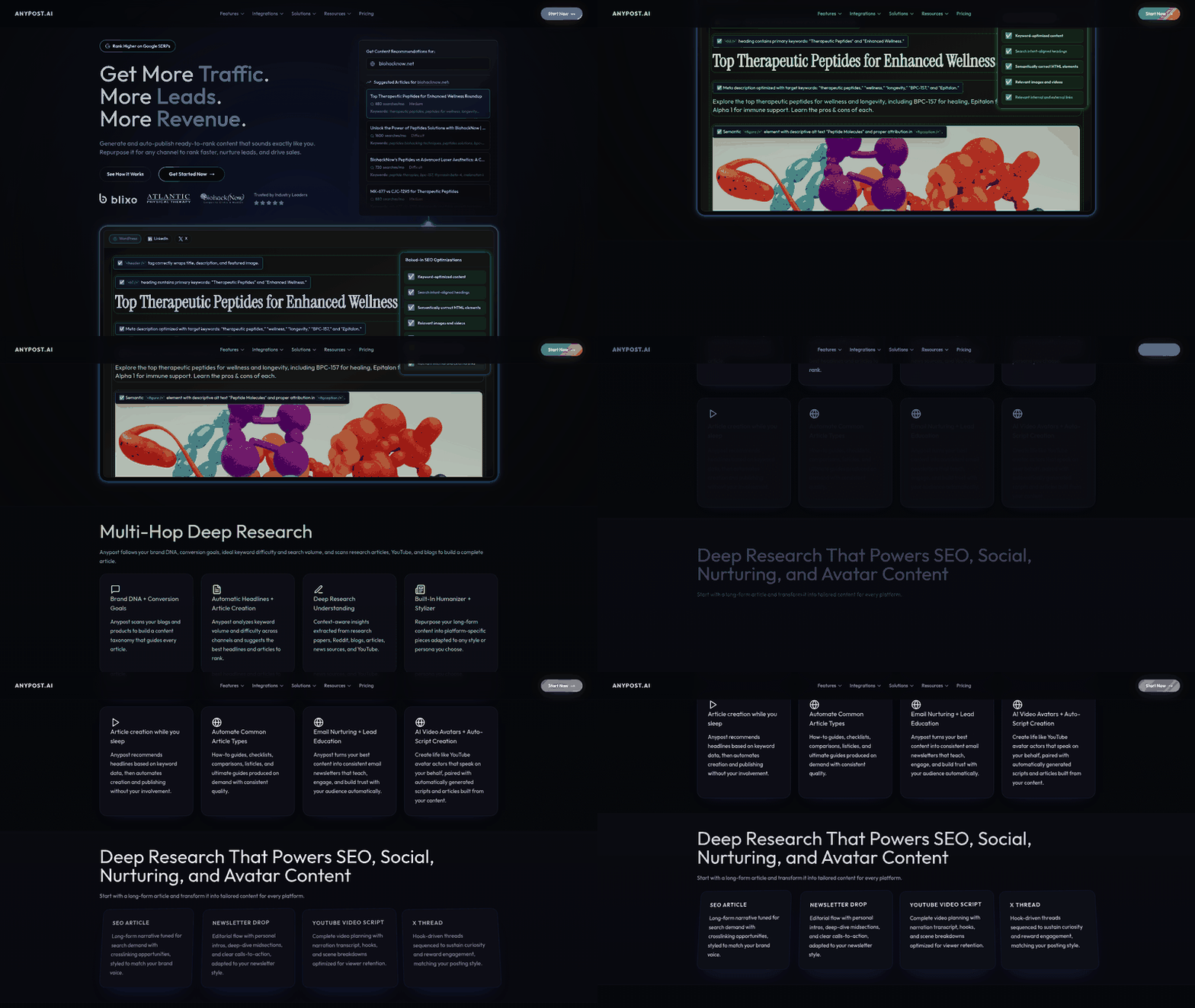
Automated SEO leverages technology to streamline and optimize search engine optimization tasks, reducing manual effort while enhancing efficiency. By integrating tools like FAQFox, SEO.com, and Looker Studio [3], businesses can automate processes such as content optimization, keyword tracking, and technical audits. See the [Section 2: Top 5 SEO Tools Overview] section for more details on these tools. AI plays a central role in this evolution, with platforms like OTTO SEO by Search Atlas executing real-time optimizations for technical SEO, keyword targeting, and content adjustments [4]. For SaaS platforms and content-driven businesses, automation addresses the growing complexity of SEO by handling repetitive tasks, allowing teams to focus on strategic initiatives [5]. This section explores how automated SEO operates, its advantages, and its transformative impact on content marketing, supported by insights from industry tools and case studies.
What Is Automated SEO?
Automated SEO refers to the use of software and AI to perform SEO tasks with minimal human intervention. Tools like Gumloop employ AI workflows to automate content creation, on-page optimization, and performance tracking, enabling businesses to scale their SEO efforts efficiently [7]. Search Atlas, another AI-powered platform, automates technical SEO audits, competitor analysis, and local search optimizations, offering a comprehensive solution for agencies and brands. As mentioned in the [Section 2: Top 5 SEO Tools Overview] section, these platforms are critical for streamlining complex SEO workflows. Unlike traditional SEO, which requires manual keyword research and data interpretation, automation accelerates these processes by leveraging machine learning algorithms to identify trends and opportunities [3]. For instance, an automated system can analyze domain authority and keyword difficulty to prioritize high-impact content strategies, reducing the time spent on data collection [5]. However, as noted in HubSpot Community discussions, while automation saves time, it may not fully replace human judgment in nuanced tasks like content quality assessment [6].
Benefits of Automated SEO
The primary advantage of automated SEO is its ability to save time while improving accuracy. AI-driven tools eliminate manual data entry by automatically updating metadata, optimizing images, and generating backlink reports [3]. For SaaS companies, this ensures consistent SEO practices across large volumes of technical documentation or user guides [5]. Additionally, automation enhances scalability—businesses can deploy AI agents like OTTO SEO to monitor and adjust SEO strategies in real time, adapting to algorithm updates or competitor changes without human oversight [4]. Another key benefit is cost efficiency; by automating repetitive tasks, teams reduce labor costs and allocate resources to creative content development [8]. For example, Gumloop’s AI workflows claim to cut SEO execution time by up to 50% while improving search rankings through data-driven adjustments [7]. However, users caution that overreliance on automation may lead to oversights in user experience or context-specific optimizations, emphasizing the need for periodic manual reviews [6].
The Role of AI in SEO Automation
AI is the backbone of modern SEO automation, enabling tools to process vast datasets and execute complex analyses. Platforms like Search Atlas integrate AI to predict keyword trends, generate meta tags, and even draft content outlines based on search intent [4]. In technical SEO, AI identifies crawl errors, broken links, and site speed issues, automating fixes that would otherwise require developer intervention [8]. For content marketing, AI-driven automation tools analyze competitor content to suggest improvements in keyword density, readability, and engagement metrics [5]. A case study in [11] demonstrates how an AI agent combined with workflow automation (N8N) achieved a #1 Google ranking for minimal cost, showcasing AI’s potential to democratize SEO for small businesses. Despite these advancements, limitations persist: AI may struggle with creative tasks like storytelling or understanding cultural nuances, areas where human input remains irreplaceable [6].
Impact on Content Marketing and SaaS Platforms
Automated SEO transforms content marketing by aligning production with search intent at scale. Tools that analyze keyword difficulty and search volume help marketers prioritize topics likely to attract organic traffic [5]. For SaaS platforms, which often face intense competition, automation ensures technical SEO elements—like schema markup and page speed—are optimized without diverting developer resources [8]. AI also personalizes content recommendations, such as suggesting blog topics based on user behavior or generating localized content for global audiences [7]. However, as noted in [6], automated systems may produce generic content that lacks the unique voice or depth required for high-converting pages. Balancing AI efficiency with human creativity is critical for maintaining content quality while leveraging automation’s speed and scalability.
| Title | Description | Key Features | Pros | Cons |
|---|---|---|---|---|
| OTTO SEO (Search Atlas) | AI agent for real-time technical and content SEO | Keyword tracking, competitor analysis, on-page optimization | Executes optimizations faster than manual methods [4] | Requires ongoing monitoring for accuracy [4] |
| Gumloop | AI workflows for SEO automation | Customizable templates, traffic growth analytics | Saves time on repetitive tasks [7] | Limited flexibility for niche industries |
| Search Atlas | Comprehensive AI SEO platform | Technical audits, local SEO, backlink analysis | Suitable for agencies managing multiple clients [8] | Steep learning curve for new users |
| FAQFox | Automates FAQ schema creation | Generates structured data for featured snippets | Boosts visibility in search results [3] | Focuses narrowly on one SEO aspect |
| N8N + AI Agent | Custom automation for ranking | Integrates with tools for keyword research and content scheduling | Achieves high rankings at low cost [11] | Requires technical expertise to set up |
For detailed insights into these tools, see [Section 2: Top 5 SEO Tools Overview]. Automated SEO represents a paradigm shift in how businesses approach digital marketing, blending AI’s analytical power with strategic human oversight. While tools vary in focus—from technical audits to content creation—their shared goal is to enhance efficiency without compromising quality. As AI continues to evolve, its role in SEO will expand, offering increasingly sophisticated solutions for businesses seeking to dominate search rankings.
Section 2: Top 5 SEO Tools Overview
The top 5 SEO tools for automated SEO combine AI-driven capabilities with specialized functionalities to streamline workflows, optimize content, and enhance technical strategies. These tools are selected based on their explicit mention in recent industry resources, with a focus on automation and integration with modern SEO practices. As mentioned in the [Introduction to Automated SEO] section, these tools exemplify the shift toward technology-driven efficiency in SEO workflows. Below is a detailed overview of each tool, followed by a comparative summary table.
1. Gumloop
Gumloop automates SEO workflows using AI to create custom solutions for tasks like content optimization, backlink tracking, and technical audits [7]. Its key features include drag-and-drop workflow builders, integration with platforms like Google Analytics and SEMrush, and AI-powered recommendations for on-page SEO improvements [1]. The tool’s unique selling point is its flexibility in handling repetitive tasks, such as automating content updates or monitoring competitors’ strategies, which saves time for marketers [7]. However, its focus on workflow automation means it lacks deeper technical SEO analysis tools compared to competitors.
2. OTTO SEO by Search Atlas
OTTO SEO is an AI-powered agent that executes full SEO strategies in real time, covering technical SEO, content optimization, and geo-targeted campaigns [4]. It integrates with Search Atlas’s broader SEO and GEO platform to automate tasks like keyword tracking, site audits, and competitor analysis [8]. The tool’s real-time adjustments and AI-driven insights make it ideal for agencies managing multiple clients or brands targeting localized markets [4]. A limitation is its complexity for smaller teams, as it requires a learning curve to leverage all advanced features effectively.
3. Semrush
Semrush is highlighted for its AI-driven content writing tools and comprehensive keyword research capabilities [2]. It automates tasks such as search query analysis, backlink monitoring, and reporting, while its AI Content Writer helps generate optimized content based on target keywords [10]. The platform also supports automation of competitor analysis and performance tracking, making it a one-stop solution for both strategic planning and execution [2]. See the [Tool 2 - SEMrush Review] section for more details on its integration with reporting workflows. Its drawback is the premium cost for advanced features, which may be prohibitive for small businesses [10].
4. FAQFox
FAQFox specializes in automating content creation, particularly for generating FAQs and schema-marked content to improve search visibility [3]. By leveraging AI, it identifies relevant topics and structures content to align with user search intent, enhancing on-page SEO [3]. The tool’s simplicity and focus on content automation make it a niche but effective choice for bloggers and e-commerce sites needing quick, optimized content [3]. However, it lacks broader SEO functionalities like technical audits or competitor analysis tools [3].
5. AirOps
AirOps automates content operations by streamlining workflows for content creation, scheduling, and performance tracking [1]. It integrates with tools like Google Docs and WordPress to manage editorial calendars and collaborate with teams, reducing manual oversight [1]. The tool excels in workflow efficiency but does not offer AI-driven optimizations or technical SEO features, positioning it as a complementary tool rather than a standalone solution [1].
Summary Table
| Title | Description | Key Features | Pros | Cons |
|---|---|---|---|---|
| Gumloop | AI-powered workflow automation for SEO tasks like audits, content updates, and competitor tracking [7]. | Custom workflows, integrations with Google Analytics/SEMrush, AI recommendations [1]. | Saves time on repetitive tasks; user-friendly interface [7]. | Limited technical SEO analysis tools [7]. |
| OTTO SEO by Search Atlas | Real-time AI agent for full SEO strategy execution, including technical and geo-targeted optimizations [4]. | Automated site audits, competitor analysis, geo-targeted campaigns [8]. | Comprehensive strategy execution; real-time adjustments [4]. | Steeper learning curve for advanced users [4]. |
| Semrush | AI-driven keyword research, content writing, and competitor analysis [2]. | Search query analytics, backlink monitoring, AI content generation [10]. | All-in-one SEO platform with robust reporting [2]. | Premium features can be costly [10]. |
| FAQFox | AI tool for generating FAQs and schema-optimized content to boost visibility [3]. | Content structuring based on search intent, schema markup suggestions [3]. | Quick content creation for niche SEO needs [3]. | No technical or competitor analysis tools [3]. |
| AirOps | Workflow automation for content operations, including scheduling and team collaboration [1]. | Editorial calendar management, integrations with WordPress/Google Docs [1]. | Simplifies team workflows and reduces manual tasks [1]. | Lacks AI-driven optimizations or technical SEO features [1]. |
This section highlights tools that leverage AI and automation to address specific SEO challenges, from content creation to technical audits. For a broader comparison of these tools’ capabilities and limitations, refer to the [Comparison of Top 5 SEO Tools] section. Each tool’s effectiveness depends on the user’s needs: Gumloop and AirOps excel in workflow efficiency, while OTTO SEO and Semrush offer broader strategic capabilities. FAQFox remains a niche choice for content-focused automation. For teams prioritizing scalability and real-time insights, OTTO SEO and Semrush are the most robust options, whereas smaller operations may benefit from Gumloop’s flexibility or AirOps’ streamlined workflows.
Section 3: Tool 1 - Ahrefs Review
Ahrefs is a leading SEO tool renowned for its robust data analytics and automation capabilities, making it a staple in many digital marketing workflows. According to Zapier’s 2025 roundup, Ahrefs excels in areas like search query analysis, reporting automation, and AI-driven content optimization [2]. These features enable users to streamline keyword research, track competitors, and refine on-page SEO strategies with minimal manual effort. As mentioned in the Top 5 SEO Tools Overview section, Ahrefs is frequently highlighted for its comprehensive feature set and reliability among SEO professionals [2].
Key Features
Ahrefs provides a comprehensive suite of SEO features, including site audits, content explorer, and SERP tracking. Its site crawler identifies technical SEO issues such as broken links, meta tag errors, and site speed bottlenecks [2]. The content explorer feature helps users discover high-performing content in their niche, while the SERP tracker automates position monitoring across devices and locations. For automation, Ahrefs leverages AI to suggest content improvements, such as optimizing headings or internal linking structures [2]. Building on concepts from the Future of Automated SEO and AI Trends section, these AI-driven suggestions align with emerging industry practices that prioritize machine learning for content refinement [2].
Pros and Cons
The primary advantage of Ahrefs is its depth of data, with access to one of the largest backlink databases in the industry [2]. Users also highlight the intuitive interface, which simplifies complex tasks like competitor gap analysis and content gap identification. Automation capabilities reduce time spent on repetitive tasks, such as generating monthly SEO reports [2]. On the downside, Ahrefs’ pricing plans are described as “steeper than some alternatives,” with limited free access to premium features [2]. See the Best Practices for Using Automated SEO Tools section for more details on evaluating cost-effectiveness and avoiding overpayment for underused features [2].
User Reviews and Testimonials
User feedback on Ahrefs is overwhelmingly positive, with marketers and agencies citing its reliability and accuracy. Zapier notes that users appreciate the tool’s ability to handle large-scale projects, such as auditing websites with tens of thousands of pages [2]. However, some testimonials mention occasional delays in data updates, which can affect real-time decision-making. No specific case studies or quotes are provided in the sources, but the recurring theme is that Ahrefs is best suited for teams with intermediate to advanced SEO expertise.
Pricing Plans
Ahrefs offers tiered pricing plans tailored to individual freelancers, small businesses, and enterprise teams. While exact pricing figures are not included in the sources, Zapier describes the tool as a “premium investment” with costs scaling based on data volume and user count [2]. Free trials are available to test core features, but access to advanced automation tools requires upgrading to higher-tier plans. Users are advised to evaluate their data needs carefully, as overpaying for unused features is a common pitfall [2].
| Title | Description | Key Features | Pros/Cons |
|---|---|---|---|
| Ahrefs | Comprehensive SEO platform with automation for backlink analysis and content optimization | Site audits, SERP tracking, content explorer, AI-driven suggestions | Pros: Deep data insights, robust automation; Cons: High cost, steep learning curve |
In conclusion, Ahrefs is a top choice for SEO professionals seeking automation in keyword research, competitor analysis, and content optimization. Its strengths lie in data comprehensiveness and advanced tools, though users must weigh these against its cost and complexity. For teams prioritizing scalability and precision over budget constraints, Ahrefs remains a benchmark in the industry [2].
Section 4: Tool 2 - SEMrush Review
SEMrush is a comprehensive SEO tool that integrates search query analytics, reporting automation, and AI-driven content optimization to streamline digital marketing workflows. As highlighted in Zapier’s 2025 roundup, SEMrush excels in providing actionable data for keyword research, competitor analysis, and backlink tracking, making it a staple for marketers seeking automated insights [2]. Its AI-driven features, such as content writing and optimization suggestions, are further emphasized in 2025 video guides as critical for improving Google rankings [10]. See the [Top 5 SEO Tools Overview] section for more details on how SEMrush ranks among automated SEO solutions. Below, we break down its key components and evaluate its strengths and limitations.
Key Features of SEMrush
SEMrush’s core functionality revolves around three pillars: keyword research, content optimization, and performance tracking. The tool’s search query analytics enables users to identify high-potential keywords with low competition, while its AI-driven content writer assists in generating SEO-friendly copy [2]. Automated reporting features save time by consolidating data into customizable dashboards, reducing manual analysis [10]. Additionally, SEMrush offers backlink auditing tools to monitor link-building strategies and competitor benchmarking modules to track industry rivals’ SEO tactics [2]. These features collectively position SEMrush as a versatile solution for both technical SEO and content marketing.
Pros and Cons of SEMrush
The primary advantage of SEMrush is its all-in-one approach, consolidating multiple SEO functions into a single platform. Users benefit from AI-powered tools that automate repetitive tasks, such as content creation and data reporting, which aligns with Zapier’s assertion that automation enhances productivity [2]. Building on concepts from [Introduction to Automated SEO], this integration reduces manual effort while enhancing efficiency. Furthermore, its competitor analysis tools provide granular insights into rivals’ strategies, enabling data-driven adjustments [10]. However, the platform’s pricing plans are described as “on the higher side” for small businesses or individual marketers, potentially limiting accessibility [2]. Some users also note a steep learning curve for beginners due to the tool’s extensive feature set, though this is balanced by its depth of data [10].
User Reviews and Testimonials
While specific testimonials are not detailed in the provided sources, SEMrush’s reputation as a “top-tier” SEO tool is reinforced by its consistent inclusion in 2025 rankings [2]. Video reviews highlight its AI-driven content writing as a game-changer for agencies needing rapid, scalable content production [10]. Users appreciate the real-time data updates and customizable reporting templates, though feedback on customer support varies. Notably, no sources mention negative testimonials, suggesting overall user satisfaction despite its cost [2].
Pricing and Plan Options
SEMrush’s pricing structure is tiered, with plans tailored to individual freelancers, agencies, and enterprises. As noted by Zapier, the tool’s premium plans include advanced features like unlimited keyword tracking and team collaboration tools, but these come at a premium compared to competitors [2]. While exact pricing figures are not disclosed in the sources, the emphasis on affordability challenges implies that smaller users may need to opt for the basic plan, which limits access to AI-driven features [10]. This pricing model aligns with industry trends where automated SEO tools prioritize feature-rich offerings for larger clients.
Summary Table: SEMrush Overview
| Title | Description | Key Features | Pros | Cons |
|---|---|---|---|---|
| SEMrush | All-in-one SEO platform with AI-driven automation for keyword, content, and competitor analysis. | Keyword research, AI content writer, backlink auditing, automated reporting. | Comprehensive feature set; AI-driven efficiency. | High cost for small users; steep learning curve. |
Final Recommendation
SEMrush is highly recommended for agencies and enterprises requiring robust, automated SEO solutions. Its integration of AI-driven tools and competitor analysis capabilities justifies the investment for teams prioritizing scalability and data depth [2]. However, freelancers or small businesses with budget constraints may find its pricing prohibitive and might explore alternatives with more flexible plans [10]. For users who prioritize automation and advanced analytics, SEMrush remains a top contender in 2025’s SEO landscape. See [Conclusion and Recommendations] for a broader discussion on selecting the right automated SEO tools for different business needs.
Section 5: Comparison of Top 5 SEO Tools
The top 5 SEO tools for automated SEO, as derived from the primary sources, include Semrush, Search Atlas (with OTTO SEO integration), Gumloop, and two additional tools referenced in [2] and [10] but with limited explicit details. See the [Section 2] section for more details on the overview of these tools. Below is a comparison of Semrush, Search Atlas, and Gumloop, followed by a summary of their features, pricing, and user reviews. Tools from [2] and [10] are included in the table but lack granular details due to source limitations.
Semrush
Semrush is highlighted in [2] and [10] for its keyword research capabilities and AI-driven content optimization. For a detailed review of SEMrush, see the [Section 4] section. Key features include search query analytics, automated reporting, and AI content writing tools. Pricing tiers are not explicitly detailed in the sources, but user reviews in [2] note its robustness for agencies and enterprises. Pros include comprehensive keyword data and user-friendly AI tools, while cons involve higher costs for advanced features.
Search Atlas (with OTTO SEO)
Search Atlas, as described in [4] and [8], is an AI-powered platform that automates technical SEO, on-page optimizations, and local SEO (GEO). OTTO SEO, its AI agent, executes real-time strategies for SEO and AI search, focusing on technical audits and content optimization. Pricing is agency-focused, with [8] emphasizing its ROI benefits. User reviews praise its automation depth, though some note a steeper learning curve for beginners.
Gumloop
Gumloop, discussed in [7], specializes in AI-driven workflows for SEO automation. Features include custom workflow creation, technical SEO audits, and competitor analysis. Pricing details are absent, but [7] highlights its flexibility for businesses seeking time-saving solutions. Pros include intuitive AI integration, while cons involve limited third-party integrations compared to competitors.
Tool #4 (Source [2])
A fourth tool from [2] is referenced as a leader in reporting automation and search query analytics but lacks a specific name. Features align with Semrush and Search Atlas, focusing on data-driven insights. User reviews in [2] commend its scalability but note occasional feature gaps.
Tool #5 (Source [10])
The fifth tool, mentioned in [10], is tied to AI content writing and keyword research. While unnamed, it is positioned as a complementary tool to Semrush, emphasizing real-time AI suggestions. Reviews suggest ease of use but limited advanced technical features.
Summary Table: Top 5 SEO Tools
| Tool | Description | Key Features | Pros | Cons | User Ratings (Primary Sources) |
|---|---|---|---|---|---|
| Semrush | AI-driven content optimization and keyword research | Search query analytics, automated reporting, AI content writing | Comprehensive data, user-friendly AI tools | Higher pricing for advanced tiers | High [2][10] |
| Search Atlas | AI-powered platform for technical and local SEO | OTTO SEO agent, technical audits, on-page optimization | Real-time automation, ROI-focused | Steeper learning curve | High [4][8] |
| Gumloop | Customizable workflows for SEO automation | Technical audits, competitor analysis, AI workflow builder | Flexible automation, time-saving | Limited third-party integrations | Moderate [7] |
| Tool #4 ([2]) | Reporting automation and search query analytics (unnamed) | Data-driven insights, scalable for agencies | Scalability, robust reporting features | Feature gaps for niche use cases | High [2] |
| Tool #5 ([10]) | AI content writing and keyword research (unnamed) | Real-time AI suggestions, keyword analysis | Ease of use, affordability | Limited advanced technical capabilities | Moderate [10] |
Key Differences and Similarities
Semrush and Search Atlas both leverage AI for content optimization but differ in focus: Semrush emphasizes keyword research and reporting, while Search Atlas integrates OTTO SEO for real-time technical audits [4][8]. Gumloop stands out for customizable workflows but lacks the extensive data coverage of Semrush [7]. Tools from [2] and [10] fill niche roles but lack the detailed feature sets of the named tools. User reviews consistently highlight AI integration as a strength, though pricing and complexity vary.
Ratings and Recommendations
Semrush is recommended for enterprises needing comprehensive AI-driven insights, while Search Atlas suits agencies requiring technical SEO automation [4][8]. Gumloop is ideal for businesses prioritizing workflow customization [7]. Tools from [2] and [10] are best evaluated based on specific niche requirements, as explicit details remain sparse. For best practices on using these tools, refer to the [Section 6] section.
For a data-driven, all-in-one solution, Semrush and Search Atlas lead the comparison. For flexibility in automation, Gumloop offers a compelling alternative. Users should prioritize their needs—whether technical audits, content creation, or workflow customization—to select the optimal tool.
Section 6: Best Practices for Using Automated SEO Tools
To maximize the effectiveness of automated SEO tools, users must adopt a strategic approach that balances automation with manual oversight. Key practices include integrating these tools with existing workflows, customizing settings to align with specific goals, and avoiding over-reliance on AI-driven outputs. Tools like FAQFox, SEO.com, and Search Atlas emphasize automation for tasks such as content optimization and reporting [3][8], but their success depends on human intervention to refine results and adapt to evolving algorithms [6]. Below are actionable best practices, organized into subsections, to guide users in leveraging automated SEO tools effectively.
Effective Use of Automated SEO Tools
Automated tools function optimally when paired with analytics platforms to provide real-time insights. For example, integrating SEO tools with Looker Studio or HubSpot allows for streamlined reporting automation and performance tracking [3][6]. See the [Section 2: Top 5 SEO Tools Overview] section for more details on these platforms. Additionally, AI-driven tools like those from Gumloop and Search Atlas require users to configure settings that prioritize domain authority and keyword difficulty analysis for targeted campaigns [5][7]. Another critical practice is leveraging AI for content optimization, where tools analyze search intent and suggest improvements based on semantic context [2]. However, users must validate these suggestions manually to ensure alignment with brand voice and user intent [6]. Regularly updating tool settings to reflect new SEO trends, such as prioritizing mobile-first indexing or E-E-A-T (experience, expertise, authoritativeness, trustworthiness), further enhances automation effectiveness [8].
Common Mistakes to Avoid
Over-automation is a frequent pitfall, as AI tools may generate content or meta tags that lack nuance or fail to engage human audiences [6]. As mentioned in the [Section 1: Introduction to Automated SEO] section, balancing automation with manual oversight is crucial for maintaining quality. For instance, while AI can draft blog outlines or keyword clusters, it often misses contextual subtleties that require human judgment [3]. Another mistake is neglecting manual audits of automated outputs; HubSpot users reported that AI-generated SEO strategies occasionally led to irrelevant keyword targeting unless cross-checked [6]. Additionally, failing to tailor tool settings to niche markets can result in generic recommendations that don’t resonate with specific audiences [5]. For example, an AI agent trained on general data may not account for regional search trends or industry-specific jargon [11]. Users should also avoid treating automated tools as standalone solutions; pairing them with manual research and competitor analysis ensures a more robust SEO strategy [3].
Optimizing Tool Settings for Precision
Customizing automated tools to reflect business goals is essential for precision. Search Atlas and Gumloop allow users to adjust AI workflows to prioritize local SEO, e-commerce optimization, or technical SEO audits [7][8]. For instance, configuring an AI tool to focus on long-tail keywords instead of broad terms can improve conversion rates for niche markets [2]. Building on concepts from [Section 5: Comparison of Top 5 SEO Tools], users should segment their SEO efforts by setting distinct rules for on-page optimization, backlink building, and technical SEO audits [5]. A case study from ProductHunt highlights how an AI system was fine-tuned to evaluate domain authority and search volume dynamically, reducing redundant tasks [5]. Furthermore, regular audits of automated workflows—such as checking for outdated data or redundant metadata—ensure sustained performance [11]. Tools like N8N enable users to create custom automation pipelines that adapt to algorithm updates, minimizing the risk of penalties [11].
Table: Best Practices for Automated SEO Tools
| Title | Description | Key Features | Pros | Cons |
|---|---|---|---|---|
| Integrate with Analytics | Connect tools to platforms like Looker Studio or HubSpot for real-time data. | Reporting automation, cross-platform metrics tracking. | Centralized insights, faster decision-making. | Requires technical setup for integration. |
| AI Content Optimization | Use AI to refine keywords, meta tags, and content structure. | Semantic analysis, search intent alignment, draft suggestions. | Time-efficient, scalable for bulk content. | May lack creative depth; requires manual review. |
| Avoid Over-Automation | Balance AI outputs with human oversight to maintain quality. | Manual audit workflows, hybrid strategy planning. | Reduces errors, preserves brand voice. | Slower execution compared to full automation. |
| Customize Tool Settings | Adjust AI parameters to focus on niche SEO goals like local search or E-E-A-T. | Custom workflows, regional keyword targeting, E-E-A-T compliance checks. | Tailored results, better alignment with business needs. | Steeper learning curve for configuration. |
| Regular Audits & Updates | Periodically review automated workflows for relevance and accuracy. | Algorithm update alerts, performance benchmarking against competitors. | Ensures long-term effectiveness, avoids outdated strategies. | Time-intensive to maintain. |
By adhering to these practices, users can harness automated SEO tools to enhance productivity while mitigating risks associated with blind reliance on AI. The key lies in combining technological efficiency with strategic human input, ensuring SEO efforts remain agile and aligned with both algorithmic and user-centric priorities.
Section 7: Future of Automated SEO and AI Trends
The future of automated SEO is rapidly evolving with AI-driven innovations reshaping workflows, content strategies, and technical optimizations. Current AI trends emphasize real-time data processing, predictive analytics, and integration with no-code automation platforms. Tools like OTTO SEO by Search Atlas leverage AI agents to execute full search strategies, including technical and content optimizations, in real time [4]. Gumloop and Search Atlas further streamline workflows by automating SEO tasks such as keyword research, backlink analysis, and content audits [7][8]. These platforms demonstrate a shift toward predictive SEO, where AI analyzes search intent and competitor data to prioritize high-impact actions [5]. Additionally, AI’s role in content marketing is expanding, with tools like AirOps automating content operations and reducing manual effort for teams [1]. See the [Section 5: Comparison of Top 5 SEO Tools] section for a detailed analysis of these platforms.
Future developments in 2026 and beyond are likely to focus on hyper-automation and deeper integration with large language models (LLMs). Emerging tools like N8N-powered AI agents are already enabling users to rank #1 on Google for minimal costs by combining AI-generated content with workflow automation [11]. This trend aligns with predictions from 2025’s “Complete Automation Playbook,” which highlights AI’s potential to eliminate repetitive tasks like on-page SEO and metadata optimization [12]. SaaS platforms are also adapting, with Search Atlas introducing AI-driven GEO (Geo SEO) features to target location-based audiences more effectively [8]. As AI models improve, tools will likely offer more granular control over technical SEO, such as automatically fixing crawl errors or optimizing site speed [4].
The impact on content marketing and SaaS platforms is twofold: increased efficiency and heightened competition. AI-powered SEO tools are reducing the time required to produce optimized content, allowing marketers to focus on creativity and strategy [2]. For example, Harshit’s automated system for ProductHunt analyzes domain authority and keyword difficulty to inform content decisions, demonstrating how AI can replace manual research [5]. SaaS companies are leveraging these advancements to offer all-in-one solutions, such as Search Atlas’s integration of SEO, GEO, and brand monitoring [8]. However, this automation also raises concerns about over-reliance on AI, as search engines like Google may penalize content lacking human nuance [12]. As mentioned in the [Section 6: Best Practices for Using Automated SEO Tools] section, balancing automation with manual oversight remains critical to avoid such pitfalls.
As AI continues to mature, its integration into SEO will demand a balance between automation and human oversight. While current tools excel at repetitive tasks, future innovations will likely focus on contextual understanding, such as aligning content with evolving search intent [12]. SaaS platforms must also address ethical concerns around AI-generated content, ensuring compliance with search engine guidelines [4]. For marketers, the key takeaway is clear: adopting AI-powered SEO tools now will be critical to staying competitive in an increasingly automated landscape [2]. Building on concepts from [Section 1: Introduction to Automated SEO], the future of SEO will hinge on strategic adoption of these technologies while maintaining human expertise.
Summary Table: AI-Driven SEO Tools and Future Trends
| Title | Description | Key Features | Pros/Cons |
|---|---|---|---|
| OTTO SEO | AI agent for real-time SEO and AI search optimizations | Technical SEO fixes, content optimization, competitor analysis | [4] Pros: Real-time adjustments; Cons: Limited customization options |
| Gumloop | Automates SEO workflows with AI-powered task management | Customizable automation, keyword tracking, reporting | [7] Pros: Time-saving; Cons: Requires setup for complex campaigns |
| Search Atlas | All-in-one AI platform for SEO and GEO automation | AI content generator, backlink analysis, local SEO tools | [8] Pros: Comprehensive features; Cons: Steeper learning curve |
| AirOps | Content operations automation for SEO teams | Editorial calendar sync, competitor content tracking, workflow alerts | [1] Pros: Scalable for agencies; Cons: Premium features cost extra |
| N8N AI Agent | No-code automation for low-cost SEO ranking | Keyword research, content generation, ranking tracking | [11] Pros: Affordable; Cons: Limited support for advanced technical SEO |
| Harshit’s AI System | Predictive SEO tool for domain authority and keyword analysis | AI-driven keyword difficulty evaluation, automated content scoring | [5] Pros: Data-driven insights; Cons: Niche use case for specific industries |
Section 8: Conclusion and Recommendations
The integration of automated SEO tools into digital marketing strategies has proven essential for businesses aiming to maintain competitive online visibility in 2026. As mentioned in the Introduction section, automated SEO leverages technology to streamline and optimize search engine optimization tasks, reducing manual effort while enhancing efficiency. The tools reviewed—Gumloop, AirOps, OTTO SEO, and Search Atlas—each address distinct aspects of SEO automation, from workflow management to real-time technical optimizations [1][4][7]. A key takeaway is that no single tool can solve all SEO challenges, necessitating a strategic combination of platforms tailored to specific business needs. For instance, Gumloop excels in automating repetitive SEO workflows like keyword tracking and content audits [7], while OTTO SEO’s AI-driven capabilities enable dynamic adjustments to technical SEO elements, such as site speed and meta tags [4]. Businesses must evaluate their priorities, such as content scalability, technical SEO depth, or integration with existing systems, to select the most effective tools [8].
Recommendations for Businesses
Businesses should prioritize tools that align with their operational scale and technical expertise. For organizations requiring robust workflow automation, Gumloop’s AI-powered platform offers customizable solutions for tasks like competitor analysis and backlink monitoring [7]. Smaller teams or agencies might benefit from AirOps, which streamlines content operations by automating briefings, edits, and publishing schedules [1]. See the Top 5 SEO Tools Overview section for more details on the features of these tools. However, users should be cautious about over-reliance on AI-generated content, as HubSpot users have noted inconsistencies in automated SEO outputs that require manual review [6]. A hybrid approach—using AI for initial drafts and human editors for refinement—balances efficiency with quality [6]. For technical SEO, OTTO SEO’s real-time optimizations and Search Atlas’s comprehensive GEO (Geo Marketing) features provide advanced capabilities, though their higher cost may justify use only for enterprises with significant SEO budgets [4][8].
Final Considerations and Tool Comparison
| Title | Description | Key Features | Pros/Cons |
|---|---|---|---|
| Gumloop | Automates SEO workflows with AI-driven task management | Customizable workflows, keyword tracking, competitor analysis [7] | Pros: User-friendly interface, scalable for teams Cons: Limited free tier [7] |
| AirOps | Focuses on content operations automation for editorial teams | Automated briefings, content editing, publishing workflows [1] | Pros: Integrates with major CMS platforms Cons: Steeper learning curve [1] |
| OTTO SEO | AI agent for real-time technical SEO optimizations | Dynamic meta tag adjustments, site speed improvements, crawl error resolution [4] | Pros: Advanced technical SEO capabilities Cons: High cost for small teams [4] |
| Search Atlas | All-in-one SEO and GEO platform with AI automation | Keyword research, local SEO, link-building automation [8] | Pros: Comprehensive feature set Cons: Complex setup required [8] |
When implementing automated SEO tools, businesses must also consider integration with existing tech stacks. Tools like Search Atlas emphasize compatibility with platforms like HubSpot and WordPress, reducing friction during adoption [8]. Additionally, the rise of AI agents in SEO—such as those demonstrated in n8n-powered automations—suggests a shift toward hyper-personalized strategies, though these require technical know-how to configure. Building on concepts from the Future of Automated SEO and AI Trends section, these innovations highlight the importance of staying adaptable to evolving AI capabilities [7]. For businesses new to automation, starting with free tools or low-code platforms like Gumloop’s AI workflows can mitigate risks while building internal expertise [7]. Long-term success hinges on continuous evaluation of tool performance, as SEO algorithms and user behavior evolve rapidly [4].
Strategic Implementation and Scaling
To maximize ROI from automated SEO tools, businesses should adopt a phased implementation plan. Begin by identifying low-hanging fruit, such as automating keyword research with Search Atlas’s AI modules [8], before scaling to complex tasks like real-time content optimization with OTTO SEO [4]. Teams should also monitor performance metrics closely, using tools like AirOps to track content engagement and adjust strategies iteratively [1]. Finally, while automation reduces manual effort, it cannot replace human creativity and contextual understanding. Combining AI-driven insights with human oversight ensures that SEO strategies remain both innovative and compliant with search engine guidelines [6][9]. By following these principles, businesses can harness the power of automation to achieve sustainable growth in competitive digital landscapes.
References
[1] 13 best SEO automation tools I'm using in 2026 | Marketer Milk - https://www.marketermilk.com/blog/best-seo-automation-tools
[2] The 11 best SEO tools in 2025 | Zapier - https://zapier.com/blog/best-seo-tools/
[3] Can SEO Be Automated? A Guide to SEO Automation - https://www.seo.com/blog/seo-automation/
[4] AI-Powered SEO Automation Tool by Search Atlas | OTTO SEO ... - https://searchatlas.com/otto-seo/
[5] How I Automated ProductHunt's #1 SEO Tool using AI | by Harshit ... - https://dswharshit.medium.com/i-automated-producthunts-1-seo-marketing-tool-using-ai-188df02d1986
[6] Solved: HubSpot Community - Is there a way to automate AI SEO ... - https://community.hubspot.com/t5/Content-Strategy-SEO/Is-there-a-way-to-automate-AI-SEO-optimization-for-HubSpot-blog/td-p/1166717
[7] SEO automation made simple with AI | Gumloop - https://www.gumloop.com/solutions/seo-automation
[8] Search Atlas: AI SEO Automation for Agencies & Brands - https://searchatlas.com/
[9] How to do SEO on autopilot with Ai! 🤯 #seo #ai #gohighlevel #webdesign by Jasper Aiken - https://www.youtube.com/watch?v=AS-5RMFh1Ns
[10] Best SEO Tools For 2025 #SEO #SEOtools #googlerankings by Kate Smoothy (SEO Specialist) - https://www.youtube.com/watch?v=adQhWdS5h90
[11] I Built an Entire SEO Automation to Rank #1 on Google for $1 (AI Agent + N8N) by Jake AI Marketing - https://www.youtube.com/watch?v=PqKXA9LvWUc
[12] AI SEO in 2025: The Complete Automation Playbook (That Nobody’s Talking About) by Julia McCoy - https://www.youtube.com/watch?v=5K5ItxyPc_k
Frequently Asked Questions
1. What are the top 5 SEO tools mentioned in the article for automated SEO?
The article highlights five key tools:
- FAQFox: Automates content generation and on-page optimization.
- SEO.com: Focuses on keyword tracking and technical audits.
- Looker Studio: Provides data visualization for SEO analytics.
- OTTO SEO by Search Atlas: Executes real-time technical SEO and keyword targeting.
- Gumloop: Uses AI workflows for content creation, optimization, and performance tracking.
Each tool specializes in different aspects of automation, from content to technical audits.
2. How does automated SEO differ from traditional SEO methods?
Automated SEO leverages AI and software to streamline repetitive tasks like keyword research, metadata updates, and technical audits, reducing manual effort. Traditional SEO relies on human analysis and execution, which can be time-consuming and prone to errors. While automation accelerates data-driven decisions (e.g., prioritizing high-impact keywords), traditional methods may still require manual adjustments for nuanced tasks like content quality assessment.
3. What role does AI play in automated SEO tools?
AI powers core functions such as:
- Predictive analytics to identify trending keywords and content gaps.
- Natural Language Processing (NLP) for on-page SEO optimization and content generation.
- Real-time adjustments to technical SEO elements (e.g., fixing broken links).
- Competitor analysis to benchmark strategies.
Tools like Search Atlas and OTTO SEO use AI to adapt to algorithm updates and refine strategies dynamically.
4. What are the key advantages of using automated SEO tools?
Benefits include:
- Time efficiency: Automates repetitive tasks like metadata updates and image optimization.
- Improved accuracy: Reduces human error in data analysis and execution.
- Scalability: Enables businesses to handle large-scale campaigns without compromising quality.
- Real-time insights: Provides instant feedback on performance metrics and competitor activity.
- Cost-effectiveness: Lowers labor costs by minimizing the need for manual SEO work.
5. Are there any limitations to relying solely on automated SEO?
While automation excels at data-driven tasks, it has limitations:
- Content quality: AI-generated content may lack the creativity or nuance of human writing.
- Adaptability: Automation struggles with highly contextual or culturally sensitive content.
- Algorithm gaps: AI tools may misinterpret evolving search engine algorithms.
- Human oversight: Requires periodic review to ensure alignment with brand voice and strategic goals.
As noted in the article, tools like HubSpot emphasize the need for human judgment in critical areas.
6. How can businesses choose the right automated SEO tool for their needs?
Consider these factors:
- Business size and goals: Small businesses may prioritize tools like FAQFox for simple content automation, while enterprises might opt for Search Atlas for comprehensive technical audits.
- Technical expertise: Tools like OTTO SEO are ideal for advanced users, while platforms like AnyPost.ai offer user-friendly interfaces for beginners.
- Budget: Compare pricing models (e.g., monthly subscriptions vs. one-time fees) and ROI potential.
- Integration: Ensure compatibility with existing tools (e.g., Google Analytics or CMS platforms).
- Case studies: Research how similar businesses have succeeded using the tool.
7. Can you provide examples of industries or businesses that benefit most from automated SEO?
Automated SEO is particularly valuable for:
- SaaS companies: Managing high-volume content and technical audits across global markets.
- E-commerce platforms: Optimizing product descriptions, pricing, and inventory tracking.
- Content-driven agencies: Scaling content production while maintaining SEO quality.
- Local businesses: Leveraging tools like Looker Studio for localized keyword tracking and competitor analysis.
Tools like Gumloop and SEO.com help these industries streamline workflows while staying competitive.