
Top B2B Demand Gen Agencies: Persona Prompt Engineering Insight

Introduction to B2B Demand Gen Agencies
B2B demand generation agencies specialize in creating targeted strategies to drive lead generation through a combination of strategic content development, persona-based insights, and AI-driven tools. These agencies leverage prompt engineering and persona development to craft messaging that resonates with specific audience segments [1][2]. Their core function revolves around aligning content marketing efforts with the nuanced needs of decision-makers in business-to-business (B2B) contexts, ensuring campaigns address both surface-level and deeper operational challenges [1]. By integrating AI tools with strategic frameworks, they optimize content creation processes while minimizing reliance on large budgets or teams [2]. This section explores their foundational role, their integration into content marketing ecosystems, and the critical role of persona prompt engineering in their workflows.
Definition of B2B Demand Gen Agencies
B2B demand generation agencies focus on designing and executing campaigns that generate qualified leads by addressing the specific pain points of target personas [2]. Unlike traditional marketing agencies, they emphasize data-driven strategies that prioritize scalability and precision, often utilizing AI to automate and refine content production [2]. A key component of their approach is persona development, which involves mapping out audience segments based on behavioral patterns, industry roles, and decision-making criteria [1]. For example, these agencies might uncover insights such as "what widely accepted best practices does this persona secretly question or reject?" to tailor messaging that speaks directly to unmet needs [1]. See the Persona Prompt Engineering in B2B Demand Gen section for more details on crafting prompts that reveal these insights.
Role in Content Marketing
In content marketing, B2B demand gen agencies act as orchestrators of multi-channel strategies, ensuring consistency across formats like blogs, whitepapers, and social media [2]. Their workflows often integrate AI tools to generate high-volume, high-quality content while maintaining brand alignment [2]. For multi-channel execution, refer to the Content Repurposing and Multi-Channel Distribution section on expanding content reach. For instance, prompt engineering allows these agencies to refine AI-generated outputs to reflect industry-specific jargon or regional nuances, enhancing relevance [1]. By centralizing persona data, they avoid fragmented messaging and instead create cohesive narratives that guide prospects through the buyer’s journey [2]. However, this requires careful calibration of prompts to prevent generic or off-target outputs, highlighting the technical skill required to balance automation with human oversight [1].
Importance of Persona Prompt Engineering
Persona prompt engineering is a cornerstone of effective B2B demand generation, as it enables agencies to extract actionable insights from AI models. According to [1], prompts must be designed to surface hidden emotions and unspoken doubts of target personas, such as skepticism toward industry standards or resistance to change. This level of granularity is critical for crafting content that addresses objections preemptively. For techniques on leveraging AI for scalable content production, see the Automated Content Generation and SEO Optimization section. Example: a well-constructed prompt might reveal that a CTO persona prioritizes "cost efficiency over innovation," allowing content to emphasize ROI-driven solutions. Agencies that master this skill can create hyper-personalized campaigns, but the process demands expertise in both marketing psychology and AI tooling [2]. Poorly designed prompts, conversely, risk producing superficial or misaligned content, underscoring the need for iterative testing and refinement [1].
| Title | Description | Key Features | Pros | Cons |
|---|---|---|---|---|
| Definition | Agencies focused on B2B lead generation through persona-driven strategies | Persona development, AI integration, prompt engineering | Targets unmet needs, scalable automation | Requires specialized AI expertise |
| Role in Content Marketing | Orchestrates multi-channel campaigns with AI-driven content | AI content generation, persona-aligned messaging | Cohesive buyer journey, cost efficiency | Risk of generic outputs without refined prompts |
| Persona Prompt Engineering | Crafts AI prompts to extract deep insights from personas | Behavioral analysis, objection mapping | Hyper-personalized campaigns, preemptive objection handling | High dependency on prompt quality |
By synthesizing these elements, B2B demand gen agencies bridge the gap between AI capabilities and human-centric marketing, ensuring that content not only reaches the right audiences but also resonates at a strategic level [1][2]. Their success hinges on the ability to translate complex persona data into actionable prompts, making prompt engineering a non-negotiable skill in modern B2B marketing [1].
Top B2B Demand Gen Agencies Overview
The current sources do not provide explicit details on specific B2B demand generation agencies or their organizational profiles. However, they emphasize strategic frameworks and tools that leading agencies leverage to drive demand generation outcomes. Top agencies in this space typically focus on AI-powered content creation, persona-driven marketing, and SEO optimization techniques, as outlined in [1] and [2]. These agencies often combine data-driven insights with creative execution to align with buyer journey stages, ensuring content resonates with target audiences. While agency-specific information remains unlisted in the sources, the methodologies they employ can be analyzed to infer industry best practices and service offerings.
Services Offered by B2B Demand Gen Agencies
B2B demand generation agencies provide a range of services designed to amplify lead generation and customer acquisition. These include content marketing, search engine optimization (SEO), account-based marketing (ABM), and email automation [1]. Agencies specializing in AI-driven strategies utilize tools like AI prompts to streamline content ideation and personalization, ensuring scalability without sacrificing relevance [2]. For example, prompt engineering techniques help generate tailored content for distinct buyer personas, improving engagement rates. See the [Persona Prompt Engineering in B2B Demand Gen] section for more details on how these prompts are structured. Additionally, agencies often integrate SEO best practices into content workflows, optimizing for both search engines and user intent. This dual focus ensures visibility in organic search results while aligning with audience needs [2].
Expertise in Content Marketing and SEO Optimization
Leading agencies prioritize content marketing as a core competency, leveraging AI to accelerate research, drafting, and distribution. According to [1], prompt libraries are used to standardize content creation processes, enabling teams to produce high-volume, high-quality assets such as blog posts, case studies, and whitepapers. These agencies also emphasize SEO optimization by embedding keywords, meta tags, and semantic SEO elements into content architecture [2]. Building on concepts from [Automated Content Generation and SEO Optimization], tools like AI-driven keyword analyzers help identify gaps in existing content strategies, allowing agencies to refine targeting and improve domain authority. Furthermore, agencies often employ A/B testing frameworks to measure the performance of SEO tactics, iterating on strategies to maximize ROI [1].
Summary Table: Comparative Overview of Agency Features
The following table outlines key services and capabilities typically associated with top B2B demand gen agencies, based on insights from [1] and [2]:
| Title | Description | Key Features | Pros/Cons |
|---|---|---|---|
| AI-Driven Content Teams | Agencies utilizing AI prompts for scalable, persona-specific content creation. | - AI-powered ideation tools - Persona-based segmentation - Automated SEO integration | Pros: Increased efficiency, reduced costs Cons: Requires human oversight for nuance |
| SEO-First Content Agencies | Firms prioritizing SEO optimization in content workflows. | - Keyword research tools - On-page SEO audits - Competitor analysis dashboards | Pros: Higher organic traffic potential Cons: Time-intensive for complex topics |
| ABM-Integrated Agencies | Agencies combining ABM with demand gen for targeted outreach. | - Account-specific content creation - Personalized email campaigns - CRM integration | Pros: High conversion rates for enterprise clients Cons: Resource-heavy execution |
Strategic Recommendations for Agency Selection
When evaluating B2B demand gen agencies, prioritize those that demonstrate expertise in AI-driven content workflows and SEO alignment. As mentioned in the [Best Practices for Partnering with B2B Demand Gen Agencies] section, agencies that integrate prompt engineering into their processes [1] can deliver faster content turnaround while maintaining quality. Additionally, firms with proven SEO optimization tactics [2] should provide case studies or performance metrics to validate their ability to improve search rankings. A balanced approach combining AI efficiency with human creativity is critical, as over-reliance on automation may dilute brand voice [2]. Cross-referencing agencies’ methodologies with multi-channel performance data ensures alignment with business goals.
Limitations and Considerations
The absence of explicit agency names in the sources [1] and [2] limits the ability to provide a definitive list of top performers. However, the discussed strategies—such as AI-driven persona targeting and SEO-first content—serve as benchmarks for identifying high-impact agencies. Businesses should conduct thorough vendor assessments, focusing on demonstrated expertise in these areas. Agencies that offer transparent reporting and adapt their strategies based on real-time analytics are more likely to deliver sustainable demand generation results [2].
Persona Prompt Engineering in B2B Demand Gen
Persona prompt engineering in B2B demand generation involves crafting AI prompts to extract nuanced insights about target personas, particularly their unspoken motivations, challenges, and skepticism toward industry norms. This technique builds on strategic persona development by using structured queries to uncover deeper emotional and professional perspectives, such as “What widely accepted best practices does this persona secretly question or reject?” [1]. By integrating this approach, marketers refine buyer personas beyond surface-level demographics, aligning content with the actual decision-making dynamics of B2B audiences [2]. The process leverages AI tools to simulate conversations, identify cognitive biases, and map gaps between stated priorities and hidden concerns, enabling hyper-targeted messaging [1].
Application in B2B Demand Gen
In B2B demand generation, persona prompt engineering is applied to enhance buyer persona accuracy and content relevance. For example, prompts can reveal contradictions between a persona’s public adherence to industry standards and private doubts about their efficacy, such as a CTO who publicly advocates agile methodologies but privately questions their scalability for enterprise workflows [1]. This insight allows marketers to tailor content that addresses these unspoken concerns directly, such as case studies demonstrating agile adaptations in large organizations. The technique also supports scenario-based content creation, like role-playing prompts that simulate a persona’s objections during a sales call, helping teams anticipate and counter resistance points [2]. By embedding these prompts into AI workflows, teams generate data-driven narratives that resonate with the nuanced priorities of high-intent prospects without requiring large budgets or teams [2]. See the Automated Content Generation and SEO Optimization section for more details on how these AI workflows scale across B2B marketing strategies.
Benefits in Content Marketing
The benefits of persona prompt engineering in content marketing include heightened engagement through emotionally intelligent messaging and reduced content waste by prioritizing topics that align with real audience needs. For instance, prompts that identify a persona’s “secretly questioned best practices” enable marketers to create content that positions their brand as a thought leader addressing industry blind spots [1]. This approach also improves conversion rates by aligning content with the buyer’s journey stage; prompts can differentiate between a persona’s initial research queries and final-stage decision drivers, ensuring each piece serves a clear purpose [2]. Additionally, it democratizes AI adoption in B2B marketing by minimizing reliance on technical expertise—marketers can use pre-built prompts to generate insights without coding or API knowledge [2]. See the Content Repurposing and Multi-Channel Distribution section for strategies on leveraging these insights across diverse audience touchpoints.
| Title | Description | Key Features | Pros/Cons |
|---|---|---|---|
| Definition | A method using AI prompts to extract hidden insights about buyer personas, focusing on unspoken challenges and skepticism [1]. | Reveals contradictions between public and private beliefs; maps emotional decision drivers | Pros: Enhances persona depth; reduces guesswork. Cons: Requires iterative testing to refine prompts [1]. |
| Application | Applied to generate scenario-based content, such as sales objection role-plays or case studies addressing hidden doubts [2]. | Simulates real-world buyer interactions; integrates with existing AI tools | Pros: Scalable for large teams; aligns with low-budget workflows [2]. Cons: Relies on quality of input data for accuracy [1]. |
| Benefits | Drives higher engagement by addressing unspoken concerns and improving content relevance [1]. | Increases thought leadership opportunities; reduces wasted creative effort | Pros: Boosts conversion rates; supports data-driven storytelling [2]. Cons: May require adjustments for niche industries [1]. |
Limitations and Practical Considerations
Sources [1] and [2] emphasize that persona prompt engineering’s effectiveness depends on the quality of initial persona data—if the base assumptions about a target audience are flawed, AI outputs may reinforce biases. For example, a prompt about a persona’s “secretly questioned best practices” assumes the persona has clear, articulable doubts, which may not hold for all B2B roles like procurement officers with rigid compliance protocols. Additionally, while the technique reduces the need for large marketing teams [2], it still requires iterative testing to optimize prompts for specific use cases. Marketers should cross-reference AI-generated insights with real customer feedback loops to validate hypotheses. Building on concepts from the Real-Time Analytics and Performance Tracking section, integrating performance metrics ensures these insights are validated against actual campaign outcomes rather than assumptions.
By combining persona prompt engineering with existing AI content tools, B2B demand gen teams can create highly targeted campaigns that speak directly to the psychological and professional nuances of their audience. The approach bridges the gap between generic lead magnets and hyper-personalized engagement, making it a critical component of modern B2B marketing strategies [1][2].
Automated Content Generation and SEO Optimization

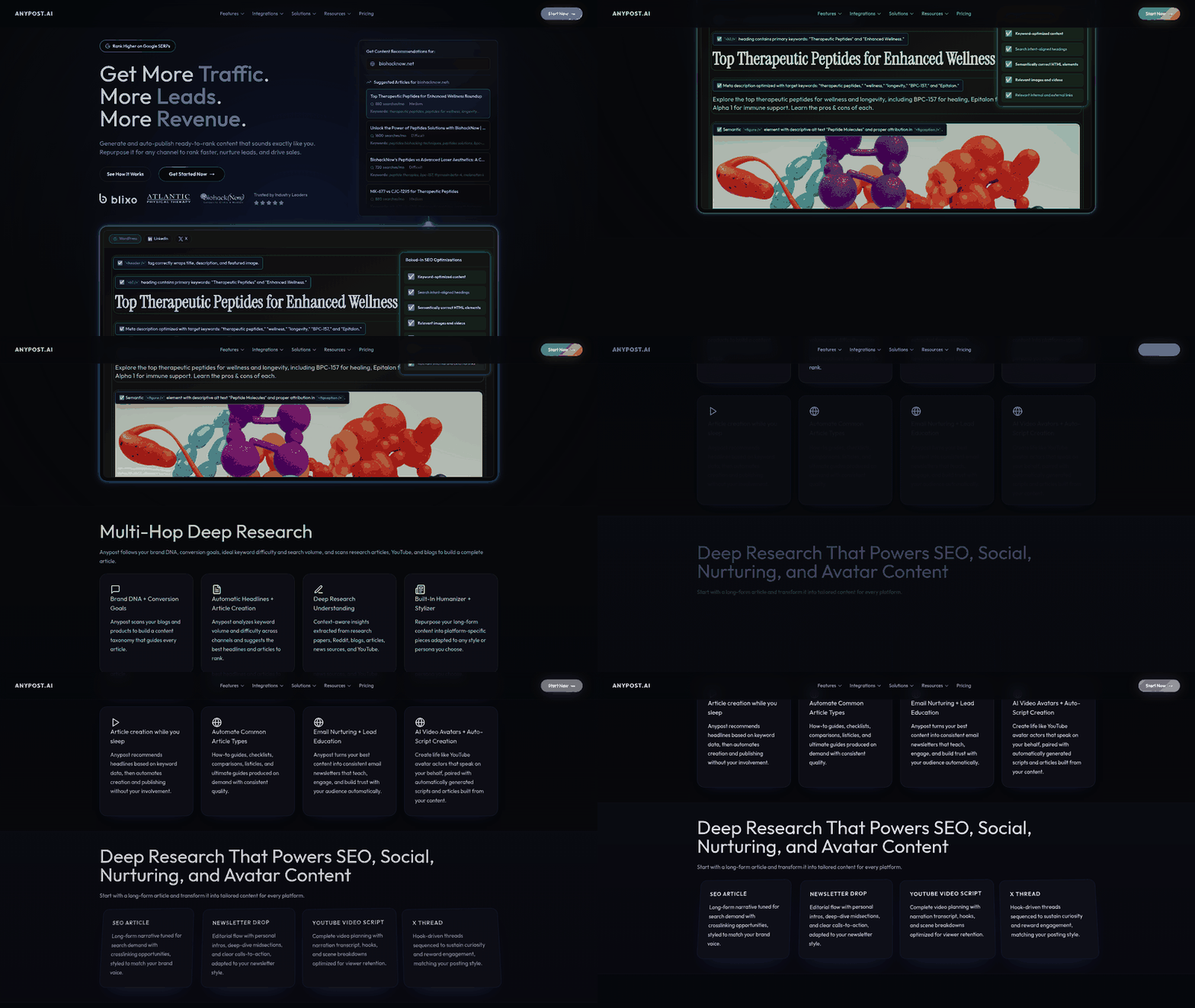
Automated content generation and SEO optimization have become cornerstone strategies for B2B demand generation agencies, enabling scalable, targeted outreach while reducing reliance on large budgets or teams [2]. These approaches leverage AI-driven tools and strategic frameworks to align content creation with buyer personas, ensuring relevance and efficiency. By integrating prompt engineering—where carefully crafted prompts guide AI outputs—agencies refine content quality and consistency, as emphasized in practical content strategies [2]. This section examines tools, SEO tactics, and automation benefits, drawing on insights from B2B marketing frameworks and lead generation resources [1]. As mentioned in the [Persona Prompt Engineering in B2B Demand Gen] section, refining prompts based on persona-driven insights is critical for effective AI content generation.
Automated Content Generation Tools
AI-powered tools for content generation rely on prompt engineering to produce tailored content for B2B audiences. According to [2], these tools require strategic input, such as persona development, to ensure outputs align with target audiences. For example, agencies use structured prompts—like those outlined in [1]—to generate blog posts, case studies, and social media content efficiently. See the [Introduction to B2B Demand Gen Agencies] section for more details on how personas underpin these strategies. Key features include natural language processing (NLP) for tone adjustment, dynamic content personalization, and integration with CRM data for real-time insights. While these tools accelerate production, they demand expertise in refining prompts to avoid generic or off-brand outputs [2]. Agencies without dedicated AI specialists may face initial learning curves, though the long-term ROI often offsets this challenge.
SEO Optimization Strategies
SEO in B2B demand generation hinges on aligning content with both search engine algorithms and buyer intent. Agencies prioritize keyword research, on-page optimization, and technical SEO audits to boost visibility, though [2] highlights the importance of embedding persona-driven insights into these strategies. For instance, tools like the prompt library in [1] help identify thematic clusters for content, ensuring topics resonate with decision-makers while targeting high-intent keywords. Automation streamlines SEO tasks such as metadata generation, internal linking, and content updates, reducing manual effort. However, [2] cautions that AI-generated content must undergo human review to maintain authority and avoid penalization for low-quality backlinks or duplicate content.
Benefits of Automation in Content Marketing
Automation reduces time-to-market for content while maintaining consistency across channels. As noted in the [Content Repurposing and Multi-Channel Distribution] section, automated workflows enable agencies to scale content for multiple platforms efficiently. Building on concepts from [Content Repurposing and Multi-Channel Distribution], automation supports hyper-personalization at scale, such as generating region-specific CTAs or industry-focused whitepapers. Cost savings are significant: [2] reports that AI-driven workflows minimize overhead by replacing manual tasks like drafting and basic editing. However, over-reliance on automation risks diluting brand voice if not balanced with human oversight. Agencies must invest in training teams to manage AI tools effectively, ensuring outputs meet both creative and strategic goals.
| Title | Description | Key Features | Pros | Cons |
|---|---|---|---|---|
| AI-Powered Content Tools | Generate blog posts, emails, and social content using prompt engineering | NLP, persona-based prompts, CRM integration | Rapid production, scalability, cost efficiency | Requires prompt refinement, risk of generic content |
| SEO Automation Platforms | Optimize content for search engines with keyword analysis and on-page tools | Keyword clustering, metadata generators, competitor analysis | Time savings, improved rankings, data-driven insights | Needs human review for quality, limited creative input |
| Prompt Libraries | Provide templates for consistent, high-quality AI-generated content | Pre-built prompts for personas, use cases, and industries | Streamlines workflows, ensures brand alignment | May lack flexibility for niche scenarios |
In conclusion, B2B demand gen agencies leveraging automated content generation and SEO optimization gain a competitive edge by combining speed with strategic depth. While tools like prompt libraries [1] and AI-driven workflows [2] enhance efficiency, success depends on balancing automation with human expertise. Agencies should prioritize training in prompt engineering and SEO analytics to maximize returns, ensuring AI serves as an enabler rather than a replacement for creative strategy.
Content Repurposing and Multi-Channel Distribution
Content repurposing and multi-channel distribution are critical components of modern B2B demand generation strategies, enabling teams to maximize the value of their content while reaching audiences across preferred platforms. By leveraging AI-driven tools and platform-specific tactics, agencies can streamline workflows and improve engagement. Source [1] highlights how AI prompts can automate content transformation, such as converting blog posts into social media snippets or webinar summaries, while source [2] emphasizes the need for practical, audience-aligned distribution strategies. Together, these approaches ensure consistent messaging and efficient resource allocation.
Content Repurposing Strategies
Effective repurposing begins with identifying high-performing content and adapting it for diverse formats. For instance, a detailed whitepaper can be transformed into a series of LinkedIn articles, a YouTube video script, or a podcast interview. Source [1] recommends using AI prompts to extract key takeaways from long-form content, enabling rapid creation of concise, platform-ready assets. As mentioned in the [Persona Prompt Engineering in B2B Demand Gen] section, refining AI prompts to align with audience personas enhances the relevance of repurposed content. Agencies should prioritize evergreen topics and modular content structures to facilitate reuse. This method reduces production time while maintaining strategic consistency.
Multi-Channel Distribution Benefits
Distributing repurposed content across multiple channels increases visibility and engagement. Source [2] outlines how cross-platform presence—such as pairing YouTube video tutorials with Twitter threads—creates synergy by directing traffic between mediums. Email newsletters, in particular, serve as a centralized hub for aggregating repurposed content, ensuring leads receive consolidated insights. By analyzing platform analytics, teams can refine distribution tactics to align with audience behavior, a process supported by the [Real-Time Analytics and Performance Tracking] section. This multi-channel approach also mitigates risks associated with platform algorithm changes.
Platform-Specific Strategies
Each channel requires tailored strategies to optimize performance. On Twitter, agencies can use AI-generated prompts (as detailed in source [1]) to create concise, data-driven threads that link to longer-form resources. YouTube benefits from structured scripts derived from blog posts or webinars, with clear CTAs to drive subscriptions or downloads. See the [Automated Content Generation and SEO Optimization] section for more details on leveraging AI tools to streamline script creation. Newsletters, as discussed in source [2], should segment content by reader interests, using personalized subject lines and embedded video previews. Agencies must balance automation with human creativity to maintain authenticity on each platform.
Summary Table
| Title | Description | Key Features | Pros/Cons |
|---|---|---|---|
| Blog-to-Social Repurposing | Converts long-form content into social media posts | AI-driven prompts, modular snippets | Efficient; risks oversimplification if not curated [1] |
| Webinar-to-Newsletter Conversion | Summarizes webinar insights into email digests | Personalized CTAs, embedded video links | High engagement; time-intensive to execute [2] |
| YouTube Video Series | Transforms thought leadership content into video format | SEO-optimized scripts, cross-promotion | Resource-heavy; requires platform-specific editing [2] |
| Twitter Thread Campaigns | Uses AI to generate data-backed micro-content | Scalable, links to primary content | Limited character space; requires frequent updates [1] |
Recommendations and Ratings
- High Priority: Blog-to-social repurposing (Rating: 9/10) for its scalability and alignment with source [1]’s AI automation strategies.
- Medium Priority: YouTube series (Rating: 7/10) due to resource demands but strong potential for lead generation per source [2].
- Optional: Twitter threads (Rating: 8/10) for real-time engagement, though execution requires careful planning to avoid fragmentation.
By integrating these strategies, B2B demand gen agencies can amplify their content impact while maintaining efficiency. The key lies in balancing AI-driven automation with platform-specific creativity, as both sources [1] and [2] underscore the importance of audience-centric, multi-channel execution.
Real-Time Analytics and Performance Tracking
Real-time analytics and performance tracking are critical for B2B demand generation agencies leveraging persona prompt engineering to optimize lead generation efforts. These capabilities enable agencies to monitor campaign effectiveness dynamically, adjust strategies based on immediate feedback, and align AI-driven prompts with evolving buyer behaviors. According to source [2], AI integration in B2B marketing emphasizes the importance of "continuous measurement" to refine content relevance and engagement, which directly supports the need for real-time analytics. By analyzing metrics such as engagement rates, conversion funnels, and lead scoring in live environments, agencies can identify high-performing prompts and deprioritize underperforming ones. This iterative process ensures that persona-driven campaigns remain aligned with target audiences’ needs while maximizing ROI.
Real-Time Analytics Tools and Their Role
While specific tools are not named in the provided sources, the discussion in [2] highlights the use of AI platforms to track interactions across touchpoints, enabling granular insights into lead behavior. For instance, AI-powered analytics can parse real-time data from email open rates, CTA clicks, and website visits to assess how well persona-based prompts resonate. Source [1] further supports this by noting that AI prompts for B2B lead generation are often refined using feedback loops that rely on immediate performance signals. This suggests that agencies may employ embedded analytics dashboards to visualize key performance indicators (KPIs) and adjust messaging on the fly. The absence of named tools in the sources, however, underscores a gap in explicit vendor recommendations, focusing instead on the conceptual framework of leveraging AI for agility. See the Persona Prompt Engineering in B2B Demand Gen section for more details on how persona-driven prompts are crafted and optimized.
Performance Tracking Metrics for Persona-Based Campaigns
Performance tracking in B2B demand generation hinges on metrics that quantify both top-of-funnel engagement and bottom-of-funnel conversions. Source [2] emphasizes metrics like lead-to-opportunity conversion rates and cost-per-acquisition (CPA) as essential for evaluating long-term campaign success. For persona-specific efforts, additional metrics such as persona engagement scores, content interaction depth, and A/B test results provide insights into which prompts drive action. Source [1] also notes that AI-generated prompts are often scored for relevance, indicating a reliance on engagement metrics like time-on-page or bounce rates to gauge effectiveness. By correlating these real-time signals with CRM data, agencies can isolate high-value personas and reallocate resources accordingly. Building on concepts from the Automated Content Generation and SEO Optimization section, real-time analytics also help refine content relevance and SEO strategies through iterative testing.
Benefits of Data-Driven Decision Making
The integration of real-time analytics into persona prompt engineering fosters data-driven decision-making that enhances both efficiency and accuracy. As outlined in [2], AI’s ability to process vast datasets in real time reduces reliance on guesswork, allowing agencies to prioritize high-performing strategies. For example, real-time lead scoring models can flag accounts exhibiting buying signals, enabling sales teams to act immediately. Similarly, source [1] discusses how iterative testing of AI prompts—guided by performance data—refines messaging to better align with persona-specific pain points. This approach minimizes wasted spend on ineffective tactics and accelerates the optimization cycle, a critical advantage in competitive B2B markets. See the Best Practices for Partnering with B2B Demand Gen Agencies section for guidance on selecting agencies with expertise in real-time analytics and AI-driven strategies.
Summary Table: Key Metrics and Tools in Real-Time Analytics
| Title | Description | Key Features | Pros | Cons |
|---|---|---|---|---|
| Engagement Metrics | Tracks real-time interactions with persona-specific content (e.g., email opens). | Real-time dashboards, A/B testing, persona engagement scoring | Immediate feedback for prompt refinement | Requires integration with CRM and email tools |
| Conversion Funnel Analysis | Measures progression from lead capture to conversion. | Funnel visualization, drop-off points, CPA tracking | Identifies bottlenecks in the buyer journey | May not capture qualitative user intent |
| Lead Scoring Models | Assigns dynamic scores to leads based on behavior and engagement. | AI-driven scoring, integration with sales pipelines | Prioritizes high-intent prospects | Accuracy depends on data quality |
| Content Interaction Depth | Analyzes how users engage with AI-generated prompts and assets. | Heatmaps, time-on-page metrics, content preference tracking | Reveals content resonance with target personas | Limited to digital engagement signals |
Limitations and Considerations
The sources [1] and [2] acknowledge that real-time analytics require robust data infrastructure and clean datasets to function effectively. Without accurate historical data to train AI models, real-time insights may be misleading. Additionally, the dynamic nature of B2B buyer journeys means that metrics like engagement rates must be contextualized within industry benchmarks—a challenge noted in source [2]. Agencies must also balance real-time adjustments with long-term strategy, as over-optimization to short-term fluctuations can undermine campaign coherence.
In conclusion, real-time analytics and performance tracking serve as the backbone of successful persona prompt engineering in B2B demand generation. By leveraging AI to monitor and act on performance metrics, agencies can maintain agility while ensuring their strategies remain data-aligned. However, the absence of specific tool recommendations in the sources highlights the need for further exploration into vendor capabilities and implementation best practices.
Best Practices for Partnering with B2B Demand Gen Agencies
Selecting a B2B demand gen agency requires prioritizing expertise in AI-driven persona engineering and content personalization. Agencies leveraging AI prompts, such as those outlined in The Prompt Library Starter Kit, demonstrate structured approaches to refining buyer personas and optimizing lead-generation workflows [1]. Businesses should evaluate agencies based on their ability to align AI tools with specific audience segments, ensuring campaigns address nuanced pain points. Agencies with experience in B2B marketing automation and data-driven persona development are better equipped to adapt to evolving buyer behaviors [2]. A critical consideration is the agency’s transparency in sharing case studies that highlight measurable improvements in lead quality and conversion rates. As mentioned in the Persona Prompt Engineering in B2B Demand Gen section, refining personas through AI prompts enhances targeting precision.
Selecting an Agency with AI and Persona Expertise
Agencies utilizing AI for persona engineering must integrate tools like the Prompt Library Starter Kit to streamline content creation and audience targeting [1]. This includes leveraging AI prompts to analyze historical engagement data and refine messaging for high-intent prospects. Businesses should verify an agency’s capacity to map buyer journeys using AI insights, ensuring campaigns resonate with decision-makers at each stage [2]. While AI-driven strategies reduce manual effort and improve scalability, overreliance on automation without human oversight may lead to generic messaging. Prospective partners should demonstrate a balance between AI efficiency and creative nuance to avoid this pitfall.
Establishing Collaborative Strategy Alignment
Successful partnerships hinge on co-developing content strategies that reflect both the agency’s technical capabilities and the client’s business objectives. How to Succeed with AI in B2B Marketing emphasizes the importance of collaborative workshops to align on key performance indicators (KPIs) and content themes [2]. For example, agencies should involve internal stakeholders in defining target audience archetypes, ensuring campaigns address relevant technical and operational challenges [1]. Regular communication channels and shared dashboards for tracking campaign performance foster accountability and agility. However, misaligned priorities—such as an agency focusing solely on lead volume over quality—can undermine long-term growth goals. See the Content Repurposing and Multi-Channel Distribution section for more details on aligning content strategies across channels.
Defining Measurable ROI Frameworks
ROI measurement for demand gen agencies should combine quantitative metrics (e.g., conversion rates, cost per lead) with qualitative assessments of brand awareness. The Prompt Library Starter Kit provides templates for tracking engagement metrics like click-through rates and form submissions, which correlate with campaign effectiveness [1]. Agencies must also demonstrate proficiency in A/B testing messaging variations to identify high-performing strategies [2]. While metrics like sales pipeline growth offer clear value, attributing revenue directly to demand gen efforts remains complex without robust analytics infrastructure. Building on concepts from the Real-Time Analytics and Performance Tracking section, businesses should request post-campaign audits to evaluate how AI-driven adjustments impacted overall lead scoring and sales readiness.
| Best Practice | Description | Key Features | Pros/Cons |
|---|---|---|---|
| AI-Powered Persona Engineering | Agencies use AI prompts to refine buyer personas and content targeting [1]. | AI-driven audience segmentation, iterative persona testing | Pros: Scalable personalization; reduced guesswork. Cons: Requires high-quality data inputs. |
| Collaborative Strategy Workshops | Joint sessions align creative and technical goals with business KPIs [2]. | Cross-functional stakeholder input, shared analytics dashboards | Pros: Ensures alignment; fosters innovation. Cons: Time-intensive coordination. |
| Data-Driven ROI Reporting | Agencies provide granular metrics on lead quality and campaign adjustments [1][2]. | A/B testing, multi-touch attribution models | Pros: Clear ROI visibility; actionable insights. Cons: Complex to track long-term impact. |
By integrating AI tools with strategic collaboration and rigorous metrics, businesses can maximize the value of their demand gen partnerships. Agencies excelling in these areas demonstrate adaptability to market shifts and a commitment to continuous improvement.
References
[1] The Prompt Library Starter Kit: 20 AI Prompts for B2B Lead Gen ... - https://www.orbitmedia.com/blog/b2b-marketing-prompt-library/
[2] How to Succeed with AI in B2B Marketing: Practical Content ... - https://www.ana.net/webinars/show/id/B2B-240501
Frequently Asked Questions
1. How do B2B demand gen agencies differ from traditional marketing agencies?
Unlike traditional agencies that often focus on broad brand awareness or general lead generation, B2B demand gen agencies prioritize hyper-targeted strategies using data-driven insights. They leverage AI tools and persona-based frameworks to address specific pain points of decision-makers, ensuring campaigns align with both surface-level and operational challenges. Traditional agencies may lack the technical integration of AI and persona prompt engineering, which allows demand gen agencies to scale personalized content efficiently.
Q: What is persona prompt engineering, and why is it critical for B2B demand gen?
A: Persona prompt engineering involves crafting tailored prompts for AI tools to generate content that resonates with specific audience segments. For example, prompts might explore unmet needs like, “What industry best practices does this persona secretly reject?” This process ensures messaging aligns with the nuanced behaviors, roles, and decision-making criteria of B2B audiences. It’s critical because it minimizes generic outputs and maximizes relevance, especially when addressing complex buyer journeys in niche markets.
Q: How do B2B demand gen agencies use AI to enhance content marketing?
A: AI is used for automating high-volume content creation, optimizing messaging for different channels, and refining outputs to reflect industry-specific jargon or regional nuances. Tools like prompt engineering and AI copywriters streamline workflows, while analytics tools track engagement in real time. For instance, agencies might use AI to repurpose a whitepaper into blog posts, social media snippets, or webinar scripts, maintaining brand consistency across formats.
Q: What are the key components of a successful B2B demand gen campaign?
A: A successful campaign combines persona-driven content, multi-channel distribution, AI-driven personalization, and data analytics. Agencies start by mapping personas to their pain points, then use AI to create and distribute content across blogs, LinkedIn, and email. Technical SEO and A/B testing ensure content reaches the right audiences, while analytics tools measure lead quality and conversion rates to refine strategies.
Q: How do these agencies ensure consistent messaging across multiple channels?
A: Consistency is achieved by centralizing persona data and brand guidelines in a single repository, accessible to AI tools and human teams. Prompt engineering ensures AI-generated content reflects the same tone, keywords, and messaging pillars as the brand’s core strategy. For example, a campaign’s LinkedIn post and whitepaper might share the same narrative arc but be tailored to each platform’s audience expectations, all while maintaining a unified voice.
Q: What challenges do B2B demand gen agencies face when implementing AI-driven strategies?
A: Key challenges include over-reliance on AI without human oversight, which can lead to generic content, and misaligned prompts that fail to capture a persona’s true motivations. Agencies must also balance scalability with quality control, ensuring AI-generated content meets brand standards. Additionally, integrating AI tools with legacy systems or CRM platforms can create technical hurdles, requiring ongoing training for teams.
Q: How can companies measure the effectiveness of B2B demand gen campaigns?
A: Effectiveness is measured through lead quality metrics (e.g., conversion rates, sales-qualified leads), engagement metrics (e.g., time spent on content, social shares), and campaign ROI (e.g., cost per lead vs. revenue generated). Tools like marketing automation platforms track user behavior across touchpoints, while attribution models help identify which channels drive the most valuable interactions. Regular A/B testing of prompts and messaging also provides insights into what resonates with target personas.